The Forgotten Civilian Pilots Who Faced Japanese Fighters at Pearl Harbor
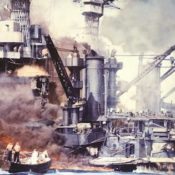
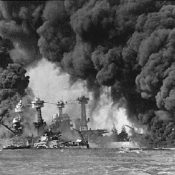
The first American planes to come in contact with the Japanese fighters were small, unarmed civilian aircraft. Some of the planes never made it back.
Ben Railton discusses the crucial work of the Hawaii Territorial Guard, from the capture of the first Japanese prisoner of war after Pearl Harbor, to the eventual formation of the Varsity Victory Volunteers.
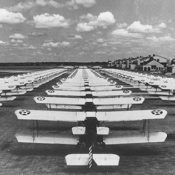
The attitude of pre-World War II America was quite different from the heroic era of the war years. The U.S. was still a modest, isolationist nation, with limited industry, a tiny army, and the hope that, by minding its own business, it could remain untouched by war. This podcast looks at those times as they were reflected in the pages of The Saturday Evening Post.
A pilot who accidentally got caught in the air war above Pearl Harbor on December 7, 1941, shares his thrilling first-person account.
The views presented in the Post reflected, and frequently guided, American opinion. As war was declared in Europe in 1939, the Post was ambivalent about intervention. But that perspective began to evolve over the next two years in the face of Japanese and German aggression.
Americans tell their personal and family stories about how life changed after the attack on Pearl Harbor. Do you have a story to share?
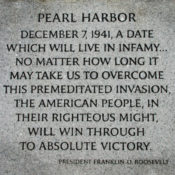
For immediate release Contact: Kevin Asselin, 317-634-1100 [email protected] Collector’s Edition The latest special issue from The Saturday Evening Post commemorates the 75th anniversary of the surprise attack on our shores, December 7, 1941. Taken from the pages of America’s most popular magazine, Pearl Harbor will bring to life the “date which will live in infamy,” […]
In November 1941, Demaree Bess argued that it was time for Americans to stop pretending that we were staying out of the war in Europe, because we were already deeply involved.
Share your memories and family stories of how life changed after the Japanese attack on Pearl Harbor.
The first Asian American woman to hold a seat in the U.S. House of Representatives fought for what she argued were the most basic needs of our society.
During World War II, a group of Japanese Americans in Hawaii joined the army and formed the Aloha Team, one of the best baseball teams in the armed forces.
Jackie Robinson can help us better remember a largely forgotten teammate and childhood friend, Shigeo “Shig” Takayama, and the connections between African American and Japanese American baseball.
Camp Ritchie’s clandestine training transformed Jewish immigrants into one of America’s most effective intelligence forces.
In the news of the week ending December 5, 2025, are a new book by Dick Van Dyke, instant Christmas trees, and delicious cookie cutter recipes.
Our look at the decades of the 1900s continues with a decade of struggle, a second World War, and TV’s Golden Age.
Just before the end of World War II, an American cruiser on a secret mission experienced one of the ghastliest naval disasters in U.S. history. But it was only 30 years later, when the movie Jaws was released, that the true horrors of the U.S.S. Indianapolis were revealed in one of the greatest monologues ever.