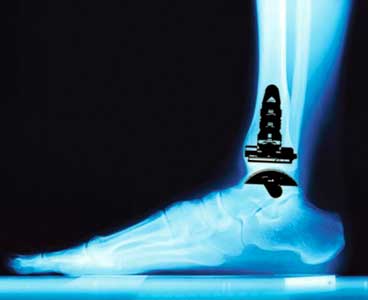
People simply don’t think too much about their feet; their ankles even less so. But as far as joints go, the ankle is decidedly one of the most crucial and complex. The intricate hinge not only supports the body, but allows for a wide range of motion and versatility—from running and walking, to jumping and dancing. That is, until something goes awry.
For the nearly 50,000 Americans seeking relief each year for debilitating bone-on-bone ankle pain and disability, there’s good news. Recent advances in arguably the most intriguing area of orthopedic surgery—total ankle replacement—are making strides in restoring mobility and quality of life to patients.
Today, four total ankle replacements are used in the U.S.: the Agility, the Inbone, the Salto Talaris Anatomic Ankle, and the Scandinavian Total Ankle Replacement (STAR).
“The technology is light years ahead of where it was a decade ago,” says Dr. Robert Anderson, an orthopedic surgeon in Charlotte, North Carolina, who performed more than 40 Inbone procedures in the past two years and is part of a design team working on a second-generation device.
Hi-tech artificial ankles provide a new alternative to surgery, which permanently fuses worn-out joints. That procedure reduces ankle pain but often limits mobility, causes a limp, and can lead to arthritis in nearby foot joints. An estimated 25,000 Americans underwent ankle fusions in 2009; others considered even more drastic measures.
Reasons for needing an ankle replacement include wear-and-tear over time, accidents, sports injuries, and bone diseases that lead to severe and life-limiting arthritis.
Four years ago, Jeanne St. John’s ankle problems led her to the brink of a difficult decision.
“I was born with deformed ankles and, eventually, was so immobilized by arthritis that I considered a double amputation,” recalls St. John, who lives in Oregon. “Then a friend heard about the Inbone. It’s been life-changing for me.”
As with hip and knee replacements, the history of total ankles dates back to the 1970s. Healthy ankles can withstand 1.5 times one’s body weight while walking, but early devices didn’t hold up. Then, Dr. Mark Reiley—who performed St. John’s surgeries in the San Francisco Bay Area—devised a new way to replace the complex joint.
“Dr. Reiley took the proven technology of knee replacements and basically flipped it upside down to be used in the ankle,” Dr. Anderson describes. “The device, now called the Inbone, has very good mechanical advantages and can be used for primary replacements, as well as revisions of failed or previously placed devices. We believe it will be successful for a long time.”
Orthopedic surgeons select the specific ankle replacements depending on patient age, anatomy, bone quality, and goals. Long-term success rates on Inbone are not yet available; European data show that 85 percent of modified Salto and STAR devices are functioning well after 10 years.
But Jeanne St. John, now age 67, prefers to focus on how far her new ankles take her.
“I think in terms of steps rather than years,” she says. “I save my steps for selected activities and for travel. Some of my friends are slowing down, but I have this ‘reverse aging’ thing going on, and I’m so thankful.”
Back on the Green
Intense ankle pain eventually trumped dogged determination, says Pennsylvania golf course superintendent Timothy McAvoy, who shares his story about ankle replacement with the Post.
Post: What initially happened to your ankle, and when did you have replacement surgery?
McAvoy: The first of many injuries to my right ankle occurred when I was a 16-year-old high school basketball player. Thinking back, we wore very ill-fitting sneakers and re-injury was common. I just sucked it up and kept plugging along. Eventually, however, it was hard to even walk to the kitchen. I had ankle replacement surgery in April 2008.
Post: What was life like after the initial injury?
McAvoy: I actually went to college on a golf scholarship. After graduation, I coached basketball and tried to run for about 20 years. My approach to running was: adapt and overcome. I would hit the ground with my left leg and then the toes of my right leg. In my 40s, a doctor pointed out that my left calf was almost 2 full inches larger than my right calf. I was basically dragging my right leg.
Post: Did problems develop inside your ankle joint?
McAvoy: Absolutely. I had severe osteoarthritis, and the surrounding ligaments were no longer able to protect the joint. I would step on a stone and fall down. And as I got older, new bone tissue grew over the top of the joint and basically eliminated all ankle movement.
Post: How did you hear about ankle replacement surgery?
McAvoy: In 2005, I had ankle surgery at Coordinated Health (CH) in Lehigh Valley to shave away excess bone and create space within the joint. It helped for a while, but then the bone grew back, and doctors said my only option was ankle fusion. In 2008, I went back to CH for an ingrown toenail and saw Dr. Stephen Brigido. He asked about my ankle and said he could help me with a new technology called the Inbone ankle replacement. I believed him, and we scheduled the surgery.
Post: How has your life changed?
McAvoy: My quality of life is greatly improved because of the implant and Dr. Brigido. I walk normally—and without the pain and noticeable limp that I had for many years. I don’t run, but I walk three to five miles a day with my Border collie. I’m also able to walk on a golf course, and my game has improved because I can push off better from my right side.
Become a Saturday Evening Post member and enjoy unlimited access. Subscribe now



Comments
Just wondering if that old song is anatomically accurate. Might the shin bone actually be connected to the ankle bone?