No sport celebrates a trilogy quite the way boxing does.
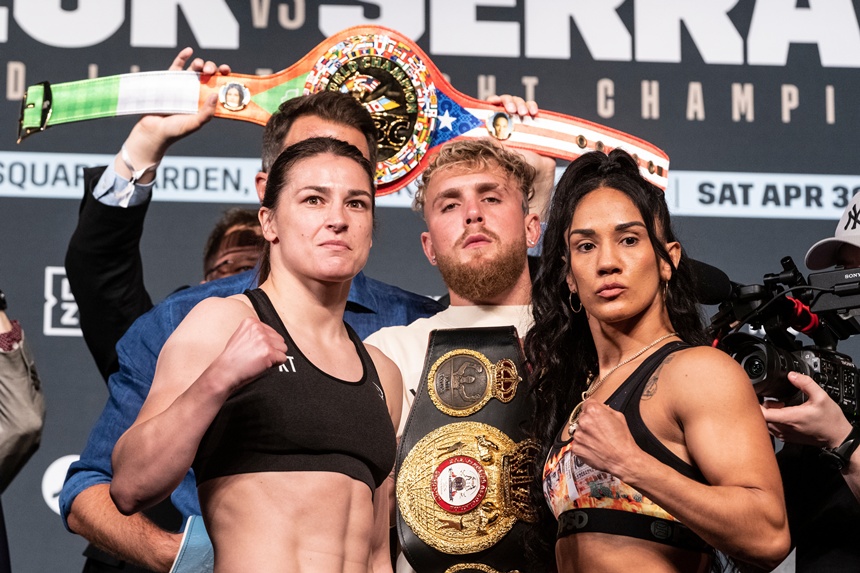
Ali–Frazier. Gatti–Ward. Fury–Wilder. What makes these matches special are the combatants; their rivalry and their camaraderie, their heart and their iron will. On July 11, under the bright lights of Madison Square Garden, two of boxing’s most thrilling talents will trade leather for the third time: Katie Taylor and Amanda Serrano.
Together and separately, these two have defied the odds, exceeded expectations, and set a new standard for women’s boxing.
For many people, their experience with women’s boxing begins and ends with 2004’s Oscar-winning Million Dollar Baby. And that’s understandable. In most cases, women’s sports are only now beginning to gain the acceptance and exposure that men’s sports have long enjoyed. Tennis, gymnastics, soccer, and even basketball are seeing record viewership of their women’s events.
Boxing is no different.
What was once called “the manly art of self-defense” now has half a century of women’s history behind it.
To understand that history a little better, I spoke with Mark Jones, a boxing historian, certified USA boxing coach, and ballot coordinator for the women’s categories at the International Boxing Hall of Fame. “The 1970s were a decade of social and political upheaval,” he explains. Women were raising consciousness and breaking glass ceilings in board rooms, at kitchen tables — and in boxing rings, too.
In 1975, Caroline Svendsen was the first woman to receive a Nevada state boxing license. Pat Pineda followed in California the next year. Then in 1978, following a prolonged court battle, three women — Jackie Tonawanda, Marian Trimiar, and Cathy Davis — received licenses in New York.
Tonawanda christened herself “the female Ali” and went on to fight a male kickboxer in a mixed-martial arts bout at Madison Square Garden, winning by kayo in two rounds. Davis became the first woman ever on the cover of The Ring magazine. Trimiar, better known in boxing circles as Lady Tyger, became a tireless advocate for women’s boxing, even staging a month-long hunger strike for better working conditions in 1987.
Building on the groundwork laid by those pioneers, a boxer named Christy Martin “ushered in the ‘modern’ era of women’s boxing” in 1996, says Jones.
At that time, Mike Tyson was plowing his way through the heavyweight division. Promoter Don King understood that his pay-per-view audience wanted their sweet science with a taste of sideshow spectacle. King took a gamble on women’s boxing. On March 16, 1996, his Las Vegas card opened with a six-round bout between Ireland’s Deirdre Gogarty and Christy Martin, the “Coal Miner’s Daughter,” from West Virginia.
The two women put on an electrifying show that no one had bargained for. Gogarty broke Martin’s nose early in the fight, and with blood splattering the canvas, the two battled through the gore like warrior-poets. Martin won the fight. Women’s boxing won the evening. Fans and commenters were in agreement — it was the most exciting bout of the night, overshadowing even “Iron” Mike Tyson. The Coal Miner’s Daughter found herself a breakout star, soon appearing on the cover of Sports Illustrated and even guest starring on an episode of Roseanne.
“When women’s sport has a star that attracts people, they’ll watch it,” says Jones.
Martin went on to score 32 kayos, a record in women’s boxing that has yet to be beaten. Now working as a promoter, she recently released an autobiography, has been inducted into the International Boxing Hall of Fame, and will be portrayed by Sydney Sweeney in an upcoming biopic.
After that fight, boxing saw the rise of a number of women who combined top-level technical ability with magnetic, star-quality personalities. There was Laila Ali, daughter of Muhammad Ali. Lucia Rijker, who played the foul-throwing “villain” in Million Dollar Baby, was a world class fighter. In England, Jane Couch dominated the ring for years and became a prominent spokesperson for women in the sport. Ann Wolfe held world titles in three different weight classes simultaneously. Holly Holm was a champion boxer before beginning an incredibly successful career in MMA.
“One achievement that is often overlooked is that of Hyun-mi Choi,” says Jones. Born in Pyongyang, North Korea, Choi showed exceptional talent for boxing early on. From the age of thirteen, her dream was to make it to the 2008 Olympics.
There was just one problem: The Olympics had never before allowed women to compete in boxing.
Despite mounting pressure, the International Olympic Committee decided against including women’s boxing in the 2008 games. For the sake of her career, Choi and her family defected. They journeyed through China and Vietnam to resettle in South Korea, where Choi turned pro. She spent more than a decade as an undefeated, two-division champion, and fought as recently as last year. But she never got to box at the Olympics.
In 2012, the Olympics finally opened their doors to women’s boxing.
“In the 1970s, female boxers knocked on the door; in the 1990s, they pounded on it,” Jones explains. “And in the 2010s, they kicked it in when the 2012 Summer Olympic Games, held in London, England, featured women’s boxing as a sport.”
Some of the women who competed in the 2012 Olympics are still fighting professionally today.
In fact, Katie Taylor is one of them.
In 2012, women’s Olympic boxing had three weight classes (men’s boxing had ten). Taylor won Olympic gold in the lightweight division.
Taylor’s career has been historic. Born in Bray, Ireland, her first amateur bouts were fought under the name K. Taylor. Women’s amateur boxing wasn’t yet legalized in Ireland, so the young Katie tucked her hair into her headgear and fought the boys. She turned pro in 2016 and won her first world title a year later. Five years of championship fights culminated in headlining boxing’s spiritual home, Madison Square Garden, in 2022. That was her first time facing Amanda Serrano. It was a close fight, and one of the best fights of the year – male or female. Taylor won a split decision from the judges.
But the fans wanted more.
Amanda Serrano’s career is no less storied. Born in Carolina, Puerto Rico, she and her family moved to New York City when she was young. When she and Taylor faced off in 2022, Taylor’s record was a clean 20-0-0, but Amanda’s stood at an impressive 42-1-1. Serrano was a world champion across seven weight classes, a feat second only to Manny Pacquiao. She took on all comers and became known for her fist-forward style and her high kayo percentage. With 31 kayos, Serrano is now just one knockout away from tying Christy Martin’s record.
After the loss to Taylor, Serrano made a very public push to move women’s boxing from two-minute rounds to three-minute rounds, the same as men’s. In 2023, She fought Danila Ramos for twelve three-minute rounds (women’s title fights are normally ten two-minute rounds). When the World Boxing Council refused to sanction the bout, Serrano chose to give up her title rather than back down.
Serrano and Taylor rematched on Nov 15, 2024; it was the co-main event of the Mike Tyson–Jake Paul fight. Taylor again won the decision, but many felt Serrano deserved to have her hand raised. A reported 65 million people watched Tyson–Paul, a viewership that made Taylor–Serrano II the most watched women’s boxing fight ever.
The event was promoted by Most Valuable Promotions (MVP), a company co-founded by YouTuber-turned-boxer Jake Paul. The 28-year-old Paul has found business success as a boxing promoter, and MVP has promoted all three Taylor-Serrano matches.
Will the trilogy between Katie Taylor and Amanda Serrano be MVP’s crowning achievement?
“At first glance, it’s the greatest female boxing card in the history of the sport, headlined by two of the top ten female boxers of all time. If Taylor wins, she’ll likely be considered the most outstanding female boxer of all time.”
Fifty years and the collective struggle of countless women boxers have brought us to this moment.
Women’s boxing represents the center and circumference of the sport right now, to paraphrase Percy Shelley. In a sport (in)famously blighted by the venal corruptions of lesser men, the Taylor-Serrano trilogy stands defiantly as the root and blossom of the sweet science.
Will Amanda Serrano kayo Katie Taylor, adding another line to her historic résumé? Or will Taylor make the trilogy a clean sweep?
We will find out on July 11.
The card will be streamed live on Netflix. It features nine fights in total, all women’s bouts, and includes six world title fights.
Become a Saturday Evening Post member and enjoy unlimited access. Subscribe now