Calvin Mackie was crying at an event on cardiovascular science, which seems appropriate. The beating heart is the symbol of our passions, the engine of our brains. If we defined Mackie with a scientific equation — he is the co-founder (along with wife Tracy) of STEM NOLA, a New Orleans nonprofit that provides children with hands-on science, technology, engineering, and mathematics activities — it might look like this: heart + mind + generosity = Calvin Mackie.
On this particular emotional day, a school gym throbbed with the energy of 200 intellectually stimulated kids, from kindergarteners to 12th graders, as they learned about the heart and circulatory system. The youngsters talked with cardiologists, examined a pacemaker, and studied a 3D printout of the human ticker. Afterward, Mackie saw a young boy named Easton. A regular on STEM Saturdays (a monthly session devoted to a particular theme), 9-year-old Easton ran to Mackie as he always does, hugging him around his legs. The boy held a small heart he’d made along with other cardio giveaways from the day’s event. As they embraced, Easton’s mom whispered in Mackie’s ear.
“You don’t know this,” she said, “but Easton is a heart patient.”
Easton had undergone four surgeries in his short life, his mother revealed.
“So I’m holding Easton now and she’s trying to wipe the tears from my face,” Mackie recalls. “His mom said, ‘Easton is gonna take all this to his appointment on Tuesday and show his doctor.’” Mackie introduced Easton and his mother to one of the event’s guest experts, a heart researcher from the University of Minnesota. As they spoke, Mackie walked away. “I had to go collect myself,” he says.
The moment encapsulates STEM NOLA’s significance. The organization doesn’t just teach kids about the heart (along with chemistry, physics, robotics, …). It has heart. And it’s bringing STEM education to students who are often overlooked in the sciences, such as girls and students of color. Since 2013, STEM NOLA has worked with roughly 175,000 K-12 students, most of them from low-income, underserved communities. In 2024 alone, STEM NOLA and STEM Global Action, its partner org, engaged nearly 42,000 children (close to 20,000 were girls), working not just in New Orleans but in 14 states. Mackie’s efforts have earned awards from AARP, the Congressional Black Caucus Foundation, and the Biden administration. In March, he was named Tulane University’s Outstanding Social Entrepreneur of the Year.
Mackie and his team of volunteer educators stir curiosity with a hands-on, do-this, watch-this-thing bubble/rise/expand/blow-up approach to STEM. Kids love it, as he well understands. He felt the same intellectual spark as a boy growing up in New Orleans’ Lower 7th ward. The son of a roofer (his father dropped out of school in eighth grade), he was mechanically inclined, but the transformative moment came at age nine, when he built a car from an Erector set he received from his uncle.
“I’ll never forget it: I hit the button and it started rolling, and he said, ‘That boy is going to be an engineer,’” Mackie recalls. “That’s the first time somebody gave a name to what I was doing.”
His drive and intellect fueled him to learn. Mackie holds degrees in mathematics from Morehouse College and mechanical engineering from Georgia Tech, and he earned a Ph.D. in mechanical engineering from the Georgia Institute of Technology in 1996. He spent 12 years on the engineering faculty at Tulane. Then, as a father, came another transformative moment. His nine-year-old son declared he was no longer interested in science. Mackie asked why.
“He said, ‘Daddy, the teacher talks to the board,’” Mackie remembers. “‘I like to do stuff with my hands.’”
So the two engaged in hands-on science activities in the family’s garage. They built a metal car. Mackie bought physics and chemistry kits. Soon they were joined by Mackie’s younger son and the boy next door. Other neighborhood kids attended as well. How successful were the garage sessions? The boy next door is now a junior in chemical engineering at the University of Alabama. Mackie’s eldest son graduated with a degree in mechanical engineering from Howard University in May 2025.
Mackie wanted to ignite that same excitement for STEM in more kids. One fateful morning at his local barber shop, he mentioned he was seeking a grant. The barbers, one of whom was a childhood friend, dismissed the idea with straight-razor sharpness.
“We were talking about leadership in the community, and I said I was waiting on this grant, and they went in on me,” Mackie says. “We’d get in arguments every Saturday, but this Saturday was personal. The conversation was like, ‘All that education and you’re waiting on the government?’ I left that barber shop feeling violated, because the community was telling me that I was separate from it. I was depending on other people to do for the community what I knew the community needed. We laugh about it now, but they went into me so hard that my barber called me a couple hours later to see how I was doing. I cursed him out. But six weeks later, I had a program.”
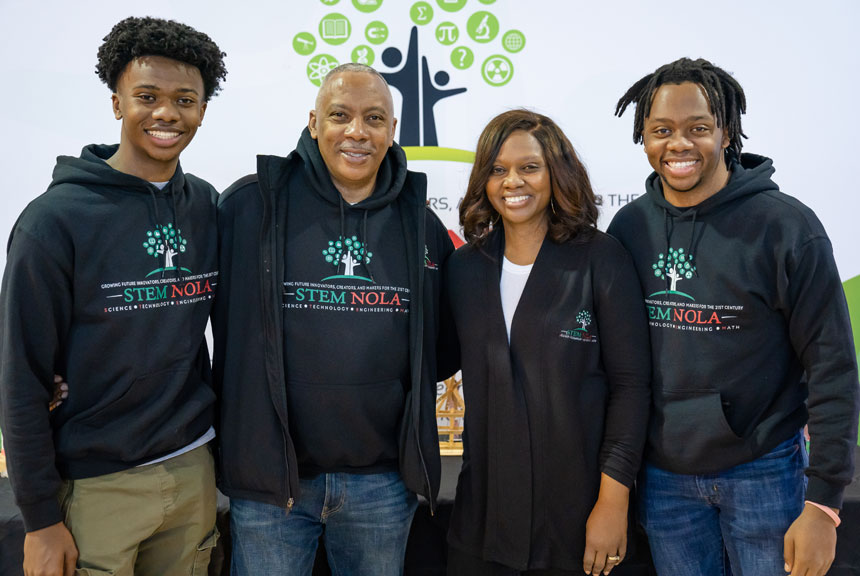
Mackie and his wife started STEM NOLA with $100,000 from their own savings. In December 2013, they hosted their first STEM Fest, a free community event with over 60 hands-on STEM stations, at a school gym in New Orleans East, an area ravaged by Hurricane Katrina. They had planned for 100 kids. They got 350, along with 150 parents and local politicians, including the mayor.
Since then, the events have grown. STEM Fests typically attract 1,000-2,000 attendees, as kids engage in numerous activities, whether working with a miniature chemical refinery or operating robots, drones, and remote-controlled boats.
For Mackie, encounters with parents can be emotional. “The most gratifying thing in the world is when I go to these events and parents from every walk of life say thank you,” he says. “These are people that want something more for their children.”
One mother recently confronted him, asking, Why didn’t I know about this?
“I said, ‘Ma’am, is everything okay?’” Mackie remembers. “She said, ‘It’s the first time my son has ever been at an event and felt like he belonged. At least eight little kids at that table are on the spectrum. This is what they need.’” STEM NOLA now partners with a group that hosts a summer camp for kids with autism.
The activities can power a life-changing passion for science. One former attendee, now an engineer with Lockheed Martin, was inspired by a STEM NOLA rocket day. The organization’s STEM Fellows program helps low-income students of color in New Orleans to pursue STEM careers. In 2024, two fellows were among 139 students honored as champions in the National STEM Challenge, which invites grade 6-12 students to submit STEM innovations, inventions, and research. And the efforts keep growing: STEM NOLA is building a 30,000-square-foot, $15 million STEM Center in New Orleans.
“Kids will have a clubhouse to come to, and we’re going to upskill them and push them ahead, just like we do athletes and entertainers,” he says. “That’s how we build long-term workforce development. That’s how we find future geniuses and innovators. We want to replicate that in every city. I believe that STEM is the last bastion of unmitigated racism, sexism, and classism. The biggest myth is that STEM is for some chosen people, somebody born with something, and only they can participate.” That’s a myth, he vows, “that we’ve got to destroy.”
Ken Budd has written for The Washington Post Magazine, The Atlantic, and many more. He is the author of the award-winning memoir The Voluntourist and a host on the literary podcast Upstart Crow.
This article is featured in the July/August 2025 issue of The Saturday Evening Post. Subscribe to the magazine for more art, inspiring stories, fiction, humor, and features from our archives.
Become a Saturday Evening Post member and enjoy unlimited access. Subscribe now