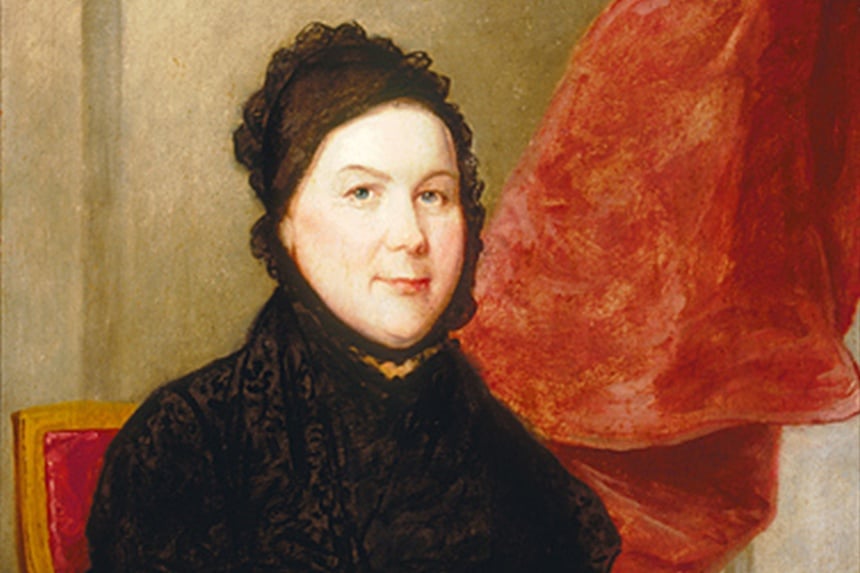
“It shall never be told me, that I set myself down quietly and waited for my Ruin.”
-From Caty: A Biography of Catharine Littlefield Greene
It wasn’t only her beauty that made Caty Littlefield Greene a favorite of the soldiers, but also her fondness for flirtation.
After her wedding at age 19 to Nathanael Greene in 1774, Caty evolved from an obedient bride into a high-spirited wife who followed her husband through the army camps of the Revolutionary War.
In May 1775, her husband led a militia to Cambridge and in June became a brigadier general with the new Continental Army. Caty, newly pregnant and lonely, followed him to the army camp. Once there, she socialized with Nathanael’s fellow officers, leading friends to declare “there never lived a more joyous, frolicsome creature,” according to Caty: A Biography of Catharine Littlefield Greene; when smallpox broke out in the camp, Greene (who had previously been inoculated) visited them and boosted their spirits. In March 1776, a month after the birth of her first son, George Washington Greene, in Rhode Island, her husband left with the army to New York. Feeling abandoned, she left the baby with her husband’s relatives and sailed to the city, according to Revolutionary Mothers: Women in the Struggle for America’s Independence.
When a letter arrived announcing her son was ill, Greene returned to Rhode Island, but after his recovery, she went back to New York. During the war, Greene’s constant shuttling between the army camps and Rhode Island became her pattern, according to Founding Mothers: The Women Who Raised Our Nation. Army life, as noted in Revolutionary Mothers, was a “perfect antidote” to Greene’s boredom.
Other officers’ wives, like Martha Washington and Lucy Knox, also visited their husbands during the war, but Caty Greene’s wit, lively chatter, and dancing with soldiers younger than her husband created gossip about her morals. However, according to Revolutionary Mothers, there is no proof that she was unfaithful.
By the time she reappeared in New York, British soldiers had arrived. Worried about her safety, Nathanael demanded she return to Rhode Island despite pleas from his peers who were “continually urging me to send for you.”
On March 14, 1777, Greene delivered her second child, Martha “Patty” Washington, and after a Caty recovered from a bout of pneumonia, she brought both babies to Abraham Lott’s estate near the Morristown, New Jersey encampment to join Nathanael for several days. Nathanael soon left for Philadelphia, and after a defeat at the Battle of the Brandywine, Nathanael wrote, “O my sweet angel how I wish – how I long to return to your soft embrace. The endearing prospect is my greatest comfort.”
By then, she and her youngsters had become guests of William Alexander, the self-titled Lord Stirling near a camp in Basking Ridge, New Jersey. There she often participated in dances with a Colonel Carey. “I am glad to hear you are so agreeably employed,” Nathanael penned, then slyly mentioned several “sweet Quaker girls” who lived nearby. Nevertheless, he added, I promise you to be as honest as ever I can,” according to her biography.
Shortly after receiving that correspondence, she quickly joined him at the Valley Forge camp. After a brief stay in one of the camp’s log cabins, she and Nathanael moved to the nearby estate of William Moore. Among the guests were the Marquis de Lafayette and the military officer “Baron” von Steuben. “In the middle of our distress, there were some bright sides to…Valley Forge,” one of Steuben’s aides later wrote. “The lady of General Greene” is a “handsome, elegant, and accomplished woman.”
In November 1779, after delivering her third child, Cornelia Lott, she rode to the military encampment at Middlebrook, New Jersey. During a ball, Greene danced with General George Washington, who joked that he had stolen her from her “Quaker preacher” husband, according to her biography; they danced “upwards of three hours without once sitting down,” Nathanael wrote to a friend. Later, he chided her for becoming “too fond of wine.”
By early winter 1779, pregnant with her fourth child, she rode through a blizzard to the Morristown encampment. Shortly after her arrival, she delivered her fourth son, Nathanael “Nat” Ray.
The following October, her husband became commander of the Revolution’s southern army, which separated him from Greene for over a year. Finally, after the victory at Yorktown in 1782, Caty met him at an encampment near Charleston, South Carolina. To a friend, a Nathanael wrote “She is a great favorite, even with the ladies,” according to Founding Mothers. Later, when several officers became ill, Greene served as their nurse.
As commander of the southern British campaign, Nathanael had supplied food and supplies to his troops from his own resources and a partner’s promissory notes, which were never paid to the creditors. That left Nathanael responsible and plunged him into such heavy debt that he sold all his properties to repay them.
Thanks to land grants primarily from Georgia and South Carolina in appreciation for restoring the peace, the impoverished Nathanael moved his wife, children and the 21-year old Yale educated tutor Phineas Miller to Mulberry Grove, a rice plantation in Georgia. There he hoped to pay off the rest of his debts. The family’s sudden poverty dramatically transformed Caty. No longer the army’s frivolous coquette, she took charge of the plantation house, nursing the enslaved people and ensuring her children’s education. Nathanael supervised the plantation, but on June 19, 1786 died of sunstroke.
Despite the shock of her husband’s death, Greene refused to be defeated. After appointing Miller the plantation manager, she worked with him to make it profitable, then turned her attention to asking old army friends now in high positions to plead for repayment of Nathanael’s debts. Insisting that as a woman she was “unaccustomed to any thing but the trifling business of a family” she relied on others to press her case; finally, Washington announced forgiveness of her late husband’s debts.
After years of pleading for justice and accusations that she was greedy, Greene sent a letter to her friend and former attorney Nat Pendleton, writing, “I am in good health and spirits and feel as saucy as you please – not only because I am independent, but because I have gained a complete triumph over some of my friends who did not wish me success and others who doubted my judgement in managing the business…o how sweet is revenge!”
In 1792, she met young Eli Whitney, who tutored her neighbors’ children. Intrigued, she invited him to live at Mulberry Grove, where he invented the cotton gin. Greene’s daughter, Cornelia, later claimed that her mother had improved the invention by adding a brush to separate the seeds, but no records prove it.
On June 13, 1796, the 39-year-old Greene wed 29-year-old Phineas Miller, after which they invested in commercialization of Whitney’s cotton gin. Caught in a land scandal, she and Miller closed Mulberry Grove and moved to Georgia’s Cumberland Island, where they opened a new plantation. On December 7, 1803, Miller died, leaving Greene a widow again.
Caty Greene Miller died of malaria at age 59 on September 2, 1814, on Cumberland Island.
Greene’s determination to follow Nathanael through the army camps of the Revolution and efforts to raise the spirits of his soldiers made her one of America’s most fascinating founding mothers.
Become a Saturday Evening Post member and enjoy unlimited access. Subscribe now




Comments
I completely agree with Mark’s comments here. An absolutely amazing woman I admire for balancing the flirtatious with the serious, to get what she needed and accomplished.
Who couldn’t love how she told Nat Pendelton in no uncertain terms she was an independent woman who had completely triumphed over those who did not wish her success, and questioned her ability to run her business. I believe she knew when to play the “woman” card, but did so sparingly, unlike Susan Lucci aka ‘Erica Kane’ in more modern times. That unlikely comparison just popped into my brain, so I went with it. I need a new one for Christmas, Nancy!
What a fascinating read on Caty Greene. Absolutely packed with information that was well researched. She made the best of a military life she married into. By handling much of the day to day business of the plantations she lived on (as well as caring for the residents) she gained valuable insights into ultimately just how to be independent. Her tenacity made her the woman she was. I’m glad we are remembering and recognizing her.