
As the title of the animated TV series Scooby-Doo, Where Are You! suggests, getting lost was a common theme. From 1969 onward, a cadre of teen gumshoes spent a lot of their time looking for young Shaggy, who often slipped away from the group, perhaps to smoke a little something, as he always had a case of raging munchies when he showed up again. His dog Scooby-Doo, of course, tagged along for the food. In one episode, a villain removes moss from the north sides of trees in a forest so Shaggy can’t tell which way north is. Because the north sides of trees get less direct sunlight, moisture-loving moss often grows thicker there, a feature that normally would have helped Shaggy orient himself. According to a recent study, he should have just asked Scooby which way was north.

A 2013 paper published in the journal Frontiers in Zoology suggests that dogs tend to line up with Earth’s north-south axis when they defecate, and actively avoid an east-west pose. I guess in that regard, all dogs are pointers. After they spent two years logging 1,893 poop events, while taking into account a range of variables such as the weather, researchers found the number one thing that influenced how dogs did a Number Two was Earth’s magnetic field. Maybe the pre-poop turning-about dance that dogs typically perform is to calibrate their internal compass.
We know that most non-human animals can find their way around without asking directions or checking their phones, but science has proven that we have innate homing abilities as well. The mechanisms are not as yet fully understood, but one thing that may be helping humans to navigate is the fact we have metal in our heads.
That’s right – move over, Magneto. Some people have more brain-iron than others, and most of us know at least one individual we suspect of having rust between their ears. The truth is that we all have ferrous-rich cells located in our cerebellums and brain stems that can help us orient to North.
Without question, other animals are better at non-GPS navigation than humans. When we talk about critters that can expertly find their way around, the homing pigeon probably comes to mind. These birds have an uncanny ability to find their way back to their owners over long distances.

And they’ve done so while under fire. Homing pigeons were used extensively in the World War I to carry messages, often during active combat, and are credited with saving many lives. Homing pigeons were also vital leading up to the 1944 Normandy invasion when radio silence was essential.
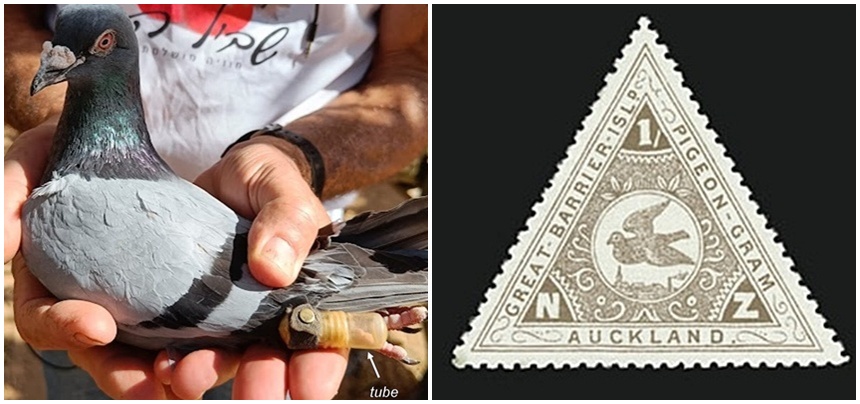
And in New Zealand, a “Pigeongram” mail service ran from 1898 to 1908. They even had special stamps, though I’m not sure on what pigeon-part one would have affixed them.
Though bird navigation has been well-studied, much remains a mystery. We know that some of the tricks that birds use to find their way around the planet include landmark recognition and solar orientation, but many species migrate only at night, when terrain and solar position can’t help. This is why sensitivity to Earth’s magnetic field is also critical.
Luckily for us, Earth is a self-generating electromagnet, thanks to its rotating outer core of molten iron. If it weren’t a giant magnet, we’d all be fried to a crisp by cosmic radiation. Recently, it has come to light that animals utilize a protein molecule called a cryptochrome to sense the planetary magnetic field. This involves being attuned to light wavelengths between 400 and 480 nanometers, which is in the blue-violet to blue-turquoise range.

Birds, it turns out, are serious metal-heads, having (as one paper elegantly puts it) “iron-containing sensory dendrites in the inner dermal lining of the upper beak.” Ferrous-rich nerve cells were first detected in homing pigeons, but all bird species are thought to have them.
Long-distance migratory species need them the most, but even poultry and resident birds are endowed with an iron-based inner compass. We now know that the same complex dendritic system in the beaks of homing pigeons is a common feature in all birds. Many biologists think this is the basis of some, if not most, kinds of animal behavior guided, or at least influenced, by magnetic fields.

But heavy metal is not just for the birds. Amphibians, sea slugs, lobsters, bacteria, and other life forms are unconscious collectors of iron as well. Real-time brain scans have showed that most humans respond to magnetic fields as well. In a lab setting, some people could even detect when the magnetic polarity was reversed during the study. And in a 2019 study published in the journal eNeuro, lead author Dr. Connie Wang said that her team found a very clear human brain response to Earth’s natural magnetic field.
What really caught my attention is a report out of South Korea. In an April 2019 PLOS One research paper, Kwon-Seok Chae et al. found that male subjects who had fasted for an entire day seemed to orient themselves in a direction they strongly correlated with food, even when blindfolded and wearing ear plugs. I bet Shaggy and Scooby-Doo would agree.
Become a Saturday Evening Post member and enjoy unlimited access. Subscribe now





Comments
As usual Paul, there’s soo much going on here, it’s not easy putting in comments. I will say this: when driving to a place I’m not familiar with, I’ll definitely MapQuest it first, writing down the steps as needed.
Usually that’s enough, but occasionally do need Waze in the last mile or so when dealing with unexpected tricky streets/turns. I prefer to not have to use it because it can/does make mistakes too. Left to their own devices for navigating, animals (again) are smarter than humans.