When I woke up Saturday morning it was quiet except for the rain. I put on my robe and went to the kitchen for coffee but there wasn’t any coffee.
“Hello?”
I looked through the house and out the front windows and saw that my wife’s car was gone. Then I remembered her telling me her parents arrived early, and the airport wasn’t close. I looked at the clock and figured I had a couple hours to myself before the bombardment. So instead of coffee, I went for a beer. I took the beer back to the living room where I lay on the couch in the dim wet morning light and felt good.
The front door opened and feet and voices shuffled in. I sat up on the couch and realized I must’ve fallen asleep. My head hurt a little.
“Oh, hey,” I said, sitting up, rubbing my face.
Kate entered first. She looked down at the beer cans disapprovingly. Her parents were behind her, and they smiled and said hello. I asked how their flight was and they said good. Her dad said he had to use the bathroom. Her mom rubbed lotion into her hands. Kate said their bags were still in the car and widened her eyes. I tried to collect the cans and take them outside but the cans were loud and I almost dropped one. I scurried outside with my head hung low, watching the floor, avoiding the look I knew my mother-in-law had, a look just like my wife’s. Outside I took a few deep breaths and brought in the bags after I threw away the beer cans.
We all sat in the living room — my wife with her parents on the couch and me in the reading chair. Her dad told a story about meeting Allen Toussaint in New Orleans, a story I had heard a dozen times before. Then he asked if I liked Allen Toussaint, a question I had also heard a dozen times before. I nodded. Her mother said the guest room would make a perfect nursery. I nodded again. They continued to make small talk, first about their flight and then about a distant cousin’s breast cancer diagnosis. I felt trapped and wanted to be anywhere else doing anything else. It was only a matter of time until her dad told the story of their trip to Cairo and run-in with Gaddafi. I needed an escape.
“I guess I should start my chores,” I said.
“What chores?” Kate asked.
“I’m going to clean out the garage,” I said. “Do some organizing.”
I slapped my knees and stood up and went to the garage. I opened the garage door and it was still raining and the freshness of it felt good. Then I opened the garage fridge and grabbed a cold beer and sat in a lawn chair. The breeze blew brown leaves down into the gutters like wounded birds. The rain filled the potholes. I drank that beer and grabbed another, cracking my knuckles and deciding it was time to get to work. Figured I should try to keep busy, keep my mind off my headache, off the unwanted visitors.
First I focused on the miscellaneous screws and nuts and bolts, separating them by type and size, emptying and refilling jars and coffee cans. After the hardware I moved to the tools and yard equipment, hanging and organizing, rewrapping the extension cords. Then it was the boxes and bins, the things stacked on shelves and pushed into corners. I made a pile of things to throw away: old magazines, paints, tubes of dried caulk, an inner tube with a hole that I never got around to patching, things I didn’t know the purpose of — junk. I moved the Christmas decorations next to the Halloween decorations; the beach stuff beside the camping stuff. I unfolded the step ladder to reach the tops of the shelves and pulled down a thick moving box no bigger than an old computer monitor. It wasn’t heavy but cumbersome and I didn’t get a good look until I was safe on solid ground. That’s when I recognized the box and my heart fluttered in my throat before sinking to the bottom of my stomach like a recently dead fish.
In my handwriting was “Family” across a flap in black Sharpie. Before opening the box I hesitated and looked out at the rain. I felt anxious. My hands were moist. At the top of the pile was our dog Dale’s leash and collar, a dog I loved more than I thought I ever could’ve loved. Then I met my wife and the three of us had ourselves a perfect little family. Ten years later and six years ago I lost him, my father, and my best friend all within a year and a half, and if it wasn’t for my wife, I too would’ve been lost. I gently rubbed the worn leather. The tag engraved with his name jingled and I could’ve cried.
When packing to move to the house we were in then, I filled that box with all the things I no longer had any real use for but couldn’t let go of — old coins, golf scorecards, my father’s watch and grease-stained work shirt, an ashtray from Mexico City gifted to me by my late best friend when we were still in high school, an old Tonka truck that was a Christmas present from my father and mother, a family bible — and opening that box was like reopening a wound. The sadness crept out from the dark and found me, like when you see an unexpected photo of someone you loved and lost and you weren’t prepared to see their face — to remember.
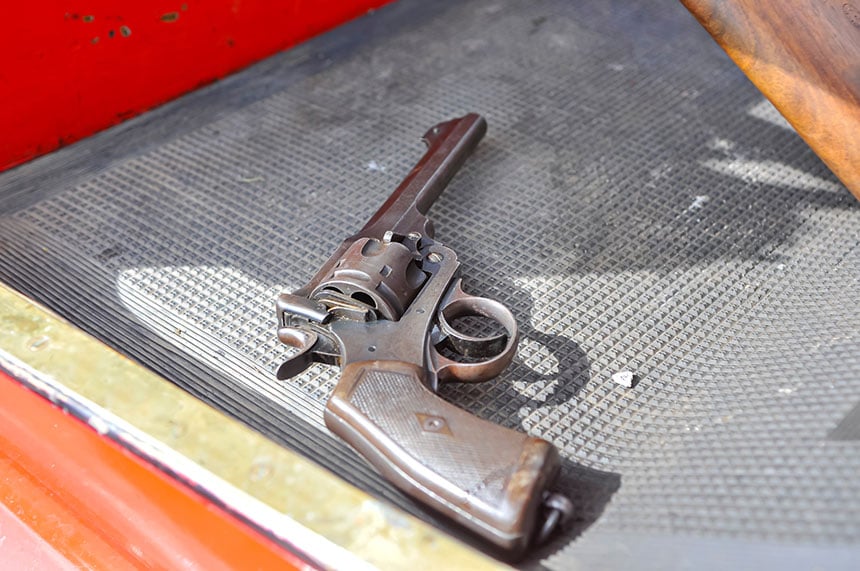
As I was about to close the box and put it back where I found it, up high and out of sight, when the slight glisten of dull steel caught my eye. I carefully dug toward it, and as my fingers touched the cool metal I instantly knew what it was — my grandfather’s service pistol from World War II, a M1917 Smith and Wesson revolver. I lifted it out of the box and it felt strange and heavy in my hand. I hadn’t held a weapon in years and I had somehow forgotten all about this one. After my father passed I’d found it among his belongings while cleaning out his apartment. I popped open the cylinder and saw that the chambers were loaded. My heart beat a little quicker as I thought about my grandfather, my father, and Dale, looking for specific memories but finding only swirling emotion. I realized it had stopped raining as screams erupted from inside the house.
The screams came from the kitchen; the stove was engulfed in flames. My in-laws stood near the kitchen table with their eyes wide and their bodies unhelpful. My wife was screaming as she struggled to put out the fire, not knowing what to do.
“What the hell’s going on!” I shouted.
“It’s on fire!” my wife shouted back.
I grabbed the kitchen towels and suffocated the flames. The edges of our cabinets were stained black. There was a broken bowl on the range and some kind of liquid everywhere.
“What happened?” I asked.
My mother-in-law stepped forward and said she was going to start dinner and turned on the wrong burner where a ceramic bowl filled with butter sat and the butter must’ve caught fire. She didn’t really apologize nor did she really help clean it up. They went back to the living room and I ordered a pizza while my wife cleaned up the mess. The sun was setting and the house was getting dark.
We all went to bed early, but I didn’t sleep well and felt restless. When morning came I remembered it was trash day and hurried outside to take the totes to the curb. It was a beautiful day with a clear blue sky. On the way back in through the garage I passed the open box and remembered the revolver. I put the box back where I found it but put the gun in my toolbox.
My mother-in-law made the coffee; it was too strong and overly bitter. I choked down a cup and announced I had to go to the hardware store, that my work on the house was only beginning. It was going to be a productive day. My father-in-law volunteered to come but I told him to stay put.
“Stay here,” I said. “I can handle the hardware store.”
I put the toolbox in the cab of my truck and left with the windows down. The sun was still low and the light shot over the yellowing soy fields like spilled amber. To go to the hardware store you took a right on Old Church Road, but I took a left, to the abandoned farmland near the river that the locals used as a gun range, where old TVs, couches, water jugs, and spray-painted plywood seemingly sprouted from the land instead of corn or tobacco.
But first I stopped at the Star Mart for beer. I parked my truck next to Cooper’s truck and left it running. The bell binged above my head as I entered the store.
“Morning Coop.”
Cooper was behind the counter, filling the cigarette case. He coughed a deep wet cough.
“Look who it is. I don’t usually see you until later,” he said.
“Got me some visitors.”
“Well how ’bout that. Wish I could get me some visitors. That would sure be nice.”
I walked back to the coolers and grabbed a six-pack of Bud. On the way to the registers I grabbed a couple bags of spicy peanuts. I put it all on the counter and Cooper turned around.
“Breakfast of champions you got here.”
“That’s what I was thinking too,” I said, rubbing my tongue over my teeth, trying to remember if I’d brushed them.
“What do you have planned for today?”
“Found my grandfather’s old service pistol, so gonna go shoot that at the old Sledge property. Forgot I even had it.”
“A 1911?”
“A M1917. He was an MP, or something like that. Couldn’t’ve found it at a better time. The in-laws are visiting and I need to blow off some steam.”
I made a finger gun and fired a few shots into the ceiling. Cooper just nodded and slid me the bag of beer and peanuts. He followed me out of the store and lit a cigarette.
“Don’t shoot y’self,” he said.
“I’ll try not to.”
As I got back onto the road I looked in the rearview mirror and saw Cooper looking down at the ground as he smoked his cigarette, and I realized I didn’t see his dog Daisy beside him — Daisy was always there beside him.
I had the roads to myself but still drove the speed limit because I had nowhere to be so I took my time and enjoyed it. The air was cool and refreshing. I wondered what they were doing back at the house. I imagined them sitting around the kitchen table, stirring sugar and milk into their coffees, their spoons dinging against the ceramic, the clock ticking forward, my wife’s mother making a snide comment and her father asking what’s for lunch.
No one was at the range. It was a Sunday and still early. I sat in the truck and drank a beer. The sun was on my face and it felt good and warm. I stepped out of the truck and grabbed the gun from the toolbox and a crow cawed somewhere above me. I looked out over the busted TVs and water jugs. There was an old couch shot to hell. Squirrels scurried over dry fallen leaves. Trying not to think of my wife and her family, of going home, I lifted my hand and took aim at a plywood target and squeezed the trigger.
It was louder than expected and everything hurt and brightened to a blinding degree. My hand felt like it had been plunged into boiling shards of glass. When I looked down the gun was no longer in my hand — my hand no longer looked like a hand. The gun had exploded and left behind a bleeding chunk of meat. I don’t remember going to the hospital, but the blood in my truck suggested I drove myself. I do remember my wife and her family — my family — walking into the hospital room after my surgery. I remember their looks of shock and concern.
Kate hugged me. She looked like she had been crying, and her mother too.
“What the hell were you thinking?” her mother asked.
“I guess I wasn’t.”
“You could have been killed,” Kate said.
“You’re a lucky man,” her father said, patting me on the shoulder.
I looked down at my bandaged hand and felt something swell in my stomach.
They even brought me my favorite thing to eat — a Hardee’s Western Bacon Cheeseburger with extra packets of ketchup that they had to open. I remember that, too. I also remember being glad they were there. And my seven and a half digits won’t ever let me forget.
Become a Saturday Evening Post member and enjoy unlimited access. Subscribe now



Comments
This story hit some solid beats. Escaping in-laws, memorabilia, missing dogs, and some tactful foreshadowing. Well penned.
This story was a trip of various and unexpected directions, starting with the very title itself.