“I believe in women even more than I do in astronomy.”
–Maria Mitchell: The Soul of an Astronomer
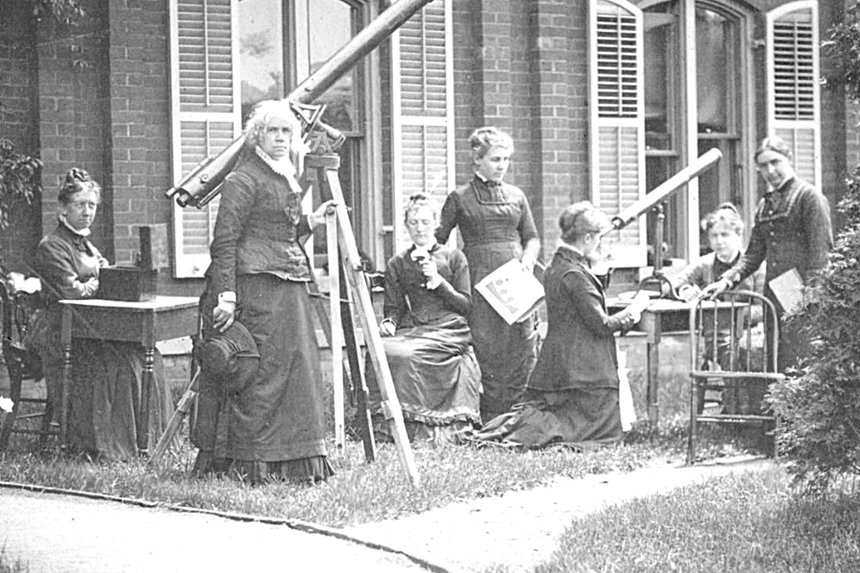
Maria Mitchell liked stars more than social life. As a child, she was so fascinated with astronomy and mathematics that her astronomer father William taught her about various astronomical instruments.
Born on August 1, 1818, on Nantucket, Massachusetts to Quakers Lydia Coleman and William Mitchell, the future astronomer was the second oldest daughter of ten siblings. Since Nantucket was then the center of the whaling industry, its sea captains depended upon William to check their navigational equipment. When Mitchell was 12 she assisted him during a solar eclipse. Her work was so accurate that sea captains soon relied upon her to correct their chronometers before setting out on voyages.
“We always had books and were a bookish people,” Mitchell said about her parents, who taught her and her siblings about the humanities and sciences. After attending the Cyrus Peirce School for young ladies, Mitchell realized that to succeed as an astronomer, she had to learn higher mathematics. She wrote, “Star gazing is not science. The entrance to astronomy is through mathematics,” according to Maria Mitchell: The Soul of an Astronomer.
In 1836, the eighteen-year-old Mitchell was appointed the librarian of Nantucket’s new Atheneum. Despite her youth, she was hired according to biographer Renee Bergland because she was “radiantly intelligent, ferociously witty” and well educated. After work, at night Mitchell continued to assist her father with astronomical observations and geographical calculations for the United States Coastal Survey.
That same year, William was named head cashier at the Pacific Bank. One of the perks of his job was an apartment on the top floor. After moving his family there, William created an opening in the roof so that he and Mitchell could continue tracking the stars with the Coastal Survey’s four-inch telescope. On the night of October 1, 1837, while the family entertained guests, Maria Mitchell suddenly left the party and climbed to the observatory. Her departure was typical according to her sister Phebe, for Mitchell “cared but little for general society and had always to be coaxed into society.”
That night while sweeping the sky with the telescope, Mitchell saw something moving above the North Star. Knowing the fuzzy star-like image was not a nebula, she suspected it was a comet. Rushing downstairs, she asked her father to confirm it. “This evening at half past ten, Maria discovered a telescope comet five degrees above Polaris,” William wrote in his diary. Then, knowing that King Christian VIII of Denmark planned to award a gold medal to the discoverer of a new comet, William notified his friend William Bond at the Harvard Observatory.

By the time Bond received his letter, Father de Vico of Rome’s Vatican Observatory had also seen the comet and had contacted the Danish king. Bond, who had long admired Mitchell’s skills, asked Harvard president Edward Everett to support Mitchell’s claim. Everett then contacted Denmark’s American diplomat and persuaded the king to honor young Mitchell and “all the friends of science in America,” according to Maria Mitchell: The Soul of an Astronomer. On October 6, 1848, the Danish king declared Mitchell winner of the gold medal for her discovery of Comet 1847 VI.
As the first American and the first woman to receive an award in astronomy, Mitchell became famous, but being shy, disliked the public attention. Newspaper articles constantly appeared, visitors arrived at the Atheneum to meet the “lady astronomer,” and party invitations came from Boston. “It is really amusing to find oneself-lionized in a city where one has visited quietly for years, to see the doors of fashionable mansions open wide to receive you, which never opened before,” she wryly commented. As Mitchell’s fame spread she entertained leading writers and intellectuals like Ralph Waldo Emerson, Herman Melville, Frederick Douglass, and Sojourner Truth.
In 1848 in recognition of her work, Mitchell became the first woman to be inducted into the American Academy of Arts and Sciences. The following year she was hired as a “computer” or mathematical expert who tracked the movement of the planets for the new American Ephemeris and Nautical Almanac. By 1850 she became a member of the American Association for the Advancement of Science. Still more recognition came from Yale astronomy professor Elias Loomis in his textbook, The Recent Progress of Astronomy, which included a chapter on “Miss Mitchell’s Comet.”
In 1855, three of Mitchell’s friends died, according to Maria Mitchell and the Sexing of Science, and her mother Lydia became seriously ill. Since her other sisters were either married or betrothed, the famed astronomer spent the next two years nursing her mother. “I have held the tears just behind my eyelids for a month not being able to cry because of the danger affecting Mother,” she wrote in her diary. To comfort herself, she finally climbed the roof one night and peered through the telescope. “I saw the stars on the evening of the tenth [of February] and met them like old friends from whom I have been long parted,” according to Maria Mitchell: The Soul of an Astronomer.
By 1857 her mother’s health was stable enough for Mitchell to travel to Europe. There she toured several observatories, met prominent astronomers Sir John and Caroline Herschel and Mary Somerville, and traveled with author Nathaniel Hawthorne and his family. After her return in 1858, she nursed her mother until her death in 1861. Soon afterwards, she and her father bought a small house in Lynn, Massachusetts near her married sister Kate and built a new observatory there. Two years later, Mitchell’s first long scientific essay based on her astronomical observations in Nantucket and Lynn appeared in Silliman’s Journal.
In 1865, Mitchell was appointed the professor of astronomy at the new Vassar College and director of its observatory. Despite her international reputation, she was so self-effacing that when a salary $1500 per year was offered she refused it, insisting “ I do not believe I am worth it!” Ultimately, she negotiated a salary of $800 along with room and board for her and her father. As a teacher and advocate for women’s rights, Mitchell resolved “to give my efforts to the intellectual culture of women, without regard to salary,” according to Maria Mitchell and the Sexing of Science.
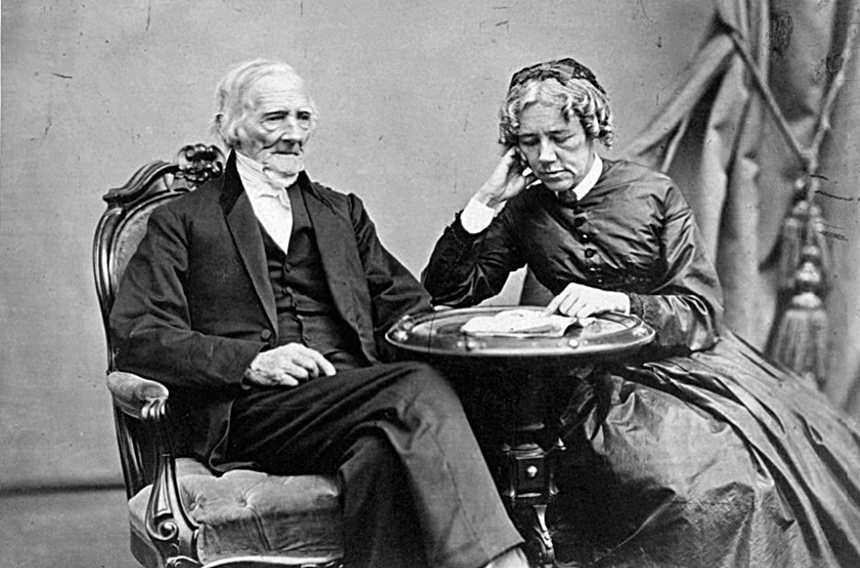
Given her long nights at Vassar’s observatory and teaching schedule, Mitchell often slept on a sofa in a classroom in the observatory, or Dome as it was called. Through her influence, Vassar College enrolled more students in mathematics and astronomy from 1865 to 1888 than Harvard University. Coupled with her passion for astronomy was Mitchell’s fervent belief in women’s higher education. In a 1874 lecture to her students, she observed that as a woman “born with the average brain of humanity – born with more than the average heart – what higher destiny could you have? …you are a power.” The following year as president of the Association for the Advancement of Women, she explained she once thought “How much women need science” but now believed “How much science needs women.”
Mitchell retired from teaching in 1888 and died on June 28, 1889, at age 70 in Lynn, Massachusetts.
“I have been asked,” she once wrote, “what lesson the comet teaches us, and to this I can only answer, that lesson which all that is inscrutable teaches – the lesson of humility.”
Honors
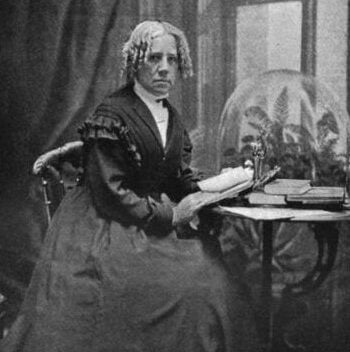
- The comet discovered in 1847, formally designated in 1847 as C/1847 T1, is known as Miss Mitchell’s comet.
- A World War II Liberty ship, the SS Maria Mitchell, was named for the astronomer.
- A crater on the Moon was named in Maria Mitchell’s honor.
- In 1994 Mitchell was inducted into the National Women’s Hall of Fame.
Become a Saturday Evening Post member and enjoy unlimited access. Subscribe now



Comments
Thanks for this wonderful feature on this extremely remarkable woman, destined for so many ‘firsts’ it’s hard to count them all. I’ve shared it with some friends, and we all wondered why we didn’t learn about Ms. Mitchell in school, or science classes more specifically, along the way.
I’m glad she’s been honored in some high profile ways, though. Learning what a humble woman she was, she might have felt it was too much. Well it wasn’t, at all. To this day collectively, we owe her a lot for the advancements her efforts have made in our knowledge of space, and here on earth otherwise.