Senior managing editor and logophile Andy Hollandbeck reveals the sometimes surprising roots of common English words and phrases. Remember: Etymology tells us where a word comes from, but not what it means today.
The U.S. women’s hockey team has been running roughshod over their competitors at the Winter Olympics. In six games, they have outscored their opponents an amazing 31 to 1. That’s five shutouts! As I write this, they are preparing for the gold-medal game against Team Canada. Their success — and the notable scoring disparity — is sparking wider interest in the game among fellow Americans.
It’s gotten me interested, too, but in a different way. Why’s the game called hockey?
Though there is some uncertainty about its exact historical evolution, the prevailing thought is that the word hockey is all about the sticks. John George Wood describes the sport in his 1875 book The Modern Playmate: A Book of Games, Sports, and Diversions for Boys of All Ages: “The game is played with a solid india-rubber ball … and the players, each with a hooked stuck or ‘hockey,’ take opposite sides, and try to drive the ball through each other’s goal.”
Hockey probably relates to the French hoquet “shepherd’s crook,” a diminutive of the Old French hoc “hook.” To put it in more common terms, hoc is to hoquet what horse is to horsey, or what towel is to towelette. That Old French hoc is from a Germanic origin, which makes it less surprising that Old English (a Germanic language) also has a word hōc meaning “hook.”
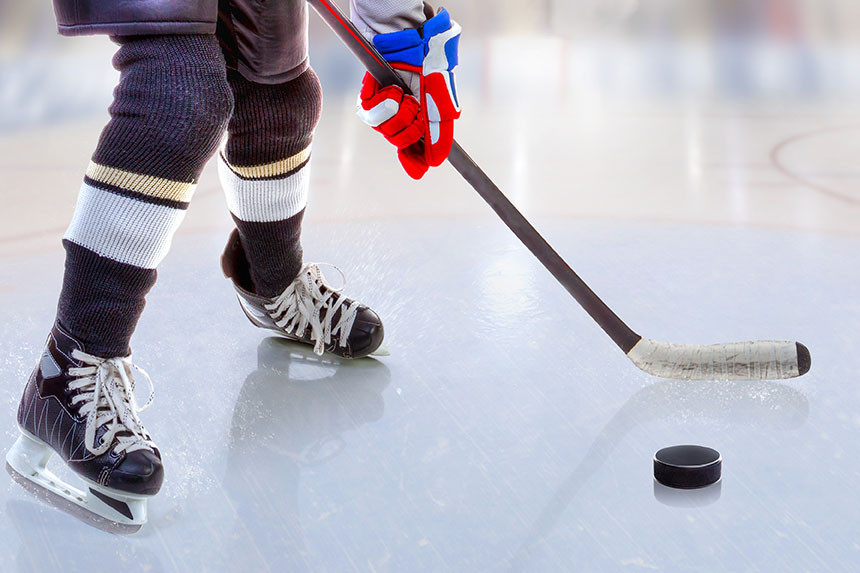
So the sport gets its name from the stick, and the stick got its name because it had a hook in it. (It was a hook-y stick, so to speak.) Early versions of hockey sticks surely resembled a shepherd’s staff more than they do now, but the equipment and the game have had half a millennium to evolve — the first known mention of hockey, as hockie, in English texts is from 1527.
Though the refrigeration technology that would make an artificial ice skating rink possible was an early-20th-century innovation, people took the game to the ice long before that. There are written references to hockey and its precursors as a fun winter game, as well as paintings of people playing some sort of stick-and-ball game on ice, that date to the 16th century!
Modern hockey isn’t hockey, though, without the puck. The first (wooden) pucks — not to mention this sense of the word puck — wouldn’t appear until the 1880s (though other non-spherical items were used on the ice even earlier). Puck was an English dialect word that means “poke, hit,” likely from the Irish verb poc “to butt” — literally a word for a male deer, or buck.
Become a Saturday Evening Post member and enjoy unlimited access. Subscribe now