Melody Lomboy-Lowe was 6 years old when she planned her own funeral. She chose the clothes she would wear. She decided which toys would go to which friends. A passionate swimmer, she requested a funeral plot overlooking a pool. Lomboy-Lowe had been diagnosed with leukemia, and in 1983, treatment options were limited. Doctors gave her a 50 percent chance of survival. Planning her funeral, she says now, was like occupational therapy.
“It was good for me,” she says. “I was in charge of something. I had control over one thing, and that was it.”
The funeral never happened. Lomboy-Lowe survived — and she now helps other children fighting their own cancer battles. Since 2020, she and her 36-year-old niece, Gracelyn Bateman, have run the Los Angeles-based Luna Peak Foundation (lunapeakfoundation.org) to publish books for kids and their families on cancer and grief, and to provide inspiration, hope, and support. Luna Peak has donated over 4,000 books to families, hospitals, palliative care and hospice centers, therapist offices, schools, and universities. This includes workbooks and children’s books such as Follow Me, Cancer Free, based on Lomboy-Lowe’s own childhood experiences, and Sean’s Best Week at Camp Luna Peak, inspired by a fellow cancer patient who died as a boy.
“I created the books I wish I’d had when I was a child,” Lomboy-Lowe says. In Follow Me, Cancer Free, “you finish treatment and everybody’s happy. But not every kid that gets a diagnosis is going to be cancer-free, so that’s why we wrote Sean’s Best Week.”
Her cancer journey began in Sierra Madre, California. The youngest of six kids, she loved swimming, but began suffering nosebleeds when she’d exit the pool. On her first day of first grade, her mother was brushing her hair and made a discovery: Her lymph nodes were swollen. By that afternoon, the swelling had doubled. The family’s pediatrician seemed unconcerned, but her worried mom insisted on tests. A bone marrow aspiration and spinal tap found leukemia.
The family had already been rocked by cancer. Weeks before Lomboy-Lowe was diagnosed, her grandfather had died from colon cancer. Her parents were open and honest with her about the disease. They told her she had something called cancer. They told her she needed chemotherapy. They said she had a 50 percent chance of surviving the first year. And she received an assignment from her “super-amazing doctor,” as she calls him.
“He told me that I was in charge of my attitude,” she says. “So I had to take part in my treatment by how I acted and how I thought and having a positive attitude. That was my job.”
It wasn’t easy. She was in and out of the hospital and took daily oral chemotherapy medications. Today, kids typically receive anesthesia for painful procedures; she was awake for spinal taps and agonizing bone marrow aspirations. Every month, for one week, she’d receive chemo cocktails, part of a successful clinical trial for a regimen that is still used today (unlike her then 50-50 odds of survival, kids today have a 90 percent chance of beating the disease).
The chemo caused nausea, but she developed coping mechanisms during her treatment. She would visualize Pac-Man eating the bad cells. She attended camps and continued swimming unless she felt too ill. She even looked forward to the hospital trips, because her friends there faced the same challenges.
“I was still going to school, but I couldn’t do all the things that the other kids were doing,” she says. “I wasn’t different at the hospital. We all knew how many cc’s of chemo we needed that day. We knew our antibiotics, we knew the medications, we knew the dosages. I always knew when I had pneumonia — I knew the feeling of it inside.”
At age 9, when she finally finished treatment, she wanted to give back. Despite her young age, she began speaking and raising money for cancer charities.
“I wanted to share my story, because in 1983, leukemia was pretty much a death sentence,” she says. “Only a handful of us were surviving. So to have a survivor speak at these events, it was special for them to see where their funds were going.”
Her story influenced those close to her as well. In high school, she met her future husband, Tom. He knew he wanted to be a doctor and, inspired by his future wife, he eventually became an oncologist.
Lomboy-Lowe received a swimming scholarship from the University of California, Irvine, and graduated with a degree in sociology. She had also studied acting, and after college she became an underwater body double on shows such as Baywatch while helping support Tom through medical school. Following the birth of their first son, she became a talent agent. But she dreamed of writing a book.

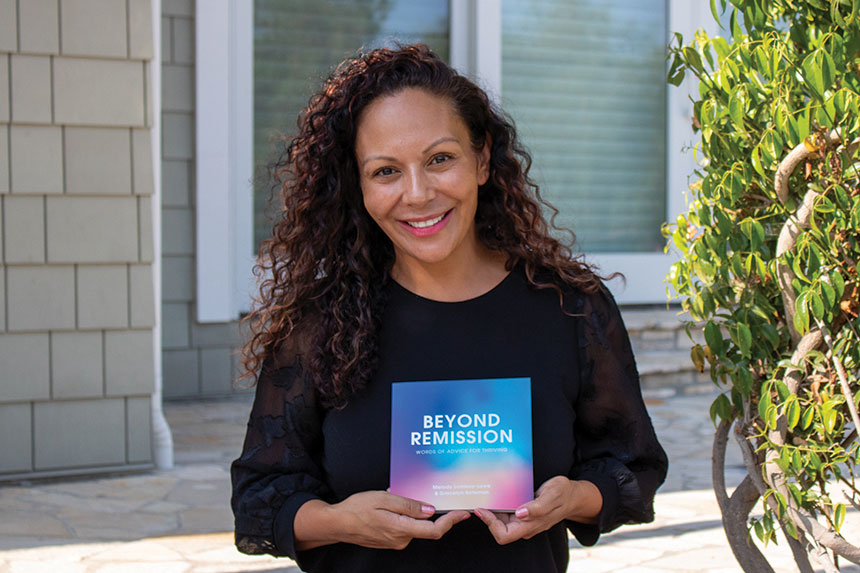
Her niece, meanwhile, was recovering from the death of her father. Bateman returned to California from New York City, where she’d attended Columbia University and worked in marketing, to help support her mom. She learned about her aunt’s aspirations and dreams and wanted to participate. They collaborated on a photography book called Beyond Remission, featuring portraits of cancer survivors with a quote about their lessons and experiences.
“When you first get sick, you’re given these big, heavy books to read, so I thought, if we had inspirational quotes and a face, so they could see what a survivor looks like, it would be an incredible resource for people,” Lomboy-Lowe says.
After working with a literary agent for Beyond Remission, they decided they could publish future books on their own. The duo founded Luna Peak, which not only publishes books but hosts workshops on cancer and grief.
“She’s a brainiac,” Lomboy-Lowe says of her niece (the two are more like sisters; they’re only 12 years apart). “She’s so organized, and she knows how to get things done. I’m more of a creative. I have a million ideas, but I don’t know how to channel them. So she helps me do that. I wouldn’t have known where to start.”
But as Bateman quickly notes, Lomboy-Lowe’s formidable presence and life experiences are the drivers behind Luna Peak’s success.
“She brings a little bit of magic into every room she’s in,” Bateman says. “She changes the energy. If you were stranded, if you were in a worst-case-scenario situation, you’d want her on your side. She’s been able to add not just a good attitude, but also humor to dark spaces like cancer and grief. That’s something that she definitely helped me with. When I was deep in the trenches of grief after losing my dad, she was able to pull me out a bit.”
Lomboy-Lowe focuses mainly on cancer, and Bateman heads the grief projects, though “they cross lines often,” Lomboy-Lowe says. The books are mostly children’s books, and as the child of a Filipino father and Italian mother, she wanted them to be multicultural.
“Cancer doesn’t care about your background or how much money you make or where you’re from,” she says. “It’s everywhere. So I wanted kids of all kinds to see themselves.”
She witnessed the power of this inclusiveness at the Loma Linda Children’s Hospital in California, when she read Follow Me, Cancer Free to a group of 4- to 10-year-old cancer patients.
“There was a little girl named Zoe, and she saw a little brown baldheaded girl in the book, and she was like, ‘That’s me,’” Lomboy-Lowe recalls. “And then she saw another girl with curly hair, and she’s like, ‘That’s you.’ It was a full-circle moment. She gets to see the beginning of the book where the kid is bald, and then she’s growing hair, which is symbolic for many cancer patients.”
As Lomboy-Lowe approaches 50, she carefully monitors her health, from regular mammograms to blood tests. Of her childhood friends at the hospital, only two, including Lomboy-Lowe, avoided a second bout with the disease. Now that she’s a mom, she worries about her three sons, age 20, 16, and 14.
“Every bump, every fever, if I see a lymph node, if they’re lethargic, I’m always worried,” she says. “Anxiety is a big part of my life, for sure. I don’t let it consume me, but it is definitely a side effect of having cancer. I’ve learned that the parents often seem to be suffering more than the kids who are going through the treatment, which sounds crazy, but now, as a parent, I see it. I see what my parents went through. Your kids are your heart outside of your body and you want to protect them at all costs. Most of my interactions are with parents or older siblings, and when they see me, or anyone that has survived as a child and now is an adult, and they’re thriving, having a good life, it’s a good example of what they can have. A lot of parents will tear up because they don’t have a chance to cry in front of their kids. We get a lot of hugs behind walls and behind doors.”
And so she keeps working, keeps helping, keeps giving. The efforts have not gone unnoticed. The Los Angeles County Commission for Women named Lomboy-Lowe one of its 2025 “Women of the Year.” And she and Bateman hope to expand Luna Peak’s impact in the coming years. They want to add office space to host more workshops and provide a library for children and families. They also want to host summer camps for survivors. But Lomboy-Lowe’s impact comes not only from doing, but from being. Her survival inspires courage in others.
For their photo-and-quote book Beyond Remission, Lomboy-Lowe wasn’t just an author. She also appeared on the pages as a survivor. Her advice: “Life has hit me with a lot of waves, but I just keep swimming. There is no one-size-fits-all approach to navigating a cancer diagnosis. You get to decide for yourself. I choose hope.”
Ken Budd has written for The Washington Post Magazine, The Atlantic, and many more. He is the author of the award-winning memoir The Voluntourist and a host of the literary podcast Upstart Crow.
This article is featured in the March/April 2026 issue of The Saturday Evening Post. Subscribe to the magazine for more art, inspiring stories, fiction, humor, and features from our archives.
Become a Saturday Evening Post member and enjoy unlimited access. Subscribe now