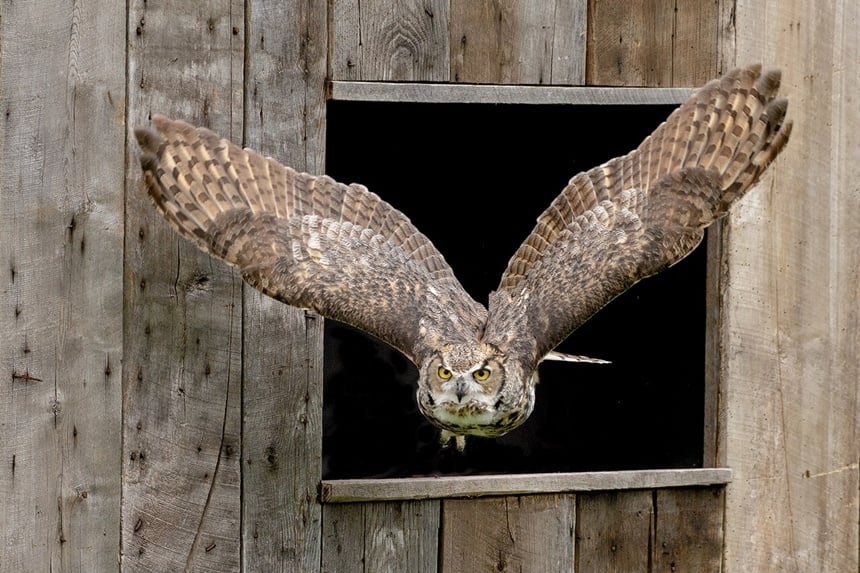
In the late 1960s, ecologist Lee Metzgar conducted an experiment demonstrating the value of knowledge. He put wild white-footed mice into a barn they had never seen before. Half were given several days to learn about the barn, and to figure out the best places to hide from a threat. The other half got no time to learn.
Then Metzgar placed a predatory screech owl in the building. The bird quickly ate mice who had no prior knowledge of the environment, but many of the experienced mice survived. Mice who had time to learn about the barn were experts. Mice who didn’t were not.
Knowledge is powerful, and can influence survival—for people, too. Our increasingly complex world needs experts who apply hard-earned knowledge to help society function. Those who devalue this kind of rigorous expertise, leaning instead on “doing your own research,” do so at our peril.
As a behavioral ecologist and conservation scientist who studies how animals and humans make decisions, I’ve thought a lot about what constitutes an expert. Managing predation risk requires expertise. Some elements of it are instinctual, developed over millennia as evolution has favored faster, stronger, or otherwise gifted animals who respond effectively to predictable threats. But in many cases expertise must be learned. Older animals have more lived experience—acquired knowledge about predators—than younger ones. This, in part, explains the relatively higher predation rates on young animals (about 50% of the marmots I study die in their first year of life). Animals moving into new areas are particularly vulnerable, too.
In my research, it often emerges that experience and acquired knowledge make the difference between life and death. I’ve sometimes tried to give endangered species experience before reintroducing them to places where they had been driven extinct by predators. If you release captive-reared, predator-naive fish, birds, or mammals into the wild, most die. If you train vulnerable Australian marsupials to recognize predatory foxes or cats, or let them gain that experience over time by putting a few cats into very large enclosures that allow the marsupials to escape, post-release survival may increase.
Human survival relies on learning, too. Most of us no longer fend for ourselves in the wild, evading predators. But we have to know a great deal to live and function in modern society—and the more advanced the task, the more we need to know. Many professions, including pilots, doctors, and lawyers, formally certify practitioners, who must acquire special knowledge and abilities. Surfing, flying an airplane safely, or conducting brain surgery require countless hours of practice. The author Malcolm Gladwell has famously suggested that it takes a human 10,000 hours to learn a complex task. A surfer riding their 10,000th wave is more proficient than one riding their first. In 10,000 hours, a pilot makes a lot of take-offs and landings.
But today, thanks to the internet, all kinds of essential decision-making information are available to everyone—from scientific studies in “open access” journals and NOAA weather data to anecdotes on Reddit and social media.
Given this knowledge explosion, shouldn’t society democratize decision-making? Shouldn’t everyone’s opinion be valued? What to make of the “wisdom of the crowd”? Increasingly, we hear that groups of people with diverse experiences can, in the right conditions, make better decisions than solitary actors, maybe even better decisions than “experts.”
But here’s the thing: True experts have more than mere access to information. They also understand how to think about their knowledge—its quality, its limitations, and its value. Such insight emerges through experience. Sometimes this experience is lived, or informal. People who have lived through homelessness have developed crucial expertise to help create solutions for it. They understand its indignities and the high barriers that prevent escaping it.
But experience can also be acquired formally, through study. Most (but not all) animals gain experience directly, but humans can teach each other. And the more technical the human problem, the more complex the decision, the more we must place value on formal training and experience. This is why scientists like me sometimes bristle when lay people dive into technical debates and rewrite the rules of the game. Our schooling steeped us in the scientific method, the exacting experimental work of testing hypotheses in search of fact and truth. To believe something, we need to see proof, again and again.
Importantly, we’re always trying to refute our ideas, not find more evidence to support them. It’s through this constant critical attack that truth emerges. Over a century of challenges, Darwin’s theory of evolution by natural selection remains because no one has been able to refute it—yet. With new ideas and new technologies, future scientists conceivably could develop a new model that explains genetic changes over time. The scientific method is effective because it is self-correcting.
By contrast, some beloved non-expert theories are explicitly not refutable. There is no way to scientifically evaluate intelligent design because it presumes that life was created by a creator. Because this fundamental assumption is unquestioned, it’s irrefutable. While untrained people may have an opinion about, say, a vaccine study, they may not have the experience or perspective to properly evaluate the information contained in the study—or to refute their pet hypothesis, if that’s where the evidence points.
Humans are wonderfully diverse and we value different things: tradition, beauty, science, nature, and profit among them. These diverging points of view matter. In a recent paper looking at natural resource conservation, my colleagues and I argued that when you’ve got a problem with more than one value at play, you’re going to have to make tradeoffs. There is no one best solution.
But even, or perhaps especially, when problems are subjective, it’s crucial to include experts who prioritize all different values, including hard-earned technical knowledge. Discounting perspectives and insights from people with years of experience addressing a problem can lead to suboptimal and potentially fatal mistakes.
For instance, framing vaccination as a personal decision completely misses its main goal, which is to create “herd immunity,” where a sufficient number of people are vaccinated to prevent spread to those who aren’t. Protecting the most vulnerable—young infants, for instance, who may not be old enough to be immunized—relies on large numbers of other people getting their shots. In this context, empowering those who specifically ignore or misuse scientific evidence, emphasizing the value of personal choice over the value of public health, makes us all vulnerable.
We should value experts in situations where experience matters. Gaining expertise takes time. We should support the education required to build it, and value experts’ role in keeping us safe.
Take it from Metzgar’s mice.
Originally published on Zócalo Public Square. Primary editor: Eryn Brown | Secondary editor: Sarah Rothbard
Become a Saturday Evening Post member and enjoy unlimited access. Subscribe now