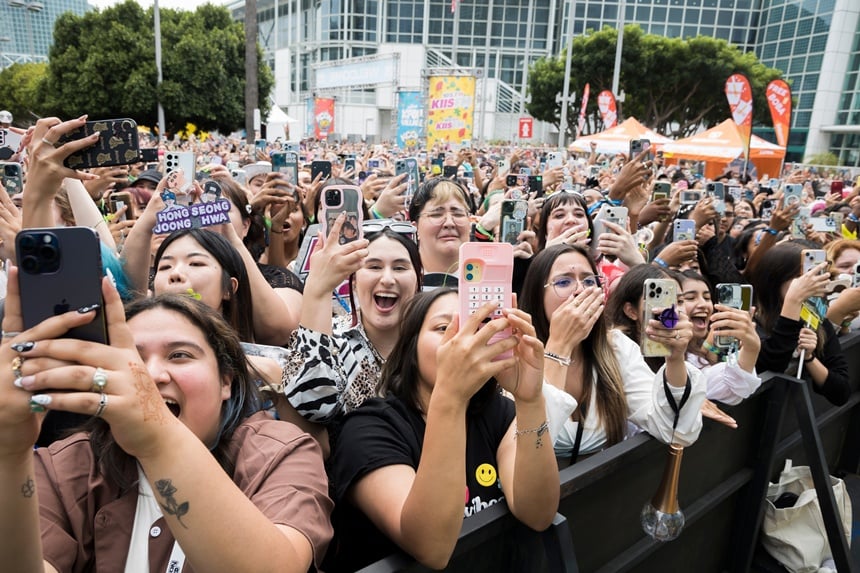
With tired eyes, I hopped into the passenger’s seat. It was the start of any other middle school morning, wearied by the unrelenting Connecticut winter of 2019. Impatiently waiting for my mom to begin our drive to school, I reached out to turn the radio up. To my astonishment, the bright and summery vocals of the Korean boy band BTS’s latest single, “Boy with Luv,” trickled through the car speakers. To me, this was the start of something new, an era where K-pop was no longer exclusive to its small community of fans but exposed to the world.
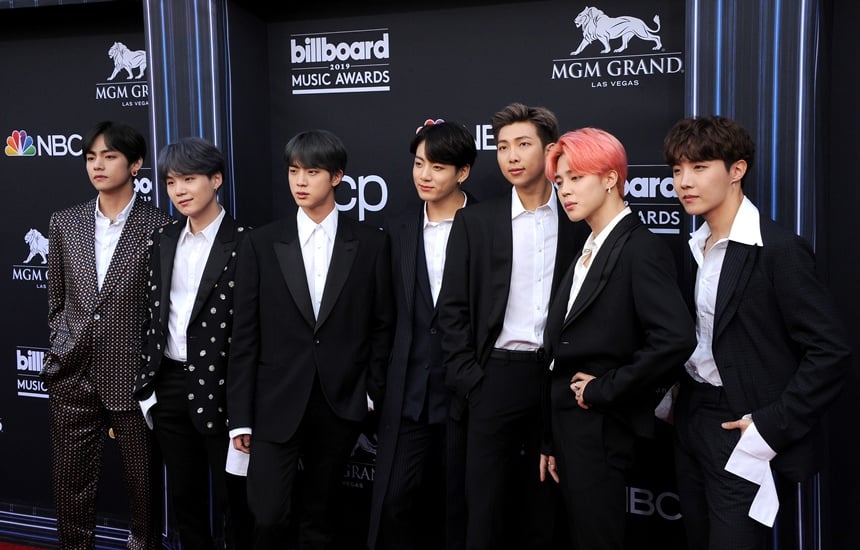
For other teens who reveled in their K-pop obsession throughout the late 2010s, BTS’s achievements were already astonishing. By 2019, the group had broken through the Western music barrier, having debuted on U.S. television on the American Music Awards two years prior, and not long after appearing at the Billboard Music Awards. Blackpink, too, was on the rise, and both groups were breaking streaming records, with Blackpink’s “Kill This Love” and BTS’s “Boy with Luv” competing for the title of most-viewed YouTube music video in 24 hours. K-pop’s global presence was finally amping up.
K-pop was going mainstream.
Bringing American Pop to Seoul
Though K-pop is marketed as a new phenomenon, Korean pop music has floated in and out of the Western music scene for decades. The genre has long sought to reshape and reimagine the American sound, beginning with The Kim Sisters in the mid-1950s. That pop trio gained attention abroad for their renditions of American classics such as the McGuire Sisters’ “Sincerely” and Elvis Presley’s “Jailhouse Rock.” More recently referred to as the “original HUNTR/X” (the girl group featured in the Oscar-winning animated blockbuster KPop Demon Hunters), the Kim Sisters mark the beginning of a long and complicated K-pop origin story. With their perfect harmonies and catchy swing beats, the all-female vocal group brought Asian talent into the budding American pop scene, eventually landing in the living rooms of over 40 million Americans through their appearance on The Ed Sullivan Show.
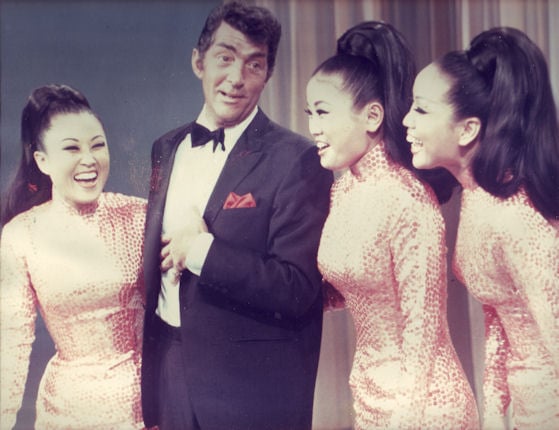
The Kim Sisters and the musical groups they inspired were major influences in the Korean pop music scene, but what they produced was as far from modern K-pop as Elvis Presley is from Sabrina Carpenter.
Modern K-pop has been around for a little more than 30 years. The genre, inspired by the MTV generation and pop giants such as Michael Jackson, can be traced back to Lee Soo-man, a then-up-and-coming music producer who found himself in Los Angeles at the end of the 1980s. Instantly enamored with the American pop culture scene — defined by its synth-pop sound and the rising popularity of boy groups like New Kids on the Block and the Backstreet Boys — Lee imagined a similar sensation back home.
Once back in Seoul, Lee quickly got to work. In 1989, he established SM Studio, the precursor to SM Entertainment, now one of K-pop’s largest entertainment companies. But SM wasn’t like any other music agency in Korea; it replicated the American “star system,” an in-house training program designed to craft an artist’s career from scratch. This included housing young talent, providing vocal and dance lessons, writing and producing their music, and marketing them to international audiences.
The studio’s first major success, the Korean boy band H.O.T., launched into stardom overnight. Their debut in 1996 marked the beginning of the modern K-pop performance: high-energy routines combining song and dance, yet still notably grounded in the American sound. Lee’s vision created an emerging new market where these manufactured pop musicians proved profitable by attracting foreign audiences. Not long after H.O.T.’s success, SM launched the careers of artists and S.E.S. and g.o.d, now revered as first-generation K-pop pioneers.
“Candy,” released as part of H.O.T.’s debut studio album We Hate All Kinds of Violence, immediately captured the world’s attention. (Uploaded to YouTube by SMTOWN)
What began as Lee’s passion project took off domestically, but soon touched foreign waters. With its newfound influence abroad, the genre’s mission shifted. The K-pop industry was no longer solely concerned with spreading its new music regionally but envisioned a different venture, one that would facilitate the exchange of Korean culture. Korea itself — from its beauty industry to its robust cuisine — became the export, with K-pop a vessel through which to transmit it.
“Korean culture has gone far beyond its typical popularity and boundaries and is being transformed into nothing less than a social phenomenon,” Lee admitted in a speech to Stanford MBA students in 2011.
As international fans became the backbone of K-pop’s success, the industry continued to expand. Each year seemed to introduce a new entertainment company, and soon the Big Three were formed: YG Entertainment, JYP Entertainment, and SM Entertainment. By the 2000s, this major expansion in K-pop infrastructure was underway.
How the Idol Steals Fans’ Hearts
K-pop began as a relatively isolated community. Early members of the K-pop fandom found something unique about the industry that reeled them in. It was a space to feel connected with other stans (aka fans of a particular group) and to support a genre that, in many ways, felt subversive to mainstream pop. Of course, listeners still hoped the world would tune into the wonders of K-pop music, and we’d finally stop being seen as fanatic fangirls or fanboys (something I often heard while showing my middle school classmates BTS’s newest performances).
For us, K-pop is more than a musical genre; it is its own universe. K-pop’s story has always been one of escapism, culture, and community. Like many others, I was roped into its alternate reality, spending much of my adolescence and early adulthood in a K-pop-induced craze.
K-pop’s appeal lies in its imaginative, almost utopian quality. The industry is known for certain traditions, like collecting images of the idols (called photocards) or seamlessly blending English and Korean lyrics. K-pop also fosters a unique idol-fan connection, with many stans admitting to having far-fetched parasocial relationships with the artists. This “K-pop ecosystem” relies on a strong reality TV presence, maximalist aesthetics, and fandom culture to keep itself afloat. In practice, other global music industries haven’t been able to capture the same immersive feeling.
What many fans, myself included, have found alluring with K-pop has been the idols’ image. Through Lee’s in-house system, each artist is carefully manufactured to be aspirational for their fans. The truth is, the industry recruits teenagers and subjects them to strict diet and exercise regimes. Many train for years with no guarantee that they will make their debut, yet the glossy veneer of perfectly sculpted faces tends to obscure this reality. Young fans who begin to idolize these artists, as they are meant to, attempt to emulate K-pop’s intense beauty standards, but they’re hard to live up to. With always flawless hair and makeup, the idol seems untouchable.
But instead of elevating its stars above their fans, the K-pop industry seeks to increase the connection between them. Rather than restricting fans to watching from afar, they are encouraged to get closer to these idols than they do with other celebrities.
Since the 1990s, meet-and-greet-style signing events have been a popular way to get up close and personal with K-pop groups. The viral livestream platform V-Live, founded in 2015 and referenced in one of BTS’s songs, was the first of its kind to allow Korean artists to chat directly with their fan bases. In 2022, V-Live was integrated into Weverse, an all-purpose social media platform where fans can privately message their favorite artists. And when COVID-19 struck, K-pop saw quarantine as a chance to innovate its means to interact with idols overseas through “fan calls,” private individual video chats. Such proximity makes these artists feel just within reach, enough so that one can easily become invested in their world.
These unique ways that K-pop artists interact with their listeners, and the structure of the whole industry, have evolved over the years. None of it would exist, however, if not for the 2010s K-pop boom.
From Regional to Global Success
While BTS is indeed a force to be reckoned with, it’s hard to say if the boy band would be quite so big were it not for the explosion of PSY’s “Gangnam Style” in 2012. With its over-the-top campy aesthetic and addictive synth-pop beat, “Gangnam Style” truly put K-pop on the map, becoming the first YouTube video to reach 1 billion views and going Quintuple Platinum in the U.S., selling over five million units in sales and streams combined. There was something so simple about K-pop at the time. PSY’s music brought an energy that the world desperately needed and became an inspiration for emerging K-pop acts.
Gangnam Style (Uploaded to YouTube by officialpsy)
Only a year later would a group of seven boys, training in a practice room tucked into the basement of Big Hit Entertainment, debut under the name Bangtan Sonyeondan (BTS). At first, Bang Sihyuk, the company’s CEO, hoped to form a hip-hop group around Kim Namjoon (known as RM), who at the time was a big name in Seoul’s underground hip-hop scene. Due to financial constraints, Big Hit pivoted to marketing the seven most promising performers as an idol group.
BTS was not an overnight success. It wasn’t until two years after their debut that the boy group began to gain a domestic fan following. At that point, BTS had released three EPs and an album and were already moving away from their hip-hop and R&B persona toward bright and refreshing ballads which sought to capture the anxieties of moving from adolescence into adulthood.
BTS’s early music was still heavily inspired by hip-hop, but the boys had a lot of freedom to contribute to the group’s music. This allowed them to distinguish themselves from other K-pop artists that debuted under the Big Three companies. By 2013, these agencies believed they had mastered the secrets to success, pinning down K-pop’s identity as a genre that depends on heavy stylization and an experimental sound. BTS’s more personal, less corporately controlled music, by contrast, felt like a breath of fresh air.
The release of “I Need You,” on the album The Most Beautiful Moment in Life, Pt. 1, was their first local win on a Korean music television program, The Show. From then on, BTS’s popularity only continued to grow, slowly trickling onto the radar of international audiences.
<iframe width=”560″ height=”315″ src=”https://www.youtube.com/embed/jjskoRh8GTE?si=5KlNMucyvhjfmrYl” title=”YouTube video player” frameborder=”0″ allow=”accelerometer; autoplay; clipboard-write; encrypted-media; gyroscope; picture-in-picture; web-share” referrerpolicy=”strict-origin-when-cross-origin” allowfullscreen></iframe>
Widely recognized as the track that took BTS global, “I Need You” depicts the group’s passionate yearning for an ex-lover in the aftermath of a breakup. (Uploaded to YouTube by HYBE LABELS)
Is There Any Soul Left in Seoul?
I can’t describe all that K-pop has achieved since 2013, as each new supergroup brings something different and innovative to the genre. Since the BTS members’ enlistment in the military in 2022, K-pop has been able to form a distinct identity apart from their influence.
Now, it’s not just BTS and Blackpink. K-pop has grown so dramatically that artists are constantly entering the scene and reshaping the musical landscape. Groups are finding novel ways to reignite global love for K-pop. The girl group FIFTY FIFTY’s massive 2023 hit single “Cupid” — which got them noticed and invited to contribute to the Barbie soundtrack — demonstrates how K-pop culture isn’t exclusive to small internet spaces anymore. It has expanded into the Western musical zeitgeist. Today, K-pop groups are headlining major American music festivals, appearing at every big celebrity event, and constantly charting on Billboard’s Hot 100.
“Cupid” by FIFTY FIFTY (Uploaded to YouTube by FIFTY FIFTY Official)
Hallyu, which in Korean directly translates to “Korean wave,” describes the cultural craze for Korean entertainment. Though initially coined by Chinese journalists in 1999, when K-pop was making waves throughout the region, hallyu more appropriately describes K-pop impact today as the world’s newest obsession. Having witnessed the ebbs and flows of K-pop’s recent history (coming on eight years since joining the fanbase!), I’ve come to see the widespread fixation on the genre as a turning point. With so many now indulging in K-pop, long-time fans must readjust to its newfound mainstream identity. Today’s groups prioritize appealing to global audiences, becoming online trendsetters, or seeking out viral moments instead of serving their original fanbase. K-pop fandoms aren’t as tight-knit as before, making many fans feel isolated rather than connected.
If you scroll on stan Twitter (now X), you will spot a lot of nostalgia for what once was. And it’s to be expected — the industry has undergone significant transformation. I, too, feel an overwhelming nostalgia for a K-pop that once was, when the fan base would experience the same thrill watching the genre reach greater heights, or when hearing BTS on the radio was something fresh and exciting. Its cultural influence is now so ubiquitous that it no longer feels distinct. Now when I turn up the radio in my own car, K-pop is all I hear.
All hope is not lost, though. BTS’s latest album, ARIRANG, was released on March 20, and their impending Arirang World Tour this summer offers me and fans like me the opportunity to return to the K-pop that I fell in love with. At least, that’s my hope.
K-pop fans will tell you time and time again that K-pop means more than just the music. I’d say that, at its core, K-pop still serves as a means of escape from our mundane lives or the stresses of reality. And as the world becomes captivated with K-pop, and global politics continues to unravel, we should take advantage of the moment: to ignite in new fans the feelings we once had as early K-pop stans.
Become a Saturday Evening Post member and enjoy unlimited access. Subscribe now