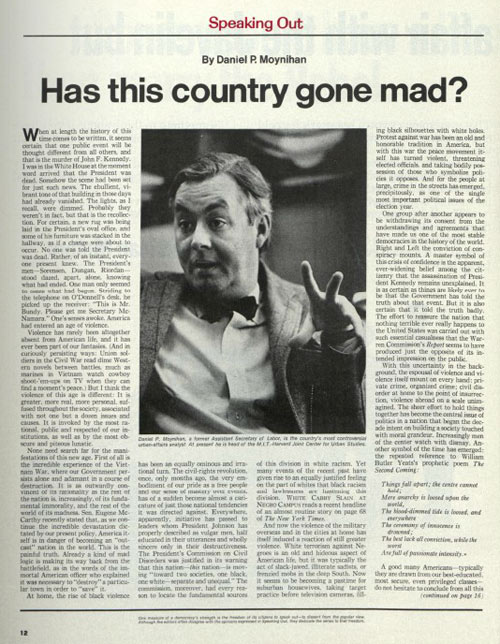
50 Years Ago: Has This Country Gone Mad?
 The happenings of the late 1960s in the U.S. seemed apocalyptic to those accustomed to the country’s status quo. Race riots, war protests, a worsening conflict in Vietnam, and several high profile assassinations brought renewed focus to American violence. Daniel Patrick Moynihan, a sociologist and politician, wrote about America’s new “age of violence” 50 years ago in the Post (“Has This Country Gone Mad?”).
Moynihan decried the country’s new status quo as one of institutional and individual violence: “It is greater, more real, more personal, suffused throughout the society, associated with not one but a dozen issues and causes. It is invoked by the most rational, public, and respected of our institutions, as well as by the most obscure and piteous lunatic.”
His preferred solution for the country’s 1968 predicament was bipartisan agreement between liberals and conservatives. “The great power of the American nation is not the natural wealth of the continent, nor its physical isolation, nor the invigorating mix of peoples that make up our population, nor the genius of scientific research and business enterprise that have made so much of these assets. Our strength lies in our capacity to govern ourselves,” he wrote. Moynihan’s indictment of violence at a time when “one group after another appear[ed] to be withdrawing its consent from the understandings and agreements that have made us one of the most stable democracies in the history of the world” can seem applicable still. The answer to it all, in turn, is just as elusive.