Prayer
In “The Power of Prayer” from the November/December 2015 issue, author Ellen Michaud describes how communal worship is a joyous experience that can take us to higher ground. Prayer and worship are common threads in the United States, and one Post artists have illustrated throughout the years. Below is a small collection.
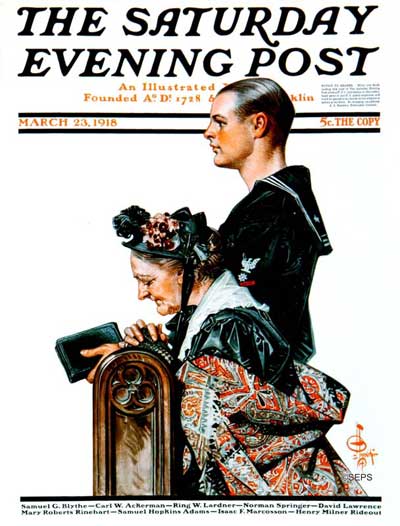
J.C. Leyendecker
March 23, 1918
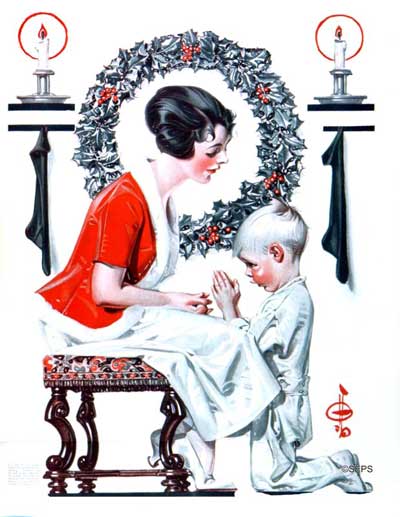
J.C. Leyendecker
December 24, 1921
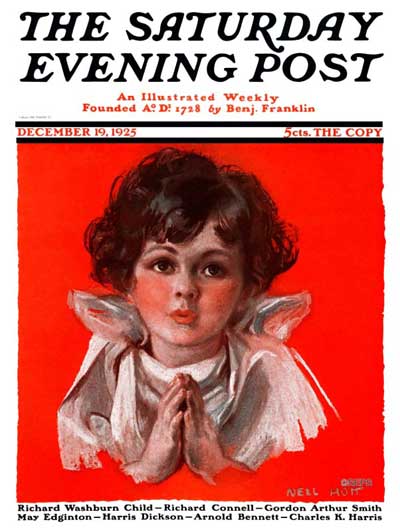
Neil Hott
December 19, 1925

J.C. Leyendecker
February 23, 1935
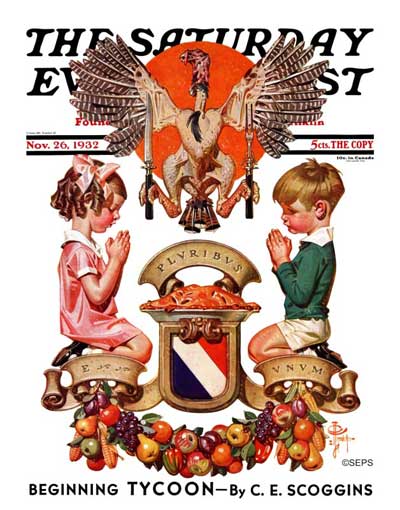
J.C. Leyendecker
November 26, 1932
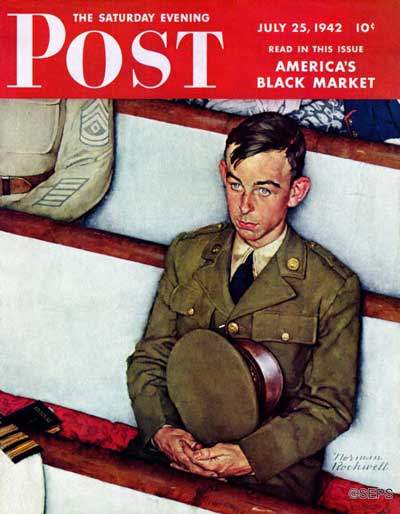
Norman Rockwell
July 25, 1942
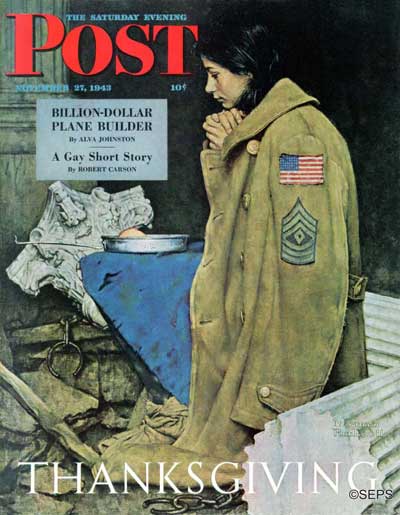
Norman Rockwell
November 27, 1943
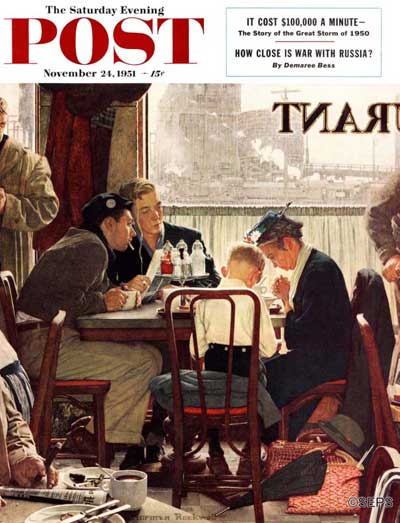
Norman Rockwell
November 24, 1951
Happy Halloween!
Long before the Great Pumpkin, Scream Queens, or Marvel Universe costumes, The Saturday Evening Post cover artists were entertaining Americans with the spooky, ghoulish, and adorable tricks and treats of Halloween.
Duck and cover, trick-or-treaters. This coven flies with an arsenal of bats and jack-o’-lantern-bearing ghouls.
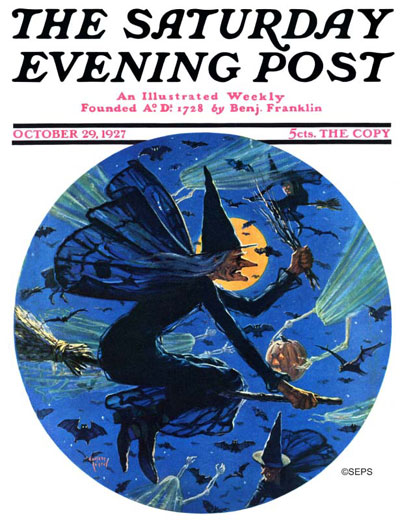
October 29, 1927
This classic cover captures the joy stemming from the first pumpkin lighting. Our only concern? The flammability of his costume.
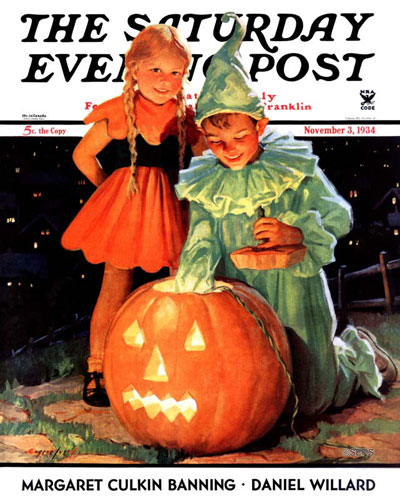
November 3, 1934
“Boo!” No one would ever guess there’s a curly-haired, doe-eyed girl behind the mask.
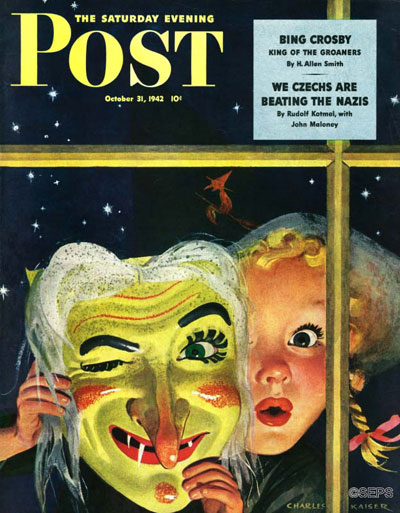
October 31, 1942
No need to fear this warty witch—looks like the chilly October air may put an end to her Halloween plans.
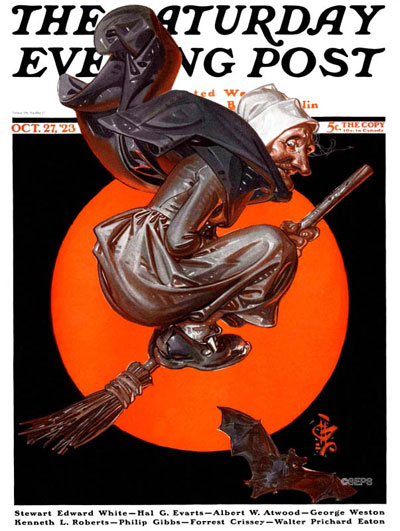
October 27, 1923
A jack-o’-lantern fit for a king—served only on the finest silver platter, of course.
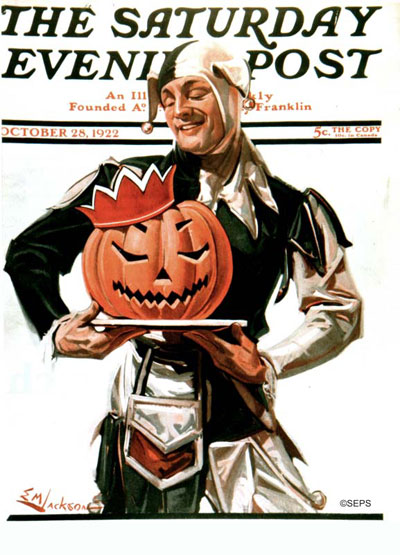
October 28, 1922
Bringing home the biggest pumpkin seems like a good idea, but the work of slugging it home might prove too much for this orange-cheeked young man.
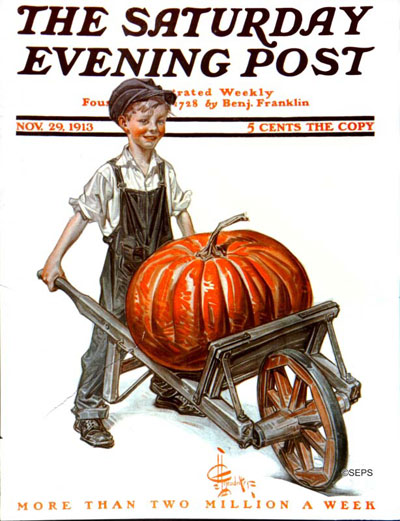
November 29, 1913
The young lady on this Ellen Pyle cover can’t help but wonder why these two are always clownin’ around.
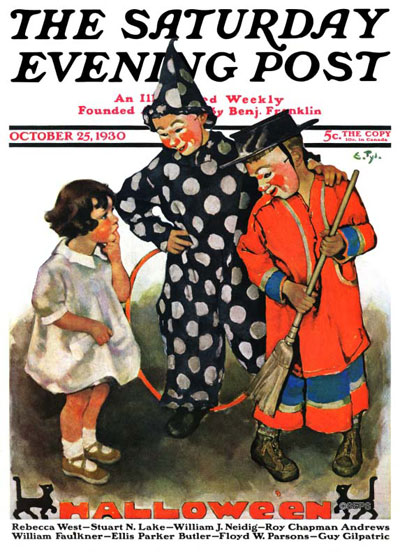
October 25, 1930
There’s always one neighbor who emphasizes the trick in trick-or-treating.
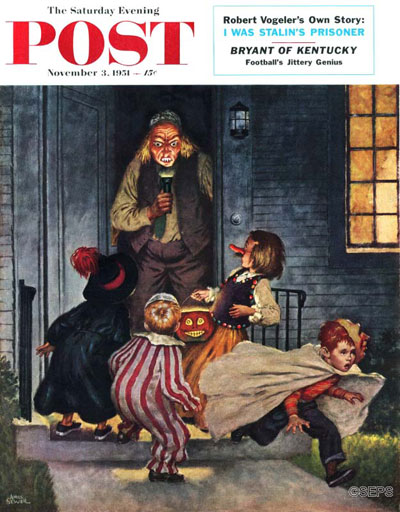
November 3, 1951
Halloween lesson no. 1: A bathrobe, baggy sport coat, or pillowcase is suitable costume wear when coupled with a homemade mask.
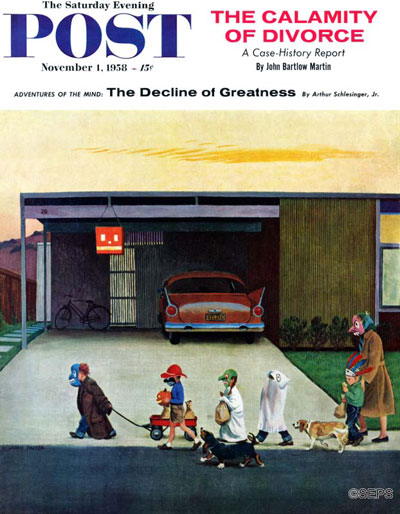
November 1, 1958
Just Beachy
Celebrate a century of beachgoing with these sun-sational covers. You might have sand in your shoes for a week afterward, but that’s a small price to pay.
For guys and gals alike, sharp style is a must to complement even the most radiant bronzed glow.
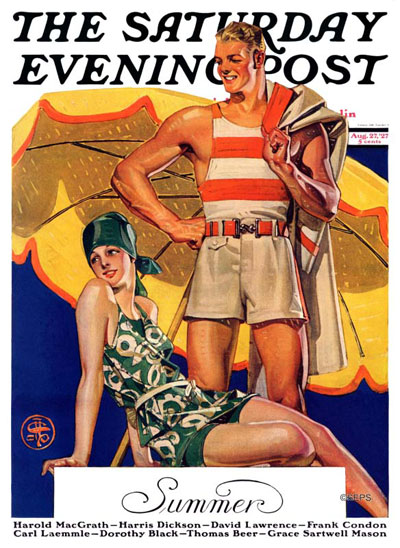
August 27, 1927
Armed with trusty life preserver, the guard holds court over his sun-toasted subjects with all the regality of a king and twice the jawline.
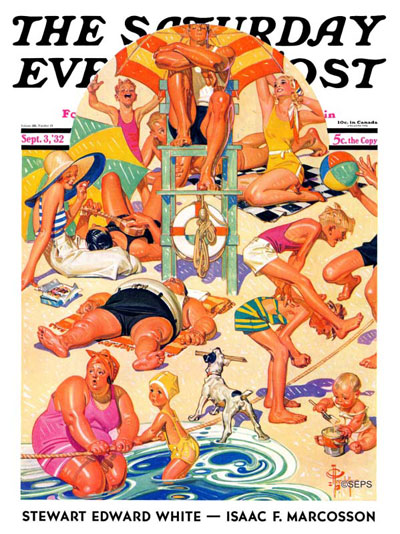
September 3, 1932
Et tu, ice cream? Getting lost in a spiraling forest of umbrellas isn’t especially ideal when you’ve got cool treats on hand rapidly turning to Neapolitan soup.
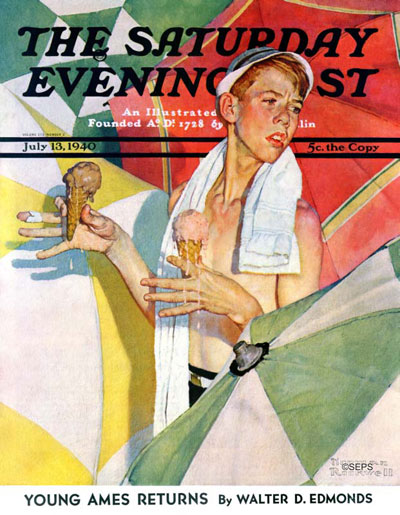
July 13, 1940
A prayer for some cloud cover might be in order if this ghostly couple wants to remain distinguishable from overcooked lobsters by day’s end.
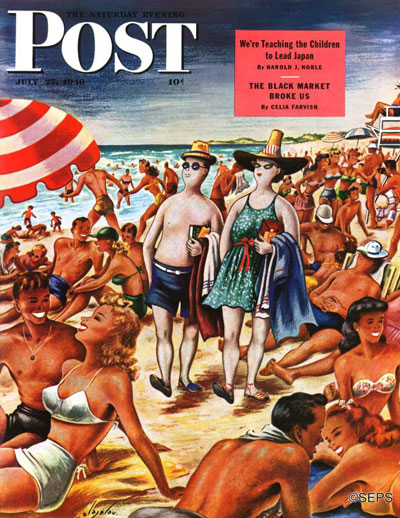
July 27, 1946
The tugboat may capsize when the tide arrives, but for one new to the sights and smells of the seaside, witnessing the frothy waves curl into the sand probably beats just about any plastic trinket.
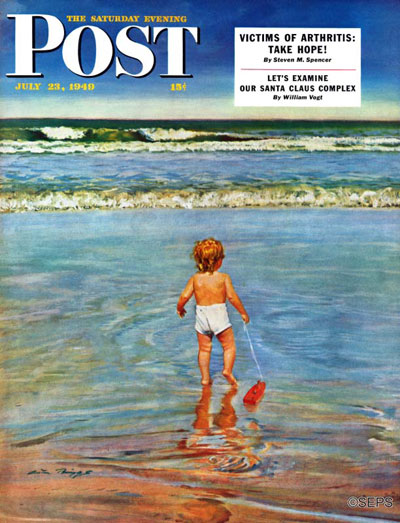
July 23, 1949
With Mom preoccupied, this baby can pick up a few early glamour lessons, though it would appear she hasn’t quite mastered coloring inside the lines.
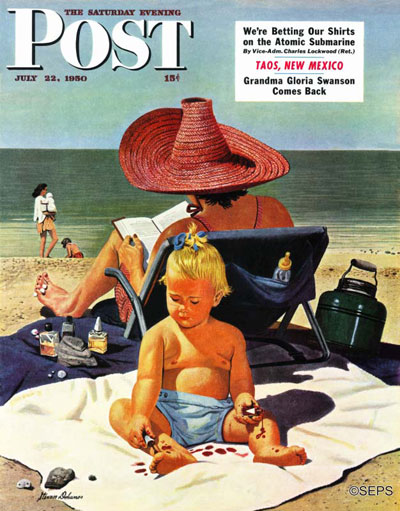
July 22, 1950
So much for fun in the sun. If the obsidian cloudbursts weren’t enough, a few peals of lightning are good reason to send sunbathers and picnickers packing.
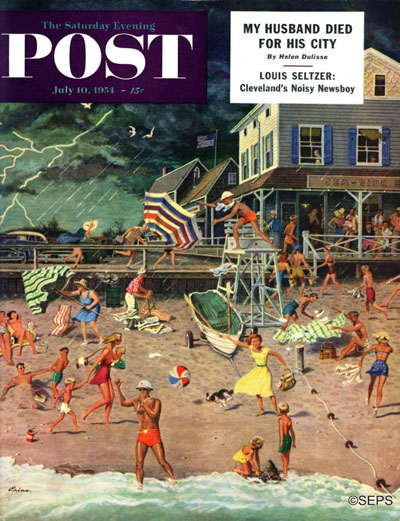
July 10, 1954
Who says you can’t mix work and play? Sipping a soda and rocking a bonnet-clad tot, this babysitter just might perfect the art of multitasking as long as that begrudging chef doesn’t boil the milk.
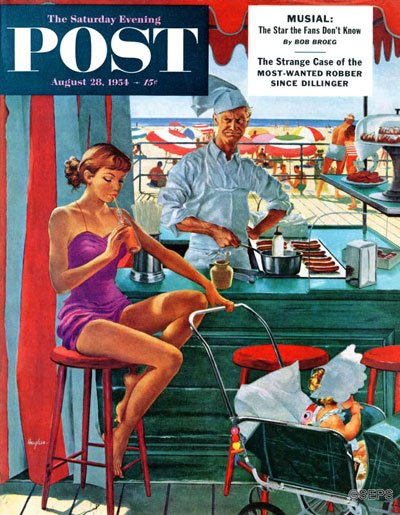
August 28, 1954
There’s plenty of fish in the sea, but the odds of this fellow catching one bigger than a guppy might be doubtful, especially with a snickering chorus of freckled critics present.
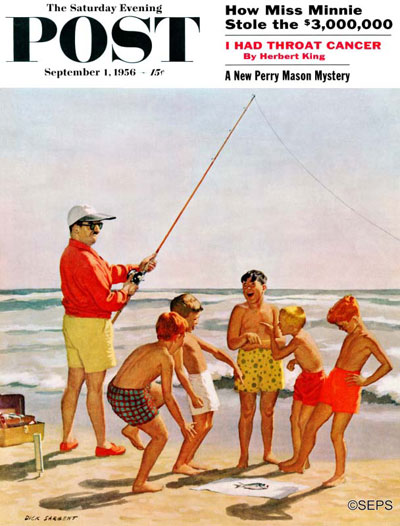
September 1, 1956
Even with enough lotion globbed on to withstand most natural disasters, some are just bound to flake under the harsh afternoon rays. Of course, where some see searing obstacles, others see opportunities to pick up a glorious golden sheen.
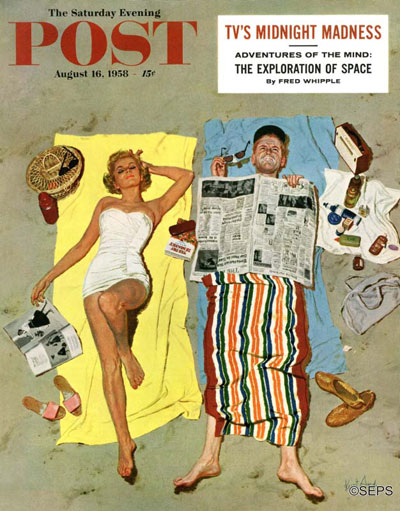
September 16, 1958
Forget frolicking in the surf when there’s romantic comedy of this caliber to be had.
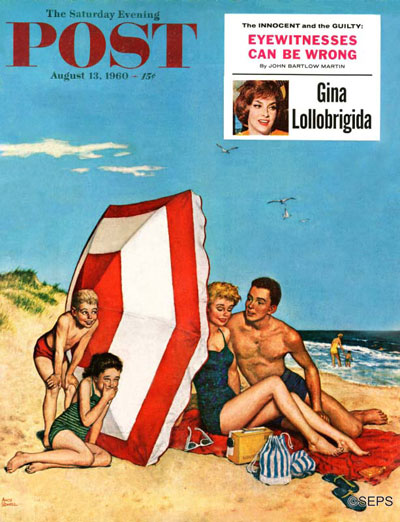
August 13, 1960
Perhaps auditioning for the Polar Bear Club under the disgruntled gaze of that swaddled lifeguard, this brave swimmer can have the entire shore to himself, as long as he doesn’t mind a touch of hypothermia. Like age, temperature is just a number.
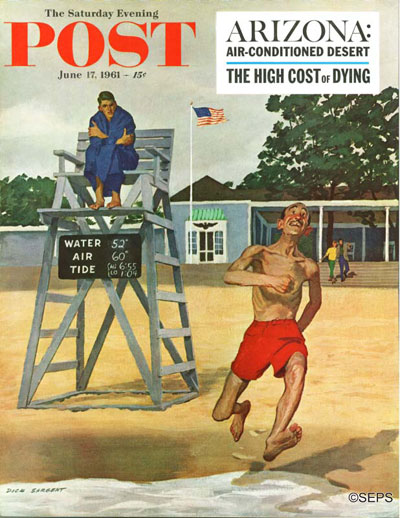
June 17, 1961
J.C. Leyendecker

While those familiar with The Saturday Evening Post often think of Norman Rockwell as its most prominent illustrator, his mentor, Joseph Christian Leyendecker, made the Post an iconic magazine. Through his illustrious career as a popular cover artist, The Post rang in the early twentieth century with dozens of J.C. Leyendecker’s babies, advertisements, and holiday illustrations.
Born to Peter and Elizabeth Leyendecker in Montabaur, Germany on March 23, 1874, “J.C.” Leyendecker emigrated from Germany to Chicago, Illinois with his family in 1882 at the age of 8. His close relationships with his two brothers, Francis Xavier and Adolph, along with sister Mary Augusta, would later impact the adorable infant and adolescent depictions of his most famous illustrations.
Having a natural talent for art, Leyendecker and his brother, Frank, studied and worked together on small projects wherever they could find them. At the age of 15, Leyendecker apprenticed with J. Manz & Co. Engraving in Chicago. He learned quickly, rising to a job as Associate Illustrator under his Chicago Art Institute instructor, John Henry Vanderpool. Vanderpool had studied, researched, and even published a book on human anatomy, passing on to Leyendecker much of what artistic anatomical knowledge was available at the time.
By age 19, Manz & Co. had given Leyendecker a solo contract to illustrate sixty images for a client’s private bible, demonstrating utmost faith in his artistic abilities. In early 1896, the artist won a magazine cover competition for Century Magazine, which elevated his artistic brand to national fame. By autumn, J.C. and his brother Frank had enrolled at the Académie Julian in Paris, France. J.C. Leyendecker quickly rose to prominence while in Europe, earning a spot in a major painting exhibition at The Salon Champs de Mars in 1897. The brothers returned to Chicago in 1898 and together opened a studio for two years before moving their firm to New York City in 1900.
Over the course of his artistic career, Leyendecker completed 322 illustrations for The Saturday Evening Post and countless others for magazines such as The American Weekly, Success, and Collier’s. Not only did the artist work for magazines, he also created some of the most successful advertising campaigns in American history.
His ingenuity led to serial popularity, whether by the continuation of his New Year’s Baby theme for The Post as started in the magazine’s December 29, 1906, edition, or his invention of the debonair Arrow Collar Man while working for Cluett, Peabody & Co. in 1905. His work for Arrow Collar single-handedly increased the company’s sales to $32 million a year, making it the nation’s most successful men’s clothing company.
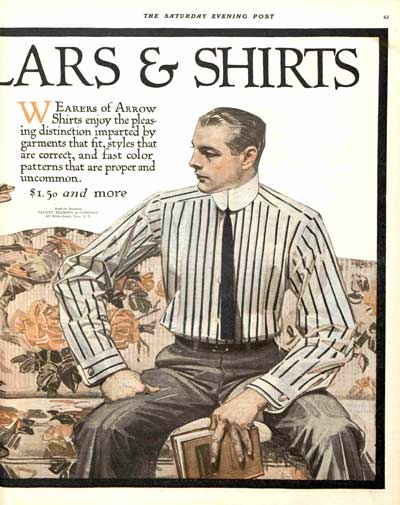
Leyendecker’s strong models defined manhood for an entire generation. His artistic reach knew no bounds. His famed illustrative depictions range from calendar holidays to collectable artwork of cherubim babies, relatable American life, and sports and war heroes. In some ways, Leyendecker happened to be a trained artist in the right place, at the right time. His work brought him financial success and international notoriety during the golden age of American illustration.
In 1914, he built a home in New Rochelle, New York where he lived with his brother Frank, sister Mary, and the original Arrow Collar model Charles A. Beach. Beach lived in the house as Leyendecker’s live-in secretary, business manager, and partner. J.C.’s brother Frank eventually moved out of the house in the early 1920s (possibly due to jealousy over his brother’s fame) and died of an overdose in 1924. Leyendecker’s popularity and financial success not only survived, but thrived during The Great Depression and World War II era.
By 1945, editorial changes at The Saturday Evening Post cut his once unbreakable relationship with the magazine. He had spent much of his earned income and returned to shopping his illustrations during the pre-eminent rise of photography.
Leyendecker lived a solitary life, keeping his family and friends close. He was never a recluse, yet shied away from public engagement. His home in New Rochelle was once known for boisterous and enjoyable parties. The grounds contained a large garden complex complete with roaming chickens and ducks where artists could trade ideas and discuss technique.
J.C. Leyendecker outlived many of his friends and, by the time he died of a heart attack in 1951, had only five individuals attend his funeral. Norman Rockwell and three of Leyendecker’s favorite male models acted as pallbearers. Leyendecker had faced some financial struggles toward the end of his life when the popularity of periodicals and illustrated covers declined. He still managed to leave a sizeable inheritance of $60,400 to his sister and 49-year live-in partner, Charles Beach. They, now famously, sold many of his life’s works in a yard sale in the gardens of the New Rochelle house for as little as $75 a piece.
Thus went the works of one of “the most popular illustrator in America,” the mentor to Norman Rockwell. Since his death, Leyendecker’s works have been rediscovered and purchased publicly and privately. In 1977, Leyendecker was deservedly added to the Society of Illustrator’s Hall of Fame. As for where his works have ended up, the Haggin Museum in Stockton, California, now holds more than 50 of his original works and continues to collect new finds.
Covers by J.C. Leyendecker
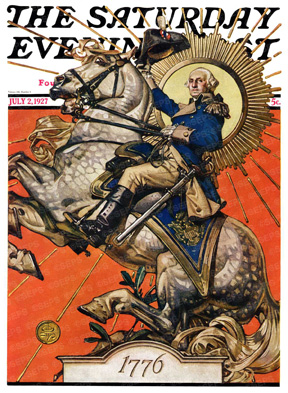
George Washington on Horseback
J.C. Leyendecker
July 2, 1927
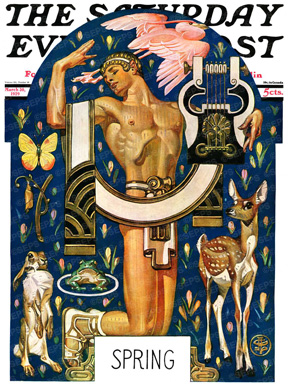
Spring 1929
J.C. Leyendecker
March 30, 1929
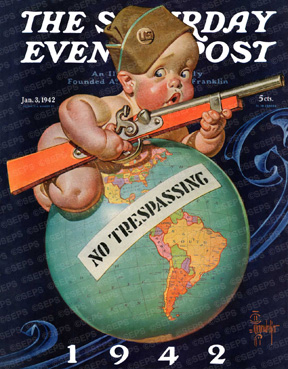
No Trespassing
J.C. Leyendecker
January 3, 1942
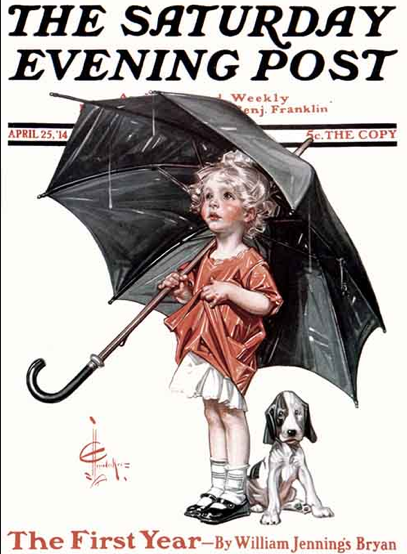
Beyond the Canvas: April Showers by J.C. Leyendecker
Click here to purchase artwork from J.C. Leyendecker.
Click here to license this and other covers from J.C. Leyendecker.
J.C. Leyendecker’s illustrations of infants and toddlers are renowned both for ringing in the New Year and as cherubic annunciations of calendar holidays.
His April 25th, 1914 cover, April Showers, takes a unique perspective on an unappreciated time of the year. This illustration celebrates the pseudo-holiday of seasonal change itself, from the dead of Christmas winter to the blossoming rebirth of Easter spring.
The artistic composition is simple, recycling the same white, canvassed background of so many other Leyendecker covers. Negative white space contrasts the cover’s dark font and the black umbrella. The girl’s black and white socks and shoes, along with the synonymous fur pattern of the loyal pup by her feet, replicate the cover’s lighting contrast.
The black-white color scheme is important to the overall composition of the work and to the story told in illustration. Black and white dogs are actually the most common canines in all of western art history. They are the symbols of Dominican Friars who wear black and white robes. The founder of their order, St. Dominic, found his way into the clergy after witnessing a harsh Spanish famine due to lack of rain. From as far back as the medieval era, the black and white dog has represented fidelity to God in images of Dominican saints and martyrs staring up at the heavens. The dog is an old Dominican biblical pun of Dominicanus, combining the Latin name of their Dominican order and “Domini-Canes,” or their nickname, “God’s dogs,” in Latin.
This issue, published the week after Easter, holds an important message about the power of spring, rebirth, and blossoming from the dead of winter. The innocence of the cherub-like child standing with her pup, looking to the sky and pondering the life-giving rains of spring, could easily awake heavenly questions.
The toddler stands out in her red dress. Her pale skin, rosy cheeks, and pure white undergarments barely distinguishable from the background embellish her childhood innocence. The umbrella too big, the girl too small, our infant merely wears the umbrella on her shoulder rather than hold it firmly by the Christian symbol of the shepherd’s crook handle.
Without the artist’s inclusion of rain, we viewers would be left out in the cold, out of seasonal context. Rather than illustrate rain in the work’s white, negative space, Leyendecker purposefully depicts droplets running off the umbrella’s edge. The glassy teardrops fall in front of the black backdrop of fabric, illuminating the objects that so transfix the eyes of a child.
The image in its entirety is bold, so bold that it’s allowed to partially cover the staple text indicating the Post’s lineage, leaving only “enj. Franklin” to express our publication’s pre-American foundations. A simple message permeates this cover; while we may dread the drench of April showers, and shield ourselves from the deluge, we ought to take a moment to appreciate the season’s arrival. Each spring in a new year is a singular experience for celebration, complete with new life, a new holiday, and new moments for reflection.