John Sheridan
American illustrator John “Jack” E. Sheridan(1880-1948) was a Midwesterner born in Tomah, Wisconsin, whose interests in art flourished during his college years at Georgetown University in Washington, D.C. He produced sports posters for the school to pay for his education and even provided posters to the school’s athletics programs after he became a successful artist. The reprints, still popular among Georgetown alums, are sold at the university today and the original prints are part of the Special Collections Department of the school’s main library. As was common at the turn of the century, Sheridan left school before earning a degree when he accepted a job offer in New York City in 1900.
Covers by John Sheridan
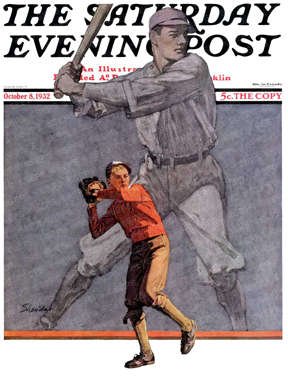
Shadow Batter
John Sheridan
October 8, 1932
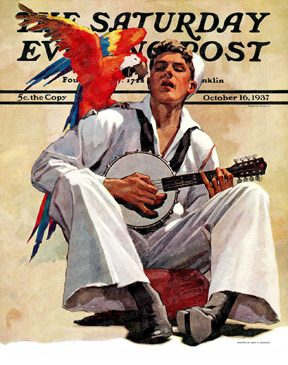
Singing Sailor and Parrot
John Sheridan
October 16, 1937
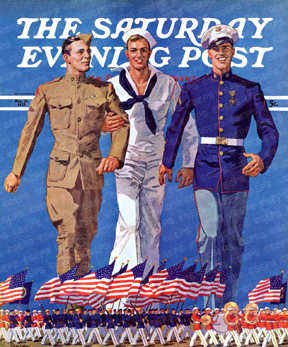
Army, Navy & Marines
John Sheridan
November 13, 1937
Purchase prints of John Sheridan’s work at Art.com.
His natural artistic talents served him well at the Manhattan office of Chicago-based clothier Hart Schaffner & Marx where he created advertisements, posters, and catalogs. He later worked for the Bosch Magneto Company. During this time, Sheridan gained much needed professional work experience before he returned to Washington, D.C., as art director for The Washington Times.
During World War I, Sheridan served on an art committee for the Federal Committee of Public Information. The art committee’s famed chairman, Charles Dana Gibson, recommended Sheridan for the position. Sheridan developed lifelong friendships while creating war posters that advertised recruitment and aid programs. One of their colleagues on the committee was James Flagg, inventor of the iconic Uncle Sam.
After completing his stint at the Times, Sheridan accepted a job editing art on the West Coast and helped produce the Sunday paper layout for The San Francisco Chronicle. While working in California, Sheridan met his future wife, Louise.
When the two married, Sheridan decided to return to academia to improve his artistic composition and technique. The couple moved to Paris, France. They lived the starving artist lifestyle for a year while Sheridan studied at the Académie Colarossi.
Upon his return from Europe, Sheridan opened a studio in Manhattan at 27 West 67th Street. He focused on producing cover art and inside illustrations for popular magazines. His first cover was for Sunset Magazine. His reputation grew. Soon he was providing cover art for The Saturday Evening Post, Collier’s, The American Magazine, and Ladies’ Home Journal.
Sheridan’s 14 covers for The Saturday Evening Post ran from 1918 to 1939. The covers are mostly sports related. The artist chose to focus on the greatness of American institutions such as baseball and the military. He also exhibited his work privately in galleries on the East Coast in New York and Philadelphia.
The artist’s style became less and less popular on the cover as other Post artists gained national recognition. Toward the end of his career, Sheridan accepted a teaching position in New York City at the Cartoonist’s and Illustrator’s School, also known as the School of Visual Arts.
The arts community in New York City adored Sheridan. He was a member of the Society of Illustrators, the Dutch Treat Club, and the Players Club. The Players Club allowed Sheridan the opportunity to act alongside many of his contemporaries including John LaGatta, James Flagg, Jefferson Machamer, and Clarence Kelland.
Today, John Sheridan is remembered for his era-defining portrayals of sports and the U.S. military. Sheridan lived a long and fulfilling life passionately employed in his career. He died on July 3, 1948 at the age of 68.
Benjamin Kimberly Prins
Benjamin Kimberly Prins’ covers for The Saturday Evening Post showed an innocent America, often on the cusp of peril. In opposition to Norman Rockwell’s ideal America, Prins tended to focus on catastrophes, troubles, storms, awkward run-ins, problems, and dilemmas facing Americans of the day.
Born in Leiden, Holland in 1902, Prins’ family had made its way to America by the time the young artist was ready to attend fine arts schools in New York City. Prins devoted himself to his instruction in the arts, completing many academic programs before beginning his career as a working artist.
Prins attended the Pratt Institute’s School of Art and Design, The New York School of Fine Arts, The Art Student’s League, and The Grand Central School of Art. Prins studied carefully under the tutelage of fine arts mentors George Bridgman and Dean Cornwell.
Covers by Benjamin Kimberly Prins
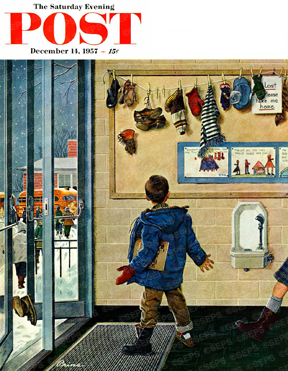
Lost His Mitten
Benjamin Prins
December 14, 1957
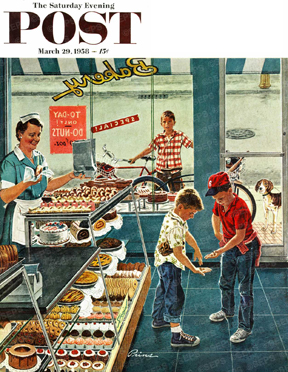
Doughnuts for Loose Change
Benjamin Prins
March 29, 1958
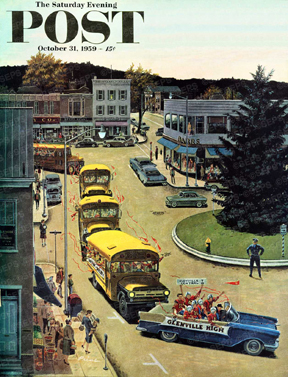
Glenville High Boosters
Benjamin Prins
October 31, 1959
Buy prints of Benjamin Kimberly Prins’ work at Art.com
After having completed his studies and finding work as an artist in New York City advertising, Ben Prins moved to the artists’ community of Wilton, Connecticut. He spent his entire career working and commuting from Wilton, enjoying the countryside outside of the urban sprawl of the city’s five major boroughs.
The artist eventually worked his way up the American corporate advertising ladder to run the art departments of some of America’s greatest advertising firms. From 1939-1945, in the middle years of his long career in corporate advertising, Prins spent 6 years as the Art Director at BBDO (Batton, Barton, Durstine & Osborn) Advertising. Even today, BBDO is one of the most famous and internationally recognized advertising firms based out of New York City with over 15,000 employees at 289 offices in 80 countries.
Prins worked on his private illustrations throughout his career spent in New York City 9:00-5:00 office jobs. His illustrations made the covers of magazines such as McCall’s, Good Housekeeping, Reader’s Digest, and of course, The Saturday Evening Post. The artist completed the majority of his magazine illustrations during the 1950s era of American idealism until the popularity of photography took hold over magazines. Prins completed over 33 cover and inside illustrations for The Saturday Evening Post during this time period.
For his contributions to the art and advertising world, Benjamin Kimberly Prins was inducted into the Society of Illustrators Hall of Fame and granted membership into The Art Director’s Club, both based out of New York City. He passed away at his home in New Canaan, Connecticut in 1980 at the age of 78.
Bavaria for Lovers
My hands are gripped around Jamie’s waist as I ride behind him on the back of a brand-new BMW motorcycle we rented in Munich. For the next five nights we will drive Bavaria’s Romantic Road, a 220-mile scenic route considered a German favorite that very few Americans have heard of, much less seen. Our first stop is the extraordinary Neuschwanstein Castle, on which Disney modeled Sleeping Beauty Castle.
I feel exactly like Sleeping Beauty with Jamie Anthony as my Prince Charming. Two years ago, we met unexpectedly at a blues club in New York City. I was wearing my T-shirt from the Blues Festival in Clarksdale, Mississippi, a festival that Jamie had also attended, so he introduced himself. I was smitten with his Southern accent (he’s from Atlanta) plus he was charming, smart, and attractive. Like me, he’d been divorced twice, thought Internet dating was a waste of time, and loved the blues.
Then he told me he loved riding his motorcycle, and I imagined black leather, silver studs, and tattoos, even though I saw none on his arms. On our third date, he invited me to join him on a motorcycle ride promising that if I didn’t like it, we’d turn around. Outfitted in protective helmets, ballistic jackets, and leather gloves, we left Manhattan bound for Bear Mountain State Park, a lovely wooded outpost just north of the northern New York City suburbs. I expected to hate riding on a motorcycle and was sure I’d want him to turn around after a couple of blocks, but it was exhilarating looking up at the skyscrapers from an entirely new perspective and, further north, watching the boats sail along the Hudson. It was also very sensual being tucked in against his body.
Since then, we’ve done some day trips by motorcycle, but never a weeklong trip in which everything we’re taking has to fit into three small cases attached to the bike. What’s even crazier is that this trip, traveling by motorcycle in a foreign country, was my idea. When I first mentioned the idea of this scenic drive by motorcycle, Jamie broke into a smile as wide as a four-lane highway, and that was it.
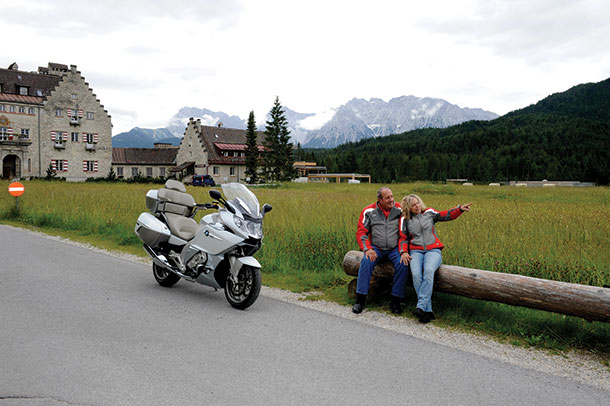
The Romantic Road route was partially based on an old trade route and on the Roman Via Claudia Augusta. During World War II it was called Germany Travel Path No. 1 and used to transport troops and supplies. In 1950, hoping to attract tourists and change its evil reputation, some clever marketing folks considered changing the name to the Romantic Road for Couples Who Fall in Love, then shortened it to the Romantic Road. And that’s exactly what it is, a region of Germany that has existed unchanged for centuries.
On the first day of our ride, a short trip from Füssen to Schwangau, we pass golden hayfields with round bales of hay glittering in the sun and pillowy hillsides laid out like patchwork quilts in every shade of green from emerald to lime. Wildflowers line the roadside, sunlight streams through groves of trees, and we pass herds of sheep and cows and dairies where we inhale the pungent smell of manure — in this context, a fresh and pure odor.
Schwangau is home to King Ludwig II’s 19th-century castle Neuschwanstein, one of the most photographed castles in the world. Ludwig, who was crowned king when he was just 18, was in love with Richard Wagner and created the castle and every room in it to depict the composer’s operas. Unfortunately, Ludwig’s love not only went unrequited, but Wagner married the wife of a famous music conductor, breaking poor Ludwig’s heart.
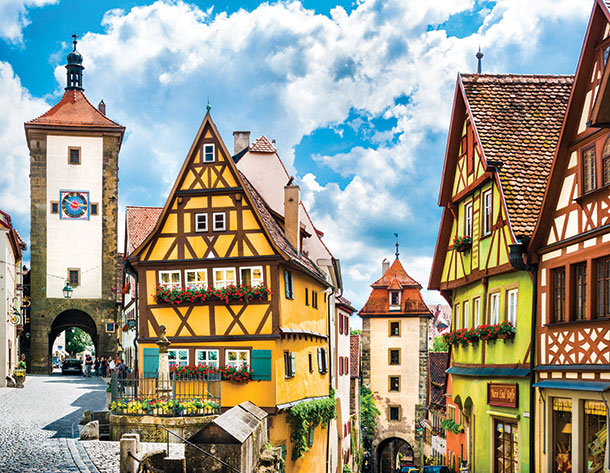
Our love is anything but unrequited, whether we’re walking hand in hand down crooked cobblestone lanes beneath the Alps in 12th-century Füssen, or sharing steaming plates of sausages, which seem to be the primary local fare. There’s bratwurst (pork sausage), weisswurst (white steamed veal or pork sausage), blutwurst (blood sausage), wiener (hotdog), and short and plump Regensburger wurst (boiled sausage with a pork filling). Every dish in Bavaria is served with potatoes or egg noodles and, always, sauerkraut. At one meal, I request a vegetable substitute for the potatoes and the waitress seems puzzled as she says, “But you have vegetable: sauerkraut!” Jamie and I squeeze each other’s knees under the table and try not to burst out laughing.
As we ride along each day, one of my favorite things is the sight of an onion-domed church in the distance, meaning we’re about to arrive in a medieval village where we’ll spend the night. It also means we didn’t get lost, which happens occasionally. Because voices can’t be heard above the sound of the engine, when I see a sign for the correct destination ahead, I stroke Jamie’s shoulder as if to say, “Nice job, sweetie, we made it.” Mostly I communicate by pointing as if to say, “look over there to that beautiful field full of sunflowers or fir tree forest or field polka-dotted with sheep,” just in case he didn’t see it. We’ve also made up our own signs. When I make a closed fist it means stop (usually for a photo), and when I make two closed fists, it means stop, take off your helmet, and kiss me.
The hotels we have chosen are not posh, but they are comfortable and each offers something special. (For suggested lodgings and restaurants along the route, see
saturdayeveningpost.com/romantic-road.) In Füssen, we sit on our private balcony overlooking the lapis-lazuli-colored lake and watch the sun sink behind the Alps; in Augsburg, our room has a heart-shaped bathtub; and in Rothenburg ob der Tauber, we squeeze into the tiny elevator and remain locked in an embrace all the way up to our floor.
Each morning begins with a huge breakfast buffet of eggs, pancakes, bacon, sausages, cold cuts, cereals, yogurts, fresh fruits, rolls, muffins, and — my favorite — pretzel bread. Afterward, we wander the town, following cobblestoned alleyways past medieval walls and houses, into museums as beautiful as the art within, and inside Gothic churches with dazzling frescoes.
By midday we are loading our stuff into the bike’s cases and setting off toward our next destination, none more than 50 miles away. Before this trip, I always thought of driving as simply a way of getting from point A to point B, but here the drives are like a reset button. I don’t have a care in the world, and can think about nothing except enjoying the magnificent scenery with my man.
It’s also fascinating to learn the love stories of Germany’s most romantic cities such as Augsburg, the birthplace of Bertholt Brecht, Hans Holbein, and Mozart’s father, Leopold. It was in Augsburg that Leopold’s son Wolfgang Amadeus Mozart fell in love with his first cousin, but he lost interest. The young Mozart next fell in love with Aloysia Weber from Mannheim, but she rejected him. Mozart wrote to his father, “I can only weep. I have far too sensitive a heart,” and then courted Aloysia’s sister, Constanze, whom he married. At their wedding, the bride, the groom, the priest, and the entire congregation wept.
That evening, Jamie calls to me from the shower. I figure he’s left the shampoo on the sink, but no, he wants me to join him. I don’t think I’ve taken a shower with a guy since I was 30, but I eagerly step in, and we embrace under the running water, giggling like kids. For a brief moment I wonder what would happen if we slipped on the tub floor and one of us broke a hip. Later, we lie contentedly on the bed, listening to the church bells toll the hour.
In Germany, love is so often associated with music, especially along the Romantic Road. When Beethoven was 20, he played viola in the concert hall at Bad Mergentheim, a 14th-century village with a medieval castle. One legend has it that he was supposed to leave for Vienna to meet Mozart, but Beethoven missed the opportunity because he fell in love with a local girl. Beethoven was nearly always in love; one was a 16-year-old countess, a pupil of his, to whom he dedicated the Moonlight Sonata.
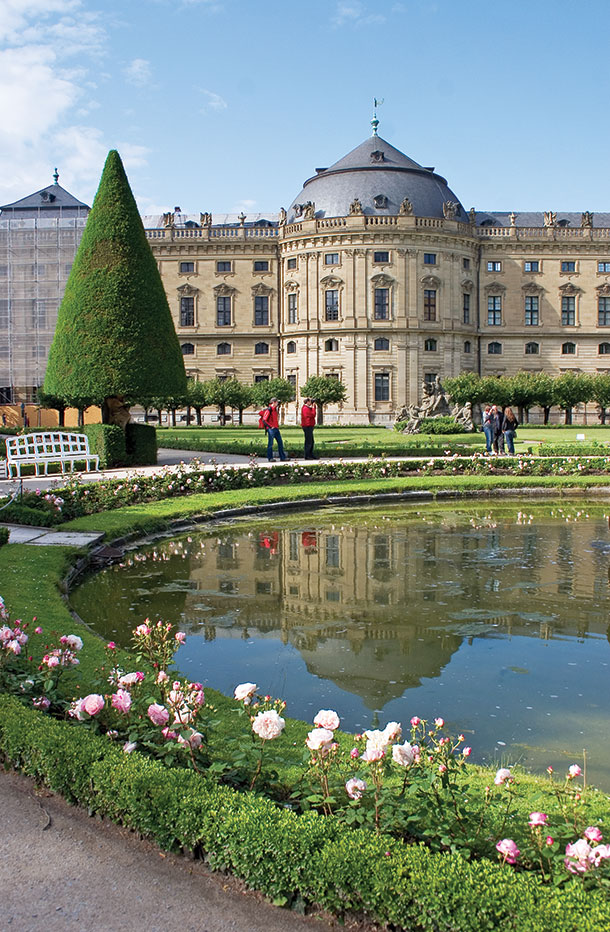
Sharing the moonlight with Jamie on the Main Bridge in Würzburg feels as romantic as any Beethoven sonata. In the middle of the bridge is a small bar where visitors can buy a glass of wine and stand overlooking the river. There, we meet a historian who tells us about Walther von der Vogelweide, a famous 12th- and 13th-century love poet who wandered from court to court, reciting poems in exchange for food and lodging. In 1230 when Von der Vogelweide died, he was buried in Würzburg, leaving instructions that the birds were to be fed daily at his tomb. But instead of birdfeed, lovesick visitors arrive with fresh flowers to leave on his grave. “It is said that when the flowers wilt, lovesick hearts will heal,” the historian tells us and then adds, “In the winter, they bring flowers that last longer.”
Jamie and I look at each other and smile. He squeezes my hand. How lucky I am that I don’t need to leave flowers at the love poet’s grave. And neither does Jamie.
Editor’s Note: Margie and Jamie were engaged in November in Bali and married December 13, 2014.
—
Margie Goldsmith’s “Bavaria for Lovers” won a 2015 North American Travel Journalists Association Silver Prize.
Amos Sewell
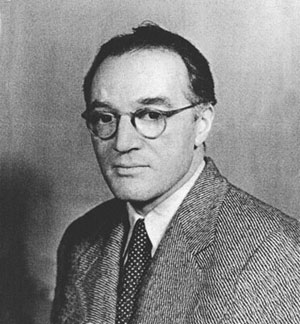
A born Californian from San Francisco, Amos Sewell enjoyed the sun and all the activities warm weather had to offer. In his youth, Sewell was a ranked amateur tennis player (15th in Singles and 9th in Doubles). He was a banker during the day who took art classes for fun. After repeated losses to his champion tennis rival, Donald Budge, he decided to quit the sport. A tennis star throughout the 1920s, Sewell had moved into the world of professional illustration by The Great Depression era of the 1930s.
He began his art education taking eight years worth of night classes at The California School of Fine Arts while working as a banker at Wells Fargo. Sewell worked at the bank from 1916-1930. He always enjoyed art, and often took vacation time to drive up the California coast to paint. It was on one of these trips that Sewell decided to make a career out of his art by moving to New York City.
In 1930, Sewell made the move. To pay his way, he worked a lumber-boat from California to New York down the coast and through the Panama Canal.
Once in New York City, Sewell took more classes at The Art Students League and the Grand Central School of Art. In art school, Amos studied under famed instructors Guy Pene Du Bois and Harvey Dunn. Each of whom became the artist’s entre into the New York City art scene. He also studied privately with Julian Levi at his studio in Easthampton, Long Island after having completed his formal schooling.
In 1932, he married his sweetheart, Ruth Allen. The two never had any children. Though a talented artist, Sewell complained that work was hard to find in the worst years of the Great Depression, specifically 1933 and 1934. He spent his days practicing illustration when there was no work to be done. Soon that period ended, however, and the experience of practice had prepared him to shine as a masterful illustrator.
One of the few financially stable working artists of the early to mid-twentieth century, Sewell kept up his passion for tennis as a hobby. His last documented tournament victory was the 1934 Cup for Westchester County, New York.
Quickly, Sewell began receiving regular work from advertising agencies and magazines around the city. All the incoming work provided a better quality of life. Eventually, he and his wife chose to move from the East Village of Manhattan to the artist’s colony in Westport, Connecticut. During World War II, he won an art award for creating the nation’s best war bond illustrations.
Amos Sewell’s successful career led him to produce covers and illustrations for The Saturday Evening Post, Woman’s Day, Good Housekeeping, Redbook, True, Today’s Woman, Coronet, Liberty, and Country Gentleman. He illustrated for Street & Smith detective “pulp” stories, and a novel, MacKinley Kantor’s “Valedictory.” He was privately contracted to illustrate for large national advertising accounts, but admitted that he had to give those up to focus on his added workload from The Post.
Though Sewell had no children of his own, the artist idealized childhood. He often chose to depict its innocence with empathic images of children playing or unknowingly making mistakes.
Amos and Ruth lived out a quiet life in Westport, Connecticut until Amos’s death in October of 1983 at the age of 82. Today, Sewell is remembered as one of The Saturday Evening Post’s best artist-illustrators.
Covers by Amos Sewell
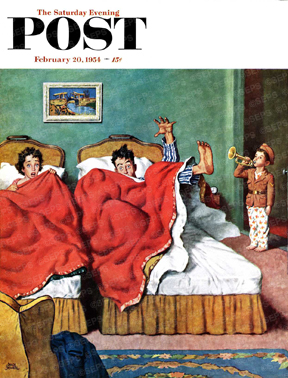
Parents’ Reveille
Amos Sewell
February 20, 1954
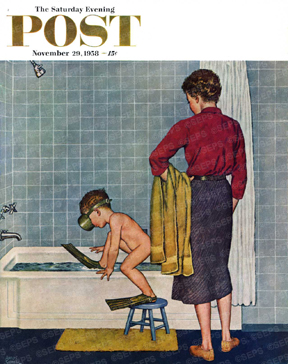
Scuba in the Tub
Amos Sewell
November 29, 1958
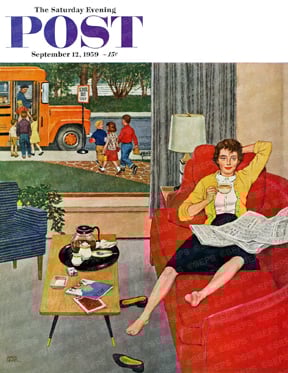
Morning Coffee Break
Amos Sewell
September 12, 1959
Foreign Customs on New Year’s Eve
For the past dozen years, our family has welcomed the new year at our friends’ house. They belong to the Quaker meeting that I pastor, and are on their best behavior. I’d hate to think what would happen if I weren’t there to keep things under control. We cheat at board games, watch old episodes of Johnny Carson, play ping-pong, discretely gossip about people who aren’t there, and overeat. At the stroke of midnight, we blow horns, throw confetti on one another, then leave before we’re pressed into service to clean up the mess we’ve made.
When our children were small, we stayed home and slept through that golden moment. We would stir at midnight when the teenagers next door set off firecrackers, then fall back to sleep. When our children went to school and discovered their friends stayed up past midnight, the going to bed early stopped, and we had to look around for somewhere to go. Several churches in our town have New Year’s Eve parties, but that felt too much like work. If I were a mechanic, I wouldn’t want to welcome the new year underneath a car. We were looking for something mildly decadent, but not so naughty it would get me fired, so we jumped at the chance to attend our friends’ party, throw confetti, gossip, and toss back a stiff apple cider at the appointed hour.
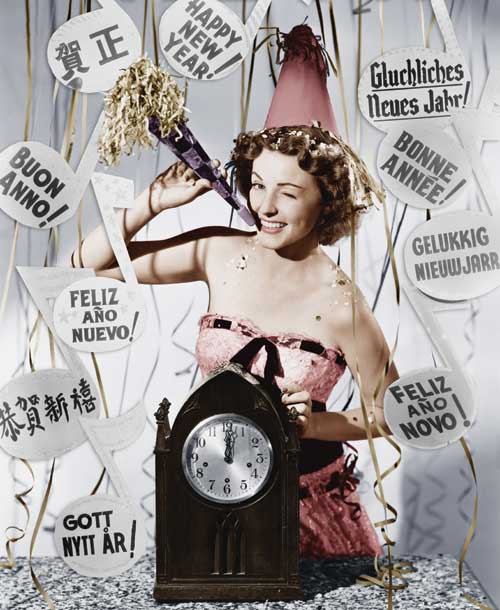
I assumed most people in the world celebrated the new year the way Americans do, but they don’t. In Belgium, children write nice letters to their parents and read them aloud. I don’t know who started that practice, but I bet it wasn’t a kid. That sounds like an adult’s idea. People in France give presents to one another. A kid dreamed up that custom; I guarantee it. In Germany, people drop a lump of hot lead into cold water to see what shape it makes. They believe the resulting shape reveals their future. For instance, if the lead assumes the shape of a bullet, it means someone is going to shoot you. But if the chunk of lead looks like France or Poland, it means you’ll be invaded by Germans. I could never live in India, where on New Year’s Eve they’re expected to finish any uncompleted work. My life is a train of unfinished tasks, one railcar after another of half-finished efforts, with no caboose in sight.
Hungarians make effigies called “Jack Straws,” then burn them at midnight. The effigies symbolize everything bad that happened the previous year, so burning them wipes the slate clean. Theoretically, it’s supposed to bring them good luck in the upcoming year, though it never does since they always have to make effigies the next New Year’s Eve. If you have to continually repeat a tradition meant to ensure good luck, it means it doesn’t work.
In Scotland they clean their homes. My father’s family is from Scotland, but I must be adopted because I wouldn’t dream of cleaning my house on New Year’s Eve. I think my birth parents were from Australia, where they welcome the new year camping on the beach.
This is our first New Year’s with the kids grown and gone. People arch their eyebrows and say, “Oh, you can finally whoop it up.” But Quakers aren’t known for their whooping. We’re good for a whoop or two, then settle down pretty quickly.
When I was little, I would take a bath, put on my pajamas, lie on the living room floor with my brothers and sister, and watch Guy Lombardo at the Waldorf Astoria Hotel in New York City. My dad would light a fire in the fireplace, and my mom would make popcorn. We were each allowed one bottle of Coke. The glass ball would drop in Times Square. Mr. New Year’s Eve, Guy Lombardo himself, would pick up his baton and the Royal Canadians would swing into action with Auld Lang Syne. My father would grow misty-eyed.
“If we were still in Scotland,” he would say, “we’d be cleaning the house right now.”
Warehouse Chic
Around the country, gritty industrialization is giving way to industrial chic as derelict warehouse districts are being revitalized into thriving art enclaves. These aren’t just hipster hangouts of vegan food trucks and green markets. They’re areas that have undergone a process known in urban planning circles as adaptive reuse. The idea being that structurally sound and historically significant buildings are reclaimed, repurposed, and reborn as the linchpins of creative new zones of commerce and tourism. Credit usually goes to young folks and artists who are drawn to these regions by the low cost of housing. Then, as the districts gain critical mass, preservationists, developers, and urban planners take notice, and previously forlorn neighborhoods evolve into places worth visiting. Art is often still the economic driver, but food and lodging tend to be cutting edge as well. Here are seven once-shunned areas now enjoying architectural and cultural renaissance.
Los Angeles’ Arts District
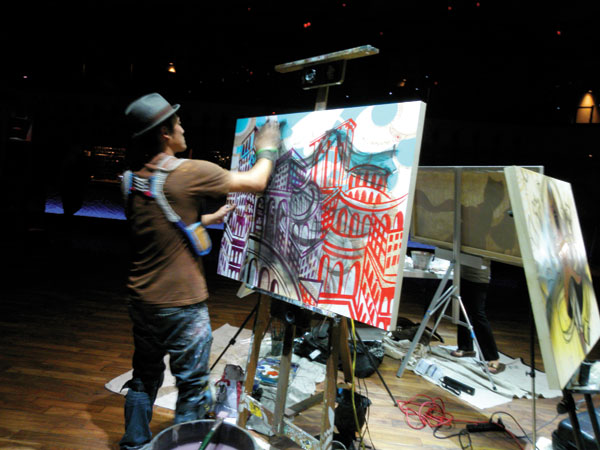
When you spot graffiti-covered walls and giant outdoor murals, you know the Los Angeles Arts District is in your line of sight. This neighborhood of aging warehouses, food-processing plants, and low-rise manufacturing facilities on downtown’s eastern fringe gained traction with artists who unofficially moved into vacant buildings in the late 1970s. The city eventually gave its stamp of approval on these live/work spaces when it passed an Artist in Residence ordinance in 1981.
The billboards on display are the antithesis of the corporate kind you see along the highway. They’re a robust collection of street-art murals including some by Europe’s elite artists: Banksy (England), JR (France), and Aryz (Spain).
As America’s entertainment capital, LA is the place artists from around the globe want to be seen. A few blocks west of where the artists live is where many of their works are displayed in the Historic Core neighborhood. In a city of automobiles, locals joke, the BMW stops here. Only in this area will you see 40,000 Angelenos get out of their cars and talk to each other face to face.
When to go: Second Thursdays of every month for the Downtown LA Art Walk.
Where to eat: Bäco Mercat, a small-plate favorite. Try one of the stuffed flatbread sandwiches with a glass of custom-made tamarind and mango pop. (408 S. Main Street; 213-687-8808; bacomercat.com)
Where to stay: AirBnB is the place to experience life in a true downtown loft for less than the cost of a hotel. (airbnb.com)
Don’t miss … a nightcap at The Varnish. Head for an unmarked door at the back of Cole’s restaurant for a vintage cocktail at this speakeasy-style watering hole (118 E. Sixth Street; 213-622-9999; 213nightlife.com/thevarnish)