News of the Week: Maher’s Remarks, Murray’s Christmas, and a Memento Remake Nobody Asked For
Stephen Colbert vs. Bill Maher
You ever watch an interview on TV that makes you squirm a little bit? I don’t mean on the cable news networks, where arguments can sprout like mold on an old bagel. I mean on a show where you don’t expect to see something uncomfortable. You’re looking for laughs and skits and music and you get a serious discussion.
That’s what happened on The Late Show with Stephen Colbert on Monday. Colbert had Real Time host Bill Maher on his show, and along with the laughs there was a sense of realistic tension too. And this wasn’t one of those fake things, like when David Letterman conducted that weird interview with Joaquin Phoenix that turned out to be a prank. This was a nuanced, realistic kind of tension. Here’s the entire interview, including footage not shown on TV because of time restraints:
It starts amiably enough, but then about two minutes in Maher makes a comment about Nixon being the type of person Colbert would have voted for, and it’s odd from there. Though Colbert remains amiable enough throughout the entire interview, and it’s not the type of wall-to-wall tension where you think they hate each other, you can see Colbert disagrees with Maher on a few things, including religion. It’s almost as if you can look inside Maher’s brain and see he’s thinking, “But Stephen, you’re liberal! How can you believe in God and be serious about religion?!” You can also see that Maher wasn’t particularly thrilled when, at the very end of the interview, Colbert takes over the bit and Maher doesn’t get to finish his joke.
The interview has a lot more bleeps than you’ll usually see on television. But isn’t it interesting that Colbert’s Comedy Central show moved over to CBS largely intact? There’s a lot more political humor and serious discussion of current events than I thought would happen when Colbert took over for Letterman, and when you have that you get nights like this.
By the way, at the start of this episode, Colbert’s band, Jon Batiste and Stay Human, performed the French National Anthem as a tribute to France and the people lost in the terror attacks last week (and we send our thoughts out to the victims and their families as well):
A Very Murray Christmas
Netflix has released the trailer for their new Bill Murray holiday special A Very Murray Christmas, which debuts on December 4. It features a cast list that can only be described as “irreverently epic”: George Clooney, Amy Poehler, Jason Schwartzman, Miley Cyrus, Rashida Jones, Michael Cera, Paul Shaffer, Chris Rock, and Maya Rudolph. How is Tina Fey not in this?
Judging from the trailer, A Very Murray Christmas serves as both the title and also a description of what the special will be like:
These Are a Few of Oprah’s Favorite Things
Every year Oprah Winfrey gives us her list of Favorite Things. This year she’s teaming up with Amazon.
I won’t list of all of the things that she likes that most of us wouldn’t want to spend money on (Okay, I’ll mention one — the rose gold iPhone 6s for $839.00), but there are some nice gifts here, including some that, oh, I don’t know, you might want to buy for a Saturday Evening Post columnist. I mean, who wouldn’t want an Elvis cake?
And This Is One of My Favorite Things
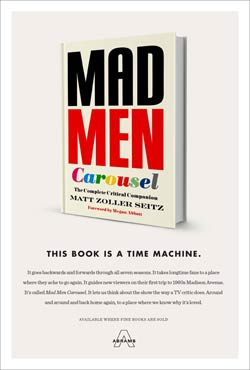
TV criticism — and I can say this because I’ve been doing it for 21 years — is often terrible. The writing is terrible, the observations are weak or obvious, and if you read enough of it you realize that just because there’s more of it doesn’t mean it’s better (we’re currently drowning in TV reviews and “hot takes”). But when TV criticism is done right, when it’s done by a good writer who not only loves television but can write about it with a mixture of wit and thoughtfulness, it can not only be important, it can rise to the level of art.
And that’s what you’ll find in the new book Mad Men Carousel by Vulture writer and RogerEbert.com editor Matt Zoller Seitz. Matt’s one of the best critics around today, and this book is filled with his perceptive, detailed reviews of every single episode of the show, along with a historical time line of things mentioned throughout the show’s run, poems by Martha Orton at the start of each season, and some great illustrations by Max Dalton.
This book is not only the perfect gift for the Mad Men fan on your Christmas list, I think that Lionsgate and Abrams Books should make some deal to make sure it’s included with every single Mad Men complete series DVD set that is sold.
Wait. Did I mention above that I wanted an Elvis cake? I meant to say the Mad Men complete series DVD set. (And an Elvis cake.)
Christopher Kimball Has Left America’s Test Kitchen
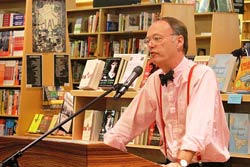

And to drive home the fact that this move is EFFECTIVE IMMEDIATELY, Kimball’s blog is already gone from the America’s Test Kitchen Feed site.
There are plenty of talented cooks on the TV shows, and they’ll probably find a new host that’s “fine,” but it’s going to be very, very weird not to have Kimball as host. He set the tone and the style for the show. You think of the show, and he’s the person on it you think of. You can’t just throw a bow tie on someone else. It just won’t be the same.
Memento Is Being Remade, For Some Reason
You ever notice that books don’t get rewritten? You never see a publishing company issue a press release that says they’ve hired a writer to rewrite A Tale of Two Cities or The Great Gatsby or The Bonfire of the Vanities. Sure, there might be other books in a series featuring the same characters or sequels or prequels or new writers hired to continue a series after an author dies, but you never hear a publishing company say they’re going to remake a novel.
I know I went off on a little tangent there, but it’s just my way of saying that doing a remake of Memento is a really dumb idea.
Thanksgiving Recipes

If you wanted to eat what was served at the first Thanksgiving, you could have clams, venison, mussels, and plums. But it’s 2015 and we have a lot more options than they had in 1621. Besides, try explaining to your family that, hey, this year, instead of turkey, we’re having boiled eel!
If you want a one-stop for all of your Thanksgiving cooking needs, you probably can’t do better than The New York Times’ Thanksgiving headquarters. You’ll not only find recipes there, but also a complete guide on how to plan the day and how to not freak out during that planning. But I’d also add some recipes from The Saturday Evening Post archives, including Red Rice Stuffing with Dried Fruit, a Pumpkin Chocolate Chip Cake with Spiced Glaze, and Spritz Cookies.
You could also be like Marilyn Monroe. Cooking-wise, anyway. Here’s her recipe for stuffing that was found among her personal letters. If the instructions are a little confusing the New York Times made it and lists the ingredients and instructions on their site a little more clearly. Note: There’s no eel in it.
Happy Thanksgiving everybody!
Upcoming Events and Anniversaries
President Kennedy assassinated (November 22, 1963)
There are approximately 3,000 different theories on the assassination, and Newsweek has a terrific, detailed piece on what happened that day.
Boris Karloff born (November 23, 1887)
The voice of The Grinch also made a mean guacamole dip you might want to try this holiday season.
Lee Harvey Oswald killed (November 24, 1963)
Millions of people watched Oswald get shot by Jack Ruby on national television.
Charles Darwin’s On the Origin of Species published (November 24, 1859)
You can read the entire text of the groundbreaking book for free at Literature.org.
National Hockey League is formed (November 26, 1917)
The NHL replaced the NHA, the National Hockey Association.
Thanksgiving (November 26)
You can start the day by watching the Macy’s Thanksgiving Day Parade and the rest of the day watching marathons of your favorite shows.
News of the Week: Facebook, Fake Phones, and Fantasy Island
Beyond the Like

Sometimes a like just isn’t enough.
Facebook users have been asking for a dislike button for a while now. The company isn’t going to give you that, but they are slowly rolling out several new buttons that might just satisfy your need to comment or everything that your friends post without actually typing anything. According to The Atlantic, the new “reaction” buttons are available in Spain and Ireland and will soon be available in the U.S., though no official date has been announced.
How will the new buttons work? When users click on the like button they’ll have more options to show emotion/reaction: a heart, a sad face, an angry face, and a face with an open mouth which is presumably meant to show shock or awe at something posted. OMG that’s the most amazing dessert I’ve ever seen. Thanks for posting it!
Right now when someone posts sad news, like a death, people often “like” it, which has always struck me as a bit odd. The new sad icon might be seen by many as a way to remedy that, to have an option to show that you’re sad about the negative news posted, but is a little icon with a frowny face a good substitute for, you know, emailing or calling that person?
This is yet another example of how, in 20 years or so, people will no longer communicate with each other using words and phrases. It will all be done by clicking buttons and posting emojis. As Facebook founder Mark Zuckerberg himself said in a Facebook Q&A in June, “One day, I believe we’ll be able to send full, rich thoughts to each other directly using technology. You’ll just be able to think of something and your friends will immediately be able to experience it too if you’d like. This would be the ultimate communication technology.”
Yikes.
ZERO: The Smartphone That Does Nothing

I have a dumb phone. That’s a phone that only makes phone calls or maybe might sends texts too (I don’t even use it, it’s sitting on a table collecting dust). It’s not connected to the Web, its main use is to make phone calls (yes, almost a quaint notion in these texting times). But what if you wanted a phone that didn’t even do that much?
You might like the ZERO, a new product from the people at the appropriately named NoPhone. It’s, well, a rectangular piece of plastic. It’s described as a phone that “allows you to stay connected to the real world.” There are several versions of the phone, including the original NoPhone for $10 and the NoPhone ZERO, which only costs $5 (that doesn’t even have the fake button indentations or a logo). Every phone is guaranteed not to come with any apps, no data overages, and no danger of batteries dying.
Maybe this will catch on. Maybe people will want to use this the way that smokers put candy cigarettes or carrots in their mouths to stop smoking. After all, the original version of the phone raised over $18,000 on Kickstarter last year. This could be the 21st-century version of the Pet Rock.
I’m sure people will still keep these things by their side at the dinner table. You know, just in case they get a text.
And in Still More TV Reboot News …

I know that we’ve had a lot of news about remakes of TV shows lately, and I don’t want to turn this into the All TV News column, but this one is worth mentioning. ABC is bringing back the late ’70s and early ’80s drama Fantasy Island (which they already brought back in 1998 with Malcolm McDowell, though no one wants to remember that). But this time there are twists. There’s no island! Instead, it will be a San Francisco corporation that grants clients’ fantasy-related wishes. Also, there’s no Mr. Roarke. This time the leader will be a “brilliant, dynamic, sexy woman,” according to The Hollywood Reporter .
So in the new version, there’s no island, there’s no Mr. Roarke, and the lead character is a woman, and there probably won’t be a small person playing Tattoo, either. Other than that, the new Fantasy Island will be exactly the same.
Internet Killed the Centerfold Star
Now when guys say “I read Playboy for the articles” they won’t be lying.
Playboy has made the decision to stop having nude women in their print magazine. Cory Jones, an editor at the magazine, ran the idea by Hugh Hefner and the 89-year-old founder agreed. There may not be a centerfold, and if there is she won’t be fully nude. It will be more, as The New York Times describes it, “PG-13 … more like the racier sections of Instagram.” The changes will start with the March 2016 issue, introducing part of a major redesign for the magazine that’s been in production since 1953.
As Donald Trump would say, this news is yuuuuuge. This is like McDonald’s deciding to no longer sell burgers. But when you can log on to a million websites any time of day that feature nude women (or so I’ve heard — I haven’t actually had any experience with this myself) why would you walk to the bookstore or newsstand and go through the embarrassing ritual of buying a magazine with nude women in it?
Now the only place that people will be able to see nude women is, well, everywhere else. But maybe this is a good move by the magazine. After all, they really do have some great articles.
Capital One … Cafes?

I went into my bank the other day and was struck by how barren it is. There used to be five or six tellers working at once, several people at desks in the back, and a lot of customers in line. It was a real, vibrant hub of activity. Now I’m amazed if there are two tellers working and more than one or two people in line, and I don’t see many people at those desks. I guess everyone’s banking online or at ATMs, and it’s actually a little sad.
But what if you could go into a bank and not only make a deposit or get a loan, you could also get a large caffé mocha with extra whipped cream, sit in a big comfy chair, and get free Wi-Fi? That’s the idea behind new Capital One 360 locations. Right now there are cafe/banks in Boston, New York, Chicago, Los Angeles, Philadelphia, San Francisco, and St. Cloud, Minnesota. Expect more if it catches on. Hey, why not? We have bookstores that also have cafes so this is a natural.
It’s probably only a matter of time before you can go to Starbucks for coffee but also do your laundry.
October Is National Chili Month

The temps were in the high 60s earlier this week, but now it looks like the cold weather is going to be locked in for the season, and what better way to celebrate than with a big hearty bowl of chili? You can go with a very simple (but delicious) chili, or maybe one that really gets into the spirit of the season by adding pumpkin and turkey. The New York Times has a special chili section, 25 Great Chili Recipes, including Vegetarian Chili with Winter Vegetables, Texas-Style Chili, and even Chinese Chili.
I want to try this Beer Chocolate Chili recipe because hey, beer and chocolate! If I were on Facebook, a heart icon would go right here.
Upcoming Events and Anniversaries
Thomas Edison dies (October 18, 1931)
The Saturday Evening Post Archives Director Jeff Nilsson reflects on Edison’s solution to copyright theft.
Battle of Yorktown ends (October 19, 1781)
It’s sometimes called the Siege of Yorktown, and it was the last major battle of the American Revolution.
Free Speech Week (October 19–25)
This annual event has a great slogan — Free Speech: The Language of America.
Congress begins investigation into Communists in Hollywood (October 20, 1947)
It’s probably not a coincidence that Free Speech Week coincides with the date this investigation started. And don’t forget Trumbo, a film based on the life of blacklisted writer Dalton Trumbo that opens on November 6.
President John F. Kennedy’s televised speech on Cuban Missile Crisis (October 22, 1962)
The speech came after the U.S. found out the Soviet Union had placed nuclear missiles in Cuba.
Johnny Carson born (October 23, 1925)
Original episodes of The Tonight Show will air again on Antenna TV at 11 p.m. starting on January 1.
3 Questions for Dick Cavett

He’s done stints on film, television, and Broadway. But Yale-educated Nebraskan Dick Cavett built his career on the art of conversation with such diverse personalities as Janis Joplin, Woody Allen, Gore Vidal, Truman Capote, John Lennon and Yoko Ono, Muhammad Ali, Timothy Leary, Katherine Hepburn, Jimi Hendrix, and the list goes on. With its au courant roster of edgy musicians, celebrities, politicians, and authors, The Dick Cavett Show was must-see TV when it ran on ABC from 1968 to 1975 and then on public television from 1977 to 1982. Still in the public eye, Cavett, 78, is a New York Times online contributor. He wrote Talk Show: Confrontations, Pointed Commentary, and Off-Screen Secrets, co-authored Cavett and Eye on Cavett, and, in late 2014, published Brief Encounters: Conversations, Magic Moments, and Assorted Hijinks — a book described by the Chicago Tribune as “erudite and witty.” That would be an apt description of the man himself.
The Saturday Evening Post: What are a few highlights in Brief Encounters, which is a compilation of your columns?
Dick Cavett: The book Brief Encounters is indeed a collection of my New York Times online blogs. It has all of the columns since my previous collection, Talk Show. I found that including them all cuts out the need to make selections. They cover about as many topics as there are columns. People have loved my befriending Stan Laurel (Do the ignorant-of-anything-before-their-birth young need an asterisk for that name?); the deaths of James Gandolfini, Jonathan Winters, and Sid Caesar; the very sad Christmas story; and the one about being compulsorily photographed “mother nekkid” (three provocative poses) along with my entire freshman class at Yale. My criminal past is included in two pieces. There is mild sex, if that is not a contradiction.
SEP: You’re known as a conversation guru of sorts. So if I were at a cocktail party and wanted to draw someone out, what would you recommend that I do?
DC: Assuming you don’t mean draw someone out into the yard or the bushes, try to be interesting and original in what you say to them, eschewing the usual, klutzy, “So what are your interests?” Or, “Do you have any hobbies?” Avoid all that sort of thing. Recently, in Hollywood, predictably a lady asked “What is your sign?” “Budweiser,” I said. I added the fact that astrology is nonsense. She turned on her heel. Groucho, at this point, would ask, “Did she turn it back off?”
SEP: You’re one of a very few public personalities to have come forward about your struggle with depression. What prompted you to open up about it?
DC: The only good part of having suffered depression and spoken and written about it is the reward of the people who come up to you and say, “You saved my dad’s life. He always liked you, and when he heard you had it, he relented and got treatment.” Or, “You convinced our suicidal daughter to ‘turn herself in’ because she is such a big fan of yours.” One of the few values of celebrity, perhaps?
News of the Week: Mulder, Voice Mail, and Millennials
The X-Files Is Coming Back!
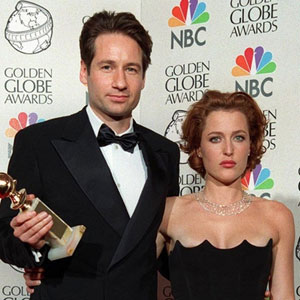
Featureflash / Shutterstock.com
Apparently the truth is still out there,mill because Fox is bringing back Agents Mulder and Scully for a six-episode miniseries later this year. Stars David Duchovny and Gillian Anderson, along with creator Chris Carter, are all back on board. Production will start this summer and the show will probably air later this year.
Having it come back for just six episodes is probably a good idea, so they can tell a contained story and not have to have the actors commit to an entire season. If you watch it, they’ll make more. The night it debuts, be ready for Twitter to implode.
Do You Still Use Voice Mail?
I’m not a boomer and I’m not a millennial. I’m part of Generation X, so I’m not sure if I’m supposed to be in the “voice mail” camp or the “text message/social media” camp. But I’m firmly a fan of voice mail, still, even if certain family members continue to call me and not leave a message, assuming I’ll scroll through my phone (a landline) when I get home to see who called and couldn’t bother to leave a message.
In this video, MarketWatch pits a boomer and a millennial in a voice mail vs. smartphone battle. I’m not sure why the millennial in the video finds voice mail “terrifiying” (or why Kermit the Frog is on the computer screen behind the boomer), but it’s right that people of different ages communicate differently these days. What do you use? Let us know in the comments below.
By the way, “millennial” never looks like a real word to me when I type it.
Blast Off!

(Shutterstock)
Later today, NASA astronaut Scott Kelly — twin brother of astronaut Mark Kelly, who is married to former Arizona Rep.Gabrielle Giffords — will take off for the International Space Station. The launch will take place via a Russian rocket in Kazakhstan, and Kelly will be accompanied by cosmonauts Mikhail Kornienko and Gennady Padalka. They’ll spend a year in space, testing the affects of weightlessness on the body. Why such a long period of time? Because one day we’ll be going to Mars, and it takes a while to get there.
CBS Sunday Morning interviewed Kelly about his trip and got a tour of a mock up of the space station. There’s no way I could spend a year up there for the bathroom situation alone.
All the News That’s Fit to “Like”

A few years ago I discovered that a lot of people actually think Facebook is the Web. That’s where they “live” online: posting pics, chatting, messaging, finding out what their friends are up to. It’s their “home,” and they see no difference between Facebook and the rest of the online world. I predict that one day Facebook will actually BE the Web, and now the social network is taking another step toward that goal.
Facebook is talking to various news outlets, including The New York Times, National Geographic, and BuzzFeed, about hosting content directly on Facebook. In the olden days (last week), a news organization would post a link to a story on Facebook that would take them to the news organization’s site. Now certain content will be housed inside of Facebook. Now you’ll never have to leave!
I’m all for newspapers and magazines making deals that will help them survive in the digital age, but this scares me. And I’m not the only one. Robinson Meyer at The Atlantic thinks it’s a bad idea, and so does Gawker. The New York Times, one of the companies in talks with Facebook, has a good breakdown on the good and bad aspects of such a deal.
I worry about giving too much centralized news power to one place like Facebook, and I’m also unsure how things like pay walls, subscriptions, copyright, and content that goes against Facebook’s terms of service would be handled.
Tomorrow Is National Something on a Stick Day
I first assumed that the “something” had to be food: a corn dog, cotton candy, a Popsicle, a candied apple. But apparently the day celebrates anything you can put on a stick. If this catches on, you can expect to see a lot of selfies that celebrate the day on Facebook and Twitter and Instagram.
Taken with a phone on a selfie stick, of course.
Upcoming Anniversaries and Events
President Reagan Shot (March 30, 1981)
Wikipedia has a detailed account of what happened that day, and here’s video of ABC News and their live coverage with anchor Frank Reynolds.
April Fools’ Day (April 1)
Here’s one of Rockwell’s April Fools’ covers. The Huffington Post has a list of 17 pranks you can play on your friends (or former friends, depending on whether or not they appreciate the prank).
Pony Express Launches (April 3, 1860)
The website of the National Museum of the Pony Express in St. Joseph, Missouri, has a great history on the delivery service as well as a list of events, a video tour, and even a store.
Dr. Martin Luther King Jr. Assassinated (April 4, 1968)
Read SEP Archives Director Jeff Nilsson’s feature about the life of King.
Everyday Life in 1939
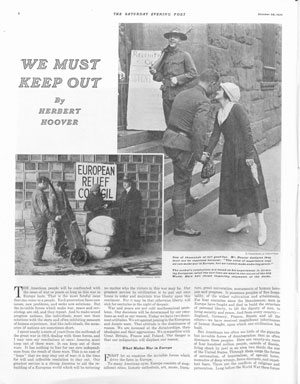
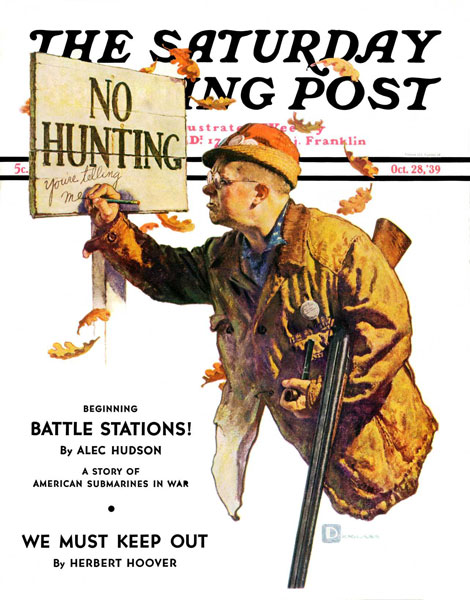
The date is October 28, 1939, and the New York Times is reporting on America’s arms embargo and the neutrality bill. The Post is offering ex-President Hoover’s isolationist appeal, “We Must Keep Out.”
But the big story in The Carlisle News is “Grass Fires Menace Farms.” In the previous week, five separate fires had burned over 200 acres in Sullivan County, Indiana. Other front-page stories concerned state conservation clubs, county electrification (“more than 50 miles of poles have been set since construction began Oct. 2”), and the Halloween carnival, which would be held in the “old gymnasium” next Tuesday.
When I read items like these in old small-town newspapers, I wonder just how accurately history captures the experience of previous generations. Histories of this era tend to focus on the major newspapers and national magazines. It’s easy to forget that life in these times wasn’t shaped just by war, economics, and politics. It was also birth and death announcements, corn-husking contests, and “Auto Crash at Busy Corner.”
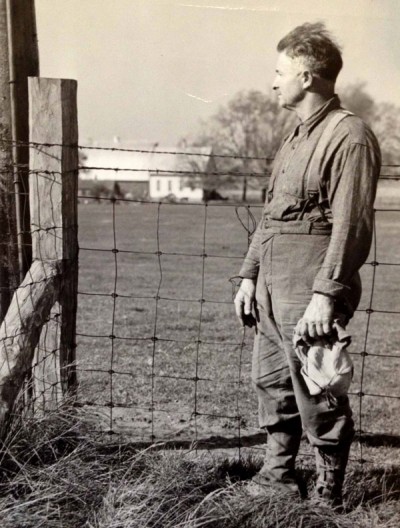
I’ve been digging up these details of American life from the small-town papers published in Sullivan County, Indiana. I chose this area simply because the 1940 census declared that it held the mean population center of the United States. (The precise location was in a cornfield just southeast of Carlisle.)
A farm community far from the city may seem too removed from mainstream America to be representative today. But in 1940, nearly half of America lived in such rural areas, and they stayed well informed of their neighbors thanks to their local newspapers. For example, The Carlisle News ran the regular front-page feature, Movements of People During the Past Week. Sixty-five years before Facebook, readers could keep track of their friends’ and neighbors’ activities: “French Willis made a business trip to Vincennes Wednesday … Mr. and Mrs. John Gibbs, of Indianapolis, spent the weekend visiting Mrs. Gibbs’ aunt, Mrs. Laura Niewald … Mr. and Mrs. Joe Finch, of Boonville, visited relatives here Monday evening while enroute home from a trip to South Bend.”
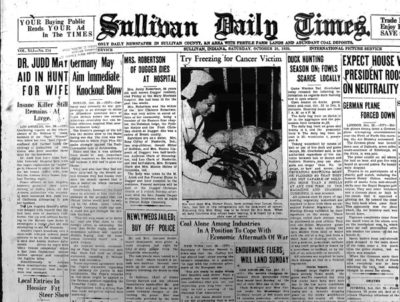
Just up the road from Carlisle is the more substantial town of Sullivan, with 5,000 people and three newspapers in 1939. The largest was the Sullivan Daily Times, which offered both national and international news. On Saturday, October 28, its front page was reporting the senate’s passage of a bill to revise the Neutrality Act, the same story reported in the New York Times.
If the bill passed in the House, the U.S. would lift the embargo that had prevented all sales of arms to the warring nations. The bill wasn’t really intended to help all sides, though. President Roosevelt had asked for this change because it had become obvious that the Neutrality Act only penalized pro-democratic nations. Germany and Japan had been well armed even before they set out on their military campaigns. With every conquest, they added more ammunition and equipment to their arsenal. France, England, and China were desperately short of weapons, shipping, and airplanes.

The editors at the Sullivan papers opposed lifting the arms embargo. Part of their objection probably came from their solid Republican opposition to anything President Roosevelt proposed. But they might also have seen the impending sale of weapons to England and France as a sign America was taking sides and inching closer to war. The paper ran a weekly column by Indiana’s 2nd District congressman, Gerald W. Landis (R), who conducted an opinion poll on the proposed change to the Neutrality Act. By October 28, the poll stood at 914 for continuing the embargo and 403 for lifting it. It wouldn’t have calmed the isolationists’ fears to read on the Daily Times’ front page that “Britons Rejoice at U.S. Senate’s Passage of Neutrality Bill.”
Other war news included “German Place Forced Down,” “Nazis Say 3 Subs Lost,” and “Germany May Aim Immediate Knockout Blow.” But these were surrounded by stories with more of a local interest, like “Duck Hunting Season On; Fowls Scarce Locally.”
And for fans of lurid crime stories, there was “Dr. Judd May Aid in Hunt for Wife: Insane Killer Remains at Large.” In 1933, Winnie Ruth Judd was convicted of first-degree murder, after the remains of two women were found in her luggage. She regarded them as rivals for a man with whom she had been having an affair. In court, Judd said she shot the women in self-defense, then packed them into shipping trunks with the help of her lover. She was committed to the Arizona State Hospital. By October 1939, though, she had escaped, and now her husband was offering to help find Mrs. Judd. She was eventually recaptured. Curiously, between 1935 and her parole in 1971, she escaped six times.
After reading these stories, Sullivan county residents might have switched on their Zenith console in the living room, or their Philips kitchen radio set to catch the Saturday-night broadcast from the city stations.
WBOW in Terre Haute was carrying the swing music of Jimmy Dorsey’s Orchestra. The Louisville, Kentucky, station would carry the countdown of the nation’s top songs on Your Hit Parade. At 8 p.m., many farm radios would be tuned in to the country music and comedy on National Barn Dance or the Western drama of Death Valley Days. Younger listeners might have chosen the Camel Caravan with Benny Goodman, broadcast out of Chicago.
From the CBS Camel Caravan broadcast of October 28, 1939. Listeners in Sullivan County would have particularly enjoyed Benny Goodman’s first song that night: “Back Home Again in Indiana.”
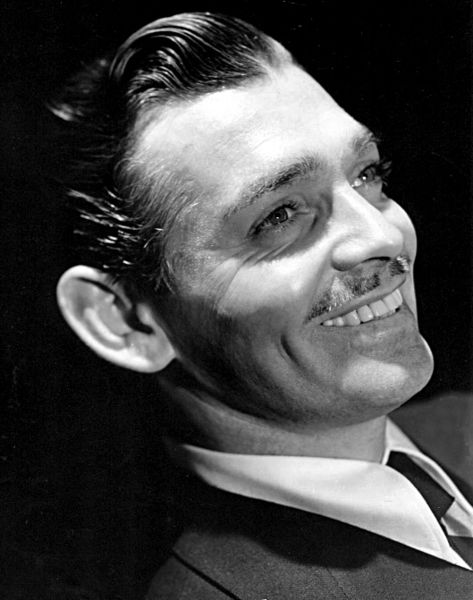
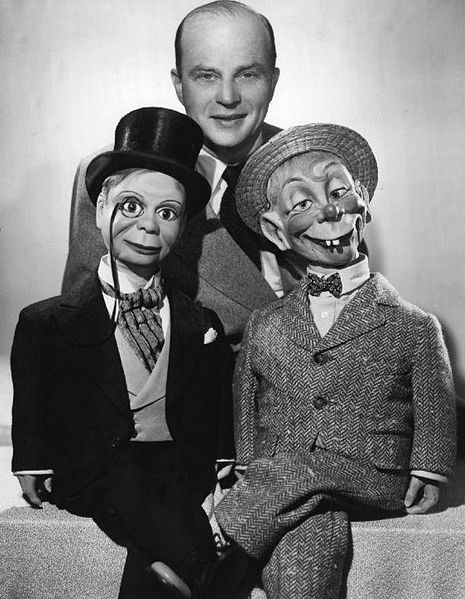
On the next evening, Clark Gable put in an appearance on theChase & Sanborn Hour, part of his promotional tour in the week preceding the December 15 premier of Gone With The Wind. In this clip, Charley McCarthy — Edgar Bergen’s alter ego—brags about his past girl friends, including Carole Lombard, apparently unaware that Gable and Lombard had recently married.
Others would head to the Sullivan movie theater. At the Sherman, they could watch Thunder Afloat with Wallace Beery (“Rebel! Rogue! Ruffian! Yet as gallant a fighting man as ever fired the last gun from a sinking ship!” hollered its newspaper advertisement). Down at the Lyric, they could see They Shall Have Music, whose newspaper ad promised, “Spellbound … that’s what you’ll be … just as the critics were.” At midnight, though, the Lyric was running an “adults only” feature titled Mad Youth. Its breathless ad copy spoke of “Home affairs forgotten — for love affairs. Thrill-seeking mothers spending alimony on hired love … Youthful innocence betrayed!” Yowza!

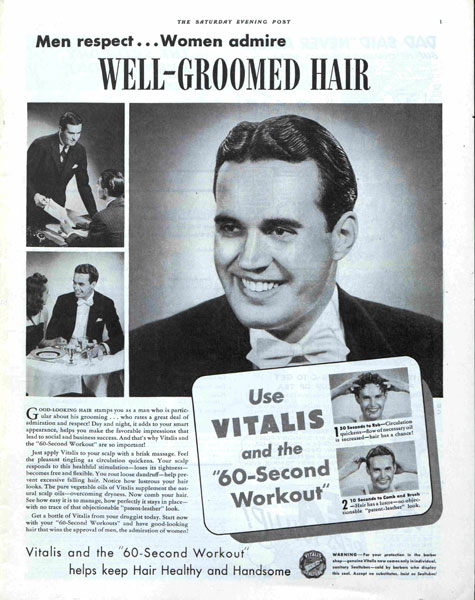
The prices in the newspaper ads seem shockingly low, but not when adjusted for inflation. The ad for Kling Brothers’ tailored-to-measure suits sold at Carlisle’s Star Store boasts prices starting at $21.50 (the equivalent to $350 today). Down the street at Sproatt Brothers, you could buy a pound of bacon or a pair of corn-husking gloves for 25 cents in 1939, which would be $4 in 2014.
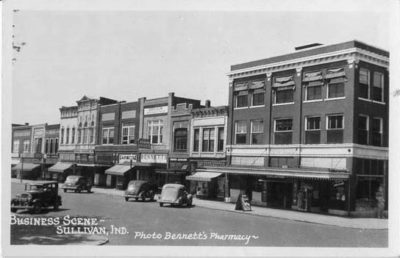
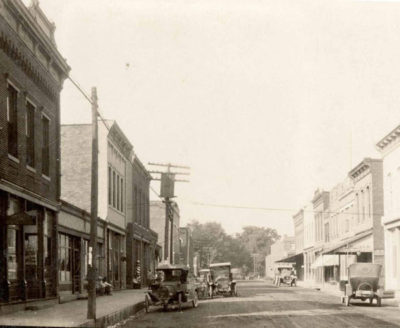
Carlisle and Sullivan have not changed greatly since 1940. About a third of the buildings in downtown Carlisle are gone, but they haven’t been replaced by chain stores or fast-food franchises. The lots remain empty except for well-tended grass.
The storefronts that line the Sullivan courthouse square have had face-lifts, but the upper stories are virtually unchanged from when they were built decades before the 1940s.
But just as I’m thinking that life hasn’t changed much in 75 years, I come across this item:
Newlyweds Jailed; Buy Off Police
Mr. and Mrs. Garland Setzer, recent newlyweds, were given a noisy reception last night by 50 or 60 people from the Graysville community.
The newlyweds were loaded in a large truck which headed a parade into Sullivan. Several cars made up the caravan of merrymakers following the truck to this city.
In Sullivan, Chief of Police George Barrick and his officers immediately handcuffed Mr. and Mrs. Setzer and put them in jail under technical charges of disturbing the peace. Bail was eventually provided by the bride and groom themselves — they bought supper for the entire crowd, and the police officers, at Gray’s Inn.
If you want to know how long ago 1939 is, consider that people of that time thought the medieval custom of rousting newlyweds from bed and dragging them off for a noisy, public exhibition was great fun for everyone.
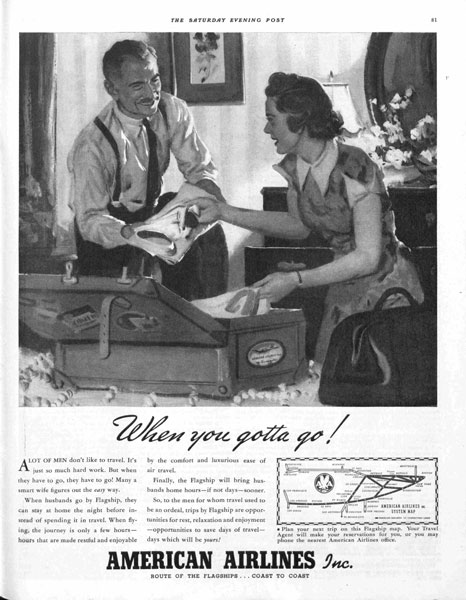
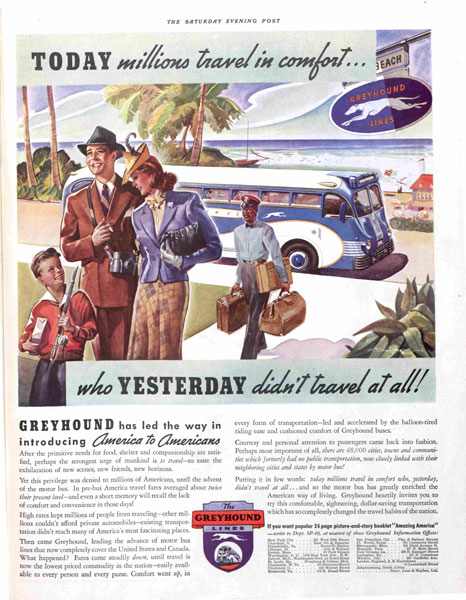
Step into 1939 with a peek at these pages from The Saturday Evening Post 75 years ago:

Personal Essay | Next Stop: Back Bay
Hugh Delehanty is a best-selling author whose latest work, Eleven Rings: The Soul of Success, written with Phil Jackson, debuted in June at number one on The New York Times bestseller list. This essay originally appeared in a slightly different form in Our Boston: Writers Celebrate the City They Love, a new collection of stories by John Updike, Susan Orlean, Leigh Montville, and others. The publisher, (Houghton Mifflin Harcourt) is donating $5 for every book purchased to The One Fund to help the victims of the Boston Marathon bombing.
It was supposed to be our most excellent adventure. My best friend, Glenn, and I–both eleven years old at the time–had talked our parents into letting us go into Boston on our own to see the movie West Side Story, which had just opened downtown. We lived in South Weymouth, a quiet, Norman Rockwell-esque village on the South Shore, then one of the safest towns in America, according to Reader’s Digest. The actor Hal Holbrook, who once lived near my house, said that the primary reason he was able to recreate the character of Mark Twain so well was that he grew up in a world that was remarkably similar to Twain’s hometown, Hannibal, Missouri.
Glenn was a quirky guy. It was no surprise that he later became a biology professor. He was always conducting whacky experiments. Once he carved his name into his arm with a razor blade to see what would happen. (He stopped, thankfully, after the letter L.) Then he almost blinded himself trying to examine the spots on the sun–with binoculars! His nuttiest stunt, however, was firing his brand new BB gun at a hall where a bunch of World War II vets were gathered. I must admit it was fun watching dozens of pot-bellied ex-soldiers, in parade uniforms, running out the door and scurrying for their cars as if they were under attack by a division of Nazis. But the next day the police showed up at Glenn’s house and confiscated his gun.
Glenn and I arrived early at the movie theatre in Boston so we decided to head for the red-light district known as the Combat Zone nearby to see if we could catch a glimpse of the go-go dancers. But while we were ogling the posters in one of the porn houses, three thugs from South Boston sidled up to us and asked where we were from. They seemed friendly enough, but as we moved down the street away from the crowds, they strong-armed us and asked for money. When I told them we didn’t have any, the scariest of the three pressed his body against mine and said, “What’s in your pockets, Weymouth?”
Luckily I had purchased a pair of trick dice at a joke store down the street. When I pulled the dice out, our assailants were so transfixed by them that Glenn and I were able to slip away down a back alley.
As we ran away, Glenn suddenly flashed a switchblade out of his pocket and said, “I should have used this on them.”
“What’s that?” I asked, appalled.
“It’s the knife my grandmother gave me for protection before I left home.”
“Are you nuts? Those guys would’ve killed us.”
* * *
This wasn’t the exactly the Boston I’d expected to find when our family moved to the area a few years earlier. The image my father painted for my brothers and me was that of a refined “city on the hill,” the epitome of culture and higher learning that also coincidentally had some of the best sports teams in the country. What intrigued Dad most about Boston, however, was its vibrant Irish culture. For a man who had the intense pride–and nagging inferiority complex–of many second-generation Irish-Americans, Boston was a place he could call home. Unlike his native New Haven, which had a broad mix of ethnic groups, Boston had a disproportionally large Irish-American population and a long tradition of charismatic politicians with names like Fitzgerald, Curley, and Kennedy. We had moved to Boston from Hamden, a small suburb of New Haven, because Dad had been offered a good executive job in the post office. Nothing short of returning to the old sod in County Claire could have made him happier.
My mom had a good feeling about the Boston area as well, but for a different reason. Her father, who was of Scottish descent, had grown up in Thomaston, Maine, and we had ancestors who had emigrated to Massachusetts from Cheshire, England, in the 1630s. Mom was intrigued with the idea of deepening her Yankee roots in the Land of the Bean and the Cod. In fact, she was so obsessed that during our first year in South Weymouth, we visited Plymouth Rock and the Mayflower no fewer than twenty-five times. What fascinated her about the Puritans was not their charming fashion sense or their love affair with the turkey, but their strong tradition of moral rectitude. Mom felt like a Pilgrim at heart. That’s why she became a second-grade teacher: so she to get students young and fill their heads with her Puritanical views of right and wrong before the dark forces of mass culture and raging hormones put them on the road to perdition.
As for me, I wasn’t so sure. I loved Hamden and I didn’t want to leave. It was my little corner of paradise. Behind our house there was a sprawling, mostly empty cemetery that my friends and I transformed into our private playground. In one section we built a regulation baseball diamond complete with white-line base paths and a makeshift outfield fence. In another section, marked by rolling hills and newly planted spruce trees, we played war games in Army-Navy store camouflage uniforms.
The day we left for Boston I was so upset I jumped out of the car, ran around the house screaming, and wrapped my arms around a tree in the front yard, swearing never to move. Eventually my mother talked me back into the car. But I was bereft for days.
Massachusetts seemed like a foreign country to me. Everybody spoke in a funny accent and used the word “wicked” to describe everything from food to music to pretty girls. And the pizza tasted like glop compared to New Haven’s divine Neapolitan-style pizza.
The main thing I couldn’t understand was why everybody deified Ted Williams and the hapless Red Sox so much. To my eye, Williams was a mean-spirited prima donna more interested in fine-tuning his batting average than winning games. He was a far cry from my hero, Jackie Robinson, who just two years earlier had led my team, the Brooklyn Dodgers, to its first World Series win.
It wasn’t until I was in high school and got a chance to explore the city beyond the confines of Fenway Park and the Combat Zone that I began to understand why Oliver Wendell Holmes had dubbed Boston “the hub of the universe.” My guide was my 10th grade English teacher, Miss Toomey, who, for reasons that escaped me, had made it her life mission to turn me into a writer.