What Happens When a Supreme Court Justice Goes Rogue?
As we all know by now, there’s a big difference between the federal government as it’s supposed to be and federal government that is. Nothing illustrates this better than the selection of Supreme Court justices.
In principle, judges are above politics, chosen for their ability to objectively apply the Constitution to legal questions.In real life, though, judges are often selected (or rejected) for their history of partisan decisions. Once approved, these judges are expected to bring their conservative or liberal biases with them into the court. For some, political slant shapes their decision so dependably that observers can predict how they’ll vote on an issue.
However, like most things in Washington, this arrangement doesn’t always work out as planned. Supreme Court justices can be unreliable servants of political parties.
Take Earl Warren for example. When nominated by President Eisenhower on September 30, 1953, the three-term governor of California and former vice-presidential candidate was a faithful Republican. In naming Warren, Eisenhower said, “He represents the kind of political, economic, and social thinking that I believe we need on the Supreme Court.”Years later, after Warren had overturned legal traditions covering race, religion, sex, reproductive rights, and criminal procedure, Eisenhower privately admitted that his choice of Warren was “the biggest damned-fool mistake I ever made.”
Within a year of coming to the Court, Warren brought the justices into a unanimous agreement on the ground-breaking Brown v. Board of Education case. The decision overturned the legal fiction of “separate but equal” citizens. Among other results, the decision opened the doors of well-funded “white only” schools to black children.
In following years, the Warren court outlawed mandatory school prayer, struck down the ban on interracial marriage, overturned state laws preventing the sale of birth control, compelled states to provide legal counsel to defendants who couldn’t afford a lawyer, and required police officers to inform suspects of their rights at the time of arrest.
Eisenhower’s misreading of Earl Warren was understandable. Everything about the man suggested he’d be a safe, predictable justice who’d support traditional interpretations of the Constitution. But as Stewart Alsop pointed out in his 1967 article, the Court has a curious effect on a judge’s outlook. Liberal judges can grow more conservative on the court, and conservatives can become more liberal.

And sometimes, a judge completely steps out of character and shakes up everything.
Featured image: Shutterstock
Great American Thinkers on Free Speech
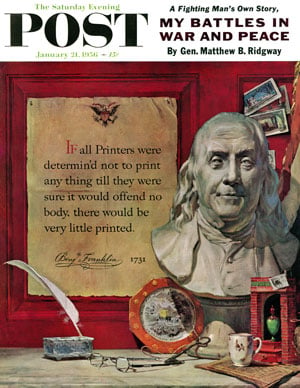
“Freedom of speech is a principal pillar of a free government: When this support is taken away, the constitution of a free society is dissolved,” wrote Founding Father Benjamin Franklin in The Pennsylvania Gazette.
You’ll find more notable quotes on the freedom of expression, a right U.S. citizens have held dear for more than 200 years, below:
“If all printers were determined not to print anything till they were sure it would offend nobody, there would be very little printed.”
— Benjamin Franklin, U.S. Founding Father
“But none of the means of information are more sacred, or have been cherished with more tenderness and care by the settlers of America, than the press.”
— John Adams, second U.S. president
“The liberty of the press is essential to the security of the state.”
— John Adams, second U.S. president
“If men are to be precluded from offering their sentiments on a matter, which may involve the most serious and alarming consequences that can invite the consideration of mankind, reason is of no use to us; the freedom of speech may be taken away, and dumb and silent we may be led, like sheep, to the slaughter.”
— George Washington, first U.S. president
“Our liberty depends on the freedom of the press, and that cannot be limited without being lost.”
— Thomas Jefferson, U.S. Founding Father
“Congress shall make no law respecting an establishment of religion, or prohibiting the free exercise thereof; or abridging the freedom of speech, or of the press; or the right of the people peaceably to assemble, and to petition the government for a redress of grievances.”
— U.S. Constitution
“Were it left to me to decide whether we should have a government without newspapers, or newspapers without a government, I should not hesitate a moment to prefer the latter.”
— Thomas Jefferson, U.S. Founding Father
“Freedom of speech is a principal pillar of a free government: When this support is taken away, the constitution of a free society is dissolved, and tyranny is erected on its ruins. Republics and limited monarchies derive their strength and vigor from a popular examination into the action of the magistrates.”
— Benjamin Franklin, U.S. Founding Father
“It is the function of speech to free men from the bondage of irrational fears.”
— Louis D. Brandeis, U.S. Supreme Court justice
“We are so concerned to flatter the majority that we lose sight of how very often it is necessary, in order to preserve freedom for the minority, let alone for the individual, to face that majority down.”
— William F. Buckley Jr., founder of National Review magazine
“Of that freedom [of thought and speech] one may say that it is the matrix, the indispensible condition, of nearly every other form of freedom.”
— Benjamin N. Cardozo, U.S. Supreme Court justice
“Freedom is not a luxury that we can indulge in when at last we have security and prosperity and enlightenment; it is, rather, antecedent to all of these, for without it we can have neither security nor prosperity nor enlightenment.”
— Henry Steele Commager, U.S. historian
“We cannot have a society half slave and half free; nor can we have thought half slave and half free. If we create an atmosphere in which men fear to think independently, inquire fearlessly, express themselves freely, we will in the end create the kind of society in which men no longer care to think independently or to inquire fearlessly.”
— Henry Steele Commager, U.S. historian
“The freedom of speech and the freedom of the press have not been granted to the people in order that they may say the things which please, and which are based upon accepted thought, but the right to say the things which displease, the right to say the things which may convey the new and yet unexpected thoughts, the right to say things, even though they do a wrong.”
— Samuel Gompers, U.S. labor leader
“If there is any principle of the Constitution that more imperatively calls for attachment than any other it is the principle of free thought — not free thought for those who agree with us but freedom for the thought that we hate.”
— Oliver Wendell Holmes Jr., U.S. Supreme Court justice
“We are reluctant to admit that we owe our liberties to men of a type that today we hate and fear — unruly men, disturbers of the peace … in a word, free men. … Freedom is always purchased at a great price, and even those who are willing to pay it have to admit that the price is great.”
— Gerald W. Johnson, U.S. journalist
“Freedom of conscience, of education, or speech, of assembly are among the very fundamentals of democracy and all of them would be nullified should freedom of the press ever be successfully challenged.”
— Franklin D. Roosevelt, 32nd U.S. president
“You tell me that law is above freedom of utterance. And I reply that you can have no wise laws nor free entertainment of wise laws unless there is free expression of the wisdom of the people — and, alas, their folly with it. But if there is freedom, folly will die of its own poison, and the wisdom will survive.”
— William Allen White, Pulitzer Prize-winning editor