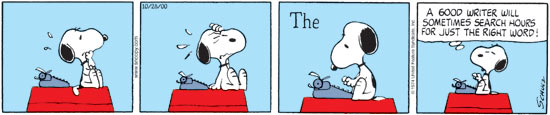
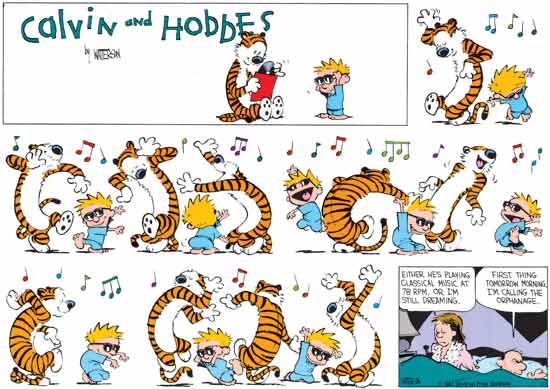
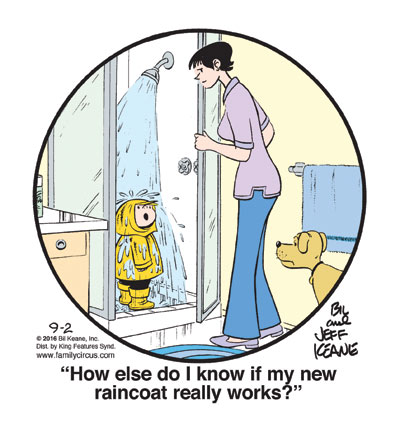
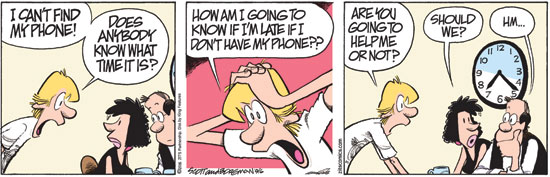
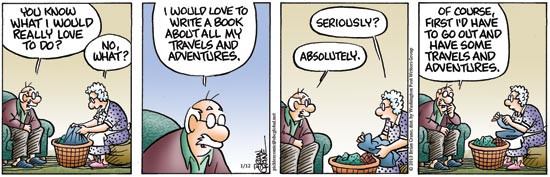
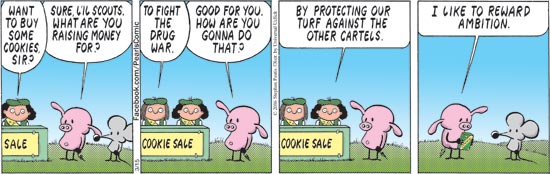
For more on comics and their evolution in the digital age, read the article, The Funny Papers, from the November/December 2016 issue of The Saturday Evening Post.
Blondie turned 86 years old last September — the comic strip, not the character.
Blondie the cartoon character shows little signs of having aged since 1930 and appears to live forever on the sunny side of middle age. The comic strip bearing her name also seems ageless despite having been around since Herbert Hoover was president. Blondie currently appears in 2,000 newspapers in 47 countries.
While the character hasn’t aged, she has changed considerably from her earliest days. When Blondie first appeared, she was a flighty, not overly bright, gold-digging flapper with the last name of Boopadoop.
For its first few years, the comic strip featured her in variations of dumb-blonde jokes. But the cartoonist, Chic Young, realized he couldn’t keep Blondie funny with this formula. So he had Blondie meet Dagwood, an earnest young man whose father had made a fortune in railroads. Dagwood’s wealthy parents disapproved of the girl, and when Dagwood married Blondie, they disinherited him. The couple moved to Joplin, Missouri, where their personalities underwent a major change. Blondie became intelligent and sensible while Dagwood changed from straight man to clown.
Chic Young continued to draw the strip for another 41 years, re-working some of the same gag setups: Dagwood’s love of naps and enormous sandwiches, his grumpy boss, the mailman who always collides with him as he rushes off to the office.
What made Chic Young so successful wasn’t the novelty of his story line but the way he kept these running jokes funny for so long.
In his April 10, 1948, profile of Chic Young in the Post, Jack Alexander described how the cartoonist came up with the ideas that kept Blondie funny. Aspiring cartoonists should read “The Dagwood and Blondie Man” to learn about creating a popular comic without depending on extraordinary artistic skills or an imaginative story line.
For recent and classic Blondie comic strips, visit Blondie.com.
The Dagwood and Blondie Man
By Jack Alexander
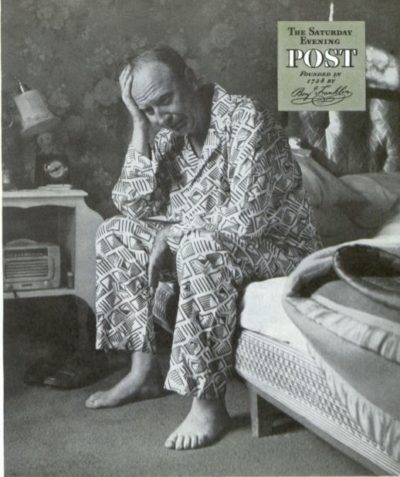
As cheerily as a man about to be executed, Young greets another happy dawn. Nothing to do but squeeze a funny idea out of his brain. It may sound easy, but over the years it wears a man down.
“I think everybody is a little tired.” That’s the strange secret which guides Chic Young in turning out the world’s most popular comic strip. An engaging portrait of the lazy genius who forces himself to earn $300,000 a year.Chic Young, who draws Blondie, which is widely held to be the funniest of the newspaper comic strips and is certainly the most popular, has been aptly described as a lazy genius with a terrific capacity for self-discipline. In the long run, it is his self-discipline which keeps Blondie alive. The production of humor is traditionally a gloomy, onerous task, and when it must be produced for publication 365 days a year the task becomes downright agonizing. Young has kept the humor of Blondie consistently high for seventeen years, allowing neither illness nor minor surgery nor an occasional throbbing tooth to divert him from his rigid program of adding to public gaiety. At present, with his income running just under $300,000 a year, he could afford to relax a little, but he keeps farther ahead of publication date than any other comic artist — twelve weeks ahead on his weekday strip and six months on his Sunday page.
The immense success of Blondie, which deals with the small frustrations and triumphs of a family man named Dagwood Bumstead, is a genuine phenomenon. Young’s drawing style is nothing to excite the art world; it resembles the stiff, uninspired kind of art taught by mail-order courses in cartooning. Almost anyone with a knack for copying can ape it. For years impostors posing as Young have been bilking innocent bartenders out of drinks on credit by sketching convincing pictures of the Bumstead family. The unpaid bar bills eventually find their way to Young, who is not a bar drinker, and wind up in his wastebasket. Half a dozen strips attempting to imitate Blondie have sprung up in recent years, but none has been very successful.
The paradox of Blondie’s popularity is further heightened by the fact that, as a comic strip, it is an anachronism. It is what is known in the trade as a gag strip — that is, one which each day presents a humorous episode in complete form. When comic strips began, more than half a century ago, they were all gag strips, but the trend lately has been toward continuity of plot. To continuity have been added such dramatic gimmicks as space ships, human monsters, scantily or tightly clad girls, torture, smuggling and grotesque distortion of human conduct, speech and appearance. Young, a wise and confident veteran of forty-seven, has not allowed the trend to disturb him. Studiously ignoring crime, sex of the teaser variety, adventure and the interstellar spaces, he has stuck faithfully to his family microcosm. He has deliberately narrowed his sphere of action to the typically suburban Bumstead home, the office where Dagwood works and the bus which transports him from one to the other.
The charm which Blondie exerts upon the newspaper reader seems to proceed from a wry twist which Young is able to impart to the everyday occurrences of family life which in themselves are not especially funny. Underlying most of the action, however, is a well-thought-out philosophy of fatigue. It is expressed, with infinite variations, through Bumstead’s preoccupation with food, sleep and protracted soakings in the bathtub. Young arrived at this philosophy by reasoning from the particular (himself) to the general, (Dagwood Bumstead; the universal type), and he enunciates it soberlysin the cautious thesis, “I think everybody is a little tired.” It follows, he says, that if everybody is tired, everybody will get vicarious satisfaction out of seeing Bumstead relieve his own fatigue by eating, sleeping or soaking in the tub. This reasoning has been confirmed by high-domed surveys.
The philosophy was a long time jelling in his mind. It began to stir vaguely in 1917, when Young, then a high-school student in St. Louis, took a summer-vacation job as a letter carrier. Young was a skinny, gangling lad who tired easily, and the St. Louis summers were discouragingly hot. The leather mail sack he carried was made particularly burdensome by the circulars of a cut-rate furniture store which advertised a bedroom suite for newlyweds at $69.50. Before starting on his route, Young would take a nap in some shady spot along the Mississippi River levee. After the nap, he would winnow the furniture circulars from his mail, toss them, a few at a time, into the river and dreamily watch them float off for New Orleans. He did this without malice toward the Federal Government, newlyweds or the $69.50 furniture store. In the delicate manner of a Chinese poet dropping lotus petals into a brook in memory of dead warriors, Young, who is kindly to an almost exaggerated degree, was simply memorializing the patient sufferings of letter carriers everywhere, including himself. Many career letter carriers lived in his own neighborhood in South St. Louis, and he liked them.
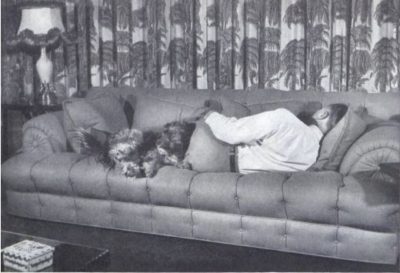
Like Dagwood, Chic is addicted to naps. Here he sneaks one while Butch, “dumbest dog in the world,” keeps watch. Butch, who does things in reverse, was asked to stay out of picture, so he got in.
“They were all nice, weary guys,” he recalls now with affection, ” and they all had appallingly large, flat feet.”
Promptly at nine o’clock every Thursday morning, Young turns on his self-discipline. At that time he rises from the breakfast table in his home in Van Nuys, California, and shuffles upstairs with the sad expression of a wrong-guessing Balkan politician mounting the scaffold. His ruddy, heavy-boned face, thrust forward from sagging shoulders, is a mask of resignation.
In the studio he is cheerily greeted by his assistant, an artist named Ray McGill, who has breakfasted heartily in his home near by and has arrived a few minutes earlier, full of a sense of well-being. Young tears open a pack of cigarettes, runs a hand through thinning sandy hair and slowly jackknifes his tall frame into a beat-up overstuffed chair. He calls it his idea chair and he has a superstitious affection for it. Once, when his wife gave it to the Salvation Army, Young drove hell-bent down to headquarters and got it back. When well settled in the chair, Young lights a cigarette and tries to clear his mind of extraneous impressions — what someone said at a party the Sunday before, what the President remarked at a White House press conference, what he read in last night’s paper about the atom bomb, what went on in his dreams. When he gets all this out of the way, he peoples his mind with the Bumsteads, their children, their neighbors, their callers and their dogs, and waits for a gag to spark from their impact upon one another.
After three or four cigarettes, Young slides lower into the chair, his elbows on the armrests, and twists his grasshopper legs into a knot. His eyes close, his head droops, and he covers his face with his hands. He squirms a few times and relapses into a trancelike state. McGill sits across the room, doodling on a drawing board and stealing glances at his disconsolate employer.
Fifteen or twenty minutes or maybe an hour later, Young unwinds his legs, sits up straight and says, “Look, Dagwood is stretched out in the bathtub, up to his ears, and one of the dogs
He asks McGill what he thinks of the idea. McGill always laughs. Young is expert at assessing the quality of McGill’s laugh. If he detects a note of charity in it, he sinks back into his trance and tries for another idea. If the laugh sounds sincere, he gets up and turns on the radio, to any program at all, and goes to work at his own drawing board. The radio blares forth its dreary fare of soap opera, rehashed news bulletins or the brittle, confidential chats of the breakfast-table couples. The noise passes irrelevantly through Young’s skull, like water through a goldfish, leaving only a subconscious deposit of singing commercials which he is able to render subsequently at parties. Young always keeps the radio on when he is drawing; it helps to liven up the monastic atmosphere of his existence.
When the animate figures of the strip are finished, he passes it on to McGill, who draws in such background items as beds, chairs, lamps, tables, doors, windows and woodwork. McGill also inserts the lettering in the conversational balloons, from a script written by Young. The texts of the balloons are masterpieces of brevity and precision, and are generally conceded by his contemporaries to be the best in the business.
The first idea is usually the hardest to come by. Sometimes a second one comes to Young while he is busy drawing the first. The idea-forming process is a mysterious one, even to Young. Once an interruption supplied by an interurban car, which runs past his front door every half hour, acted as a catalyzes. Young describes what happened as follows: “Something exciting was coming in on the radio, and I stopped drawing to listen to it. It was the climax of an adventure serial or a news bulletin about an airplane lost in the Alps, or something like that. Just then the interurban car came roaring by and drowned out everything, and I never did find out just what happened. But a pretty good idea popped into my mind: Dagwood has put a piece of cheese in front of a mousehole and he’s standing there with a broom upraised, ready to belt the mouse. Blondie calls to him from another room. When he turns to answer her, the mouse takes the cheese and scoots back into the hole, and Blondie yells, ‘Never mind.’ That’s deflation of the ego, I guess, or the triumph of the little guy — the mouse — over the big guy — Dagwood. Or maybe it’s just anticlimax. Well, that’s one way you get an idea. You get hold of a premise that can be applied in a hundred ways, and you use it in only one. It isn’t very clear, is it?”
Another of the ideas Young considers among his better ones came while he was puttering around at cabinetmaking, which he does for spare-time diversion. While trying to insert a recalcitrant dowel pin, he began thinking subconsciously of food. This gave birth to a strip in which Dagwood tries to use a cold frankfurter as a dowel pin to hold together the layers of a multiple-decker sandwich. Still other ideas come from Young’s close observation of what goes on around his own house. His continual presence there gives him many opportunities. He gets in the way of the vacuum cleaner and applies the experience to Dagwood in several ways. The house is usually full of the neighbors’ children, and Young astutely watches the byplay when their parents deliver or call for them. In the strip he ascribes to Blondie what the visiting parent does or says, and to Dagwood what the child does or says. This makes Dagwood look like a childish man, but that is what he happens to be. Every time Young gets in the bathtub the telephone rings and someone wants to speak to him, or some other interruption occurs. He used to get annoyed at this, but now he just lies back comfortably and thinks up another strip showing Dagwood in the tub.
Mostly, though, the ideas originate during Young’s brain-beating sessions in his studio. The best ones come quickly; Young finds that an idea which takes two or three hours to develop usually has to be discarded. “You discover,” he says, “that you were fighting it too much, the way a duffer fights a golf ball.”
By dinnertime Young, with McGill’s aid, has completed three of his stint of six weekday strips. Between dinner and midnight they finish two more, keeping awake by drinking black coffee. On Friday, after breakfast, they forgather again and manage to finish the sixth and last by noon. Then Mrs. Young is called in to pass on the quality of the strips, and to help in checking them for misspellings and other miscues. The chances for error are numerous. Blondie readers seem to know by heart the floor plan of the mythical Bumstead house and the position of each article of furniture in each room. A misplaced lamp, chair or chiffonier will draw hundreds of letters of protest. So will failure to give Blondie her regulation number of curls. The King Features Syndicate distributes the strip, and several editors in the New York office also check over it, but somehow errors occasionally creep in.
On the following Tuesday, Young and McGill spend most of the day doing the Sunday page. This is a more complicated job than drawing a weekday strip, as it requires a series of connected gags. Newspapers subscribing to the Sunday page also get a “top piece,” a sort of bonus strip, called Colonel Potterby and the Duchess. Its characters are unrelated to the Bumsteads. Young writes the script for Colonel Potterby and sends it on to another assistant, Jim Raymond, in New York, who draws it.
Much of what remains of Young’s week is devoted to scanning contracts which involve various commercial enterprises the strip has spawned. Blondie is an industry in its own right. Each year millions of Blondie comic books are sold, their sequences running about a year behind that of the strip. The Bumstead family is the subject of a fairly successful novel, a Sunday CBS radio program which runs all year round, and a Columbia Pictures series of B movies, two dozen of which have been produced to date. Forty-odd items of small merchandise bear the names of members of the Bumstead family, including those of the dogs. Among the items are coloring books, paint sets, Easter-egg transfer papers, jigsaw puzzles, dolls, a cookbook, a soap, a hair tonic, a shampoo, a hand lotion, talcum powder, sweaters, polo shirts, knitted suits, bubble bath, underwear, whisk brooms, mops, watches, clocks, clay-modeling packages, rubber pipes, bubble-blowing sets, home movies, doll houses and stationery. The latest addition is a kazoo instrument with a tin housing which is painted to look like a Dagwood sandwich. All in all, the Bumsteads are well fixed in the American consciousness.
Young is a canny businessman. Copyrights to comic strips are usually owned by the syndicate which distributes them, and the artists are salaried employees removable at the syndicate’s whim. When Young originated Blondie, he insisted on being its sole proprietor, and the syndicate consented; the syndicate holds the copyright, but reassigns it periodically to Young. Young is thus an independent producer and the syndicate is his primary customer. If at any time he should decide to retire, he would continue to receive his full income, minus whatever he had to pay for the services of a substitute artist.
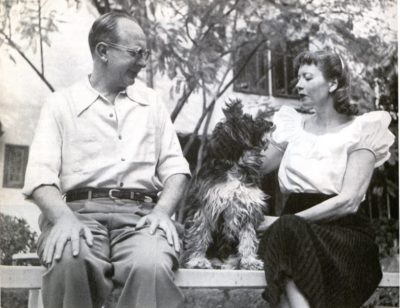
The artist and his wife in the yard of their California home. Mrs. Young, a former concert harpist, passes judgment on strips before publication.
The chief obstacle to retirement would be finding a substitute who could function under the galling restrictions which torment Young. Besides those inherent in the restricted scope of the Bumstead scene, there are innumerable ones in the form of taboos. Some of the taboos are imposed by syndicate censorship, some by the requirements of foreign distribution, and some by Young’s own tender feeling for good taste. The conversation in the balloons must be short and translatable into other languages without serious loss of meaning. Any situation Young uses must be as recognizable to residents of Shanghai and Helsinki as it is to residents of Evansville, Indiana. Situations based upon holidays, normally a fertile field for comic-strip humor, cannot be used; many countries do not observe, and never heard of, Saint Valentine’s Day, April Fool’s Day, the Fourth of July and Thanksgiving. Racial or nationalistic humor is forbidden. Once Young, dipping back into his South St. Louis childhood memories, came up with the name of Kosciusko Street, and used it in the strip as the name of a police station. Poles all over the country complained bitterly, and Young never made the same mistake again.
Because cigarettes are still offensive to a lot of people, no one in the strips ever smokes them, although Dagwood sometimes smokes a pipe. Controversial topics such as politics and religion are shunned, and liquor and saloons are never even mentioned. Because radio competes with newspapers for advertising, it doesn’t figure in the strip except in an unfavorable context — the Bumstead radio gets out of order or Dagwood is disturbed by its noise. The family refrigerator is drawn in such a way that the reader cannot tell whether it is a mechanical one or an old-fashioned icebox. If it were identifiable, there would be anguished complaints from either the mechanical-. refrigerator manufacturers or the ice dealers. The same taboo applies to the kitchen stove and other widely advertised appliances found in the average household; for all the reader can detect, the appliances used by the Bumsteads may be powered by hand, gas, electricity or a yoke of oxen.
Women are always shown in a flattering light. Blondie is never shrewish, and if she triumphs over her husband, she does it in a nice way. Young early perceived that, though the frustrations which beset a man can be funny, a frustrated woman is not a source of respectable humor. Blondie is never frustrated. And she has that ingredient which makes so many otherwise undistinguished marriages tick along pleasantly — a detached appreciation of her husband as a cross between the archangel Michael and a semi-enlightened clown.
Children are always referred to as “children,” never as ” kids ” — an expression that Young feels is detrimental to the dignity of childhood. Because Young has a special affection for household callers who help break up the loneliness of the homebound cartoonist’s life, he avoids offending paper hangers, plumbers, letter carriers, carpenters and policemen. Privately, he can work up a fine anger at the United Parcel Service, whose efficient route men never have time for a sociable chat; when he lived in New York, the drivers for Macy’s and Gimbel’s were among his most pleasant social contacts.
He steers clear of humor about physical infirmities, such as deafness or nearsightedness. Any sickness beyond a simple headache is also taboo; Young feels that sickness isn’t funny to the thousands of readers who may happen to be laid up at the time. He by-passes localisms, such as humorous situations that only big-city dwellers would enjoy; golf humor, which is apt to bore the nongolfer, and other specialized subjects which would detract from the simple, basic appeal of the strip. He has never introduced the stock market into the Bumstead ménage, because he thinks it isn’t funny — possibly because he himself was painfully clipped in the 1929 crash. Currently, though, he is dallying with the idea of broadening his area of potential humor by giving the fumbling Dagwood an automobile. If he goes through with this, it will be only because someone has convinced him beyond a reasonable doubt that the war made the automobile a recognizable vehicle even to the inhabitants of interior China.
Only in the field of sex, as exemplified in the marriage relationship, is Young mildly revolutionary. The Bumsteads sleep in a double bed and, despite protests from skittish readers, Young steadfastly refuses to be bullied into getting them twin beds. He holds, and the fan mail he gets from clergymen sustains him, that twin beds constitute a major threat to the solidity of marriage. He is very stubborn about this.
It is perhaps a hopeful sign — if adult addiction to comics can be construed hopefully — that Blondie is read by more persons over eighteen than any other strip. This was established in a seven-year study of newspaper-reading habits made by The Advertising Research Foundation, an independent agency. In the field of comics, the study showed that seventy-four out of one hundred women read Blondie, and that Gasoline Alley, a rival family strip, was second with a score of sixty-eight. Dick Tracy — cops and robbers — led the male readers with a score of seventy, with the two family strips just a point behind. On an averaging of the scores, Blondie came out with 71.5, Gasoline Alley with a 68.5 and Dick Tracy with 67.
Blondie is published by 753 daily and 249 Sunday papers in the United States and Canada, and, abroad, by 93 daily and 41 Sunday papers. It is especially popular in the Scandinavian and Low Countries, for some undetermined reason. Blondie has never succeeded in cracking Russia, but, then, no other strip has either — capitalistic propaganda.
Sudden prosperity often has an upsetting effect upon the behavior of comic artists. Some go on spending sprees, acquiring mansions, expensive automobiles, airplanes, cabin cruisers or racing stables. A few use their newfound prominence to crusade politically or try to crash society. Some work so bard at being night-club characters that they have to hire substitutes to keep their strips going. Young sticks closely to his home, an unpretentious and vaguely Spanish house in a middle-class section of Van Nuys, and to his wife and two children. He owns several automobiles, but most of the time uses the oldest one, a 1940 sedan. On rare occasions he drives across the Santa Monica hills for dinner at a Hollywood restaurant, but he goes unrecognized by headwaiters and is easily turned away to make room for the tourist trade. His only concession to the Hollywood style of living is a small swimming pool in his back yard. A previous owner installed it, and Young is delighted with it. He likes to swim, but can’t stand the temperature of the Pacific Ocean. “It’s like Jones Beach, Long Island,” he says. “Stick your foot in the water and your toes turn blue.”
In trying to understand Young, it is helpful to know something about the South St. Louis German, one of the minor anthropological glories of our land. He is as distinct a type as the Boston Brahmin or the London cockney. Young fell under the benign influence of the South Side when his parents moved to St. Louis from Chicago during his boyhood. Both of his parents were of German blood. The typical South Sider is a solid citizen. He dislikes display and cold weather, owns his home, moves with deliberateness, avoids drafts, saves his money, jealously guards his privacy and political rights, and spends as much time around the house as he can. He is apt to devote his vacation to digging a cellar or papering the upstairs, and he returns to his job as much refreshed as if he had been loafing at Cape Cod. He meditates frequently about food and is an impressive performer with the knife and fork. It isn’t often that a South Sider makes much money, but, if he does, he doesn’t splurge with it. Young is a typical South Sider, with the addition of a brilliant sense of humor.
The clan feeling is strong in South St. Louis. It expresses itself in family string ensembles or saxophone sextets nr in simple, uninhibited parlor singing. The Youngs, as a family, happened to be devoted to art. Mrs. Young, who had painted since girlhood, taught her children to draw, and they took to it as some children take to penmanship or burning mottoes in wood. The elder Young, who was a shoe-store proprietor, couldn’t draw, but he encouraged his children to keep at it. One son, Lyman, now draws a syndicated strip Called Tim Tyler’s Luck. A daughter, Jamar, did well as a fashion artist and art instructor until she married and settled down in California.
Chic, who was christened Murat Bernard, fell hard for the lure of Chicago art schools which implied in their mail-order advertising that they could make ” big-money ” artists out of anyone with the wit to hold a pencil steady. After graduating from high school and a secretarial college, he got a job in a Chicago railroad office and sporadically attended art classes at night.
A year later Young transferred to his first paid job as an artist, drawing a wise-cracking strip called The Affairs of Jane, for a syndicate in Cleveland, at thirty dollars a week. The strip died of malnutrition, and there was talk of firing him. Learning of this, Young devised another strip, which he named Beautiful Baba, and in 1921 moved on to New York, where he succeeded in foisting it on another syndicate. Beautiful Baba was a minor success, and
Young began to feel cocky. He shared an apartment with another artist in an upper Manhattan building that seemed to be otherwise populated by bookmakers, dope peddlers, soiled doves and other dubious characters. Police raiders visited the neighbors almost every night. This exciting atmosphere seemed to breed a peculiar gambling spirit in the downy fledgling from St. Louis. Young might have stumbled much earlier upon Dagwood Bumstead and fatigue — and consequent fortune — had he not chanced to develop as a cartoonist during the jazz age. Leisurely and genial by nature, he stepped out of character in trying to express the hard, cynical spirit of the era. His best break came in 1923, when he got an offer from King Features. He dropped Beautiful Baba forthwith and accepted. At that time King Features ran what amounted to an academy of the comic-strip art. Promising newcomers worked as understudies to established artists and drew their strips when the stars went off on benders, as some of them did with regularity. In return for the favor, the stars in their soberer moments coached the understudies. Young learned the tricks fast, and within a year had sold the syndicate a strip of his own, Dumb Dora, another fast-moving job. Dumb Dora did rather well. Young began investing in stocks, and, when this proved too tame for him, in cotton futures. At a party given by a fellow artist, Young met and fell in love with Athel Lindorff, an attractive girl from Rock Island, Illinois, who was in New York playing concert engagements as a harpist. After their marriage, they moved to Great Neck, Long Island, and Young did his work at home.
The financial disaster which Young suffered in the 1929 crash had the odd effect of increasing his belief in his worth as an artist. He was making $500 a week out of Dumb Dora, but, as South St. Louisans have a way of doing on depressing afternoons, he decided one day in 1930 that his talents weren’t being properly appreciated. The syndicate was the villain of his reveries. It owned the Dumb Dora copyright and was making much more money from the strip than he was. Under a threat to resign, Young demanded either the surrender of the copyright or a big raise. The late Joseph V. Connolly, who was the syndicate manager, calmly accepted his resignation and turned Dumb Dora over to another artist.
Young withdrew in defeat to Great Neck and spent several months just sitting around and licking his wounds. He came out of his funk one day in September and drew a week’s supply of a strip based upon the adventures of a young gold digger named Blondie Boop-boop-a-doop. Among Blondie’s suitors was a crackbrain aspirant whose father was a railroad billionaire and whose mother was a jewel-bedecked society matron. Young gave the harum-scarum suitor the unlikely surname of Bumstead; he had known a Bumstead family in the Midwest, and the name had always struck him as funny. The given name, Dagwood, was an inspiration of the moment, and Young can’t remember where he got it. Young took the strip in to Connolly, who was glad to see him return to the fold.
Under high-pressure promotion by the syndicate, including the sending of overnight bags of lingerie purporting to be Blondie’s to newspaper editors all over the country, the strip got off to a good start. At the time, Blondie was strictly in the Dumb Dora tradition. The pace of the strip was fast, the gags were furiously exploded and the characters bounced around and collided like puppets in a Punch-and-Judy show. The times were harsh and serious, though, and gradually the newspapers began dropping Blondie. The saddest blow came in 1933, when the New York American, the syndicate’s anchor paper, dropped it.
“Here I am,” Young said lugubriously to his assistant that morning, ” only thirty-two years old and a has-been already.” He went into town that afternoon and sought Connolly’s advice.
“Why don’t you have them marry?” Connolly suggested wisely, adding, with a bite in his voice, “You know more about married life than you do about flighty dames anyway.”
Young straightway married Dagwood and Blondie. Dagwood’s parents disinherited him, and haven’t appeared in the strip since. Blondie did a quick change from a female-on-the-loose to an apron-wearing housewife, gentle and considerate. Dagwood, who bad been a slick-haired lounge lizard, developed his now distinguishing double cowlick and got a job in an office. Timing the events appropriately, Young endowed the Bumsteads with a son and a daughter. He gave them a dog, Daisy, who, in turn, endowed the Bumsteads with a litter of puppies. The mailman, the milkman, the door-to-door salesman, the plumber, the neighbors — all the characters who impinge upon the average suburban home — were brought in from time to time. The pace of the strip automatically slowed down, and so did the chief characters, and Young worked in humorous switches upon the weariness that comes from raising a family. In the quieter atmosphere, the gags detonated with greater effectiveness. Dagwood became the figure of that character so beloved of the politicians, The Common Man. The changeover in Blondie coincided with the advent of the New Deal. The strip rose in popular favor along with the New Deal and, over the long haul, outlasted it.
Young’s dislike of cold weather and, in particular, his struggles with snow, finally impelled him to get away from New York. His driveway in Great Neck got clogged with drifts in an impressive way. It was hemmed in on one side by a neighbor’s fence and, on the other, by his own house. There was no space in which to throw the snow; in clearing the driveway, Young had to carry each shovelful all the way down to the street, and he was fed up with it. In 1939 he moved to Florida, and a couple of years later to California. The only snow he sees now is on distant mountain peaks, and even this slight proximity causes him to shudder.
Young is delighted with California, and with its community-property laws, too, and he gets a great deal of satisfaction out of his home and the two-and-a-half acres which surround it. His reluctance to leave the place, even temporarily, for the more exciting life of Hollywood stems equally from his protoplasmal love of the home base and an apparently sincere conviction that he is a minor leaguer by comparison with the screen celebrities. His idea of a satisfying holiday is to struggle in his workshop to make a cabinet door hang properly or to shine the family’s shoes, a chore he has appropriated to himself. His grounds are lushly planted with common and exotic trees, and Young has never overcome his surprise at the yield of avocados, oranges, grapefruit, walnuts, pecans, olives, kumquats, loquats, lemons, pomegranates and apricots. In nut-ripening time he sits in an easy chair on the lawn and is fascinated by the sight of squirrels waiting for the nuts to drop. The tree which interests him most is a strange hybrid which he calls the Frustration Tree. Its fruit, which is a cross between a banana and a pear, isn’t edible until it falls from the tree, and when it falls it squashes beyond recovery. At night Young sometimes sits at an open window listening to the plopping of the fruit and chuckling to himself.
“If a cartoonist doesn’t play games with himself,” he explains, “he will go crazy in short order.”
Young’s social life is limited almost exclusively to small parties. For some reason he can’t explain, a disproportionate number of his friends are radio announcers. Among his other friends are fellow artists, newspapermen, real estate men and advertising men, most of whom live in his neighborhood. Once in a while he visits the Columbia Pictures lot’ when a Blondie film is being shot, chiefly to renew acquaintance with the dog that plays Daisy. ” Daisy is a little honey,” Young will say. “Sweetest little pup you ever met — just like meeting a person.” If encouraged, he will go on to tell about the day Daisy had to go through one scene forty-six times because the child actors, playing the Bumstead youngsters, kept muffing their dialogue. “Most dogs wouldn’t do that,” Young says admiringly. “They’d get tired and quit.”
Daisy, who happens to be a male, is a truly remarkable character. He was bought ten years ago from a pet shop for ten dollars by his trainer, Rennie Renfro, and he has since earned more than $150,000. Daisy appears to be a mixture of cocker spaniel and bull and fox terrier, and is seriously credited with adding bits of business which are not in the scripts. He has a stand-in, and makes personal-appearance tours in a specially constructed trailer. After each scene Renfro rewards him with a bit of food, and when the scene turns out badly, Daisy doesn’t come to collect the reward. He knows when he’s terrible.
Daisy’s real-life pups are much in demand around Hollywood. He has sired eighty-five, all told, and one pup belongs to the Youngs. The Young dog, Butch, is distinctly odd. The hair on the forepart of his body is coarse; on the afterpart it is silky. He refuses all meats except pork liver, and is avid for such oddities as pancakes, cookies and popcorn. Butch is a clumsy dog, unable to perform as simple a canine act as sitting on his haunches without falling over. Sometimes he falls backward, sometimes sideways. Young once had to rescue him when Butch, while chasing a squirrel that leaped across an edge of the swimming pool, misjudged his distance and fell in; Butch can’t even swim. He sleeps on his back, with his legs protruding upward, and has a fondness for stealing naps in his master’s bed.
Young calls Butch “the dumbest dog in the world,” but he adds defensively: “Butch is bright in a way, though, when you understand that he does things in reverse. For example, if he’s standing in the front doorway and you order him out of the house, he’ll obediently come right in. If you tell him to sit down, he’ll stand up and give you that I’ll-bet-you-thought-I-couldn’t-do-it look.”
A recurring debate among those who know the Youngs revolves about the question of whether or not they resemble the Bumsteads. The consensus is that they do. Young stoutly denies this, and insists that the Bumsteads are purely imaginary. Normally an easygoing man, he gets excited when upholding the negative, and the hairs stand out on his neck like a dog’s hackles.
Certain resemblances, however, are apparent. Mrs. Young’s disposition is much like Blondie’s, and Young shares some of Dagwood’s traits. His loving attachment to food is plainly Dagwoodish and, in the manner of his hero, he often scouts the refrigerator for sandwich material late at night.
Like Dagwood, too, he is devoted to the occasional nap, and he sprawls out on a divan in much the same manner, with one foot propped atop the other and his head covered with cushions. He has, moreover, some of Dagwood’s physical awkwardness. Young is a careful automobile driver, but his coordination is bad. He is prone to become hesitant at crowded intersections, and his car’s fenders are generously dented from his struggles with the art of parking.
For ten years Young labored to improve his golf game by studying instruction books, only to tighten up when he tried to put their deceptively simple advice into practice. He quit the game two summers ago.
Through the fog of awkwardness a passionate and unending quest for precision is discernible. Since abandoning golf, Young has spent more of his spare time amid his lathes, sanders and grinders, making tables and other articles of furniture. Here, also, his fervor outstrips his manual ability, but after each failure he plunges into another and more complicated venture in woodworking.
He is an inveterate phonograph fan and in his choice of records, too, his love of the precise performance is manifest. Among his favorite performers are Frankie Carle, the pianist, who brings the clean-cut grace of the ballet to the keyboard, and Dinah Shore, whose carefully distinct enunciation of lyrics pleases him. Young likes the modern French troubadours, Charles Trenet and Jean Sablon, because they achieve precision in a language that is difficult to handle.
His current favorite is the French chanteuse, Edith Piaf.
“Boy, she’s really got it!” he will say with unbuttoned enthusiasm while a Piaf record is turning. “Listen to that baby bite off those gutturals — that’s what Tetrazzini used to do!”
On free evenings Young listens to records for hours on end. He switches out all the living-room lights and reclines beside the phonograph in an easy chair, with a highball within arm’s reach on the floor and Butch prostrate beside it. The only glow in the room comes from the tiny red light above the control panel of the machine. By midnight any friends who happen to be sitting in on the session will usually have had enough and gone home. An hour or two later Mrs. Young will acknowledge defeat and retire for the night.
Young may continue with his concert until dawn. When he finally plods upstairs, he finds that Butch, the dog of utterly no distinction, has sneaked out under cover of darkness and is asleep in his master’s bed, lying incongruously on his back with his legs pointed stiffly toward the ceiling. The solution to the problem Butch poses is easy. Young awakens him and tells him to stay where he is; Butch obediently falls out of bed and goes downstairs to his own quarters.
Featured image: Photos by Bob Landry from the April 10, 1948, issue of the Post.
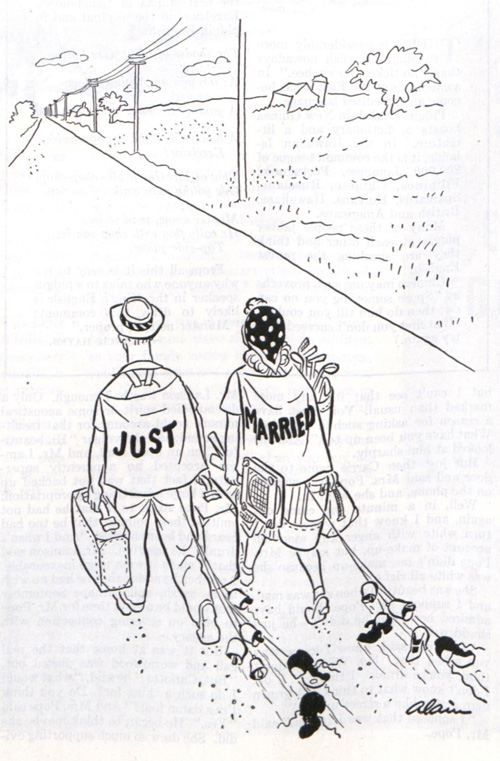
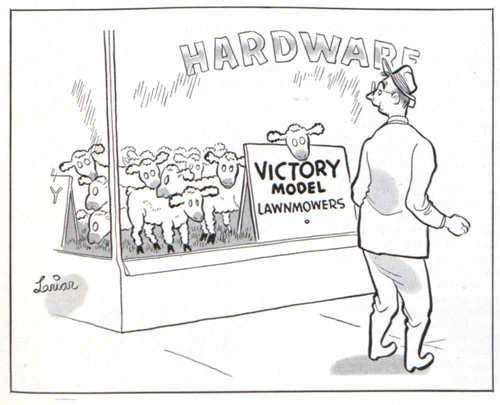
Tires and fuel were the first items to be rationed in America during World War II. This put a dent in the nation obsessed with automobiles, and The Saturday Evening Post’s cartoonists capitalized on the road rage!
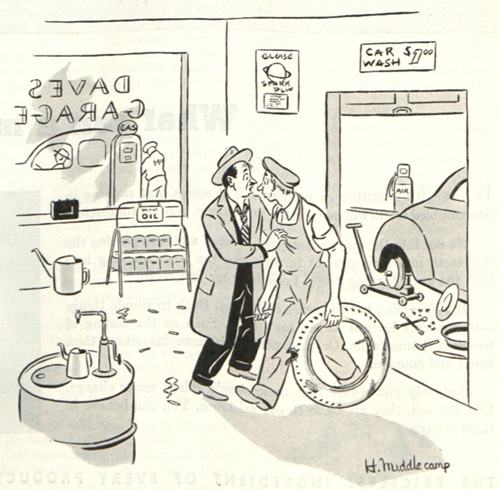
“Tell me, Dave — she gonna be okay?”
H. Middlecamp; March 14, 1942
“Malcolm and I feel that our tire problem will soon be solved.”
March 21, 1942
Daniel Brustlein (aka Alain); September 5, 1942
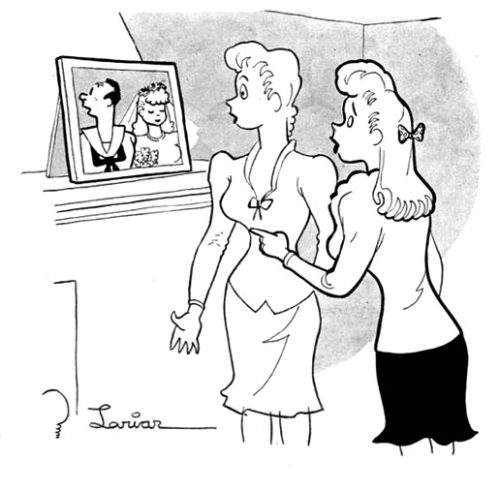
Lawrence Lariar; May 22, 1943
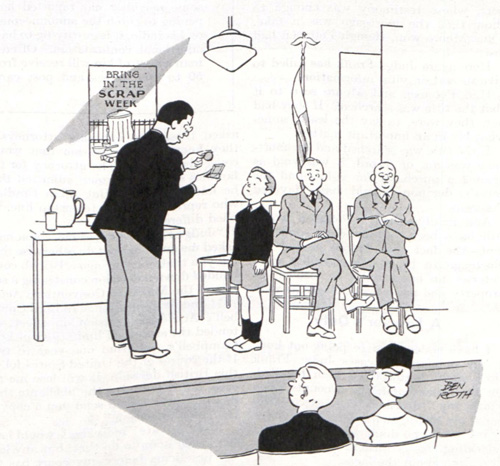
“I award you this bronze medal for collecting the most scrap. Now, young man, what are you going to do with this bronze medal?”
Women entered the workforce during World War II by filling in for unavailable soldiers in manufacturing, agriculture, government, and more. Popular icons like Rosie the Riveter symbolized the woman’s help in the war effort. We’ve assembled the best one-liners and most riveting cartoons featuring World War II women at work.
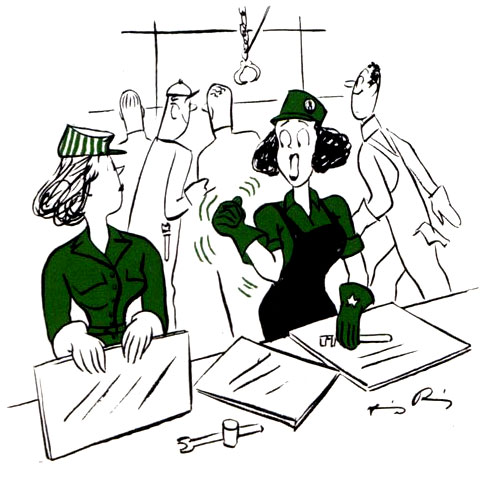
“I’m new here — which ones are wolves?”
May 1, 1943
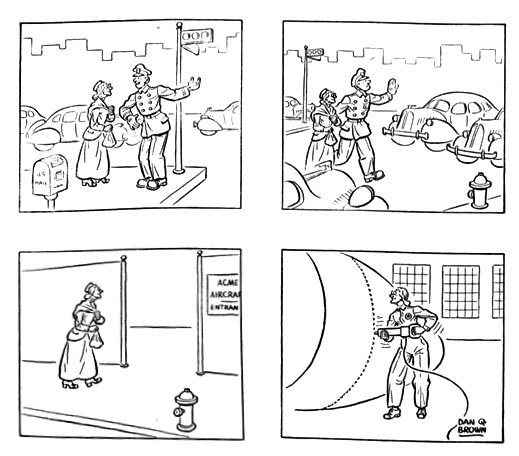
Dan Brown; May 22, 1943
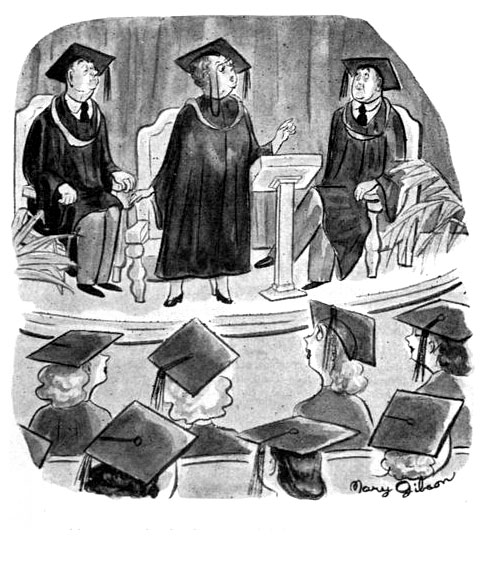
“And when you go forth into the world, be it as riveters, welders, or mechanics, keep ever bright before you the slogan of Sweet Lawn Seminary — ‘A lady first, a lady always!’”
Mary Gibson; June 5, 1943
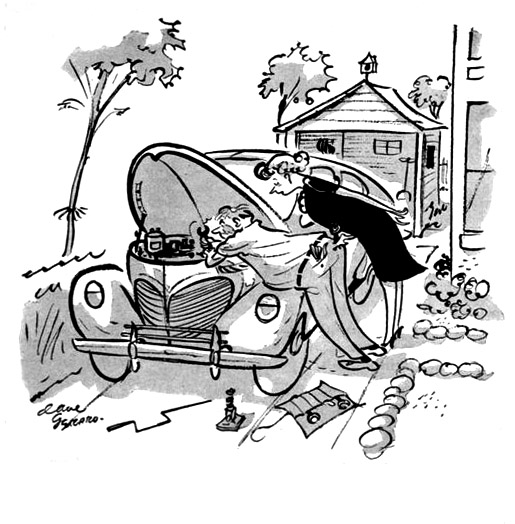
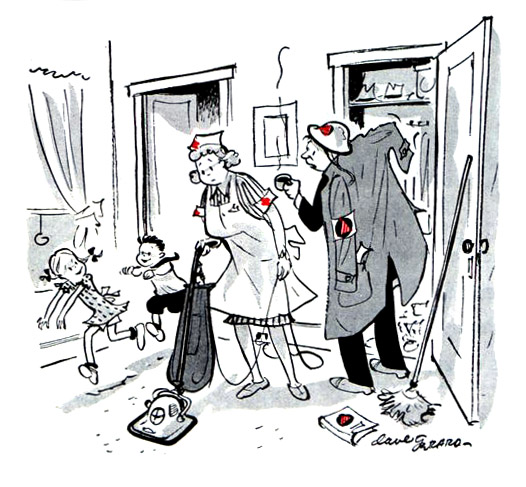
“You’d get along much better with a 5/16 instead of a 3/8 — and are you sure it’s the distributor? If you’d try a new condenser and set your timer forward to pick up the fire lag —”
Dave Gerard; August 21, 1943
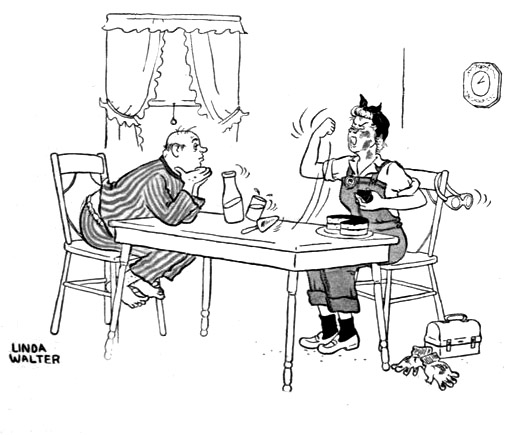
“So, I says to the boss —”
Linda Walter; November 20, 1943
“Better say something nice about the propellers — she makes ’em.”
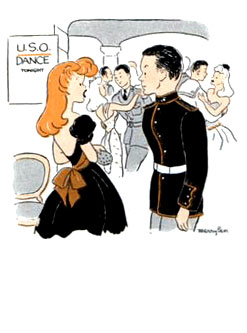
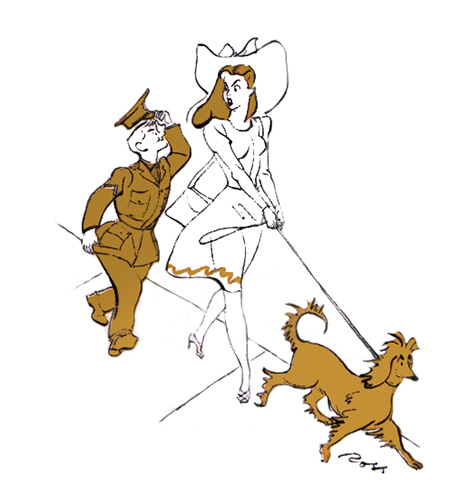
Dating is complicated, and this is never truer than in wartime! We have strung together a selection of sentimental cartoons from the Second World War. Going steady was different for soldiers and civilians in the ’40s.
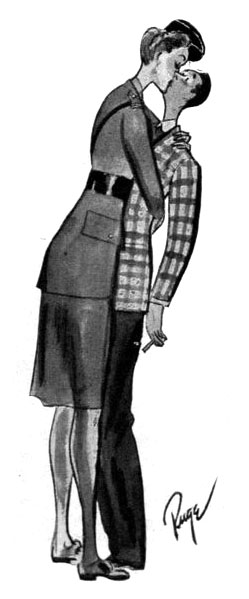
John Ruge; May 16, 1942
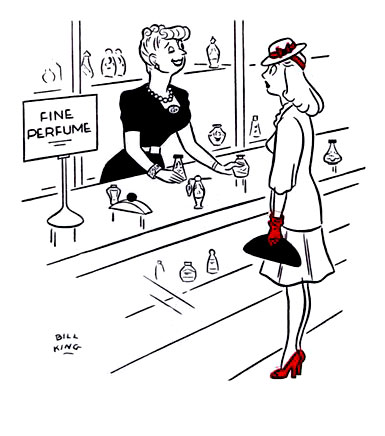
“Well, frankly, if he’s in the armed forces, you don’t need anything at all!”
Bill King; June 13, 1942
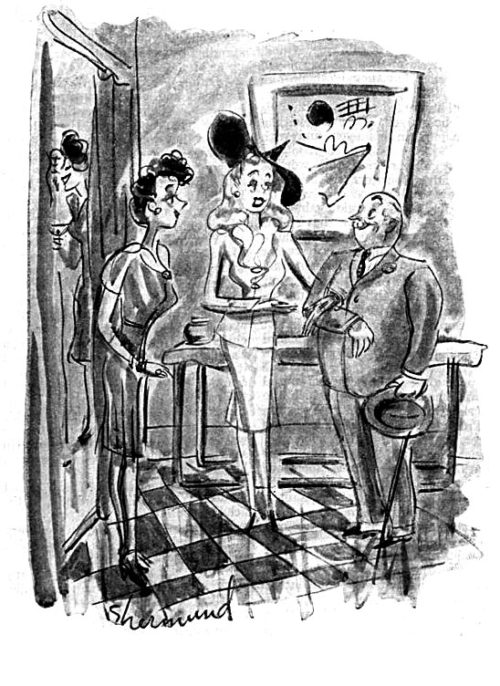
“This is Mr. Thompson — c’est la guerre!”
Barbara Shermund; June 13, 1942
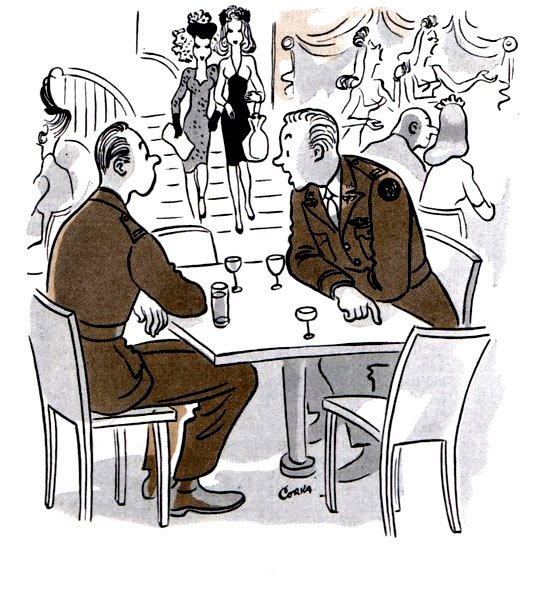
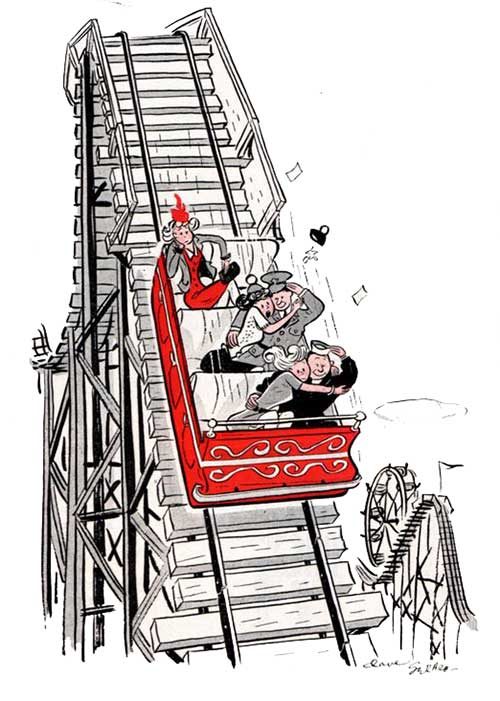
Dave Gerard; September 12, 1942
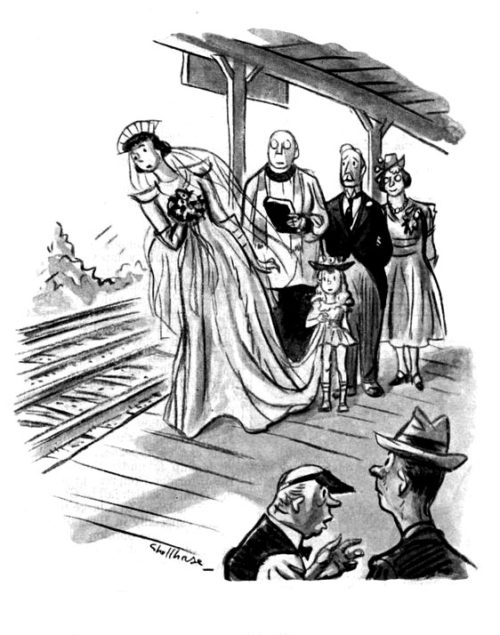
“Her fiance is getting a four-day furlough and they don’t want to waste any time.”
George Shellhase; September 12, 1942
“Oh, no, I couldn’t let you take me to 222 Elm Street, the big white house three blocks from here, where I live. It’s against the rules.”
Merrylen Townsend; April 3, 1943
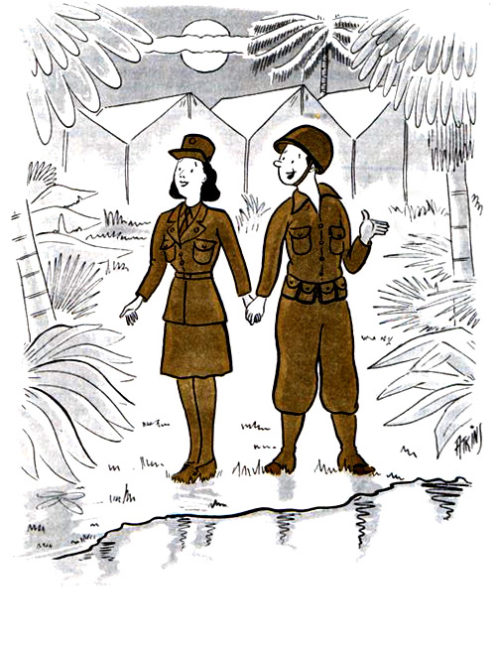
“This is what we always dreamed of, dear, being alone together on a South Sea island.”
Elmer Atkins; July 17, 1943
“Aren’t you overestimating the power of a uniform?”
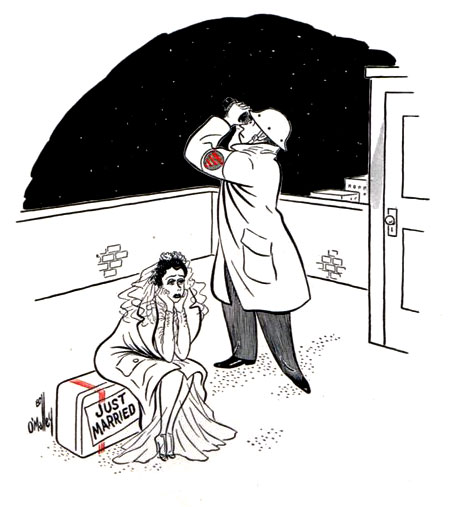
Life changed dramatically for civilians during WWII. The homefront was characterized by sacrifice of luxuries and enrollment in the various duties of the Civil Defense Corps. The World War II-era cartoons in this collection focus on the uncertainty and paranoia of civilians under threat of attack, all served with a dollop of black humor.
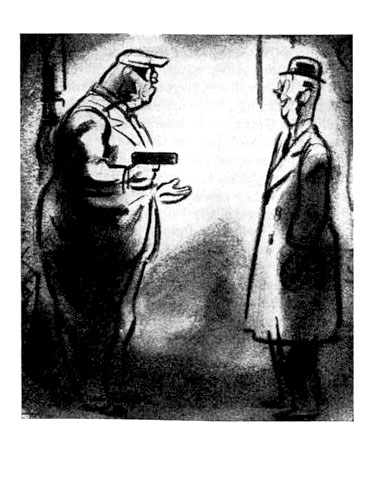
“Oh, come now. With all that’s happening these days you don’t think you could frighten me?”
March 7, 1942
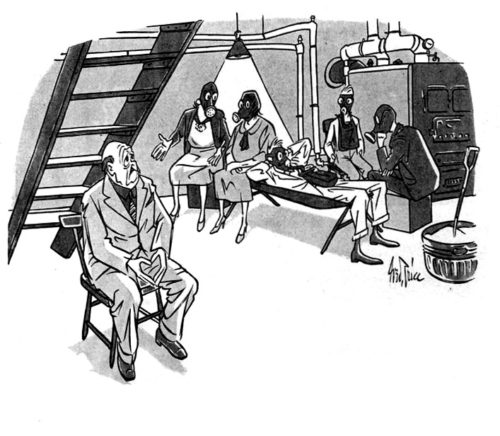
“I’m so glad Mr. Burley is a fatalist. We were one mask short.”
Fred Price; March 7, 1942
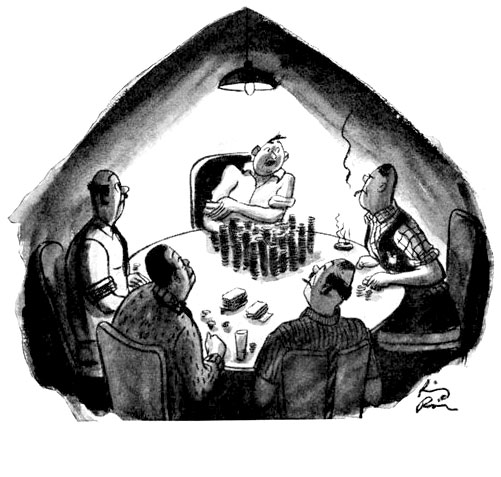
“I think I’ll quit, boys — I find it impossible to concentrate on poker with the war going on.”
July 4, 1942
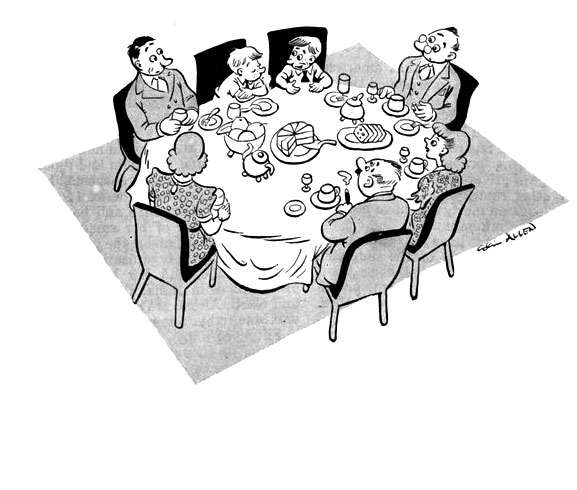
“Of course the Messerschmitt Me-109F has a high ceiling and speed, but don’t forget that our P-38 does 404 mph and climbs 35,000 feet, and also that our Turbo-supercharged B-17 carries 4 tons of bombs and outclimbs both the Me-110 and the Me-109F.”
Colin Allen; August 29, 1942
Bill O’Malley; December 19, 1942
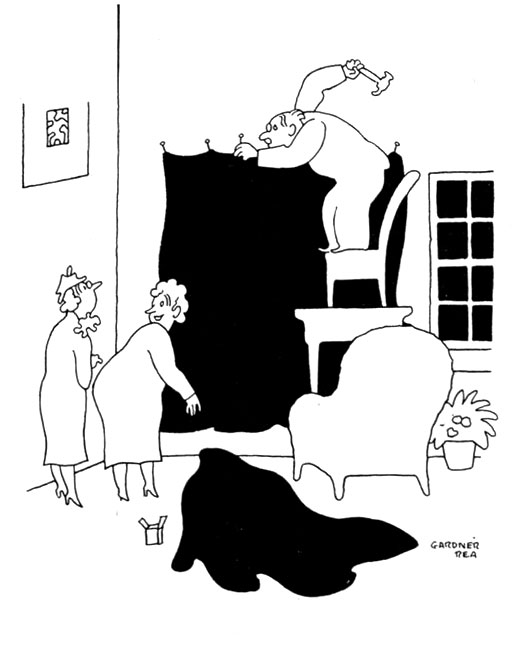
“And, then, just to make absolutely sure, we always just sit in the dark.”
Gardner Rea; June 5, 1943
“What the heck did we do every evening before this war started?”
Hundreds of thousands of American women served in the military during World War II. The new precedent of women involvement in areas previously reserved for men was a mark of the era. The cartoons in this collection derive their humor from the subversion of strict gender roles apparent in 1940s America.
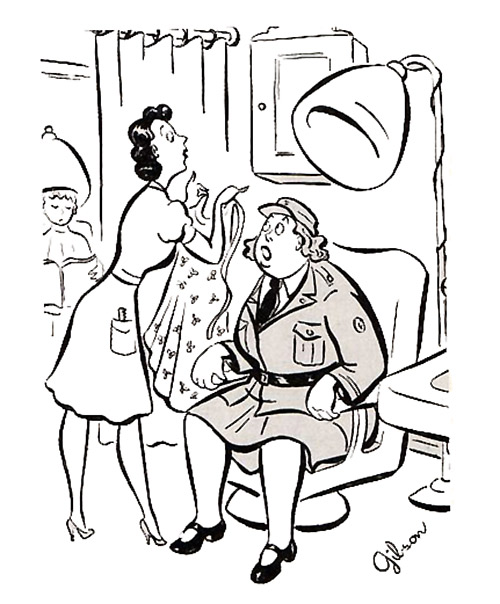
“We’ll have to be quick, Mimi — I’m AWOL.”
Gilson; March 21, 1942
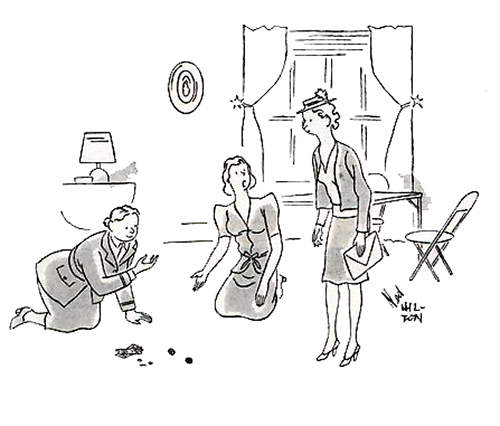
“It’s some game she learned in the Army.”
Ned Hilton; August 22, 1942
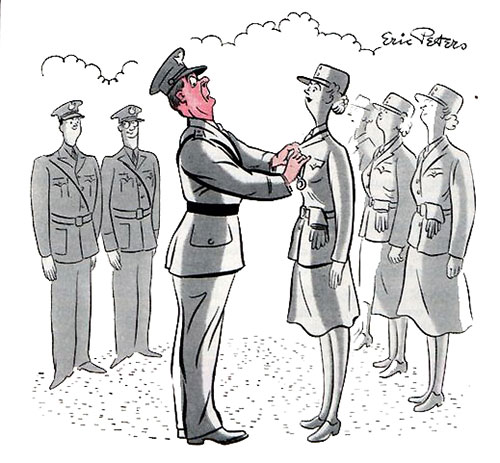
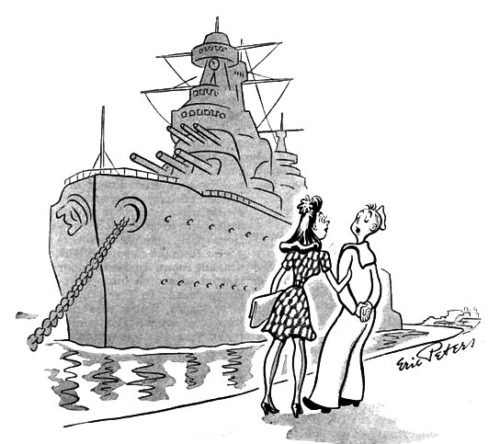
Eric Peters; February 27, 1943
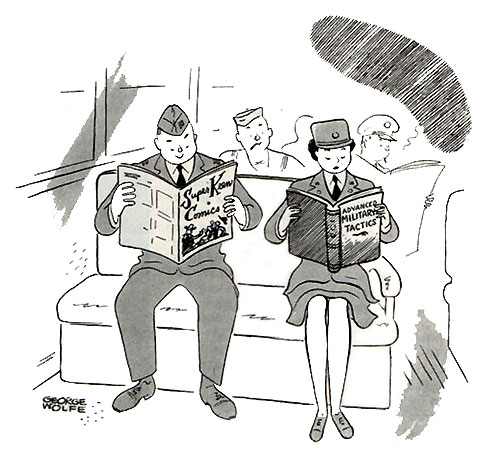
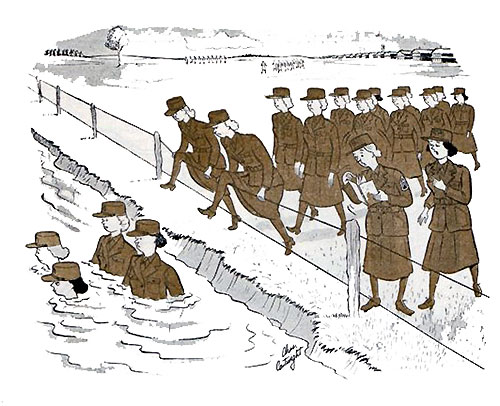
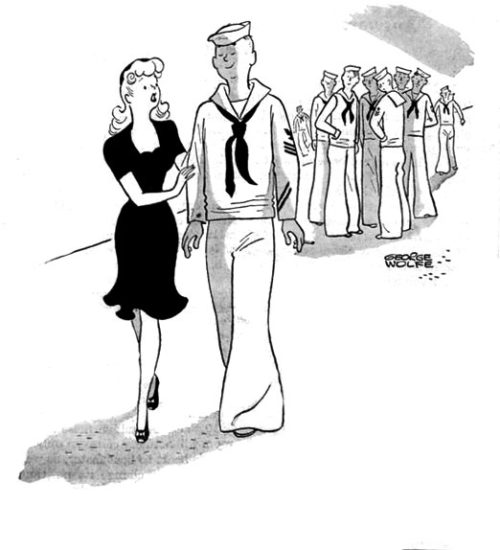
George Wolfe; June 19, 1943
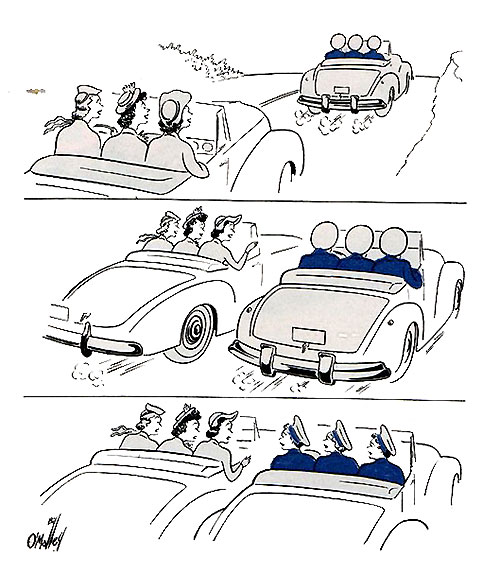
Bill O’Malley; July 10, 1943
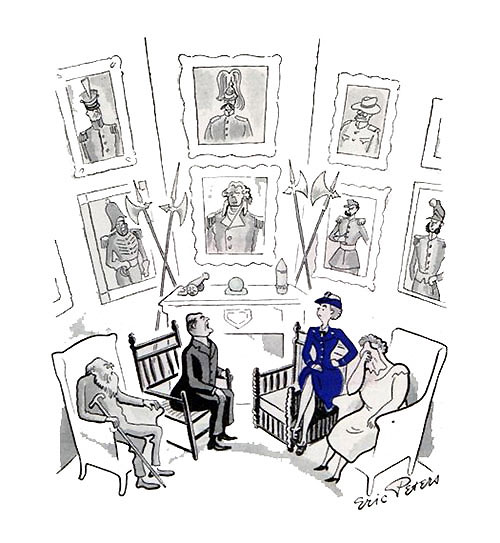
“It is unthinkable, Mildred — a Harrison always goes Army.”
Eric Peters; September 4, 1943
“I think the phrase ‘Column, halt!’ on the next page is what you’re looking for, Sergeant Ditmarle.”
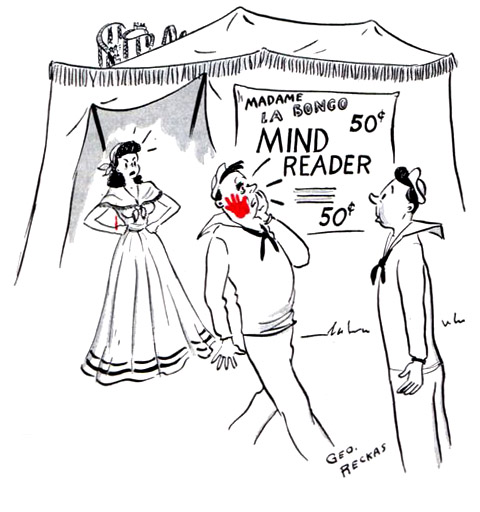
The Saturday Evening Post chronicled the war effort over 70 years ago, and we published cartoonists who found the humor in wartime. We salute the soldiers of World War II in this collection of some of our favorite cartoons depicting life on the base, in combat, or on deck.
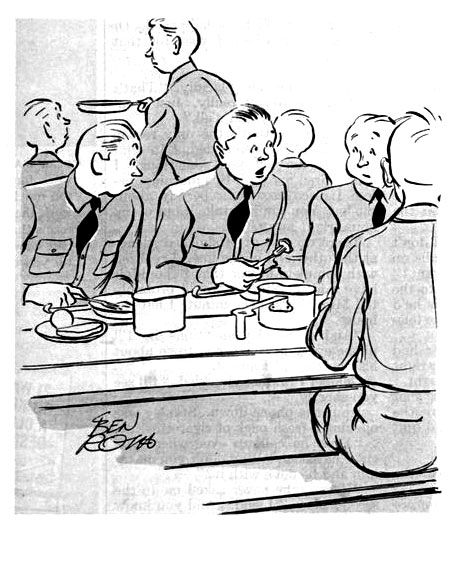
“A horse bit me one time, but I never thought I’d be driven to a reprisal.”
Ben Roth; March 28, 1942
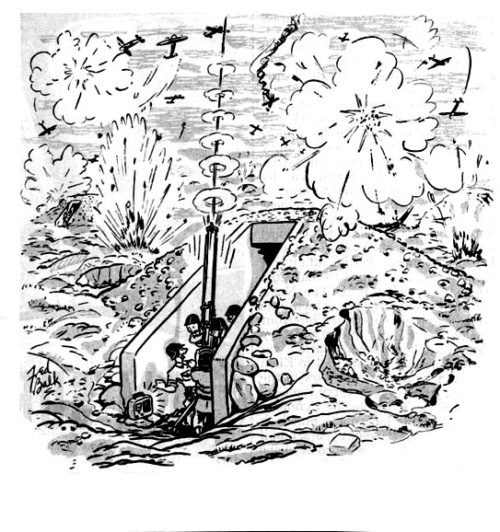
“How would you like to be in that guy’s shoes? Facin’ DiMaggio, with the bases loaded!”
Fred Balk; July 11, 1942
Brandt; November 21, 1942
“I hope you’re not angry with me for taking you away from your friends.”
In the late 1950s and early 1960s, before I was old enough to get a work permit, I delivered newspapers in my suburban Philadelphia neighborhood. You might say it was my first job in publishing. At the time, Philadelphia was a three-paper town: There was the Inquirer, the Bulletin, and the tabloid Daily News. Where I lived, we also had a local paper, the Norristown Times-Herald.
First, I delivered the evening Bulletin (its slogan: “In Philadelphia, nearly everybody reads the Bulletin”) daily and Sundays. It was heavy with advertising, especially on a week leading up to a holiday, and I would pile the papers on a Radio Flyer wagon that I hauled up and down the streets like an undersized tugboat pulling a coal barge upriver. If the weather was especially rotten, my sainted mother would drive me around in the family station wagon. But I was usually on my own — come wind, rain, or snow. After two years humping the Bulletin, I jumped at the chance to deliver the much thinner Times-Herald. The route was smaller, there was no Sunday edition, and it actually paid better. I did that until I landed a job bagging groceries at a local supermarket.
Looking back, being a paperboy was a formative experience. I earned decent money for a 14-year-old; I learned how to sell subscriptions and keep payment records; I got to meet the neighbors (and their daughters). But above all, I got to see the funnies before anybody else. I would cut open the bundle, fish out a fresh copy, and settle back for some chuckles and thrills before heading out on my route.
It was then that I fell in love with comic strips in all their glorious variety — humor, adventure, romance, you name it. I had favorites — Peanuts, Prince Valiant, Pogo, The Phantom, Blondie, Li’l Abner — but I would also get caught up in the soap operas unspooling in the likes of Brenda Starr, Mary Worth, and Rex Morgan, M.D. Over the years, some old favorites faded away, as did the Philadelphia Bulletin, but inventive new strips like Doonesbury, Calvin and Hobbes, Bloom County, and Mutts arrived on the scene and took the comics in wonderful, sometimes challenging, directions.
Today, wherever I am, I still open the paper to the “funny pages” first thing to start my day with a smile. But I am in increasingly diminished company, as newspapers have consolidated or shut down across the country and readership has dropped dramatically. The numbers tell the tale: In 1960, there were 1,763 total daily newspapers (morning and evening) with a total circulation of 58,882,000; in 2014, there were 1,331 with a total circulation of 40,420,000. Meanwhile, average daily newspaper readers are now in their mid-50s and getting older. And reading the newspaper is not a habit with younger generations, who prefer to get their news online (ironically, often at newspaper websites) or via social media like Facebook or Twitter. Even some of my own contemporaries tell me that they don’t read the print newspaper. “Print, how quaint,” they sniff.
Despite such chattering, I believe we can say with assurance that print is definitely not dead and newspapers will endure, albeit as less of a fixture in daily life than in years past. But what do these demographic and digital changes bode for the comics, an indigenous American art form that has entertained hundreds of millions of readers — including me — since the turn of the 19th century?
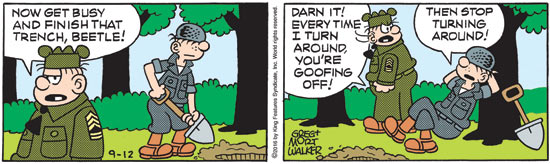
If there’s such a thing as comics royalty, Brian Walker is it. His dad, Mort Walker, created Beetle Bailey in 1950 and is still penciling it at age 93. The perennially popular strip set in Camp Swampy and starring the goof-off private and his nemesis Sergeant Snorkel currently appears in 1,800 papers around the world. (Fact: Like many young artists in the late ’40s and early ’50s, Mort Walker contributed gag cartoons to The Saturday Evening Post before gaining fame with his comic strip. Beetle himself was named after Saturday Evening Post cartoon editor John Bailey.)
The younger Walker is also a historian, the author of The Comics: The Complete Collection (Abrams ComicArts), an indispensable and authoritative (and big!) survey of the strips and artists who have delighted readers from the 1890s to the 21st century, from The Yellow Kid and Little Nemo in Slumberland to Zits and Pearls Before Swine.
“I think of comics as ‘snackables’ that brighten the day.”
—UClick’s John Glynn
In The Comics, he makes a compelling case for the comics as a singular art form, writing, “Cultural elitists relegate comics to the status of ‘low art.’ Cartoon art should not be judged by the same criteria as fine art. Comics are a unique visual and narrative art form, and both elements should be considered when evaluating the work of an individual cartoonist. Comic creations are also the products of the culture within which they are produced. All these factors must be taken into account when developing an appreciation for cartoon art.”
Finally, he’s a cartoonist in his own right, collaborating since the early ’80s with his brother, Greg Walker, and other artists on Hi and Lois, which was created by Mort Walker and the late Dik Browne (Hägar the Horrible) in 1954 and appears in 1,000 papers today. (Fun fact: Hi and Lois Flagston are Beetle Bailey’s sister and brother-in-law.)
So, you take him seriously when he says, “I wouldn’t recommend newspaper cartooning to an aspiring artist — it’s not a growth industry.”
Indeed, with circulation declining and more and more readers getting their news online, print newspapers nationwide have been allotting less space to the funnies. That and canceling strips that don’t score well in reader polls. In a few instances, even the venerable Beetle Bailey has been dropped as struggling newspapers fold or cut costs by eliminating older, more established (and more expensive) strips. Meanwhile, Walker explains, the major syndicates that distribute comic strips are paying “next to no money” to new artists. “They’re practically giving away new strips,” he says.
At the same time, syndicates like Universal Uclick and King Features are putting their comics online for the enjoyment of the millions of fans who don’t read print newspapers or can’t get their favorite strips in their local paper. “The internet changed the game,” Walker says. “The syndicates were rather slow to jump on the web, thinking their newspaper clients would be upset. They’ve since gotten savvier about expanding their presence in social media with sites like GoComics.com and ComicsKingdom.com, blogs, and Facebook.”
Asked to put on his historian’s hat and name a Golden Age of comics, Walker points to the ’30s and an “explosion of creativity” that brought about such classics as Flash Gordon, Dick Tracy, Prince Valiant, Popeye, Blondie, and Li’l Abner. The decade is also memorable, he says, for the rise of the adventure strip with its long-running story lines and danger-defying heroes (e.g., Terry and the Pirates and Mandrake the Magician) that delivered thrills by the panel-full over the years.
Walker then fast-forwards five decades to the emergence of the baby-boomer artists of the ’70s and ’80s who ushered in a “renaissance” of comics art. “The new generation was inspired by Charles Schulz’s multidimensional characters,” he says. Although children, Charlie Brown, Lucy, Linus, and the rest of the Peanuts crew grappled with such adult, existential issues as loneliness, disappointment, failure, and loss. With the massive success of Peanuts, Schulz established that a cartoonist could examine the darker aspects of everyday life and still provoke a smile. For the Me-Generation cartoonists, this was a clarion call: What better life to examine than your own? And the time was right for a new approach. “Tastes had changed,” explains Walker. “Readers wanted to see themselves and their experiences in the strips. In the classic era, the artist was in the shadows, behind the scenes; the boomer artists were more autobiographical. When you read strips like Doonesbury, Cathy, Dilbert, and For Better or Worse, you were getting a glimpse into the lives of the artists.”
The new comics cadre also catered to the irreverent, anti-authoritarian spirit of the times with unconventional, envelope-pushing strips like the (sadly) short-lived The Far Side, Bloom County, and Calvin and Hobbes, this last chronicling the adventures of a wildly imaginative 6-year-old boy and his stuffed toy tiger. “If pressed to name the best comic strip of all times,” Walker says, “I’d have to say Calvin and Hobbes. It works on so many levels.” Indeed, aside from Peanuts, no modern strip has had such an influence and won such acclaim.
Hi and Lois, on the other hand, has been a quiet success for 62 years, as the immutable Flagstons navigate life in suburbia together. With its gentle life lessons and G-rated humor, Hi and Lois offers a sweet counterpoint to the snark and surreal antics of newer strips. “They’re a functional family in a dysfunctional world,” Walker says. “I get nice letters from mothers.”
In the Flagstons’ world, things change over time without really being that noticeable (with the exception of Chip aging into a teenager). “We now have computers, cellphones, flat-screen TVs, and things like that,” Walker explains, “but that’s just the background.”
The one thing sure to never change is the bond between the family members, which can be difficult to capture in a couple of panels. “It’s challenging to show love in a strip,” says Walker, who credits The Family Circus creator and friend Bil Keane with being an inspiration. “He gave me the courage to do things that are sweet and loving.”
But while the Flagston world may change incrementally, Hi and Lois itself has embraced the digital age. There is a Hi and Lois website (HiandLois.com), which attracts thousands of visitors a week with new strips, a weekly blog by Walker, and access to an archive of decades of vintage strips. And these days, the classics must maintain a presence on social media: both Hi and Lois and Beetle Bailey have Facebook pages boasting more than 2,500 likes each.
In another telling sign of the times, Walker’s own comics-reading habits have changed. “I buy the Sunday paper,” he reports, “but for daily comics, I go online to the syndicate sites where I can keep up on strips that never run in my local paper.”
Asked about the condition of the newspaper comic strip today, King Features Syndicate Editor Brendan Burford paraphrases Mark Twain’s famous line: The report of its death was greatly exaggerated.
Yes, he acknowledges, print has been in decline, but “there’s no reason to think because there’s a contraction in newspapers that people are going to stop reading and enjoying comics. Overall, our business has been stable.”
Launched in 1915 by legendary publisher William Randolph Hearst, King Features is the second-largest comics syndicate after Universal Uclick. It currently syndicates 62 comic strips to newspapers worldwide and maintains an extensive archive of vintage strips on its website, ComicsKingdom.com. The King Features roster runs the funnies gamut: from boomer faves Mutts and Baby Blues to such old-school stalwarts as Mary Worth and Mark Trail — along with some of the biggest titles in the business. “The number of comic strips we license to more than a thousand clients — strips like Dennis the Menace, Hägar the Horrible, Family Circus, Beetle Bailey — is remarkable,” Burford says. “That’s rare air.”
Still, growth is hard to come by, especially in newspapers, where King Features is competing for space with other syndicates. “Our newspaper clients want something fresh,” says Burford, who has seen tastes change in his 15 years at the syndicate. Adventure comics are on the wane, as readers get their escapist satisfaction in comic books, television, and movies. “People now want to see themselves and their friends,” he says, echoing Brian Walker. “They want a reminder that life has levity.” To prove the point, he cites the enormous popularity of Zits, which features the foibles and fantasies of teenager Jeremy Duncan — and the reactions of his often perplexed parents. “It’s a reflection of today’s family.”
To find that “something fresh” for his clients, Burford sifts through “thousands of submissions” from would-be syndicated cartoonists every year. Sadly, of those few that show promise, he says, “I can only run with one or two” in today’s tight market — which can be frustrating for a syndicator. “I wish we could represent all the talent we like.”
As for the 62 active strips it does represent, King Features has assembled the whole batch, along with a library of vintage comics, on the web at ComicsKingdom.com. For fans of the funnies, this is liberating stuff. No longer get Crankshaft or Judge Parker in your local paper? You can catch up with them online. Or browse past installments of classics like Krazy Kat, The Katzenjammer Kids, and Popeye. Even better, you can subscribe to the site and have your favorite strips emailed to you daily.
Over at rival syndicate Universal Uclick, President and Editorial Director John Glynn remembers being told in 2000 that there “wouldn’t be newspapers by 2010.” Nearly seven years past that deadline, the largest independent syndicate in the world represents more than 80 active comic strips in approximately 2,000 papers worldwide, including such legendary strips as Garfield, Doonesbury, Peanuts, and Dilbert — all of which appear in thousands of newspapers around the world — plus offbeat hits like Pearls Before Swine, Foxtrot, and Get Fuzzy. “Newspapers will be here, one way or another,” says Glynn, “and it wouldn’t be a newspaper without comics.”
Universal Uclick also runs a website, GoComics.com, where funnies fans can browse day-of-publication installments of Universal Uclick’s active strips, plus an archive of such classics as Peanuts, For Better or For Worse, Dick Tracy, and Alley Oop. One of the beauties of the web, he says, is “there is no limitation to the real estate.” Which makes it possible for them to distribute some 400 strips digitally. (In a bit of irony, they syndicate comics to newspaper sites looking to improve on their limited print offerings. “They can carry as many as 40 to 60 strips online with us,” Glynn says.)
In Glynn’s view of the future, “newspapers will hang on” while the funnies will continue to find new markets. “We’ll deliver comics to wherever people are reading them,” he says, “be it newspapers, desktops, tablets, or smartphones. I’m a big believer in the medium,” Glynn says, “I think of them as ‘snackables’ that brighten the day.”
Glynn might have had Pickles in mind. The award-winning, G-rated, gag-a-day strip that celebrated its 25th anniversary in 2015 is a welcome tonic in trying times. A former graphic designer turned cartoonist, Pickles creator Brian Crane takes a sweetly wry look at the lives of 70-something retirees Earl and Opal Pickles and their family and pets. Married 50 years, Earl and Opal have learned to (sometimes grudgingly) accept each other’s quirks as they grow old together, while imparting their accumulated wisdom and humor to the younger generations.
Looking back, Crane considers himself lucky to be where he is today. “I was a long shot to get syndicated,” he says. “You’d get better odds at a racetrack.” Nevertheless, the 40-year-old novice had encouragement on the homefront — “my wife kept pushing me to submit my work” — and after only three rejections, he was a syndicated cartoonist, right in the midst of what was allegedly an imploding market for newspaper comics. “That’s what they told me in 1990, and papers have gone out of business on me,” he says. “But I’ve weathered the storm pretty well. I’m almost always on top of reader polls, and I’m closing in on 1,000 papers.”
Not surprisingly, the Pickles readership skews older — but not exclusively. “When I speak at events,” Crane says, “there’s a lot of gray hair in the audience, but I do well with younger folks in reader polls.” How to account for the strip’s multigenerational appeal? “I’ve heard it from folks a thousand times,” says Crane. “They tell me, ‘You must have a microphone hidden in our home!’” It doesn’t hurt that Crane maintains a strong digital presence. Pickles is carried online by GoComics.com/Pickles and ArcaMax.com, where it is enjoyed by tens of thousands of fans. And the Official Pickles Comic Page on Facebook — which posts the daily strip, past favorites, videos, reader comments, and personal shares — had amassed more than 34,000 likes at last count.
Crane’s hero is Charles Schulz, whose approach to Peanuts and life Crane admires. “He was humble and kind,” he says. “He never went the easy route, never coasted.”
It’s an ideal that Crane tries to follow in a hyper-competitive business. “I can’t rest on my laurels,” he says. “My daily challenge is to be funny today. I keep trying to surprise myself, looking to find things in my own life that spark ideas.” He doesn’t have to look all that far: With seven children and 11 grandchildren of his own, Crane literally inhabits the world of doting — and occasionally dotty — grandparents Earl and Opal Pickles.
There has always been an underlying purpose to Pickles, Crane says, which is “to point out that being older is a good time to be alive; to laugh at the foibles of growing old.” And, today, 26 years after breaking into the comics business, he wouldn’t change a thing about his own life: “From my myopic point of view, it’s a nice situation for me. I write something that makes me happy.”
Like Brian Crane, Pearls Before Swine creator Stephan Pastis ditched a paying career to follow his dream. Unhappy with practicing law in the San Francisco Bay area in the mid-’90s, he decided “I have to do something else” and began cartooning. Pastis studied Dilbert to learn how to write a three-panel strip. In a bold step, he approached Charles Schulz himself at a Northern California skating rink coffee shop and asked for advice. (Schulz was gracious and helpful.) He also recruited Darby Conley of Get Fuzzy fame for input on coloring the artwork. After submitting various strips “five or six times” to syndicates, he clicked with Pearls Before Swine, which debuted online in 2000 in a test by United Features Syndicate, and then in newspapers on December 31, 2001. In 2002, he quit his day job and became a full-time cartoonist.
“It’s sheer, dumb luck it worked.” —Artist Stephan Pastis describing Pearls Before Swine
Today, Pearls Before Swine is carried by 750 papers worldwide and growing. The strip (gocomics.com/pearlsbeforeswine) chronicles the exploits of Rat, Pig, Goat, Zebra, and a crew of delightfully dimwitted Crocs who speak with a mysterious, unidentifiable accent. Regular targets of his snarky humor include vegans, bikers, other strips (e.g., Cathy, The Family Circus), and sometimes even Pastis himself. Often controversial for its adult humor and eagerness to test the boundaries of propriety (is that a swear word I see?), Pearls Before Swine has nevertheless won the National Cartoonists Society’s Best Newspaper Comic Strip award three times and been nominated eight times for the Reuben Award, the society’s highest honor. “You’re not artistic or creative if you’re not pushing the boundaries,” he says.
Part of the secret is being true to himself. “If you write honestly, your body of work reveals who you are,” he says. “If you’ve read the strip faithfully for 15 years, you know me as well as my relatives.”
It’s a successful approach that no longer relies on newspapers alone. Cartoonists today need to diversify and self-promote relentlessly. “To be famous these days, you have to be famous in a number of piles — newspapers, books, music, cable, social media,” Pastis says. “Everybody is hustling harder, even a superstar like Bruce Springsteen has to do a lot more promotion than he did in the ’70s.” There are 18 Pearls Before Swine collections and eight treasuries, plus merchandise (T-shirts, mugs, plush animals, etc.), and Timmy Failure, a best-selling series of chapter books aimed at middle schoolers. The Stephan Pastis Facebook page has upwards of 154,000 likes as this article goes to press. “It’s a revolution,” he declares. “The winners will adapt. With the internet, you now have the ability to address people directly and react to events quicker. I have more fans in Mumbai than in any other city in the world.”
Of course, all the marketing and promotion in the world won’t sell your work if it doesn’t strike a nerve. A sociologist might say the secret to the success of Pearls Before Swine lies in Pastis’ ability to tap into the current snarky zeitgeist using angry Rat, naive Pig, bookish Goat, even the inarticulate Crocs, as his stand-ins. The artist himself makes no such claim, suggesting instead, “It’s sheer, dumb luck it worked.”
I’m sure Rat would disagree.
As a lifetime fan of the funny pages, I’m gratified that many of the great ones continue to thrive. As Brian Walker writes in The Comics, this particular art form has endured because the funnies have timeless appeal. “Their daily appearances make them familiar to millions. Their triumphs make them heroic. Their struggles make them seem human. Cartoonists create friends for readers. Pogo, Peanuts, Calvin and Hobbes, and Dilbert are part of a great cultural legacy that is being further enriched every day. The final panel has yet to be drawn.”
During World War II men ages 18-65 were required to register with selective service. Across the country, American men waited for the “lottery” to call their number. Like other World War II conventions, conscription became a target in The Saturday Evening Post cartoons of the 1940s. Our cartoonists searched for the lighter side of local draft boards, draft classifications, and the dreaded rejection!
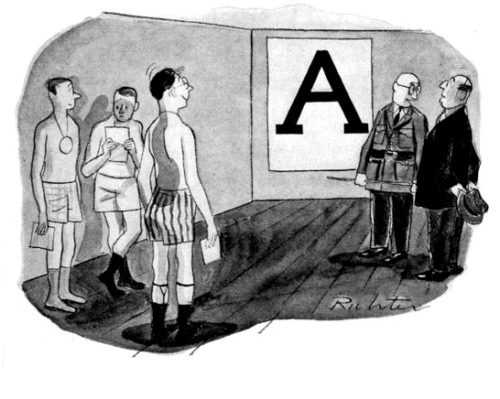
“We’ve relaxed our requirements just a bit.”
Misha Richter; December 19, 1942
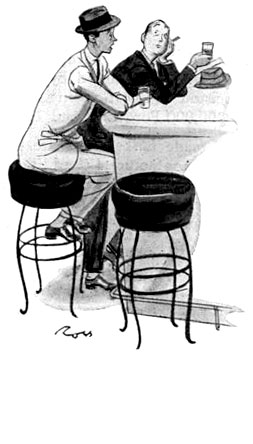
“Friends of the family? Oh, no, sir — we were just passing by.”
Al Ross; January 16, 1943
“I’ve been trying for 15 years to get my affairs in order, and now my draft board expects me to do it in 10 days.”
June 5, 1943
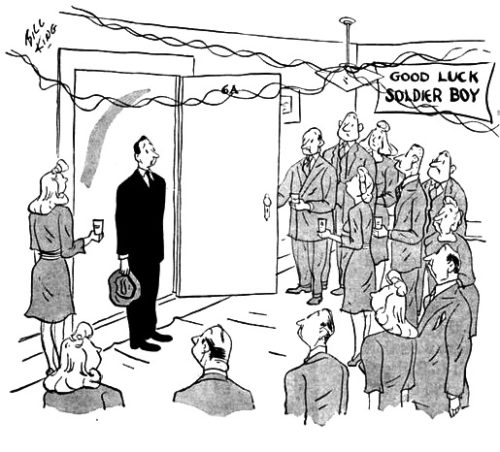
“I was rejected.”
Bill King; October 16, 1943
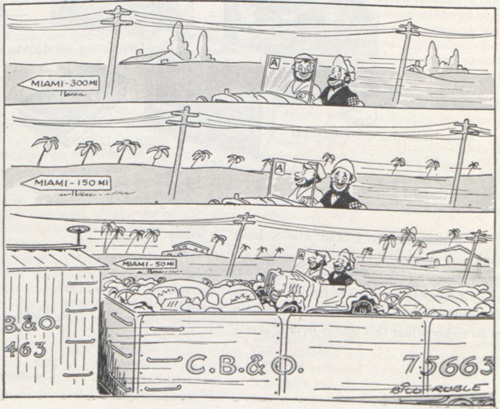
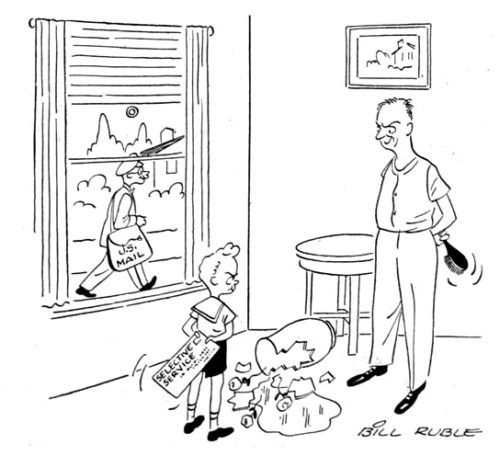
Bill Ruble; November 13, 1943
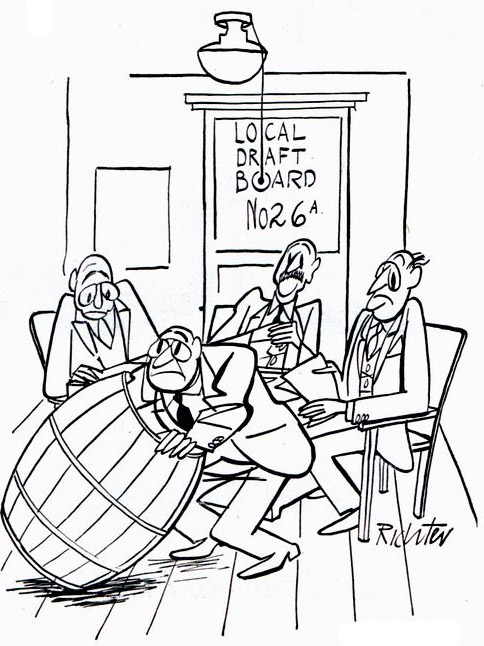
Mischa Richter; February 19, 1944
“He was recalled to duty just as the picture was taken!”
What’s the secret to being a successful comic strip artist? “It takes the right combination of being kind of smart without being too well educated,” said Charles Schulz in 1957. Many of the legendary comic strip artists got their start in the pages of The Saturday Evening Post. Here’s a sampling from our archive:
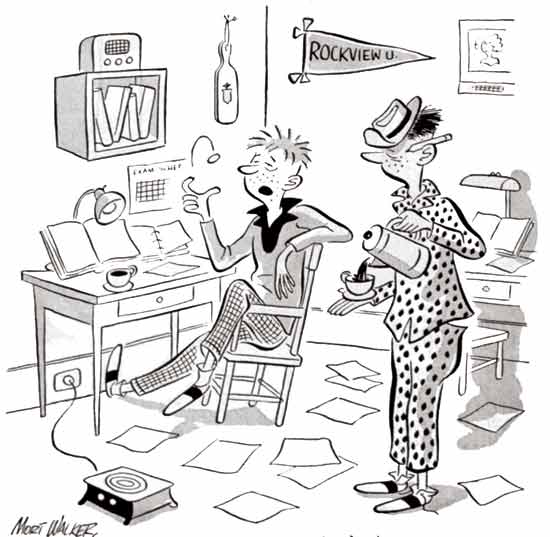
Beetle Bailey creator Mort Walker, The Saturday Evening Post, November 27, 1948
“Okay, Spider, heads we join the Army, tails we go on studying for final exams.”
Peanuts creator Charles Schulz, The Saturday Evening Post, January 1, 1949
“I sleep well enough at night … it’s living during the day that I find hard.”
Peanuts creator Charles Schulz, The Saturday Evening Post, May 21, 1949
“We’re close enough … let’s try for a field goal!”
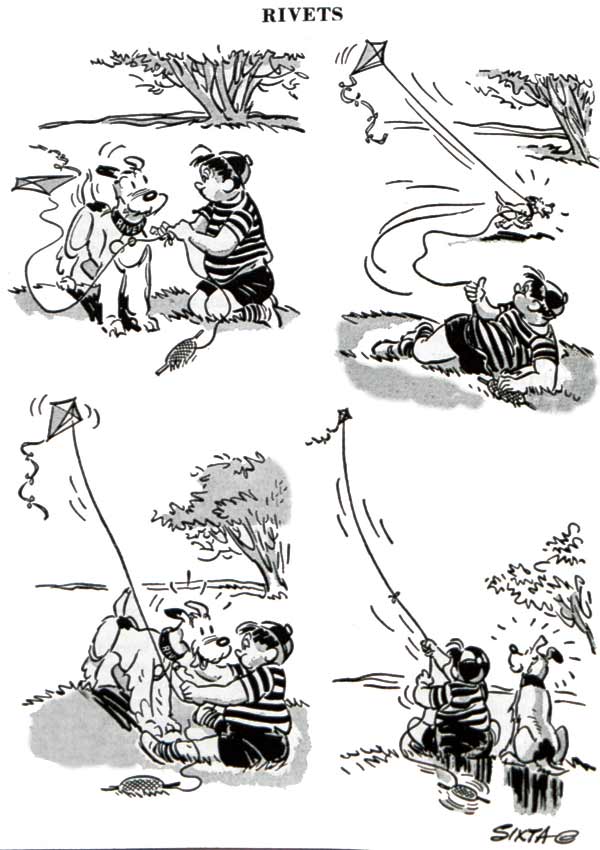
Rivets and Hit or Miss creator George Sixta, The Saturday Evening Post, May 21, 1949
Beetle Bailey creator Mort Walker, The Saturday Evening Post, June 17, 1950
Father’s Day
B.C. and Wizard of Id creator Johnny Hart, The Saturday Evening Post, June 12, 1954
“Why can’t you ask for rolls like anyone else?”
The Family Circus creator Bil Keane, The Saturday Evening Post, July 4, 1959
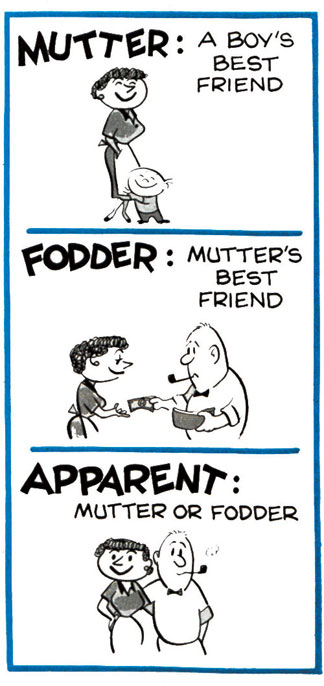
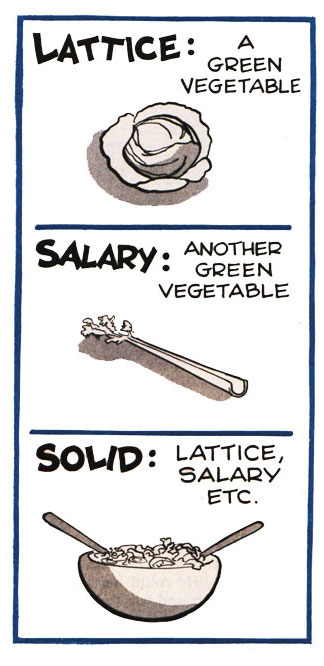
Pun-Abridged Dictionary
The Family Circus creator Bil Keane, The Saturday Evening Post, July 25, 1959
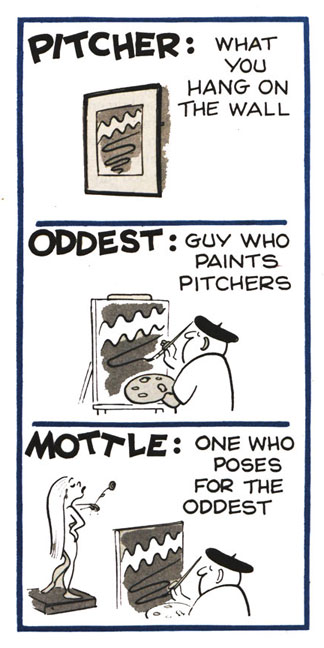
Pun-Abridged Dictionary
The Family Circus creator Bil Keane, The Saturday Evening Post, August 8, 1959
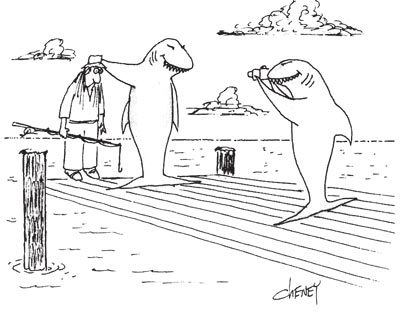
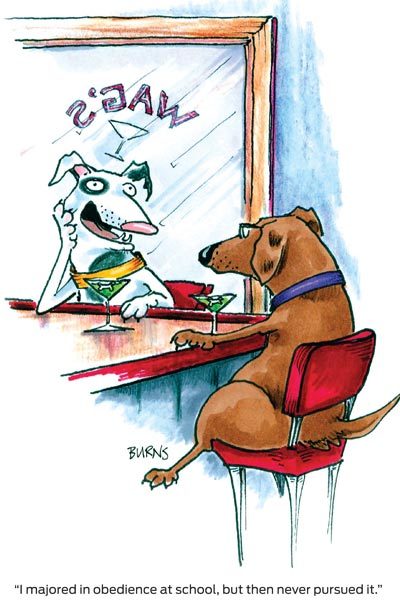
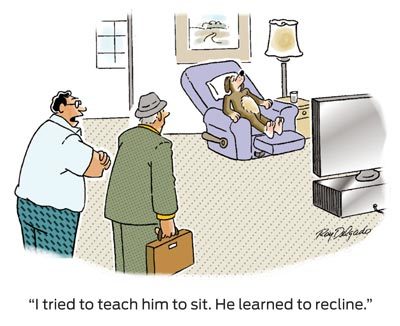
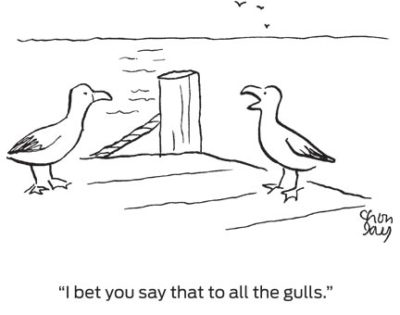
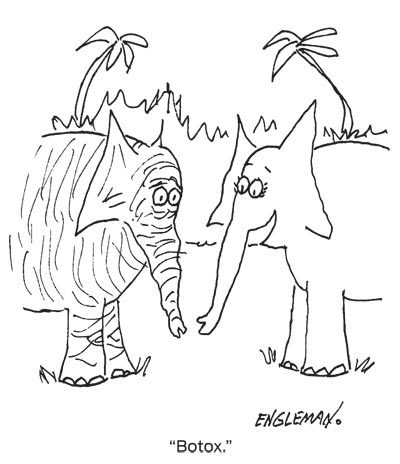
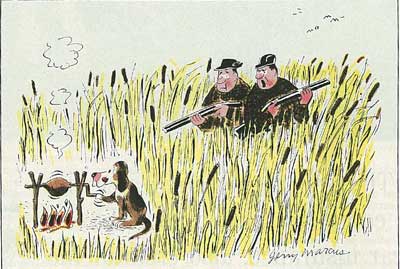
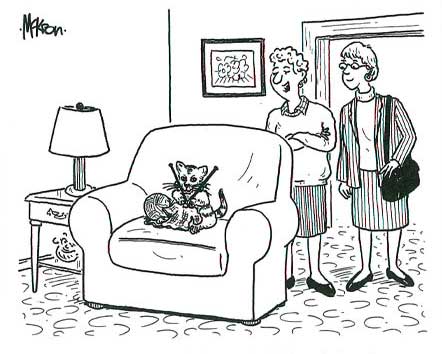
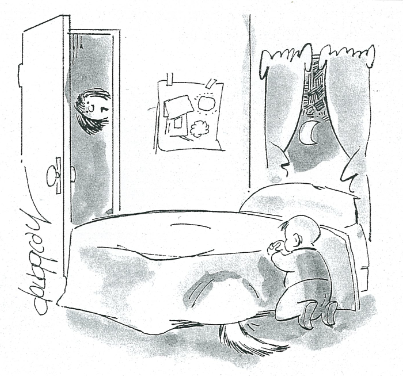
From Garfield and Heathcliff to Snoopy and Marmaduke, people love to laugh at animals doing normal human things, like sitting at a bar or surfing the Internet. The Saturday Evening Post has published its share of original and hilarious animal cartoons over the years. The following frames from our Special Humor Issue, featuring our favorite frantic and fantastic fauna, give new meaning to the phrase “funny farm.”
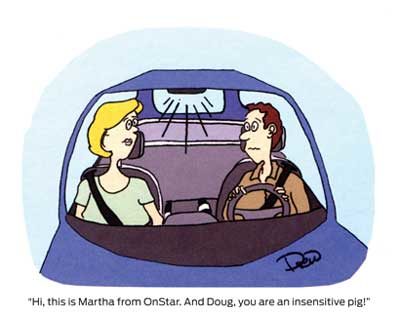
It’s no secret that technology has taken over, from how we travel to our interactions with other people. Keeping with The Saturday Evening Post’s cartoon tradition, we’ve found some hilarious illustrations about our modern world. These cartoons poke fun at all the ways technology has seeped into our lives, from TSA x-rays to tech in schools. The following are just a glimpse of the laugh-out-loud cartoons in our Special Humor Issue.
From fad diets to weight-loss pills to fitness regimes, The Saturday Evening Post cartoonists love to poke fun at our struggles to live healthy. In our special humor issue, couch potatoes, confused dieters, and witty doctors crack wise in cartoons from some of our favorite artists — like the ones below.