Spanish Pasta
Most people associate pasta with Italian cuisine, but this main dish has a decidedly Spanish flair. Saffron, a popular spice in many Spanish dishes, infuses an earthy, hay-like flavor and beautiful yellow-orange color. Saffron is the dried tiny threadlike strands of the fall flowering crocus, also known as the saffron crocus—a member of the iris family. Although it’s the world’s most expensive spice by weight, very little is needed to flavor and color food.
Spanish cuisine is also ripe with olives. Note that if seasoning with salt, go a little lighter because olives contribute to the saltiness of the sauce as do the capers. The capers, which are the unripened, pickled flower buds of a prickly perennial plant native to the Mediterranean and some parts of Asia, round out the Latin flavor with their tangy, lemony essence.
Add your favorite green salad and you have a complete, nutritious meal featuring an old favorite—spaghetti—in a new Spanish style.
Spanish Spaghetti
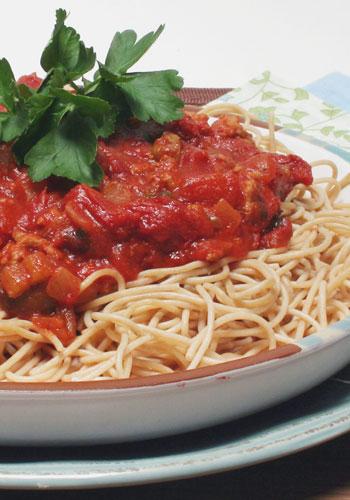
Makes 6 servings.
Ingredients
- 1 tablespoon extra virgin olive oil
- 2 medium yellow onions, chopped
- 1 large stalk celery, cut into 1/4-inch pieces
- 5 cloves garlic, minced
- ¼ cup chopped sundried tomatoes
- 8 ounces ground turkey (lean ground beef may be substituted)
- 2 (14.5-ounce) cans no salt added diced tomatoes
- 2 (6-ounce) cans tomato paste
- ½ cup water
- ¼ teaspoon red pepper flakes or to taste
- Salt and ground black pepper to taste
- 1 teaspoon dried oregano
- ¼ teaspoon crushed saffron threads, optional*
- ⅓ cup pimento stuffed queen olives, coarsely chopped (black olives may be substituted)
- 2 teaspoons capers, rinsed
- ¼ cup chopped fresh parsley, divided
- 8 ounces whole-wheat angel hair pasta
*Tip: Saffron is also available in powdered form. Be careful if buying the powdered variety because it is sometimes combined with turmeric or other less expensive substances. The powdered spice also loses its flavor more quickly than the threads. You can recognize good quality threads because they are bright red but have a dark shade with tips that have a slightly lighter shade, indicating that they are natural and have not been dyed to look darker. Some threads include a small amount of yellow, which usually means that they are not as strong.
Saffron is very sensitive to heat and light, so it should be stored in a cool, dark, and dry location. High humidity can cause it to smell musty and make it age faster. If stored properly, it can last for several years. Before cooking, place saffron in small bowl and add 1 to 2 tablespoons hot water. Let it sit until dissolved, about 20 minutes, before using.
Directions
- In large pot, heat oil over medium-high heat. Add onions and celery and sauté for 4 minutes.
- Add garlic and sun dried tomatoes and sauté 2 minutes. Add turkey and sauté 6-8 minutes, until thoroughly cooked and beginning to brown.
- Stir in diced tomatoes and tomato paste. Add water-use less for thicker sauce. Mix gently until well combined.
- Sprinkle in red pepper, salt, pepper, dried oregano, saffron, olives, capers and half the parsley. Cover and bring to a boil.
- Uncover and reduce heat and let sauce simmer for at least 15 minutes, stirring gently and fairly frequently. Meanwhile, cook paste al dente according to package instructions. Set aside.
- Either add pasta to sauce and combine or rinse pasta with hot water and place on serving dishes and top with sauce. Sprinkle with remaining parsley. Serve.
Nutrition Facts
Per serving
Calories: 330
Total fat: 7 g
Saturated fat: 1.5 g
Carbohydrate: 54 g
Fiber: 10 g
Protein: 16 g
Sodium: 490 mg
The Genius in Lincoln’s Gettysburg Address

After 150 years, the Gettysburg Address remains one of the most powerful speeches ever delivered. It is also one of the most surprising. In just 270 words, a self-educated, frontier lawyer managed to convey a sense of national loss and give purpose to America’s civil war. He also produced as fine a work of prose as any American has ever created.
In 1959, historian Jacques Barzun invited Post readers to take a closer look at “Lincoln The Literary Genius.” If you only knew Lincoln from his Gettysburg speech, he wrote, you might get the impression of a man who sat down one day and wrote a masterpiece. But Lincoln had been working on his unique style for a lifetime before he spoke at the Gettysburg cemetery.
His talent with words seemed to come from nowhere. Certainly it wasn’t anything he learned; Lincoln’s formal education amounted to less than a year of instruction spread thinly across his youth. Learning all he could from borrowed books and stolen hours of reading, he left home and drifted between jobs, finally studying law and entering politics. It would have seemed like one more of Abe Lincoln’s poor career choices because, on the surface, he had little appeal. He was awkward, homely, ill-dressed, unkempt, and spoke with a high, nasal voice.
But his years of riding the court circuit in Illinois had taught him how to capture and hold the attention of strangers. He learned how to translate questions of law into simple, clear choices. He spoke in a comfortable, familiar style, which narrowed the emotional distance between himself and his audience. And when necessary, he could drop into joking talk, mimicking the drawl and twang spoken by Illinois farmers.
Lincoln learned to write standing up; that is, he developed his clear, powerful style while he honed his oral arguments for court. As a result, his writing and his speeches have a similar clarity and cadence. But Lincoln had a special genius for order and brevity, Barzun claimed; he presented his thoughts in the most convincing sequence using the least words. Barzun also stressed Lincoln’s gift for rhythm, illustrating it with a fragment from a lecture by Lincoln.
“There is a vague popular belief that lawyers are necessarily dishonest. I say vague, because, when we consider to what extent confidence and honors are reposed in and conferred upon lawyers by the people, it appears improbably that their impression of dishonesty is very distinct and vivid. Yet the impression is common, almost universal. Let no young man choosing the law for a calling for a moment yield to the popular belief—resolve to be honest at all events; and if in your own judgment you cannot be an honest lawyer, resolve to honest without being a lawyer.”
“The paragraph moves without a false step,” Barzun observed, “neither hurried nor drowsy; and by its movement, like one who leads another in the dance, it catches up our thought and swings it into willing compliance. The ear notes at the same time that none of the sounds grate or clash: The piece is sayable like a speech in a great play.”

Lincoln never mastered the florid, wordy style that kept 19th Century audiences enraptured for hours. The admirers of fine oratory found Lincoln’s speaking style “flat, dull, lacking in taste,” Barzun wrote. When they came to the dedication ceremony at the Gettysburg cemetery, November 19, 1863, they were more interested in hearing the keynote speaker, Edward Everett.
The difference between Lincoln’s and Everett’s speeches that day illustrates the changes taking place in American thought and style. Lincoln spoke for two minutes. Everett spoke for two hours. Lincoln’s opening sentence, “Four score and seven years…,” was a concise statement of American principles. Everett began his speech with this windy fanfare:
“Standing beneath this serene sky, overlooking these broad fields now reposing from the labors of the waning year, the mighty Alleghenies dimly towering before us, the graves of our brethren beneath our feet, it is with hesitation that I raise my poor voice to break the eloquent silence of God and Nature. But the duty to which you have called me must be performed;–grant me, I pray you, your indulgence and your sympathy.”
In Everett’s defense, he knew what made a good speech. He wrote Lincoln on the following day, telling him, “I should be glad, if I could flatter myself that I came as near to the central idea of the occasion, in two hours, as you did in two minutes.”
The lean but powerful beauty of Lincoln’s prose impressed itself on Americans’ minds as generations of schoolchildren committed it to memory. It helped influence American writers to favor clarity over ornamentation. And its lean style, free of sentimentality and romanticism, brought a new honesty to the way Americans though about the Civil War.
Hospice Girl Friday | ‘Just Being There’
Devra Lee Fishman’s dear friend and college roommate, Leslie, died from breast cancer one month shy of her 46th birthday after a four-year battle with the disease. Being with Leslie and her family at the end of her life inspired Devra to help care for others who are terminally ill. Each week, she documents her experiences volunteering at her local hospice in her blog, Hospice Girl Friday.
I’ve been playing clarinet in a community band for 20 years. We rehearse Wednesday evenings for two hours in a local high school and perform in retirement homes and parks every other month. There are no auditions required and no age limits, so we have members who are just out of college and people who recently retired and started playing their instruments after a 50-year career hiatus.
When I first joined the band I was working full-time and I rushed to get to rehearsal every week. Other than the rest of the clarinet section and a flute-playing friend I had recruited, I didn’t know anyone else’s name. There wasn’t time to socialize during rehearsal, and I didn’t stick around afterward because I needed to get up early for work the following day.
That all changed when I stopped working and could linger after rehearsal to chat with some of the other musicians. I learned that a clarinet player who sat next to me for more than 10 years was a former nuclear physicist, and one of the trombonists—Frank—once commanded a submarine and was married for more than 40 years to Betty, a French horn player also in the band.
When I got married I encouraged my husband Jim to dust off his trumpet and join the band, which he did in the fall of 2011. Jim introduced himself at his first rehearsal (a band ritual) and announced that he was married to me. This seemed to delight Frank so much that he made his way over to Jim that evening to share stories about being happily married to another musician. Often Frank, Betty, Jim, and I would walk out to our cars together after rehearsal chatting about superficial stuff like the weather, a recent concert we played, or our new conductor’s sense of humor.
Last summer Frank was diagnosed with inoperable brain cancer. He underwent chemotherapy and for several months and it seemed to keep the cancer at bay, but earlier this year we watched Frank get weaker and thinner. He still came to band, but talking was difficult for him, and then impossible as the cancer affected his ability to speak. At rehearsal about a month ago, I looked over and saw Frank slumped in his chair with his trombone across his lap while the rest of his section stood and played the final ‘big brass’ strain of Sousa’s “Stars and Stripes Forever.” When Jim and I were leaving that evening we noticed Frank shuffling behind a walker with one band member carrying Frank’s trombone and Betty guiding him to their car.
I know from my hospice volunteering and from spending time with my friend Leslie at the end of her life that being a caregiver can be physically and emotionally draining, so when I got home that night I sent an email to Betty saying just that. I offered to come over and stay with Frank while she ran errands or took a walk. I told her I knew we weren’t close friends, but we were part of the same band family and I hoped she would take me up on my offer. To make it easier for her to accept, I suggested a few specific dates and was delighted when she replied to my email to lock in a time. In her note she told me she was grateful for the chance to go to the mall in order to have Frank’s cell phone transferred over to her, a seemingly mundane task that she hadn’t been able to do because Frank was no longer able to walk on his own.
Jim wanted to come with me. I told him that, according to Betty, Frank would likely be sleeping when we got there since we would arrive just after a visit from his hospice nurse. When we arrived, Frank was sitting on their sofa with the day’s newspaper draped in his lap. He gave us a weak smile when we greeted him, and then a gauze curtain dropped behind his eyes as he tried and failed to stay focused on us. As soon as Betty left, he nodded off and slept until she returned two hours later. I gave her a hug when we said goodbye, and she fought back tears as she thanked us for coming over.
That evening I told Jim I was glad he came with me. I liked having him there and I believe Frank did too. Jim said, “I know you’re around people like Frank every week at the hospice, but I was kind of scared. I’m not used to being with people who are sick like that, and I don’t know what to do or say.”
“I’ll tell you a secret,” I said. “I’m scared too. Every time I go into a patient’s room I get nervous. And today, for a split second as we walked into Frank and Betty’s house, I felt that old familiar flutter of fear that I am not qualified to be around someone who is terminally ill. But I’ve learned that simply showing up and saying ‘I am here with you’ is all that a patient or their loved one needs to know they are not going through this horrible thing alone. You did that today for Frank and Betty.”
“Wow,” he said, “I never thought about it that way.”
Frank passed away two weeks after our visit, and Betty came to band rehearsal the following Wednesday. During our break I went over and sat quietly next to her as people stopped to chat and pass along their condolences. I wanted Betty to know that she was not alone in that moment, even though she was surrounded by our bandmates. As I left to go back to my seat, I offered my help again and this time she said, “Maybe in a couple of weeks we could just get together and talk.”
I’ll be here for her whenever she’s ready.
Note: Names have been changed to protect privacy.
Previous post: Learning How to Listen Next post: Coming Home to Say Goodbye
Curtis Stone’s Leek and Herb Stuffing
The true name for a stuffing that is not actually stuffed into food is dressing. I don’t want to break any rules, but stuffing sounds so much more appetizing to me.
Leek and Herb Stuffing
(Makes 8 servings)
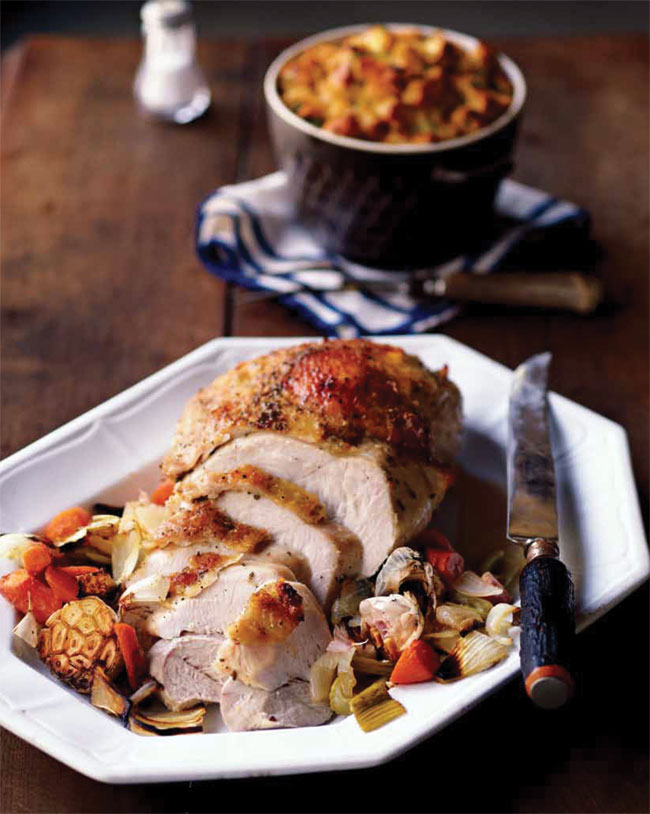
Ingredients
- ½ pound (2 sticks) unsalted butter, cut into ½-inch cubes, plus butter for baking dish
- 1 pound French or Italian bread, cut into ¾-inch cubes
- ¼ cup olive oil
- 1 large yellow onion, finely chopped
- 4 medium leeks (white and pale green parts only), well rinsed and finely chopped
- 5 celery ribs, cut into ¼-inch pieces
- 6 large sprigs of fresh thyme
- 2 sprigs of fresh rosemary
- 6 garlic cloves, finely chopped
- ¾ cup dry white wine
- 2 cups reduced-sodium chicken broth
- ⅓ cup finely chopped fresh flat-leaf parsley
- Kosher salt and freshly ground black pepper
- 2 large eggs, lightly beaten
Directions
- Preheat oven to 350°F.
- Butter 13″ x 9″ x 2″ baking dish.
- Spread bread on large, rimmed baking sheet.
- Bake for about 15 minutes, or just until dried but not browned. Let cool.
- Meanwhile, heat large deep skillet over medium-high heat. Add olive oil, then add onions and cook, stirring occasionally, for about 3 minutes, or until they soften.
- Add leeks, celery, thyme, and rosemary and cook, stirring often, for about 4 minutes, or until leeks are translucent.
- Stir in garlic and continue cooking, stirring often, for about 5 minutes, or until vegetables begin to brown. Add wine and cook for about 2 minutes, or until wine has evaporated but vegetables are still very moist.
- Add broth and butter, bring to simmer, and simmer for about 5 minutes, or until liquid is reduced by half.
- Transfer to large bowl and let cool slightly; remove and discard rosemary and thyme stems.
- Stir parsley into leek mixture. Add bread cubes and mix well. Season to taste with salt and pepper. Mix in eggs.
- Spread stuffing in baking dish and cover with aluminum foil. Bake for about 30 minutes, or until stuffing is heated through and puffed.
- Remove foil and continue baking stuffing for about 40 minutes longer, or until golden brown. Serve hot.
Nutrition Facts
Per serving
Calories: 483
Total fat: 33 g
Saturated fat: 16 g
Carbohydrate: 35 g
Fiber: 4 g
Protein: 9 g
Sodium: 420 mg
 © 2013 Curtis Stone, published by Random House.
Curtis Stone’s Banana Bread with Lots of Toasted Walnuts
Banana bread is the perfect thing to have on standby. Serve it to guests who pop in. This recipe is full of walnuts to give the bread an extra burst of toasty flavor.
Banana Bread with Lots of Toasted Walnuts
(Makes 8 servings)
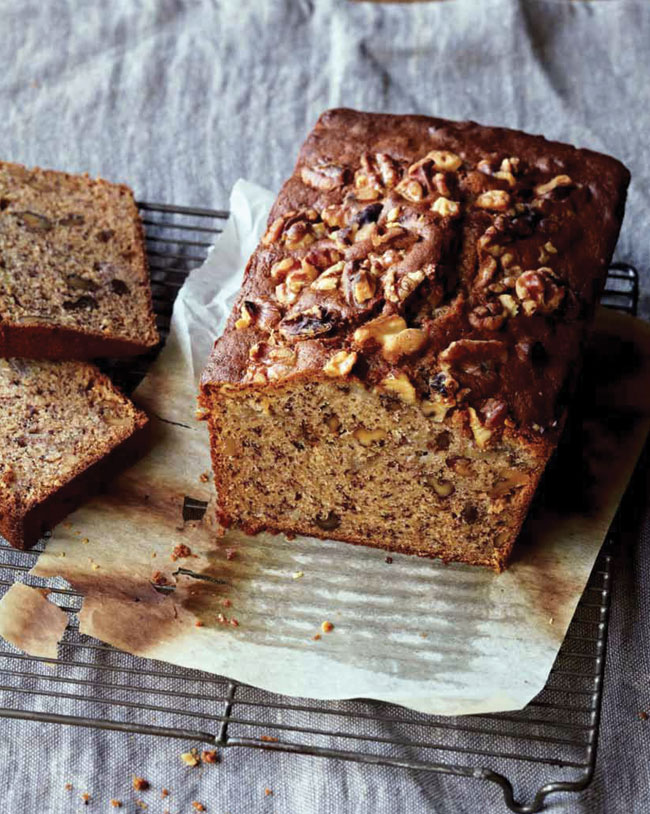
Ingredients
- Nonstick cooking spray
- 2 cups walnuts
- 1 ⅔ cups all-purpose flour
- 1 teaspoon baking soda
- ½ teaspoon fine sea salt
- ½ teaspoon freshly grated nutmeg
- ¼ teaspoon ground cinnamon
- 1 ¼ cups sugar
- 2 large eggs
- ½ cup canola oil
- 1 ⅓ cups coarsely mashed ripe banana (about 3 large)
- 2 tablespoons plain whole-milk yogurt
- 1 teaspoon pure vanilla extract
Directions
- Position a rack in center of oven and preheat oven to 350°F. Spray 9″ x 5″ x 3″ loaf pan with nonstick spray.
- Spread 1 ½ cups of walnuts on large heavy baking sheet. Bake, stirring occasionally, for about 8 minutes, or until walnuts are toasted and a nut broken in half is golden brown in center. Let cool, then coarsely chop.
- In medium bowl, whisk flour, baking soda, salt, nutmeg, and cinnamon together to blend.
- In large bowl, using an electric mixer on medium-high speed, beat sugar and eggs for about 8 minutes, or until pale and thick. Gradually beat in canola oil. Beat in bananas, yogurt, and vanilla.
- Reduce speed to low, add flour mixture, and mix just until blended. Using large flexible spatula, fold toasted walnuts into batter.
- Spread batter in loaf pan. Sprinkle top with remaining ½ cup walnuts. Bake for about 1 hour and 15 minutes, or until top is browned and a wooden toothpick inserted into center of loaf comes out clean. If bread is browned before it tests done, then top with aluminum foil. Let cool in pan on wire cake rack for 15 minutes.
- Invert banana bread onto rack and turn right side up. Slice and serve warm, or let cool completely before serving.
Nutrition Facts
Per serving
Calories: 471
Total fat: 24 g
Saturated fat: 2 g
Sodium: 324 mg
Carbohydrate: 62 g
Protein: 7 g
Fiber: 3 g
© 2013 Curtis Stone, published by Random House.Curtis Stone’s Roast Turkey Breast with Lemon and Sage Brown Butter
Roast turkey is perfect for holiday meals. A soak in a lemon-and-herb-flavored brine is insurance against dry turkey, as the brine works itself into the meat and adds moisture.
Roast Turkey Breast with Lemon and Sage Brown Butter
(Makes 6 servings)
Ingredients
- 4 cups cold water
- ¼ cup sugar
- 2 tablespoons kosher salt
- 1 teaspoon black peppercorns
- Finely grated zest of 3 lemons
- ¼ cup fresh lemon juice
- 2 garlic cloves, crushed and peeled, plus 1 head garlic, halved horizontally
- ¼ cup lightly packed fresh sage leaves
- ¼ cup lightly packed fresh thyme sprigs
- 1 sprig of fresh rosemary
- 1 (3 ¼-pound) boneless turkey breast
- 1 large carrot, cut into 1 ½-inch chunks
- 2 large celery ribs, cut into 1 ½-inch lengths
- 1 yellow onion, cut into 8 wedges
- ½ cup reduced-sodium turkey or chicken broth
Sage Brown Butter Ingredients
- ½ pound (2 sticks) unsalted butter, at room temperature
- 2 tablespoons finely chopped fresh sage
- 2 tablespoons finely chopped shallots
- 1 large garlic clove, finely chopped
- Kosher salt and freshly ground black pepper
- Leek and Herb Stuffing [Click here for recipe.]
Directions
- To brine turkey: In large bowl, combine water, sugar, salt, peppercorns, lemon zest, lemon juice, and crushed garlic cloves. Using side of heavy knife, lightly crush sage, thyme, and rosemary on cutting board, then stir them into brine. Submerge turkey breast, meaty side down, in brine. Cover and refrigerate for at least 2 hours, and up to 8 hours.
- Meawhile, make sage brown butter: In medium skillet, stir 6 tablespoons of butter over medium heat for about 4 minutes, or until it melts and turns nutty brown. Add sage, shallots, and garlic and stir for about 1 minute, or until shallots soften. Pour butter into medium bowl and let cool. Add remaining 10 tablespoons butter to brown butter and blend well. Season to taste with salt and pepper.
- To roast turkey: Preheat oven to 350°F. Remove turkey from brine; discard brine. Rinse turkey under cold running water. Pat it dry with paper towels. Place turkey on cutting board. Using your fingers, carefully make pocket between skin and breast meat. Spread about ⅓ cup of butter under skin to cover breast meat completely, then rub ⅓ cup of remaining butter all over outside of turkey breast. Tie breast crosswise in a couple of places with kitchen twine to help it hold its shape.
- Spread carrots, celery, onions, and garlic halves on large, rimmed sheet. Set turkey breast on top and roast for about 1 hour and 20 minutes, or until an instant-read thermometer inserted into thickest part of turkey reads 155°F. Transfer turkey and vegetables to platter and let rest for 10 minutes.
- Meanwhile, pour any pan juices into small saucepan. Let stand for 3 minutes, then spoon off fat that has risen to surface of juices. Set baking sheet over medium heat, then pour in broth and bring to simmer, scraping up browned bits in pan with wooden spoon. Add to skimmed juices in saucepan. Bring to simmer and season with salt and pepper. Transfer to sauceboat.
- In small saucepan, melt remaining sage brown butter over medium-low heat; transfer to bowl. Using large sharp knife, cut turkey crosswise into slices. Return turkey to platter and serve with stuffing, melted sage brown butter, and pan juices.
Nutrition Facts
Per serving
Calories: 688
Total fat: 34 g
Saturated fat: 20 g
Carbohydrate: 43 g
Fiber: 1 g
Protein: 56 g
Sodium: 472 mg
© 2013 Curtis Stone, published by Random House.Since the Shawnee
Sheriff Lovell was almost, absolutely one hundred percent sure there were no wild turkeys left in Muhlenberg County. He couldn’t say exactly when they disappeared, but it was sometime after the Shawnee, after everybody except Mennonites gave up horses for cars and after the invention of the telephone, but before anybody got a single line. That is to say, Jerry had enough of a notion of when the big birds flew away that he sounded almost confident when he told Mrs. Henryetta that she might not have seen a single wild turkey, let alone four, perched on the fence of the house opposite the one she shared with her sister, Mrs. Daisy, on a road so busy that a car whizzed by at least once every three minutes.
But Henryetta replied, “Think what you like. The only other birds that big around here are turkey buzzards.”
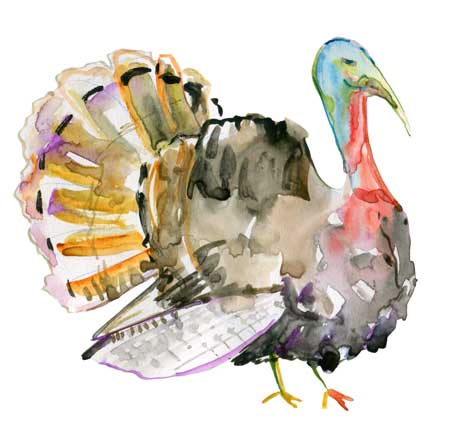
“I agree with you there. But I don’t believe I’ve ever seen a turkey buzzard in town.” Jerry was standing in the dress shop part of a hardware-dress store owned by Daisy, and Daisy was helping a customer. Henryetta called across to her nephew on the hardware side of the store, “Mark, tell the sheriff what Ray Ramsey said yesterday.”
“Said he saw a big bird in his back yard,” Mark said.
“How big?” Jerry asked.
“Don’t know. Could’ve been a pigeon. Ray exaggerates.”
Jerry thought Mrs. Henryetta was exaggerating, too. But he didn’t say that because he’d already crossed her more in a single conversation than he ever had in his life. He hesitated to press his luck any further, and not just because it was late October and he was up for re-election in November. He respected Mrs. Henryetta because everybody did, and because his mother would’ve taken a switch to his little bottom a long time ago had he not. Mrs. Henryetta was a frail woman, not long for this world, and that had been true since the sheriff was a little boy, and, maybe, even since the Shawnee had become extinct in the county. He said, “Mrs. Henryetta, did anybody else see them?”
Henryetta arched an eyebrow and pursed her lips. The look was not lost on Jerry. He added, “I have to ask as part of the investigation. The more witnesses to a crime the better.”
Henryetta said, “It’s not a crime for birds to sit around.”
Jerry was tempted to respond, “Then, why did you call the sheriff?” But he was called for all sorts of things. Just that morning he got a kite off a roof. He thought the fire department would’ve been the logical people for that, as they carried ladders; but they were mostly volunteers and not up for re-election. So he said, “But you suspected a crime?”
“Not until you mentioned turkey buzzards. I just didn’t want anybody shooting wild turkeys for Thanksgiving dinner.”
“I see. Preventing a crime.”
Mark, who was leaning on a knife display case, said, “Is shooting a wild turkey a crime?”
Sheriff Lovell didn’t know. That was really the business of the state fish and game rangers, and the only dealings he’d had with them were the occasional coordinated nighttime raid on Rocky Creek, where heavy petting between minors and fishing without licenses were common. Usually, any raid would collect one or the other, and the sheriff had a good working relationship with Fish and Game, so he said, “I can find that out easily.”
“If it’s not,” Mark said, “I’ll set up on the front porch and bag us Thanksgiving Dinner.” He was talking to his aunt, who along with his mother provided him, his wife, his children, his brother, his brother’s wife and children, and assorted cousins who dropped in unannounced, dinner every Sunday after church. So Henryetta just ignored that remark. She didn’t expect Mark to actually provide a dinner until long after she was dead. She did say, “We’ve lost the train of conversation. I saw the birds, whatever they are, about a half hour before dawn.”
“I hope they weren’t owls. You can’t eat those,” Mark lamented.
Sheriff Lovell said, “Well, I promise you I’ll get to the bottom of it.” The hardware/dress store family, like Jerry’s, had been Republicans since the Civil War, but the county was split half and half by the parties, and the Democrats had the governorship, the senate seat on the ballot, and a machine with some money.
How to Win the Writing Game

when your writing is clear as a bell and beautiful to gaze upon,
trust me, you’ll be proud as a peacock.
Many of you out there in this great land of ours have taken pen in hand to write in seeking the inside dope on how to write good. I’ve reached into my bag of tricks and come up with one sure-fire tip from the top: Avoid clichés like the plague.
A hearty hats off to the man or woman who gave us that pearl of wisdom. Those are, as sure as I’m sitting here, words for writers to live by.
Though I’m busier than a one-armed paperhanger, and I’ve got a lot on my plate, I’ll take time out of my busy day to clue you in about how clichés can ruin your whole day. Here are three good reasons you should give clichés a wide berth.
First, clichés suck the life out of those words you’ve been working overtime on, leaving your sentence without a leg to stand on, as it were.
Second, a cliché is old hat, pure and simple. People in all walks of life have heard them time and time again—more times than you can shake a stick at.
Third, if you were a fly on the wall, getting an earful of folks spewing clichés left and right, you’d fall all over yourself to bid a fond farewell to that wall and get the hell out of Dodge.
If you want to make your writing smooth as silk and solid as a rock, you must set yourself apart from the crowd. Put some distance between yourself and all those run-of-the-mill writers. Realize that you’re not your own worst enemy; the cliché gets that nod. You may work your fingers to the bone, but in the end, when your writing is clear as a bell and beautiful to gaze upon, trust me, you’ll be proud as a peacock.
Keep your nose to the grindstone, and before you know it you’ll find brand spanking new ways to put into words things you’ve kept bottled up in your heart of hearts for lo, these many years. Just a once-over-lightly look at your letters tells me that you’re dead serious about making something of yourself. I know as well as I know my own name that you’re willing to give cliché-avoidance the old college try. It’s as plain as the nose on your face, and you deserve a pat on the back. It’s only natural that you want more than anything in the world to make your colleagues so green with envy that they’ll scream bloody murder. Get with the program, and soon you’ll be in Fat City—sitting in the catbird seat, happy as a clam.
Taking a long, hard look at your questions tells me in words I can’t ignore that you’ll spare no effort to write paragraphs that light up the page like a Christmas tree.
So, how do you rid that Great American Novel, the one you’re burning the midnight oil over, of clichés? It’s as easy as falling off a log—just keep in mind the hoary old chestnut that says: If it walks like a duck, looks like a duck, and sounds like a duck, you can bet your bottom dollar it’s a duck. Stick to your guns, and you’ll have those clichés on the run before they know what’s hit them. Tell them not to let the door hit them on their way out. What crosses the mind of your average eagle-eyed editor when a cliché-laden manuscript lands on his desk? Dollars to doughnuts, he’ll get madder than a wet hen. Chances are, at the very least, he’ll tell the writer in no uncertain terms never to darken his door again.
Fighting the good fight against clichés can take the wind out of your sails on any given working day, but there’s no question in my mind that working like a dog to rid the world of clichés is taking the linguistic high road. When you get right down to brass tacks, the herculean task of wiping clichés—and the horse they rode in on—off the face of the earth is as easy as shooting fish in a barrel. But only if you adopt a take-no-prisoners approach to your work. Do that, and those hard-to-please editors will not only sing your praises, they will beat a path to your door.
Simple: Less Is More

IN1980, the typical credit card contract was about a page and a half long. Today it is 31 pages. The consequence is that people no longer read these agreements, then find their accounts canceled or subject to high interest rates. Here are some examples of the mess we’ve gotten into thanks to the crisis of complexity:
- Landline phone customers paid more than $2 billion a year for unauthorized charges, according to 2011 FCC estimates, largely because the bills are so confusing that most customers “never realized they were being charged.” Of course they didn’t realize it. What is the difference between “Basic,” “Regional,” “Non-Basic,” and “All Other” charges? Not to mention that there are 11 separate taxes, fees, and “other charges” that amount to almost 50 percent of a typical wireless phone bill.
- Homeowners spend an average of $868 per year for homeowner’s insurance without understanding what they’ve bought. A 2007 National Association of Insurance Commissioners survey revealed that one-third to one-half of insurance policyholders were misinformed about what perils are covered and how much they might receive if they made a claim. The study included 673 respondents interviewed by phone with a margin of error of 3.8 percent at a 95 percent level of confidence.
- Marquis Dunson died in 2002 after his parents gave the one-year-old Infants’ Tylenol for three days to treat his cold symptoms. In the subsequent lawsuit, which resulted in a $5 million award, the plaintiffs argued that the warning labels and directions on the Infants’ Tylenol label did not make clear that an overdose of acetaminophen, Tylenol’s active ingredient, could lead to liver failure. The FDA estimates that an average of 458 deaths each year are due to acetaminophen overdoses.
- Southern Medical Journal published a study that estimated a dermatologist signs his or her name 29,376 times a year. Can someone do anything 30,000 times a year with focus and certainty?
- The United States was founded and governed for over two centuries on the basis of a document that is six pages long. That is 0.1 percent of the length of the current income tax code, which currently runs a whopping 14,000 pages.
- Over 425,000 apps in the Apple iPhone App Store.
- 241 selections on the Cheesecake Factory menu, not including lunch or brunch specials.
- 223 mascaras, 454 lotions, and 367 fragrances at Sephora.
- 14,568 diagnostic codes maintained by the Centers for Medicare and Medicaid Services.
These are just a few examples of how complexity is costing us money, undermining government and business, and putting our health and even our lives at risk. This crisis is just now beginning to be the subject of public debate. But for the most part, how are we as citizens, patients, businesspeople, consumers, investors, borrowers, and students responding? With even more complacency.
We have allowed complexity to get the better of us—permitted companies, organizations, governments, and institutions to overwhelm our good judgment and violate our basic rights. We have passively paid when faced with indecipherable fees and ignored dozens of mysterious features on gadgets we can’t figure out how to use. We find ourselves lost in multilayered phone trees and jumping through hoops to make insurance claims.
All of which raises the question: Why do we tolerate complexity in our lives? Most of us figure we don’t have a choice. We may even occasionally blame ourselves for being overwhelmed and confused. (“This is over my head, I must be an idiot.”) So we pay the occasional overdraft fee of $34 that strikes us as unfair and certainly annoying, but not devastating. We don’t see the ice age of complexity approaching in the distance, because we only experience small blizzards of paperwork. So we trudge along, hoping that we’re not too misinformed and that we’re not getting cheated too badly.
It doesn’t have to be that way.
There is a powerful antidote and a practical answer within our grasp. It can be summed up in a word: simplicity.
Making things simple requires dedication to clarity, honesty, discipline, and intelligence. Simplicity works—in business, in government, in life. People can and should demand it. We need a call to action: the spark for a movement toward reduction of societal, governmental, and corporate complexity. Before writing our book Simple: Conquering the Crisis of Complexity, we worked with Carnegie-Mellon University to establish a Communications Design Center that combined communications theory and cognitive research. For the past 30 years, we’ve been out there on the front lines, witnessing firsthand how companies, government agencies, and everyday people are coping with the crisis of complexity.
We’ve learned several invaluable lessons.
We refuted the erroneous belief that simplicity was “dumbing down” by continually stressing that it is an effective shorthand for clarity, accessibility, and usability.
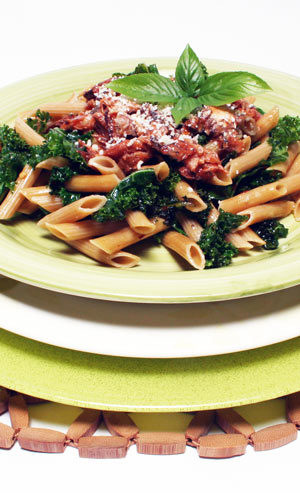
Sardines with Kale and Pasta
Budget-friendly sardines are a delicious, healthy, and safe seafood option that are too often overlooked. The little fish are full of omega-3 fats, vitamin B12, vitamin D, and calcium. Low on the food chain, sardines eat plants, not other fish, so they don’t have the mercury and other potential toxic load of some seafood.
This recipe calls for sardines packed in tomato sauce, but you can also use those packed in olive oil (this will result in a little more fat). If you can find fresh sardines, you may remove the bones by splitting or butterflying them. But you don’t have to debone them. Gently rub off the scales, remove the head and innards with a small paring knife and rinse. Then they are ready to cook.
One note of caution if you are using fresh sardines: These little fish can easily spoil if stored too long, even in the freezer. So use them within one or two days.
Sardines with Kale and Pasta
(Makes 4 servings)
Ingredients
- 8 kale leaves, stems removed, torn into 1-inch pieces
- 1½ teaspoons olive oil
- 4 cloves garlic, minced
- ¼-½ teaspoon red pepper flakes or to taste
- Salt and freshly ground black pepper
- 8-ounce whole-grain penne cooked according to package instructions (other short or long pasta may be substituted)
- 12-ounce canned sardines packed in tomato sauce (can sizes typically vary from 3.75 to 4 ounces and larger)*
- 4 tablespoons Parmesan cheese, finely grated (pecorino may be substituted)
*Sardines canned in olive oil or cooked fresh sardines may be used with ½ cup tomato sauce.
Directions
- In large covered pot steam kale in 1/2-inch water until softened, about 3-4 minutes. Set aside.
- In large saucepan over medium heat add oil, garlic, kale, and red pepper flakes and season with salt and pepper to taste.
- Sauté mixture until kale wilts, stirring occasionally, about 5 minutes. Add cooked pasta and stir gently until heated through.
- Spoon mixture on four plates and arrange sardines on top. Dust with cheese and serve immediately.
Nutrition Facts
Per serving
Calories: 380
Total fat: 13 g
Saturated fat: 3.5 g
Carbohydrate: 41 g
Fiber: 7 g
Protein: 28 g
Sodium: 449 mg
Cheating in College Sports

You can bet on it: Where there’s sports, there’s gambling. And where there is gambling, frequently there is cheating. In just one of the most recent scandals, former University of San Diego basketball star Brandon Johnson and seven others were convicted of “altering” games and sent to federal prison: Johnson was sentenced to six months in a federal facility.
Gambling on collegiate sports, an estimated $100 billion-a-year industry, is increasing every year, according to Albert Figone, author of Cheating the Spread: Gamblers, Point Shavers, and Game Fixers in College Football and Basketball. The problem of cheating is exacerbated by the increasing commercialization of collegiate sports and the huge amounts of money made by universities at the expense of underpaid student players. Case in point: Texas, the number one earner, generated in excess of $163 million from its sports programs in 2012.
With millions of dollars swirling around them, some college athletes see themselves as pawns in a system that exploits their talents. “These high-performing athletes have been trained for over 10 years and now work for the equivalent of $8 per hour based on the value of their scholarship. Sometimes they are vulnerable to gamblers who approach them with payoffs,” says Figone.
“Fixing a college game is like shooting fish in a barrel,” says Brian Tuohy, author of The Fix is In. “You can pretty much fix any college game you want to. And it wouldn’t take a lot of money to do it.”
Most college stars will never see the pot of gold associated with an NBA contract, and they know it. “At top-ranked programs, there may be two guys on the team who will end up in the NBA,” says Tuohy. “But then you’ve got a third senior who is a starter with no hope of going pro and no prospects for earning the big bucks pros make. What if you go to him and say, ‘Hey, look, I’ll give you 10 grand a game to make sure you don’t cover the spread’?”
The spread, or point spread, is essentially a gambling handicap favoring the underdog team. Rather than a straight win-or-lose proposition, the wager becomes “Will the favorite win by more than a given number of points?” A player on a team favored to win can intentionally blow a layup or miss a free throw to “shave points” off the score so as not to beat the spread. In doing so, his team can win the game while still enabling his corrupt paymasters to win their bet on the opposing team. This kind of cheating can be difficult to discern, though it frequently leads to a certain amount of lead-footed play. According to an FBI report presented at Brandon Johnson’s trial, the athlete “was heard on electronic surveillance talking about how he wouldn’t shoot at the end of a particular game because it would have cost him $1,000.”
How widespread is cheating? Figone estimates fixing the outcome of games involves only about 1 percent of the roughly 430,000 collegiate athletes. “Although the percentage may sound small, that still means more than 4,300 college athletes may be asked to influence the outcomes of games in some way,” he says. A March 2012 NCAA survey of collegiate athletes supports his estimate. Of 23,000 student athletes, about 5 percent of Division I men’s basketball players and 2 percent of Division I men’s football players admitted to having been “contacted by outside sources to share inside information.” Around 1 percent admitted to “providing inside information to outside sources.”
Gambling is like a dark cloud enveloping college athletics. Bookies and professional gamblers hang around college campuses in order to approach players about upcoming games, and the players know exactly what’s happening, even the honest ones. “I have not talked to one college basketball player who did not know the line [point spread] on the game he was playing,” says a Las Vegas-based bookie who agreed to be interviewed on the condition of anonymity.
Still, most experts say the vast majority of players are honest. “I am sure gambling or fixing collegiate games happens five times more often than you hear about. But it’s still the exception and not the norm,” says James Whitford, head basketball coach at Ball State University and former associate head coach of the 2013 University of Arizona basketball team that went to the Sweet 16.
Certainly there is awareness at the schools that the danger of cheating is very real, and the NCAA has launched initiatives to combat corruption. For example, all teams making it to the Sweet 16 in the NCAA basketball tournament are visited by FBI agents who warn them about the risks of collaborating with gamblers.
But a few strong words and even the legal consequences of violating the rules are not enough to stop all cheating. “It’s almost a perfect storm for criminal conspiracy when you’ve got young athletes with uncertain futures and financial hardships who feel they’re not going to be hurting anybody if they shave a few points,” says David Schwartz, director of the Center for Gaming Research at the University of Nevada, Las Vegas.
Hospice Girl Friday | ‘Lessons from Room 4’
Devra Lee Fishman’s dear friend and college roommate, Leslie, died from breast cancer one month shy of her 46th birthday after a four-year battle with the disease. Being with Leslie and her family at the end of her life inspired Devra to help care for others who are terminally ill. Each week, she documents her experiences volunteering at her local hospice in her blog, Hospice Girl Friday.
“You might not want to go into room four,” the nurse warned me as I looked over the list of patients.
“Why not?” I asked.
“Well,” the nurse said, lowering her voice and leaning in. “The patient, Mr. Kennerly*, has some sort of face cancer that made his tongue huge. So huge it doesn’t fit in his mouth. It kind of hangs out like this,” she said, sticking out her tongue as far as she could and closing her lips around it.
“That doesn’t seem so bad,” I replied, although my voice sounded more like a question than a statement. The nurse continued.
“Well, because his tongue is so swollen, he can’t swallow. So he basically drools a thick, gooey mess all the time, and he has to breathe through a hole in his neck. You might not want to see that, and I’m not sure how much he wants visitors. It’s up to you.”
As soon as I arrive I check the patient list and read through the notes that other volunteers made. I make a cheat sheet of who is in what room, and I ask the nurses on duty if there is anything I should know before I make my rounds, knocking on patients’ doors and asking if I can help in any way. Usually the answer is ‘no.’ Most patients are comfortable and know that if they want anything, they can just ring the call bell and either a nurse’s assistant or a volunteer will answer.
“Um, okay,” I say, “thank you for telling me.” I want to say “thank you for the warning,” but don’t want her or anyone else to know I am still a little tentative around patients. “Anything else I should know?”
“No, everyone else is either resting or sleeping, and I am about to check on room 8. Time for her meds,” the nurse said. As she turned to leave, I looked at the cover sheet for Mr. Kennerly. Forty-two years old. Arrived five days prior from a rehab facility. Primary contact: his father.
I did not knock on Mr. Kennerly’s door when I walked around to say hello to the patients, and I was relieved when his father came to visit about an hour into my shift. That meant that if Mr. Kennerly needed anything, his father would convey the message to me. I didn’t hear from either one of them before I left for the day.
The following Friday, Mr. Kennerly was still there. As I settled in, a nurse told me that Mr. Kennerly’s father would be picking him up within the hour to take him to a doctor’s appointment. I read through the volunteer notes and saw that several people checked in on him throughout the week. They wrote that Mr. Kennerly was very friendly and seemed content playing video games and texting his friends. I wondered if the nurses warned all of them or if there was some reason they felt a need to protect me. Before I had a chance to ask, Mr. Kennerly’s call bell rang.
I walked into his room and asked what I could do to help. Mr. Kennerly was standing by his bed and he looked exactly as the nurse described. He was chubby, like a teddy bear, wearing sweatpants and a T-shirt. Around his neck, to catch the drool, was a large paper bib, which made him look like he just escaped from the dentist office, mid-cleaning. His face was pointing downward even though his eyes were looking at me. I don’t think he could move his neck very much.
“Hi there, Mr. Kennerly,” I said. “How can I help you today?”
He grunted and pointed to his sneakers on the floor.
“You want to put on your sneakers?”
He grunted and gave a small nod, still pointing.
“Okay, have a seat,” I said, reaching for the shoes. His feet and ankles were swollen like he was wearing boots under his white socks. I stretched the laces of his left sneaker as wide as I could and urged it onto his foot. When I started to tighten the laces he grunted again. I looked up to see him swivel his head slightly from side to side. “Don’t tie the laces?” He gave another grunt. No.
“Got it. Other foot,” I said, as I reached for the right sneaker, stretched it open, and guided it onto his foot.
“Is your father on his way?”
Same grunt. Yes.
“Is there anything else I can get for you before I go?”
Mr. Kennerly stood up and took hold of my right arm with his left hand. I thought he might need me to help him walk outside so I started to turn toward the door. That’s when Mr. Kennerly grabbed my right hand with his, pulled me toward him and gave my hand—and entire arm—a strong shake as he grunted quietly and looked into my eyes. Thank you.
I gave him a quick hug before I left, careful not to disturb his bib or jar his neck and made a mental note to try not to let other people’s fears cause my own.
*Names have been changed to protect patient privacy.
Previous post: Receiving Thanks Next post: Learning How to Listen
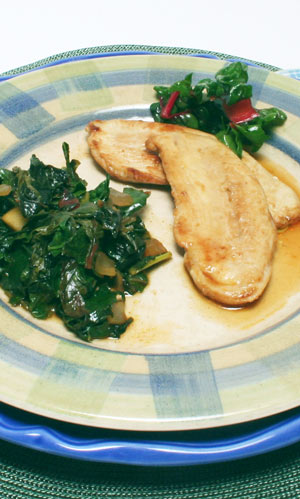
Turkey and Cider-Braised Greens
Pairing pan-cooked turkey cutlets with kale and Swiss chard braised in cider is one of my favorite fall-winter combinations. Simmering greens gently in sweet cider along with apples and onions tenderizes them and adds pleasing sweetness. Cook the greens in the same skillet, right after the turkey, for a delicious one-dish meal, even if it takes two steps.
Curry powder or pimenton, Spanish smoked paprika, added to the greens gives them an interesting accent. So does cooking them in the liquid you get by adding water and scraping up the browned bits sticking to the pan after cooking the turkey cutlets.
Turkey and Cider-braised Greens
(Makes 4 servings)
Ingredients
- ½ pound Tuscan kale (pre-washed and cut may be substituted, remove stems)
- ½ pound Swiss chard (pre-washed and cut may be substituted, remove stems)
- 2 tablespoons extra virgin olive oil, divided
- 4 turkey cutlets (about 1 pound)
- 1 ½ cups chopped red onion
- ½ Granny Smith apple, cored, peeled, and finely chopped
- 1 cup sweet apple cider
- 1 teaspoon curry powder or ½ teaspoon smoked paprika
- Salt and freshly ground black pepper
Directions
- Wash greens well. To remove tough kale stem, lay kale leaf on work surface, stem toward you. Run small, sharp knife down each side of stem, making inverted v-shaped cut. Lift out stem and discard. Stack leaves and cut crosswise into 1-inch strips. Then chop into 1-inch pieces. Repeat with chard, keeping piles of chopped chard and kale separate. There will be about 8 cups of each chopped greens.
- In large pot of boiling water, cook kale for 6 minutes. Using large slotted spoon, transfer kale to large bowl filled with water and ice. Add chard to pot and cook for 2 minutes. Add wilted chard to bowl. When greens are cool enough to handle, drain in colander. A handful at a time, squeeze moisture from greens, leaving them in clumps. Slice clumps of greens, and then chop them coarsely.
- In medium skillet, heat 1 tablespoon oil over medium-high heat. Sprinkle turkey cutlets lightly with salt on one side. When oil shimmers, add cutlets to pan. Cook 4 minutes, until bottom of cutlets are browned in places. Turn and cook until cutlets no longer look raw in center, about 4 minutes. Transfer turkey to plate and cover loosely with foil. Add ¾ cup water to pan. As liquid boils, scrape pan well, gathering up browned bits clinging to bottom. When liquid is reduced to ½ cup and rich brown in color, after 4-5 minutes, pour into cup and set aside. Rinse and wipe out pan.
- Add remaining 1 tablespoon oil to pan over medium-high heat. When oil shimmers, add onion and cook until limp, 6 minutes. Add chopped apple and cook 2 minutes, stirring occasionally. Pour in cider, reduced pot liquid and greens. Reduce heat to medium, cover and simmer for 5-7 minutes. Remove cover and simmer 5-10 minutes, stirring occasionally, until greens are tender enough to suit you and about ¼ cup liquid remains in pan. Stir in curry powder or paprika and cook 1 minute longer.
- To serve, divide cutlets among four dinner plates. Spoon greens alongside and pour remaining liquid over cutlets. Serve immediately.
Nutrition Facts
Per serving
Calories: 288
Total fat: 9 g
Saturated fat: 1.5 g
Carbohydrate: 22 g
Fiber: 3 g
Protein: 30 g
Sodium: 220 mg
Hospice Girl Friday | ‘Receiving Thanks’
Devra Lee Fishman’s dear friend and college roommate, Leslie, died from breast cancer one month shy of her 46th birthday after a four-year battle with the disease. Being with Leslie and her family at the end of her life inspired Devra to help care for others who are terminally ill. Each week, she documents her experiences volunteering at her local hospice in her blog, Hospice Girl Friday.
“Gratitude can transform common days into thanksgivings, turn routine jobs into joy, and change ordinary opportunities into blessings.” —William Arthur Ward
My hospice has its own wing in a building that also houses a large nursing home facility. Volunteers sit at a desk near the entrance to the unit and are the first point of contact for people who call or visit patients.
At the beginning of my shift on the day after Valentine’s Day a man walked in gripping a small bunch of long-stem yellow and red roses. He was probably in his late 60s, was heavy set, bald, and wore dress slacks and a sport coat. The flowers were wrapped in a wet paper towel and looked like he randomly pulled them from a larger arrangement. Instead of stopping at my desk or pausing to say hello, he walked to the back of the unit where the nurses and chaplain were eating lunch around one of the tables in the living room area. I watched the man hand the roses to one of the nurses.
“Thank you for taking care of my brother,” he said, putting the flowers on the table. Then he turned and hurried back toward the door. “It was a pleasure doing business with you,” he said over his shoulder. As he passed me, he pulled a white handkerchief out of his trouser pocket and dabbed his eyes.
I stood up and walked over to the nurse to ask her about what just happened.
“ ‘It was a pleasure doing business with you’? Who was that?”
“That was Mr. Jakes’* brother,” she said.
I remembered Mr. Jakes from the previous week. Brain cancer.
The nurse continued. “He flew in from Chicago the day before Mr. Jakes died. He wasn’t very nice to me, and I don’t really want these flowers,” she said, stabbing at her salad with her fork. “I think he feels badly about being so rude.”
“Maybe he does. And maybe he truly is grateful for the way you took such good care of Mr. Jakes. After all, he didn’t have to come back in,” I said.
“Fair enough,” she said. But I could tell she didn’t want to continue the conversation so I went back to my desk. Five minutes later, another man walked in. He was around 40 years old, tall, broad-shouldered, and he wore blue jeans, a ball cap, and work boots. His green sweatshirt had a ‘Johnson’s Florist’ logo over his heart. I’m used to signing for flowers, but he wasn’t carrying any.
“Hi, there. How can I help you?” I said.
He took off his hat, walked up to me and introduced himself. “Good afternoon. My name is Mike, and I’ve brought over some roses for the staff of the home and hospice. I left them by the main entrance and wanted to let you know before they’re all gone.”
“That is so sweet,” I said. “I’ll tell the nurses. I’m not staff. I’m just a volunteer.”
“You be sure to get some too. There’s plenty for everybody.”
“Are these leftover from yesterday?” I asked.
“Yes ma’am. And we want to share them with the staff here.”
Just then both of the nurses on shift walked over. I introduced them to Mike. After saying hello, he took a long look around and said, “My mom was in this hospice and everyone was so nice to her and my family. I’ve never forgotten it.”
“When was she here?” one of the nurses asked.
“Oh a long time ago. She’s been gone 25 years now.” Then he told us again where the roses were and left. The nurses followed him out and a few moments later came back in, each carrying a vase bulging with a dozen long-stem red roses.
I’ve always found Valentine’s Day too commercial, and long ago I asked my husband not to buy flowers for me. I wouldn’t appreciate the gesture, as roses seem like a waste of money, especially since they don’t last more than a day or two before drooping over with broken necks. But Mike came in again, and this time he was carrying an open box of long-stem roses that looked like they were made of dark crimson velvet. Each one was nearly the size of a tennis ball. I started to reconsider my position.
Mike handed me the box. “I wasn’t sure if you were allowed to leave your post,” he said, “so I brought you these. Please take them home and enjoy them, and thank you for everything you do here.”
“Thank you, Mike. They’re beautiful,” I said, looking at the bouquet and feeling like had I just won the Miss America pageant.
When I got home I put the flowers in the biggest vase I could find and set it in the middle of my kitchen table where they bloomed and thrived for almost two weeks. I used to think that the main focus of hospice was the patient, but those roses reminded me that the family members and caregivers also benefit, so much so that they come back to say thank you. Sometimes, as with Mike, they come back years later. And sometimes, as with Mr. Jakes, the thank you is clunky and possibly a veiled apology. But in each case they make sure they delivered a message of gratitude to the hospice staff and volunteers.
*Names have been changed to protect patient privacy
Previous post: These Four Walls Next post: Lessons from Room 4
Pumpkin Stew
Indigenous to the Western hemisphere, pumpkins have been grown in the Americas for more than 5,000 years. A member of the gourd family (which includes cucumbers, cantaloupe, watermelons, and zucchini), pumpkins are rich in vitamin A, specifically beta-carotene—a powerful cancer-protective antioxidant. Count on pumpkin to provide vitamin C, fiber, and potassium too.
This easy recipe calls for canned pumpkin, but you can use fresh pumpkin or butternut squash, about 2 cups chopped. It’s fun to experiment to discover which you like best!
Make it a meal: Serve with some crusty whole-grain bread or add a cucumber, avocado, and tomato salad. Cut the cucumbers into thick slices, add tomato and avocado wedges, and onion slices. Then drizzle on extra virgin olive oil and a sprinkle of good quality vinegar–or a squeeze of lemon juice–and some dried Italian seasoning. Gently toss. You have goodness in two bowls, one orange and one green.
Pumpkin Stew
(Makes 4 servings)

Ingredients
- 1 tablespoon olive oil
- 1 green bell pepper, chopped
- 1 red bell pepper, chopped
- 1 medium onion, chopped
- 4 cloves garlic, minced
- ½ teaspoon ground cumin (curry powder may be substituted)
- 1 (15 ounce) can pureed pumpkin (2 cups fresh may be substituted)
- 1 (15 ounce) can black beans, no salt added, drained
- 1 (15 ounce) can yellow corn kernels, no salt added, drained (1-1½ cups fresh or frozen may be substituted)
- 1 (14 ounce) can diced tomatoes, no salt added
- 2 cups reduced-sodium chicken broth (vegetable may be substituted)
- ¼ cup fresh cilantro, finely chopped, divided
- Salt and freshly ground black pepper to taste
- ¼ cup plain, low-fat yogurt, optional
Directions
- In large saucepan warm oil over medium heat. Stir in peppers, onion, and garlic and sauté about 6 minutes until peppers and onion soften. Stir in cumin and continue to cook 1-2 minutes.
- Pour in pumpkin, beans, corn, tomatoes, and broth. Add 1 teaspoon cilantro and season with salt and pepper to taste. Bring to boil, and then reduce heat. Cover and simmer 25 minutes.
- Divide stew among four bowls and garnish with cilantro and yogurt, if desired.
Nutrition Facts
Per serving
Calories: 301
Total fat: 5 g
Saturated fat: 1 g
Carbohydrate: 57 g
Fiber: 14 g
Protein: 14 g
Sodium: 307 mg
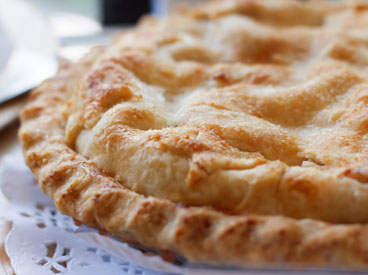
Curtis Stone’s Spiced Apple Pie
The power of apple pie is awesome: This simple dessert has been making grannies famous for generations. There is something about the smell of cinnamon, cloves, and apples baking in a buttery crust that makes you feel good. I use different varieties of apples to get the best qualities of each, but feel free to use your favorite type. I always make my pastry dough in a food processor, because it is so fast, but I provide a handmade version as a variation here.
Spiced Apple Pie
(Makes 8 servings)
Crust Ingredients
- 2 ½ cups of all-purpose flour
- 2 tablespoons granulated sugar
- 1 teaspoon fine sea salt or table salt
- ½ pound (2 sticks) cold unsalted butter, cut into ½-inch cubes
- ½ cup ice-cold water
Filling Ingredients
- ⅔ cup packed light brown sugar
- 3 tablespoons all-purpose four
- 1 teaspoon freshly grated nutmeg
- Pinch of ground cloves
- ¼ teaspoon fine sea salt
- 3 Granny Smith apples, peeled, cored, and cut into ½-inch wedges
- 2 Golden Delicious apples, peeled cored, and cut into ½-inch wedges
- 2 Gala apples, peeled, cored, and cut into ½-inch wedges
- ⅓ cup dark raisins
- 2 tablespoons unsalted butter, thinly sliced
- About 1 teaspoon whole milk
- 2 teaspoons raw or granulated sugar
- Vanilla ice cream, for serving
Directions
- To make crust: In food processor, pulse flour, sugar, and salt to blend. Add butter and pulse about 10 times, until butter is in pea-size pieces. While pulsing food processor, drizzle ice water through feed tube and process just until moist clumps form. Transfer dough to work surface, divide it in half, making one half slightly larger than other half, and form into 2 thick discs. Wrap each one in plastic wrap and refrigerate for at least 30 minutes, and up to 1 day.
- Position rack on lowest rung of oven and preheat oven to 425°F. (Being near source of heat helps bottom crust of the pie to bake and brown properly.)
- To make filling: In large bowl, whisk brown sugar, flour, cinnamon, nutmeg, cloves, and salt together. Add apple wedges and raisins and mix to combine.
- Unwrap larger disc of dough and set it on a floured surface. Lightly dust top of dough. (If dough is too cold and firm to roll out, let it stand at room temperature, covered, until it softens slightly.) Starting from center of dough and rolling toward edges, roll out dough into 13-inch round, occasionally rotating dough and dusting surface with flour to prevent dough from sticking. Brush away excess flour. Place rolling pin on edge of dough that’s farthest away from you and gently and loosely roll dough up around pin until you have half of it on pin. Hold pin over edge of 9- to 9 ½-inch glass pie plate and unroll dough into dish. Trim overhang to ½ inch. Refrigerate pie shell. Roll out other disc of dough on floured surface into 12-inch round.
- Spread apple mixture in pie shell, then scatter sliced butter on top. Cover pie with remaining dough round. Trim overhang to ½ inch and press edges together, fold dough under itself so it is flush with edge of pie plate. Crimp dough edge decoratively.
- Lightly brush top of pie with milk and sprinkle all over with raw sugar. Using small sharp knife, cut 4 stream vents in the top crust. Bake for 20 minutes. Reduce the oven temperature to 350° and bake pie for about 55 minutes longer, or, until crust is golden and filling is bubbling through steam vents. Let pie cool on wire rack until warm.
- Cut pie into wedges and serve with ice cream.
Variation: Handmade Pie Dough
In large bowl, whisk flour, sugar, and salt together. Add butter. Using pastry blender or two forks, cut butter into flour until butter is in pea-size pieces. Drizzle ice water over flour and gently toss mixture together to moisten. Turn mixture out onto work surface and gently gather it to form dough.
© 2013 Curtis Stone, published by Random House.