Annie Jump Cannon: The Woman Called the Census Taker of the Sky
“Oh, be a fine girl — kiss me!” was the mnemonic repeated over and over by the pioneering astronomer Annie Jump Cannon as she classified over 350,000 stars. O, B, A, F, G, K, and M represented the hottest to coolest rankings of stars, as observed by Cannon. On this day in 1922, her stellar classification system was accepted by the International Astronomical Union, and it is still widely used in astronomy today.
Cannon began her career in astronomy as a “computer” for Edward Pickering at the Harvard College Observatory in 1896. “Pickering’s Women” were a group of female workers tasked with computing the optical spectra of stars on glass plates photographed by a team of male astronomers by night. Cannon and the rest of her cohorts were paid factory wages for their tedious work of analyzing and cataloguing thousands of stars despite their prestigious qualifications.
As technological innovation brought more powerful photography, Cannon and her team were able to observe more details regarding star temperatures. The glass plate renderings were not in color; they were made using prisms attached to the lens of a refracting telescope. “Pickering’s Women” observed absorption and emission lines on the plates to classify stars in — originally — an A through Q system. When Cannon was brought into the group, she simplified and rearranged the stellar classification system based on a new understanding of spectra from plates that had just been obtained from the sky of the southern hemisphere. Thus, her “Oh, Be A Fine Girl…” system was born.
Cannon’s stellar classification system never bore her name, though. It was adopted by the International Astronomical Union as the Harvard system, and an additional luminosity classification in the ’40s begat the Morgan-Keenan system.
The Country Gentleman mentioned Cannon in 1927, after she had received an honorary doctorate from Oxford and was named the first female officer of the American Astronomical Society: “When Miss Annie Jump Cannon, world-famous astronomer, completed her bibliography of variable stars, comprising about 75,000 references, and compiled her catalogue of 225,000 stellar spectra, she was writing of the same stars she had gazed at in her girlhood home at Dover, Delaware.”
It would be a tall order to expect any astronomer to live up to Cannon’s reputation for classifying three stars per minute, but each year, the Annie Jump Cannon Award in Astronomy is awarded to a North American woman for significant contributions to the field.

Sources
“The Women Who Created Modern Astronomy” Dvorak, John, Sky & Telescope, 1 August, 2013
Statesville Record And Landmark: https://www.newspapers.com/clip/10251323/statesville_record_and_landmark/
Brooklyn Museum: https://www.brooklynmuseum.org/eascfa/dinner_party/heritage_floor/annie_jump_cannon
North Country Girl: Chapter 51 — Big Pink and the Invisible Man
For more about Gay Haubner’s life in the North Country, read the other chapters in her serialized memoir.
James and I were in his hated hometown of Winnipeg. He had been summoned there by Elena, the daughter he had deserted years ago. As a family reunion it was a disaster; James showed no desire to spend any quality time with his chubby, homely daughter, who was more introverted and tongue-tied at 22 then I had been at 15.
Having completed his obligatory visit with Elena, James rooted out his best friend from high school, Robert, whom he had heard was doing well financially, but not exactly through legal means. Luckily for James, his pal was not locked up in the hoosegow; he was currently out on bail waiting for his next court appearance.
I felt right at home as we drove through Winnipeg to Robert’s house; his neighborhood was almost identical to the middle-class one I grew up in: big red brick houses on spacious, carefully maintained lots shaded by tall pines and paper-barked birch trees. We pulled up to one of these stately homes. A pretty blonde woman invited us in with a tight, brittle smile, introduced herself as Robert’s wife, and led us into the living room where Robert was waiting for us.
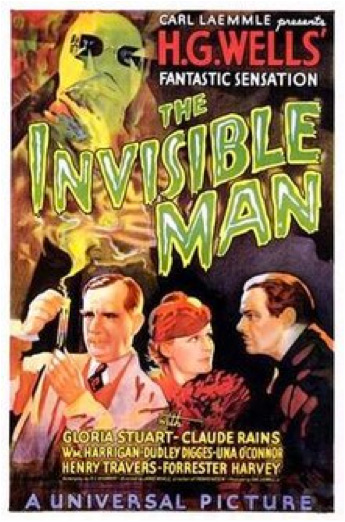
Robert’s head and hands were completely swathed in white bandages; he looked like Claude Rains in The Invisible Man. Where his face was supposed to be there were four holes poked out for eyes, nose, and mouth; his hands were oversized, slightly grimy gauze mittens. The charge he was facing was arson for profit. Robert may have been a successful criminal, but he had obviously completely screwed up this last job.
Robert’s nervous blonde wife brought out a round of Seagrams and Seven-Ups, my alkie grandfather’s tipple of choice but not mine; the rich, spicy, evocative smell of the whisky made me feel that I was seven years old.
Robert took his highball through a bendy straw, squeezing his glass between his stiff bandaged hands like a raccoon. James never asked “How’re ya feeling?” or “Oh boy, I bet that stung,” or made any reference to the fact that we were having a conversation with a man who didn’t have a face. Unlike sitting with someone who has a cast on their arm or leg, there was no humorous recounting of how Robert came to have these injuries. My own face twisted into a rictus of a smile as I tried to get through the inevitable small talk: where I was from, how I liked Winnipeg, how long the drive from Chicago had taken. I was relieved when the conversation turned to anecdotes of boyhood hijinks and whatever-happened-to’s, although I couldn’t seem to relax my face.
After they had exhausted the boring gossip about their old schoolmates, Robert said, “Hey, why don’t we all go up to my house on the lake for a few days?” I did not want to look at this talking mummy for another second, but James had already accepted, probably delighted to be out of the reach of his daughter.
In Minnesota if you had a place on the lake it was a homey cabin, with appliances from the 1940s, one or two bunkbeds in every room, musty furniture, a deck of cards with “two of clubs” scribbled on a joker, tangled fishing gear, and either electricity or indoor plumping, but never both. That was what I had pictured in my mind as we drove through the forest surrounding Lake of the Woods, catching glimpses of the shining silver water between trees. It all seemed so welcoming: the almost black firs contrasting with the gleam of white birch, the hand-painted signs posted at each turnoff with the owners’ names or the corny names of their cabins — “Dunmovin”, “The Oar House,” “Dock Holiday” — were all as familiar to me as breathing. I almost forgot that riding in the passenger seat in the car in front of us was a man with no face.

James followed that car when it turned at one of those signs, a white board with “In the Pink” neatly painted on but wanting a bit of touching up. James’s El Dorado bumped down a narrow dirt track towards the lake where we found not the rustic cabin I had expected but a sprawling modern white brick ranch. We walked into an immense living room with three sides of floor-to-ceiling windows that held all shades of sky and lake blue. Along the shore, the dark green forest was as perfectly reflected as if the water were a mirror. Next to one set of windows were twelve chairs surrounding a lengthy dining table. To the left I could see into a spacious, sleek kitchen. Robert had already told us, “Plenty of room! We’ve got four bedrooms, each with its own bath!”
There was only one thing wrong. Everything inside the house was pink. Not just any old pink, but the exact shade of a carnation pink Crayola crayon. The sofa, the rug, the paint on the walls. The bathtubs and sinks. All the modern appliances in the kitchen. That big dining table and all the chairs.
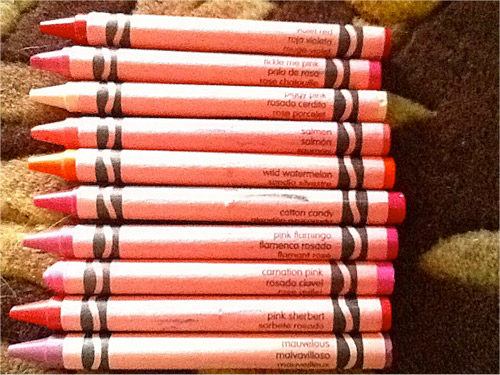
Robert, raising his voice to be heard through his mask of bandages, showed us around, the proud owner of all that pinkness. “You wouldn’t believe the deal I got!” he boasted. When the woman who had owned and proudly decorated the house had died, there had been no other offers, and the heirs couldn’t wait to get that pink elephant off their hands.
It was like being in a brain, or an intestine, all that throbbing pink. As I soaked in the pink tub later that evening, I tried to imagine different scenarios for this obsession, but failed to come up with a likely story, as it was obviously just madness.
Not only was everything pink, everything was really nice. That tub was huge, the hot water inexhaustible. You sunk so deep and comfortably into the pink couches, all you wanted to do was sip a cocktail and gaze out the picture window at the lake. The wooden dining table and chairs were heavy and substantial, all painted and shellacked so they shone like a manicured nail. Where could you even go to buy a pink Whirlpool dishwasher? I wondered.
“You wanna see something funny?” Robert asked and led us down to the lake. There, at the end of the dock, deep in the water, under the flashing pike and drifting waterweeds, was a pink refrigerator. A salmon pink refrigerator. The wrong shade of pink. When it was delivered to the house, Mrs. Pink had freaked out and made the delivery men dump it in the lake. The big two-door refrigerator that was currently purring away in the kitchen perfectly matched the stove and the walls and the cabinets and everything else in the pink house.
“Some house,” said James. “How long have you had it?” Robert bought the house three years ago and hadn’t changed a thing. He didn’t see anything wrong with the interior, everything was first class, custom made, top of the line. So what if it was pink?
During the day I spent as much time as possible down at the dock reading or swimming or gazing out at the lake, trying not to think about James losing his fortune and his mind, his unhappy twice-rejected daughter, the bandaged arsonist with third degree burns, or the crazy house looming behind me. I lingered by the water till the loons started their plangent calls, the signal for swarms of enormous mosquitoes to descend and drive all humans inside, where three of us dined off pink plates at the huge table, Robert alternating between highballs and a disgusting looking liquid food sucked up through a straw.
James never mentioned his daughter Elena, and I certainly was not going to bring her up. He was restless as a chained wolf at that lake house; the Winnipeg Free Press did not carry even yesterday’s NYSE reports, and his requests for a New York or even a Chicago paper were met everywhere with disbelief: why would you want a newspaper from somewhere else? There was no TV at the lake house, Robert apologized, no reception out there in the north woods. James, not a lover of country life under the best of circumstances, cut our visit short. We said goodbye to that ranch house of insanity. James went to shake hands with our host, slapped him on the back instead, and we drove back to Chicago.
The news waiting for James was especially bleak. Highline shares were tumbling faster than ever. James spent the day yelling at the TV, trying to get his broker — who he now was convinced had intentionally dumped that piece of shit stock on him — on the phone, or staring into space.
I needed my own money and had a harebrained idea of how to earn it. I was going to be a model. I had already made one commercial and earned $100, why couldn’t I do two or three commercials a week?
I didn’t have a copy of my Mexico commercial. I didn’t have any professional photos. And I topped off at 5’3”. When I showed up at the Ford Modeling Agency the receptionist gazed several inches above my head, where my face was supposed to be, then showed me the door. Ditto at Wilhelmina.
In the Chicago Yellow Pages I found a small ad for the Ann Geddes Modeling Agency, which turned out to be a waiting room with three chairs, an unoccupied receptionist’s desk, and a tiny private office where Ann Geddes, a former model herself, was waiting for me, along with her husband Silver, who was a stockier, grayer version of James, and who, true to his name, wore massive Navajo silver rings and bracelets and a silver hoop in one ear.
“When’s your birthday?” Ann asked.
“Oh, I’m twenty-one.”
“No, the date and the year and if you know it, the time.”
Having gotten that settled, I started babbling about my Mexico tourism commercial (leaving out that I had been the emergency replacement) and my acting experience in high school (leaving out that the experience consisted of three lines in “You Can’t Take It With You” and the co-star role in a student-directed one-act play).
Ann Geddes was ethereally gorgeous, with long, rich red hair and milky skin unmarred by a single freckle. Her beauty was not intimidating. She was as warm and friendly as an older sister; it was easy for me to rattle on like an idiot. Silver, who had been scribbling on a pad the whole time, interrupted my life story: “I’ve got it!” He was an astrologer; while I was trying to talk my way into being a model, he was casting my horoscope. He announced that despite my shortcomings, the stars were aligned and the Geddes Agency would be happy to represent me, their take ten percent of everything I earned.
This did not mean I would have steady work or a regular income. The star of the Ann Geddes Agency was another small blonde, who was a lot prettier than I was and had several commercials under her belt that she actually had copies of. When the call came in for a model to pose next to a refrigerator or power tool to make it look bigger, she was sent. I was the backup blonde.
I did not discover my second banana status until later. At the moment I was thrilled: I was officially a model. Ann blithely handed me a contract to sign and a Xeroxed contact list of every photographer in Chicago, from the newest Chicago Art School graduate to Screbneski. It was up to me to call on all of them, trolling for modeling work.

But before I could do that, I needed a composite, an eight by eleven calling card with a pretty head shot on the front and photos showing a range of commercial personas (young mom, career girl, sportswoman) on the back to leave with the photographers. Ann took a red pen and scrawled a circle around one name on her list.
“Go see Frank Wojtkiewicz first. He might take composite photos of you for free,” she said, her face as smooth and blank as a china plate.
“Your Husband Loves Me!” by Leland Webb
Just before sunset she drove into the enormous parking lot of the South Gate Shopping Center and parked near the telephone booth closest to the highway. She sat sideways in the seat, resting her cheek on her arm, and watched the street that ran from the new Rivermere suburb into the highway. Waiting, she wore her daytime face and thought her daytime thoughts.
She saw him, as he drew up to the highway and glanced quickly to his left, and then he drove down the highway and passed the shopping center, his eyes straight ahead. She kept her head on her arm, willing herself slack, but feeling the tension mount deep within as her purpose gathered itself.
Five minutes, she thought; let five minutes go by, and then I will or I won’t, but wait five minutes, please wait five minutes, just five minutes, only five. . . She fixed her attention on her watch and waited while the second hand swung slowly down and slowly up, and she did not stir until the fifth ascent had been completed.
She got out of the car. She entered the telephone booth and closed the door behind her. She took a dime from her purse and dropped it into the slot. She dialed the numbers, taking great care that each spin was complete before she began the next. When the telephone rang at the other end, she licked her lips and cleared her throat.
“Hello.” Hearing the cool, assured voice, she felt a giggle shape and heap itself within her, wild, enormous and absurd, and she knew for the first time that she was really going to do what she had planned for weeks to do.
“Mrs. Blackwell?” No, no, no, she thought. You cannot, you must not giggle, not now. She bit her lip and fought it.
“Yes, speaking. Who is it? Who’s speaking please?”
“Mrs. Blackwell, I know you won’t believe me, but I am a friend of yours, or I wish to be. But Mrs. Blackwell, I love your husband and he loves me, and you must let him go.”
It was so easy, once begun. The words came out exactly as she had rehearsed them, with just the right blend of sympathy and assurance. And most important, not once did she slip back into her normal voice.
She talked for nearly three minutes and then stopped suddenly in the middle of a sentence and stared at the telephone in bewilderment before she hung up. Then she went back to her car and waited. It was almost an hour before she saw him drive back down the highway and turn left. She counted carefully to 100 before she backed her car out and followed.
She drove past his house without looking at it. At the end of the long street she turned and drove back slowly, with the headlights off. When she was a half block from him, she turned into the driveway of one of the darkened, still-vacant houses.
She kept the motor running. She sat facing toward where the lighted houses began. She felt very tired and very sad, and she cried a little while she watched and waited.
Tracy Blackwell had soft, clear gray eyes; he walked with a very slight limp because of a piece of shrapnel imbedded in one leg; there emanated from him the faint, pleasant aroma of the five expensive cigars he allowed himself each day.
He came home from the neighborhood library that evening a placidly contented married man. More so than most, for his wife and three-year old son had returned that morning from a weeklong visit with her mother. In the bedroom he put the books he had been carrying on the night table and saw that Della was standing at the window with her back to him.
“Got a Maigret, a Perry Mason, and a Mr. and Mrs. North,” he said. “That ought to hold you. As for me, please address all communications to the planet Aldegor. All hell has broken loose and I’m off with the Intergalactic Patrol to see what’s up.”
And he shut up, quickly. Della was crying, and he could tell that she had been crying for some time. He moved toward her, to hold her and hush her tears. “Sugar, sugar, what on earth is wrong?” he asked, and then stood appalled, when she turned, by the look on her face.
“Nothing,” she said and pushed him away. “Just nothing at all. Just leave me alone.” She walked past him out of the room, leaving him to stare after her, no longer a placid, contented married man.
“Sex,” he said aloud, and his face became sullen. Because Della had been away for a whole week, he had planned that tonight, after Tim was asleep, they would go to bed and read for a while, and then he would turn off the light, and then Mr. Blackwell would declare war on Mrs. Blackwell, and they would live happily ever after. Or at least sleep and wake up to another day.
But, he thought, why do I have this sick flutter in my gut? When her father died, Della had cried from grief, and she sometimes cried from a peculiar mixture of vexation and exhaustion. In the early days of their marriage, he remembered wistfully, she had touched and confounded him often by crying from a sudden excess of happiness. But these tears made him want to cut and run. He felt he had to do something, anything rather than stay in the bedroom feeling as though he had been cursed.
“Ho, Tim,” he shouted. “Time for bath, bed and Bimbo.” He moved into the bathroom behind the frolicking Tim, confused, uneasy and very much aware of Della standing silently now in the living room.
For the next half hour he had no problems save keeping a firm grip on a slick eel of a three-year-old boy. Then he dressed Tim and popped him into bed, and while the boy lay with his hands clasped behind his head, he embarked on another Bimbo adventure. Tracy had invented Bimbo when Tim was two, and for a year now he had been improvising, with increasing desperation, one ridiculous story after another about a little boy with the happy gift of changing into a horse or a dog or a bumblebee, or whatever he chose. Sometimes he wished that Tim would get as tired of Bimbo as he was, although he knew he would be hurt when it happened.
“And so Bimbo said, ‘Stick, Stack, Stimbo,’ and once again, he was no longer a blackjack squirrel but a stumbling, bumbling, butt-headed, bowlegged little boy,” he concluded. “And now to sleep with you, old Tim Blackwell.”
At the door he looked back. Tim was already asleep, and he moved without haste down the hall and entered the living room. Della sat with her gaze fixed on the opposite wall. He sat down on the sofa, facing her, and lighted a cigar.
“Whenever I ask what’s wrong,” he said, “and you say, ‘Nothing,’ it turns out to be something I’ve done. So, what is this ‘nothing’ that makes you cry?”
Della said in a flat, dead voice, “Tracy, have you been unfaithful to me?”
Her face persuaded him to take it seriously. “Son of a gun,” he said. “Della, that’s not a question to ask me. If I have been, I’d say no, and if I haven’t, I’d say no, but how could I prove it?” The reply pleased him and he gave her a look of triumph.
She looked back at him as though she felt sorry for him. “Who was it that said whenever a man and a woman reach a perfect understanding, one of them is lying?”
“I don’t know,” Tracy said. “Probably one of those jug headed detectives in one of those detective novels you read. It sounds like it. What’s this all about?”
Like a child reciting a dull lesson, she said, “While you were at the library, a woman called me. She said she was in love with you. She said that you were in love with her. She said that she and you had a wonderful week together while I was at mother’s. So much better, she said, than the hour or two you’ve been able to steal before. That’s what this is all about.”
“This woman,” Tracy said carefully, “what did she say her name was?”
“She didn’t say. I suppose she would have, but I got so upset I hung up. And,” Della added sadly, “she said she wanted to be a friend to me. And I guess she was.”
He thought with a sudden clarity that if he were guilty, he could probably stare her down. But now he could only look sullenly at the floor.
“You believed her? Just like that you believed her? You couldn’t even wait to talk to me? You try me, convict me and sentence me, just like that?” Anger made him look at her. “I’ve heard you say you love me, Della,” he said. “Not often, but a few times, these past five years. Now you make me wonder what you meant.”
“You can ease up,” Della said.
She put her hand in her dress pocket and fished out a man’s handkerchief. She held it up and then let it float down to the floor.
“And what do you call this?” she asked.
Tracy rose slowly. He picked up the handkerchief and looked at the monogram.
“I call it a handkerchief,” he said. “What do you call it?”
“I call it exhibit A,” she said. “You will note, Mr. Blackwell, the lipstick on it. She — my friend — said I’d probably find a handkerchief like this in the laundry. I’ll anticipate your next question, Mr. Blackwell. No, it is not a shade of lipstick I have ever used.”
Although the handkerchief could not be his, it was. And if Della said it wasn’t her lipstick, then even though it had to be, it wasn’t. Nothing could be explained. He wished suddenly that he were Bimbo and could turn into a rat or a roach or a measle germ and get out of that room, where there was nothing to do but stand, still and dumb.
The prosecution rests.” Della stared with cold, empty eyes at the far wall.
“I don’t have a story about the handkerchief,” Tracy said. “Or about this woman, whoever she is, or whatever she said.” He looked about the room as though he had never seen it before. “How in the hell did I wind up here?” he said and walked out.
She heard him in the bedroom, opening and shutting drawers. She heard him begin to curse aloud, which frightened her. And then, because he was so disturbed, she became uneasy and no longer sure. She held out her shaking hands and watched them tremble until her raging hurt steadied them. When he came back down the hall minutes later, carrying an overnight bag, she was still sitting there, small, huddled and implacable.
“I’ll come for the rest of my stuff tomorrow night,” he said.
“Tracy, where are you going?” she asked.
“You can reach me at the office,” he said. “Anytime between nine and five.”
“But where will you sleep?” she cried. “Where will you eat? Who’ll look after you?”
“Oh, for God’s sake,” he said, “I took care of myself for a long time before I ever saw you. I’ll manage somehow.”
“Tracy Blackwell, if you walk out that door, you know I can only think one thing?” she said.
He moved to the door. “That’s why I’m leaving, so you can think about it, Della,” he said. “Get my stuff together. I’ll come for it between six and seven tomorrow.”
She heard with dull disbelief the car backing down the driveway. She went on thinking nothing and feeling nothing, long after the sound of the motor died away, until Tim cried out in a dream. He was quiet by the time she got to him, and after fussing with his blankets she came back to the living room and put out the lights. She went to the door and stood looking through the screen at nothing in particular.
She heard another car and saw its black shape move out of a carport down the street. She thought it curious that its lights were not on. It picked up speed as it approached her house. As it sped by, the horn blared three times, raucous and hateful.
“Oh, I am a fool!” Della Blackwell cried. She darted out on the stoop. “You! You!” she said under her breath to the disappearing car.
She sat down on the stoop. The cold stone seemed to steady her, and she began to sort out her feelings, one by one. Deep within her bones she knew that she could not forgive an unfaithful husband, that she would hug this hurt to her forever. But she would not, she decided, cry for the moon.
As her mother had cried for the moon she thought, and for a single such error had divorced her father. She saw her mother suddenly, for the first time, as a spoiled, fretful woman. And with a swift rush of pity and understanding, she thought of her father, remembering his shabby funeral a year ago. Her mother had not been there.
Tracy was gone. Tracy must come back. No matter what it cost her. She would not relive her mother’s life, nor could she send Tracy to relive her father’s life. And never, never, never, she thought fiercely must Tim become a stranger, or even worse, a mere acquaintance of his father.
She stood up and shook her fist in the direction the car without lights had taken, and went back in the house and locked the door.
In bed she reached over and pulled Tracy’s pillow into the crook of her arm and lay there holding onto the pillow looking into the dark.
Who is my enemy? she thought. And why? The memory of the woman’s voice came back to her, and she was filled not with anger but with an unaccountable sadness. She pondered the strange business of the horn blowing. Still mulling over these matters, she fell asleep.
After she passed his house, she turned the headlights on. She drove across town and parked behind a run-down apartment house. Through a rear door she entered an apartment on the ground floor. She crossed a dark room and pulled down the shades before she lighted a lamp. “Well, my dearest darlings,” she murmured, “did you miss your sugar lump while she was gone?”
In a large chair, facing the window, a male figure sat with a smaller male figure on his knee. Neither spoke or stirred. She stood behind the chair, her hands lightly carressing the backs of their heads.
“A cup of tea, Tracy, my sweetikins? You’d rather have sherry? I hear my lord, and his slave hastens to obey. And for you, Tim, my lambikins, a nice, hot cup of Postum.”
She went into a small alcove and turned on the gas under the kettle. Her foot touched something soft and, bending, she picked up a cheese sandwich. She looked at it, perplexed, and then put it on the drain board.
“Sherry,” she said and opened the cupboard. She found a bottle labeled PURE CIDER VINEGAR and filled a glass halfway. The kettle began to whistle. She spooned Postum into a cup and added hot water.
She carried the cup of Postum and the glass of vinegar back across the room and set them on the table by the big chair. She sat down on the floor before the two figures and began to talk, quickly and urgently. Her voice was low, murmuring, and she never paused for a reply. She leaned forward often and patted the still hand of the larger figure with timid little pats, as though she feared reproof.
“I told her,” she said. “She wouldn’t believe me at first, and then she became very angry, but she let you go. I knew she would understand that you belonged to me, if I explained it.”
She talked this way for almost two hours, and then she subsided. Presently she rose and turned off the lamp. She undressed in the dark, letting her dress and undergarments stay where they fell. She took a man’s shirt from the closet and put it on. She picked up the smaller figure and paced the room, rocking it to and fro in the cradle of her arms. Very softly she sang:
“Go to sleep, my little baby Before the boogey man gets you. When you wake, you shall have cake, So ride on, Prince Charlie.”
She paced and rocked and sang the one song for a long time, and then stopped abruptly. She threw the smaller figure back into the closet. Returning to the chair, she picked up the larger figure and sat down with it on her lap. Gently, her fingers stroked the figure’s hair.
In the closet the Charlie McCarthy doll lay where it had landed, legs bent, head flung back. A chink of light came through the window shade and was reflected by the monocle in the doll’s right eye.
She sat with the store-window dummy on the chair, caressing its cold cheeks until sleep came over her, and then she left it and got into the bed in the corner of the room. She lay back in the bed, her face as blank as the face of the figure in the chair.
Tracy Blackwell sat at his big desk at the end of the long office, studying the employee called Wilhelmina Forth, who sat directly in his line of vision. There were two paper coffee cups on Miss Forth’s desk — both cold, he guessed — one half-gnawed candy bar and one half empty package of cheese crackers. For the past half hour the rollers of her chair had been going back and forth over a tuna sandwich that had fallen or been brushed from her desk.
“She can’t keep house like that,” he said to Molly Grimes, Miss Forth’s supervisor.
“I have news for you, Tracy,” Molly said. “I went by to see her once. She keeps house exactly like that. She only washes dishes once a week, and I think she prepares a lot of things she never eats.”
“There’s no hope for her, is there?” he asked. “You know I don’t like to fire anybody.”
“Her work is messy,” Molly said, “and she’s messy, and she tries so damned hard to be liked that the other girls can’t stand her. So you may as well scuttle her. And not next week. Today, Tracy.”
He winced as the chair wheel gouged the tuna sandwich again. “All right,” he said. “Send her over in a few minutes and I’ll do the dirty deed.”
Today, he thought, any problem that can be handled is welcome. Della had called him shortly after he reached his desk that morning.
“Mr. Blackwell, your wife,” she had said. “When you come this evening to get your things, Tim will be over at Nell’s. I want you to bring my rival with you. I want to talk to both of you.”
She had hung up before he could speak, flinging him back into the unreasoning rage he had mastered during the long, sleepless night. Before Della’s call he had made up his mind simply to return that afternoon and sue for peace. The telephone call from the unknown woman was probably a misguided practical joke; the explanation, if one ever came, would be as simple as that.
But after Della’s call, no ma’am. Not Tracy Blackwell. He had not looked at another woman since the day of his marriage. He had been a good husband to his wife and a good father to his son, and he had worked like a Turk to make a living for them. If Della needed proof of his innocence, then their marriage was a mockery. She could go straight to the devil.
He began to fill out the multitude of forms required to discharge an employee, and a moment later he saw Miss Forth get up and come toward him with her peculiar, graceless stride. As she drew closer, he noted the ardent, hopeful expression on her face. He felt vaguely sorry for her, as he would for any misfit, but she did not meet the company’s standards and must be rejected.
As traffic manager for Flamingo Airlines, he was in charge of the three dozen women who answered the constantly ringing phones. He did not think of them as women; he thought of them as the company did, as agents — good, average and borderline. Scrupulously he kept his distance from them and praised, admonished, promoted and discharged, in strict accordance with the circumstances and company policy. And, above all, he never thought of them between five p.m. and nine a.m.
When Miss Forth sat down by him, he plunged ahead. “I’ve been reviewing your record, Miss Forth,” he said, “and frankly, your work is not up to our standards.” He was suddenly uncomfortable beneath the steadiness of her gaze. “Not up to our standards at all. I’m afraid that I’ll have to let you go.”
It’s like a play, she thought. How serious he was! She must play her part too! Oh, he would laugh soon over her cleverness with the handkerchief, how she had whisked it away when he left his jacket hanging on the chair, and marked it with her lips, and returned it deftly, secretly. No one had seen her then, and she would not fail him now!
“Of course,” she said. “I understand why you have to fire me. It’s only natural.” She leaned forward. “Do I look concerned enough?”
He said, “What? Well, fired is a pretty rough word, Miss Forth. It’s just that I think you ought to be doing something more — ah — suited to your particular qualifications. Flamingo Airlines just isn’t the place for you.”
She nodded. How deliciously formal he was! “When do you think I can settle down in my new position?” she asked.
How many times, he thought, have I put of firing a girl only to find that she takes it more calmly than I do?
“With your spirit, very soon, Miss Forth,” he said. “I admire the way you’re facing up to this. You make it much easier for me.”
“Do you think I might assume my new duties today?” she asked.
He knew he was staring at her.
“I should think you’d like to take time out today and take stock of yourself,” he said. “But if you realty feel up to it and look around, I suppose it’s quite possible you’ll place yourself before the sun goes down.” He felt a wave of guilt about his insincerity. “And I hope your new boss will appreciate you and that you’ll be very happy with your next job, Miss Forth.”
She nodded. “Should I make a scene or something? Or should I just walk out now, quietly and with dignity?”
He was caught up in a whirl of shapeless thoughts and feelings. Things had gone lopsided and wrong; something grave was happening. Then, remembering the desolation he had felt as he stood in his living room looking at a handkerchief with lipstick on it, he rejected Miss Forth and whatever problems she might have.
“I hadn’t really thought about it, Miss Forth,” he said, “but I should imagine quiet dignity would be more in keeping with your character.”
Deep down at the bottom of the well, where it had always been so very dark, a bright, warm light pulsed and flowed upward through her veins. She smiled warmly at him; surely that much was permissible. Now, she must pretend to bid him farewell and go to ready the apartment for his arrival. He had not said so, but she knew from the tenderness in his gray eyes that it would be tonight.
“Mr. Blackwell” — she rose and put out her hand — “I’ve enjoyed working for you, and I am very sorry my work was not good enough. I promise you that I will perform my new duties in a more satisfactory manner.”
She pressed his hand; he returned the pressure — nervously because he was so shy. She turned, never more proud of herself than now, and walked away from him.
Tracy Blackwell watched her pick up her belongings. The girl at the next desk said something to her, and he heard her laugh, high and free. She walked to the door, and there she turned slightly, toward him, and gave him a careless wave of her hand as she went out.
He half rose in his chair, feeling that he should follow her, and then he sat down again and stared across the office for a long time. Later he stirred himself and called the janitor and told him to get the tuna sandwich off the floor.
Miss Forth drove straight through a red light onto the highway. The screech of brakes and the white face of the man whose car she missed only by inches were exhilarating. She turned the radio volume up as high as it would go, and just in time; the giggling had begun to shake her so that she could no longer drive. She pulled off the road, stalling the engine, and lay back.
After a while she turned the radio down. “I am disgusted,” she said. “Simply sick and disgusted with you, Wilhelmina Forth. We will have no more of this nonsense, thank you.” She drove on into the city, to the bank, and drew out all her money. It came to $307.81, but she paid no attention to the amount as she stuffed it into her purse.
She drove to a grocery store across town from where she lived. There she bought hams and roasts and steaks and chops; fish and shrimps, oysters, lobsters and scallops; apples and oranges and figs and grapes; eggs, bacon and sausage; cheese, pickles, olives and anchovies; cookies and cakes and pie; ice cream and candy; and one large watermelon.
The grocery bill came to $176.60, and she tipped the boys who lugged everything out to her car one dollar each.
She drove to still another part of the city and stopped at a liquor store. There she bought whiskey, rum, brandy, gin and vodka, and twelve bottles of various brands of sherry. She had four dollars and one penny left after she paid the man at the liquor store, which was a disappointment to her, but there was nothing else she wished to buy.
When she got back to her apartment, she carried in her purchases, a bag at a time, making several trips. She piled everything in the middle of the room and arranged it all in a high pyramid. A bottle of sherry broke, but she paid no attention.
Finished, she felt suddenly almost ill with exhaustion. She lay down on the unmade bed but did not allow herself to cross more than halfway over the threshold of sleep. From the secret, twilight places of her mind came memories of things once dear to her.
Once she had a canary. It sang for a day or two, but she kept forgetting to feed it, and it died. And there had been a mouse that lived in the walls some place where she lived, and it would creep out into the pantry at night, and she would listen to its furtive rustling. But it had stopped coming — she never knew why — and she had missed it very much and would wake crying in the night.
She also remembered a song (But where? But when?) that someone had sung to a little girl as she was being rocked to sleep, the same song always, over and over and over.
“Go to sleep my little baby, Before the boogeyman gets you. When you wake, you shall have cake, So ride on, Prince Charlie.”
She remembered the song and the singing, but she could not remember the singer; it did not seem likely that she could have been that little girl, but if not, why did she remember it?
Down the hall a door slammed; voices were raised in angry dispute. She sat upright in bed. The twilight was gone, and soon he would be coming. Her first thought was clear, and she spoke it aloud. “It is you, Wilhelmina Forth, who has everything now. That woman has nothing.”
She had never seen Della Blackwell, and she imagined a magazine illustration, a woman with a pearl choker and a fur coat, with a look of glossy self-assurance, a woman accustomed to the unflagging devotion of countless men.
“I have been… thoughtless,” she said. She considered what to do about this unfortunate Della Blackwell. She left the apartment. There was a telephone in the hall, but she never used that one.
She ran to the booth at the corner. (Hadn’t the canary died? Hadn’t the mouse gone away? She had so little time.) She had five dimes, and she put all of them into the slot and dialed the number as swiftly as she could.
“Oh, Mrs. Blackwell,” she said. “This is your friend, Wilhelmina Forth.”
And, because she was not too late, she began to giggle with relief.
Della Blackwell stood by the bedroom window. “You will look around and see if I’ve left anything out?” she asked.
“No,” Tracy said. “Whatever’s not here, you can throw away.”
His suitcases lay open on the bed. There had been little conversation between them since he arrived. Imprisoned by self-pity in separate cells, they were aware of the electric clock on the night table as it hummed away, serenely, the minutes of their lives. They felt at the mercy of some monstrous reality from which there was no escape.
She had packed the suitcases as an opening bluff in an encounter with her husband and his paramour. But Tracy had come home alone, and she had been left without a role to play. All she could do now was look out the window.
The sight of the suitcases when he came home had swept away the last vestige of Tracy’s intention to let sleeping dogs lie. He would think about Tim later; Tim needed more than bedtime stories from him. Their marriage had become no more than the reading, by chance acquaintances, of different books in bed. Sheer lack of happenstance had kept the Blackwell’s together, so from sheer lack of desire the Blackwell’s would bust up — and here his line of reasoning failed him, for a life without Della could not be imagined or believed.
He had shut the last bag when the telephone rang. Della answered it on the bedroom extension.
He heard her say, “Who are you? What kind of woman are you, to do this awful thing, and then call me to laugh about it — to laugh at me?”
They looked at each other, his sudden fear and her quick rage meeting across the double bed. He made a little gesture to her and went down the hall to the living room and picked up the telephone receiver.
He knew immediately who it was. He listened to the voice climb dizzyingly upward and plunge helplessly downward and collapse finally into sick, gleeful laughter. Filled with terror, he thought, So I am guilty after all. The thought was too quick for understanding. He spoke quietly into the telephone.
“Miss Forth, this is Tracy Blackwell,” he said. “Just what in hell do you think you’re up to, calling my wife?” His terror was so strong that only rage could check it.
The giggling stopped. “Mr. Blackwell? Tracy? You’re there?” The voice was a child’s, waking in a strange house, puzzled, hesitant.
“Miss Forth, you could be arrested for this,” he said. “If you call my house again, I’m going to notify the police. Do you understand me, Miss Forth?”
The child was awake now, the night was dark, the house empty. “I have everything. Food, wine, everything. And love too. I have love too. And you aren’t coming?” The last words trailed off.
Della said, “My dear, is something wrong? Are you in trouble? Are you not well?”
But the line went dead; there was only the whirring rasp of the dial tone. Della came down the hall. Tracy stood in the living room with the receiver still in his hand. They stared at each other.
“I’m a fool,” Della said. “So are you. She’s sick. She’s very sick, and I’m afraid for her. and for you, and for me. Where does she live?” She cried out suddenly. “Find out where she lives! I’m afraid!”
He felt stupid, thick-blooded. He hung up and then dialed his office, and when he got the address he wrote it down on the pad by the telephone.
“It’s a half-hour from here,” he said. “What shall we do when we get there?”
“Whatever we have to,” she said. “We don’t have time to stand and talk.”
He followed her outside. She did not wait for him to open the car door for her, and she slid under the wheel to the other side. He backed out of the driveway, and by the time he reached the highway he was driving at full speed.
She returned the receiver to the hook — very carefully, as it might break. She left the booth and walked back to the apartment house. She kept her head down and took pains not to step on any cracks in the sidewalk, thus averting the hooded calamity which hovered over her, ready to strike her down if she gave any sign of having relaxed her attention.
In her room she leaned against the door and said, in high, mincing disdain, “Martha Wilhelmina Forth. You have been such a foolish, such a wicked — oh such a very awful girl! And you have gone too far now. Really, much too far!”
She walked around the pyramided grocery purchases to the closet. She opened the door a crack, peeped in, then opened it wide and took the small male figure and held it by one leg, upside down.
“I know you, little man,” she said. “You’re not little old Tim Blackwell; you’re little old Charlie McCarthy. My, you used to make me laugh.”
She threw the doll across the room. It landed on top of the grocery pyramid, and she clapped her hands when she saw that it was securely lodged. From the trunk at the foot of the bed she dragged the larger male figure. She sat him up on the trunk.
“And you, big mister, you’ve been found out,” she said. “You’re not Mr. Tracy Blackwell. You’re just a smart-alec window dummy, and I just picked you up and walked out of the store with you, and nobody stopped me, because who would steal a window dummy, except a crazy person?”
She went to the window and threw up the shade, and turned on all the lights. She kicked off her shoes, removed her coat and dress, and put them neatly away in the closet. She made up the bed, propping both pillows on her side. She took two blankets out of the trunk and stuffed them around the door. She tore an old dress to rags and stuffed them in the cracks of the windowsill. She went into the alcove and turned on the jets beneath the hot-water heater and beneath each of the three burners of the stove, and she opened the oven door wide. Then she cocked her head to one side and breathed with a light daintiness.
“There are things that smell worse,” she said.
She got into bed. She pulled the covers up to her hips and half-sat, half-lay against the pillows. She composed her face into a most serious, most thoughtful expression. The dingy smell of gas began to fill the room, and she felt her body sliding into an easy voluptuousness. She said drowsily, “Rock me. Sing to me.”
Tracy Blackwell came back into the hospital room after he had talked to the policeman. Della sat by the head of the bed, looking very small in the dim night light. He glanced at the woman in the bed and, too weary to check it, thought, Because of this, I won’t sleep tonight. The ignoble thought made him weakly angry.
“She can’t be left alone,” he said. “The police handle attempted suicide as if it were murder. So it’s me or a policeman. You go on home.”
Della shook her head. “She came to, about an hour ago,” she whispered. “The doctor gave her a sedative. He said she’d sleep through the night. I’ll stay.”
“All right,” he said. He drew a chair up by Della’s and sat down. He felt spent, hard used, grateful for a breathing space.
The door had been hard to open. The blankets had jammed it. But he had gotten a whiff of the gas and put his full weight against the door and crashed through into the room. Holding his coat over his face, he had blundered into a huge pile of stuff in the center of the floor. When he fell, his knees were cut by broken glass.
His hand had closed on a man’s leg, which paralyzed him briefly before he realized it was some sort of huge doll and flung it away. He had gotten, somehow, across the room. Throwing up the window, he leaned out to suck in fresh air. He could not remember how or when he turned and got the woman off the bed and out of the apartment into the hall.
“Is she dead?” Della had asked.
He had put his coat under the woman’s head. “I don’t know. Find a phone and call the fire department. Tell them to bring oxygen. Move!”
He had straddled her and, remembering things from some half-forgotten firstaid course, began artificial respiration. She was breathing when the firemen came with oxygen. The firemen were quickly followed by an ambulance and — what he had not expected — a policeman.
When Miss Forth was settled at last in a hospital bed, the policeman asked his questions. He had answered all of them, including the last, which came as no surprise.
“I guess you put her in this jam,” the policeman had said. “Are you going to stay by her until she comes out of it?”
“I’ll be here,” Tracy said. “As long as need be.”
And now Miss Forth slept, and he sat all wrapped up in his own kindness and nobility and decency. But when she woke up, what then?
“I remember one time,” he said, and Della started. “I came home late at night, driving through the Cherry Hill section, and I saw this woman. She was sort of staggering down the street, and I thought she was drunk. And then, driving past her I saw she was hurt. There was blood on her face. I thought of stopping to see if I could do something for her. But instead I stepped on the gas and got the hell out of the Cherry Hill section.”
“You never told me about that,” Della said, but he gave no sign of having heard.
“Do you remember that time two, three years ago, when I had jury duty?” he said. “They made this man stand up in the courtroom right in front of two hundred people, and they read off what he had done. It was a very bad thing — molesting a child, that sort of thing — and he stood there with everybody looking at him, and he had to say, ‘Guilty.’ And you know, I thought, I am kin to that man, and then the next thought I had was, / must deny it to the last breath. Now, isn’t that a crazy thing?”
He looked at Della. She sat with her head bowed and her eyes closed, but her face seemed watchful.
“What’s going to happen?” he said. “Do you know?”
“I don’t know,” she said. “Last night, when you left me, suddenly I didn’t know who I was. And I don’t know now.”
“I won’t lie,” he said. “And it’s too late to be polite. She scared me into being good and coming home.”
“She doesn’t know who she is either,” Della said. “I guess we can’t help her find out. I wish we could. But you can help me.”
“What can I do for you?” he said. He closed his hand tightly over hers.
“Go to work every day,” she said. “Tell Tim about Bimbo every night. And hold me, or beat me, anything at all, but don’t ignore me. What must I do for you?”
“Keep my house,” Tracy said. “Mind my son. Be there to be held. No more than that. There is no more than that.”
They were silent, looking at the woman on the bed. She was an accident that had happened to them. Before her, they were accidents that had happened to each other. For a long time they had only been making the best of things; now, thanks to her, they would begin making the most of things.
In patience, they settled down together. Presently they slept, two children who had wandered all night through a tangled wood, and had come upon a dark house, and found there another child more lost than they.
What’s the Best Way to Teach Kids about Sex?
Even in the late ’60s, with all the talk of changing social mores, our puritan roots still showed when it came to talking to kids about sex.
—from “Sex in the Schoolroom,” Editorial, June 29, 1968
“Everything that science knows about sex and sexuality, our children must have access to. … We must give full information. … The willingness to answer, to discuss any question no matter how distasteful, should be the emphasis.” So says the legendary Dr. Mary Calderone as she argues, in John Kobler’s article on page 23 of this issue, the most extreme viewpoint on sex education. And one is tempted to answer this series of imperatives, these “musts” and “shoulds,” with a simple question: Why?
We have all come a long way since those quaint days when legs were called limbs, bathing suits extended from wrist to ankle, and a lady never smoked a cigarette in the street. We have come a long way even from those quaint days when an obscene book or movie was banned as obscene. And yet, when it comes to making sex part of the public school curriculum, as has happened in about half of the nation’s schools, there is some reason to wonder whether we are really following the course of wisdom.
One comes back to the question: Why? What is the purpose of sex education? And why should it be taught in the schools?
Part of the answer — part of what is taught — is purely factual: The mechanics of sex, of reproduction and contraception. It can be argued that children learn all this on their own quite soon enough, or that it should be taught by the parents, but the argument for sex education is probably stronger here. Human biology is as legitimate a part of the curriculum as animal biology, and straightforward teaching of the subject may help to free it from snickering and embarrassment.
But if factual information about sex were the only purpose, there would be little controversy. Basically, our schools do not just teach children what sex is, but also why they should abstain from it. In this, their function is not one of education but of propaganda.
The apparent reason for all this lies in a widespread feeling of moral deterioration, documented by a series of statistics with which we like to alarm one another. Reported cases of venereal disease among teenagers of 15 to 19, to take one popular example, have increased about 70 percent in the last decade. It sounds terrible. But the number of teenagers has also increased, and the actual rate of increase in V.D. is 7 percent. Moreover, in terms of all people within that 15–19 age group, almost 18 million of them, the number who reported V.D. cases is approximately 0.4 percent.
Similarly, as more evidence of moral decay, it is argued that the number of unwed teenage mothers has doubled in the past two decades. So it has, but the rate of illegitimate births among girls of 15 to 19 is still lower — and the rate of increase has been lower — than in any other age group up to 40. And the actual rate of such births is 1.7 per 100 girls. Yet figures like these influence the way we plan to teach the other 98 percent.
In that teaching, we impose upon our children the same terrors with which we scared ourselves in the first place. We really do not know, in all honesty, at what age our children are ready for sex, or in what circumstances. We may not insist on virginity until marriage, but we cannot agree on any other set of rules. So we ask that sex “education” rely on the traditional threats, portraying the way of the transgressor as a rake’s progress through disgrace and misery. And this at a time when the old dangers are much less than they used to be. Drugs do, by and large, cure venereal disease, and the Pill does provide contraception, and yet this only makes us try all the harder to persuade our children, who do not believe us, that our technology will fail them.
Part of all the alarm is probably a matter of class and racial feeling. It is in urban schools, one suspects, in mixed and changing neighborhoods, that the demand for sex education is strongest — not so that one’s own child may be instructed, but so that those others will be taught to behave. Then, we hope, our own child will be protected.
It seems hard to believe that any such approach will work very well — no matter how fervently the parents want it to work — nor is this really the intention of the better teachers in this area. To an idealist, sex education is quite a different matter. “Sex is not just something you do in marriage, in bed, in the dark …” says Dr. Calderone. “Sex is what it means to be a man or a woman.” A commendable thought, but any teacher who can teach a classroom of teenagers, with all their differences and all their problems, “what it means to be a man or woman,” would be a teacher of a very high order.
There is nothing very wrong with sex education, of course. It may well do some good, in some ways, for some people. But as an experiment in attaining mass morality, its value is rather doubtful. And the danger — as with a patent medicine that falsely convinces a patient of his cure — is that we may think the schools have somehow achieved a solution we could not achieve ourselves, and assumed a responsibility that remains our own.
—“Sex in the Schoolroom,” Editorial, June 29, 1968
Considering History: Tillie Olsen and the Challenges and Inspirations of Motherhood
This column by American studies professor Ben Railton explores the connections between America’s past and present.
Motherhood is often presented in clichéd and simplified terms, in greeting-card platitudes and ideals. Its realities can be far more complex and challenging, especially for single mothers, mothers living in poverty, and all those whose situations do not match up with mainstream images or narratives. As one of the first feminist writers, Tillie Olsen gave voice to these more complex versions of motherhood in her short stories. Her writing, nearly 60 years later, still has a powerful story to tell.

Olsen’s “I Stand Here Ironing [PDF],” the first of four short stories collected in her debut book Tell Me a Riddle (1961), offers one of American literature’s most raw and realistic depictions of motherhood. In the story, Olsen’s unnamed narrator struggles to answer a concerned teacher’s questions about her teenage daughter Emily, reflecting on her time as a Depression-era single mother while performing the titular domestic task late at night. At best, the narrator had to leave Emily with others while she worked or sought work; too often, Emily was removed to foster homes or state facilities when the narrator could not provide for her. Although the narrator has since remarried and Emily now has a stepfather and step-siblings, she worries that those childhood circumstances have profoundly damaged her daughter, concluding with a fraught plea: “Only help her to know—help make it so there is cause for her to know—that she is more than this dress on the ironing board, helpless before the iron.”
Olsen’s story is at least as much about her narrator-mother character as about Emily. Olsen herself composed the story’s first draft while ironing. The narrative mirrors her own autobiographical story along with those broader and more universal themes of motherhood. Indeed, Tillie Olsen’s life and career reflect both the challenges and inspirations of motherhood.
Born Tillie Lerner in Nebraska to Russian Jewish immigrants, Olsen (1912-2007) dropped out of high school at 15 to work and support her family, and was a union organizer and socialist activist by 20. At that age she also began writing her first novel, Yonnondio. When an excerpt of the opening chapter was published in the Partisan Review in 1934, Random House offered her a contract for the entire book sight unseen. She had her first daughter, Karla, at the age of 20, and the challenges of single motherhood in the Depression era made it impossible for her to continue work on the novel. Over the next decade she would meet and have three more daughters with fellow activist Jack Olsen, and in the process dedicate herself even more singularly to motherhood and household work (although she did publish a number of articles on her activist efforts).

It was only in the late 1950s, with her daughters grown and her family situation more stable, that Olsen was able to return to creative writing. “I Stand Here Ironing” was her first completed short story, and that starting point is far from coincidental: although she argued that a friend’s situation (in which the friend was questioned in court about her fitness as a single mother when her teenage son was caught drinking beer) provided the story’s origins, it clearly transformed in the writing over that ironing board into a deeply autobiographical reflection on her own early years as a Depression-era working single mother.
We were poor and could not afford for her the soil of easy growth. I was a young mother, I was a distracted mother. There were other children pushing up, demanding. Her younger sister seemed all that she was not. There were years she did not want me to touch her. She kept too much in herself, her life was such she had to keep too much in herself. My wisdom came too late. She has much to her and probably little will come of it. She is a child of her age, of depression, of war, of fear.
From that story and the three others collected in Tell Me a Riddle, a debut book released when Olsen was nearly 50 years old, she built a frustratingly sparse but still strikingly diverse body of published work over her remaining few decades. She was finally able to return to and finish her novel, releasing Yonnondio: From the Thirties in 1974; the subtitle subtly reflects and comments upon the four-decade gap between the Partisan Review excerpt and the novel’s publication.

In her next book she engaged directly and analytically with such gaps: Silences (1978) analyzes silent periods in authors’ lives and careers, with autobiographical reflections woven into an impressively thorough account of historical and contemporary examples. And in two subsequent edited works, Mother to Daughter, Daughter to Mother: Mothers on Mothering: A Daybook and Reader (1984) and Mothers & Daughters: That Special Quality: An Exploration in Photographs (with Estelle Jussim, 1987), Olsen and her collaborators explore the role that had contributed so fully to her own multi-decade literary absence.
Yet while motherhood had unquestionably presented such challenges and limits to Olsen’s professional writing career, it also could be said to provide a vital inspiration for that career when it blossomed so potently in the second half of her life. Without minimizing all the work that could have been written in the decades between her Random House contract and Tell Me a Riddle, it’s nonetheless the case that each of Olsen’s books offers unique contributions to late 20th century American literature and culture. Her works focus both on the roles and realities of motherhood in all their complexity and on the intersections between that identity and women’s creative and professional careers and lives.
Tillie Olsen’s works confront those realities at their most raw and affecting. Yet they also include, and in their very existence illustrate, motherhood’s inspiring potential and effects. All good reasons to read Tillie Olsen for this Mother’s Day.
Your Weekly Checkup: The Coffee-Cancer Connection
“Your Weekly Checkup” is our online column by Dr. Douglas Zipes, an internationally acclaimed cardiologist, professor, author, inventor, and authority on pacing and electrophysiology. Dr. Zipes is also a contributor to The Saturday Evening Post print magazine. Subscribe to receive thoughtful articles, new fiction, health and wellness advice, and gems from our archive.
Order Dr. Zipes’ new book, Damn the Naysayers: A Doctor’s Memoir.
In last week’s column I discussed the potential beneficial effects of coffee and caffeine on the heart. After reading the column my editor rightly asked, “Wait a minute. What about cancer?” He called my attention to the preliminary ruling of a Los Angeles Superior Court judge that coffee purveyors must warn consumers about a potential cancer risk. According to California’s Safe Drinking Water and Toxic Enforcement Act of 1986, also known as Proposition 65, businesses with more than 10 employees must warn consumers if their products contain one of many chemicals that the state has ruled as carcinogenic. One such chemical is acrylamide, which causes cancer in rats given high doses not comparable to anything we ingest.
Acrylamide is created almost anytime we cook starches at temperatures above 250 degrees Fahrenheit, whether it is toasted bread, French fries, breakfast cereals, snack foods like potato chips, cookies, pretzels, and crackers, or roasted coffee beans. It is found in about 40 percent of the calories consumed by Americans. There appears to be no way to roast coffee beans without producing some acrylamide.
The website of the American Cancer Society reports that “there are currently no cancer types for which there is clearly an increased risk related to acrylamide intake.” The International Agency for Research on Cancer calls it a “probable human carcinogen,” based primarily on animal research, but then hedged, saying “drinking coffee was not classifiable as to its carcinogenicity to humans.” Most studies show that drinking coffee actually may lower the risk of several types of cancer, including head and neck, colorectal, breast, endometrial, and liver, or exert a neutral effect.
Based on the available evidence I have seen, I would conclude that the potential health benefits from drinking coffee outweigh the cancer risks, which are unclear, but do not seem substantial, if they exist at all. If you are worried about whether your lifestyle increases your risk of cancer, I would suggest the five greatest choices you can make to reduce that risk and live longer: stop smoking (cigarette smoke contains acrylamide), limit alcohol intake, maintain a healthy weight and diet, and exercise. If acrylamide exposure is of concern, cut back on the snack foods rather than coffee.
50 Years Ago: Has This Country Gone Mad?
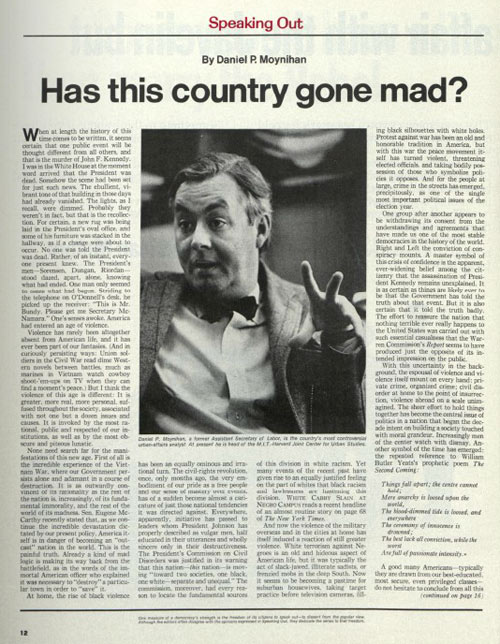
 The happenings of the late 1960s in the U.S. seemed apocalyptic to those accustomed to the country’s status quo. Race riots, war protests, a worsening conflict in Vietnam, and several high profile assassinations brought renewed focus to American violence. Daniel Patrick Moynihan, a sociologist and politician, wrote about America’s new “age of violence” 50 years ago in the Post (“Has This Country Gone Mad?”).
Moynihan decried the country’s new status quo as one of institutional and individual violence: “It is greater, more real, more personal, suffused throughout the society, associated with not one but a dozen issues and causes. It is invoked by the most rational, public, and respected of our institutions, as well as by the most obscure and piteous lunatic.”
His preferred solution for the country’s 1968 predicament was bipartisan agreement between liberals and conservatives. “The great power of the American nation is not the natural wealth of the continent, nor its physical isolation, nor the invigorating mix of peoples that make up our population, nor the genius of scientific research and business enterprise that have made so much of these assets. Our strength lies in our capacity to govern ourselves,” he wrote. Moynihan’s indictment of violence at a time when “one group after another appear[ed] to be withdrawing its consent from the understandings and agreements that have made us one of the most stable democracies in the history of the world” can seem applicable still. The answer to it all, in turn, is just as elusive.
Healthy Weight, Healthy Mind: The ABCs of Thinking about Weight Loss
We are pleased to bring you this regular column by Dr. David Creel, a licensed psychologist, certified clinical exercise physiologist and registered dietitian. He is also credentialed as a certified diabetes educator and the author of A Size That Fits: Lose Weight and Keep it off, One Thought at a Time (NorLightsPress, 2017).
Do you have a weight loss question for Dr. Creel? Email him at [email protected]. He may answer your question in a future column.
A simple process can help you change your thinking for more successful weight management. Based on the work of Albert Ellis and Aaron Beck, cognitive behavioral therapy includes identifying a situation (activating event) that leads to a thought/belief, that in turn yields an emotional reaction. In Lisa’s case the process looked like this:
Activating Event (A): Boss asks for a volunteer.
Belief (B): “The boss will be disappointed if I don’t volunteer.”
Consequence (C): Feeling pressured, overwhelmed, and even angry.
Patients come to see me to lose weight. But my patients don’t lose weight before every visit. Sometimes they gain quite a bit, depending on how long they’ve been away and events in their lives. Body language usually reveals their expectations even before they step onto the scale. Patients who know their weight is up are sometimes tearful, disgusted with themselves, and embarrassed. After a weight check, our interaction might go something like this:
“You seem upset, what’s going on?”
“It’s just that my weight is up. I’m so frustrated.”
“Were you expecting it to be up?”
“Yeah, I guess, but seeing it reminds me that I’m not reaching my goals.”
“So you’re upset because you feel like you’re not making any progress right now?”
Weight gain is the activating event here. Patients tell me they’re upset by the added pounds, but that is actually not why they’re upset. They are unhappy because of beliefs about increased weight. If gaining weight automatically caused distress, then everyone who added a few pounds would be unhappy. Yet, weight gain is often desirable for people who are too thin. Therefore, seeing numbers go up on a scale isn’t guaranteed to cause unhappiness. Our personal beliefs about weight gain inspire feelings like these:
“I’m hopeless at losing weight.”
“This diet and exercise thing isn’t going to work for me.”
“People are laughing at me.”
These beliefs—not the actual weight gain—lead to the consequence of negative feelings. And those negative feelings make us want to give up, which would create even more emotional distress.
Activating Event (A): Gained 10 pounds.
Belief (B): “I have absolutely no willpower.”
Consequence (C): Feeling frustrated, angry, and hopeless. Tempted to stop trying.
You may be asking, “How can I think more positively if my weight gain was caused by ignoring my goals, emotional eating, or late-night snacking? In these instances, we are not necessarily looking for positive thoughts, but instead rational, functional thoughts that can help you get back on track. We want to think in a way that’s functional without making it personal and judgmental.
Instead of using beliefs to put yourself down, translate your beliefs into rational, functional thoughts that will help you move forward without overwhelming blame and shame.
Activating Event: Gained 10 pounds.
Belief: For me, snacking late at night leads to weight gain. But I can control this behavior with a reasonable plan.
Consequence: I feel hopeful and will plan my snacks this week.
Thoughts Are Automatic
The bad thing about dysfunctional thinking is that our thoughts are often automatic. We respond to a situation in the same way for so long that the situation-thought-emotion cycle becomes like a bad golf swing repeated over and over for years; it seems almost impossible to change. We begin telling ourselves, “That’s just how I think. It’s part of my personality.” Even if we want to think differently, those knee- jerk-reaction thoughts keep popping up, and we don’t even realize the damage they’re doing until we’ve lashed out at someone, checked out with three glasses of wine, or polished off a bag of Ruffles. The thoughts are as automatic as flipping on a light switch even after you’ve lost power in your house.
We could compare the brain’s neural networks to a daily commute. Perhaps you’ve taken the same morning drive for fifteen years, which includes traveling the same roads and encountering familiar traffic lights, merges, and landmarks. This daily routine is a highly organized schema in our mind and requires little thought or processing. You can do it on autopilot and barely remember the trip after you arrive. Even if the streets are congested and dangerous you take them anyway, because it’s the only path available, or is the most reasonable option to take you where you need to go. But what if you discovered a newly constructed road that was safer, required less time, and was more scenic? Would you take it? I’m guessing you would, but you’d need to be intentional about the choice. If you forgot to focus on the new route, in a morning stupor you might still drive the old way.
Sometimes change requires great effort. Our home is in a newly developed neighborhood and the builder piled huge mounds of dirt in an empty lot about 50 yards behind our property. We could see the pile of dirt from the sunroom of the back of our house, and of course my children wanted this to be their new playground. So I checked it out and decided they were unlikely to become permanently maimed by playing there.
I spoke to my wife about letting the little ankle biters expend some energy playing “King of the World” and “Mountain Tag,” and she agreed, as long as it happened before their baths. We still had one problem: The only reasonable trek to this alluring dirt pile meant walking to the front of our house, along the road, and then along a dirt path created by the builder where work trucks frequently traveled. From inside our house we couldn’t see our preschoolers walk this way, and even if we could see them, we didn’t feel the route was safe without adult supervision. So if they wanted to play, my wife or I needed to chaperone them to the pile. This round-about trek was a major inconvenience because as soon as we reached the dirt pile one child needed to go to the bathroom or was hungry and wanted to come back to the house, and then back to the mountain— and back—and forth.
If only the kids could just walk out the back door and run safely to the dirt pile. We could keep an eye on them from the rear of our house and easily hear what was happening. But the landscape in between included high weeds, sticker bushes, and insects. I even saw a small garter snake back there. The weeds were so high we’d lose sight of our kids if they tried to hike through them. Besides, a previous attempt led to ouchies, bug bites, and a quick return to our backyard after four steps into the tangled mess of vegetation. After a weekend of walking the kids back and forth to the dirt pile via the road, I decided we had to find a better way.
I got out a hatchet and begin cutting down the weeds and brush that separated our backyard from the dirt pile. With the big stuff out of the way, I took our push mower and began making a path. The mosquitos were terrible and my mower wasn’t made to cut tall weeds, but with persistence I eventually reached the dirt pile. The kids now had a safe, short, and efficient route to their playground that didn’t require hand-holding.
Our thoughts are sometimes like the first route my kids first took to the dirt pile. They cause anxiety, are inefficient, and require a lot of support from others in order to make them work in our daily lives. Changing these entrenched thoughts often requires the tough work of creating a new set of beliefs and different neural pathways in the brain. This can take determination and, like making a path to the mountain, it requires tools and persistence.
One of the first steps to changing your thinking is to identify thoughts that get in your way. Categorizing these irrational beliefs can lead to building a shortcut that will bypass the weeds and lead directly to functional thinking and healthier behavior.
In the next few articles, I’ll cover many of the common types of dysfunctional thinking and how to avoid them.
Good Writing Calls for a Pen or Pencil
This item is from The Vault, which features gems from The Saturday Evening Post archive.
Herbert Spencer admits in his autobiography that the habit of dictating spoiled his style and made him diffuse. And we have only to glance at the work of any of the literary “artists” who use the typewriter to put their thoughts on paper to see that facility breeds slovenliness.
Typewriting and stenography are the wonderful, invaluable aids to the mind of today. But they can be abused. If the man has anything to set down that calls for clearness and terseness of style and exact expression of exact meaning, he will do well to shut himself in with pen or pencil and work out his problem in the old laborious way. Then let him send the results to the typewriter, in order that who must read shall not have to share in his labor.
—“Returning to the Pen,” Editorial, April 15, 1905

This article is featured in the May/June 2018 issue of The Saturday Evening Post. Subscribe to the magazine for more art, inspiring stories, fiction, humor, and features from our archives.
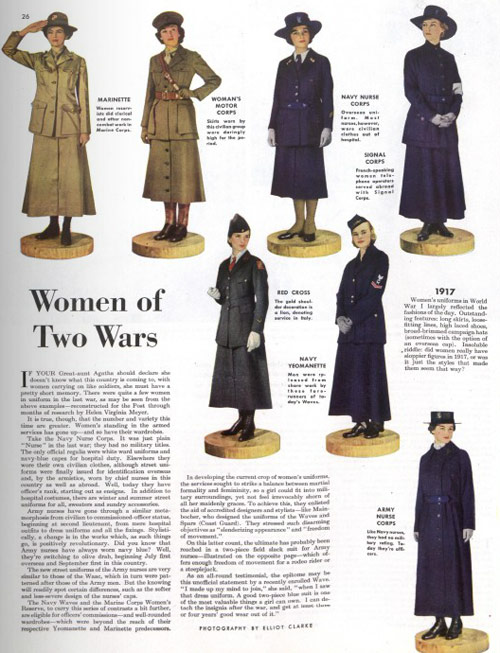
The Evolution of Women’s Military Uniforms
In honor of National Nurses Day in the United States, we’re reprinting an article from our archive that examines the uniforms that women — who primarily served in nursing roles — wore in World Wars I and II. From 1917 to 1943, their service attire evolved from simple white dresses to full military uniforms. Both eras illustrate the tension between modesty and function, fashion and practicality. By 1943, long skirts had given way to more useful configurations, although the author expressed concern that slacks had become an option for field nurses.
Regardless of the limitations imposed on them by their uniforms or by the stricter gender roles of the era, 23,000 women served in military hospitals in World War I, and 350,000 women were part of the Armed Forces in World War II. We continue to be grateful for their service.
Movies for the Rest of Us with Bill Newcott: 15 Favorite Star Wars Moments
What’s your favorite Star Wars moment? The original opening sequence? Blowing up the Death Star? When Leia kisses Luke? (ewww…) Film critic Bill Newcott reviews 15 favorite Star Wars moments.
(Note that if you haven’t watched all of the movies, spoilers abound.)
News of the Week: A Simpsons Record, Tony Nominations, and the Search for Discontinued Snacks
636
I used to watch Gunsmoke. I wasn’t there at the beginning — it started in 1955 — but I did watch it in the early ’70s, and then the repeats. I wanted to be Marshal Dillon, shooting bad guys and then going to the saloon to hang out with Miss Kitty. For a very long time it was the longest-running scripted show in TV history (it ended in 1975), but now that record has fallen away.
The Simpsons is now the longest-running scripted show. Last week’s episode was number 636, which means they flew past the 635 episodes of the James Arness western, as well as Lassie, which lasted for 591 episodes in various incarnations.
That’s going to be a very hard record for another show to beat. Even if they brought Lassie back (which I’m surprised they haven’t done since people love dogs), it would still be hard to catch up to The Simpsons. They’ve been renewed for at least a couple more seasons, and since they’re a cartoon, it’s not like the actors are going to get tired of the roles.
SpongeBob Is Up for a Tony?
Another famous cartoon just made news, too. The Tony nominations were announced this week, and SpongeBob SquarePants: The Broadway Musical tied with Mean Girls for the most, getting a total of 12, including Best Musical, Best Book of a Musical, and Best Performance by an Actor in a Leading Role in a Musical (for Ethan Slater). Other nominees include Denzel Washington, Tina Fey, Amy Schumer, Laurie Metcalf, Andrew Garfield, and Nathan Lane.
Of course, this being an awards show, there were snubs, including Jimmy Buffett’s Escape to Margaritaville, which got a whopping … zero nominations. Sorry, Parrotheads!
The Man Who Designed Radio City Music Hall
The Tony Awards will air live from Radio City Music Hall on CBS on June 10. This segment from this week’s CBS Sunday Morning talks about the anniversary of the death of Donald Deskey, the man who designed the New York City landmark. But what’s even more interesting is that the advertising man designed the packaging for many products you probably have in your home right now.
Attack of the Giant Mosquito
The warm weather is here, and that means the bugs are back. (I killed a giant bee in my apartment this week, which was “fun.”) Just be glad you’re not in China, where they have these things.
https://twitter.com/nypost/status/990946897161609217?ref_src=twsrc%5Etfw
This is how every monster movie starts. A giant bug like this stows away on a ship, comes over to the U.S., and wreaks havoc.
For Sale

I’ve bought items on eBay in the past, usually out-of-print books and other collectibles. And there are many other things I can imagine buying on the site. It never occurred to me to buy food, though.
Apparently, people are selling discontinued candy and other snacks on eBay. Since they’re discontinued, they’re often fairly expensive. But if you have an urge for Surge or Cinnamon Spice Tic Tacs, and also have a couple hundred dollars to spare, they can be yours.
You can also buy candy from several retro/nostalgia sites, including Old Time Candy, Dylan’s Candy Bar, Candy Favorites, and The Vermont Country Store.
RIP Arthur B. Rubinstein, Paul Junger Witt, Charles Neville, Michael Anderson, Pamela Gidley, and Gertrude Jeannette
Arthur B. Rubinstein was a composer who wrote music for films such as WarGames, Blue Thunder, and Stakeout, as well as TV shows like Scarecrow and Mrs. King, The Wizard, and many documentaries. He died last week at the age of 80.
Paul Junger Witt was a producer of many TV shows, including The Golden Girls, The Partridge Family, Beauty and the Beast, It’s a Living, Soap, and Benson. He also produced the movies Dead Poets Society, Three Kings, Brian’s Song, and a movie that scared the heck out of me when I was a kid, Satan’s Triangle. He died last Friday at the age of 77.
Charles Neville was a saxophonist and co-founder of the Neville Brothers band. He died last week at the age of 79.
Michael Anderson directed such films as Around the World in 80 Days, Logan’s Run, Orca, The Quiller Memorandum, and the 1956 version of 1984. He died last week at the age of 98.
Pamela Gidley appeared in the movie Twin Peaks: Fire Walk with Me and was a regular on TV shows like CSI, The Pretender, Angel Street, and Strange Luck. She died on April 16 at the age of 52.
Gertrude Jeannette was not only an actress, writer, and director in film and on Broadway, she was also the first woman to have an official cab driver’s license in New York City. She died last month at the age of 103.
Best and Worst of the Week
Best: I really enjoyed this Sports Illustrated essay by Jack Dickey on what it was like to be a recent two-day champion on Jeopardy! He gives a lot of inside info on how the show is filmed (they do several episodes a day, so you have to change clothes) and what the contestants can and can’t do while they’re there.
Worst: Well, this is depressing. Apparently, British kids can’t tell time on analog clocks, so the schools there are getting rid of them and replacing them with digital ones. Actually, this isn’t confined to just Britain; it’s true in the U.S. too, as this segment from Jimmy Kimmel Live! shows.
This Week in History
New York World’s Fair Opens (April 30, 1939)
The Flushing Meadows fair was open for a year and a half, closing in October of 1940. There’s a time capsule still buried there that is going to stay buried until the year 6939. The Post is planning a special issue for the time capsule’s opening.
Empire State Building Dedicated (May 1, 1931)
The New York City landmark has 102 floors and was once the tallest building in the world. It was the site of a 1945 plane crash, and there was also that time in 1933 when a giant ape climbed it.
This Week in Saturday Evening Post History: Dieting Through Dessert (May 2, 1959)
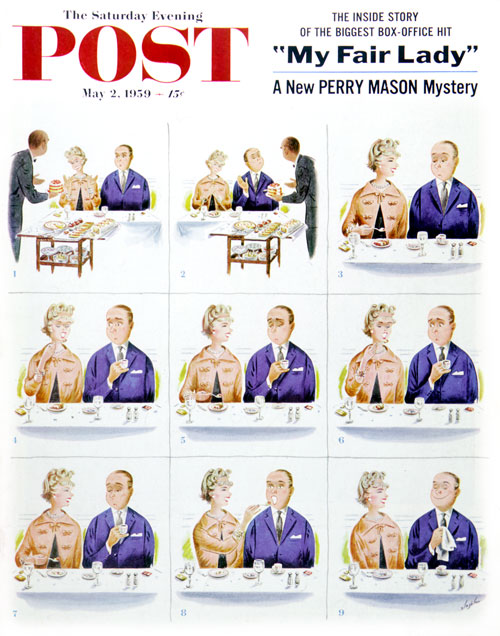
Constantin Alajalov
May 2, 1959
There aren’t many Post covers that feature nine different panels, but this one by Constantin Alajálov is an effective way to show how much the guy wants the dessert, which he finally gets a bite of in the last panel.
Post Writers You Should Read
By the way, the Perry Mason story featured in that issue was “The Case of the Mystical Monkeys,” in which Perry defends a secretary accused of murdering a Las Vegas gambler. The Post published many of Erle Stanley Gardner’s Mason stories, even before the TV series started in 1957. Here’s a bibliography of the Mason novels and stories, including the ones we published. Many of them were illustrated by James Bingham.
Desserts!
Continuing with our celebration of the above Post cover, Sunday is International No Diet Day. Now, for a lot of people, every day is “no diet day,” but this is the day when you have official (and international!) approval to not diet.
Here’s a recipe for Aunt Mary Ann’s Four-Layer Whiskey Cake, and here’s one for a cake that Mary Todd Lincoln made for her husband. I don’t think it has a name, but it is advertised as “the best in Kentucky.” And if you like bananas, here are several really old recipes, including Banana Pie, Banana Pudding, and the ever-popular Banana Cakes to Be Served with Meat.
Next Week’s Holidays and Events
Free Comic Book Day (May 5)
Comic books are one of those things that I put in the category of “I haven’t bought one in many years and I have no idea what’s going on with them but I’d like to get one again.” Saturday just might be the day to do that.
V-E Day (May 8)
It stands for Victory in Europe and it celebrates the day in 1945 that Nazi Germany surrendered to the Allied Forces.
Hungry
Linda had gotten into the habit of stopping by the bridge after work, never 100 percent sure if today would be the day. The sun had set, and she stuck her bare hands in her pockets to warm them. She leaned over and looked down at the water. At night, it looked dark and fathomless. She felt like she could disappear into it, become one with the water, and leave everything behind.
Headlights silhouetted her as she gripped the handrail. She wondered what people thought she was doing there, standing and looking down. Part of her wanted someone to notice her, to stop and ask. But she knew she would have been mortified if that happened.
When the tip of her nose was numb and her lungs ached from the cold air, she moved on. She watched the sidewalk as she walked, stepping over cracks. She didn’t believe in taking chances.
A bell rang as she pushed her way into the convenience store, and the warm air hit her like a blanket. She unwrapped her scarf and unbuttoned her jacket. The owner looked up and smiled at her. “Hello,” he said.
She waved and smiled. “Hi, Mr. Kim.” She walked up and down the aisles, looking for something she might eat. She picked up bags of chips, read ingredients on cans of soup. She wondered what Mr. Kim thought of her, if he thought it was strange that she spent so much time in his store every night. He wouldn’t say anything though; he was too polite.
The bell rang, and someone else came into the store. Linda craned her neck to see the other shopper. It was a teenager wearing a dirty hoodie, pulled up to shade his or her face. A hoodie wasn’t enough protection in this weather, so the kid probably lived close by.
Linda continued browsing and, after a while, picked out a bottle of soda and a bag of pretzels. Mr. Kim rang her up but seemed distracted. Usually, he made small talk, showed her pictures of his grandchildren or told her funny stories about customers. Today, he was silent, peering over her shoulder and barely looking at her. It made her sick to her stomach. She looked forward to the conversation all day.
Mr. Kim gave her the total and she handed him cash, but he dropped the money and hurried around the counter. “Hey you, I saw that!”
Linda turned to see the teenager running for the door, but Mr. Kim intercepted the kid. He was a small man, but wiry. He grabbed the kid’s arm and didn’t let go. “I saw you put that in your pocket. You want to pay, or should I call the cops?”
The kid tried to break free of Mr. Kim’s grip, but couldn’t. “Let me go!” the kid said. It sounded like a boy’s voice. “Leave me alone. I didn’t do nothing.”
“You didn’t? Then what’s this?” Mr. Kim reached into the front pouch of the kid’s hoodie and pulled out a box of granola bars and a pint of chocolate milk.
“It’s … I was going to pay for it. I just … forgot my wallet.”
“Cops then,” Mr. Kim said. “You don’t steal from me.”
“I’ll pay,” Linda blurted out.
They both looked at her, their faces mirroring the same shock she felt. “Here, ring it up and I’ll pay for it.” She fumbled another $20 out of her purse and showed Mr. Kim, as if he wouldn’t believe her.
“You don’t have to pay. Damn kids think they can steal. Not from me,” Mr. Kim said, scowling.
“It’s okay, really.” Linda realized why she’d offered to pay. The teenager was stealing food, and she wondered what his story was.
Mr. Kim narrowed his eyes at Linda, and then relented. “Fine. You pay.” He still held the items, and he released the teen.
Linda thought the kid would bolt then. His body stiffened as if he were thinking about it, but he relaxed. Stuffing his hands into his jeans, he sauntered over to her. Not looking her in the eye, he said, “Thanks.”
Mr. Kim bagged the items and handed them to the teen. “Don’t come back, okay? Miss Linda is a nice lady.”
The teen glanced up at her then. Just a flash of brown eyes.
Linda said, “Hey, what’s your …” but before she could finish the sentence and ask the boy his name, he was gone.
Mr. Kim handed her back her change. “Damn street kids come in and think they can take what they want. They’d rob me blind if I didn’t watch them every second. I’m just trying to make a living.”
“Street kids?” she asked. “What’s that mean?”
He shrugged. “They live on the street. Homeless.”
Linda couldn’t stop thinking about the boy. She went on the internet and looked up information on homeless teens. It shocked her to learn that kids actually did live on the street. In many cases, they’d run away from abusive homes and were afraid of the systems that could help them.
Linda was so involved in her research that when the phone rang, she didn’t check the caller ID before answering. She realized her mistake a split second too late. “Hi, Mom.”
“Hey, honey. How are you today? How was work?”
They made small talk for a few minutes, and Linda braced herself for the real conversation. She didn’t have to wait long. “I get tired of being the only one at work who does anything. Lizzie takes breaks every five minutes to go smoke, and she acts like no one knows. And the bitch twins spend the whole time gossiping. No one listens to me, even though I’ve been there the longest …”
They were the same complaints as usual. Linda tried to click quietly, surfing the internet and listening just enough to make it sound like she was paying attention. But she wasn’t quiet enough.
“What are you doing? Are you online?” her mother asked, then, before Linda could answer, hurried on. “Are you doing that online dating thing? I read it was dangerous. In my day, we met people at church, or through friends.”
Linda wasn’t sure what question to answer first, so she just avoided the ones she didn’t want to answer. “I’m not online. I just needed to click something really quick. You have my undivided attention. You were saying something about what Brenda said?”
But her mother was onto her favorite topic and wouldn’t be distracted. “You’re not getting any younger. It’s time to settle down. I was hoping you’d have kids while I could still enjoy them. Why aren’t you dating?”
It was a sticky subject. Linda could either admit that she’d been on a few dates that didn’t go well, leading her mother to advice and dieting tips. Or say she wasn’t dating and hear a lecture on how she’d wind up bitter and alone.
When she finally got off the phone, her mind drifted back to earlier that day. Though sometimes she hated her mom, part of the reason she never took that step off the bridge was that there’d be no one to take care of her mother.
It made her wonder about the boy. Where was his mother?
The next day, Linda detoured by the bridge and looked down at the water. But the water didn’t call to her that day, so she moved on to the store.
Mr. Kim was behind the counter, as always. She only spent a few moments browsing, and then just grabbed a cup of instant oatmeal for dinner.
As Mr. Kim rang her up, she stared at his gnarled hands, not wanting to look him in the eye. She tried to sound casual as she asked, “That boy who was in here last night … do you know him?”
“Yeah. He’s a thief.”
“No. I mean, his name. Or where he lives.”
Mr. Kim gave an irritable shrug and shoved her bag toward her. “On the street. He’s a street kid. He comes in here and steals. But not anymore. If he comes again, I’ll call the cops. I mean it!”
“Okay,” she said, backing out of the store. When she left, instead of going straight home, she walked for a while, paying attention to kids. There were a few homeless adults, and Linda gave them each a dollar. But no kids. She wondered where they slept and how many of them there were.
It was a few weeks later when she finally saw him again. It was still cold, but at least the weather hinted at spring. He looked like he was scoping out a street cart vendor, seeing if he could snatch a hot dog.
Linda came up behind him and said, “Can I buy you dinner?”
He jumped and took two steps away, then turned toward her. His hood was up, and she couldn’t see much of his face, but streetlights reflected in his eyes enough to show he was glaring at her.
Linda motioned toward the hot dog cart. “You hungry?” she asked. “I can buy you one. Or two. Whatever you’re hungry for.”
Linda could tell he wasn’t sure if he wanted to run away or not. Finally, his muscles relaxed a little, and he said, “Why?”
“Just … because. You’re hungry.”
“What do you want?” he asked.
“Nothing.”
He laughed, a sharp bark of sound that wasn’t amused. “Everybody wants something. I’m not going to do anything for it.”
Linda had no idea what he meant. “I don’t want anything. Just to buy you dinner.”
He shrugged. He didn’t approach the vendor, so Linda finally moved in front of the cart and ordered three hot dogs. She wasn’t really hungry, but having a hot dog in her hand would give her an excuse to stand with him.
She held two hot dogs out toward him, offering the food. He didn’t react at first, but then slowly put his hands out. His hands darted out and snatched the hot dogs from her as if he thought it was a trick, that she’d pull away at the last minute.
She expected him to bolt. But he didn’t. He stood there and wolfed down the food. His hood fell back and exposed his face.
He was younger than she’d thought. A teen, but barely. He didn’t seem to notice her watching him, and Linda tried not to stare. When he was done with his two hot dogs, she handed him the third one.
He didn’t pause this time, but grabbed it from her. Barely chewing, he finished the hot dog, then wiped his sleeve across his mouth and looked at her.
His eyes were angry and too old. After a moment, he shoved his hands into his pockets and stood awkwardly. “Thanks,” he said begrudgingly.
“What’s your name?” she asked, her voice soft, hoping she wouldn’t scare him.
He rocked back and forth on his feet, and she looked down at his shoes. They seemed too small for him, and his left big toe poked through a hole in the upper. Linda made herself look back at his face.
“What’s it to you?” he asked.
She shrugged. “Nothing. I just wanted to know.” He seemed to be waiting for her to say something else, but she didn’t know what else to say. So she waited, hoping that he wouldn’t run.
His jaw tensed, and he held her gaze for an uncomfortably long time. “Raymond,” he said. Then he pulled up his hood and ran.
Linda wanted to help the boy. She wasn’t sure what she wanted to do, wasn’t sure what she could do. But a month passed, and then two. Though she’d traded her bridge habit for walking around, looking for Raymond, she didn’t find him.
She told her mother about Raymond, and shouldn’t have been surprised when her mom said, “What’s a meal going to do for him?” Then her mother had gone into a crazy phase, and her phone calls came daily. Linda seldom answered them. She didn’t want to listen to the messages, but she couldn’t help herself. What if there was something important?
There never was.
“Linda, it’s your mom again. Remember that time I fell, and you couldn’t come?” Linda had called an ambulance, and then driven straight to the hospital from work. The problem was it had been snowing, and it had taken her over hour to get there. “I was laying in bed today, crying because I’m always alone like that. I can’t stop thinking about how when I needed you, you weren’t there for me.”
“Linda, it’s your mom again. I know you’re ignoring me. If I took all my meds, I’d die, and you’d never even know it. The neighbors would find me when I started to smell. You’d like that, wouldn’t you? Then you wouldn’t need to feel guilty about me anymore.” And so on.
Even though she knew it was her mother’s mental illness talking, that she didn’t really mean what she said, it still made Linda’s chest ache. She wouldn’t find Raymond again, couldn’t do anything about him. She couldn’t even help herself. Linda started spending more time on the bridge again, looking down at the river.
If she jumped, her mother might realize how awful she’d treated her and regret it.
If she jumped, her mother might be consumed with guilt, and finally follow through with overdosing on her medication.
If she jumped, she might finally get some peace.
If she jumped, she might go to hell. Even though she didn’t believe in hell. Probably.
She didn’t jump.
When summertime came, her mother’s crazy phase was over. Linda had started dating Greg, a guy she met online, and things were going well. They were at his apartment, and she’d made him dinner. “I was thinking about taking my mom out for her birthday next week,” she said.
“Do I finally get to meet her?” Greg asked.
Linda’s heart leaped. “If you want to, yeah. I mean you don’t have to. But …” She made herself stop babbling.
“Of course I want to meet her,” Greg said.
She smiled. When she called her mom that night, her mom could barely contain her excitement. It had been a long time since Linda introduced her mom to one of her boyfriends.
The night of the birthday came, and they had all made arrangements to meet at Fast Eddie’s, her mom’s favorite restaurant.
Greg was never late, but when 15 minutes passed, Linda texted him. At a half hour, she called him. At 45 minutes, Linda and her mom ordered dinner. Linda didn’t taste a bite of her dinner. Greg didn’t show up by the end of dinner, and she didn’t hear from him.
“I’ve heard that these men who meet you online aren’t reliable,” her mom said. She probably meant to be helpful, but it made Linda feel like throwing up every bite she’d managed to choke down. Her mom continued. “It sounds like he’s ghosting you. I read about that, where the boy doesn’t break up with you. He just stops answering your calls.”
“He’s not breaking up with me,” Linda snapped. “Something probably came up. He’ll text me later.” Please let him text me later.
By the time they finished dinner, Linda was exhausted. She wanted to go home and drink a bottle or two of wine, then sleep for a week. Instead of heading home, she headed for the bridge.
It was a quiet evening. She was alone, no headlights spotlighting her. She could be the last person alive. If she were the last person alive, she could just step over the railing, sink into the black water, and it wouldn’t matter.
Despair tried to suck her under, as her bleak, loveless life stretched before her. Her mom going through periods of time where she hated Linda. Dating, finding someone who seemed good, until he realized he didn’t want her. Eventually, even her mother would die, and then she’d be alone. Maybe she’d catch herself complaining to strangers who nodded politely and wished for the crazy lady to stop talking.
She couldn’t stand the idea of the well-meaning phone calls that would inevitably follow, her mother checking on her every day to see if Greg had called. They’d almost be worse than the crazy, mean messages.
Linda stepped up on the railing, to see what it was like. She’d never done that before. She unclasped her hands and leaned forward, thighs pressed against the top bar.
All she’d have to do was climb over. Lean forward. Gravity would take care of the rest. It would be like falling off a bike. Easier.
“Hey lady!”
She heard the voice, but didn’t connect it to herself at first.
“Lady!”
It broke through her daze, and she stepped down, embarrassed to be caught at … whatever it was she was doing. She turned toward the voice.
It was Raymond, hurrying toward her. He was taller, and wasn’t wearing his hoodie, but she recognized him.
He stopped a few feet in front of her, not as tense as normal, but still ready to run. He seemed to be waiting for her to speak, but she didn’t know what to say. Was she supposed to pretend she hadn’t climbed up on the railing? Was she supposed to ask him how he was doing? She didn’t know the rules.
When she couldn’t stand the silence another second, she asked, “Have you been eating?”
“Yeah.”
Do you go to school? Where are your parents? Can I help you? She wanted to ask him a million questions, but they’d only make him run away. But he’d found her, and she wasn’t ready to be alone. It was like all the blood rushing back into a sleeping limb; painful, but proof of life.
“Do you want to get something to eat?” she asked. “There’s a diner around the corner.”
He eyed her suspiciously, and then jerked his head in a nod.
Raymond fell in step beside her as they walked to the diner. He could have a meal tonight, and Linda would stick around, one more day.
How the Self-Storage Boom Snuck Up on Us
Last year, when my grandmother was moved from Central Illinois to my parents’ house in Indiana for hospice care, I wanted to help in the transition somehow. As it turned out, she had some belongings that would need to be stored for a short time while everyone was dealing with her eventual passing, so I was tasked with finding a storage locker.
The job seemed simple enough, but locating available self-storage proved a grueling days-long affair. I had never rented storage before, and I failed to realize that, nationally, self-storage is 90 percent full. There were plenty of nearby businesses to choose from, but it seemed that everyone else had the same need as me. It hadn’t occurred to me that those giant buildings I mentally blocked out on my morning commute had formed themselves into an American necessity. There are more than 50,000 of them all over the country, and they make up a 38 billion-dollar industry. That’s more than three times Hollywood’s gross box office revenue in 2017.
Last year marked a new record for investment in self-storage, with just under 4 billion dollars spent on the construction of new facilities (that’s double the amount spent in 2016). At this point, we have more than 7 square feet of rentable storage space for every person in the U.S. We’re also unique in our culture of storage, taking up 90 percent of the global market as of 2013.
The data hits you square in the face like a stack of old comic books. Are we so profanely materialistic, or is nomadic city-living and short-term necessity propping up a temporary industry?
Professor Valerie Folkes is an expert in consumer psychology at University of Southern California, and she says the changing demographics in U.S. consumers could play a role. Delayed marriage — and homeownership — in younger people leads to longer independence and fluidity in living situations, according to Folkes. Since millennials are still acquiring stuff during this period, they may need somewhere to put it in the case of a sudden move or unexpected circumstance.
Younger people might be utilizing storage for specific needs, but it appears that the majority of its consumers skew older. According to the Self-Storage Association, 68 percent of facilities are in suburban and rural areas and 65 percent of renters already have a garage. The crux of the industry’s success may just be that, as Folkes says, “Self-storage relieves consumers from having to make hard decisions about disposal.” Renting a storage unit can effectively delay the stress of arbitration when it comes to never-worn clothing or years-old keepsakes. Disposal can be painful because we place more value on items we own than those we don’t. “Part of that is because an object becomes an extension of our own image and identity once we own it,” Folkes says. Throwing that away can be, at least fleetingly, distressing.
America’s relationship with our possessions is not new, though, at least according to The Saturday Evening Post. In 1950, the article “Tales of the Moving Vans” tells about the original moving and self-storage company, Bekins:
Sentiment clings to objects which have become symbols of old joys and griefs. The possessive instinct, which takes in collectors and hobbyists, just clings. The man who won’t let his wife throw away an old magazine and fills attic and basement with stuff that “might come in handy,” sometimes cannot part with his hoardings even when the moving van backs up.
The company, founded in 1891, used the apt slogan “Corridors Where Dreams Are Stored.” Bekins, while serving the Silent Generation, understood their attachment to items — such as the clothing of a son or husband who didn’t return from the war — but it was perceived as a virtue that grows with age, as the 1950 article put it: “The young never have been sentimental about things. They have few things and haven’t had them long; it takes years of association before a thing becomes part of you.”
If sentimental attachment to ones possessions drives the construction of storage facilities, then the modern consumer is perhaps doubly so. For some dense cities, this poses a problem. In places like New York and San Francisco, the rise of storage buildings has been met with resistance from city officials and community groups. While the enterprise of owning such an operation can be extremely lucrative — and 74 percent of self-storage facilities are owned by small-time entrepreneurs — it adds very few jobs to a community and gobbles up precious real estate that could be used for housing and businesses. On top of that, the boxy, windowless buildings decrease walkability and can scarcely be considered an aesthetic addition to a neighborhood. Some city councils have carved out zones that ban the development of storage buildings, to popular approval from constituents.
Although business is booming, around 155,000 rental units are abandoned each year. Tenants either can’t pay or won’t pay, allowing their possessions to go to auction. Professor Folkes isn’t surprised that people often abandon their possessions after some time apart. They may adjust to life just fine without their grandmother’s tchotchke collection, but it’s the initial decision of disposal that is so difficult.
Whether ubiquitous self-storage is an impending lifestyle or a fleeting idiosyncrasy isn’t clear. Will we wake up in 40 or 50 years and think, why in heaven’s name did we build all of these things? Given the rise of trendy minimalist living in a sharing economy, the storage industry’s boom comes at an unexpected time. Only time will tell if it’s a new reality or a last gasp.
Instead of constructing new buildings, some storage companies will likely be looking at existing, underutilized places to set up shop. With the “retail apocalypse” underway, a shopping mall could be the perfect spot. That’s right, you could soon be taking your stuff — and your money — right back where you got it.
Funny Business: Why the Comedy Club Scene Is Booming
The comedy gods have not been kind to Sioux Falls, South Dakota. Nitwits, Funny Bone, Wacko’s — the city’s three top clubs — all shut down in the last year or so, the yuks yielding to economic reality. But a new venue, called Boss’, has leapt in to fill the void. It’s situated inside a chicken-and-pizza joint. Seriously.
That’s almost funny — possibly even to the itinerant comics who count on the country’s club circuit for their livelihoods. It’s a peculiar bunch, these touring stand-ups. If they’re good enough, every weekend they climb on stage to deliver a set of jokes to a crowd that’s alcohol-primed and rowdy. It can be brutal.
And yet, Sioux Falls’ issues notwithstanding, club comedy is in the midst of a boomlet in America. The streets are alive with the sound of guffaws.
It’s no shocker, then, that wannabe comics are abundant. Where once kids coming out of college aimed to be hedge-fund traders, some of today’s grads actually see comedy as a legit option. That’s a crack-up, eh?
“You can make an amazing living doing stand-up, but you have to love it,” I was told by Bruce Smith, who heads Los Angeles-based Omnipop Talent Group, which mainly represents comics. “It’s a high price you’re paying.” By which he means the constant travel and the crummy hotels in which club owners frequently house their performers. “There are a lot of indignities in comedy,” Smith told me.
Andy Kindler knows from indignities — oy! — but also the unparalleled high of being on a stage with nothing but a handheld mic. Kindler is one of the fortunate ones, a comic who’s worked pretty much nonstop since 1987. “Overall, it’s a way better scene now,” Kindler said from his home in L.A. just before flying off to another gig. For one, social media has allowed comics to nurture their audiences. What hasn’t changed: the fun of mingling in the green room. “Hanging out with all the other comics keeps me sane.”
Typical of an ascendant stand-up whom Kindler might encounter backstage is Erica Rhodes, who was a little-known actress before deciding, five years ago, to take a shot at stand-up. At first, she told me, she was doing “bringer shows,” where you literally bring your own audience. It was degrading. Sometimes she bombed. There was no money. Things looked grim.
But who’s laughing now? Audiences aplenty. Today, Rhodes is a frequent headliner. She’s performed in at least 20 U.S. cities. (Plus she’s scored small parts on a few top TV shows, such as Modern Family and Veep.) On first seeing her name illuminated atop a club marquee: “It was cool, but it had no huge effect on me.” What? Like many comics, Rhodes has a hard time acknowledging success. The veteran Andy Kindler, who’s worked clubs with Rhodes, observed, “It’s a tough biz, but Erica’s doing it the right way. She’s been very relaxed.”
Rhodes is pleased — well, as pleased as a comic can be — to have broken through, despite the fact that it demands more travel. “Every club is so different,” she said. “And comics are all weird. Female comics can be cold to each other. Local comics can be arrogant. They all have insecurities.” Rhodes herself has an ample amount of those, which she readily confesses in her largely autobiographical act.
Will today’s thriving club scene last? Possibly. According to a recent Wall Street Journal story, “as the world becomes a more unsettling place, the comedy club becomes a haven of sorts.” And thus a predictable punchline: In especially troubled times, we Americans will go looking for laughter. Even, it would seem, in a Sioux Falls pizza parlor.
In the last issue, Neuhaus wrote about tattoos.
This article is featured in the May/June 2018 issue of The Saturday Evening Post. Subscribe to the magazine for more art, inspiring stories, fiction, humor, and features from our archives.
Is it Too Late to Jump on the Superhero Movie Bandwagon?
Warning: Contains cryptic spoilers.
In 2012, when The Avengers hit theaters, I was a third-year film student holed up in a 300-level course watching the 1956 John Ford classic The Searchers. I missed out on all of the films that composed Marvel’s Cinematic Universe, but I was well-versed in the worlds of Bergman, Godard, and Antonioni. This past weekend, that all changed. I was coerced into seeing the latest Marvel installment by a new romantic interest who explained everything I’d missed in the last decade over brunch.
I’ve never been in a packed movie theater — at least not since Titanic (I had the entire house to myself for Woody Allen’s Magic in the Moonlight), but when we ambled up to buy matinee tickets for Infinity War, we were told that only the front row seats were available. I didn’t take issue with this until I found myself staring skyward in 3-D glasses, craning my neck from side to side to take in explosions and fast-paced fighting on either side of the screen. In addition to the neck-muscle workout, the entire picture was warped, rendering Don Cheadle as a giant three-dimensional triangle with a tiny head. I couldn’t help but think that this wouldn’t have been a problem had we seen Chappaquiddick.
I nearly spat out my mimosa when I first learned that the movie’s running time was 2 hours, 40 minutes. I’ve seen the 5 hour, 12 minutes-long Swedish drama Fanny och Alexander more than once, but I felt that this star-studded blockbuster would be eating up too much of a sunny day. The time actually passed quickly. I enjoyed the film despite the poor viewing conditions. I was particularly awestruck by the stunning special effects. Computer-generated imagery had come a long way since my last theater viewing of a superhero flick, 2007’s Ghost Rider, which is in the running for all-time worst superhero movie.
My lack of thorough superhero knowledge wasn’t the setback I thought it would be either. Of course, I haven’t been living under a rock for the past ten years: I knew that Iron Man was a smug billionaire, Spider-Man a naïve teen, and that Thor was portrayed by People’s 2014 Sexiest Man Alive. For the first time, however, I felt a part of the collective experience of following their stories. I was involved — not as involved as the man in the audience who shouted “No!” when a fan favorite was stabbed — but involved nonetheless.
These superheroes aren’t so different from the cowboys of the old westerns: larger-than-life characters battling their own faults and a villainous outlaw. In the case of Infinity War, the stakes are much higher than the average western, but one can picture the callous-faced Thanos in a ten-gallon hat smoking a cigar.
Richard Brody and Anthony Lane, of The New Yorker, took stabs at reviewing the epic sequel over the weekend. After reading their thoughts, I suspected they were each as unfamiliar with the current cult of superhero fandom as I was. Brody lamented that Infinity War “presumes that viewers have seen all the preceding films in the Marvel series” and Lane “felt like a mourner at the graveside of cinema.” Twitter’s reactions to the prestigious critics’ reviews ranged from “you suck” to “delete this.” What may have eluded the reviewers is that Infinity War, as a film, doesn’t exist on the same cinema plane as The 400 Blows or even Birdman. The Avengers sequel could be better compared to an episode of an interconnected streaming series, with no time for redundant characterization or tidy resolutions. It makes sense that cinema audiences would demand pure episodic storytelling in the age of the blockbuster television show.
Given the exhaustive list of Marvel heroes appearing in Infinity War, the title of Brody’s review has a point: “The Latest Marvel Movie Is a Two-and-a-Half-Hour Ad for All the Previous Marvel Movies.” If that’s the case, I suppose I’m buying it. I foresee a long-time-coming binge of Doctor Strange, Thor, and Captain America: The First Avenger in the near future. That kind of background isn’t a necessity though; superhero neophytes can show up to Infinity War armed only with casual cultural literacy and still have fun watching some familiar faces kick ass.
As the film drew to its shocking conclusion (I won’t give it away, but it isn’t unlike The Shootist), I was aghast. The disappointment and anticlimax of the ending seemed more akin to a film directed by Michael Haneke. “Is that really it?” I said. My date turned to me: “There’s going to be a sequel.” Of course there is.