The Art of the Post: From the Pages of the Post to Museum Walls
Read all of art critic David Apatoff’s columns here.
The illustrations that appeared in The Saturday Evening Post were intended to last until the next issue came out. The Post was a “periodical,” designed only to fill a period of time until it was updated by a newer issue containing more current information, fashion trends, and merchandise for sale.

Generations of illustrators created beautiful pictures to fill the Post and other magazines, but it was always understood that they were creating temporary art; one day that thin magazine paper would turn brittle and yellow with age, and eventually crumble and return to mother nature.
It took a while for experts to recognize that illustrations had enduring value, but once Norman Rockwell’s 1951 cover for the Post, “Saying Grace,” sold for $46 million, even the most stubborn nay-sayers realized that this “temporary” art form was worth preserving.

Today illustration art is being rescued and conserved by experts, to take its rightful place on museum walls.
During the decades when Rockwell and other illustrators were exiled from “fine” art, thousands of drawings and paintings were saved from the trash heap by a hardy band of collectors and artists who had the courage to ignore the condescension of highbrow art critics. These collectors weren’t intimidated by labels. Instead, they collected for the best possible reason: they loved the images. Their love of the pure art made them fearless, and they helped preserve the art form in private collections while the experts slowly had a change of heart.
One such collector was Andrew Sordoni III, who started out as a young boy smitten by the art in Sunday comic strips. He liked Dick Tracy and Krazy Kat and a handful of other strips that were delivered to his house in the funny papers. Fortunately, Sordoni’s mother was a fashion illustrator, and she taught him to respect the craft of good drawing. For many years “craftsmanship” was a dirty word in the fine arts community, but it served as a polar star for Sordoni’s collecting. Soon Sordoni began collecting unfashionable illustrators such as Maxfield Parrish. Today Parrish paintings have sold for millions of dollars.
 |
 |
|
U.S. postage stamps featuring comics Dick Tracy and Krazy Kat. (Shutterstock) |
|
A lifetime of collecting has come to fruition in an opening this month of a large exhibition of American illustration art at the Sordoni Art Gallery in Wilkes-Barre, Pennsylvania.

The show, which features one of the great private collections of American illustration, will run from April 7 to May 20, 2018. It was curated by Stanley I. Grand, Ph.D., a professor of art history and expert on the allegorical engravings from Giovanni Battista Ferrari’s De Florum Cultura.
The Sordoni show includes 135 works of art, including a number of illustrations that were originally seen in the pages of the Post, but which now can be seen as the artist created them.


The collection reflects the personal taste of Sordoni, who collected what was once ignored as “lowbrow art.” As the catalog notes, “Andrew found his own way and collected works that were considered of lesser importance at the time, but are now highly regarded both in market and aesthetic terms.”


The art in the exhibit includes work by famed illustrators such as Rockwell, Parrish, and N.C. Wyeth. The substantial catalog accompanying the show is a prime example of how critical attention surrounding the field of illustration art has evolved from initial skepticism to serious study by respected academics and biographers who are devoting years and substantial critical analysis to multiple biographies.
While Rockwell was a groundbreaker in being accepted by the “fine” art community, other illustrators whose work appeared in the Post are hot on Rockwell’s heels. Artists such as J.C. Leyendecker, Dean Cornwell, Bernie Fuchs, Robert Fawcett, and others all have their own coffee table art books now, and the value of their original work at auction has increased dramatically. While illustration art was once auctioned in a separate category, much of it is now commingled and sold interchangeably with traditional American “fine” art.
Seriously Good Films to See in May 2018

The Seagull (May 11)
Annette Bening, gloriously full-voiced as ever, presides over this lush film version of Anton Chekov’s first major play. She plays a famous but insecure actress, brooding at her lake house outside Moscow and hosting, among others, her bon vivant brother (Brian Dennehey), her super-slick author/boyfriend (Corey Stoll), her playwright son (Billy Howle), and a sweet young neighbor girl (Saoirse Ronan). Everyone here is madly in love with someone who doesn’t love them in return — a situation that starts out comic and ends up quite badly. Every performance is a gem.

On Chesil Beach (May 18)
Ian McEwan’s film adaptation of his own novel about a naive couple on their honeymoon is a moody masterpiece, capped by haunting performances by Saoirse Ronan (Lady Bird) and Billy Howle — and yes, they’re also paired up in The Seagull, reviewed above. What begins as charming awkwardness descends into blind panic, and soon we’re learning just how mismatched this adorable but doomed pair is.
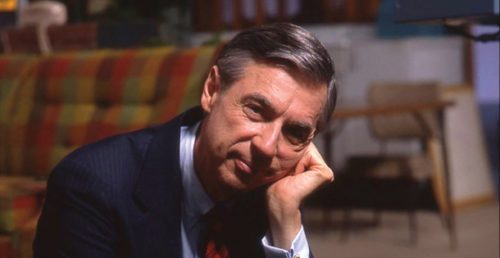
Won’t You Be My Neighbor? (June 8)
Tom Hanks will play TV’s Mr. Rogers in an upcoming biopic, but there’s no way he’ll match the genuine warmth and unique genius of the real guy, captured in this adoring documentary. Oscar-winning director Morgan Neville (20 Feet from Stardom) dishes no dirt about his subject, but then again, along with Bob “Captain Kangaroo” Keeshan, Fred Rogers may well be one of the few truly unsullied media figures of the past half-century.
For biweekly video reviews of the latest films, go to saturdayeveningpost.com/movies or check out Bill Newcott’s website, moviesfortherestofus.com.
North Country Girl: Chapter 49 — We Turn Outlaw
For more about Gay Haubner’s life in the North Country, read the other chapters in her serialized memoir.
It was time for James and me to leave Mexico and drive back to Chicago. We were far from the gilded, blithe couple of the year before. James now actually looked at bar and restaurant tabs before paying them. The value of his heavily leveraged stock portfolio had plummeted; he was desperate for ready cash.
James had a doctor in Acapulco who wrote him legal prescriptions for Quaaludes. We had gone to see him together the day after we arrived, so James could apologize for his failure to get the doc a gun. A thick layer of dust covered everything in that dingy, one-room medical office, but there was nowhere to sit down anyway. The place stank of body odor and old cigar. James’s doctor was an elderly, bald, and short, his face and skull covered with constellations of brown age spots. Dr. Lude leered at me while kicking his legs about his chair, like a four-year-old at a birthday party. When James tried to push me closer to this hideous imp, I arched my eyebrows in an are-you-kidding look. James shrugged and peeled off twenty dollars from his ever-present roll of American money. Prescription and bill were exchanged, and we headed to the pharmacia next store.

Now, on our last morning in Acapulco, James took off in the Cadillac without a word while I packed up my pink Samsonite. When he returned he announced that he had made one last visit to see his doctor. I wasn’t surprised. I expected that James would want to bring back Quaaludes for himself and to dole out to pretty cocktail waitresses to demonstrate what a cool guy he was.
“Look here,” said James; and there was the glitter and the grit of the old James in his eyes as he handed me his new prescription. I couldn’t decipher the scrawled Spanish, but I clearly saw the number 1,000.
“A thousand Quaaludes?”
James’s doctor had told him that was legally the maximum number of Quaaludes he could prescribe. This obliging doctor also told James that he should fill his prescription at the Rorer factory outside Mexico City, since no local pharmacia carried 1,000 Quaaludes. Quaaludes were forty cents apiece in Mexico. James believed he could sell them in Chicago for four or five dollars a pill.
James claimed that because he had a prescription, possession of Quaaludes, even in that amount, would not be illegal in Mexico. He had also worked out where to hide 1,000 Quaaludes in the Cadillac.
I had been dreading the drive back, the horrors of the Mexican highway, the days filled with cigarette smoke, cassette tapes I never wanted to hear again, and too little food, the nights trying to sleep sitting up. But my heart lifted a little at any reappearance of the old James, even one with such a crazy, pill-in-the-sky dream.
We drove out of Acapulco, James beaming at his cleverness: “The ludes have to be even cheaper than forty cents at the factory. In Chicago, they were at least five dollars apiece when we left. I bet I can get six dollars now.” Not for a minute did I believe that James would be able to buy that many ludes, but for James, that four or five thousand dollars he was going to make was as real as if it were already in his pocket.
We reached Mexico City that evening. James navigated the maze of highways and cobblestone streets to the Zona Rosa, pulled in front of a wedding cake of a hotel, and handed the keys to a waiting valet. James popped for this lovely hotel room and a real dinner, something I had not enjoyed for days. He was preening; he felt he was in control, on the verge of a big score that was even more satisfying because it was illegal.

The next morning, a helpful man at the front desk gave James directions to the industrial suburb where the Rorer factory was, and we were off on what I was sure was a wild goose chase. Within an hour, we pulled up to the gatehouse in front of the immense steel grey factory, distinguished from the surrounding buildings and warehouses by a giant RORER sign. A guard left his post to peer into our car and James whipped out his prescription as if he was showing it to a Walgreen’s pharmacist. The guard shrugged, raised the control bar, and waved us through. I felt a squirt of panic in my guts. We parked; James left the air conditioning and the Mexican radio running for me while he strolled into the building.
I had finally managed to calm myself down when the dark tinted front door swung open and James appeared carrying several cardboard boxes, one stacked on top of the other, a tottering tower of pills. “Pop the trunk,” he called out. With 1,000 ludes in the back of the car and me without a thought in my head that I could bear thinking, we drove and drove through Mexico north, finally stopping at a rundown motel in the border town of Nuevo Laredo.
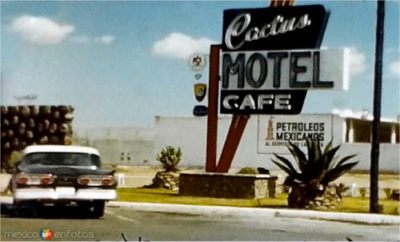
The motel did get American TV, and I spent hours flipping channels, trying to find something to take my mind off the fact that James was busy finding hiding places for a 1,000 Quaaludes in the Cadillac. Whenever I looked out the greasy motel window he would be under the car or disassembling the trunk. James did know his cars. He also thought he knew border crossings well enough to get away with this.
“There is nothing to worry about. The Border Patrol is looking for pot and heroin, not pills,” he said. “There’s been no pot in the car. They can bring in the dogs, there’s nothing for them to sniff out.” And of course, he reminded me, he did have a legal prescription. We were perfectly safe.
James was a degenerate gambler. As he always did while in the midst of a big game, James doubled his bet. At some point while I was watching re-runs of Star Trek and The Mary Tyler Moore Show, James had not only stuffed 1,000 ludes in the Cadillac, he had found someone at the motel to sell him a pound of weed, and made a trip to a hardware store for roll of duct tape.
James put the pot and tape in a brown paper bag, took off his gold chain, ransacked my suitcase for the plainest dress I owned, and told me to swap my contacts for glasses. Thus disguised, we went into the motel office, where James put a five-dollar bill on the counter, asked the startled clerk for the name of the best restaurant in Laredo, on the American side of the border, and to please call a cab to take us there.
The taxi, a rusty and rattling Volkswagen Beetle, came, we hopped in, and James shoved the bag of pot under the back seat. James had become an overnight expert on drug smuggling, always the self-taught man.
“If we’re stopped and searched, and they find the pot, we’re in a cab. A cab is a public conveyance, they can’t prove it’s ours, anyone could have left it there,” as if forgetting a pound of marijuana in a cab were as common a misplacing an umbrella.
At the border crossing, a bored official asked the cab driver where we were going and then waved us through, not even looking in the back seat or asking for our passports. James reached under the seat for the brown paper bag, put it in my purse, and gave me instructions.
It was a nice restaurant. Too bad I couldn’t swallow a bite. While James paid the bill and called a cab to take us back across the border to Mexico, I went to the ladies’ room, locked the door, and got down on my hands and knees under the sink. I took the tape out of the bag, and attached the brown bag to the top of the drain pipe, winding the tape around and around. I crawled back out, stood up, craned my neck from a bunch of angles to make sure nothing was visible under the sink, brushed off my legs, washed my hands, tossed the rest of the tape in the garbage, and went out to where James and the cab were waiting.
The next day, we put on the just-plain-folks clothing from the night before, trying to look as innocent as a twenty-one-year-old blonde and a swarthy forty-three-year-old man in a new model Cadillac El Dorado coming back from Mexico could look. I suggested buying some souvenirs to make us seem even more normal, but the newly expert James said that would draw attention to us: too many people tried to smuggle drugs in piñatas and marionettes.
We looked suspicious enough for the border patrol to give us their full attention at the crossing. We politely stepped out of the car when asked, James opened the trunk and all our suitcases, I dumped out the contents of my purse. The guards walked away for a little conference while James smoked a cigarette. I sweated and had to pee and made up my mind that if we were busted, I would claim that I was a simple Minnesota country girl, being held against my will and forced into a life of deviance and drug smuggling. I practiced crossing my eyes; I could say James was keeping me doped up on those Quaaludes…
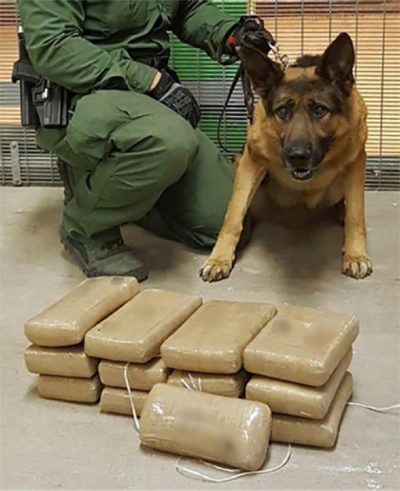
“Okay, sir, you’re free to go. Have a nice day.” And with that, we were back in the U.S., with 1,000 Quaaludes somewhere in the Cadillac and a pound of pot to pick up. We stopped at the restaurant from the night before, where James ordered two coffees. I reclaimed our pot in its brown paper bag from under the ladies’ room sink, and we were back on the road.
We had gotten away with it, but our thirty-minute encounter with the Border Patrol had undone me. James was rubbing my leg and complimenting me on keeping my cool, and I was running through everything that could still go terribly wrong. We were in Texas, where the Caddy’s license had already been flagged for guns and white slavery. We had a carload of illegal and semi-legal drugs. And we had thousands of miles and a bunch of other god-forsaken states to cross before we safely home on Oak Street.
My mind suddenly snapped into focus: I told James I needed to go see my mom in Colorado. Like right away. James shrugged and said he didn’t mind doing the rest of the drive by himself. We had been together non-stop for months and needed a break from each other. James pulled into the next rest stop and I called my mom from a pay phone; a recorded message told me that number was no longer in service and gave me a new one. I dialed that one, my mom picked up right away, and I discovered that my mother and her new second husband had moved to Steamboat Springs, where they were renovating a run down ski hostel called the Haystack. I mouthed a silent “shit.” I knew that rathole; I had stayed there once on a ski trip. My mom didn’t have much of a reaction to my announcement that I was coming to visit and didn’t comment on how strained and anxious I must have sounded.
James drove me to the Dallas-Ft. Worth airport, where I bought a ticket to Denver and then onward to Steamboat Springs. A last night together in a real motel with working AC and clean-smelling sheets made me cautiously optimistic that we had gotten away with it. I was almost relaxed, now that I had planned my own escape and James was crowing. No lawful gains could have made him as happy — it was proof that he would always turn up winners, even when faced off against the Border Patrol. During an attention getting airport goodbye, James lifted his face up from mine just long enough to say, “Promise me you’ll be back in Chicago soon.”
7 Ways to Attract Pollinators to Your Garden
Nature’s pollinators, particularly bees, are essential to the balance of life on our planet. Without them our ecosystem would collapse. Wherever you live, you can help support the birds, bees, bats, and even beetles that keep you alive. It all starts in your own garden.
- Plant Native: The pollinators in your local ecosystem have evolved alongside native plants of the region. Of course, these will be different for each region of the country, but the following North American natives enjoy a variety of climates and landscapes:
Purple Coneflower
Aster
Coreopsis
Azalea
Joe Pye Weed
Black-Eyed Susan

- Vary Flower Shapes and Colors: Different types of insects and birds are inclined to pollinate flowers with certain features. Many bees prefer the large landing pads of sunflowers and daisies, while hummingbirds go for the tubular blooms on lilies and foxglove. Planting an assortment of flower shapes and colors will ensure that you please the most pollinators possible.
- Forgo Pesticides: Your best protection against pests in the garden is biodiversity: growing a wide range of plants and shrubs that encourages a healthy, robust habitat for beneficial organisms. Take note that weed killers and insecticides can hurt the pollinators that you depend on for good growth. If you must use one, go for a mild, organic pesticide, and apply it carefully at night when pollinator activity is lower.
- Provide Water: Maybe your garden already sports a birdbath, but bees and butterflies need water too! To hydrate your insect pollinators, you can fill a shallow bowl with stones or marbles along with water togive the bugs a spot to land.
- Make a Bee Hotel: Many of the bees visiting your landscape aren’t “hive” bees, but rather solitary ones like mason bees or leafcutter bees. These natives like to nest in myriad places including the crevices of reeds and bark. A “bee hotel” can be as simple or as ambitious as you’d like. The basic construction consists of a frame filled with hollow bamboo sticks or drilled logs. Try the method offered by Modern Farmer.

- Hang a Hummingbird Feeder: In addition to flowers like lupine, bee balm, and hollyhock, hummingbirds are happy to have a mixture of one part white sugar to four parts water from a hummingbird feeder. These cute backyard favorites are attracted to bright reds, so whether you purchase a feeder or make one yourself, it should don the birds’ favorite color.
- Time Your Garden: Bugs and birds need to eat throughout the warmer months, so you should have flowers blooming all spring, summer, and fall. From the earliest crocuses to rhododendrons, daylilies, sedum and on through sunflowers and sage, a mix of perennials and annuals with staggered flowers will keep pollinators in your yard all year long.
“Head and Shoulders” by F. Scott Fitzgerald
F. Scott Fitzgerald’s first story for The Saturday Evening Post was published a month before his first novel, This Side of Paradise. In “Head and Shoulders,” Fitzgerald debuts an incarnation of his signature “flapper” character. Fitzgerald’s free-spirited female characters would fill most of his stories with the Post over the following 15 years.
In 1915 Horace Tarbox was 13 years old. In that year he took the examinations for entrance to Princeton University and received the Grade A — excellent — in Caesar, Cicero, Vergil, Xenophon, Homer, Algebra, Plane Geometry, Solid Geometry, and Chemistry.
Two years later while George M. Cohan was composing “Over There,” Horace was leading the sophomore class by several lengths and digging out theses on “The Syllogism as an Obsolete Scholastic Form,” and during the battle of Chateau-Thierry he was sitting at his desk deciding whether or not to wait until his seventeenth birthday before beginning his series of essays on “The Pragmatic Bias of the New Realists.”
After a while some newsboy told him that the war was over, and he was glad, because it meant that Peat Brothers, publishers, would get out their new edition of “Spinoza’s Improvement of the Understanding.” Wars were all very well in their way, made young men self-reliant or something but Horace felt that he could never forgive the President for allowing a brass band to play under his window the night of the false armistice, causing him to leave three important sentences out of his thesis on “German Idealism.”
The next year he went up to Yale to take his degree as Master of Arts.
He was 17 then, tall and slender, with near-sighted gray eyes and an air of keeping himself utterly detached from the mere words he let drop.
“I never feel as though I’m talking to him,” expostulated Professor Dillinger to a sympathetic colleague. “He makes me feel as though I were talking to his representative. I always expect him to say: ‘Well, I’ll ask myself and find out.’”
And then, just as nonchalantly as though Horace Tarbox had been Mr. Beef the butcher or Mr. Hat the haberdasher, life reached in, seized him, handled him, stretched him, and unrolled him like a piece of Irish lace on a Saturday-afternoon bargain-counter.
To move in the literary fashion I should say that this was all because when way back in colonial days the hardy pioneers had come to a bald place in Connecticut and asked of each other, “Now, what shall we build here?” the hardiest one among ‘em had answered: “Let’s build a town where theatrical managers can try out musical comedies!” How afterward they founded Yale College there, to try the musical comedies on, is a story everyone knows. At any rate one December, “Home James” opened at the Shubert, and all the students encored Marcia Meadow, who sang a song about the Blundering Blimp in the first act and did a shaky, shivery, celebrated dance in the last.
Marcia was 19. She didn’t have wings, but audiences agreed generally that she didn’t need them. She was a blonde by natural pigment, and she wore no paint on the streets at high noon. Outside of that she was no better than most women.
It was Charlie Moon who promised her five thousand Pall Malls if she would pay a call on Horace Tarbox, prodigy extraordinary. Charlie was a senior in Sheffield, and he and Horace were first cousins. They liked and pitied each other.
 Horace had been particularly busy that night. The failure of the Frenchman Laurier to appreciate the significance of the new realists was preying on his mind. In fact, his only reaction to a low, clear-cut rap at his study was to make him speculate as to whether any rap would have actual existence without an ear there to hear it. He fancied he was verging more and more toward pragmatism. But at that moment, though he did not know it, he was verging with astounding rapidity toward something quite different.
The rap sounded — three seconds leaked by — the rap sounded.
“Come in,” muttered Horace automatically.
He heard the door open and then close, but, bent over his book in the big armchair before the fire, he did not look up.
“Leave it on the bed in the other room,” he said absently.
“Leave what on the bed in the other room?”
Marcia Meadow had to talk her songs, but her speaking voice was like byplay on a harp.
“The laundry.”
“I can’t.”
Horace stirred impatiently in his chair.
“Why can’t you?”
“Why, because I haven’t got it.”
“Hm!” he replied testily. “Suppose you go back and get it.”
Across the fire from Horace was another easy chair. He was accustomed to change to it in the course of an evening by way of exercise and variety. One chair he called Berkeley, the other he called Hume. He suddenly heard a sound as of a rustling, diaphanous form sinking into Hume. He glanced up.
“Well,” said Marcia with the sweet smile she used in Act Two (“Oh, so the Duke liked my dancing!”) “Well, Omar Khayyam, here I am beside you singing in the wilderness.”
Horace stared at her dazedly. The momentary suspicion came to him that she existed there only as a phantom of his imagination. Women didn’t come into men’s rooms and sink into men’s Humes. Women brought laundry and took your seat in the streetcar and married you later on when you were old enough to know fetters.
This woman had clearly materialized out of Hume. The very froth of her brown gauzy dress was art emanation from Hume’s leather arm there! If he looked long enough he would see Hume right through her and then be would be alone again in the room. He passed his fist across his eyes. He really must take up those trapeze exercises again.
“For Pete’s sake, don’t look so critical!” objected the emanation pleasantly. “I feel as if you were going to wish me away with that patent dome of yours. And then there wouldn’t be anything left of me except my shadow in your eyes.”
Horace coughed. Coughing was one of his two gestures. When he talked you forgot he had a body at all. It was like hearing a phonograph record by a singer who had been dead a long time.
“What do you want?” he asked.
“I want them letters,” whined Marcia melodramatically — “them letters of mine you bought from my grandsire in 1881.”
Horace considered.
“I haven’t got your letters,” he said evenly. “I am only 17 years old. My father was not born until March 3, 1879. You evidently have me confused with someone else.”
“You’re only 17?” repeated March suspiciously.
“Only 17.”
“I knew a girl,” said Marcia reminiscently, “who went on the ten-twenty-thirty when she was 16. She was so stuck on herself that she could never say ‘16’ without putting the ‘only’ before it. We got to calling her ‘Only Jessie.’ And she’s just where she was when she started — only worse. ‘Only’ is a bad habit, Omar — it sounds like an alibi.”
“My name is not Omar.”
“I know,” agreed Marcia, nodding — “your name’s Horace. I just call you Omar because you remind me of a smoked cigarette.”
“And I haven’t your letters. I doubt if I’ve ever met your grandfather. In fact, I think it very improbable that you yourself were alive in 1881.”
Marcia stared at him in wonder.
“Me — 1881? Why sure! I was second-line stuff when the Florodora Sextette was still in the convent. I was the original nurse to Mrs. Sol Smith’s Juliette. Why, Omar, I was a canteen singer during the War of 1812.”
Horace’s mind made a sudden successful leap, and he grinned.
“Did Charlie Moon put you up to this?”
Marcia regarded him inscrutably.
“Who’s Charlie Moon?”
“Small — wide nostrils — big ears.”
She grew several inches and sniffed.
“I’m not in the habit of noticing my friends’ nostrils.”
“Then it was Charlie?”
Marcia bit her lip — and then yawned. “Oh, let’s change the subject, Omar. I’ll pull a snore in this chair in a minute.”
“Yes,” replied Horace gravely, “Hume has often been considered soporific — ”
“Who’s your friend — and will he die?”
Then of a sudden Horace Tarbox rose slenderly and began to pace the room with his hands in his pockets. This was his other gesture.
“I don’t care for this,” he said as if he were talking to himself — “at all. Not that I mind your being here — I don’t. You’re quite a pretty little thing, but I don’t like Charlie Moon’s sending you up here. Am I a laboratory experiment on which the janitors as well as the chemists can make experiments? Is my intellectual development humorous in any way? Do I look like the pictures of the little Boston boy in the comic magazines? Has that callow ass, Moon, with his eternal tales about his week in Paris, any right to — ”
“No,” interrupted Marcia emphatically. “And you’re a sweet boy. Come here and kiss me.”
Horace stopped quickly in front of her.
“Why do you want me to kiss you?” he asked intently, “Do you just go round kissing people?”
“Why, yes,” admitted Marcia, unruffled. “‘At’s all life is. Just going round kissing people.”
“Well,” replied Horace emphatically, “I must say your ideas are horribly garbled! In the first place life isn’t just that, and in the second place. I won’t kiss you. It might get to be a habit and I can’t get rid of habits. This year I’ve got in the habit of lolling in bed until seven-thirty — ”
Marcia nodded understandingly.
“Do you ever have any fun?” she asked.
“What do you mean by fun?”
“See here,” said Marcia sternly, “I like you, Omar, but I wish you’d talk as if you had a line on what you were saying. You sound as if you were gargling a lot of words in your mouth and lost a bet every time you spilled a few. I asked you if you ever had any fun.”
Horace shook his head.
“Later, perhaps,” he answered. “You see I’m a plan. I’m an experiment. I don’t say that I don’t get tired of it sometimes — I do. Yet — oh, I can’t explain! But what you and Charlie Moon call fun wouldn’t be fun to me.”
“Please explain.”
Horace stared at her, started to speak and then, changing his mind, resumed his walk. After an unsuccessful attempt to determine whether or not he was looking at her Marcia smiled at him.
“Please explain.”
Horace turned.
“If I do, will you promise to tell Charlie Moon that I wasn’t in?”
“Uh-uh.”
“Very well, then. Here’s my history: I was a ‘why’ child. I wanted to see the wheels go round. My father was a young economics professor at Princeton. He brought me up on the system of answering every question I asked him to the best of his ability. My response to that gave him the idea of making an experiment in precocity. To aid in the massacre I had ear trouble — seven operations between the age of 9 and 12. Of course this kept me apart from other boys and made me ripe for forcing. Anyway, while my generation was laboring through Uncle Remus I was honestly enjoying Catullus in the original.
“I passed off my college examinations when I was thirteen because I couldn’t help it. My chief associates were professors, and I took a tremendous pride in knowing that I had a fine intelligence, for though I was unusually gifted I was not abnormal in other ways. When I was 16 I got tired of being a freak; I decided that someone had made a bad mistake. Still as I’d gone that far I concluded to finish it up by taking my degree of Master of Arts. My chief interest in life is the study of modern philosophy. I am a realist of the School of Anton Laurier — with Bergsonian trimmings — and I’ll be 18 years old in two months. That’s all.”
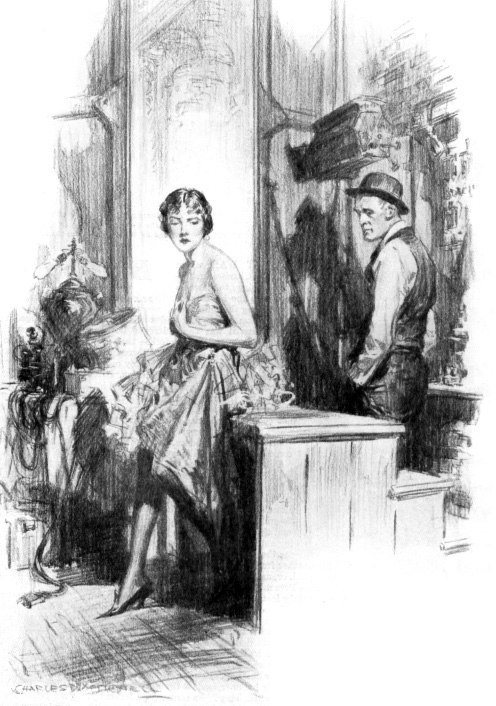
“Whew!” exclaimed Marcia. “That’s enough! You do a neat job with the parts of speech.”
“Satisfied?”
“No, you haven’t kissed me.”
“It’s not in my programme,” demurred Horace. “Understand that I don’t pretend to be above physical things. They have their place, but — ”
“Oh, don’t be so darned reasonable!”
“I can’t help it.”
“I hate these slot-machine people.”
“I assure you I — ” began Horace.
“Oh shut up!”
“My own rationality — ”
“I didn’t say anything about your nationality. You’re Amuricun, ar’n’t you?”
“Yes.”
“Well, that’s O.K. with me. I got a notion I want to see you do something that isn’t in your highbrow programme. I want to see if a what-ch-call-em with Brazilian trimmings — that thing you said you were — can be a little human.”
Horace shook his head again.
“I won’t kiss you.”
“My life is blighted,” muttered Marcia tragically. “I’m a beaten woman. I’ll go through life without ever having a kiss with Brazilian trimmings.” She sighed. “Anyways, Omar, will you come and see my show?”
“What show?”
“I’m a wicked actress from ‘Home James’!”
“Light opera?”
“Yes — at a stretch. One of the characters is a Brazilian rice-planter. That might interest you.”
“I saw ‘The Bohemian Girl’ once,” reflected Horace aloud. “I enjoyed it — to some extent — ”
“Then you’ll come?”
“Well, I’m — I’m — ”
“Oh, I know — you’ve got to run down to Brazil for the weekend.”
“Not at all. I’d be delighted to come — ”
Marcia clapped her hands.
“Goodyforyou! I’ll mail you a ticket — Thursday night?”
“Why, I — ”
“Good! Thursday night it is.”
She stood up and walking close to him laid both hands on his shoulders.
“I like you, Omar. I’m sorry I tried to kid you. I thought you’d be sort of frozen, but you’re a nice boy.”
He eyed her sardonically.
“I’m several thousand generations older than you are.”
“You carry your age well.”
They shook hands gravely.
“My name’s Marcia Meadow,” she said emphatically. “‘Member it — ”
“Marcia Meadow. And I won’t tell Charlie Moon you were in.”
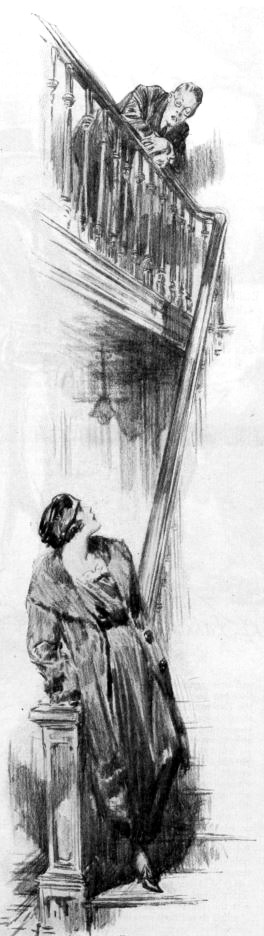
An instant later as she was skimming down the last flight of stairs three at a time she heard a voice call over the upper banister: “Oh, say — ”
She stopped and looked up — made out a vague form leaning over.
“Oh, say!” called the prodigy again. “Can you hear me?”
“Here’s your connection Omar.”
“I hope I haven’t given you the impression that I consider kissing intrinsically irrational.”
“Impression? Why, you didn’t even give me the kiss! Never fret — so long.”
Two doors near her opened curiously at the sound of a feminine voice. A tentative cough sounded from above. Gathering her skirts, Marcia dived wildly down the last flight, and was swallowed up in the murky Connecticut air outside.
Upstairs Horace paced the floor of his study. From time to time he glanced toward Berkeley waiting there in suave dark-red reputability, an open book lying suggestively on his cushions. And then he found that his circuit of the floor was bringing him each time nearer to Hume. There was something about Hume that was strangely and inexpressibly different. The diaphanous form still seemed hovering near, and had Horace sat there he would have felt as if he were sitting on a lady’s lap. And though Horace couldn’t have named the quality of difference, there was such a quality — quite intangible to the speculative mind, but real, nevertheless. Hume was radiating something that in all the two hundred years of his influence he had never radiated before.
Hume was radiating attar of roses.
II
On Thursday night Horace Tarbox sat in an aisle seat in the fifth row and witnessed “Home James.” Oddly enough he found that he was enjoying himself. The cynical students near him were annoyed at his audible appreciation of time-honored jokes in the Hammerstein tradition. But Horace was waiting with anxiety for Marcia Meadow singing her song about a Jazz-bound Blundering Blimp. When she did appear, radiant under a floppity flower-faced hat, a warm glow settled over him, and when the song was over he did not join in the storm of applause. He felt somewhat numb.
In the intermission after the second act an usher materialized beside him, demanded to know if he were Mr. Tarbox, and then handed him a note written in a round adolescent band. Horace read it in some confusion, while the usher lingered with withering patience in the aisle.
“Dear Omar: After the show I always grow an awful hunger. If you want to satisfy it for me in the Taft Grill just communicate your answer to the big-timber guide that brought this and oblige. Your friend, Marcia Meadow.”
“Tell her,” — he coughed — “tell her that it will be quite all right. I’ll meet her in front of the theatre.”
The big-timber guide smiled arrogantly.
“I giss she meant for you to come roun’ t’ the stage door.”
“Where — where is it?”
“Ou’side. Tunayulef. Down ee alley.”
“What?”
“Ou’side. Turn to y’ left! Down ee alley!”
The arrogant person withdrew. A freshman behind Horace snickered.
Then half an hour later, sitting in the Taft Grill opposite the hair that was yellow by natural pigment, the prodigy was saying an odd thing.
“Do you have to do that dance in the last act?” he was asking earnestly — “I mean, would they dismiss you if you refused to do it?”
Marcia grinned.
“It’s fun to do it. I like to do it.”
And then Horace came out with a faux pas.
“I should think you’d detest it,” he remarked succinctly. “The people behind me were making remarks about your bosom.”
Marcia blushed fiery red.
“I can’t help that,” she said quickly. “The dance to me is only a sort of acrobatic stunt. Lord, it’s hard enough to do! I rub liniment into my shoulders for an hour every night.”
“Do you have — fun while you’re on the stage?”
“Uh-huh — sure! I got in the habit of having people look at me, Omar, and I like it.”
“Hm!” Horace sank into a brownish study.
“How’s the Brazilian trimmings?”
“Hm!” repeated Horace, and then after a pause: “Where does the play go from here?”
“New York.”
“For how long?”
“All depends. Winter — maybe.”
“Oh!”
“Coming up to lay eyes on me, Omar, or aren’t you int’rested? Not as nice here, is it, as it was up in your room? I wish we was there now.”
“I feel idiotic in this place,” confessed Horace, looking round him nervously.
“Too bad! We got along pretty well.”
At this he looked suddenly so melancholy that she changed her tone, and reaching over patted his hand.
“Ever take an actress out to supper before?”
“No,” said Horace miserably, “and I never will again. I don’t know why I came tonight. Here under all these lights and with all these people laughing and chattering I feel completely out of my sphere. I don’t know what to talk to you about.”
“We’ll talk about me. We talked about you last time.”
“Very well.”
“Well, my name really is Meadow, but my first name isn’t Marcia — it’s Veronica. I’m 19. Question — how did the girl make her leap to the footlights? Answer — she was born in Passaic, New Jersey, and up to a year ago she got the right to breathe by pushing Nabiscoes in Marcel’s tea-room in Trenton. She started going with a guy named Robbins, a singer in the Trent House cabaret, and he got her to try a song and dance with him one evening. In a month we were filling the supper room every night. Then we went to New York with meet-my-friend letters thick as a pile of napkins.
“In two days we landed a job at Divinerries’, and I learned to shimmy from a kid at the Palais Royal. We stayed at Divinerries’ six months until one night Peter Boyce Wendell, the columnist, ate his milk-toast there. Next morning a poem about Marvellous Marcia came out in his newspaper, and within two days I had three vaudeville offers and a chance at the Midnight Frolic. I wrote Wendell a thank-you letter, and he printed it in his column — said that the style was like Carlyle’s, only more rugged and that I ought to quit dancing and do North American literature. This got me a coupla more vaudeville offers and a chance as an ingenue in a regular show. I took it — and here I am, Omar.”
When she finished they sat for a moment in silence she draping the last skeins of a Welsh rabbit on her fork and waiting for him to speak.
“Let’s get out of here,” he said suddenly.
Marcia’s eyes hardened.
“What’s the idea? Am I making you sick?”
“No, but I don’t like it here. I don’t like to be sitting here with you.”
Without another word Marcia signalled for the waiter.
“What’s the check?” she demanded briskly “My part — the rabbit and the ginger ale.”
Horace watched blankly as the waiter figured it.
“See here,” he began, “I intended to pay for yours too. You’re my guest.”
With a half-sigh Marcia rose from the table and walked from the room. Horace, his face a document in bewilderment, laid a bill down and followed her out, up the stairs and into the lobby. He overtook her in front of the elevator and they faced each other.
“See here,” he repeated “You’re my guest. Have I said something to offend you?”
After an instant of wonder Marcia’s eyes softened.
“You’re a rude fella!” she said slowly. “Don’t you know you’re rude?”
“I can’t help it,” said Horace with a directness she found quite disarming. “You know I like you.”
“You said you didn’t like being with me.”
“I didn’t like it.”
“Why not?” Fire blazed suddenly from the gray forests of his eyes.
“Because I didn’t. I’ve formed the habit of liking you. I’ve been thinking of nothing much else for two days.”
“Well, if you — ”
“Wait a minute,” he interrupted. “I’ve got something to say. It’s this: in six weeks I’ll be 18 years old. When I’m 18 years old I’m coming up to New York to see you. Is there some place in New York where we can go and not have a lot of people in the room?”
“Sure!” smiled Marcia. “You can come up to my ‘partment. Sleep on the couch if you want to.”
“I can’t sleep on couches,” he said shortly. “But I want to talk to you.”
“Why, sure,” repeated Marcia. “in my ‘partment.”
In his excitement Horace put his hands in his pockets.
“All right — just so I can see you alone. I want to talk to you as we talked up in my room.”
“Honey boy,” cried Marcia, laughing, “is it that you want to kiss me?”
“Yes,” Horace almost shouted. “I’ll kiss you if you want me to.”
The elevator man was looking at them reproachfully. Marcia edged toward the grated door.
“I’ll drop you a postcard,” she said.
Horace’s eyes were quite wild.
“Send me a postcard! I’ll come up any time after January first. I’ll be 18 then.”
And as she stepped into the elevator he coughed enigmatically, yet with a vague challenge, at the calling, and walked quickly away.
III
He was there again. She saw him when she took her first glance at the restless Manhattan audience — down in the front row with his head bent a bit forward and his gray eyes fixed on her. And she knew that to him they were alone together in a world where the high-rouged row of ballet faces and the massed whines of the violins were as imperceivable as powder on a marble Venus. An instinctive defiance rose within her.
“Silly boy!” she said to herself hurriedly, and she didn’t take her encore.
“What do they expect for a hundred a week — perpetual motion?” she grumbled to herself in the wings.
“What’s the trouble? Marcia?”
“Guy I don’t like down in front.”
During the last act as she waited for her specialty she had an odd attack of stage fright. She had never sent Horace the promised postcard. Last night she had pretended not to see him —
had hurried from the theatre immediately after her dance to pass a sleepless night in her apartment, thinking — as she had so often in the last month — of his pale, rather intent face, his slim, boyish fore, the merciless, unworldly abstraction that made him charming to her.
And now that he had come she felt vaguely sorry — as though an unwonted responsibility was being forced on her.
“Infant prodigy!” she said aloud.
“What?” demanded the negro comedian standing beside her.
“Nothing — just talking about myself.”
On the stage she felt better. This was her dance — and she always felt that the way she did it wasn’t suggestive any more than to some men every pretty girl is suggestive. She made it a stunt.
Uptown, downtown, jelly on a spoon,
After sundown shiver by the moon.
He was not watching her now. She saw that clearly. He was looking very deliberately at a castle on the back drop, wearing that expression he had worn in the Taft Grill. A wave of exasperation swept over her — he was criticising her.
That’s the vibration that thrills me,
Funny how affection fills me
Uptown, downtown —
Unconquerable revulsion seized her. She was suddenly and horribly conscious of her audience as she had never been since her first appearance. Was that a leer on a pallid face in the front row, a droop of disgust on one young girl’s mouth? These shoulders of hers — these shoulders shaking — were they hers? Were they real? Surely shoulders weren’t made for this!
Then — you’ll see at a glance
I’ll need some funeral ushers with St. Vitus dance
At the end of the world I’ll —
The bassoon and two cellos crashed into a final chord. She paused and poised a moment on her toes with every muscle tense, her young face looking out dully at the audience in what one young girl afterward called “such a curious, puzzled look,” and then without bowing rushed from the stage. Into the dressing room she sped, kicked out of one dress and into another, and caught a taxi outside.
Her apartment was very warm — small, it was, with a row of professional pictures and sets of Kipling and O. Henry which she had bought once from a blue-eyed agent and read occasionally. And there were several chairs which matched, but were none of them comfortable, and a pink-shaded lamp with blackbirds painted on it and an atmosphere of other stifled pink throughout. There were nice things in it — nice things unrelentingly hostile to each other, offspring of a vicarious, impatient taste acting in stray moments. The worst was typified by a great picture framed in oak bark of Passaic as seen from the Erie Railroad — altogether a frantic, oddly extravagant, oddly penurious attempt to make a cheerful room. Marcia knew it was a failure.
Into this room came the prodigy and took her two hands awkwardly.
“I followed you this time,” he said.
“Oh!”
“I want you to marry me,” he said.
Her arms went out to him. She kissed his mouth with a sort of passionate wholesomeness.
“There!”
“I love you,” he said.
She kissed him again and then with a little sigh flung herself into an armchair and half lay there, shaken with absurd laughter.
“Why, you infant prodigy!” she cried.
“Very well, call me that if you want to. I once told you that I was 10,000 years older than you — I am.”
She laughed again.
“I don’t like to be disapproved of.”
“No one’s ever going to disapprove of you again.”
“Omar,” she asked, “why do you want to marry me?”
The prodigy rose and put his hands in his pockets.
“Because I love you, Marcia Meadow.”
And then she stopped calling him Omar.
“Dear boy,” she said, “you know I sort of love you. There’s something about you — I can’t tell what — that just puts my heart through the wringer every time I’m round you. But honey — ” She paused.
“But what?”
“But lots of things. But you’re only just 18, and I’m nearly 20.”
“Nonsense!” he interrupted. “Put it this way — that I’m in my 19th year and you’re 19. That makes us pretty close — without counting that other 10,000 years I mentioned.”
Marcia laughed.
“But there are some more ‘buts.’ Your people — ”
“My people!” exclaimed the prodigy ferociously. “My people tried to make a monstrosity out of me.” His face grew quite crimson at the enormity of what he was going to say. “My people can go way back and sit down!”
“My heavens!” cried Marcia in alarm. “All that? On tacks, I suppose.”
“Tacks — yes,” he agreed wildly — “on anything. The more I think of how they allowed me to become a little dried-up mummy — ”
“What makes you think you’re that?” asked Marcia quietly — “me?”
“Yes. Every person I’ve met on the streets since I met you has made me jealous because they knew what love was before I did. I used to call it the ‘sex impulse.’ Heavens!”
“There’s more ‘buts,’” said Marcia
“What are they?”
“How could we live?”
“I’ll make a living.”
“You’re in college.”
“Do you think I care anything about taking a Master of Arts degree?”
“You want to be Master of Me, hey?”
“Yes! What? I mean, no!”
Marcia laughed, and crossing swiftly over sat in his lap. He put his arm round her wildly and implanted the vestige of a kiss somewhere near her neck.
“There’s something white about you,” mused Marcia “but it doesn’t sound very logical.”
“Oh, don’t be so darned reasonable!”
“I can’t help it,” said Marcia.
“I hate these slot-machine people!”
“But we — ”
“Oh, shut up!”
And as Marcia couldn’t talk through her ears she had to.
IV
Horace and Marcia were married early in February. The sensation in academic circles both at Yale and Princeton was tremendous. Horace Tarbox, who at 14 had been played up in the Sunday magazines sections of metropolitan newspapers, was throwing over his career, his chance of being a world authority on American philosophy, by marrying a chorus girl — they made Marcia a chorus girl. But like all modern stories it was a four-and-a-half-day wonder.
They took a flat in Harlem. After two weeks’ search, during which his idea of the value of academic knowledge faded unmercifully, Horace took a position as clerk with a South American export company — someone had told him that exporting was the coming thing. Marcia was to stay in her show for a few months — anyway until he got on his feet. He was getting a hundred and twenty-five to start with, and though of course they told him it was only a question of months until he would be earning double that, Marcia refused even to consider giving up the hundred and fifty a week that she was getting at the time.
“We’ll call ourselves Head and Shoulders, dear,” she said softly, “and the shoulders’ll have to keep shaking a little longer until the old head gets started.”
“I hate it,” he objected gloomily.
“Well,” she replied emphatically, “Your salary wouldn’t keep us in a tenement. Don’t think I want to be public — I don’t. I want to be yours. But I’d be a half-wit to sit in one room and count the sunflowers on the wallpaper while I waited for you. When you pull down three hundred a month I’ll quit.”
And much as it hurt his pride, Horace had to admit that hers was the wiser course.
March mellowed into April. May read a gorgeous riot act to the parks and waters of Manhattan, and they were very happy. Horace, who had no habits whatsoever — he had never had time to form any — proved the most adaptable of husbands, and as Marcia entirely lacked opinions on the subjects that engrossed him there were very few jottings and bumping. Their minds moved in different spheres. Marcia acted as practical factotum, and Horace lived either in his old world of abstract ideas or in a sort of triumphantly earthy worship and adoration of his wife. She was a continual source of astonishment to him — the freshness and originality of her mind, her dynamic, clear-headed energy, and her unfailing good humor.
And Marcia’s co-workers in the nine o’clock show, whither she had transferred her talents, were impressed with her tremendous pride in her husband’s mental powers. Horace they knew only as a very slim, tight-lipped, and immature-looking young man, who waited every night to take her home.
“Horace,” said Marcia one evening when she met him as usual at eleven, “you looked like a ghost standing there against the street lights. You losing weight?”
He shook his head vaguely.
“I don’t know. They raised me to a hundred and thirty-five dollars today, and — ”
“I don’t care,” said Marcia severely. “You’re killing yourself working at night. You read those big books on economy — ”
“Economics,” corrected Horace.
“Well, you read ‘em every night long after I’m asleep. And you’re getting all stooped over like you were before we were married.”
“But, Marcia, I’ve got to — ”
“No, you haven’t dear. I guess I’m running this shop for the present, and I won’t let my fella ruin his health and eyes. You got to get some exercise.”
“I do. Every morning I — ”
“Oh, I know! But those dumbbells of yours wouldn’t give a consumptive two degrees of fever. I mean real exercise. You’ve got to join a gymnasium. ‘Member you told me you were such a trick gymnast once that they tried to get you out for the team in college and they couldn’t because you had a standing date with Herb Spencer?”
“I used to enjoy it,” mused Horace, “but it would take up too much time now.”
“All right,” said Marcia. “I’ll make a bargain with you. You join a gym and I’ll read one of those books from the brown row of ‘em.”
“‘Pepys’ Diary’? Why, that ought to be enjoyable. He’s very light.”
“Not for me — he isn’t. It’ll be like digesting plate glass. But you been telling me how much it’d broaden my lookout. Well, you go to a gym three nights a week and I’ll take one big dose of Sammy.”
Horace hesitated.
“Well — ”
“Come on, now! You do some giant swings for me and I’ll chase some culture for you.”
So Horace finally consented, and all through a baking summer he spent three and sometimes four evenings a week experimenting on the trapeze in Skipper’s Gymnasium. And in August he admitted to Marcia that it made him capable of more mental work during the day.
“Mens sana in corpore sano,” he said.
“Don’t believe in it,” replied Marcia. “I tried one of those patent medicines once and they’re all bunk. You stick to gymnastics.”
One night in early September while he was going through one of his contortions on the rings in the nearly deserted room he was addressed by a meditative fat man whom he had noticed watching him for several nights.
“Say, lad, do that stunt you were doin’ last night.”
Horace grinned at him from his perch.
“I invented it,” he said. “I got the idea from the fourth proposition of Euclid.”
“What circus he with?”
“He’s dead.”
“Well, he must of broke his neck doin’ that stunt. I set here last night thinkin’ sure you was goin’ to break yours.”
“Like this!” said Horace, and swinging onto the trapeze he did his stunt.
“Don’t it kill your neck an’ shoulder muscles?”
“It did at first, but inside of a week I wrote the quod erat demonstrandum on it.”
“Hm!”
Horace swung idly on the trapeze.
“Ever think of takin’ it up professionally?” asked the fat man.
“Not I.”
“Good money in it if you’re willin’ to do stunts like ‘at an’ can get away with it.”
“Here’s another,” chirped Horace eagerly, and the fat man’s mouth dropped suddenly agape as he watched this pink-jerseyed Prometheus again defy the gods and Isaac Newton.
The night following this encounter Horace got home from work to find a rather pale Marcia stretched out on the sofa waiting for him.
“I fainted twice today,” she began without preliminaries.
“What?”
“Yep. You see baby’s due in four months now. Doctor says I ought to have quit dancing two weeks ago.”
Horace sat down and thought it over.
“I’m glad of course,” he said pensively — “I mean glad that we’re going to have a baby. But this means a lot of expense.”
“I’ve got two hundred and fifty in the bank,” said Marcia hopefully, “and two weeks’ pay coming.”
Horace computed quickly.
“Inducing my salary, that’ll give us nearly fourteen hundred for the next six months.”
Marcia looked blue.
“That all? Course I can get a job singing somewhere this month. And I can go to work again in March.”
“Of course nothing!” said Horace gruffly. “You’ll stay right here. Let’s see now — there’ll be doctor’s bills and a nurse, besides the maid: We’ve got to have some more money.”
“Well,” said Marcia wearily, “I don’t know where it’s coming from. It’s up to the old head now. Shoulders is out of business.”
Horace rose and pulled on his coat.
“Where are you going?”
“I’ve got an idea,” he answered. “I’ll be right back.”
Ten minutes later as he headed down the street toward Skipper’s Gymnasium he felt a placid wonder, quite unmixed with humor, at what he was going to do. How he would have gaped at himself a year before! How everyone would have gaped! But when you opened your door at the rap of life you let in many things.
The gymnasium was brightly lit, and when his eyes became accustomed to the glare he found the meditative fat man seated on a pile of canvas mats smoking a big cigar.
“Say,” began Horace directly, “were you in earnest last night when you said I could make money on my trapeze stunts?”
“Why, yes,” said the fat man in surprise.
“Well, I’ve been thinking it over, and I believe I’d like to try it. I could work at night and on Saturday afternoons — and regularly if the pay is high enough.”
The fat men looked at his watch.
“Well,” he said, “Charlie Paulson’s the man to see. He’ll book you inside of four days, once he sees you work out. He won’t be in now, but I’ll get hold of him for tomorrow night.”
The fat man was as good as his word. Charlie Paulson arrived next night and put in a wondrous hour watching the prodigy swap through the air in amazing parabolas, and on the night following he brought two age men with him who looked as though they had been born smoking black cigars and talking about money in low, passionate voices. Then on the succeeding Saturday Horace Tarbox’s torso made its first professional appearance in a gymnastic exhibition at the Coleman Street Gardens. But though the audience numbered nearly 5,000 people, Horace felt no nervousness. From his childhood he had read papers to audiences — learned that trick of detaching himself.
“Marcia,” he said cheerfully later that same night, “I think we’re out of the woods. Paulson thinks he can get me an opening at the Hippodrome, and that means an all-winter engagement. The Hippodrome you know, is a big — ”
“Yes, I believe I’ve heard of it,” interrupted Marcia, “but I want to know about this stunt you’re doing. It isn’t any spectacular suicide, is it?”
“It’s nothing,” said Horace quietly. “But if you can think of a nicer way of a man killing himself than taking a risk for you, why that’s the way I want to die.”
Marcia reached up and wound both arms tightly round his neck.
“Kiss me,” she whispered, “and call me ‘dear heart.’ I love to hear you say ‘dear heart.’ And bring me a book to read tomorrow. No more Sam Pepys, but something trick and trashy. I’ve been wild for something to do all day. I felt like writing letters, but I didn’t have anybody to write to.”
“Write to me,” said Horace. “I’ll read them.”
“I wish I could,” breathed Marcia. “If I knew words enough I could write you the longest love letter in the world — and never get tired.”
But after two more months Marcia grew very tired indeed, and for a row of nights it was a very anxious, weary-looking young athlete who walked out before the Hippodrome crowd. Then there were two days when his place was taken by a young man who wore pale blue instead of white, and got very little applause. But after the two days Horace appeared again, and those who sat close to the stage remarked an expression of beatific happiness on that young acrobat’s face even when he was twisting breathlessly in the air in the middle of his amazing and original shoulder swing. After that performance he laughed at the elevator man and dashed up the stairs to the flat five steps at a time — and then tiptoed very carefully into a quiet room.
“Marcia,” he whispered.
“Hello!” She smiled up at him wanly. “Horace, there’s something I want you to do. Look in my top bureau drawer and you’ll find a big stack of paper. It’s a book — sort of — Horace. I wrote it down in these last three months while I’ve been laid up. I wish you’d take it to that Peter Boyce Wendell who put my letter in his paper. He could tell you whether it’d be a good book. I wrote it just the way I talk, just the way I wrote that letter to him. It’s just a story about a lot of things that happened to me. Will you take it to him, Horace?”
“Yes, darling.”
He leaned over the bed until his head was beside her on the pillow, and began stroking back her yellow hair.
“Dearest Marcia,” he said softly.
“No,” she murmured, “call me what I told you to call me.”
“Dear heart,” he whispered passionately — “dearest heart.”
“What’ll we call her?”
They rested a minute in happy, drowsy content, while Horace considered.
“We’ll call her Marcia Hume Tarbox,” he said at length.
“Why the Hume?”
“Because he’s the fellow who first introduced us.”
“That so?” she murmured, sleepily surprised. “I thought his name was Moon.”
Her eyes dosed, and after a moment the slow lengthening surge of the bedclothes over her breast showed that she was asleep.
Horace tiptoed over to the bureau and opening the top drawer found a heap of closely scrawled, lead-smeared pages. He looked at the first sheet:
SANDRA PEPYS, SYNCOPATED
By Marcia Tarbox
He smiled. So Samuel Pepys had made an impression on her after all. He turned a page and began to read. His smile deepened — he read on. Half an hour passed and he became aware that Marcia had waked and was watching him from the bed.
“Honey,” came in a whisper.
“What Marcia?”
“Do you like it?”
Horace coughed.
“I seem to be reading on. It’s bright.”
“Take it to Peter Boyce Wendell. Tell him you got the highest marks in Princeton once and that you ought to know when a book’s good. Tell him this one’s a world beater.”
“All right, Marcia,” Horace said gently.
Her eyes closed again and Horace crossing over kissed her forehead — stood there for a moment with a look of tender pity. Then he left the room.
All that night the sprawly writing on the pages, the constant mistakes in spelling and grammar, and the weird punctuation danced before his eyes. He woke several times in the night, each time full of a welling chaotic sympathy for this desire of Marcia’s soul to express itself in words. To him there was something infinitely pathetic about it, and for the first time in months he began to turn over in his mind his own half-forgotten dreams.
He had meant to write a series of books, to popularize the new realism as Schopenhauer had popularized pessimism and William James pragmatism.
But life hadn’t come that way. Life took hold of people and forced them into flying rings. He laughed to think of that rap at his door, the diaphanous shadow in Hume, Marcia’s threatened kiss.
“And it’s still me,” he said aloud in wonder as he lay awake in the darkness. “I’m the man who sat in Berkeley with temerity to wonder if that rap would have had actual existence had my ear not been there to hear it. I’m still that man. I could be electrocuted for the crimes he committed.
“Poor gauzy souls trying to express ourselves in something tangible. Marcia with her written book; I with my unwritten ones. Trying to choose our mediums and then taking what we get —
and being glad.”
V
“Sandra Pepys, Syncopated,” with an introduction by Peter Boyce Wendell the columnist, appeared serially in Jordan’s Magazine, and came out in book form in March. From its first published instalment it attracted attention far and wide. A trite enough subject — a girl from a small New Jersey town coming to New York to go on the stage — treated simply, with a peculiar vividness of phrasing and a haunting undertone of sadness in the very inadequacy of its vocabulary, it made an irresistible appeal.
Peter Boyce Wendell, who happened at that time to be advocating the enrichment of the American language by the immediate adoption of expressive vernacular words, stood as its sponsor and thundered his endorsement over the placid bromides of the conventional reviewers.
Marcia received 300 dollars an installment for the serial publication, which came at an opportune time, for though Horace’s monthly salary at the Hippodrome was now more than Marcia’s had ever been, young Marcia was emitting shrill cries which they interpreted as a demand for country air. So early April found them installed in a bungalow in Westchester County, with a place for a lawn, a place for a garage, and a place for everything, including a soundproof impregnable study, in which Marcia faithfully promised Mr. Jordan she would shut herself up when her daughter’s demands began to be abated, and compose immortally illiterate literature.
“It’s not half bad,” thought Horace one night as he was on his way from the station to his house. He was considering several prospects that had opened up, a four months’ vaudeville offer in five figures, a chance to go back to Princeton in charge of all gymnasium work. Odd! He had once intended to go back there in charge of all philosophic work, and now he had not even been stirred by the arrival in New York of Anton Laurier, his old idol.
The gravel crunched raucously under his heel. He saw the lights of his sitting-room gleaming and noticed a big car standing in the drive. Probably Mr. Jordan again, come to persuade Marcia to settle down’ to work.
She had heard the sound of his approach and her form was silhouetted against the lighted door as she came out to meet him. “There’s some Frenchman here,” she whispered nervously. “I can’t pronounce his name, but he sounds awful deep. You’ll have to jaw with him.”
“What Frenchman?”
“You can’t prove it by me. He drove up an hour ago with Mr. Jordan, and said he wanted to meet Sandra Pepys, and all that sort of thing.”
Two men rose from chairs as they went inside.
“Hello Tarbox,” said Jordan. “I’ve just been bringing together two celebrities. I’ve brought M’sieur Laurier out with me. M’sieur Laurier, let me present Mr. Tarbox, Mrs. Tarbox’s husband.”
“Not Anton Laurier!” exclaimed Horace.
“But, yes. I must come. I have to come. I have read the book of Madame, and I have been charmed” — he fumbled in his pocket — “ah I have read of you too. In this newspaper which I read today it has your name.”
He finally produced a clipping from a magazine.
“Read it!” he said eagerly. “It has about you too.”
Horace’s eye skipped down the page.
“A distinct contribution to American dialect literature,” it said. “No attempt at literary tone; the book derives its very quality from this fact, as did ‘Huckleberry Finn.’”
Horace’s eyes caught a passage lower down; he became suddenly aghast — read on hurriedly:
“Marcia Tarbox’s connection with the stage is not only as a spectator but as the wife of a performer. She was married last year to Horace Tarbox, who every evening delights the children at the Hippodrome with his wondrous flying performance. It is said that the young couple have dubbed themselves Head and Shoulders, referring doubtless to the fact that Mrs. Tarbox supplies the literary and mental qualities, while the supple and agile shoulder of her husband contribute their share to the family fortunes.
“Mrs. Tarbox seems to merit that much-abused title — ’prodigy.’ Only 20 — ”
Horace stopped reading, and with a very odd expression in his eyes gazed intently at Anton Laurier.
“I want to advise you — ” he began hoarsely.
“What?”
“About raps. Don’t answer them! Let them alone — have a padded door.”
Zora Neale Hurston and the Cowboy
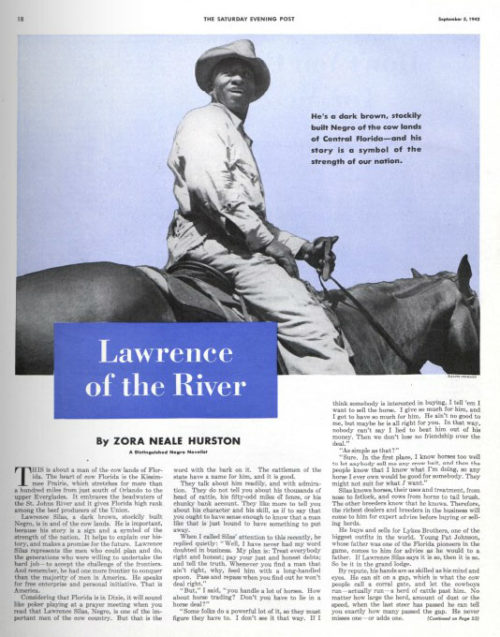
Although Zora Neale Hurston is best known for her fiction — and especially for her novel Their Eyes Were Watching God — the luminary of the Harlem Renaissance was educated at Barnard College as an anthropologist. In 1942, she interviewed the Florida cowboy Lawrence Silas, a black man who, during the Jim Crow era, had earned the respect of those in the beef industry for his fairness and skill.
In “Lawrence of the River,” published in the Post on September 5, 1942, Hurston calls Silas’ story “a sign and symbol of the strength of the nation” that “helps to explain our history, and makes a promise for the future.”
On full display in the story is Hurston’s knack for catching the rhythm and cadence of the Southern dialect. How Silas speaks — and how Hurston reproduces that speech — reveals as much about his personality as what he says.
Your Weekly Checkup: The Benefits of a Sauna Bath
“Your Weekly Checkup” is our online column by Dr. Douglas Zipes, an internationally acclaimed cardiologist, professor, author, inventor, and authority on pacing and electrophysiology. Dr. Zipes is also a contributor to The Saturday Evening Post print magazine. Subscribe to receive thoughtful articles, new fiction, health and wellness advice, and gems from our archive.
Order Dr. Zipes’ new book, Damn the Naysayers: A Doctor’s Memoir.
In my memoir, Damn the Naysayers, I wrote about a trip to Vilnius in 1977 when our hosts greeted us with a hot sauna in which temperatures approached 150 degrees Fahrenheit and “an attendant poured cold water on hot coals, generating wet clouds of humid air that enveloped and almost suffocated us.” It turns out they may have known something we didn’t: a 30-minute sauna bath is apparently associated with a variety of health benefits, including reduced blood pressure, improved blood vessel flexibility, and lowered risk of coronary disease, sudden cardiac death, hypertension, Alzheimer’s disease and dementia. Sauna bathing also has been associated with a reduced risk of respiratory diseases and inflammatory markers.
Both the frequency and duration of the sauna bath exert important impact. Compared with men having one sauna bathing session per week, those having two to three sauna bathing sessions per week had a 22% reduction in fatal cardiovascular events, while those having four to seven sauna bathing sessions enjoyed a 63% reduction. Compared with men having a sauna bathing session lasting less than 11 minutes, those having sessions lasting more than 19 minutes had a 52% reduction in sudden cardiac death.
Sauna bathing may also alleviate pain and improve joint mobility in patients with arthritis. The sauna heat causes blood vessels to dilate and relax, so avoid drinking alcohol during the sauna since that would increase the risk of hypotension and its complications. Regular sauna therapy appears to be safe, providing multiple health benefits for regular users. Pregnant women early in pregnancy might need to be cautious because of evidence suggesting hyperthermia might harm a developing fetus.
While all the above benefits may exist as reported, I must emphasize that the published studies on sauna benefits are few, with several of the excellent reports described only by the group noted above. Critics raise the issue that such observational studies cannot establish causality and those individuals who regularly take sauna baths might have better outcomes because they might be in better health, live a healthier lifestyle, eat a heart-healthy diet, exercise, not smoke, and have more leisure time for soaking.
The authors’ rebuttal to those claims is that they observed “graded inverse associations with sudden cardiac death, fatal coronary heart disease, and cardiovascular disease events, which are the characteristics of a true inverse association between sauna bathing and outcomes,” and that they carefully adjusted for socioeconomic status, physical activity, and cardiorespiratory fitness.
Whatever the answer, there’s nothing quite like a good hot soak, and, as my grandmother might have said in her Russian accent, “It vuldn’t hoit.”
Why Earth Day Still Matters
This series by American studies professor Ben Railton explores the connections between America’s past and present.
This past weekend featured the 48th annual Earth Day commemorations and celebrations. In our 2018 world of climate change crises and divisive political debates, Earth Day might seem to be an outdated or irrelevant holiday, a quaint relic of an era when the counter-culture ideals of the 1960s produced idealistic narratives of “peace and love” through which to view such issues and occasions.
There’s no doubt that Earth Day’s 1970 origins were specific to that moment, and much has changed in the nearly five decades since. But why Earth Day began and how it developed into that first 1970 celebration offers valuable insights on how it was different from today’s social and political movements.
Earth Day was the brainchild of Wisconsin Senator Gaylord Nelson (1916-2005), a lifelong conservationist who had gradually become more dedicated to environmental concerns. In 1963, his first year as a senator (after two terms as Wisconsin governor), Nelson helped convince President John F. Kennedy to embark on a speaking tour focused on conservation issues; such efforts led no less a Wisconsin legend than Vince Lombardi to call Nelson “the nation’s #1 conservationist” at a 1968 reelection campaign event. But it was the January 1969 Santa Barbara oil blowout, one of the worst man-made environmental disasters in American history, that energized Nelson to wed his conservationism to more direct environmental activism.
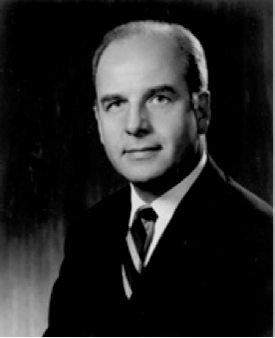
Nelson realized that widespread awareness and knowledge were vital prerequisites for any collective and sustained environmental activism. He identified young Americans — specifically college students — as a crucial cohort for that kind of consciousness raising. To that end, Nelson imagined and publicly presented Earth Day as a “national teach-in on the environment,” and recruited a 25 year-old environmental activist and graduate student at Harvard’s Kennedy School of Government, Denis Hayes, as Earth Day’s national coordinator. Hayes and his team chose April 22nd as the date for the initial Earth Day celebrations precisely because it fell between Spring Break and the end of college semesters, and worked closely with more than 2000 colleges and universities to maximize student participation in the event.
The initial Earth Day planning relied on a bipartisan political vision and effort. Early in the process Nelson recruited Pete McCloskey, a young Republican congressman from California with an interest in conservation, as co-chair of the Earth Day planning committee. Together Nelson and McCloskey drummed up support from fellow elected and party officials across the political spectrum, helping connect with local constituencies such as community organizations and public schools (more than ten thousand primary and secondary schools took part in the 1970 celebrations). Compared to more overtly political student-led activism such as the era’s anti-war movement, Earth Day was able to remain largely non-partisan and engage communities such as the nation’s public schools far more fully as a result.
These distinct but complementary efforts produced unprecedented success. They did so on the day itself, with more than 20 million Americans taking part in Earth Day teach-ins, celebrations, and protests. But they also just as importantly extended beyond April 22nd, with a range of effects including profoundly practical and political ones: by the end of 1970 the Environmental Protection Agency had been created and Congress had passed the Clean Air Act; over the next few years the Clean Water Act and Endangered Species Act would follow. These legislative actions might seem less grass-roots and more bureaucratic than the student and community organizing that produced the massive turnout for the first Earth Day celebrations. But when we highlight Nelson and McCloskey’s bipartisan political coalition-building alongside the grass-roots organizing of Hayes and his team, it becomes clear how fully the holiday developed out of precisely a combination of such distinct yet complementary efforts.
Combining forces to educate and mobilize in service of shared concerns might seem like a straightforward enough objective for any social movement. But in practice it’s far from simple to bring together students and politicians, educational institutions and grass-roots activists, national leaders and local communities. 2018 is not 1970, and perhaps such collective efforts are quite simply no longer possible in this era. Yet history can offer models for the present, and the history of the first Earth Day illustrates both the strategies for and the possibilities of building a truly communal coalition to raise national awareness about the crucial issues we still face.
11 Old Words We Should Bring Back
Language is always changing, like a living, breathing animal. But some words are more like roadkill, forsaken to a time gone by. They don’t have to be, however. Here are some outdated words that deserve a comeback along with examples of how they might be used today.
Carking: (adjective) burdensome, annoying
Ashley would have been on time for her yoga class if it hadn’t been for the carking traffic.
Afternoonified: (adjective) presentable, smart or sophisticated
It’s a shame Henry is sporting a Merlot stain on his otherwise afternoonified linen suit.
Chockablock: (adjective) full
“We will have to part with your stepmother’s wooden swan collection since our storage unit is chockablock with golf clubs and wicker baskets.”
Chirr: (noun) the short vibrant or trilled sound of an insect
Henrietta’s know-it-all granddaughter advised her that the sound of the cicadas was not a chirp, but a chirr.
Aphonia: (noun) loss of voice and of all but whispered speech
Henrietta was admittedly appreciative of her granddaughter’s aphonia after a week of babysitting the little smart aleck.
Orotund: (adjective) marked by fullness, strength, and clarity of sound
The preacher’s orotund voice is captivating, but this sermon is pushing two hours.
Rawgabbit: (noun) a person who speaks confidently but ignorantly
Dr. McKinney was accustomed to dealing with rawgabbits, but she never thought her son-in-law would attempt to explain obstetrics to her.
Lummox: (noun) a clumsy person
A cracked iPhone screen is the calling card of a hopeless lummox.
Chuffy: (adjective) fat or chubby
After months on the gluten-free diet, Karen is still as chuffy as ever.
Termagant: (noun) a harsh-tempered or overbearing woman
Gerald learned a tough lesson when he tossed around the word termagant in an argument with his wife.
Overmorrow: (adverb) the day after tomorrow
“I wish today would never end, because I have a root canal tomorrow and a colonoscopy overmorrow.”
Healthy Weight, Healthy Mind: Are You a Weight Management “Dry Drunk”?
We are pleased to bring you this regular column by Dr. David Creel, a licensed psychologist, certified clinical exercise physiologist and registered dietitian. He is also credentialed as a certified diabetes educator and the author of A Size That Fits: Lose Weight and Keep it off, One Thought at a Time (NorLightsPress, 2017).
Do you have a weight loss question for Dr. Creel? Email him at [email protected]. He may answer your question in a future column.
Have you ever tried to fake having a good time? Even if it’s only for a few hours while shopping for window coverings with your wife or walking through an antique car show with your husband, it’s hard to pretend you’re having fun when you’re thinking about a dozen other things you’d rather be doing. Now think about something more long-term, like a job or marriage. If your head isn’t into your work or a relationship, you can’t pretend things are wonderful day after day. Your behavior will eventually reveal your discontent.
Weight management is the same. If your thoughts, emotions, and behavior are not in sync you won’t be able to fake your way through it by using willpower or ignoring your true feelings year after year — that just won’t work. How long will you be able to eat healthy if your thoughts are “this diet is for the birds, I wish I could eat real food” or “I just want to eat the way everybody else eats?” Alcohol treatment circles like Alcoholics Anonymous have a name for this type of disconnect between thoughts and behaviors: a dry drunk. It goes something like this:
For many years Pete couldn’t control his drinking. He drank almost every day, much to his wife’s chagrin. Occasionally he white knuckled it for a day or two and didn’t drink, mainly to show his wife he had no problem and could stop anytime he wanted. He sometimes missed work due to hangovers and oversleeping. Recently things escalated as his boss wrote him up for skipping work, and two days later he received his third DWI and went to jail. This time, the judge revoked his driver’s license. Needless to say, Pete’s wife was not happy, knowing she’d be responsible for driving him to and from work and he wouldn’t be able to help take the kids to events. She let him sit in jail for two nights before bailing him out and then gave Pete an ultimatum — quit drinking or the marriage is over.
Not only was Pete getting tough love from his wife, the judge ordered him to alcohol treatment. Getting his license back was possible only if he completed treatment and had clean random urine screens for a prolonged period of time.
How did Pete react to these humiliating events? He got angry. First of all, the cop had no right to pull him over; he was driving fine and just had a broken tail light. From his perspective, no one was in danger. His wife was overreacting as usual — even her own mom agreed she could be too emotional. The judge, well, he was ridiculous. Pete, in his mind, was not like all of the other losers who appeared in court.
Besides the anger, Pete was jealous of his buddies who could seemingly drink without being harassed by a badgering wife, an uptight boss, and overzealous cops looking for a reason to lock people up. But he felt backed into a corner with no other option but to stop drinking so, reluctantly, he did. At the court-mandated AA meeting he sat with arms folded in the back of the room, feeling sorry for himself.
Pete was what we call a dry drunk. Dry in the respect that he wasn’t drinking, a drunk because he still had the thinking patterns of an alcoholic in the throes of denial: a toxic combination of blaming others and rationalization.
What happens with dry drunks? Usually they begin drinking again because their thinking patterns and attitudes have not changed. At some point, a person with Pete’s frame of mind glorifies the freedom to drink while ignoring the potential consequences. He takes the first sip and then finishes the drink. Since he’s already blown it, he has another. Not only has he already screwed up, but the effects of the alcohol are setting in and that feels good, so he keeps drinking, not for one night, but tomorrow, too. This lapse leads to a complete relapse into old patterns of behavior, all but destroying his confidence to give recovery another attempt.
But there is another possibility. In some cases, a dry drunk will change his thinking patterns and remain sober. Possibly, Pete will begin to notice his mind is clearer, he has more energy, and is getting along with his wife better now that he’s sober. He starts to remember why they got together in the first place. He is “present” with his kids and sees what he’s been missing all these years. His 9-year-old daughter is so smart and seems to enjoy having grown-up conversations with him. Shooting baskets with his 11-year-old son is much more rewarding than sitting on the couch drinking and watching TV. He hears the news about a drunk driver killing an entire family in an accident and starts to accept that his behavior could have led to the same terrible result. His buddies’ lives aren’t as great as they once seemed; their marriages and relationships with their kids leave much to be desired. If his positive thoughts about sobriety translate into changed behavior, it’s feasible, even likely, that Pete will stay sober.
People cannot easily overcome alcoholism, and Pete’s scenario shows that staying sober only happens when we align our thinking with our behavior. Changing both thoughts and behavior takes a lot of courage and hard work.
The same goes for managing weight. Over the years, I’ve encountered many weight management dry drunks. These folks follow a diet for a while, but what they really want is to eat whatever they want, whenever they want. Following a diet is akin to serving a prison sentence, and they feel they’re “doing time” for a crime they didn’t commit. They tell themselves, or other people tell them, they must follow a certain eating and exercise regimen. Certain foods are off limits and their choices are non-negotiable.
This constant oversight by the food police, whether themselves or others, can lead to sadness, anger, and jealousy. These feelings are often directed at friends or family members who don’t have to struggle with weight, despite their poor diets and little exercise. Typical thoughts include:
“I don’t know how she stays so thin eating like that—it isn’t fair!”
“I can’t have any pie because this miserable diet doesn’t allow it.”
“I have to get on that boring treadmill to burn more
calories.”
“What’s the point in going out to dinner if I can’t eat food I like?”
Some of these weight management dry drunks are distressed and saddened by the notion that they can only lose weight by giving up something they love so much — delicious food. Along with these thoughts comes the reality of what will happen if they don’t lose weight:
“My doctor said I can’t have knee surgery until I lose 50 pounds, and I can’t stand this pain.”
“I avoid any building that requires walking up stairs and I’m afraid if I fell I couldn’t get up—so I have to lose weight.”
“I have no choice because I can’t bear the thought of someone having to care for me when I get older. It would take two or three people just to lift me.”
Like Pete, these people feel backed into corners. They don’t really want to change their behavior and often think about the misery associated with dieting, exercise, and paying attention to their weight. They just want to live a “normal” life, but the threat of bad things to come will keep them on track for a while. Yet their heads are not in the game. They are reluctantly meandering away from bad things instead of running toward something they truly desire. Like a child who behaves only to avoid punishment, they are primed to rebel. They secretly look for a way to cheat the system or deceive those who are seemingly in charge.
After losing 20 pounds, Debbie hit a weight plateau. In fact, her weight was starting to creep back up ever so slightly. As we talked about this, she told me she was starting to “rebel.”
“That’s an interesting way to put it,” I said. “Tell me what you mean.”
“Well, I know I have to follow this diet, and knowing I have to makes me want to do just the opposite,” she said.
“Who said you had to follow the diet?”
“Well I guess no one actually said that.” She broke eye contact and looked down at the table.
“Do you feel like our team is pressuring you?”
She leaned forward, placed her elbow on the table, and rested her head in her hand. “No, it’s not you guys,” she said as she ran her fingers side to side above her eyebrow.
“Debbie, you can do whatever you want. You’re free to get up right now, head to Burger King, and order everything on the menu.”
She giggled and then sighed. “I guess you’re right, but it doesn’t feel that way. I tell myself I have to do this. The more I tell myself I have to follow a diet and exercise, the less I want to do it. I start to rebel against my own thoughts. Am I crazy?”
Debbie was not crazy, but she was right about feeling rebellious because of her own thoughts. She made demands on herself that caused her to feel as if she didn’t have a choice. Her compliant self was wagging a finger at her alter ego and saying, “You must eat this and you can’t eat that.” In response, the part of her that didn’t like being told what to do was feeling the urge to flip her the bird, take her I’ll-show-you attitude to a convenience store, and buy a candy bar and a regular, not diet, soda.
This back-and-forth type of thinking is not only exhausting, but can have a powerful effect on attitude — and our attitudes obviously impact our long-term behavior. The only way someone loses weight is to change behavior. We cannot educate our way to a healthier body, think our way to success, or pay our way to weight loss. In the end, it boils down to behavior: The types and amounts of food we eat and the physical activity we perform.
But focusing only on behavior is short-sighted when it comes to long-term weight management. Since most dieters already know about the behavior needed to lose weight, it makes sense to explore how our thoughts and feelings are connected to those behaviors. The following illustration shows that our thoughts, feelings, and behavior are connected, each influencing the other. The arrows between the three concepts are bi-directional which means that:
- Thinking can impact our behavior, and
- behavior can change our thinking.
- Thoughts can change our feelings, and
- our feelings impact our thoughts.
- Our feelings can affect behavior, similar to how
- behavior impacts our feelings.
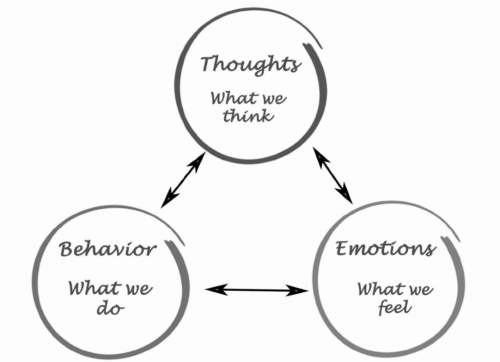
While working to become a better weight manager, you’ll find it important to identify which of these connections most often gets in your way. Do you need a more structured behavior plan to improve your confidence? Or perhaps your plan is fine, but emotions derail your progress. Perhaps your thinking is the problem — how you interpret life situations leads to stress eating and abandoning your exercise routine. Pete and Debbie showed us how thoughts, feelings, and behavior interact to shape our attitudes .
News of the Week: Vanishing Signatures, Things You Shouldn’t Do in Public, and Strange Burgers
Sign Here
Supposedly, in some horrible future where pen and paper will be viewed the same way we now view butter churns and 8-track tapes, signatures are going to go away. Instead, we’re going to use electronic signatures, fingerprints, retinal scans, and other technological “improvements” that will replace the burden of taking two seconds to sign our names to something. I am going to fight this to my last breath.
That’s why I was happy to read this defense of the signature in The New York Times from Steven Petrow. He talks about how the major credit card companies are getting rid of signatures and how he himself didn’t even do a traditional signature when he bought a home last year.
I don’t want to live in a world where signatures go away. I think that’s why I consciously fight against a lot of this stuff, even if I have to use some of it because I have no other choice. But as long as cursive handwriting and signatures don’t lead to a lengthy jail sentence, I will continue to sign contracts with a pen and send out paper Christmas cards and thank-you notes. To paraphrase Charlton Heston, they can have my checkbook when they pry it from my cold, dead hands.
Spitting and Swearing
While we’re on the subject of seemingly old-fashioned things like signatures, how about good manners and the way we dress?
While surfing around Twitter, which one of these days I’m going stop surfing around because I hate it, professor and author Tom Nichols wrote a series of tweets bemoaning what people seem to think are okay things to do, say, or wear in public (scroll down his feed here). Among the things he can’t stand are adults wearing sweatpants and baseball caps everywhere, swearing in public, wearing shorts to dinner or church, and spitting.
I agree with all of those (side note: I have never once spat in my life — true story), and I would add people who put their feet on the seat in front of them at the movies, people who don’t return shopping carts to the parking lot corral, and people who chew loudly with their mouths open. As for hats, I wouldn’t mind seeing the return of dress hats like fedoras, but guys, you’d have to take them off when you go inside a building.
What’s your public pet peeve?
Lost Monkey
The weirdest story this week comes from Minneapolis. Workers renovating an old Dayton’s department store building found the mummified remains of a monkey!
No one knows how it got in there, or why it stayed in there and died, but Robbinsdale, Minnesota, mayor Regan Murphy might have the answer. His dad and a friend actually stole a monkey from a “Pet-O-Rama” display in Dayton back in the 1960s while playing hooky from school. His mom and his dad’s friends all knew about it. The monkey tore up his dad’s house, so they brought it back. They left it on the escalator and ran out of the store.
This scenario is the exact reason why Theodore Roosevelt once famously said, “Never bring a monkey into a department store.”
Fribo
Hey, Fribo would be a good name for a monkey.
Fribo is billed as “the robot for lonely people.” It’s a creepy … I mean “cute” … black thing with big eyes that sits on your table. As it learns more and more about you, it can anticipate what you want or need, and even encourage you to text your friends or post on social media. Judging from the video, it looks like the type of thing that will eventually steal money electronically from your bank account and kill your pets because they’re too much competition. Just think: One day we won’t have to deal with other people at all!
This will be the perfect companion in a world where we no longer have signatures.
Mayochup!
Just when you thought we couldn’t possibly invent another condiment, along comes Mayochup. That’s right, it’s a combination of mayonnaise and ketchup. It’s been so popular in the Middle East that Heinz is bringing it to the United States.
The company might continue to call it Mayochup, but they’re open to other suggestions as well.
We heard you saucy Americans and we’re bringing you our version of the delicious duo you’ve been eating for years. Are you Team Mayochup or should we call it something else? Let us know your thoughts! pic.twitter.com/q0PRofYOO5
— Heinz US (@HeinzTweets) April 16, 2018
New Books and Movies
Show Trial: Hollywood, HUAC, and the Birth of the Blacklist, by Thomas Doherty, gives an in-depth look at how the Hollywood blacklist of the 1940s and ’50s started. I recently watched Trumbo, the 2015 film about the blacklisted writer Dalton Trumbo (played by Bryan Cranston), and while it’s a highly entertaining film, it’s not entirely accurate, so Doherty’s book will probably tell you more about the period.
Andre the Giant is a new documentary on the famous wrestler, who died in 1993. It’s currently airing on HBO and is available On Demand.
He had big hands.
André the Giant's hands were….large. https://t.co/ETTglo0Giq
— Jonah Goldberg (@JonahDispatch) April 13, 2018
RIP Barbara Bush, Miloš Forman, Harry Anderson, Carl Kasell, R. Lee Ermey, Tim O’Connor, and Jean Marzollo
Former First Lady Barbara Bush married future president George Herbert Walker Bush on January 6, 1945, during World War II, which means they were married for over 73 years. She was the author of several books and a champion of literacy and AIDS research. She died Tuesday at the age of 92.
Miloš Forman won Oscars for directing Amadeus and One Flew Over the Cuckoo’s Nest. He also helmed Ragtime, The People vs. Larry Flynt, Hair, and Man in the Moon. He died Friday at the age of 86.
Harry Anderson starred in the 1984–1992 NBC sitcom Night Court and later played writer Dave Barry in the CBS comedy Dave’s World. He was also an acclaimed magician and made several appearances on Cheers and Saturday Night Live. He died Monday at the age of 65.
Carl Kasell started on the radio at the age of 16 and went on to work at NPR for over three decades as a newscaster and a judge on the quiz show Wait Wait … Don’t Tell Me! He died Tuesday at the age of 84.
R. Lee Ermey was a veteran character actor whose early career in the Marine Corps served him well in his many roles as military leaders and other serious types. He appeared in such movies as Full Metal Jacket, Se7en, Mississippi Burning, and the Texas Chainsaw Massacre remake. He also lent his voice to the Toy Story movies, The Simpsons, and Family Guy. He died earlier this week at the age of 74.
Tim O’Connor was a regular on Peyton Place and Buck Rogers in the 25th Century, and made appearances on shows like The Twilight Zone, The Defenders, All in the Family, Columbo, Star Trek: The Next Generation, and dozens more. He died earlier this month at the age of 90.
Jean Marzollo was the author of the popular I Spy books for children. She also wrote several books for adults. Marzollo died last Tuesday at the age of 75.
Best and Worst of the Week
Best: While doing some research on the career of Harry Anderson, I came across a pilot he did in 1999 for a new version of What’s My Line? I couldn’t find anything except this very short clip, but it looked like it could have been promising. The panelists on the pilot were Betty White, Bryan Cranston (hey, there he is again), Catherine Bell, and Al Franken.
I’d love to see this show come back, as long as they did it like the original and not the horrifying new version of To Tell the Truth currently on ABC.
Worst: Far be it for me to say something against museums, but do we really need a Museum of Selfies? That’s an actual place that opened up earlier this month in Los Angeles. Is the taking of more selfies something we actually want to encourage?
Luckily, the museum is only a limited thing, running until May 31. Besides, we already have a permanent museum of selfies. It’s called “the internet.”
This Week in History
Titanic Sinks (April 15, 1912)
Rare correspondence from the doomed luxury liner will be auctioned off this weekend at the British auction house Henry Aldridge & Son. Items include letters, postcards, and even menus from the dining room.
First Appearance of Daffy Duck (April 17, 1937)
The iconic Looney Tunes character looked very different when he made his debut in the Porky Pig cartoon Porky’s Duck Hunt.
This Week in Saturday Evening Post History: Sack Full of Trouble (April 14, 1956)
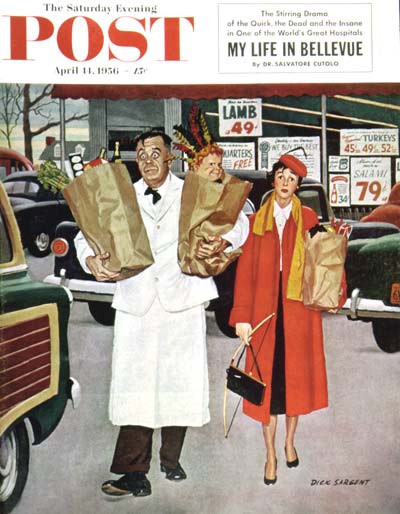
Richard Sargent
April 14, 1956
I don’t know why, but at first I didn’t even realize that the kid in this Richard Sargent cover is actually inside the bag. I think I was trying to figure what the “Quarters” sign behind them is referring to. Free quarters?
Strange Burgers
I know that the warm weather will eventually arrive, and when it does, it means that cookout season has begun. I could link to some traditional recipes, but where’s the fun in that? I assume you already know how to cook a cheeseburger. How about something a little … weirder?
You’ve probably always wanted to try a burger with a tarantula on top of it. I couldn’t find a recipe for it, but you can go to Bull City Burger and Brewery in Durham, North Carolina, and get one for $30. That sounds like a lot, but I really don’t know what the going rate for a tarantula burger is. If that’s a little too exotic for you, how about these Cream Cheese Stuffed Garlic Burgers or this Lasagna Burger from Dude Foods?
Maybe the tarantula burger would be better with some Mayochup on it. Lots and lots of Mayochup.
Next Week’s Holidays and Events
Administrative Professionals’ Day (April 25)
This is what we used to call Secretaries’ Day, and it’s not the only national day whose name has changed.
Take Our Daughters and Sons To Work Day (April 26)
This used to be called Take Your Daughter To Work Day until they expanded it to include boys in 2003.
Charlie’s Bar
Whisky.
Scotch or Irish?
Irish. I need to kill a man.
The bartender raised a bottle of Jameson’s; the bar separating him from the man. His patron sat on the stool, head bowed to his cupped hands as his black duster dripped rainwater on the floor. The Customer looked at the glass, said nothing, as the bartender poured the whisky. He poured it neat. The Customer looked like he could use it, and the bartender wanted to make him happy. Kill a man. The bartender assessed the Customer from the corner of his eye and saw a dark lump sitting at the bar like a gunslinger from a movie. Tired, angry, just looking to do a job. The bartender set the bottle on its shelf, got the man a glass of ice water, and then backed away a few steps.
Wiping the back bar, he wondered if the Customer was joking. No one would walk into a pub and just confess he was going to kill a man. That’s a pretty sad excuse for a joke. In these days of school shootings and terrorists, it wasn’t funny. He went to the other end of the bar and asked his only other afternoon patron, one of those sulky well-dressed hipsters working on a laptop, if he’d like another. The young man looked up as distracted as he was distracting in a bar like Charlie’s and said he would. Nice and simple. No jokes.
The bartender went to the taps and tipped the glass to pour the beer. Charlie’s Bar was a Western establishment with thick floors, walls painted in several whatever-was-on-sale colors, and an old tin ceiling with bullet holes. It was legend in the village of Ruxton Springs. The place was worn and redolent of old beer, sweat, sex, and vomit. That mildew smell that settles in the back of the tongue rather than the nose. It was the bar that was magnificent: a solid trunk of oak carved with intricate designs of whales, ships, and sailors with harpoons that was completely out of place at the edge of the Rocky Mountains. The back bar was anchored by two wooden masts with flying sails cut and polished out of oak, between them a huge leaded mirror with shelves that held gin and vodka on either side of a large selection of whisky, and various colors of mixers. Beneath that, taps with several types of domestic beer. Dick, the bartender and owner of the establishment, had just installed a few taps for those locally made craft beers that his older regulars thought were bitter swill but briefcased professionals and the younger crowd on Japanese sport bikes happily gulped down at $5.50 a glass. The moody, hip young man wanted a $2 PBR.
As Dick poured it, the Customer looked up from his whisky. I need another, he said.
Be right with you, mister, said Dick.
Sad morose clientele. A typical late afternoon at any bar in America. If people had someplace they needed to be, they’d be there. At least it was easy to keep track of the tabs. The Customer stared at his empty glass.
The bartender carried the beer to the hipster at the end of the bar. In all the years he had owned Charlie’s, pistols shoved in his face, fists to his kidneys, knives tossed on the bar in anger, he kept his cool, and he ran a tight ship. The Customer had reckoned his soul.
You okay? the hipster asked.
Just the cowboy at the end of the bar, said Dick.
The hipster said, Looks like the dude could use a drink. Dick weighed the Customer with his eyes as the hipster continued, Wonder what’s his story.
I suppose I should ask, said Dick.
I’ll be here for a while, said the young man. I’ve got a lot of code to check and a lot of emails to answer. Let me know if there’s trouble.
Dick nodded and strolled back down the bar. He poured the Customer a double.
On the house, he said. The Customer nodded.
One of the town’s colorful street extras, a homeless man that smelled vaguely like shit and tuna, came through the door. He wore a trash bag as a rain jacket and shivered in the cold. Dick reached behind the bar and brought out an old raincoat.
Hey, Gus, said Dick. I picked this up for you at the Salvation Army. Why don’t you put it on?
The homeless man limped over to the bartender and cautiously took the rain coat. He slowly lifted the trash bag over his head and for a moment didn’t know what to do with it. Dick took it from him and then looked at the smiling hobo in his bar.
Ah, he said, that looks good.
The door opened again and Melissa, the evening server, came in from the rain.
Afternoon, Melissa, said Dick. Don’t Gus look good in his new raincoat?
Yeah, he looks boss, she said.
She tossed her wet, red hair away from her face, removed her jacket and shook the rain from her body. Her breasts swayed back and forth, and her round ass did a wiggle as the Customer averted his eyes and saw Dick ogling her.
I do like the ladies, Dick said with a wink.
Me too, said Gus.
Now, Gus, I told you not to be talking about my girls, said Dick. Why don’t you go outside and give that jacket a try?
Gus nodded and slumped out the door.
He’s not a bad guy, said Dick to the Customer. Haven’t we all been down on our luck at some point?
The Customer smirked and sipped his whisky. I’ll drink to that, he said.
Melissa came around the bar and asked Dick if he thought it would remain this slow.
No, said Dick. It’ll pick up.
Then he gave her a swat on the butt and told her she’d have to work for a change. She leaned over the counter revealing her cleavage.
Get you anything? she asked the Customer.
He shifted in his seat and lowered his chin so only his beard and greasy gray hair peeked from under his hat.
I’m fine, he said, shy from the closeness of the pretty lady. She sauntered off to the young man at the end of the bar with Dick’s leering eyes following her until he settled on the Customer.
I’ve seen you in here before, mister, said Dick.
Been around.
Yeah-yeah, you like the heavy metal music.
Yep.
You look more like a country music fan.
Got a soft spot for Reba. That’s it.
Well, mister, I got a girl coming in here next month that will knock your socks off. She sounds like Reba but plays those rock-n’-roll chords, if you know what I mean.
The Customer nodded.
Music is how to draw a crowd, said Dick. I bought this place from Uncle George Olson when I got out of the army about 20 years ago. He ran it for about 50 years. He had his regulars, now I’ve got mine.
You must’ve been a young man, said the Customer.
Dirty-one, Dick said with a wink.
Where’d you get the money? the Customer asked. Rob a bank?
Uncle George financed me. No banks.
The rich will kill you, said the Customer raising his glass.
He took a full swallow of whisky and winced.
That’s good, he said. Those bankers are nothing but thieves and liars.
Dick gave a nervous look in the direction of the hipster who may, or may not have been in finance, but had money. Not that he’d blame the Customer if he killed a banker. Many had it coming.
Yeah, said Dick. After the war Uncle George bought it that way from Allan Ford and Ford bought it from Charlie Butler. Of course, back in Charlie’s day, it was called Jane’s Place after his dead wife. Some say she was a crazy old witch. What brings you in today?
I told you. I need to kill a man.
Dick stepped away from the bar. He eyed the big bat he kept under the counter and mentally measured the distance to the register, which held a small pistol.
Sure, Dick said. Who doesn’t want to kill a man every now and again? Given free rein, I can think of three, maybe four.
You got a wife? the Customer asked.
Dick laughed. Never married. You?
The Customer took a nourishing sip of whisky and licked his lips. Divorced.
Bitches, said Dick. He reached under the bar to rinse out his rag and felt the bat. Outside the loud drip of rainwater poured off the roof and splashed on the sidewalk without rhythm or chorus. Dick looked at the Customer and saw him staring at the mirror focused on a ghost, he supposed, only the Customer could see. Turning from his reflection, the stranger stared for a few cool seconds at the young man at the end of the bar. Nothing said. They summed each other up and exchanged nods like men do. Dick kept rinsing out the rag until the Customer tapped his finger on the edge of his glass.
Another.
A double?
The Customer shook his head. No.
Dick poured. One more swirled around the bottom of the green bottle. He’d have to bring another Jameson’s up from the basement before the evening rush. Being a barkeep, he had seen guys like this before. Full of rage at how life had turned out. Some guys took it out on deer and elk at hunting season. Some sought solitude in fly-fishing. For others it was radical politics, and for others still, it was the burning need for retaliation.
The Customer stood up, placed one hand on the counter, and the other under his jacket. The hipster looked up from his screen. Dick stepped back.
Whoa, where you going? Dick asked. I just poured. Drink your drink, mister. I’ve been a bartender for a long time, heard a lot of stories. I’m better than a shrink and only half the cost.
The Customer hovered for a beat, reluctantly nodded, and then sat back on the stool. He fired a look at the hipster until the man turned back to his laptop.
Your divorce, asked Dick, does that have something to do with the man you’re going to kill?
Don’t know him, said the Customer.
Dick stepped closer to the bar. So why kill him?
After the divorce, I bought her out of the house, the Customer said. I’d raised two kids there. It’s not much. Just a thousand square feet over in Colorado Springs with a vacant lot to the east that looks over the city. Then a wealthy man bought that lot. He wants to build a house into the hillside just a few feet from my porch.
He emptied the glass. Dick lifted the whisky bottle but the Customer put his hand over the top of the tumbler. He had had enough of the brown lady, so Dick set the bottle on the bar. The Customer took a long drink of ice water and shivered the chill away as it settled in his gut.
A week ago, a rich young man approached me with a promise to buy the other guy out, he said. I just had to kill a man. An investment in vengeance, but I’d get my quarter acre. The Customer traced the initials of some forgotten person on the bar.
The only thing that can stop a rich man, said Dick, is a richer man.
The doors to the back kitchen swung open and Melissa sashayed in with her tight jeans and revealing top. She wanted to know how much to prep for the night.
We sell a lot of pizza on Tuesdays, said Dick.
I’ll thaw out a few skins, said Melissa.
She turned and started to leave. Dick smacked her butt. She gave a little jump, then his hand grabbed her ass, and slid into her crotch as he sniffed her hair. He gave a peccant chuckle through his skinned teeth. Dick grinned and watched her go.
You do indeed like the ladies, said the Customer. Can’t keep your hands off them.
He took a drink of ice water.
All the ladies want it, Dick said. Especially that one.
And if they don’t?
Dick laughed, Mister, when a woman says no, she’s just playing hard to get. A man has got to dominate. You take her by the hand or by the titties and just show her the way to heaven.
The rich hipster at the end of the bar pulled out a pack of cigarettes and a lighter. He slipped away from his barstool and started for the front door.
Dick stopped him right away. You leaving?
I just want to smoke, said the young man.
Dick pointed to a door near the back. Not out front and not inside; out back on the deck, he said. It’s got an awning, so you won’t get wet.
The hipster nodded, slipped a cigarette in his mouth, and walked through the door leaving the Customer and Dick alone in the bar.
You like the young ones. Early 20s, pretty, said the Customer. Naïve.
I don’t get your meaning, said Dick.
The Customer held his empty, blood-red water-glass before his eyes. You understand me, he said.
I think you’re done, mister, said Dick.
The Customer set his glass on the bar with a sharp hollow bang of plastic on wood. Dick jumped. Then — cool like — he leaned on the bar with an eye on the door. The hint was obvious. Time for the man intent on murder to leave and get to his business. The Customer stood up and set his hat on the bar, his hair sticking to his face, blue eyes sharp but determined. He glanced at the grandiose bar with its wood carved sailing ships and hunter’s hand on the harpoon ready to strike the giant sea beast.
Gus walked through the door looking wet and resplendent in his new raincoat.
Dick said, Hey, look at my man, Gus. That working out okay?
Gus nodded. The bartender went to the till and opened the drawer. The pistol lay neatly above the 10s and 20s. He took out a couple of tens and handed them to Gus. The drawer remained opened. Ready.
You go over to Mountain View Café and get a bowl of that soup Maisie is making. It’s good stuff. Keep the rest.
Gus smiled and walked out. Dick went back to the Customer, his grin turning harsh, his shoulders tight. He leaned over the bar with his hand grazing the neck of the bat.
The Customer took a step back. His coat parted revealing the shotgun tucked inside that came out faster than Dick could grab the bat. The blast into the bartender’s face shattered the air knocking Dick and the remains of his head against the back bar into the taps. Beer flowed to the floor. The shotgun went back in the Customer’s coat. He put his hat on, walked out the bar, and into the dark rain as the thunderstorm kicked up to a gale. Lightning crashed and rattled the windows.
Gun smoke hung in the air and drifted up to the lights hanging from the ceiling.
The rich hipster came back into the bar; his sport coat pulled tight around his shoulders. The tang of the blast smacked the tip of his nose. He looked at the empty bar and lit another cigarette. He was satisfied with his investment. Melissa came from the kitchen, went to the register, and removed the pistol Dick kept there. She set it on the bar, careful not to step in the blood and beer pooling on the floor. She called the police with a tale of a robbery gone bad, the boss pulled his gun, and well …
She poured the last of the whisky into a glass and gave it to the rich young man.
What Makes Ed Sullivan Tick?
 The Ed Sullivan Show was America’s top-rated variety program, and Ed himself was an icon, despite his awkward mannerisms and the belief by many that he was talent-free.
—Originally published April 20, 1968—
The Lovin’ Spoonful sings. Stage left stands the host, watching a monitor. Arms akimbo, tongue poking about in his cheek as though seeking surprises, expression unmistakably one of delight — or distaste, or disbelief, or boredom. Out there sits the studio audience, enthralled. The adolescent girls wail ecstasy. Mrs. Robert Lindquist, visiting from Richmond, Virginia, grins happily. “Oh-h-h, my!” she says. “Ed Sullivan — in person. That Ed is just the greatest. He’s — well, he’s like Howard Johnson’s. Do you know what I mean? Wherever you are, there’ll always be good food and clean restrooms.”
On the face of it, Sullivan’s success appears to be a terrible mistake. He twitches. He mumbles. He flubs. Once, presenting actress Dolores Gray to bolster a musical in which she was appearing, he said, “And here is the actress now starving in a new show …” His tastes, by current standards, are consummately square. He never seems quite at ease with a rock-’n’-roll act; but Smith and Dale, the venerable vaudevillians, brought tears to his eyes when they appeared on the show (“Vat business you in?” “Cleaning and dyeing. In de dyeing business I’m cleaning up, and in de cleaning business I’m dying”).
No one has ever credited him with a sparkling personality (“He has a certain indefinable nothing,” a critic wrote), or cultural insight, or performing talent. Yet at NBC and ABC, platoons of anguished executives have been pondering the secret of his success for years. Even at CBS, the officials of his own network don’t know the answer. “If someone walked into my office and said he wanted to be just like Ed Sullivan, I’d throw him out,” says Michael Dann, a CBS vice president. “Nobody should want to be like Ed. He is all wrong for television. He just happens to be great.”
At NBC, another freethinker speaks: “People watch Sullivan so they can hate him — it’s mass masochism,” says Paul Klein, a network vice president. “But listen, you think we want to knock him off. We don’t. Who watches Sullivan? Little old ladies. Every year more of his audience dies from old age. We can’t sell that audience. We’re not even trying to take it.”
Talk like this doesn’t bother Sullivan. “They’ve been trying to knock me out of the box for years,” he says, “and they can’t do it. My show has lasted all these years because it is a damn good show. I run it, and I know what the people want.”
Even his most caustic critics concede that Sullivan has the showman’s instinct, honed by experience, for the right act, the right moment, the right showcase. In London a few years back, he read in the newspapers that the queen’s plane had been delayed in takeoff because London airport was aswarm with youngsters awaiting the arrival of a vocal group — then virtually unknown in this country — called the Beatles.
Sullivan invited the Beatles’ manager to New York to discuss an appearance on the show. The manager came, bearing tough terms — among them, a demand for top billing. The show’s producer, Robert Precht, considered it outrageous.
“Bob,” Sullivan said, “there must be something here,” and closed the deal. The first of the Beatles’ three appearances netted Sullivan the highest rating in the history of his show.
—“Let’s Really Hear It for Ed Sullivan” by Martha Weinman Lear, April 4, 1968
Illusions of Glamour in Silent-Screen Hollywood
A Hollywood makeup artist in the early days of movies tells readers that the beauty of the silent-screen stars is more appearance than reality.

 The fellow who said beauty was only skin deep exaggerated; ask any cameraman and he’ll tell you screen beauty is very much thinner than that; it is quite superficial, in fact, having absolutely nothing to do with the lady’s soul, bearing only a slight relationship to her contours, and depending least of all upon her skin. True, the claimant must furnish some sort of a tree upon which to hang superlatives, but it is amazing how shy she may be on ordinary charms, and still get on the payroll.
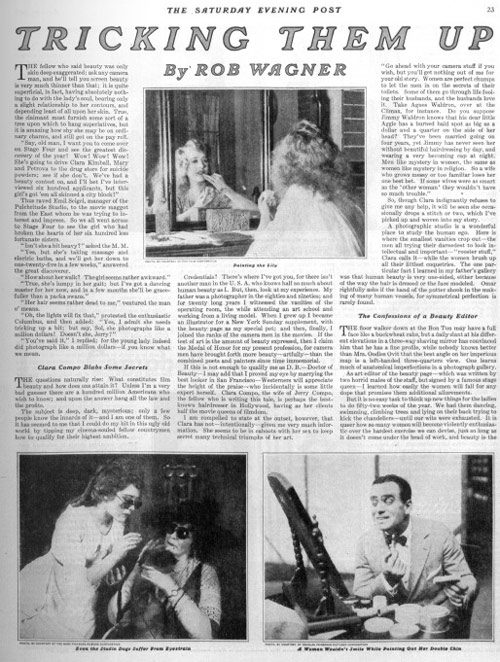
151-Year-Old Design for Sustainable Farming
A blueprint from American essayist Donald G. Mitchell (aka Ik Marvel) on starting your own small-scale farm:
—
What a Garden May Be
Originally published in The Country Gentleman, May 7, 1864.
Here let me outline, in brief, what a farmer’s garden may be made, without other than home labor. A broad walk shall run down the middle of either square enclosure, or long parallelogram. A box edging upon either side is of little cost, and contributes eminently to neatness; it will hold good for eight years, without too much encroachment, and at that time, will sell to the nursery men for more than enough to pay the cost of resetting. On either side of this walk, in a border of six feet wide, the farmer may plant his dwarf fruit, with grapes at intervals, to climb upon a homemade cedar trellis, that shall overarch and embower the walk.
At least one-half the garden, as I before suggested, he may easily arrange, to till — Spring and Autumn — with plough; and whatever he places there in the way of tree and shrub, must be in lines parallel with the walk. On the other half, he will be subjected to no such limitations; there, he will establish his perennials — his asparagus, his thyme, his sage, his parsley; his rhubarb, his gooseberries, strawberries, and raspberries; and in an angle — hidden if he choose by a belt of shrubbery — he may have his hot-bed and compost heap. Fork culture, which all these crops demand, will admit of any arrangement he may prefer, and he may enliven the groupings, and win the good wife’s favor, by here and there a little circlet of such old-fashioned flowers as tulips — yellow lilies and white, with roses of all shades.
Upon the other half he may make distribution of part, by banding the various crops with border lines of China or Refugee beans; and he may split the whole crosswise, by a walk overarched with climbing Limas, or the London Horticultural — setting off the two ends with an abutment of Scarlet runners, and a surbase of fiery Nasturtium.
There are also available and pretty devices for making the land do double duty. The borderlines of China beans, which will be ripened in early autumn, may have Swedes sown in their shadow in the first days of July, so that when the Chinas have fulfilled their mission, there shall be a new line of purple green in their places. The early radishes and salads may have their little circlet of cucumber pits, no way interfering with the first, and covering the ground when the first are done. The early Bassano beets will come away in time to leave space for the full flow of the melons that have been planted at intervals among them. The cauliflower will find grateful shade under the lines of sweet corn, and the newly-set winter cabbages, a temporary refuge from the sun, under shelter of the ripened peas. I do not make these suggestions at random, but as the results of actual and successful experience.

With such simple and orderly arrangement, involving no excessive labor, I think every farmer and country liver may take pleasure in his garden as an object of beauty; making of it a little farm in miniature, with its coppices of dwarf trees, its hedge rows of currants and gooseberries, and its meadows of strawberries and thyme. From the very day on which, in Spring, he sees the first, faint, upheaving, tufted lines of green from his Dan O’Rourkes, to the day when the dangling Limas, and sprawling bloody tomatoes are smitten by the frost, it offers a field of constant progress and of successive triumphs. Line by line, and company by company, the army of green things take possession; the little flowery banners are flung to the wind; and lo! presently every soldier of them all — plundered only the earth and sunshine — is loaded with booty.
What to Do When You Weigh 352 Pounds and Everything Else Has Failed
Stated bluntly, this is the core of the obesity problem—the high failure rate of nearly every conventional reducing scheme. Pounds come off for a while and then creep back on. In spite of the millions of dollars poured into low-calorie foods and drinks, artificial sweeteners, formula diets, pills, reducing spas and clubs, most of the really fat people have little permanent success in losing weight.
Those words were written 50 years ago this week in a Saturday Evening Post article by Steven M. Spencer that looked at last-ditch efforts by obese people to lose weight, but it could have just as easily been written today. Despite half a century of studies, novel diets, advances in surgery, and potentially lucrative drug options, more people are obese today than in 1968. Back then, the estimate was one in five adults were obese. Today it’s one in three.
Some things have changed. In the late ’60s, people were just realizing that using digitalis, amphetamines and thyroid pills to lose weight had terrible consequences. The Senate had just concluded hearings on the largely unregulated diet pill business, and restrictions were imminent.
Some of the up-and-coming methods weren’t much better. One doctor promoted a two-week starvation diet that consisted mostly of Sanka and diet soda.
Others, while not necessarily extreme, have since fallen out of favor. Dr. Kempner’s famed rice diet was “low-fat, low-protein and almost unbearably salt-free” — the opposite of the high-protein, low-carb paleo diets currently in vogue.
Another new option for rapid weight loss in 1968 was surgery. The operation, which involved bypassing most of the small intestine, had only been performed in a few, extreme cases. Doctors eventually realized that this particular surgery had many unpleasant consequences, including diarrhea, night blindness, osteoporosis, malnutrition, and kidney stones. More effective surgeries soon took its place.
Despite the apparent simplicity of the weight loss solution (calories in must be lower than calories out), doctors and researchers of the 1960s were realizing that humans are mysteriously, frustratingly complex. Spencer wrote, “Why does the obese person find it so hard to reduce? The reasons, of course, must be sought in the baffling perversities of human motivation, in the tangle of social, psychological, genetic and biochemical strands that drew him into the fat life in the first place.”
Fifty years later, many still try to untangle their motivations in the same places: gyms, structured meal plans, and doctors’ offices. Of course many aspects have moved online, from support groups to exercise videos to illegal diet pills. And some people now reject society’s obsession with the slender altogether and embrace fat acceptance.
But the fact remains that most people want to weigh less than they do now. A socialite once quipped, “You can never be too rich or too thin.” The person who invents the key to successful long-term weight loss will likely be both.