150-Year-Old Recipes from the Emerald Isle
Whether you’re looking for a new dish to serve on St. Patrick’s Day — or just in the mood for some hearty home cooking — here are three delicious Irish recipes from the 1800s.
—
An Irish Stew
Originally published in The Saturday Evening Post, April 8, 1865
Take off the under bone from the best end of a neck of mutton, and cut it into chops; season them with pepper and salt, some mushroom powder, and beaten mace. Put the meat into a stew pan, slice a large onion, and tie up a bunch of parsley and thyme, and add these and a pint of veal [or beef] broth to the meat.
Let this simmer until the chops are about three-parts done, then add some onions and whole potatoes peeled, and let all stew together until thoroughly cooked. Take out the parsley and thyme, and serve up in a deep dish.
Spiced Beef in the Irish Style
Originally published in The Saturday Evening Post, October 10, 1868
For Spice Rub
- 1 pint salt
- 1 ounce saltpeter
- 2 ounces pepper
- 2 ounces cloves
- 1 ounce allspice
- 4 ounces brown sugar
To a round weighing from 20 to 25 pounds, take [spice rub ingredients], all well pulverized, and mixed together; rub the round well with it, and lay it in a small tub or vessel by itself. Turn and rub it once a day for 10 days. It will not injure if it remain a week longer in the spices, if it should not be convenient to bake it.
When you wish to have it cooked, strew over the top of the round a small handful of suet. Be particular to bind it tight round with a cord, or narrow strip of muslin, which must be wrapped several times round to keep it in shape; put it in a dutch-oven, and add three pints of water when it is first put down; keep water boiling in the tea-kettle, and add a little as it seems necessary, observing not to add too much. It will require a slow heat, and take four hours to bake.
This is a very fine standing dish, and will be good for three weeks after cooking. Keep the gravy that is left over it to pour over it to keep it moist.
Irish Griddle or Slim Cakes
Originally published in The Saturday Evening Post, April 23, 1870
Rub 2 ounces of butter into half a pound of flour with a little salt, make it into a stiff paste with a little milk, roll it out half an inch thick, and cut it into squares and rounds, or any shape you like. It will take half an hour to bake; it should be baked on a griddle over a stove, or in the oven with the door open.
Scientific Notes: Irish Whisky
Originally published in The Saturday Evening Post, May 6, 1876
Irish, and especially Dublin whisky, when genuine, is prepared in old-fashioned stills called “pot” stills, by the distillation of a mash made partly from malted and partly from unmalted barley. The process of distillation is so managed as to bring over a product of the proper fineness, loaded with only so much essential oil as will undergo the desired changes within a reasonable time; and the new spirit is then stored in old sherry casks, from which it derives some additional flavor, and also its well-known yellowish tint — all distilled spirit being originally colorless — and it is kept in bond generally for about three years. By the end of that time, the fusel oil which it once contained has undergone conversion into other compounds, and the result — the real Dublin whisky — is a spirit singularly free from any tendency to produce acidity, and flavored in a manner highly esteemed by connoisseurs, by the products of the gradual and spontaneous decomposition of its fusel oil, which although in itself noxious, is ultimately replaced by essences of a harmless character. From whisky made and treated as described, the bulk of fusel oil generally disappears in about 12 months, although the spirit continues to undergo beneficial changes for a much longer period of time.
Curtis Stone’s Shrimp Tales
Steamed, grilled, sautéed, broiled, or baked — shrimp is the nation’s seafood of choice. The average American gobbles up more than 4 pounds of the succulent crustacean per year. Low in calories and high in protein, shrimp is both healthy and versatile, and a perfect companion to fresh spring produce.
When selecting fresh shrimp, look for bright, smooth shells and firm tails and avoid any that smell like ammonia — a telltale sign of spoilage. Fresh shrimp have a two-day shelf life, so cook as soon as possible. Most shrimp sold at markets were frozen, usually right on the boat, and shipped to retailers. Opt for shrimp that’s labeled “individually quick-frozen” (IQF); they don’t stick together and they defrost faster.
The beauty of shrimp is that they cook in minutes, turning pink with bright-red tails on the outside when done. Cooking shrimp in the shell helps prevent overcooking. And save the flavor-packed shells to create a beautiful stock for a risotto, paella, or pasta.
Guests will devour Shrimp Steamed in Paper with White Wine and Orange elegantly presented in shades of green, orange, and pink. New Orleans “Barbecued” Shrimp with Amber Ale is fun, quick, and delectable. Leaving shells on makes eating it a little messier, so keep a roll of paper towels and lemon wedges on the table when setting the stage for a true shrimp boil party.

Shrimp Steamed in Paper with White Wine and Orange
(Makes 4 servings)
- 8 ounces French green beans, ends trimmed
- 12 baby carrots, peeled, halved lengthwise
- 2 shallots, thinly sliced salt and freshly ground black pepper
- 24 extra-large shrimp, peeled, deveined
- 2 oranges, segmented
- 2 teaspoons finely chopped peeled fresh ginger
- 1/2 cup dry white wine
- 4 thyme sprigs
Preheat oven to 400°F and place 2 large heavy baking sheets in oven to preheat. Fold four 24×16-inch sheets of parchment paper in half so that they are 12×16 inches. Cut each rectangle into half-heart shape with center of heart being the fold. Open paper hearts and lay them flat on work surface. Lay green beans tightly together on right side of each paper heart. Lay carrots on green beans so they are perpendicular to green beans. Sprinkle shallots over and around vegetables; then sprinkle vegetables lightly with salt and pepper.
Season shrimp with pepper. Place shrimp on top of vegetables and lay orange segments over shrimp. Sprinkle ginger over, and then drizzle wine over, being careful to keep liquid next to vegetables and shrimp. Place sprig of thyme atop each.
Fold left panel of each heart over fillings to form half-heart shape. Starting from top of each parcel, make small, overlapping pleats to seal open sides and create half-moon shape. Be sure to completely close or crimp package so steam does not escape while cooking. Place four paper packages on preheated baking sheets and return baking sheets to oven. Bake for 14 minutes. (Paper will puff up while baking.)
Remove parcels from oven and let sit at room temperature for 3 minutes. Carefully cut or tear open paper parcels, being careful of steam; transfer parcels to serving plates and serve immediately.
Per serving
- Calories: 294
- Total Fat: 2 g
- Saturated Fat: 0
- Sodium: 228 mg
- Carbohydrate: 50 g
- Fiber: 17 g
- Protein: 17 g
- Diabetic Exchanges: 1 starch, 2 lean meat, ½ fruit, 3 vegetables
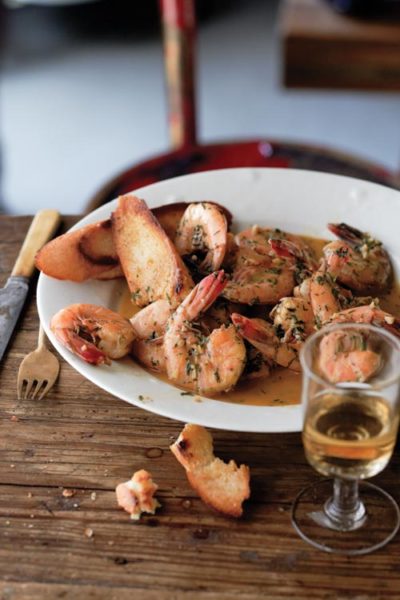
New Orleans “Barbecued” Shrimp with Amber Ale
(Makes 4 servings)
- 2 pounds (16 to 20 count) extra-large shrimp in the shell
- 1 tablespoon olive oil
- 5 tablespoons unsalted butter
- 8 garlic cloves, finely chopped
- 1/4 teaspoon cayenne pepper kosher salt and freshly ground black pepper
- 1/2 cup amber ale
- 2 tablespoons fresh lemon juice
- 1 tablespoon hot pepper sauce, such as crystal or Tabasco
- 1 tablespoon Worcestershire sauce
- 3 tablespoons finely chopped fresh flat-leaf parsley
- 1 teaspoon chopped fresh oregano
- 1 teaspoon chopped fresh thyme
- 1/2 teaspoon chopped fresh rosemary
- Sliced French bread, warmed or lightly toasted
Using small sharp knife or small sharp kitchen shears, cut down back of each shrimp just deep enough to expose dark vein. Devein shrimp under cold running water, leaving shells intact. Heat large heavy skillet over medium-high heat. Add olive oil, then add 2 tablespoons of butter and swirl to melt it. Add garlic, sprinkle with cayenne pepper, and season with 1 teaspoon salt and ½ teaspoon pepper. Cook for about 1 minute, or just until garlic is tender. Add shrimp and toss to coat well with butter mixture. Add ale, lemon juice, hot sauce, and Worcestershire sauce and simmer for about 2 minutes, or until shrimp are almost cooked through, turning shrimp after 1 minute. Add remaining 3 tablespoons butter, parsley, oregano, thyme, and rosemary and simmer gently for about 1 minute, or until butter melts and shrimp are just cooked through. Season to taste with salt and pepper.
Transfer the shrimp and sauce to four wide, shallow bowls. Serve with the bread to sop up the sauce.
Per serving
- Calories: 479
- Total Fat: 21 g
- Saturated Fat: 10 g
- Sodium: 400 mg
- Carbohydrate: 28 g
- Fiber: 1 g
- Protein: 35 g
- Diabetic Exchanges: 1 starch, 4 lean meats, 4 fat
Curtis shares two more shrimp recipes — Barbecued Shrimp with Olive Oil and Lemon Juice, and Stir-Fried Shrimp with Chilies, Bell Peppers, and Peanut — and tips on segmenting an orange at saturdayeveningpost.com/stoneshrimp.
Excerpted from What’s for Dinner? by Curtis Stone, Copyright © 2013 by Curtis Stone. Excerpted by permission of Ballantine Books, a division of Random House LLC. All rights reserved. No part of this excerpt may be reproduced or reprinted without permission in writing from the publisher.
This article appears in the March/April 2018 issue of The Saturday Evening Post. Subscribe to the magazine for more art, inspiring stories, fiction, humor, and features from our archives.
Post Travels: 5 Adventures in Cabo San Lucas
Though its spring break stories are legendary, there’s more to Cabo San Lucas, Mexico, than late nights filled with tequila. Long, sunshine-filled days are the norm on the southern tip of the Baja Peninsula, but how to best stay busy in these parts is a matter of opinion. For some it’s as simple as soaking up vitamin D while napping on the sand. For others, off-roading on mountain trails and beaches provides a sought-after adrenaline boost. Outdoor options are plentiful and typically come with postcard-worthy views that getaways were made for. Need more inspiration? There are plenty of ways to fills those vacation days.
1. Watch the Parade of Boats
If you’re an early riser, you’re in luck because you’ll experience the Cabo San Lucas most others miss. Grab a cup of caffeine and head straight to the marina for sunrise. Boat after boat charges past El Arco, Cabo’s famous arch, loaded with hopeful fisherman competing for the catch of the day. Take in the view and then take advantage of the quiet and stroll along Medano Beach, one of Cabo’s few swimmable stretches of sand. Even first thing in the morning, chances are good it’ll be warm enough to jump right in.

2. Test Your Sea Legs
As impressive as El Arco is from the beach, it knows how to take a close up. A sea lion colony blends into the scenery, but their boisterous barks give them away. Pack a picnic and explore Lovers Beach, go snorkeling near Pelican Rock, or simply enjoy the scenic ride. (Some boats even boast glass bottoms.) If you’re organized you can plan ahead and book a tour; if you like to do things on the fly, just hire a water taxi.

3. Have a Whale of a Time
They don’t stay for long, but when humpback whales come to town, it’s worth setting aside a few hours to try and catch a glimpse. Whale watching cruises run daily, typically December through mid-March, or when the whales decide it’s time to head north again. Small boats can maneuver a little quicker and easier, but larger boats come with amenities like bathrooms, food, and drink.
Dress in layers. It can be quite a bit cooler on the open sea, and it’s always better to be able to shed layers than wish you had them.

4. Ride Camels in Cabo
Giddy up! Well kind of. More than a dozen camels are giving horses a run for their money on the coast. Camel-back beach tours are run daily by Cabo Adventures. A handful of the camels are rescues. After a little education about the curious creatures, guests saddle up two to a camel and embark on a cruise along the sand. There’s little skill involved on the part of the rider; guides are plentiful and the camels know the way to beach. Every camel has a four-day work week, followed by two days off to roam dozens of seaside acres.

5. Spin Your Wheels in the Dirt
First the bandana gets tied across your nose and mouth. Next, a guide slides a helmet over your head. But it’s when the goggles go across your eyes and the straps get tightened that your heart may start to beat a little faster. Buckle up and hold on: you’re ready to go off-roading in Cabo San Lucas.
About a 40-minute drive northwest of town, Cabo Adventures runs daily tours in an area known as Elias Calles. With dusty trails, cacti, and the occasional cow, the landscape is everything you’d expect to find in the Mexican desert. But in this stretch of arid scenery, adventurous travelers get to hit the gas and roar their way through in a Polaris UTV (utility task vehicle) with seats for four. (Be sure to bring your driver license if you want to drive.) The dust gets in every crevasse. You’ll have dirt under your fingernails. And there’s a good chance you’ll get wet. But you’ll be smiling from ear to ear through every grimy minute.

Live Your Own Life: The Journey of Paralympic Athlete Saylor O’Brien
While watching the 2018 Olympic Games in PyeongChang on television, I wondered how the athletes got started and how they had the perseverance to train long and hard enough to compete for their country. In Park City, Utah, some of my questions were answered by a teenage competitor.
Some might imagine that a person with spina bifida might not be top at her sport, sailing downhill at high speeds and winning medals.
But they would be wrong.
I had the honor to ski with 14-year-old Saylor O’Brien, who is on the Paralympic Alpine Development Team. She is the youngest member of the team that trains at the National Ability Center. Saylor has been skiing since she was three years old. When she was ten, she told her mom she wanted to compete in the Olympics. She has shown stamina and persistence her entire life. In fact, she had her first surgery before she was born. Saylor has spina bifida, and her mother chose in utero fetal surgery to close a hole in Saylor’s back that left her spinal cord exposed. Spina bifida is a birth defect that occurs when the spine and spinal cord don’t form properly, affecting 1,500 to 2,000 babies born in U.S. each year.

More than 50 million Americans and over a billion people on our planet have some type of disability. The Paralympics opens up opportunities to many with physical disabilities. The Paralympic games began 80 years ago on July 28, 1948 with a single sport and 16 competitors. Starting thirty years ago in 1988 in Seoul, South Korea, the games of the Olympics and Paralympics were held in the same country one after the other. Saylor hopes to compete the 2022 Paralympic Games in Beijing, China.
In the O’Brien family, each of the six children is encouraged to find their passion and make their way forward. Saylor’s oldest brother, Jamaal, is a professional football player for the Green Bay Packers. Her sister, Storie, is a competitive swimmer, and another brother, Stockton, is an accomplished wrestler. Her two youngest brothers have not picked a sport yet, but it seems likely that they will live up to the high standards of their family.
Saylor is committed to do what it takes to improve, participate, and win in her chosen sport. She told me it is “hard to do speed events. You have to get used to going fast. I was probably going 50 miles per hour, but the highest speed is likely 80 miles per hour.” I asked, “How do you get psyched up for a race but remain grounded enough to do your best?” She replied, “Music really helps me. I listen to rock mainly. I like Panic at the Disco, but their older stuff.”
In order to win races, your body and your mind have to be focused: in control, but at the same time relaxed. Saylor told me, “You cannot think about 500 things because your body will not know what to do.” She talks with her coach and thinks about one thing. After the first race, her coach will check in with her, and ask, “How did you do?” Together they decide if she needs to change her focus on the one thing she is thinking about.

Saylor credits her success thus far to her supportive family, amazing teammates, and talented coaches at the National Ability Center. Her favorite thing is, after she has a frustrating result, one of her teammates calls Saylor and says, “Did you leave room for improvement?” Saylor believes there is always room for improvement.
Saylor has been working with the team at NAC for the last few years. She says, “The coaches are amazing, uplifting, and positive. When I am in the mountain center, I only see smiles. It is important for kids who are physically or mentally disabled to feel special, to feel valued, and to believe they can do anything. The volunteers and the coaches make a difference in someone’s life. Everyone feels like they belong there. Some of the kids feel not normal and I think it is okay to not be normal. It is better to not be normal. Everyone at NAC can do whatever they want to do.”

Saylor has participated in many NAC programs to learn what it will be like to be a Paralympic athlete, including an action camp where she went rafting in the Grand Canyon. She says, “It was a life changing experience to be on the water and even really cool to be offline for two weeks. I liked camping too. The best part was to interact with people and see so many people with all kinds of disabilities doing crazy awesome things.” She has tried everything from archery and biking to rock climbing and says the NAC programs have taught her how to be adaptable.
Saylor told me, “It’s your life. No one can tell you, you can’t. Don’t live someone else’s life. Live your own.” She goes to school two or three days a week and trains on the other days on the ski slope with her teammates. She is at the gym several times a week for strength and cardio training.
At her high school, nearly everyone has heard Saylor’s story. Students come up to Saylor and tell her she is so inspiring. She has won medals in Grand Slalom in 2016, Super G in 2017, and is on track to be on the top of the podium at the Paralympic Games in 2022 in China. But in many ways, she is like other teenagers: she has dyed part of her hair blue, she sends texts and puts photos on social media, and she loves her classes in history and science.
Saylor told me she thinks about how her skiing ability has evolved. When Saylor first began, she stood using four track skiing. The decision to be a racer meant that four years ago when she was ten, she had to begin again and learn to use a mono ski. One of her coaches is from Australia, and when he visited recently he told Saylor how much she had improved since one year ago. She explained that moments like that keep her going.

Saylor thinks to herself, “Where have I progressed? Let me compare this year to last year. Who can I ask for help that will give me a reality check on where I am today?” She knows she is stronger this season and advancing toward her chosen goals.
I cannot wait to watch Saylor win a medal in Beijing, China in 2022 at the Paralympic Games. I wonder what else she will have accomplished by then. What are you going to do to make your dreams come true?
New Math: When the Indiana Legislature (Almost) Changed Pi
Today is Pi Day, the day we recognize the wonder of 3.14. Since 200 B.C., we’ve known we can calculate the area of a circle by (1) squaring the distance from the circle’s center to its edge, then (2) multiplying this value by 3.14 — the value of pi.
This number is the ratio of every circle’s circumference to its diameter. An irrational number, pi contains an infinite number of numbers behind the decimal point. (You can find it calculated to the 100,000th digit here.)
Back in 1894, an amateur mathematician in Solitude, Indiana, thought there had to be a better way to measure a circle’s area. Edward Goodwin believed that, using a compass and a ruler, he could create a square with the same area as a circle. And a square’s area would be so much easier to measure.
There was one problem with his method. It didn’t work. In fact, 12 years earlier, a mathematician had proven, mathematically, that it was impossible to calculate the area of a circle this way.
One reason Goodwin’s method didn’t work is that it changed the value of pi from 3.141592 etc. to 3.2. (As he expressed it, “The ratio of the diameter and circumference is as five-fourths to four.”)
Enchanted by his own genius, Goodwin copyrighted his method. Now he could earn a royalty whenever businesses and schools used his new, improved system.
But he knew the state of Indiana couldn’t afford the royalties that introducing his system into Indiana’s schools would involve. So he offered the state a deal: If Indiana’s legislature would officially acknowledge the validity of his system, he’d waive the royalty fees.
Representative Taylor I. Record was Goodwin’s state representative, and he thought it a generous offer. So, in 1897, he introduced House Bill 246, which declared, “a circular area is to the square on a line equal to the quadrant of the circumference, as the area of an equilateral rectangle is to the square on one side.”
If that sounds confusing to you, you’re not alone. Many legislators didn’t understand it either. Nonetheless, they passed the bill in the state House on February 5, 1897. Unanimously. No one stood up and said, “Wait. I’m not supporting this until I understand it.”

The Indianapolis newspapers were wholly supportive of Goodwin’s theory, though it appears they didn’t understand it any better than the legislators did.
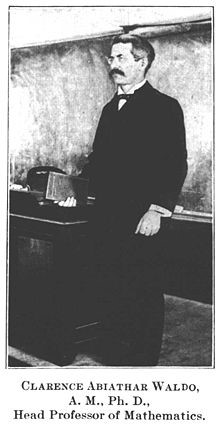
And so the bill moved on to the Senate. Fortunately, a math professor from Purdue University was coincidentally in the capitol building when the bill was being debated. Professor Clarence Abiathar Waldo was aghast to hear the state might make this erroneous theory part of school curriculum. He cornered some senators to ask about the bill. They offered to introduce him to the learned Goodwin. Waldo declined, saying that he’d already met as many crazy people as he cared to know.
He explained to the senators why Goodwin’s method was flawed. Armed with this knowledge, they took to the Senate floor to mock the bill and Goodwin’s theory. Finally, a senator moved to postpone the bill. It was never brought up again.
It was easy to make fun of the idea after Waldo had spoken up. Even the newspapers changed their tune. The Indianapolis Journal observed, “The Senate might as well try to legislate water to run up hill as to establish mathematical truth by law.
Featured image: Shutterstock
North Country Girl: Chapter 43 — Sweet Home, Minnesota
For more about Gay Haubner’s life in the North Country, read the other chapters in her serialized memoir.
There was something about me that triggered a Svengali-like impulse in my older lover James, who had swept me off my feet and into his Acapulco beachfront condo. James loved playing the worldly sophisticate and I was a young sponge, eager to soak up every detail of the kind of life that a year ago I had no idea even existed.
While I did learn to drop that water ski, I never picked up any of the disco dance steps James excelled at (“Do the Hustle!”). James did get me to give up the arm flailing for smooth lifts and shrugs of my shoulders, movements that were occasionally in time with the music. He taught me the complicated economics of tipping: who, when, and how much; we lived in bars, clubs, and restaurants where we never had to wait for a table and drinks appeared and were replaced as if by magic.
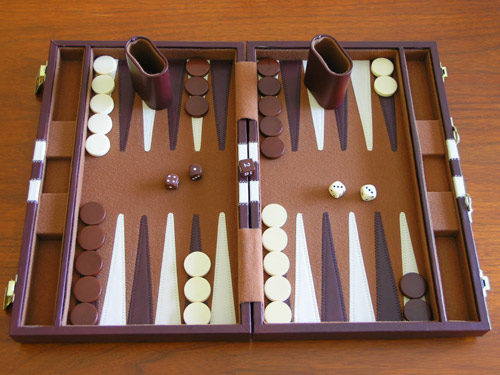
After one raised eyebrow from James I stopped ordering White Russians before dinner, and even after. James instructed me to slowly sip the Remy Martin he always finished with, and it was fun sticking my whole face in those enormous snifters. When we dined out, James asked me what I would like to eat and then ordered it for me while I smiled and blinked at the waiter like a deaf mute. James taught me how to do the New York Times crossword puzzle and to play backgammon, and I quickly became better at both of these than he was, though neither of us would admit it. I was always a penny ante gambler: if I lost five dollars at backgammon I felt a pang in my stomach; that five dollars could have bought an economy-size box of the frozen fish sticks I survived on a year ago.
James believed that it was gauche to wear anything less than 18 karat gold; his own heavy chain was 22 karat. One afternoon, he led me into a chic boutique across from his condo, where he ordered a custom-made piece of jewelry, not another chain for himself but a necklace for me. That year, all the girls in Acapulco wore gold pendants spelling out their names. James got off cheap buying only three letters, and in that time and place I could wear GAY around my neck without too many double takes and annoying comments.
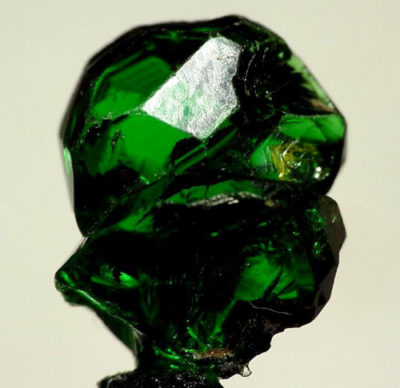
To my pleasure and amazement, I had a man buying me jewelry in an elegant store, even if I did end up with the least expensive piece possible. While James was consulting with the saleswoman on the right font and chain for my necklace, I was eyeballing the display of uncut emerald rings and hoping one of them might be in my future. A ring with even the smallest uncut emerald would still make me inordinately happy.
It was a wonderful dream I never wanted to wake up from, but my time in Mexico with James was coming to an end. May is the start of the rainy season in Acapulco, the end of the party season. The lease was up on the apartment and the rented jeep; James was headed back to Chicago. The French Canadian girls had vanished; I hope they all landed wealthy fiancés. The crowds had thinned out at Armando’s and Carlos’N Charlies. Even Fito was leaving, Jorge told me, for a gig in Mexico City.
I checked my bankroll of Pracna one dollar bills; it was almost the same size as it had been when I stepped off the plane. When I was with James, I never had to carry anything in my purse besides lipstick and a comb. I had more than enough to fly back to Minneapolis and keep me going till I figured out what was going to happen next.
James and I had our last dinner at Carlos‘N Charlie’s, our last dance at Armando’s, and did our “Wow, it’s been great” farewells. Then to my surprise, James asked for my phone number. My number? I had no idea of where I would be living; I could have given him my mother’s phone, but my gut said no. James scribbled his number on a piece of paper, told me to call him, and we kissed, a kiss that did not feel like goodbye.
I had no idea what I was going to do back in Minneapolis. I was counting on Pracna to hire me back; no one had been mad that I left with literally no notice, and with the return of summer I knew the place would be swamped with customers. But where could I live?
Even if she had kept our crappy apartment, I could not ask Liz to take me back; I had proved to be the most unreliable of roommates. Mindy and Patti shared a tiny studio that was barely big enough for the two of them. Eduardo had that big apartment, but it would have been weird to ask to stay there whether he was back with Patti or not. And for all I knew, Eduardo might have finally received his academic walking papers and be off at another, more lenient, college, or he could be back home in Miami, being force fed mondongo.
I got off the plane in Minneapolis, went to a pay phone, and stayed there pumping the same quarter in again and again until my old boyfriend Steve finally answered his phone. By a miracle, I had caught him on his last day in the Middlebrook dorm. He gave me the address of his new place and said he would meet me there.
Once again I stood outside a guy’s apartment with my pink Samsonite suitcases, waiting to move in uninvited. Unlike Jorge, Steve was happy to see me. Very happy, in fact. It had been almost a year since the last time we were together, an intense bout of sex in his dorm bed followed immediately by an epic fight when I found a pair of panties, not mine, in the sheets.
Now I was very thin (thanks to James), very tan, and very blonde. I tried to radiate a new sophistication, hoping that my recent Mexican adventures had made me more exotic and desirable than the nerdy brunette from Duluth Steve had met our freshman year. That girl was dead.
Steve looked exactly the same, small-town boy gone to the dark side, his smile still more of a sneer, costumed as the Caucasian Super Fly in a cheap white polyester suit. I couldn’t help but think that in that outfit, he would have been left standing in line all night outside Armando’s. But when we touched, that familiar and thrilling bolt of desire shot through me, making me catch my breath and hold him tighter. The two of us hustled up the stairs and into his new place.
It had taken years, but Steve had finally convinced Outward Bound to let move him out of the dorm and into an apartment of his own, an apartment they still paid the rent on. His new place was the top floor of recently built duplex not far from the university campus. A sign in front announced “Buttercup Complex Now Renting” or some such nonsense, but Steve’s building was the only one on the block: vacant lots surrounded the duplex on all sides, portioned out with stakes and string. The closest building was behind the duplex and across a field, a single story red brick creamery topped with a huge billboard featuring the Land O’Lakes Indian maid with her butter, her mysterious smile, and her plump knees sticking out of her buckskin garb.
Steve was upholding part of his deal with Outward Bound, puttering away nicely towards his degree in Accounting or Business or Pharmaceutical Sales. But he kept his eye on the prize and wanted to expand his drug dealing beyond his fellow dorm residents. He knew the quickest way to get busted and lose his scholarship would be to start buzzing in shady characters to his dorm room at all hours; drug dealing is the business that never sleeps. If he had his own apartment, he could expand his customer base and make even more money. Every few days he would drop into the dorm “to visit friends,” friends who in an emergency could come to him. He probably had a complete business plan, repurposed from some economics assignment, in place.
I can’t imagine that Steve’s benefactor from Outward Bound ever came to check up on him in his new digs, as there was always a wide sampling of drugs strewn across the coffee table, like a display case at a jewelry store. Most of his stash was tucked away in the freezer, while the cash was cleverly concealed in a Folgers coffee can on top of the bedroom TV. A steady stream of customers came by all day and pretty far into the night, as late as possible in a town where the bars shut at one. Sometimes they called first, sometimes they just showed up and banged on the door.
My original plan, concocted on the flight to Minneapolis, had been to hole up in Steve’s dorm for a few days till I found a place to live; but Steve welcomed me to stay as long as I liked in his apartment and his full-size bed, and I was happy to be there, happy to sit on his tiny back patio, smoking his pot with no one around except the Land O’Lakes maiden.
I did sneak in a quick phone call to James in Chicago. We talked about the weather and if I had signed up for summer classes yet. When conversation faltered I gave him Steve’s number to reach me without mentioning Steve himself.
I also phoned my mother to let her know I was alive. The only way to make a long-distance phone call in Acapulco was to go to the phone company, which was a shabby, un-air-conditioned edifice in the hot, steamy downtown. I did try to call my mom; I filled out the blurry form at the desk, and then stood in a long line waiting to enter a wooden phone booth, where I waited some more for the right number to be connected, which generally took two or three tries. I stood in that hot box, sweating and hoping someone would be at home to answer the damn phone. After my second fruitless attempt to reach my mother, the long-suffering look on James’ face as he sat smoking in the jeep discouraged me from trying again.
When I phoned her from Steve’s place, my mother was not as concerned about my going missing for six weeks as I thought she should be. She had a bigger problem. My sister Lani had appealed to have her custody switched to my father, and the minute that happened, dad gave Lani permission to marry her Colorado Springs boyfriend. The boyfriend was twenty-one, Lani was sixteen and about to be a June bride. Neither mom nor I were invited to the wedding. For some reason the fact that Lani had picked out a big virginal white wedding gown to get married in was what drove my mom over the edge. I knew she wasn’t listening to me, but I assured my mother I was fine, and hung up to the sound of her tearing out her hair.
As I had hoped, Pracna was happy to hire me back. They had opened the outdoor cocktail area overlooking the Mississippi River. People showed up at eleven in the morning to snag one of those tables, and every table outside and in was occupied till we closed the joint at one. I sweet-talked Steve into driving me to and from work, promising to introduce him to potential new customers, the hard-partying Pracna staff. I treated myself to a new pair of work shoes, lovingly tucked my growing bankroll into the empty shoebox, and slid the box way under Steve’s bed, till it rested back against the wall.
The deadline for enrolling in summer classes came and went. I was not ready to get back on the treadmill. I had always been an industrious ant; now I discovered that grasshoppers and blondes do have more fun. It was too pleasant waking up next to Steve, who was already rolling that morning’s first joint, and not having to go anywhere for hours. We were getting along better than we ever had before. Steve seemed mesmerized by the new me, and his outlaw life excited me enough to overlook his pimp-style wardrobe. Steve had grown up poor, his few articles of clothing were hand-me downs or from Goodwill, and children are cruel. He made up for that childhood deprivation now, with a closet full of candy colored wide brimmed hats, bell bottoms in every fabric except denim, shiny patterned shirts, and platform shoes of a tottering height that I would have plunged from, but that he managed to strut around in with aplomb.
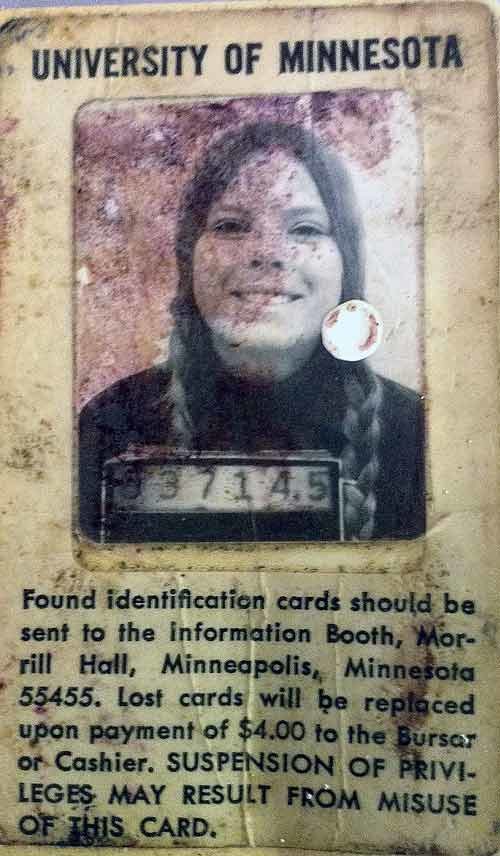
Our only disagreements came from the fact that Steve did not want to leave the apartment. For a guy whose entire life was bankrolled by an outdoors education organization, Steve was reluctant to go outside. There were no cell phones, no beepers, not even answering machines, and he did not want to miss a single prospective buyer. But it was glorious summer in Minnesota, when the air is a balmy blessing and the grass a soft carpet. I was drifting along, with no thought for the future, but well aware that there were only a handful of summer days to enjoy. I wanted to be outside, coaxing what warmth there was to be had from the Minnesota sun on my still tan skin.

I would pout and fuss until I got Steve to drive us and a blanket and a bottle of something to Lake Calhoun (now Lake Bde Maka Ska) where we would snog publicly and smoke pot and drink surreptitiously, although in those days no one cared as long as we didn’t make a mess or too much noise. Sometimes I would get him out of his platform shoes and into a his old pair of hiking boots and we’d walk the trail to Minnehaha Falls, a bit of wilderness in Minneapolis that we often had all to ourselves. I even talked Steve into driving to the Corn on the Curb Festival, held in Le Sueur, home of the Jolly Green Giant, on the exact day when the corn stalks were as high as an elephant’s eye and the emerald fields waved gently under a summer sky bleached almost white. Steve claimed to hate small Minnesotan towns. But he took me anyway, after swallowing a few pills, and as his reward he got to see me eat twenty ears of corn while he pounded bottle after bottle of Schell beer and sneered at the yokels.
Considering History: Fanny Fern, American Original and Women’s History Month Icon
This series by American studies professor Ben Railton explores the connections between America’s past and present.
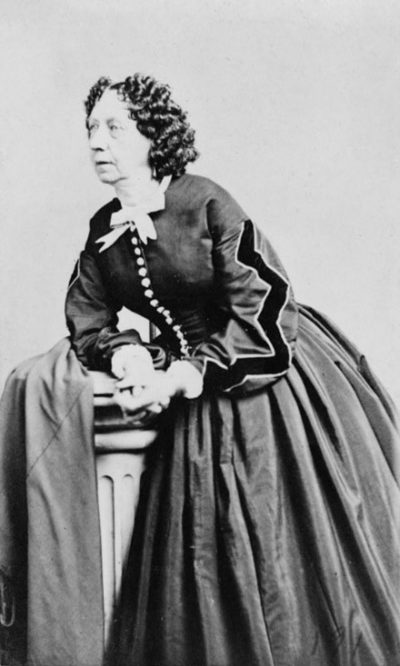
Writing witty and pointed daily newspaper columns under the pseudonym Fanny Fern (itself a parody of the pen name of one of the period’s most prominent sentimental writers, Grace Greenwood), Sarah Payson Willis (1811-1872) became the highest-paid newspaper writer in America. By 1854 she was receiving $100 for each column in the New York Ledger, and collected editions of her works such as Fern Leaves from Fanny’s Port-folio (1853) were runaway bestsellers. She would continue to publish acclaimed and popular journalism, along with novels and children’s stories, for the next two decades until her death from cancer in October 1872.
Fern’s career successes speak for themselves, and make her one of the 19th century’s most significant writers and a voice well worth remembering and reading in the 21st century. But there are a number of additional, inspiring layers to her career and life, aspects that go beyond the salary and sales and truly establish Sara Payson Willis as an icon of women’s writing and rights worth celebrating for Women’s History Month.
For one thing, Willis had overcome a number of personal challenges and tragedies in order to get to that 1850s moment of success. Her first marriage, to Boston banker Charles Harrington Eldredge, ended after nine years with his 1846 death, the last in a string of tragedies between 1844 and 1846 that included the death of their oldest daughter Mary and of Willis’s younger sister Ellen. Widowed with two surviving daughters, and receiving virtually no support from her family, Willis remarried Samuel Farrington, a Boston merchant who turned out to be a jealous and abusive husband. In 1851, after only two years of marriage, Willis and her daughters moved out, choosing to live in a hotel and endure numerous rumors spread by Farrington rather than put up with his abuse.

The lack of support from her family throughout this time extended beyond financial. Willis’s brother Nathaniel Parker Willis was a prominent literary figure and editor, and had begun his own successful publication, the Home Journal. Yet he refused to support or publish his sister’s writing, and when his young editor James Parton reprinted some of her columns, Willis forbade him to do so, forcing Parton to quit in protest. These and other incidents, along with the tragedies and struggles of her first two marriages, became central threads in Ruth Hall: A Domestic Tale of the Present Time (1854), the autobiographical novel through which Fern found a way to have her say in response to Nathaniel, her family, the Boston literary scene, and the vicissitudes of life.
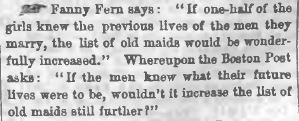
Fern also used her daily columns to highlight, satirize, and challenge the kinds of social norms and prejudices that limited and oppressed mid-19th century American women. “Hungry Husbands” (1857) uses a witty, sly examination of domestic gender roles to raise the specter of domestic abuse. “A Law More Nice Than Just” (1858) highlights the case of a woman arrested for wearing men’s clothes, with Fern performing her own experimental, illegal walk in men’s garments with the aid of her supportive third husband (none other than James Parton!). And “Male Criticism on Ladies’ Books” (1857) takes to task and turns on its head the stereotypes and dismissals with which the literary establishment all too often treated writers like Fern.
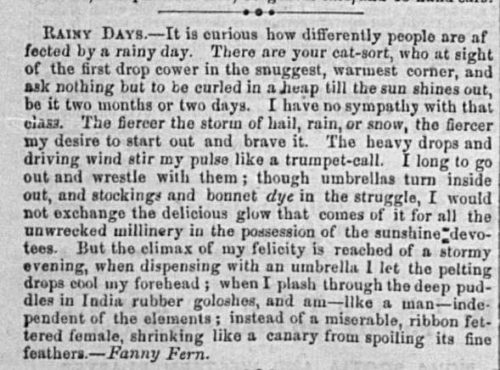
While such witty and sarcastic pieces were Fern’s stock-in-trade, she was also more than capable of producing thoughtful investigative journalism that examined other sides of women’s experiences and identities in her society. Exemplifying that genre was her multi-part 1858 series on Blackwell’s Island, the women’s prison (primarily for prostitutes, although that category often simply meant extremely poor, mentally unstable, or other marginalized women) located in New York Harbor. Already the nation’s highest-paid columnist at this time, Fern uses some of that literary capital to bring her audience with her out to Blackwell’s, and to take a long, imperfect but important look at the forgotten women housed in that fraught space.
Reading Fanny Fern today introduces us to a unique and original writer and voice, helps us understand some of the social and historical issues facing mid-19th century women, and offers an inspiring reminder of how our strongest figures have transcended such challenges to create powerful and enduring literary and cultural works. I can think of no better combination of effects with which to celebrate Women’s History Month.
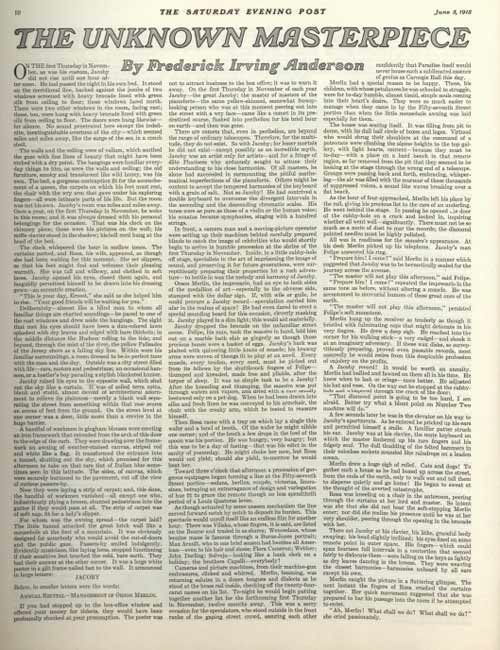
“The Unknown Masterpiece” by Frederick Irving Anderson
On the first Thursday in November, as was his custom, Jacoby did not rise until one hour after noon. He had passed the night in his own bed. It stood on the meridional line, backed against the jambs of two windows screened with heavy brocade lined with green silk from ceiling to floor; these windows faced north. There were two other windows in the room, facing east; these, too, were hung with heavy brocade lined with green silk from ceiling to floor. The doors were hung likewise — for silence. No sound penetrated here except the indefinite, inextinguishable overtone of the city — which seemed miles and miles away, like the surge of the sea in a conch shell.
The walls and the ceiling were of vellum, which soothed the gaze with fine lines of beauty that might have been etched with a dry point. The hangings were familiar everyday things to him, as were the walls and ceiling; the old furniture, smoky and translucent like wild honey, was his own. The bed, a gorgeous contraption fit for the accouchement of a queen, the carpets on which his feet must rest, the chair with the wry arm that gave under his exploring fingers — all were intimate parts of his life. But the room was not his own. Jacoby’s room was miles and miles away. Once a year, on the first Thursday in November, he woke in this room; and it was always dressed with his personal belongings for the occasion. That was his clock on the chimney piece; those were his pictures on the wall; his mute clavier stood in the shadow; his bell cord hung at the head of the bed.
The clock whispered the hour in mellow tones. The curtains parted, and Rosa, his wife, appeared, as though she had been waiting for this moment. She set slippers, so that his feet might find and welcome their pleasing warmth. She was tall and willowy, and clothed in soft laces. Jacoby opened his eyes, closed them again, and languidly permitted himself to be drawn into his dressing gown — an eccentric creation.
“This is your day, Ernest,” she said as she helped him to rise. “Your good friends will be waiting for you.”
Deliberately — almost like a blind man to whom all familiar things are charted soundings — he paced to one of the east windows and drew aside the hangings. The sight that met his eyes should have been a dun-colored lawn splashed with dry leaves and edged with bare thickets; in the middle distance the Hudson rolling to the tide; and beyond, through the mist of the river, the yellow Palisades of the Jersey shore as a falling sky line. Within were his familiar surroundings, a room dressed to be in perfect tune with the man and the day. Outside was a city street filled with life — cars, motors and pedestrians; an occasional hansom, or a hostler’s boy parading a stylish blanketed hunter.
Jacoby raised his eyes to the opposite wall, which shut out the sky like a curtain. It was of soiled terra cotta, blank and stolid, almost devoid of architectural adornment to relieve its plainness — merely a blank wall separating the street from something within that rose scores on scores of feet from the ground. On the street level at one corner was a door, little more than a crevice in the huge barrier.
A handful of workmen in gingham blouses were erecting an iron framework that extended from the arch of this door to the edge of the curb. They were drawing over the framework an awning of weather-stained canvas, striped red and white like a flag. It transformed the entrance into a tunnel, shutting out the sky, which promised for this afternoon to take on that rare tint of Italian blue sometimes seen in this latitude. The sides, of canvas, which were securely buttoned to the pavement, cut off the view of curious passers-by.
Now they were laying a strip of carpet; and, this done, the handful of workmen vanished — all except one who, industriously plying a broom, shunted pedestrians into the gutter if they would pass at all. The strip of carpet was of soft nap, fit for a lady’s slipper.
For whom was the awning spread — the carpet laid? The little tunnel attacked the great brick wall like a mousehole at the foot of a mountain. It was obviously designed for somebody who would avoid the out-of-doors and the public gaze. Passers-by smiled indulgently. Evidently musicians, like laying hens, stopped functioning if their sensitive feet touched the cold, bare earth. They had their answer at the other corner. It was a large white poster in a gilt frame nailed fast to the wall. It announced in large letters:
JACOBY
Below, in smaller letters were the words:
ANNUAL RECITAL — MANAGEMENT OF ORSON MERLIN.
If you had stepped up to the box-office window and offered your money for tickets, they would have been profoundly shocked at your presumption. The poster was not to attract business to the box office; it was to warn it away. On the first Thursday in November of each year Jacoby — the great Jacoby; the master of masters of the pianoforte — the same yellow-skinned, somewhat frowsy looking person who was at this moment peering out into the street with a wry face — came like a comet in its predestined course, flashed into perihelion for his brief hour on earth — and then was gone.
There are comets that, even in perihelion, are beyond the range of ordinary telescopes. Therefore, for the multitude, they do not exist. So with Jacoby; for lesser mortals he did not exist — except possibly as an incredible myth. Jacoby was an artist only for artists — and for a fringe of elite Pharisees who arduously sought to attune their understanding to his close harmonies. Of all masters, he alone had succeeded in surmounting the pitiful mathematical imperfections of the pianoforte. Others might be content to accept the tempered harmonies of the keyboard with a grain of salt. Not so Jacoby! He had contrived a double keyboard to overcome the divergent intervals in the ascending and the descending chromatic scales. His tones were as pure as those of a violin or the human voice; his sonatas became symphonies, singing with a hundred strings.
In front, a camera man and a moving-picture operator were setting up their machines behind carefully prepared blinds to catch the image of celebrities who would shortly begin to arrive in humble procession at the shrine of the first Thursday in November. Inside, in a little cubby-hole off stage, specialists in the art of imprisoning the image of sound, and preserving it for future generations, were surreptitiously preparing their properties for a rash adventure — to bottle in wax the melody and harmony of Jacoby.
Orson Merlin, the impresario, had an eye to both sides of the medallion of art — especially to the obverse side, stamped with the dollar sign. If, with wile or guile, he could procure a Jacoby record — speculation carried him afar in the realms of space! He had even dared to erect a special sounding board for this occasion, cleverly masking it. Jacoby played in a dim light; this would aid materially.
Jacoby dropped the brocade on the unfamiliar street scene. Felipe, his man, took the maestro in hand, laid him out on a marble bath slab as gingerly as though those precious bones were a basket of eggs. Jacoby’s back was plaited with quivering little knots of muscle; his brawny arms were woven of thongs fit to play at an anvil. Every muscle, every tendon, every cord, must be picked out from its fellows by the shuttlecock fingers of Felipe — thumped and kneaded, made free and pliable, after the torpor of sleep. It was no simple task to be a Jacoby! After the kneading and thumping, the maestro was put through waters and vapors, and dried with a care usually bestowed only on a pet dog. When he had been drawn into silks and fresh linen he was conveyed to his armchair, the chair with the creaky arm, which he tested to reassure himself.
Then Rosa came with a tray on which lay a single thin wafer and a bowl of broth. Of the wafer he might nibble one corner; and of the broth a few drops in the heel of the spoon was his portion. He was hungry, very hungry; but this was to be a day of fasting — that was his edict in the sanity of yesterday. He might choke her now, but Rosa would not yield; should she yield, tomorrow he would beat her.
Toward three o’clock that afternoon a procession of gorgeous equipages began forming a line at the Fifty-seventh Street portico — sedans, berlins, coupes, victorias, limousines, betraying an extravagance of design and variegation of hue fit to grace the remote though no less spendthrift period of a Louis Quatorze levee.
As though actuated by some unseen mechanism the line moved forward notch by notch to deposit its burden. This spectacle would unroll itself like an endless film for another hour. There was Viliska, whose fingers, it is said, are listed on the Bourse and traded in as shares; Wenceslaus, whose leonine mane is famous through a Burne-Jones portrait; Max Arnult, who in one brief season had become all American — even to his hair and shoes; Flora Cameron; Webber; John Darling; Solveja — looking like a bank clerk on a holiday; the brothers Capelli — everybody!
Cameras and picture machines, from their machine-gun embrasures, clicked and whirred. Merlin, beaming, was returning salutes in a dozen tongues and dialects as he stood at the brass rail inside, checking off the twenty-four carat names on his list. Tonight he would begin putting together another list for the forthcoming first Thursday in November, twelve months away. This was a sorry occasion for the speculators, who stood outside in the front ranks of the gaping street crowd, assuring each other confidently that Paradise itself would never house such a sublimated essence of genius as Carnegie Hall this day.
Merlin had a special reason to be happy. These, his children, with whose petulances he was schooled to struggle, were for today humble, almost timid, simple souls coming into their heart’s desire. They were so much easier to manage when they came in by the Fifty-seventh Street portico than when the little mousehole awning was laid especially for them.
The house was seating itself. It was filling from pit to dome, with its dull half circle of boxes and loges. Virtuosi who would shrug their shoulders at the command of a potentate were climbing the alpine heights to the top gallery, with light hearts, content — because they must be today — with a place on a hard bench in that remote region, so far removed from the pit that they seemed to be looking at the stage through the wrong end of a telescope. Groups were passing back and forth, embracing, whispering — the air was filled with the murmur of these thousands of suppressed voices, a sound like waves breaking over a flat beach.
As the hour of four approached, Merlin left his place by the rail, giving his precious list to the care of an underling. He went behind the stage. In passing he opened the door of the cubby-hole on a crack and looked in, inquiring whether all went well — significantly. There must not be so much as a mote of dust to mar the records; the diamond pointed needles must be highly polished.
All was in readiness for the maestro’s appearance. At his desk Merlin picked up his telephone. Jacoby’s man Felipe answered his ring.
“Prepare him! I come!” said Merlin in a manner which suggested that Jacoby was to be hermetically sealed for the journey across the avenue.
“The master will not play this afternoon,” said Felipe.
“Prepare him! I come!” repeated the impresario in the same tone as before, without altering a muscle. He was accustomed to mercurial humors of these great ones of the earth.
“The master will not play this afternoon,” persisted Felipe’s soft monotone.
Merlin hung up the receiver as tenderly as though it bristled with fulminating caps that might detonate in his very fingers. He drew a deep sigh. He reached into the corner for his walking stick — a very cudgel — and shook it at an imaginary adversary. If these wax disks, so surreptitiously preparing, proved even passable records, most assuredly he would retire from this despicable profession of cajolery on the profits.
A Jacoby record! It would be worth an annuity. Merlin had bullied and fawned on them all in his time. He knew when to lash or cringe — none better. He adjusted his hat and rose. On the way out he stopped at the cubbyhole and whispered through the crack of the door:
“That diamond point is going to be too hard, I am afraid. Better try what a blunt point on Number Two machine will do.”
A few seconds later he was in the elevator on his way to Jacoby’s apartments. As he entered he pricked up his ears and permitted himself a smile. A familiar patter struck his ear. Jacoby was at his clavier, the mute keyboard on which the master limbered up his rare fingers and his fidgety soul. The dull thudding of the felted hammers in their voiceless sockets sounded like raindrops on a leaden ocean.
Merlin drew a huge sigh of relief. Cats and dogs! To gather such a house as he had boxed up across the street, from the ends of the earth, only to walk out and tell them to disperse quietly and go home! He began to sweat at the thought of the averted catastrophe.
Rosa was kneeling on a chair in the anteroom, peering through the curtains at her lord and master. So intent was she that she did not hear the soft-stepping Merlin enter; nor did she realize his presence until he was at her very shoulder, peering through the opening in the brocade with her.
There sat Jacoby at his clavier, his lithe, graceful body swaying; his head slightly inclined; his eyes fixed on some remote point in outer space. His fingers — which could span fourteen full intervals in a contortion that seemed fairly to dislocate them — were falling on the keys as lightly as dry leaves dancing in the breeze. They were weaving the closest harmonies — harmonies unheard by all ears except his own.
Merlin caught the picture in a fluttering glimpse. The next instant the fingers of Rosa crushed the curtains together. Her quick movement suggested that she was prepared to bar his passage into the room if he attempted to enter.
“Ah, Merlin! What shall we do? What shall we do?” she cried passionately.
Merlin’s look said as plainly as words that she was talking one of the very few languages extant with which he was not familiar. Evidently it was Rosa and not the master himself who was struggling with an attack of nerves. He smiled reassuringly and said soothingly:
“It’s all right, child — it’s all right. They are waiting for him. Never — never has there been such a house before! They are waiting for him. Come!”
He reached out to part the curtains and enter; but she thrust him fiercely back. He stared at her in astonishment.
“Hush! He is asleep!” she said. “Sound asleep!”
“Asleep?” repeated Merlin incredulously. “Asleep! Bah! What folly is this, Rosa?” He pushed her roughly aside and strode in through the hangings. He came to a halt at the clavier. “Ernest!” he cried sharply.
Jacoby gave no sign. The head inclined lower; he was smiling, as though enthralled with the ghostly harmonies his flying fingers were fabricating. His dull eyes were still staring into the same uncertain distance. Merlin bent over the clavier, brought his face directly into the line of sight of the performer — but the eyes did not see him. On this day of days, the first Thursday in November, the soul of the master was a million miles away.
The impresario, aghast at the situation, fell back slowly, his eyes glued to the figure at the instrument.
“But he plays — he plays!” he said, unbelieving; and then sharply, and with a note of irritation in his voice: “Ernest! Ernest!” he cried. But the automaton at the keys gave no heed. His phantom music held the dreamer fast. For a moment Merlin was overpowered by the strangeness of the situation. “But he plays — he plays!” he insisted; and then, turning on the woman, who had now fallen limply into a chair, his eyes gleaming, he demanded: “What does he play? What does he play, Rosa? Tell me that!”
“It is — it is the sonata,” she whispered.
Now the great Merlin fairly rose on his toes, his eyes blazing.
“The sonata! The sonata?” he repeated.
And, without a second glance at the limp figure of poor Rosa, he went back to the clavier. There was a tradition about this sonata — the sonata of Jacoby. This was its only title — the sonata. That described better than anything else the awe and reverence in which this master of masters was held by his following. No one had ever heard it. It existed only in Jacoby’s brain — the brain in his head and the brain in his fingertips. No one who ever saw him play would deny that his fingers were capable of cerebration. And now the sonata was being played before the very eyes of Merlin! But not before his ears. Merlin was clever at the keys. Now he was studying those flying fingers like a hawk. Cats and dogs! What sprite of the devil had contrived this outlandish keyboard, with its pure intervals! Even to the trained eyes of the impresario, these interpretative fingers spoke only in cryptograms. Merlin could decipher the tempo — even something of the phrasing.
“How long will this go on?” asked Merlin, finally going back to Rosa. He shook her roughly, made her sit erect and listen to him. “They are waiting for him. It is rank idiocy! How long will it go on?”
“For hours and hours — till finally he is exhausted.”
“Felipe! Go to my office. Tell my secretary to bring Doctor Vossberg. Take care! No word of this — remember!”
Thus dispatching the valet, Merlin went back to the clavier. He rested his elbows on the case, as his hawklike eyes resumed their study of the fingers.
Doctor Vossberg might have been a virtuoso had he not chosen medicine instead. Now, in his advanced years, he consorted with the people who lived the profession he had denied himself. He was sitting silent in his box when they found him; and, with practiced dissimulation — lest the impatient house catch the infection of alarm — he rose after a few seconds and followed them out. When he entered the anteroom Merlin acquainted him with the circumstances; they whispered together for some time; later they took Rosa aside. Steadied by the presence of the old physician she grew more coherent.
“It is not sleep,” she cried, much moved. “It is — as though he were translated — by this strange music. It carries him far from us — he is no longer here.”
“No,” said the old doctor, studying the performer narrowly; “it is not sleep. It is an amazing form of psychosis.”
“He will tear his soul to rags if this goes on,” began Merlin. “If we could get him over there — to his own piano — the sound of the strings might cause him to come back quite naturally, without shock.”
Strive as he would, Merlin could not mask the excitement and eagerness in his tones; the others, however, were too absorbed to note this. As they talked together in hushed voices at his very elbow, the unconscious pianist, with unseeing eyes, continued to pursue his theme.
“Rosa, think!” commanded the physician. “Let us seek some impulse stronger than all else. It may be the key to unlock his senses. A great grief — a great happiness! Is there not some all-powerful emotion in his life that you can call back by some simple act?”
Rosa suddenly sat erect, her eyes bedewed with happy tears. She drew them to her and whispered.
It was an intimate confidence.
“Do you remember, at his first Thursday, years and years ago, I had to come to lead him off — he was so overcome with the ovation? He has never forgotten the scent of the violets I wore. Could that not rouse him now?”
It was a desperate expedient, fantastic at the best. The doctor nodded eagerly. There is nothing more powerfully hypnotic than a perfume to awaken recollection. The invasion of the physical sense reacts on the mental; the association of ideas is immediate.
“Violets!” commanded the doctor; but Merlin was already at the door. When Felipe returned with a great bunch of the purple flowers the doctor ruthlessly crushed them in his hand until the air was heavy with the scent. He thrust them into the lace of the woman’s dress.
The dreamer at the clavier was now beating the keys with arms that swung like flails. Suddenly his hands fell to his side. He sat back, staring at the wall, his lips moving as though he were counting. It was the pause between movements of the ghostly sonata.
“Quick, Rosa! Now! Before he begins again!” cried Vossberg. “Put your arms about him; speak to him — as though he were awake — gently. Take his hand as you did on that first Thursday long ago.”
And Rosa, her lips quivering, tears coursing down her cheeks, gently took him in her arms.
“How your friends love you, Ernest! We will go now! Come!” she whispered softly, as she put his head to her breast.
A slight shiver ran through the frame of the musician. She took his hand and he rose, with the simple obedience of a child. The old physician was now at his other hand. And Jacoby, yielding to the tender urging of familiar hands, started forward.
The auditorium was booming like a hive of angry bees when Merlin walked out on the stage. At his appearance the hum of impatient voices ceased and he was greeted with applause. He raised a hand for silence; then he said haltingly as he sought to control his breath:
“Good friends, we must crave your utmost indulgence. Let me ask of you one great favor: When the maestro comes out let there be no demonstration. As you love him, be silent — be as silent as death itself. It is imperative. Let there be no sound, I beg of you!”
A murmur of surprise followed the strange words of the impresario. To the true virtuoso the tone of his house is almost as vital as the tone of his instrument. And they were asked, in all earnestness, to sit mute before their master!
The clusters of lights illuminating the vast auditorium disappeared one by one until there remained only the tiny red bulbs at the emergency exits to spot the darkness. The murmur faded into absolute silence. The pendent chandelier on the stage, its scores of glowing bulbs screened with yellow silk, was dimmed to twilight; so that even the great piano itself loomed misty and indistinct.
The house took to watching the small door on the left through which the great man must enter. Shortly the door opened; and against the light from within appeared the silhouetted figures of Jacoby and Rosa his wife. The musician was leaning heavily on her arm and she was helping him up the short flight of steps to the stage. He walked like a blind man. As the little door closed behind them the hush of the house became tense. Now — if ever — these three thousand throats should acclaim him; but they kept their faith with Merlin and sat rigid.
The two people advancing on the stage seemed like pygmy creatures lost in the vast defiles of some enchanted island, so oddly did the dim lights dwarf them in the broad setting. They moved slowly, the maestro once or twice putting out a hand, as though to pierce the darkness.
Finally, they reached the piano; his wife seated him on the bench and laid his hand on the keys. Then she did a very odd thing — she turned to the great house and laid a warning finger on her lips; then stole away.
The house settled itself. This was the first Thursday in November! Jacoby sat motionless. His eyes were fixed on some indefinite spot in the shadows. He sat thus for a full minute — an eternity to the house, which began shifting uneasily; and, most of all, an eternity to the three who watched him off stage. Jacoby had permitted himself to be brought across the street like one under a spell — physically obedient but, to all appearances, with his mind still in the abyss.
“We have lost!” murmured Rosa despairingly. Merlin tore his eyes loose from the odd figure on the stage, as though to make sure that he himself was not dreaming. Cats and dogs! Had they succeeded in rousing the dreamer, only to lose him again in full view of this staring throng? They were not here to exhibit a somnambulist. An idea arrested him.
“Georges!” he cried and his secretary — faithful shadow — was at his elbow. “In my office, on the safe, is Richard Spurling’s violin. Bring it to me!” And when it was brought he said: “Open it! What! What! Locked! Smash the lock — so! Now — Georges! Severine is out in front — the aisle seat, fourth row, left center. Bring him to me.”
In a trice little Severine, the violinist, had been dragged from his seat and taken behind the stage.
“He is asleep — in a trance?” said the little man as he came in.
Merlin, at the table, was scribbling on a scrap of paper. Over his shoulder he growled:
“Yes — asleep! And you are to waken him. Play this!”
Merlin thrust the violin into Severine’s hands and held up the sheet of paper, on which were half a dozen bars of a strange melody.
“Here is the tempo — so!” Merlin was saying as, with his hand, he swung an imaginary baton. “Do you get it? Now play!”
“But —” began the puzzled violinist.
“But nothing! Play, you fool! So — take it slowly to the rise — the merest hum — so! Now begin!”
He opened the door to the stage a little wider and motioned for the lights to be extinguished behind him so that he might not make himself conspicuous to the audience. This audience, if he knew it, was dangerously near the exploding point.
“Once more — a little louder — more free — so! Gad! Vossberg, look!”
Jacoby was bending forward, searching the uncertain depths of the stage as though seeking to surprise the echo of some familiar cadence. The violin sang though its half dozen bars as softly as a breath of air. Jacoby was smiling now. He began to caress the keys with his fingers — to explore them.
Then suddenly the air began to vibrate. So gently did the felted hammers fall on the tense strings of his instrument that, for a moment, the sustained tone seemed to come less from the piano itself than from the very atmosphere. The air became saturated with throbbing sound — hung heavy under it, as under the stress of distant thunder on a summer day. The tone became more firm; it divided itself into inarticulate phrases. Through it there came a voice, calling. It was trying to speak, to sing — the voice grew, faltered, was gone — came again; until finally it found itself, burst crystal clear on the ears, singing the song that the violin in the trembling fingers of Severine had been whispering.
No sooner did the theme burst forth than it seemed to be taken up by scores of voices near and far — calling, answering each other, laughing, echoing; twisting and turning the thin little motif into myriad fantastic shapes. The musician at the keys began to sway from side to side with the rhythm — for there was rhythm, in spite of the inextricable tangle of counterpoint.
The song of the multitude grew faster and faster; the volume of tone rose measure by measure, until it became a mighty, sustained diapason which swept the whole instrument. And then, like a rocket curving through its zenith, the thing burst into a shower of glittering sparks, which glowed for a moment and died away.
The silence was so abrupt that it left the house fairly gasping for breath. Little Severine was listening, almost terrified; it was beyond his power to conceive what the master had done with that ragged little theme he had scraped off on the strings. Rosa was silent, her head buried in her arms.
Merlin threw open the door and was on the stage in one bound. He sprang forward on tiptoe, waving his arms wildly in the air, his face going through the most grotesque contortions. There was no sound from his lips; but with all his might he was impressing silence — silence! — silence! — before the storm should break. The performer at the keys had let his hands fall; his head moved and he seemed to be counting.
The youthful violinist stole away and found his place again, out in front.
“He is in a dream!” he whispered to his neighbor; and, like a spark in tinder, the whisper flashed across the house from row to row, from tier to tier — to the very topmost gallery.
The master was playing in a dream! Hush! Not a sound! What does he play? They looked at each other timidly. What does he play? Could there be any question? What should Jacoby — their great Jacoby — play when he dreamed? The sonata — the sonata!
Jacoby raised his hands again. The fingers fell on the keys. The allegro movement began. It was like the opening of a flower, its lifetime of color and fragrance compressed into a few precious moments.
“Cats and dogs! They are under the spell — every mother’s son of them!” muttered Merlin to himself.
He was staring out at the house. The impresario was not insensible to the wizardry of sound the master was weaving on his amazing instrument, with its pure intervals; but, like the sailors of Ulysses, he was stopping his ears to it lest he fall under its magic and forget the business at hand.
With a conscious effort he tore himself loose; he tiptoed cautiously to the rear door, making a passing appraisal of Rosa, who was watching the maestro in awed reverence. Merlin slid down the corridor to the little cubby-hole, opened the door and thrust in his head.
“How goes it?” he cried in a half whisper.
The two mechanicians did not take their eyes from the revolving disks which were imprisoning the exquisite vagaries of the unconscious musician. They nodded their heads impatiently, waving their hands in mute answer; they were blowing industriously on their needles, so that not so much as a fleck of dust, not a mote, should mar the project of stealing the tangible image of the unknown sonata.
It might very well have been that those three thousand listeners were asleep. When the allegro ended there was just the suggestion of a drawn breath of relief among them; and in another moment the deep, sonorous chords of an andante, introducing a variant theme, began to pervade their senses. Merlin did not know which fascinated him more — the dreaming performer or the house struggling under the spell he cast. It was well, thought he, that he had provided for this windfall. Never again would such music be heard from human hands.
The new theme, translating itself from key to key with uncanny modulations, sounded the depths of pain as the tempo slackened to the largo, like a chant through an echoing cathedral. Then, silence. Blank silence! And the scherzo broke like the rays of warm sunlight through the clouds.
Faster and faster the fingers flew, weaving together the two themes that had gone before. A moment ago and the house seemed dissociated from its body; now the physical predominated. The deathly stillness was gone. It was as though a magician with mere facile fingers had steeped their senses in every phase of emotion — love, beauty, sorrow — leading them down into the depths step by step until it became numb pain to listen.
Then, with a wave of the wand — the wand of the sprightly, capricious scherzo — Jacoby was saying:
“See! It is all a trick — I do it with my fingers; I do it with my piano — my wonderful piano, with its two sets of black keys! Pain and sorrow, love and beauty — they reside in my fingertips, not in my soul! There is nothing not subject to motion and number. Mind is mathematics — tone is merely the sums and divisions on a child’s slate! It is I — I — I — Jacoby! Not Jacoby’s heart, but his fingers, his piano!”
Merlin was conscious of a strange pricking sensation in the back of his neck. An electric thrill was in the air. The thing outside ended in a wild, shrieking crash. Then silence.
Then the storm broke. The vast auditorium became a hollow cone, within the imprisoning sides of which bedlam broke loose. Every man of the three thousand was on his feet now — waving his hands, tearing his hair, stamping his feet, clapping, shouting — anything to make noise; noise that battered itself back and forth between the walls, which seemed to shake the very rafters of the edifice.
Cries of Bravo! Bravo! and Jacoby! Jacoby! rent the air. They were crowding into the aisles, surging in struggling lines toward the stage. They banked themselves just beyond the rail, the din becoming louder and louder as they gave way more and more to their exultation.
“Fools! What becomes of the finale? Cats and dogs! Why couldn’t they be still to the end!” Merlin was snarling as he rushed to the front.
He started out on the stage again, imploring them to be still — to return to their chairs. He signaled frantically. The crowd neither saw nor heard him. Another thing had checked them. The tumult of acclaim ceased as suddenly as though choked by some gigantic hand. Jacoby had raised his head and was looking about him in a dazed way. His querulous voice broke the taut silence.
“Rosa! Rosa!” he was calling. Rosa was by his side in an instant, her hand on his “What is it? Who are all these people?” And he indicated with a wave of his hand the bank of upstaring faces.
Merlin was equal to the occasion. He sprang forward.
“This is your day, Ernest! Have you forgotten? These are all your good friends — who love you. This is the first Thursday in November.”
Merlin waved the house back to their chairs. Jacoby rose. He gently pushed his wife aside.
“Am I a child, that you must lead me? Begone!”
He bowed stiffly to the house; then he began to play. It was a rhapsody of insurmountable technical difficulties — the first number on his program for the afternoon. He blazed through it like a skyrocket. It was six o’clock when the house emptied itself into the street. He had played through his set program, denying, as was his custom, all encores.
Merlin some time later took his priceless master record from its fireproof vault and presented himself in Jacoby’s drawing room. Rosa was frightened at his advent, for he had confessed to her the existence of this record and that it awaited only the master’s signature and approval to be given to the world.
Everything was arranged with the utmost care. The machine was started when Jacoby was in conversation with Doctor Vossberg and Severine, the violinist. The maestro looked up quickly.
“Who plays Jacoby’s piano?” he demanded in the middle of that wonderful introduction.
Merlin came forward.
“Who should play your piano — who but Jacoby?” said he, eying the musician sharply.
The master listened through to the end of the third movement of the unfinished masterpiece. He clapped his hands in ecstasy and cried:
“Again! Again! Once more, Merlin! ‘Tis wonderful!”
Merlin chuckled and went back to the beginning. The musician sat spellbound.
“Who plays?” he asked when it was finished.
“Who but Jacoby?” answered Merlin.
“I? Jacoby? Do you laugh at Jacoby, Merlin? Eh, Merlin? At last we have somebody greater than Jacoby! This man is as much greater than Jacoby — as Jacoby is above the rest of the world. Who is it, I say?”
The little group looked at Jacoby, dashed.
“But, maestro,” persisted Merlin, who was breaking into a sweat, “this is your sonata — the sonata — your unpublished masterpiece! — with which you began your day — your first Thursday. They went mad! Listen! You can hear them calling your name at the end of the scherzo.”
“Silence!” cried Jacoby. “My sonata? You blaspheme! This is the music of a prophet. Here are such close harmonies as I have dreamed of, but never attained.”
“But there are millions in it — for you and me, Jacoby!” cried Merlin, aghast as he saw a fortune slipping through his fingers. “Here are millions — if you will only sign the record!”
“Millions to steal!” thundered Jacoby. Then suddenly, his face changing: “You have been imposed on, my good Merlin. That is not my sonata — the sonata. I have never played it. No one has heard it. The sonata” — he whispered with a rapt look as he tapped his forehead — “it is still here.”
There the matter rests. The priceless record of the unknown masterpiece still remains in Merlin’s safe.
Your Weekly Checkup: Learning from Nature to Reduce Cholesterol
“Your Weekly Checkup” is our online column by Dr. Douglas Zipes, an internationally acclaimed cardiologist, professor, author, inventor, and authority on pacing and electrophysiology. Dr. Zipes is also a contributor to The Saturday Evening Post print magazine. Subscribe to receive thoughtful articles, new fiction, health and wellness advice, and gems from our archive.
Order Dr. Zipes’ new book, Damn the Naysayers: A Doctor’s Memoir.
Nature has much to teach us if we are smart enough to listen.
For example, in 1928 an English doctor named Alexander Fleming returned to his messy hospital lab after a long vacation. He noted that a mold growing in the dish containing Staphylococcus bacteria had inhibited growth of the bacteria. The name of the mold? Penicillium. Louis Pasteur said, “Fortune favors the prepared mind.” Fleming’s mind was prepared and nature led him to the birth of antibiotics, revolutionizing the treatment of infections.
In modern times, statin drugs that reduce cholesterol, especially the “bad” LDL cholesterol, have revolutionized treatment of atherosclerosis, the fatty cholesterol build up in arteries that leads to heart attacks and strokes. But what if the cholesterol buildup is so great, it overpowers the statin effect? Are there other choices?
Yes, because nature opened another door likely to precipitate another revolution.
In 2005, a study found that a specific group of African Americans had very low cholesterol levels and virtually no heart disease. Researchers sought the reason and established that these people were born with a specific gene that was underperforming and was responsible for their low cholesterol. Scientists set about creating a drug that could block that gene, to reproduce nature’s experiment.
They created a new medicine, evolocumab, that opposed the gene’s function. In a recent study of over 27,000 individuals with preexisting atherosclerotic cardiovascular disease, almost all of whom were already taking a statin, those treated with evolocumab had a major drop in cholesterol—particularly the bad LDL cholesterol—to low levels never seen before, with a significant reduction in heart attacks and strokes. The downside is that the medicine is expensive and must be administered by injection. Nevertheless, nature has opened the door to an approach potentially more powerful than statins in preventing heart attacks and strokes.
Apps for Spring Organizing
Get the jump on spring with four apps to freshen up your life.
Upcycle your wardrobe: Poshmark (free). Connect with people whose style you adore by shopping and selling at virtual clothing parties.
Prep for Easter: Martha Stewart Living, Egg Dyeing 101 ($0.99, iPhone only). Mix your favorite hues from a color wheel and properly design Easter eggs with easy-to-follow guides from the queen of good things.
Clean like a pro: BrightNest ($0.99). Make a chore list, set a schedule, and much more with tons of spring-cleaning tips.
Get growing: Garden Designer ($9.99). Map out your dream garden from hundreds of symbols for plants, trees, paths, ponds, you name it.
This article appears in the March/April 2018 issue of The Saturday Evening Post. Subscribe to the magazine for more art, inspiring stories, fiction, humor, and features from our archives.
America’s First Museum: Charles Willson Peale’s “Novel Idea That Stuck”
What does it take to create a museum from scratch, particularly when it hasn’t been done before? As the colonies of the New World united to prepare for war against England, Charles Willson Peale established America’s first successful public museum in Philadelphia, in addition to being an artist, soldier, and naturalist.
“Peale was both a self-promoter and a deeply curious person, so he was always eager to see what he could learn from others,” says Merrill Mason, director at American Philosophical Society (APS), which exhibited “Curious Revolutionaries: The Peales of Philadelphia” at the APS Museum in Philadelphia last year.
Peale became a saddle maker’s apprentice early on in life, but he realized fairly quickly he needed to make more money and gain greater public recognition. “While a saddle maker’s apprentice, he also did other odd jobs — including sign painting,” Mason says. “He was skilled at this, and likely thought if he took some lessons, he could make more money doing portraits.” Acting on this hunch, he traded a saddle for a few painting lessons.
Eventually, Peale acquired a small following among prominent Marylanders, who funded Peale’s trip to London in 1767. It was on this trip that he met Benjamin Franklin. “When in London, Peale called upon Benjamin Franklin without an introduction,” Mason says. “Peale’s sketchbook includes a light pencil drawing of Franklin with a young lady in his lap, a scene that he claimed to have observed while waiting to meet with Franklin.”
After returning to the American colonies in 1769, Peale created a studio in Annapolis, MD. He then began traveling around the eastern shore of Maryland and to Baltimore and Virginia, where he gained a following for his portraits.
His involvement in revolutionary politics progressed after moving his family to Philadelphia. “He enlisted in the continental army when the Revolutionary War broke out, fighting in the battles of Trenton and Princeton with his brother James,” Mason says.
Well-liked among officers, Peale rose to the captain rank in the Pennsylvania militia. Mason says, “Peale’s involvement with politics and the revolution put him in contact with many of the leaders of the revolution, and his portraits of them would be the thing to gain him recognition as a key artistic and political figure.”
Near the war’s official end, in 1782 — just a year or so before both sides signed the Treaty of Paris — he opened a portrait gallery in his home studio. He displayed his portraits of George Washington, Benjamin Franklin, and Alexander Hamilton. It’s here where he opened the first public museum — called the Philadelphia Museum — in 1786.
“We say the Philadelphia Museum was the nation’s ‘first successful public museum,’” she says. “The Charleston Museum predates the Philadelphia Museum (opened in 1773), but did not open to the public until 1824. The Swiss artist Pierre Eugene Du Simitiere opened a public natural history museum in Philadelphia in 1782, but the collection was sold soon after his death in 1784, so it did not make the same impact as the Philadelphia Museum.”
Nearly 10 years later, in 1794, the Philadelphia Museum moved to The American Philosophical Society, a scholarly organization founded by Benjamin Franklin and others.
Peale’s museum was much more than a portrait gallery. As a follower of The Enlightenment, he believed there was much to be learned from the natural world. In 1801, on a trip funded by APS, he excavated two mastodons in upstate New York (he memorialized the scene some years later in a painting called The Exhumation of the Mastodon). Mason calls it his “most famous contribution to science and the fledgling field of paleontology.” Peale, his son Rembrandt, and Moses Williams, a Peale family slave at the time, reconstructed the fossilized mastodon. On Christmas Eve in 1801, the Peale family unveiled the completed project in APS’ Philosophical Hall.
“Charles Willson had established not only America’s first successful public museum, but its first natural history museum,” Mason says. “More than accumulated oddities, Peale’s collections were ordered, classified and labeled according to scientific principles. His ‘Wonderful Works of Nature’ were ‘classed and arranged’ by species, according to Linnaean principles of taxonomic order, for ‘greater ease to the Curious.’”
The following year, both Philosophical Hall and the Pennsylvania State House (now Independence Hall) housed the museum’s galleries. “Silhouettes were a popular souvenir at the Philadelphia Museum,” Mason says. “They used a physiognotrace — a device that traces the sitter’s profile and shrinks it down to miniature size. The tracing is then cut out of white paper and the outline attached to a black background.” Williams became known for his silhouettes after the Peale family trained him on the instruments.
The museum eventually transitioned to the State House entirely by 1810. Over the next few decades, the museum continued to exhibit natural history collections — many of which were either bought by the Peale family or donated to the museum.
“The first donation — a preserved paddlefish — came from APS President Robert Patterson, who served on the Philadelphia Museum’s board of visitors,” Mason says. “Bird specimens were brought back from the Lewis and Clark Expedition, which was partially funded by the APS.”
A jack of all trades, Peale had a fascination with technological advancement. Throughout his life, he tinkered with this and that; his family shared his enthusiasm. For instance, they patented efficient stoves, improved bicycle prototypes and even tested false teeth.
“At the museum, they introduced ceiling fans and gas lamps,” she says. “In their artistic and scientific pursuits, they used the camera lucida, experimented with pigments, and advanced the use of photography. Above all, the Peales embraced the Enlightenment ideal to expand man’s universal knowledge while improving life on earth.”
The museum remained at the State House until 1827, the year of Peale’s death. Afterward, his sons moved the museum to another location nearby. Despite their best efforts, Peale’s children were unable to sustain the museum.
“Peale’s Museum and all of its collections were sold at auction between 1848 and 1854,” Mason says. “Many of the paintings were purchased by the city of Philadelphia, and today can be seen in the Second Bank building as part of Independence National Historic Park. The bulk of the natural and cultural collections were lost to catastrophic fires after they were sold to P.T. Barnum.”
The surviving natural collections are some of the earliest in the United States. Museums at Harvard, Philadelphia’s Academy of Natural Sciences, and APS have preserved a few of the remnants (some of which are reference specimens).
“Peale’s Museum was a novel idea that stuck,” Mason says. “As a repository of significant artworks, natural objects, and cultural artifacts aimed at amusing and educating the broad public, the Philadelphia Museum set the precedent for modern museums. Peale’s innovations such as tiered ticketing, yearly membership, advisory boards, and targeted programming are all recognizable in today’s museums. The legacy of Peale’s democratic museum lives on, embedded in the museums we visit today.”
50 Years Ago: The Unstoppable Oscar Robertson
 A half-mile from the office of The Saturday Evening Post, in Indianapolis, sits Crispus Attucks High School, a historically black public school known for distinguished alumni like jazz guitarist Wes Montgomery and U.S. Representative Julia Carson. The school faces Oscar Robertson Boulevard, named for the legendary basketball player who also attended Crispus Attucks and who led his high school team to two consecutive state championship wins in 1955 and 1956. It was the first all-black high school in the nation to win a state title.
Robertson went on to win a gold medal at the 1960 Olympics before being drafted to the NBA. He played for the Cincinnati Royals for 10 seasons until coach Bob Cousy traded the standout player to the Milwaukee Bucks. It was with the Bucks that Robertson won an NBA championship.
Fifty years ago, a profile of Oscar Robertson appeared in the Post (“There’s No Telling How High He Can Go”) extolling his superiority in every aspect of basketball: “Oscar controls the flow of a game even more than a top quarterback does in football.” His ability to excel in rebounds, assists, and points all at once was unmatched: he was the first player in the NBA to average a triple-double (double digits in three stats) for a season.
In fact, Robertson has three of the only five triple-doubles to take place in NCAA Final Four history. The last was Magic Johnson in 1979, and no player has managed a triple-double since assists became an official statistic in 1984.
But Robertson came from the humblest of beginnings, growing up on the west side of Indianapolis without enough money to buy a basketball. Even after proving his talent, Robertson faced racial prejudice gaining endorsements. In 1968, Robertson said, “I had a big department store — I don’t want to mention the name — ask me to do an ad for them. They wanted to give me 50 dollars. They said I had to remember that this wasn’t New York or Chicago. After they tell me something like that, I wouldn’t appear in their ad no matter what they offered.”
Two years after this article was published, Robertson went on to become the president of the NBA players association and spearheaded an antitrust lawsuit against the NBA that resulted in major changes to their free agency and draft rules and led to higher salaries for the players. After he retired, he focused on improving the living conditions of African Americans in Indianapolis by developing a housing initiative to help families make down payments.
Robertson’s success story parallels that of Crispus Attucks High School itself. Built during an Indiana era of Klan power, the segregated school was designed for failure. Instead, its strong faculty and supportive community created a flourishing legacy. Robertson’s contributions continue to have lasting influence both on and off the court.
Healthy Weight, Healthy Mind: Gaining Weight After Quitting Smoking
We are pleased to bring you this regular column by Dr. David Creel, a licensed psychologist, certified clinical exercise physiologist and registered dietitian. He is also credentialed as a certified diabetes educator and the author of A Size That Fits: Lose Weight and Keep it off, One Thought at a Time (NorLightsPress, 2017). See all of David Creel’s articles here.
This week’s column is based on a question from a reader. Do you have a weight loss question for Dr. Creel? Email him at [email protected]. He may answer your question in a future column.
Reader Question: Help!!! I am one of those older women who finally quit smoking and find myself twelve pounds heavier. I eat the same way I have always eaten, although not necessarily the healthiest. All the weight is in the midriff/waistline area. I am so uncomfortable I can barely bend down. I hate the word diet, but I need to do something that I can hopefully stick to. Can you help?
First of all, congratulations on your persistence with quitting smoking—what an accomplishment!
Although smoking cessation often leads to weight gain, the net effect is generally a great improvement in overall wellbeing. One large study published in the Journal of the American Medical Association showed gaining weight after smoking cessation did not offset the beneficial effects on heart health.
But to your point, weight gain is something few desire, and gaining fat around our organs is related to increased risk of diseases. The obvious, ideal situation is to remain tobacco-free while maintaining a healthy weight.
Although there might be a slight change in metabolic rate after quitting smoking, it appears that increased appetite is more to blame. Although it might not seem like your eating has changed since you stopped smoking, sometimes these changes are so subtle we don’t recognize it. Consuming only 100 calories more than we burn each day can lead to 10 pounds of weight gain in one year. So, to your question—what’s a person to do?
There is no perfect diet for weight loss. In order to lose weight, we must create a calorie deficit. Many different diets/plans can help you accomplish this. Unfortunately, successful weight loss is often short-lived because the plan is unrealistic or people struggle to commit to a new lifestyle. Although I don’t know anything about your medical conditions, limitations, or preferences, I usually encourage the following:
- Begin monitoring what you are doing—track your food intake and your physical activity.
- Identify problem areas such as mindless snacking, skipping meals and overeating later on, late-night eating, portion problems, dining out, eating too few vegetables, or low levels of physical activity.
- Focus on a few small changes related to improved eating and increased physical Perhaps you could start by walking an extra mile per day and decreasing your calories by 300-500 per day.
- Consider professional accountability with a registered dietitian, fitness professional, physician or mental health provider specializing in weight management.
- Monitor trends on your scale to help you figure out what is working.
- Lastly, be patient. Frustration and perfectionism can kill commitments before they ever begin.
Thank you for your question. We’d love to hear back from you in the future. Good Luck!
Heroes of Vietnam: The Stories of Fallen Soldiers
 This article and other features about America in Vietnam can be found in the Post’s Special Collector’s Edition, The Heroes of Vietnam.

The Vietnam Veterans Memorial is names — more than 58,000 names of men and women who were killed or missing in action during the Vietnam War. When you visit the Memorial, the sheer volume of names is inescapable.
Millions of people visit The Wall each year. For some, it is another stop on an agenda filled with tourist attractions. But for others, it is a special visit to see and touch the name of a loved one enshrined forever on our National Mall, maybe to leave a note or personal item in remembrance. Veterans overwhelmed by emotion come to pay their respects. Friends and family remember loved ones lost decades ago. Parents show names to their children, and talk about why that person was special.
It is important for us to honor these people who served and sacrificed for their country. But we should also remember that they were people, just like us. They enjoyed crazy adventures with high school friends. They had crushes, fell in love, and got married. Some even had children. They were people with special talents and many goals. Some wanted to be soldiers or pilots; others wanted to be doctors, nurses, or ministers. Some excelled at sports. Others liked fast cars or motorcycles. Some had children they cherished and missed when they were away. Others had children they never met. There are so many stories on The Wall — stories of people as diverse as our nation itself.
—Jan C. Scruggs, founder and president emeritus Vietnam Veterans Memorial Fund (VVMF)
An American Hero
William David Howsa Ragin is honored on Panel 1E, Row 62 of the Vietnam Veterans Memorial
Capt. David Ragin was my brother-in-law and my hero. He was killed in action on August 24, 1964, in a bloody battle along with three other brave American advisors serving with the Vietnamese 41st Ranger Battalion in Kiên Hoa province, 45 miles southwest of Saigon. The Rangers suffered more than 200 casualties during this violent ambush. All four received the Distinguished Service Cross, the nation’s second-highest award for valor. Dave was last seen alive firing a machine gun while covering the withdrawal of his unit.
—Retired Army Gen. Barry McCaffrey, who served 32 years of active military duty, was awarded three Purple Hearts for wounds received in infantry combat, two Distinguished Service Crosses, and two Silver Stars for valor.
Remembering Sgt. Tom Young, USMC
Thomas Franklin Young is honored on Panel 37E, Row 16 of the Vietnam Veterans Memorial
We were sitting in one of the huge old blimp hangars at the Marine Corps Air Facility, Santa Ana, California, in the late summer of 1967, contemplating orders to pack our trash and say our goodbyes. We were headed for Vietnam. Tom said he thought he’d better submit his leave papers in a hurry and try to squeeze out 30 days with his family back in Arkansas. The anxiety over leave was perfectly understandable. But Tom was even more anxious to get to Vietnam and talked about leave as though it were just an expected step along the way to some momentous journey of discovery.
“Hemingway was right,” he once told me. “War is man’s greatest adventure.” As Marine Corps Combat Correspondents, we could be assigned anywhere in-country where Marines operated, as well as in a few interesting billets that did not involve accompanying line units into combat. I got orders to one of the line units, and Tom got assigned to an American Forces Vietnam Network radio and TV outlet in Huê. That meeting was in January 1968. There was no way for either of us to know what lay in store. When the North Vietnamese army staged its offensive during the countrywide Têt celebrations, Huê was one of their primary targets. After a gallant standoff involving vicious firefights, the station was overrun. Two were killed in the action — and one of those was my friend Sgt. Tom Young.
Later in the fighting to retake Huê, I was assigned to assault units and managed to get a close look at the battered and shattered AFVN station where I’d visited Tom prior to Têt. The evidence was clear: The NVA made a major effort to take the station, and the people resisting that effort had put up a hell of a fight to prevent it. It was cold comfort for the loss of a friend, but it was obvious that Sgt. Tom Young had experienced man’s greatest adventure — and greatest tragedy.
—Dale Dye enlisted in the U.S. Marine Corps in 1964 and served as a Marine correspondent in Vietnam during 1967–70, surviving 31 major combat operations. During the war, he received a Bronze Star and three Purple Hearts for wounds suffered in combat.
Remembering Max
Muriel Stanley Groomes is honored on Panel 39W, Row 8 of the Vietnam Veterans Memorial
Besides being new guys in the platoon, Max and I both came from the same area of the country: Max from Hampstead, Maryland, and me from Manassas, Virginia. There was only three years difference in our ages — he was 19 and I was 22 — yet he referred to me respectfully as “Lieutenant” or “The Old Man” (with a smile) when I later became the company commander. I referred to him as “Little Brother” because our interpreter had told me that the Vietnamese word for an enlisted man was anh em, which means “little brother.” It was appropriate; I was the big brother responsible for taking care of and watching out for him and my other men.
My recollections of Max are of a Marine who was always willing to do more than what was expected of him. On patrol, even when suffering from both malaria and active dysentery, he willingly shouldered another Marine’s heavy machine gun when that Marine complained of not being able to make it. Max willingly shared the contents of his packages from home and gave away his rations of beer and cigarettes. He was selfless in nature, always willing to do his job without complaint and usually with a shy smile. Seldom did he speak of home except an occasional mention of older brothers, a fondness for Maryland seafood, and a desire to get back to “the world,” our slang term for the United States. He was the quietest member of our small portion of the brotherhood. There was no pretense or false bravado about him. Max listened more than he talked. His actions were more memorable than his conversations. He was just a damn good Marine.
As a combat leader, I learned to steel my emotions to the news of casualties in our unit. However, shortly after I left the rifle company and was awaiting reassignment, I was notified that one of my men had been killed in action. I ran to the landing zone to check on the casualties evacuated to the battalion aid station, and there was Max, his shattered remains wrapped in a poncho and guarded by the sergeant who had been wounded with him. Both men had absorbed the blast of a command-detonated claymore mine. One Marine had lived; the other had died. Max had volunteered to carry the radio that day. Typical of Max, he had helped someone else and then made the ultimate sacrifice.
—Justin “Jerry” Martin is a retired Marine Corps lieutenant colonel and Vietnam veteran. Among his combat decorations are the Silver Star for gallantry and the Purple Heart.
‘I Don’t Remember His Name’
The medical patients usually came in late afternoon. Most would be an FUO (fever of unknown origin, which usually would turn out to be malaria or typhus), sometimes dysentery, occasionally pneumonia, and once or twice a cardiac case. One afternoon, a call came from the ER: FUO, unconscious, temperature off the end of the thermometer. They brought him up from the ER on a stretcher, packed in bags of ice. We got all the diagnostic tests, got another IV in him and a urinary catheter. None of the tests showed anything in particular. We kept sponging him down, and between that and the aspirin suppositories, his temperature started coming down. And then he began to slip away from us. It was nothing dramatic, just blood pressure gradually dropping, urine output decreasing. No heroics — there wasn’t anything else to be done. And then, he was gone. I don’t remember his name or where he was from, but I know where he is now. His name is somewhere on the west wall of the Vietnam Veterans Memorial, panels 26-19.
He didn’t die alone.
And I remember him.
—Sara McVicker served in the U.S. Army Nurse Corps from 1968 to 1971, including a tour in Vietnam at the 71st Evacuation Hospital in Pleiku. A longtime member of Vietnam Veterans of America, she currently serves on its National Board of Directors.
His Great Love
Earl Watson Tharp Jr. is honored on Panel 9W, Row 97 of the Vietnam Veterans Memorial
Earl Watson Tharp Jr. was born on October 3, 1949, to Earl and Billie Tharp. Earl got the baby sister he wanted when I was born. I thought he was great — strong, handsome, generous, patient, and kind. I felt safe and secure with him.
When Earl graduated from high school, he promptly enlisted in the Army and served with Company B, 229th Aviation Battalion (Assault Helicopter) (Airmobile). He wanted the people of Vietnam to have the freedom we had. He wanted the children of Vietnam to have a better life than their parents. Given his mechanical skills, it was no surprise to find out that he would be a helicopter gunner and, subsequently, crew chief overseeing maintenance of a helicopter. Earl’s fellow soldiers gave him the nickname “Preacher” because of the example he set and his faith in Jesus. June 26, 1970, he demonstrated this with honor when his base came under heavy rocket and mortar attack.
Earl made it to the protection of a sandbagged bunker. But when he saw that a friend caught in the open fire had been seriously injured and was unable to get to cover under his own power, Earl ran through a barrage of exploding rounds to help. Before he could carry his wounded friend to safety, an exploding round mortally wounded him. He died a short time later. In the Bible, John 15:13 says: “Greater love has no man than this, that he lay down his life for his friends.”
My brother died carrying a friend, not firing a gun. He laid down his life for a friend he knew less than two years. He is a hero. I honor him for his great love.
—Jane (Tharp) Woodruff and her husband live in Virginia with their four children. In 2008, she joined VVMF’s Teach Vietnam teachers network.
A Simple Day
Jose L. Montes is honored on Panel 41W, Row 25 of the Vietnam Veterans Memorial
Dad and I left the house early. As always, we had breakfast together. It was still dark outside, but I did not care. That day was going to be just Dad and me.
After lunch, Dad and I played golf. I had never played golf before that day. I do not like golf. I never have. That day, I loved golf. It was our special day, and for a little girl who adored her father, it was heaven. We talked, walked, and laughed all through the golf course while trying unsuccessfully to play. Years later, I learned that Dad had received deployment orders just a week before our little outing. He was going to Vietnam. He left, never to come back.
Among the personal items returned to us by the Army were pieces of Dad’s rosary. He always wore it around his neck. On my wedding day, I hid it in my bouquet. No one knew. In a very simple and quiet way, he walked down the aisle with me.
—Yolanda Acevedo lost her husband, Navy Cmdr. Joseph Acevedo, in 2003 during Operation Iraqi Freedom and is a member of Sons and Daughters in Touch.
Living Life to the Fullest
Keith Allen Campbell is honored on Panel 15E, Row 8 of the Vietnam Veterans Memorial
Live, laugh, love. When I think of my brother Keith Allen Campbell, I think of those three words. Keith was the epitome of someone who lived life to its fullest. Sadly, he left this earth on February 8, 1967, while serving in the U.S. Army in Vietnam with the 173rd Airborne Brigade (Separate). An Army medic, he used his body as a shield to protect a fellow soldier after he had provided life-saving medical treatment. Being a medic in the Army was just the first step in my brother’s life plan — he eventually saw himself becoming a doctor. While he never was able to complete all he wanted to do, he did use his medical skills to help many people before he died. In my heart, I will always be honored to say that not only did I know Keith Allen Campbell, but I was blessed to be his baby sister.
—Judy C. Campbell lives in Wilmington, Delaware, and is an active participant in VVMF ceremonies and programs. She works tirelessly on behalf of Gold Star Families everywhere.
From the book Dreams Unfulfilled: Stories of the Men and Women on the Vietnam Veterans Memorial by Jan C. Scruggs. Published by the Vietnam Veterans Memorial Fund.
How the Kellogg Brothers Changed Breakfast
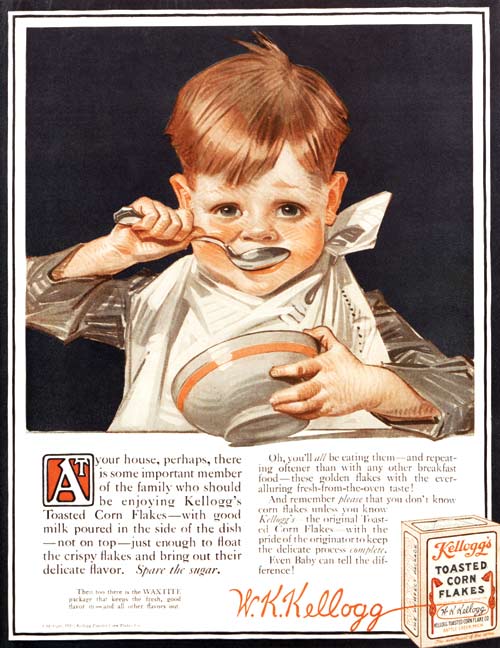
The popular singer and movie star Bing Crosby once crooned, “What’s more American than corn flakes?” Virtually every American is familiar with this iconic cereal, but few know the story of the two men from Battle Creek, Michigan, who created those famously crispy, golden flakes of corn back in 1895, revolutionizing the way America eats breakfast: John Harvey Kellogg and his younger brother Will Keith Kellogg.
Fewer still know that among the ingredients in the Kelloggs’ secret recipe were the teachings of the Seventh-day Adventist Church, a homegrown American faith that linked spiritual and physical health, and which played a major role in the Kellogg family’s life.
For half a century, Battle Creek was the Vatican of the Seventh-day Adventist Church. Its founders, the self-proclaimed prophetess Ellen White and her husband, James, made their home in the Michigan town starting in 1854, moving the church’s headquarters in 1904 to Takoma Park, outside of Washington, D.C. Eventually, Seventh-day Adventism grew into a major Christian denomination with churches, ministries, and members all around the world. One key component of the Whites’ sect was healthy living and a nutritious vegetable- and grain-based diet.
From the distance of more than a century and a half, it is fascinating to note how many of Ellen White’s religious experiences were connected to personal health. During the 1860s, inspired by visions and messages she claimed to receive from God, she developed a doctrine on hygiene, diet, and chastity enveloped within the teachings of Christ. She began promoting health as a major part of her ministry as early as June 6, 1863. At a Friday-evening Sabbath welcoming service in Otsego, Michigan, she described a 45-minute revelation on “the great subject of Health Reform,” which included advice on proper diet and hygiene. Her canon of health found greater clarity in a sermon that she delivered on Christmas Eve 1865 in Rochester, New York. White vividly described a vision from God which emphasized the importance of diet and lifestyle in helping worshippers stay well, prevent disease, and live a holy life. Good health relied on physical and sexual purity, White preached, and because the body was intertwined with the soul, her prescriptions would help eliminate evil, promote the greater good in human society, and please God.
The following spring, on May 20, 1866, Sister White formally presented her ideas to the 3,500 Adventists comprising the denomination’s governing body, or General Conference. When it came to diet, White’s theology found great import in Genesis 1:29: “And God said, ‘Behold, I have given you every herb bearing seed, which is upon the face of all the earth, and every tree, in which is the fruit of a tree yielding seed; to you it shall be for meat.’” White interpreted this verse strictly as God’s order to consume a grain and vegetarian diet.
She told her Seventh-day Adventist flock that they must abstain not only from eating meat but also from using tobacco or consuming coffee, tea, and, of course, alcohol. She warned against indulging in the excitatory influences of greasy, fried fare, spicy condiments, and pickled foods; against overeating; against using drugs of any kind; and against wearing binding corsets, wigs, and tight dresses. Such evils, she taught, led to the morally and physically destructive “self-vice” of masturbation and the less lonely vice of excessive sexual intercourse.
The Kellogg family moved to Battle Creek in 1856 primarily to be close to Ellen White and the Seventh-day Adventist Church. Impressed by young John Harvey Kellogg’s intellect, spirit, and drive, Ellen and James White groomed him for a key role in the Church. They hired John, then 12 or 13, as their publishing company’s “printer’s devil,” the now-forgotten name for an apprentice to printers and publishers in the days of typesetting by hand and cumbersome, noisy printing presses. Like many other American printer’s devils who went on to greatness — including Thomas Jefferson, Benjamin Franklin, Mark Twain, Walt Whitman, and Lyndon Johnson — Kellogg mixed up batches of ink, filled paste pots, retrieved individual letters of type to set, and proofread the not-always-finished printed copy. He was swimming in a river of words and took to it with glee, discovering his own talent for composing clear and balanced sentences filled with rich explanatory metaphors and allusions. By the time he was 16, Kellogg was editing and shaping the church’s monthly health advice magazine, The Health Reformer.
The Whites wanted a first-rate physician to run medical and health programs for their denomination, and they found him in John Harvey Kellogg. They sent the young man to the Michigan State Normal College in Ypsilanti, the University of Michigan in Ann Arbor, and the Bellevue Hospital Medical College in New York. It was during medical school when a time-crunched John, who prepared his own meals on top of studying round the clock, first began to think about creating a nutritious, ready-to-eat cereal.
Upon returning to Battle Creek in 1876, with the encouragement and leadership of the Whites, the Battle Creek Sanitarium was born, and within a few years it became a world-famous medical center, grand hotel, and spa run by John and Will, eight years younger, who ran the business and human resources operations of the Sanitarium while the doctor tended to his growing flock of patients. The Kellogg brothers’ “San” was internationally known as a “university of health” that preached the Adventist gospel of disease prevention, sound digestion, and “wellness.” At its peak, it saw 12,000 to 15,000 new patients a year, treated the rich and famous, and became a health destination for the worried well and the truly ill.
There were practical factors, beyond those described in Ellen White’s ministry, that inspired John’s interest in dietary matters. In 1858, Walt Whitman described indigestion as “the great American evil.” A review of the mid-19th-century American diet on the “civilized” eastern seaboard, within the nation’s interior, and on the frontier explains why one of the most common medical complaints of the day was dyspepsia, the 19th-century catchall term for a medley of flatulence, constipation, diarrhea, heartburn, and upset stomach.
Breakfast was especially problematic. For much of the 19th century, many early-morning repasts included filling, starchy potatoes fried in the congealed fat from last night’s dinner. For protein, cooks fried up cured and heavily salted meats, such as ham or bacon. Some people ate a meatless breakfast, with mugs of cocoa, tea, or coffee, whole milk or heavy cream, and boiled rice, often flavored with syrup, milk, and sugar. Some ate brown bread, milk toast, and graham crackers to fill their bellies. Conscientious (and frequently exhausted) mothers awoke at the crack of dawn to stand over a hot, wood-burning stove for hours on end, cooking and stirring gruels or mush made of barley, cracked wheat, or oats.
It was no wonder Dr. Kellogg saw a need for a palatable, grain-based “health food” that was “easy on the digestion” and also easy to prepare. He hypothesized that the digestive process would be helped along if grains were precooked — essentially, predigested — before they entered the patient’s mouth. Dr. Kellogg baked his dough at extremely high heat to break down starch contained in the grain into the simple sugar dextrose. He called this baking process dextrinization. He and Will labored for years in a basement kitchen before coming up with dextrinized flaked cereals — first wheat flakes, and then the tastier corn flakes. They were easily digested foods meant for invalids with bad stomachs.
Today, most nutritionists, obesity experts, and physicians argue that the easy digestibility the Kelloggs worked so hard to achieve is not such a good thing. Eating processed cereals, it turns out, creates a spike in blood sugar, followed by an increase in insulin, the hormone that enables cells to use glucose. A few hours later, the insulin rush triggers a blood sugar “crash,” loss of energy, and a ravenous hunger for an early lunch. High-fiber cereals like oatmeal and other whole-grain preparations are digested more slowly. People who eat them report feeling fuller for longer periods of time and thus have far better appetite control than those who consume processed breakfast cereals.
By 1906, Will had had enough of working for his domineering brother, whom he saw as a tyrant who refused to allow him the opportunity to grow their cereal business into the empire he knew it could become. He quit the San and founded what ultimately became the Kellogg’s Cereal Company based upon the brilliant observation that there were many more average people who wanted a nutritious and healthy breakfast than invalids — provided the cereal tasted good, which by that point it did, thanks to the addition of sugar and salt.
The Kelloggs had the science of corn flakes all wrong, but they still became breakfast heroes. Fueled by 19th-century American reliance on religious authority, they played a critical role in developing the crunchy-good breakfast many of us ate this morning.
Howard Markel is the George E. Wantz Distinguished Professor of the History of Medicine at the University of Michigan and author of The Kelloggs: The Battling Brothers of Battle Creek (Pantheon Books, 2017). This essay is part of What It Means to Be American, a partnership of the Smithsonian National Museum of American History and Zócalo Public Square. Originally published at Zócalo Public Square.
This article appears in the March/April 2018 issue of The Saturday Evening Post. Subscribe to the magazine for more art, inspiring stories, fiction, humor, and features from our archives.
Mickey Spillane: American Master of Sex and Violence
On the 100th birthday of an American original, we recall the career, writing style, and surprising private life of Mickey Spillane, renowned for his brutal detective novels filled with sex and violence.
“I’m not a guy that takes any crap. Not from anybody,” detective Mike Hammer tells a suspect in the book Vengeance Is Mine. “I’ve had some punks tougher than you’ll ever be on the end of a gun, and I pulled the trigger just to watch their expressions change.”
Mickey Spillane’s fictional character, Mike Hammer, is one of the most lethal detectives in the genre. Over the course of five novels, he kills 58 people. (In one book, he mows down 40 of them — all communists — with a machine gun. Spillane’s publisher had to talk him down from 80.)
The hard-boiled detective genre was well established by the time Frank Morrison Spillane started writing in the late 1940s. But he ramped up the sex and violence to levels previously unseen in pulp fiction, starting with I, The Jury.
Critics had little good to say about this Mike Hammer adventure. “Spectacularly bad” was how the New York Times described it. The San Francisco Chronicle’s review said the book was “so vicious a glorification of force, cruelty, and extra-legal methods that the novel might be made required reading in a Gestapo training school.” The Saturday Evening Post referred to Spillane as the master of the “thud and blunder” thrillers.
Yet Spillane proved to be in tune with American readers in the post-war years. After a respectable 10,000 copies in hardback, I, The Jury sold an astonishing six million copies. His next book, Kiss Me, Deadly, became the first detective novel to land on the New York Times’ bestseller list.
Mickey Spillane had originally wanted to develop a comic around a tough-guy detective named Mike Danger. Neither the comic book nor newspaper strip worked out, so he recast Mike Danger as Mike Hammer in a novel. Spillane claimed it only took him nine days to write I, The Jury. If so, they were among the most profitable nine days any writer ever spent, for they launched a 30-novel career with total sales around 225 million copies.
Spillane was aware of what book reviewers said about him, but didn’t care. He called himself a writer, not an author. “I don’t give a hoot about readin’ reviews. What I want to read is the royalty check,” he said. “I’m a money writer. I write when I need money.”
He once told an interviewer, “I have no fans. You know what I got? Customers. And customers are your friends.”
Spillane wasn’t necessarily obsessed with sex and violence. He said he simply wrote what his customers wanted to read. And in the late 1940s and early ‘50s, many readers wanted stories that made life, law, and morality straightforward matters. They appreciated his minimalist style, fast-paced plots, and graphic acts of violent revenge — often against communists.
Spillane’s success rested on his ability to shock readers. But by the 1960s, censorship had relaxed and a lot more writers were pushing the limits. And with the Cold War settling into a stalemate, communists lost much of their usefulness as villains. Yet Spillane kept writing, completing his last novel in 2003.
Surprisingly, there was little resemblance between the vengeful, violent, and promiscuous detective and his creator. Unlike Mike Hammer, Spillane neither smoked nor drank, and he was very serious about his Christian beliefs.
In 1952, Spillane became a Jehovah’s Witness and, for the next ten years, he gave up writing to witness to his faith. He helped build the Jehovah’s Kingdom Hall in Murrells Inlet, South Carolina. He taught bible classes. And, like other Witnesses, went door-to-door sharing his faith.
In 1962, he returned to publishing with a new Mike Hammer book. Another 29 novels followed. Many featured his brutal detective hero in stories of sexual adventure and bloody vengeance. But Spillane remained a devoted Jehovah’s Witness until his death in 2006.
Featured image: Illustration by William A. Smith for The Saturday Evening Post, ©SEPS