Babe Ruth and The Post
Babe Ruth
Given Name: George Herman Ruth Jr.
Born: February 6, 1895, Baltimore, MD
Died: August 16, 1948, New York City, NY
Position: Pitcher/Outfielder
Baseball Career:
• Boston Red Sox, 1914–1919
• New York Yankees, 1920–1934
• Boston Braves, 1935
More than just an icon of American baseball, Babe Ruth was also a showman, a gambler, a humanitarian, and an international ambassador of baseball. Read some of The Saturday Evening Post’s reporting on the Great Bambino, the Sultan of Swat, and the Colossus of Clout — George Herman Ruth Jr.
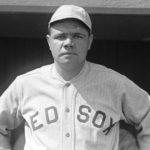
Babe Ruth’s Beginnings
In talking about himself, the Babe wishes to make it clear that he has been both bad and good. In this 1931 profile, Babe Ruth describes growing up in an orphanage and his lucky early break.
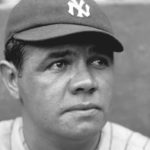
Babe Ruth: The Homely Hero
Ruth was a natural — truly comfortable fielding, pitching, and (especially) hitting. His records are well-known, but his over-sized personality has been flattened over the decades, and the quick glimpses we get of him today as an overweight, ungainly, hard-drinking yokel don’t do him justice.

Babe Ruth’s Compassion
In a now-famous story, Babe Ruth made an unscheduled trek to the country to comfort a young, sick child who was one of his greatest fans..
Curtis Stone’s Delicious Shrimp Recipes
Barbecued Shrimp with Olive Oil, Lemon Juice, and Fresh Parsley

(Makes 6 servings)
Ingredients
- 20 jumbo shrimp, cut in half lengthways with shell on
- 3 tablespoons extra-virgin olive oil, divided
- 2 small Fresno chilies, finely chopped
- 2 tablespoons coarsely chopped fresh flat-leaf parsley
- 2 lemons, zested
Preheat barbecue for high heat. Drizzle shrimp with 1 ½ tablespoons oil and sprinkle with salt. Grill shrimp flesh-side down for 45 seconds. Turn shrimp over and sprinkle with half of chilies, parsley, and lemon zest. Squeeze juice of 1 lemon over. Cook 45 seconds longer, or until pink and just cooked through.
Transfer shrimp to plates. Sprinkle with remaining chilies, parsley, and lemon zest. Drizzle with 1 ½ tablespoons oil and remaining lemon juice. Season with salt and serve.
Per serving
- Calories: 93 calories
- Total Fat: 8 g
- Saturated Fat: 1 g
- Sodium: 174 mg
- Carbohydrate: 2 gm
- Fiber: 0 gm
- Protein: 9 g
- Diabetic Exchanges: 1 lean meat, 1 fat
Stir-Fried Shrimp with Chiles, Bell Peppers, and Peanuts

(Makes 4 servings)
Ingredients
- ¼ cup oyster sauce
- 1 tablespoon unseasoned rice vinegar
- 1 teaspoon Thai or Vietnamese fish sauce (nam pla or nuoc cham)
- 1 teaspoon toasted sesame oil
- 2 tablespoons canola oil
- 1 small yellow onion, thickly sliced
- ½ large red bell pepper, cored, cut into about ⅓-inch-wide strips
- ½ large green bell pepper, cored, cut into about ⅓-inch-wide strips
- 1 small fresh red or green chile, thinly sliced into rings
- 3 garlic cloves, finely chopped
- 1 shallot, finely chopped
- 2 tablespoons peeled finely chopped fresh ginger
- 12 ounces uncooked large (31 to 35 count) shrimp, peeled and deveined
- ½ cup coarsely chopped unsalted roasted peanuts
- 1 cup fresh Thai basil leaves or regular basil leaves
- 2 scallions, white and green parts, thinly sliced
- Cooked rice, for serving
In small bowl, mix oyster sauce, vinegar, fish sauce, and sesame oil and set aside. Heat large wok or skillet over medium-high heat. Add canola oil and swirl to coat inside of wok. Add onion and bell peppers and stir-fry for 3 minutes, or until onion begins to soften. Add chile, garlic, shallot, and ginger and stir-fry for 15 seconds, or until fragrant. Add shrimp and stir-fry for 2 minutes, or until they begin to turn opaque. Add reserved sauce and peanuts and stir-fry for 1 minute, or until shrimp are just pink and cooked through. Stir in basil leaves. Season to taste with salt. Transfer stir-fry to a platter. Sprinkle with scallions and serve immediately with rice.
Per serving
- Calories: 351 calories
- Total Fat: 19 g
- Saturated Fat: 2 g
- Sodium: 1,100 mg
- Carbohydrate: 25 g
- Fiber: 4 g
- Protein: 20 g
- Diabetic Exchanges: 1 starch, 2 lean meat, 1 vegetable, 3 fat
These recipes supplement Curtis Stone’s Healthy Eating feature in the March/April 2018 issue of The Saturday Evening Post. Subscribe to the magazine for more art, inspiring stories, fiction, humor, and features from our archives.
An Interview with Kenneth Branagh

Sir Kenneth Branagh soared to fame as a Shakespearean actor who has directed and starred in most of the Bard’s classics, from Hamlet to Richard III, on both stage and screen. But he’s not above going for the mainstream, even stepping behind the camera to direct the comic-book action flick Thor.
This winter, he took on the role of the beloved sleuth Hercule Poirot while also directing Murder on the Orient Express (Now available on digital, 4K Ultra HD, Blu-ray and DVD.) One of his biggest challenges was negotiating Poirot’s enormous mustache, which, he says, “was the enemy of all food, so I became a soup-with-a-straw martyr.” Branagh also co-starred as British naval admiral Commander Bolton in Dunkirk and says the role reminded him of his father. “He had a sort of stoicism that is in the British character, where the cardinal sin is to make a fuss or be over-emotional.”
As irrepressible and charming as ever, Branagh seeks variety, and even after years of acting, writing, directing, and producing, declares, “I love good stories, so I’m the perfect audience.”
Jeanne Wolf: Multitasking is not a grand enough term for all you do. How do you pull off juggling so many jobs?
Kenneth Branagh: I tell myself that Shakespeare ran his own theater. He had to look at the balance sheets and write the plays. I have taught myself to clear things away and think about where I am at the moment. I am forced to focus on what I’m doing then. Perversely, I got a chance to be more immersed in my preparation for Hercule Poirot because I had to be so ready to welcome a bunch of famous movie stars and direct them. This is how it happened on the first morning: I open the door, and in come Michelle Pfieffer, Willem Dafoe, Penelope Cruz, Derek Jacobi, Johnny Depp, and Judi Dench. They all walk past, and I’m kind of terrified because in a moment I’ll have to say something to them that gets them going. But at the same time, I’m saying to myself, “Ken, you have been here before. You’ve done your hours.” They say it takes about 10,000 hours of practice if you want to be really good at tennis or playing the piano, and it’s the same with performing. You’re excited about how to tell that story. It’s something about which you care. I think people see that because you can’t fake it. It’s not like, “I’ll get these people together and make a ton of money!”
As for playing Hercule Poirot, I’ve lived a professional life where I’ve done many parts that have been played by other people. There’s 33 Poirot novels, plenty of material for many actors to pull out their own characterizations. I know people are coming to see Poirot, and hopefully me, but it’s the part that counts, and I was privileged to play the part.
JW: You came from what people call “humble beginnings.” Could you have envisioned all the things that have happened to you?
KB: Time is a funny thing. At 16, I was waiting at the stage door to try and get Derek Jacobi’s autograph as he came out from having just played Hamlet. It feels like two minutes ago that I got off a plane in Los Angeles and went walking down to Rodeo Drive for the first time. I felt like I had landed on the moon! I got stopped by a cop for jaywalking across the street. Cut to 30 years later, and to be here making movies and having Shakespeare run through all of that experience is really quite something.
They say there’s an age that you feel you are for most of your life. You may look in the mirror and the truth confounds you. You know, it sounds silly, but I’ve always felt that I was 23. I’m 57 now and I still feel like I’m 23. I hope that if I get to be any older, I’ll always feel that. With 23 comes a certain sense of wow. How am I here? How am I talking to Jeanne Wolf again after all of these meetings over the years? But on the other hand, you can have those Hamlet-y moments, which I suspect more regularly happens in one’s early 30s. Suddenly, you’ve roared through your 20s, when anything’s possible. You see the great career, or the great life that you want, and you’re suddenly thinking, “I can just begin to hear the sound of a clock ticking.” I realize I’m not here forever.
JW: You still seem to be getting a kick out of life and work. Is this still a thrill for you?
KB: I remember a great man was once asked about what the secret of life was. And he said, “Be cheerful.” That sounds trite and banal but, actually, it kind of works in almost everything, however perplexing and challenging the situation is. We’ve got the moment we live in and we can choose to have a twinkle in our eye even when we’re dealing with deprivation and pain. That’s what I try to do, even if it just reminds me to pull myself out of some sort of self-regarding moment.
You have to realize you’re a beggar, which is very much in the Shakespearean tradition. You’re hoping people might like what you do, and if they don’t, sometimes that’s pretty hard. Whatever the ups and the downs, you have to enjoy it for the kind of passing parade that you are part of. I think when you’re a little bit older, you learn to sort of relish it. Life is kind of like flying through turbulence: You’re up there soaring and you’ve got to be ready for the bumps.
Watch Jeanne Wolf’s interview with Kenneth Branagh here. An abridged version of this interview appears in the March/April 2018 issue of The Saturday Evening Post. Subscribe to the magazine for more art, inspiring stories, fiction, humor, and features from our archives.
Jeanne Wolf is the Post’s West Coast editor.
“To Kill a Man” by Jack London
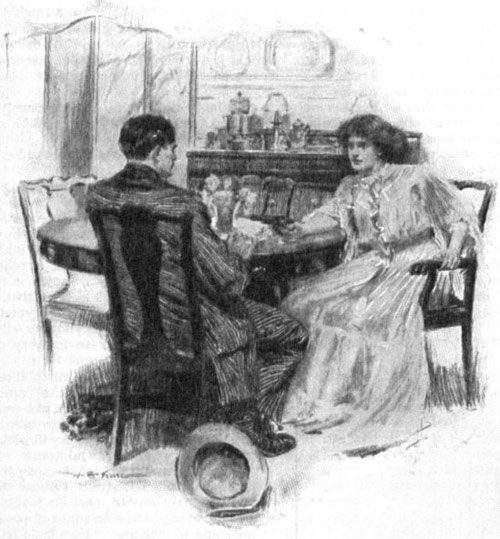
Though dim night-lights burned, she moved familiarly through the big rooms and wide halls, seeking vainly the half-finished book of verse she had mislaid and only now remembered. When she turned on the lights in the drawing room she disclosed herself clad in a sweeping negligée gown of soft rose-colored stuff, throat and shoulders smothered in lace. Her rings were still on her fingers, her massed yellow hair had not yet been taken down. She was delicately, gracefully beautiful, with slender oval face, red lips, a faint color in the cheeks, and blue eyes of the chameleon sort that, at will, stare wide with the innocence of girlhood, go hard and gray and brilliantly cold, or flame up in hot willfulness and mastery.
She turned the lights off and passed out and down the hall toward the morning room. At the entrance she paused and listened. From farther on had come not a noise but an impression of movement. She could have sworn she had not heard anything, yet something had been different. The atmosphere of night quietude had been disturbed. She wondered what servant could be prowling about — not the butler, who was notorious for retiring early save on special occasions. Nor could it be her maid, whom she had permitted to go that evening.
Passing on to the dining room she found the door closed. Why she opened it and went in she did not know, except for the feeling that the disturbing factor, whatever it might be, was there. The room was in darkness; and she felt her way to the button and pressed it. As the blaze of light flashed on she stepped back and cried out. It was a mere “Oh!” and it was not loud.
Facing her, alongside the button, flat against the wall, was a man. In his hand, pointed toward her, was a revolver. She noticed, even in the shock of seeing him, that the weapon was black and exceedingly long-barreled. He was a well-built man, roughly clad, brown-eyed, and swarthy with sunburn. He seemed very cool. There was no wabble to the revolver and it was directed toward her stomach, not from an outstretched arm but from the hip, against which the forearm rested.
“Oh!” she said. “I beg your pardon. You startled me. What do you want?”
“I reckon I want to get out,” he answered with a humorous twitch to the lips. “I’ve kind of lost my way in this here shebang; and if you’ll kindly show me the door I’ll cause you no trouble and I’ll sure vamoose right away.”
“But what are you doing here?” she demanded, her voice touched with the sharpness of one used to authority.
“Plain robbing, miss; that’s all. I came snoopin’ around to see what I could gather up. I thought you wa’n’t to home, seein’ as I saw you pull out with your old man in an auto. I reckon that must ‘a’ ben your ma, and you’re Miss Setliffe.”
Mrs. Setliffe saw his mistake, appreciated the naïve compliment and decided not to undeceive him.
“How do you know I am Miss Setliffe?” she asked.
“This is old Setliffe’s house, ain’t it?”
She nodded.
“I didn’t know he had a daughter, but I reckon you must be her. And now, if it ain’t botherin’ you too much, won’t you show me the way out?”
“But why should I? You are a robber, a burglar.”
“If I wa’n’t an ornery shorthorn at the business I’d be accumulatin’ them rings on your fingers instead of being polite,” he retorted. “I come to make a raise outa old Setliffe and not to be robbing womenfolks. If you get outa the way, I reckon I can get out.”
Mrs. Setliffe was a keen woman and she felt that from such a man there was little to fear. That he was not a typical criminal she was certain. From his speech she knew he was not of the cities, and she seemed to sense the wider, homelier air of large spaces.
“Suppose I screamed?” she queried curiously. “Suppose I made an outcry for help? You couldn’t shoot me — a woman?”
She noted the fleeting bafflement in his brown eyes. He answered slowly, as if working out a difficult problem.
“I reckon, then, I’d have to choke you and maul you some bad.”
“A woman?”
“I’d sure have to,” he answered, and she saw his mouth set grimly.
“You’re only a soft woman; but you see, miss, I can’t afford to go to jail. No, miss, I sure can’t. There’s a friend of mine waitin’ for me out West. He’s in a hole and I’ve got to help him out.” The mouth shaped even more grimly. “I guess I could choke you without hurting you much to speak of.”
Her eyes took on a baby stare of innocent incredulity as she watched him.
“I never met a burglar before,” she assured him, “and I can’t begin to tell you how interested I am.”
“I’m not a burglar, miss. Not a real one,” he hastened to add, as she looked her amused unbelief. “It looks like it, me being here in your house; but it’s the first time I ever tackled such a job. I needed the money bad. Besides, I kind of look on it like collecting what’s coming to me.”
“I don’t understand,” she smiled encouragingly. “You came here to rob; and to rob is to take what is not yours.”
“Yes and no, in this here particular case. But I reckon I’d better be going now.”
He started for the door of the dining room, but she interposed; and a very beautiful obstacle she made of herself. His left hand went out as if to grip her, then hesitated. He was patently awed by her soft womanhood.
“There!” she cried triumphantly. “I knew you wouldn’t.”
The man was embarrassed.
“I ain’t never manhandled a woman yet,” he explained,” and it don’t come easy. But I sure will if you set to screaming.”
“Won’t you stay a few minutes and talk?” she urged. “I’m so interested. I should like to hear you explain how burglary is collecting what is coming to you.” He looked at her admiringly.
“I always thought womenfolks were scairt of robbers,” he confessed; “but you don’t seem none.”
She laughed gayly.
“There are robbers and robbers, you know. I am not afraid of you, because I am confident you are not the sort of creature that would harm a woman. Come, talk with me a while. Nobody will disturb us. I am all alone. My — my father caught the night train to New York. The servants are all asleep. I should like to give you something to eat. Women always prepare midnight suppers for the burglars they catch — at least they do in the magazine stories. But I don’t know where to find the food. Perhaps you will have something to drink?”
He hesitated and did not reply, but she could see the admiration for her growing in his eyes.
“You’re not afraid?” she queried. “I won’t poison you, I promise. I’ll drink with you to show you it is all right.”
“You sure are a surprise package of all right,” he declared, for the first time lowering the weapon and letting it hang at his side. “No one don’t need to tell me ever again that womenfolks in cities is afraid. You ain’t much — just a little, soft, pretty thing; but you’ve sure got the spunk and you’re trustful on top of it. There ain’t many women, or men either, who’d treat a man with a gun the way you’re treating me.”
She smiled her pleasure in the compliment, and her face was very earnest as she said:
“That is because I like your appearance. You are too decent-looking a man to be a robber. You oughtn’t to do such things. If you are in bad luck you should go to work. Come, put away that nasty revolver and let us talk it over. The thing for you to do is to work.”
“Not in this burg,” he commented bitterly. “I’ve walked two inches off the bottom of my legs trying to find a job. Honest, I was a fine, large man once — before I started looking for a job.”
The merry laughter with which she greeted his sally obviously pleased him, and she was quick to note and take advantage of it. She moved directly away from the door and toward the sideboard.
“Come, you must tell me all about it while I get that drink for you. What shall it be? Whisky?”
“Yes, ma’am,” he said as he followed her, though he still carried the big revolver at his side and glanced reluctantly at the unguarded, open door.
She filled a glass for him at the sideboard.
“I promised to drink with you,” she said hesitatingly; “but I don’t like whisky. I prefer sherry.”
She lifted the sherry bottle tentatively for his consent.
“Sure!” he answered with a nod. “Whisky’s a man’s drink. I never like to see women at it. Wine’s more their stuff.”
She raised her glass to his, her eyes meltingly sympathetic.
“Here’s to finding you a good position — ”
But she broke off at sight of the expression of surprised disgust on his face. The glass, barely touched, was removed from his wry lips.
“What is the matter?” she asked anxiously. “Don’t you like it? Have I made a mistake?”
“It’s sure funny whisky. Tastes like it got burned and smoked in the making.”
“Oh! How silly of me! I gave you Scotch. Of course you are accustomed to rye. Let me change it.”
She was almost solicitously maternal as she replaced the glass with another and sought and found the proper bottle.
“Better?” she asked.
“Yes, ma’am. No smoke in it. It’s sure the real good stuff. I ain’t had a drink in a week. Kind of slick, that — oily, you know; not made in a chemical factory.”
“You are a drinking man?”
It was half a question, half a challenge.
“No, ma’am, not to speak of. I have rared up and ripsnorted at spells, but most unfrequent. But there is times when a good stiff jolt lands on the right spot kerchunk, and this is sure one of them. And now, thanking you for your kindness, ma’am, I’ll just be pulling along.”
But Mrs. Setliffe did not want to lose her burglar. She was too poised a woman to possess much romance, but there was a thrill about the present situation that delighted her. Besides, she knew there was no danger. The man, despite his jaw and the steady brown eyes, was eminently tractable. Also, further back in her consciousness glimmered the thought of an audience of admiring friends. It was too bad not to have that audience.
“You haven’t explained how burglary, in your case, is merely collecting what’s your own,” she said. “Come, sit down and tell me about it — here at the table.”
She maneuvered for her own seat and placed him across from her. His alertness had not deserted him, as she noted, and his eyes roved sharply about, returning always with smouldering admiration to hers, but never resting long. And she noted likewise that while she spoke he was intent on listening for sounds other than those of her voice. Nor had he relinquished the revolver, which lay on the table between them, the butt close to his right hand.
He was in a new habitat that he did not know. This man from the West, cunning in woodcraft and plainscraft, with eyes and ears open, tense and suspicious, did not know that under the table, close to her foot, was the push-button of an electric bell. He had never heard or dreamed of such a contrivance and his keenness and wariness went for naught.
“It’s like this, miss,” he began in response to her urging. “Old Setliffe done me up in a little deal once. It was raw, but it worked. Anything will work full and legal when it’s got a few hundred millions behind it. I’m not squealin’ and I ain’t taking a slam at your pa. He don’t know me from Adam and I reckon he don’t know he done me outa anything. He’s too big, thinking and dealing in millions, to ever hear of a small potato like me. He’s an operator. He’s got all kinds of experts thinking and planning and working for him, some of them, I hear, getting more cash salary than the President of the United States. I’m only one of thousands that have been done up by your pa; that’s all.
“You see, ma’am, I had a little hole in the ground — a dinky, hydraulic, one-hoss outfit of a mine. And when the Setliffe crowd shook down Idaho and reorganized the smelter trust, and roped in the rest of the landscape, and put through the big hydraulic scheme at Twin Pines, why, I sure got squeezed. I never had a run for my money. I was scratched off the card before the first heat. And so, tonight, being broke and my friend needing me bad, I just dropped around to make a raise outa your pa. Seeing as I needed it, it kinda was coming to me.”
“Granting all that you say is so,” she said, “nevertheless it does not make housebreaking any the less housebreaking. You couldn’t make such a defense in a court of law.”
“I know that,” he confessed meekly. “What’s right ain’t always legal. And that’s why I am so uncomfortable asettin’ here and talking with you. Not that I ain’t enjoying your company — I sure do enjoy it — but I just can’t afford to be caught. I know what they’d do to me in this here city. There was a young fellow that got fifty years only last week for holding a man up on the street for two dollars and eighty-five cents. I read about it in the paper. When times is hard, and they ain’t no work, men get desperate. And then the other men who’ve got something to be robbed of get desperate, too, and they just sure soak it to the other fellows. If I got caught I reckon I wouldn’t get a mite less than ten years. That’s why I’m hankerin’ to be on my way.”
“No, wait.” She lifted a detaining hand, at the same time removing her foot from the bell, which she had been pressing intermittently. “You haven’t told me your name yet.”
He hesitated.
“Call me Dave.”
“Then, Dave” — she laughed with pretty confusion — “something must be done for you. You are a young man and you are just at the beginning of a bad start. If you begin by attempting to collect what you think is coming to you, later on you will be collecting what you are perfectly sure isn’t coming to you. And you know what the end will be. Instead of this, we must find something honorable for you to do.”
“I need the money and I need it now,” he replied doggedly. “It’s not for myself, but for that friend I told you about. He’s in a peck of trouble and he’s got to get his lift now or not at all.”
“I can find you a position,” she said quickly; “and — yes, the very thing — I’ll lend you the money you want to send to your friend. This you can pay back out of your salary.”
“About three hundred would do,” he said slowly. “Three hundred would pull him through. I’d work my fingers off for a year for that — and my keep and a few cents to buy tobacco with.”
“Oh! You smoke! I never thought of it.”
Her hand went out over the revolver toward his hand as she pointed to the telltale yellow stain on his fingers. At the same time her eyes measured the nearness of her own hand and of his to the weapon. She ached to grip it in one swift movement. She was sure she could do it and yet she was not sure; and so it was that she refrained as she withdrew her hand.
“Won’t you smoke?” she invited.
“I’m ‘most dying to.”
“Then do so. I don’t mind. I really like it — cigarettes, I mean.”
With his left hand he dipped into his side pocket, brought out a loose wheat-straw paper and shifted it to his right hand, close by the revolver. Again he dipped, transferring to the paper a pinch of brown, flaky tobacco. Then he proceeded, both hands just over the revolver, to roll the cigarette.
“From the way you hover close to that nasty weapon you seem to be afraid of me,” she challenged.
“Not exactly afraid of you, ma’am; but, under the circumstances, just a mite timid.”
“But I’ve not been afraid of you.”
“You’ve got nothing to lose.”
“My life,” she retorted.
“That’s right,” he acknowledged promptly. “And you ain’t ben scairt of me. Mebbe I am overanxious.”
“I wouldn’t cause you any harm.” Even as she spoke her slipper felt for the bell and pressed it. At the same time her eyes were earnest with a plea of honesty. “You are a judge of men. I know it. And of women. Surely, when I am trying to persuade you from a criminal life and to get you honest work to do — ”
He was immediately contrite.
“I sure beg your pardon, ma’am,” he said. “I reckon my nervousness ain’t complimentary.”
As he spoke he drew his right hand from the table and, after lighting the cigarette, dropped his hand by his side.
“Thank you for your confidence,” she breathed softly, resolutely keeping her eyes from measuring the distance to the revolver and keeping her foot pressed firmly on the bell.
“About that three hundred,” he began. “I can telegraph it West tonight and I’ll agree to work a year for it and my keep.”
“You will earn more. I can promise seventy-five dollars a month at the least. Do you know horses?”
His face lighted up and his eyes sparkled.
“Then go to work for me — or for my father, rather; though I engage all the servants. I need a second coachman — ”
“And wear a uniform?” he interrupted sharply, the sneer of the freeborn West in his voice and on his lips.
She smiled tolerantly.
“Evidently that won’t do. Let me think. Yes. Can you break and handle colts?”
He nodded.
“We have a stock farm and there’s room for just such a man as you. Will you take it?”
“Will I, ma’am?” His voice was rich with gratitude and enthusiasm. “Show me to it. I’ll dig right in tomorrow. And I can sure promise you one thing, ma’am: you’ll never be sorry for lending Hughie Luke a hand in his trouble — ”
“I thought you said to call you Dave,” she chided forgivingly.
“I did, ma’am; I did. And I sure beg your pardon. It was just plain bluff. My real name is Hughie Luke. And if you’ll give me the address of that stock farm of yourn, and the railroad fare, I’ll head for it first thing in the morning.”
Throughout the conversation she had never relaxed her attempts on the bell. She had pressed it in every alarming way — three shorts and a long, two and a long, and five. She had tried long series of shorts and once she had held the button down for a solid three minutes; and she had been divided between objurgation of the stupid, heavy-sleeping butler and doubt if the bell were in order.
“I am so glad,” she said; “so glad that you are willing. There won’t be much to arrange, but you will first have to trust me while I go upstairs for my purse.” She saw the doubt flicker momentarily in his eyes and added hastily: “I am trusting you with the three hundred dollars.”
“I believe you, ma’am,” he came back gallantly. “Though I just can’t help this nervousness.”
“Shall I go and get it?”
Before she could receive consent a slight muffled jar from the distance came to her ear. She knew it for the swing-door of the butler’s pantry, but so slight was it — more a faint vibration than a sound — that she would not have heard had not her ears been keyed and listening for it. Yet the man had heard too. He was startled in his composed way.
“What was that noise?” he sharply demanded.
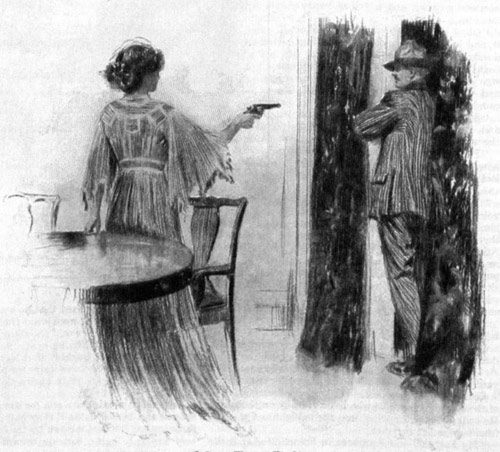
For answer her hand flashed out to the revolver and brought it back. She had had the start of him and she needed it, for the next instant his hand leaped up from his side, clutching emptiness where the revolver had been.
“Sit still!” she commanded sharply, in a voice new to him. “Don’t move! Keep your hands on the table!”
She had taken a lesson from him. Instead of holding the heavy weapon extended, the butt of it and her forearm rested on the table, the muzzle pointed not at his head but his chest. And he, looking coolly and obeying her commands, knew there was no chance of the kick-up of the recoil producing a miss. Also, he saw that the revolver did not wabble, nor did the hand shake; and he was thoroughly conversant with the size of hole the soft-nosed bullets could make. He had eyes not for her but for the hammer, which had risen under the pressure of her forefinger on the trigger.
“I reckon I’d best warn you that that there trigger is filed dreadful fine. Don’t press too hard or I’ll have a hole in me the size of a walnut.”
She slowly slacked the hammer partly down.
“That’s better,” he commented. “You’d best put it down all the way. You see how easy it works. If you want to, a quick, light pull will jiffy her up and back and make a pretty mess all over your nice floor.”
A door opened behind him and he heard somebody enter the room, but he did not turn his head. He was looking at her and he found it the face of another woman — hard, cold, pitiless, yet brilliant in its beauty. The eyes, too, were hard, though blazing with a cold light.
“Thomas,” she commanded, “go to the telephone and call the police. Why were you so long in answering?”
“I came as soon as I heard the bell, madam,” was the answer.
The robber never took his eyes from hers nor did she from his, but at mention of the bell she noticed that his eyes were puzzled for the moment.
“Beg your pardon,” said the butler from behind, “but wouldn’t it be better for me to get a weapon first and arouse the servants?”
“No; ring for the police! I can hold this man. Go and do what I tell you to do — quickly!”
The butler slippered out of the room and the man and the woman sat on, gazing into each other’s eyes. To her it was an experience keen with enjoyment and in her mind was the gossip of her crowd, and she saw notes in the society weeklies of the beautiful young Mrs. Setliffe capturing an armed robber single-handed. It would create a sensation, she was sure; she could see her social stock, high as it was, appreciating still more.
“When you get that sentence you mentioned,” she said coldly, “you will have time to meditate upon what a fool you have been, taking other persons’ property and threatening women with revolvers. You will have time to learn your lesson thoroughly. Now tell the truth — you haven’t any friend in trouble. All that you told me was a lie.”
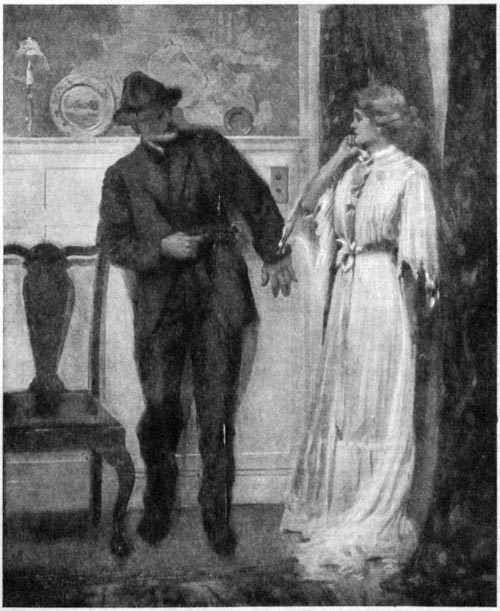
He did not reply. Though his eyes were upon her, they seemed blank. In truth, for the instant, she was veiled to him and what he saw was the wide, sun-washed spaces of the West, where men and women were bigger than the rotten denizens, as he had encountered them, of the thrice-rotten cities of the East.
“Go on. Why don’t you speak? Why don’t you lie some more? Why don’t you beg to be let off?”
“I might,” he answered, licking his dry lips. “I might ask to be let off if — ”
“If what?” she demanded peremptorily as he paused.
“I was trying to think of a word you reminded me of. As I was saying, I might if you was a decent woman.”
Her face paled.
“Be careful!” she warned.
“You don’t dast kill me,” he sneered. “The world’s a pretty lowdown place to have a thing like you prowling around in it, but it ain’t so plumb lowdown, I reckon, as to let you put a hole in me. You’re sure bad, but the trouble with you is that you’re weak in your badness. It ain’t much to kill a man, but you ain’t got it in you. There’s where you lose out.”
“Be careful of what you say,” she repeated; “or else, I warn you, it will go hard with you. It can be seen to whether your sentence is light or heavy.”
They were interrupted here by the entrance of the butler.
“Something is wrong with the telephone, madam,” he announced. “The wires are crossed or something, because I can’t get Central.”
“Go and call one of the servants,” she ordered. “Send him out for an officer and then return here.”
Again the butler withdrew and the pair was left alone.
“Will you kindly answer one question, ma’am?” the man said. “That servant fellow said something about a bell. I watched you like a cat and you sure rung no bell.”
“It was under the table, you poor fool! I pressed it with my foot.”
“Thank you, ma’am. I reckoned I’d seen your kind before and now I sure know I have. I spoke to you true and trusting and all the time you was lying to me.”
She laughed mockingly.
“Go on. Say what you wish. It is very interesting.”
“You made eyes at me, looking soft and kindly; playing up all the time the fact that you wore skirts instead of pants — and all the time with your foot on the bell under the table! Well, there’s some consolation. I’d sooner be poor Hughie Luke, doing his ten years, than be in your skin. Ma’am, hell is full of women like you.”
There was silence for a space, in which the man, never taking his eyes from her, studying her, was making up his mind.
“Go on,” she urged. “Say something.”
“Yes, ma’am, I’ll say something. I’ll sure say something. Do you know what I’m going to do? I’m going to get right up from this chair and walk out that door. I’d take the gun from you, only you might turn foolish and let it go off. You can have the gun. It’s a good one. As I was saying, I’m going right out that door; and you ain’t going to pull that gun off either. It takes guts to shoot a man and you sure ain’t got them. Now get ready and see if you can pull that trigger. I ain’t going to harm you. I’m going out that door and I’m starting.”
Keeping his eyes fixed on her, he pushed back the chair and slowly stood erect. The hammer rose halfway. She watched it. So did he.
“Pull harder,” he advised. “It ain’t half up yet. Go on and pull it and kill a man. That’s what I said, kill a man; spatter his brains out on the floor or slap a hole into him the size of your fist. That’s what killing a man means.”
The hammer lowered jerkily but gently. The man turned his back and walked slowly to the door. She swung the revolver around so that it bore on his back. Twice again the hammer came up halfway and was reluctantly eased down.
At the door the man turned for a moment before passing on. A sneer was on his lips. He spoke to her in a low voice, almost drawling; but in it was the quintessence of all loathing as he called her a name unspeakable and vile.
A Brief History of Teenagers
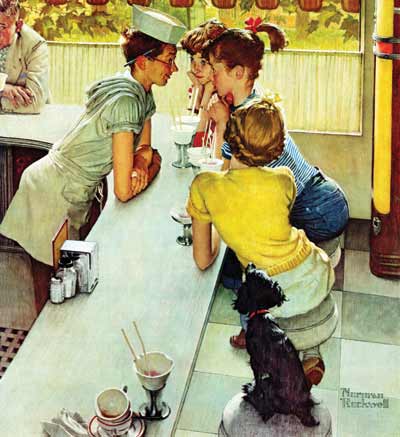
The teenager is one of the more unusual inventions of the 20th century. Humans have been turning 13 for tens of thousands of years, but only recently did it occur to anybody that this was a special thing, or that the bridge between childhood and adulthood deserved its own name. The term teen-ager dates back to the early 1900s, but the word didn’t stick. Even until World War II, there are hardly any instances of teenagers in the popular press.
In the last few decades, however, the national media has nurtured a growing obsession with teenagers, in the sort of way that is neither lewd nor, perhaps, fully healthy. The press exhaustively tracks the apps young people use, the music they listen to, and the brands they follow. In the last few years, the fastest-growing large companies have been software and technology firms whose first adopters are often young people who know their way around a computer, smartphone, or virtual reality app. If most ancient cultures were gerontocratic, ruled by the old, modern culture is fully teenocratic, governed by the tastes of young people, with old fogies forever playing catch-up.
The teenager emerged in the middle of the 20th century thanks to the confluence of three trends in education, economics, and technology. High schools gave young people a place to build a separate culture outside the watchful eye of family. Rapid growth gave them income, either earned or taken from their parents. Cars (and, later, another mobile technology)
gave them independence.
1. The rise of compulsory education
As the U.S. economy shifted from a more localized agrarian society to a mass-production machine, families relocated closer to cities, and — at least initially — many sent their children to work in the factories. This triggered a countermovement to prevent kids from being forced to toil in mills.
The solution: compulsory public education for kids. Between 1920 and 1936, the share of teenagers in high school more than doubled, from about 30 percent to more than 60 percent. As young people spent more time in school, they developed their own customs in an environment away from work and family, where they could enforce their own social rules. It is impossible to imagine American teenage culture in a world where every 16-year-old boy is working jowl-to-jowl with his father on an assembly line.
2. The postwar economic boom
A serious commercial interest in teenagers didn’t begin in earnest until after World War II. To entice marketers, teenagers needed money, and that money would come from two principal sources: the labor force and parents. The 1950s saw one of the great periods of economic expansion in American history. With full employment came rising wages for unionized adults and older teenage workers.
Meanwhile, parents gradually had fewer children and spent more per child, as befits any scarce and valuable investment. Birth rates declined across the advanced world in the second half of the 20th century due to both the rise of female education and the legalization of the pill. Since the 1970s, the richest 20 percent of U.S. households have more than doubled their spending on childhood “enrichment,” such as summer camps, sports, and tutors. As the modern marriage has come to revolve around children, young people emerged as the chief financial officers of family spending.
3. The invention of the car
It might be a horrifying consideration for today’s singles, but a first date once meant an introductory chat in the living room with a girl’s parents. This might have been followed by a deliciously awkward family dinner.
But cars emancipated romance from the stilted small talk of the family parlor. Just about everything a modern single person considers to be a “date” was made possible, or permissible, by the invention and normalization of car-driven romance. The fear that young men and fast cars were upending romantic norms was widespread. The chorus of the 1909 Irving Berlin song “Keep Away from the Fellow Who Owns an Automobile” is instructive:
Keep away from the fellow who owns an automobile
He’ll take you far in his motor car
Too darn far from your Pa and Ma
If his 40 horsepower goes 60 miles an hour say
Goodbye forever, goodbye forever
If you think Tinder and dating apps are destroying romance today, you would have hated cars in the 1900s. Cars didn’t just hasten a historical shift from teenage codependence to independence. They fed the growth of a high school subculture. When buses could drive students farther from their homes, one-room schoolhouses gave way to large buildings filled with teeming hordes of adolescents and their hormones.
The fall of the farming economy and the rise of mandatory education combined to create a teenage culture that Americans viewed with deep anxiety. Fears of “juvenile delinquency” were bicoastal, inspiring Hollywood films, such as Rebel without a Cause and Blackboard Jungle, and galvanizing Washington subcommittees on the terrible problem of teens.
These forces conspired to unleash an abundance of leisure time, a temporal vacuum that teenagers filled with experimentation. “The abolition of child labor and the lengthening span of formal education have given us a huge leisure class of the young, with animal energies never absorbed by tasks of production,” wrote one New York Times critic in 1957. Even in the early years of their classification, teenagers were regarded as cultural nomads. Rather than settle into the established rituals of American society, they were roving vagabonds seeking out new frontiers of tastes and behavior.
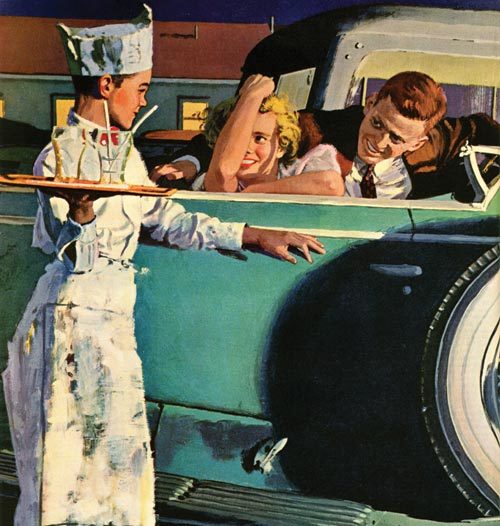
Kids These Days!
Hand-wringing about American youth is nothing new.
The problem with teens is that, well, they’re just a pain in the you-know-what and always have been. With all those wild hormones surging, and little of the self-control that a mature person naturally possesses, they’re bound to cause trouble, as these 20th-century excerpts from our pages reveal.
We Made It Too Easy for Them
What could have happened 40 years ago that took the stamina out of the men and women who were to become the parents of these amorphous youths whose accent of conscious superiority indicates so clearly immature minds? We ourselves had lived as pioneers, abstemiously, obediently, with few pleasures, and under hardships that produced strength of character. The idea was to give our children more happiness and a better chance. We have made it so easy for them that too many of them have become unfilial and egotistical.
But these young people are of the same stock that wrought a civilization out of a wilderness. The recent panic sent some of them to work, and what sends all of them to earning their bread will not be a panic — however it looks on the ticker — but a national blessing.
—“Parents and Children, Yesterday and Today” by Corra Harris, May 28, 1932
Lost Generation
The 5 million kids who were between 10 and 13 years old when the Japanese attacked Pearl Harbor six years ago are a lost generation and are rapidly becoming America’s major sociological problem. Everywhere on applications the classification “Check here if a veteran” haunts them.
Because they were born too late to fight, the feeling of not belonging has created a serious morale problem for the lost generation. Accustomed during the war to his own spending money and a feeling of social independence, the young nonveteran today finds himself literally an outcast.
The need for some kind of immediate action is pressing. The lost generation asks only for the chance to belong.
—“Our ‘Lost Generation’ Wants to Belong” by Arnold L. Horelick, August 2, 1947
Rush to Judgment
“Boys will be boys,” we used say, when the neighborhood kids jumped on the back end of the streetcar and pulled the trolley off its overhead wire. We said it again when they broke out with a black eye after a fight behind the barn. Now all the neighborhood kids are juvenile delinquents, whether they belong to the switchblade set under the Brooklyn Bridge or to the baseball team that plays in the Smiths’ empty lot at the corner of Elm and Pine. … Granted, juvenile delinquency — especially in our cities — is a serious problem, but why continually drag in that dispiriting phrase every time a teenage activity is mentioned?
—“You’d Think It Was Unconstitutional to Be a Teenager” by Carol Spicer, September 20, 1958
Teen Spirit
“Our youths now love luxury. They have bad manners, contempt for authority, disrespect for older people. Children nowadays are tyrants. They no longer rise when their elders enter the room. They contradict their parents, chatter before company, gobble their food, and tyrannize their teachers.”
This remark sounds like the beginning of a letter to a metropolitan newspaper or the lament of an old-fashioned parent of the 20th century. In fact, it was made by Socrates in the fifth century B.C.
Are these comments any more valid now than they were in Socrates’ time? I am inclined to think not. What the young person of today needs above all else is peace — peace with himself. Most of them, left alone, come to some sort of armistice with themselves sooner or later, but one is never sure that hostilities are over. This sort of peace involves recognition; and it is our job as teachers and parents to see that this recognition comes in a way which will lead to happiness in the future.
—“Why Do They Misbehave?” by Edward T. Hall, September 10, 1960
In 1953, J. Edgar Hoover published an FBI report warning that “the nation can expect an appalling increase in the number of crimes that will be committed by teenagers in the years ahead.” The message reverberated in Congress, where President Dwight Eisenhower used his 1955 State of the Union to call for a federal legislation to “assist the states in dealing with this nationwide problem.” Fredric Wertham’s international bestseller Seduction of the Innocent relied on sketchy forensics and hysterical prissiness to argue that comic books were a cause of juvenile delinquency. On the one hand, Wertham’s consideration for art’s influence on young people is noble in the abstract. But his specific recommendations were priggish in the extreme; he complained, for example, that Superman was a fascist and Wonder Woman turned women into lesbians. He called comic books “short courses in murder, mayhem, robbery, rape, cannibalism, carnage, necrophilia, sex, sadism, masochism, and virtually every other form of crime, degeneracy, bestiality, and horror.”
As soon as teenagers were invented, they were feared. Many social critics made no distinction between the young car-jacking thieves and the comic readers. To an old worrywart, they were all feral gypsy sprites.
The last 60 years have made teenagers separate. But are they really so different? Or are teens just like adults — but with less money, fewer responsibilities, and no mortgage?
There is some evidence that, as many parents quietly suspect, teenagers are chemically distinct from the rest of humanity. They suffer uniquely from loosely connected frontal lobes, the decision center of the brain, and an enlarged nucleus accumbens, the pleasure center. So where adults tend to see the downsides of risky behavior in high definition, teenagers see the potential rewards as if projected onto an IMAX screen with surround sound. The result is sadly predictable: Teens take more risks and suffer more accidents. Americans between 15 and 19 have a mortality rate that’s about three times higher than those ages 5 to 14.
For Laurence Steinberg, a career investigating the teenage mind started with a common observation that is self-evident to parents, teachers, or anybody with even the faintest memories of high school: Teenagers often act dumber around other teenagers. Steinberg, a psychologist at Temple University, put people of various ages in a simulated driving game with streets and stoplights. Adults drove the same, whether or not they had an audience. But teenagers took twice as many “chances” — like running a yellow light — when their friends were watching. Teenagers are exquisitely sensitive to the influence of their peers. The precise definition of coolness may change over time, from cigarettes to Snaps, but the deep, animal need to possess it does not.
But what is coolness, anyway? In sociology, it is sometimes defined as a positive rebellion. It means breaking away from an illegitimate mainstream in a legitimate way. That might sound like a fussy definition. But it has its uses. My high school had a dress code, and when you’re 14 years old, violating a repressive clothing regime is a beautifully obvious way to signal to other kids that you’re noncompliant. But not always. What about sagging your slacks at a school memorial for war heroes? Or proudly untucking your shirt at a funeral for the school’s favorite teacher? The same group of people can consider an outfit cool or deeply disrespectful, depending on how legitimate people view the norm that it’s violating.
At the end of the 20th century, many teens gravitated to logos. The long economic expansion from the 1980s and the 1990s gave them the means to spend lavishly on clothing emblems. A fashion hit like Ralph Lauren was based not only on the quality of the garment, but also on the logo’s talismanic power in high school hallways.
In recent years, the smartphone screen displaced the embroidered logo as the focal point of teen identity. It was once sufficient to look good in a high school hallway, but today, Snapchat, Facebook, and Instagram are all high school hallways, where young people perform and see performances, judge and are judged. Many decades after another mobile device, the car, helped to invent the teenager, the iPhone and its ilk offered new, nimble instruments of self-expression, symbols of independence, and better ways to hook up.
And so, in half a century, teenagers went from being a newfangled classification of awkward youth to an existential threat to American security to a valuable consumer demographic and a worthy topic of research. Teenagers are the market’s neophiles, the group most likely to accept a new musical sound, a new clothing fashion, or a new technology trend. For adults, especially those with power and money, the rules are what keep you safe. When you’re young, every rule is illegitimate until proven otherwise. It is precisely because they have so little to lose from the way things are that young people will continue to be the inexhaustible motor of culture.
From Hit Makers by Derek Thompson, published by Penguin Press, an imprint of Penguin Publishing Group, a division of Penguin Random House LLC. Copyright 2017 by Derek Thompson.
Derek Thompson is a senior editor at The Atlantic magazine, where he writes about economics and the media and is a regular contributor to NPR’s Here and Now.
This article is featured in the January/February 2018 issue of The Saturday Evening Post. Subscribe to the magazine for more art, inspiring stories, fiction, humor, and features from our archives.
The Unknown World of Competitive Adult Figure Skating
The Winter Olympic Games offer a spotlight to the thrilling, high-stakes atmosphere of elite figure skating. Part performance, part athleticism, and — sometimes — part melodrama, the dazzling sport has enjoyed decades of wide appeal.
Nathan Chen’s quadruple jumps and Adam Rippon’s sassy social media presence are excellent reasons to follow Team USA this year, but Pyeongchang isn’t the only destination for competitive figure skating. Since 1995, the U.S. Figure Skating Association has held an annual national competition to find America’s best adult athletes.
These skaters often train daily, spinning and jumping on the rink and working full-time off the ice. The five classes of competitors range in age from 21 to over 66 years old, and this year they’re heading to Marlborough, Massachusetts for the championships in April.
Donna Wunder, of Yarmouth Ice Club, is the competition chair, and she thinks the resilience of adult figure skaters can be an inspiration to everyone. Although figure skating is admittedly easier on a younger body, Wunder says, “Once you have the passion to be on the ice, it’s hard to let it go.” Maybe that’s why these mature skaters have risked falls, concussions, and broken hips to dedicate hours of ice time to self-improvement. The unyielding nature of the ice rink seems dangerous, but “as a member of the older crowd, sometimes walking across the floor can be dangerous,” Wunder says.
Whether they’re seeking renewal of a former career or just beginning their new favorite sport, these grown-up skaters want the world to know that toe loops and camel spins aren’t just for the pros.
Civics on Ice
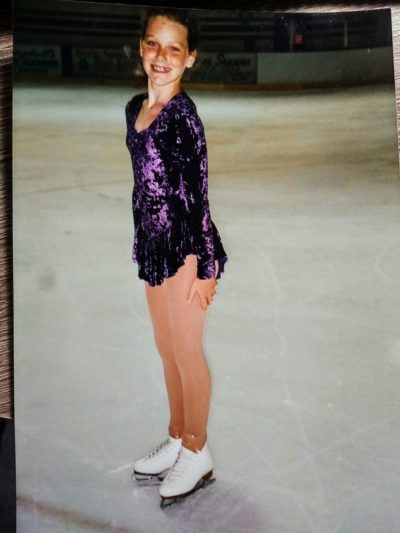
In Brewster, Massachusetts, Rebecca Hamlin grew up skating on frozen cranberry bogs while her grandfather drove the Zamboni at the famed Cape Cod Coliseum.
“I did ballet and gymnastics,and figure skating was like a combination of both. The grace of ballet with the adrenaline of gymnastics. Throw a quarter-inch blade into the mix and I was sold.”
Hamlin will be 33 at the national competition, and she’s coming back after a second-place result in 2014. “That was something I never had as a kid, having to end the career and go to school. It was a big moment,” she says.
As a youth competitor, Hamlin skated at the Tony Kent Arena when Nancy Kerrigan and Paul Wylie trained there for the Olympics in the ’90s: “She was my idol. Being a 10-year-old girl in the same rink as your idol is a big deal.” It was at Tony Kent that Hamlin collided with another skater at age 11 and took a toe pick to the leg. She needed stitches, but it didn’t hold up her “fast and fearless” skating.
Off the ice, Hamlin uses her Master’s degree in International Politics as chief of staff for Massachusetts House member Timothy Whelan. While she craves the tension of a fast, packed skating program, Hamlin says running for office herself probably isn’t in the cards.

This year, she is competing with two showcase programs. After travelling with a theatre on ice team, Hamlin became interested in how storytelling and skating can combine. She will perform Annie Lennox’s “I Put a Spell on You” in a sequined black dress and Michael Jackson’s “The Way You Make Me Feel” in a beaded, hot pink one. “It’s all about how you can involve the audience in your program,” she says.
Hamlin looks at skating as a lifelong gift she’s received from her parents, who sacrificed time and money for all that goes into it. Costumes, skates, travel, and competitions add up financially, and that becomes crystal clear as an adult.
New Wave and Old Aspirations
“I don’t want to skate to Duran Duran because they’re my favorite band, and I don’t want to get sick of the music,” says Los Angeles-native Julie Gidlow. At 49 years old, Gidlow is competing in her 24th adult national competition. That makes her one of a handful of skaters to attend every year since 1995.
A self-described “rock ‘n’ roll chick,” Gidlow worked as a news editor for the music magazine Radio & Records for almost 20 years. Apart from affording her opportunities to meet INXS — and
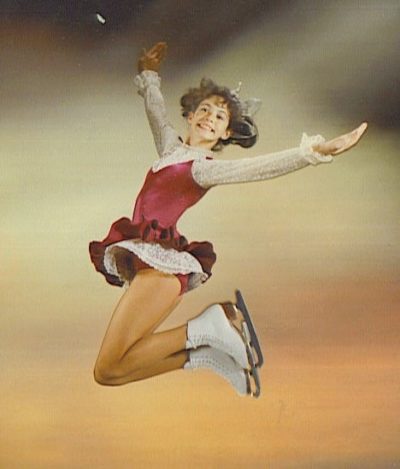
Duran Duran — the journalism job allowed her to rekindle her love of ice skating: “It always nagged at me that I didn’t finish skating. I stopped skating, but I didn’t finish it.”
She found her passion for the ice at a birthday party at 9 years old and competed until she was 16. Gidlow grew up skating at the Santa Monica Ice Capades Chalet, the training rink of Tai Babilonia and Randy Gardner. Babilonia and Gardner were gold medalists at the 1979 World Championships, but the duo had to withdraw from the 1980 Olympics when Gardner pulled a groin muscle.
Gidlow found that, as a child, she never understood the concept of competitive skating. Her parents worked the logistics, and she just showed up. At a certain point, she didn’t feel she was skating for herself anymore. When she was a teenager, her father asked if she wanted to keep skating or to have a car, and “before he finished the question, I chose a car,” Gidlow said.
In 1994, Elaine Zayak returned to the U.S. Championships after a 10-year hiatus from competitive skating and placed fourth, receiving a standing ovation and an alternate status on the Olympic team at Lillehammer. Gidlow was inspired by Zayak’s comeback, and she

thought, if she can do that, so can I, albeit on a smaller scale. Gidlow wanted to complete her skating tests — like “free skate” and “moves in the field” — but she discovered the nascent USFSA’s adult competition and gave it a shot.
Skating to songs by Sting and 10,000 Maniacs, Gidlow fell in love with the ice all over again. She understood her parents’ sacrifices, and it gave her a new appreciation for the sport. “Everything I do is in support of my skating,” she says, “My job gets me a paycheck so that I
can pay for the things I love, and one of the things I love is skating.”
After several herniated discs, she can no longer perform double jumps or single axels, but Gidlow looks forward to the national competition each year. She particularly enjoyed the first time a fan yelled “Go, mommy!” to a skater. That was something she’d never heard before.
The Spinning Florist
Lisa Stevenson spends many weekends at the skating rink with her four hockey-playing kids, and she gets the opportunity to work on her combination jumps while she’s there. The 50-year-old mother from Nantucket didn’t grow up with a nearby rink, but she embraced figure skating in her 20s as a way to decompress.
While Stevenson was studying for her PhD in biochemistry, she found skating to be an exciting respite. In the lab, she was genetically modifying breast cancer cells, a tedious task that involved long periods of waiting. Stevenson remembered watching Dorothy Hamill skate as a young girl, so she decided to lace up some blades and head to a rink in between sessions at the lab.
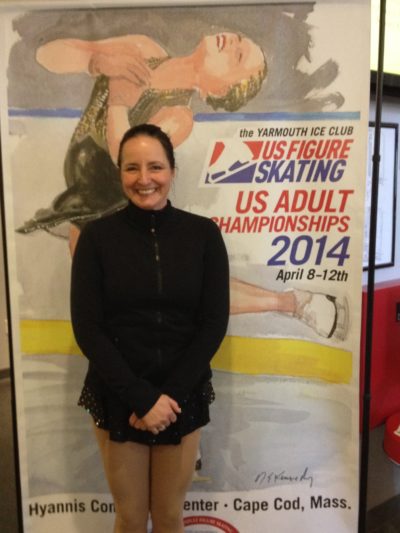
After inquiring around, she got in touch with an experienced skater who could give her lessons: Konstantin Kostin, a Latvian Olympian who taught her a flip jump and a loop jump on the first lesson.
Since she had skied in high school, Stevenson had a good sense of balance, but the footwork was all new. She loves figure skating because it clears her mind and helps her to focus on learning and improving. “There’s a hint of danger. You have to get your nerve up to try something new, but once the music’s on, you kind of forget about it.” Lately, she enjoys skating to “Havana” by Camila Cabello.
Stevenson will be attending her second national competition. She notes the supportive atmosphere of the championships, saying people will throw flowers to every skater. One man makes paper flowers by hand with attached notes and gives one to each competitor. Stevenson particularly appreciates this because she is a florist herself.
Her flower company, Foxgloves and Fern, started while she was the president of the town garden club. Her house is a 1700s Williamsburg-style colonial home abutting 80 acres of conservation land, and the garden — featuring rhododendrons, indigo, anthemis, and her great-grandmother’s peonies — was designed to reflect the home’s history.
At this year’s competition, Stevenson will be performing her combination jumps and camel spins to the theme from Jurassic Park (the same music as Tonya Harding’s 1994 reskate at the Lillehammer Olympics, but Stevenson chose it because her son played it in band). She isn’t vying for a top spot, but she would like to perform her personal best. Stevenson hopes to figure skate for the rest of her life and, maybe, convince one of her kids to get into figure skates as well.
Your Weekly Checkup: Are Married People Healthier?
“Your Weekly Checkup” is our online column by Dr. Douglas Zipes, an internationally acclaimed cardiologist, professor, author, inventor, and authority on pacing and electrophysiology. Dr. Zipes is also a contributor to The Saturday Evening Post print magazine. Subscribe to receive thoughtful articles, new fiction, health and wellness advice, and gems from our archive.
Order Dr. Zipes’ new book, Damn the Naysayers: A Doctor’s Memoir.
Are you married? Happily? My wife and I have been married 57 years—happily, though we sometimes have our disagreements. (She calls them discussions. I call them fights. She likes them. I don’t.)
According to a recent study of more than 6,000 individuals undergoing heart catheterization for known or suspected coronary (cholesterol-related) artery disease and followed for almost four years, the chances of living longer were greater if they were married.
Unmarried individuals—whether divorced, separated, widowed, or never married—have about a 50% higher rate of cardiovascular death or heart attack compared to married folks. In other heart studies, unmarried people undergoing coronary bypass surgery or stent placement had higher adverse cardiovascular events compared to married people. But you need a happy marriage because unhappy marriages had poorer outcomes compared to happy ones.
What might explain these findings? A host of possibilities exist: unmarried people may experience a lack of social support, lack of caregiving, and emotional or financial stress and a more sedentary lifestyle. Unmarried individuals may have also self-selected because of psychological or socioeconomic problems. Married couples may have better adherence to medical advice and taking medications. Loneliness, which I addressed in a previous column, can play a role. Blood pressure may be important since high marital quality has been shown to be associated with lower blood pressure, lower stress, less depression, better sleep patterns, and greater satisfaction with life.
Note the emphasis on “high marital quality.” Unmarried individuals compared with those in low-quality marriages had lower blood pressure, suggesting that single individuals fare better than their unhappily married counterparts. Happily married couples have reduced inflammatory markers in the blood, reduced neural stress on the heart, and better functioning immune systems, all of which can impact the development of coronary artery disease. The link between marriage quality and cardiovascular risk appears to be greater in older individuals and more pronounced among women than men.
Whatever the reasons—and they are many and complex—marital status and marital quality are consistent predictors of health outcomes, including cardiovascular disease and mortality. What can you do about it? Obviously, be happily married—not so easy for many people. But at least be aware of the fact that being unmarried or unhappily married can detrimentally affect your general and cardiovascular health. Forewarned is forearmed. Try to change that, if you can.
Get the Most from Your Cruise with These 4 Apps
These four free apps are perfect for those in need of vitamin “sea.”
Cruise Finder: Check out more than 25 destinations on 40 cruise lines and 25,000 itineraries for your dream vacation. (iOS | Android)
Ship Mate App: Chat with shipmates, share photos, and find excursion options not offered by the cruise line.
TripAdvisor: Sift through must-see sights, restaurants, and tours while exploring ports on your own. (iOS | Android)
CruiseCardControl: Budget, itemize by categories, and track onboard spending with this simple and efficient app.
Healthy Weight, Healthy Mind: Pay Attention to Lose Weight
We are pleased to bring you this regular column by Dr. David Creel, a licensed psychologist, certified clinical exercise physiologist and registered dietitian. He is also credentialed as a certified diabetes educator and the author of A Size That Fits: Lose Weight and Keep it off, One Thought at a Time (NorLightsPress, 2017). See all of David Creel’s articles here.
Do you have a weight loss question for Dr. Creel? Email him at [email protected]. He may answer your question in a future column.
As we go through daily life, multiple thoughts enter our heads like a parade that never ends. Each thought may lead to an action that can trigger more thoughts, more behavior, and so on. Our minds relentlessly create judgment, worries, memories, and ideas. For those of us concerned about weight, these thoughts are often related to eating. Like a game of tennis played on the court of life, our thoughts and behaviors are constantly in flux, moving us toward or away from healthy places. When it comes to food, the back and forth of our tennis match may go something like this:
It’s nine p.m. and you just finished watching your favorite TV show. Now the food commercials start. In less than 30 seconds you see a woman seemingly transformed by a bite of creamy Greek yogurt. Her eyes close and her head tilts slightly to the side as her lips close softly around this magical spoonful of raspberry swirled yogurt. “Wow, that looks great,” you think. You respond to that thought by heading to the refrigerator. You pull the door open and see yogurt, some cheese sticks, and, oh—there’s the chocolate sauce. Seeing chocolate sauce reminds you of ice cream in the freezer. Perhaps you should make sure it’s there.
Yep, you still have ice cream. You open up the container and consider “cleaning up” the ice cream stuck to the inside edges of the carton and then scraping and tasting until all is symmetrical and level. Should you scoop some into a bowl?
If you decide to eat ice cream, your beliefs about that behavior also have a lot to do with how much you eat. Thinking about the flavor instead of the health effects of ice cream can lead to overeating.
Over time, strings of behavior and thoughts like the ones above can lead to bad habits. It’s like we’re stuck playing tennis on one part of the court. Upcoming chapters will help you learn to change your environment and alter your thinking, but the first step to interrupting these thoughts and breaking bad habits is to pay closer attention to what you’re doing.
We have discussed motivation and the idea of committing to the process of weight management. This commitment is not simply about how we think—we also commit to taking action, because actions propel us to improve our health and transform our bodies. More importantly, some practices eventually shape our perspectives and become part of who we are.
As a young man, I learned a valuable lesson about dangerous patterns of thoughts and behavior—a lesson that would eventually help me break the risky and costly habit of speeding. At two different times in my 20s, I received multiple traffic tickets within a year. Not only did it cost me money I didn’t have to spare, it earned me two separate trips to defensive driving school. If you’ve never attended a defensive driving class, take my word, it isn’t a great way to spend Tuesday evenings. After my second set of enthralling group interactions, I decided I didn’t really like the idea of paying fines and watching videos about the dangers of speeding. But speeding was sort of a habit with me. I told myself I was driving with the flow, but in reality I drove with the flow in the far left lane. To avoid getting additional traffic tickets I did two simple things: I noticed the speed limit wherever I was driving, and I frequently checked my speedometer. I stopped “going with the flow.” I began paying attention.
“Going with the flow is one way of describing ingrained habits for eating and exercise. We need to pay attention in order to change eating and activity levels. It may seem you don’t eat differently than other people, and that may be true, depending on who you compare yourself to. But if you’re gaining weight, or maintaining excess weight, then going with the flow probably won’t lead to weight loss.
Come back each week for more healthy weight loss advice from Dr. David Creel.
Abe Lincoln’s Favorite Cake
On the anniversary of Abraham Lincoln’s birthday, try the cake Lincoln called “the best in Kentucky.”
Originally published in The Saturday Evening Post, February 16, 1957.
Every year when the 12th of February comes around, Dr. R. Gerald McMurtry, of Fort Wayne, Indiana, gets a special birthday cake which his wife, Florence, knows exactly how to bake for him. It’s rather rich cake, containing whites of six eggs and a cup of chopped blanched almonds, with half a cup of candied pineapple and fine-chopped cherries poured into the icing. This isn’t for Doctor McMurtry’s birthday, however. It’s for Abraham Lincoln’s. The recipe was handed down in the family of Mary Todd Lincoln. Mrs. McMurtry learned it from her husband, a cheery, mild-mannered man with a Kentucky drawl who, as it happens, is one of the world’s leading professional Lincoln scholars.
“Lincoln had a great sweet tooth,” says McMurtry, who has honorary doctoral degrees from Centre College and Iowa Wesleyan. “For instance, in 1841 he wrote a letter to Mary Speed, of Louisville, Kentucky, telling how he remembered ‘delicious dishes of peaches and cream’ he used to get at her house. Otherwise, Lincoln was a spare eater.”
Mary Todd Lincoln’s Recipe (with Mrs. McMurtry’s baking hints in parentheses)
Mary Todd made this cake for Lincoln before their marriage, and he declared it “the best in Kentucky.”
- 1 cup butter
- 2 cups sugar
- 1 cup milk
- 3 cups flour (cake or pastry)
- 2 tsps. baking powder (double-acting)
- 1 tsp. vanilla
- 1 cup chopped blanched almonds
- 1/4 tsp. salt
- 6 egg whites
Cream butter and sugar lightly. Sift flour and baking powder together and add alternately with milk (to the first mixture). Add well-floured nuts, then vanilla. Fold in stiffly beaten whites of egg, to which salt has been added. Bake in three layers (9″ or 8″ pans) in moderate (350° F) oven. Ice with boiled icing, to which add 1/2 cup candied pineapple and cherries, chopped fine.

How to Impress Your Valentine Without Spending a Fortune
Valentine’s Day is a holiday celebrating love, but it’s easy to feel pressured to make reservations at a fancy restaurant, buy expensive chocolates, and order out-of-season, overpriced bouquets. We’ve compiled a list of cheaper Valentine’s Day alternatives that will keep up with the holiday theme without breaking the budget.
Skip the Reservations and Make a Special Heart-Themed Meal at Home

The most obvious answer to save money on Valentine’s Day is to ditch the fancy restaurant reservation. It’s easy to create V-Day themed goodies with just various sized heart-shaped cookie cutters. Start the day with breakfast in bed, complete with heart-shaped pancakes and fruit. Send them off to work with a lunch heart-shaped sandwich, and, if they haven’t gotten tired of the heart theme yet, create a heart-shaped pizza right at home (if pizza making is not your forte, both Papa John’s and Pizza Hut make them on V-Day) and finish off with chocolate covered strawberries and some homemade heart sugar cookies.
If you want to skip the cutesy heart theme, then chicken piccata, beef bourguinon, and homemade spaghetti and meatballs are romantic dinners with a lot of bang for your buck. No cookie cutters needed.
Try Temporary Tattoos
Feel like a kid again with these custom temporary tattoos. Scare your mom (or kids) into thinking you got a tattoo with your SO’s name or put them in an obvious place when going out and see what kind of reactions you receive. Don’t worry, they wash off after 24 hours.
Ditch the Roses
Daisies, tulips, and carnations are cheaper than roses, but still beautiful. Trader Joe’s is known for their cheap floral department with beautiful bouquets and 1-800 Flowers offers great savings.
Did you know if you subscribe to The Saturday Evening Post you get 15% off your 1-800 Flowers purchase?

Make Homemade Candy
Instead of buying your favorite candy bars, make them instead. Homemade Twix, Reese’s Cups, and Snickers are simple, and you can make them together.
Write a Book of Love Poems
Didn’t major in Creative Writing? That’s okay. A book filled with romantic prose will still get your point across. Write a special note on the first page to add a personalized touch.
Get Creative with a $20 Budget
Or $10, or $50. Sticking to a low budget relieves the pressure of getting the perfect gift. Turn the spending budget into a game and see who can come up with the most creative present.
Remember, Valentine’s Day really is about showing your loved one you care. Snuggle up with a movie, pop some popcorn, and enjoy each other’s company.
The Lincoln Cult
From the February 15, 1957 issue of The Saturday Evening Post
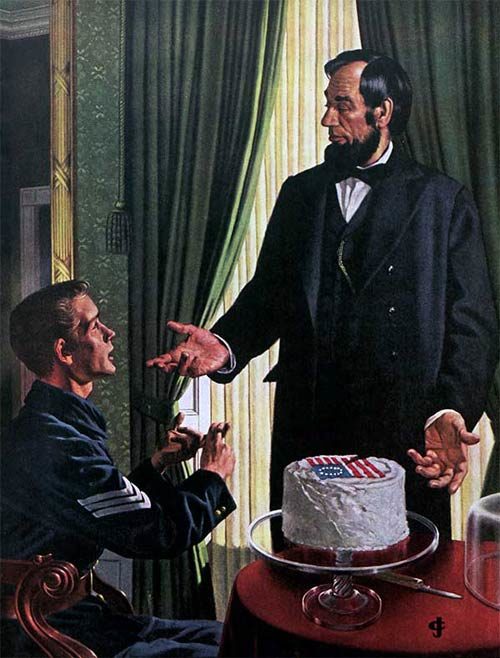
No other man ever won such a firm place in our hearts as Honest Abe, whose every act has been subjected to microscopic scrutiny. And the years witness an ever-widening expansion of The Lincoln Cult.
Every year when the twelfth of February comes around, Dr. R. Gerald McMurtry, of Fort Wayne, Indiana, gets a special birthday cake which his wife, Florence, knows exactly how to bake for him. It’s rather rich cake, containing whites of six eggs and a cup of chopped blanched almonds, with half a cup of candied pineapple and fine-chopped cherries poured into the icing. This isn’t for Doctor McMurtry’s birthday, however. It’s for Abraham Lincoln’s. The recipe was handed down in the family of Mary Todd Lincoln. Mrs. McMurtry learned it from her husband, a cheery, mild-mannered man with a Kentucky drawl who, as it happens, is one of the world’s leading professional Lincoln scholars.
“Lincoln had a great sweet tooth,” says McMurtry, who has honorary doctoral degrees from Centre College and Iowa Wesleyan. “For instance, in 1841 he wrote a letter to Mary Speed, of Louisville, Kentucky, telling how he remembered ‘delicious dishes of peaches and cream’ he used to get at her house. Otherwise, Lincoln was a spare eater. By the way, some authorities credit him with popularizing bacon fried crisp. He’s supposed to have taught soldiers around Washington, D.C., how to prepare bacon that way.”
Doctor McMurtry will gladly tell you anything you may wish to know about Abraham Lincoln and the Civil War period. If he doesn’t know right off, he can look it up handily in one of the largest collections of organized information ever gathered about any historical character, the Lincoln National Life Foundation library and museum at Fort Wayne. The foundation has more than 9000 books and pamphlets exclusively about Lincoln, including 300 in foreign languages. As director of the foundation, Doctor McMurtry answers several hundred letters a month from all over the world. He settles arguments on such subjects as Lincoln’s political views, his appearance, whether he ever visited a certain town or said this or that. Or, frequently, whether Abraham Lincoln was legitimate.
“He was, definitely,” Doctor McMurtry reports, patiently citing Kentucky documents and dates. Thomas Lincoln, Abe’s father, was married to Nancy Hanks on June 12, 1806, by the Reverend Jesse Head, a Methodist minister. Head’s return of this marriage can be seen today at the courthouse in Springfield, Kentucky. Lincoln was born in 1809.
Answering questions is only part of Doctor McMurtry’s job. He is constantly on the look-out for new material for the Fort Wayne collection. He travels here and there, lecturing before civic groups, schools and clubs. He edits Lincoln Lore, a monthly bulletin which goes out free on request to more than 6000 historians, collectors and nonprofessional Lincoln admirers, including Herbert Hoover, Cardinal Spellman and Jim Farley. A typical issue tells about Lincoln’s diverse occupations. He was a farmer, railsplitter, flatboatman, soldier, store clerk, postmaster, surveyor, lawyer, newspaper publisher, politician, and even inventor, having patented a device to help river boats navigate in shallow water.
Doctor McMurtry serves a vast and growing Lincoln cult which is, in itself, a national and international phenomenon. More and more people, it seems, are ravenous for information about every phase of Lincoln’s life, background and career. Every week in the year on an average, Doctor McMurtry says, at least one book or pamphlet is published about our sixteenth President. There are approximately 12,000 Lincoln publications available now. These range from learned biographies and popularizations such as Carl Sandburg’s famous works to peculiar titles like Lincoln Never Smoked a Cigarette or Lincoln and the Pig.
Besides reading about Lincoln and his times, the Lincoln cultists get together as often as they can to talk about him; they have discussion groups in all the major United States cities. London, England, has its active Civil War Round Table. The London group, McMurtry says, is particularly interested in the Confederate viewpoint. Doctor McMurtry’s remarkable public probably ranks as the world’s most active tourist clan too.
More than 2,000,000 people a year visit the Lincoln Memorial in Washington, D.C., and some 200,000 go to the Ford Theater museum in the Capital. Elizabeth E. Hamer, of the Library of Congress, says most visitors to the library—about 750,000 annually—see the Lincoln exhibit there. It includes the first draft and reading copy of the Gettysburg Address, the Second Inaugural Address, and a page from Lincoln’s school note book. Mrs. Hamer is fond of a bit of doggerel scrawled in his notebook by the backwoods youth:
Abraham Lincoln, his hand and pen
He will be good, but God knows when.
The Library of Congress has President Lincoln’s personal papers, donated by his son, Robert Todd Lincoln, who died in 1926. Robert made a provision that the papers could not be opened until twenty-one years after his death. The opening, in 1947, was an exciting occasion for a select group of historians invited. Doctor McMurtry was among them, and he’ll never forget this curious Washington party.
“They almost rushed the guards for that first look,” he says. “The papers cleared up many problems, but there are more than eighteen thousand items in the collection. It will take another fifty years to evaluate them fully.”
Some 300,000 people a year go to view the birthplace log cabin at Abraham Lincoln National Historical Park, Hodgenville, Kentucky. One day last fall, Ernest L. Wright, Jr., superintendent, got to wondering where they came from. “We checked in forty-six states, the District of Columbia and thirty-one foreign countries,” he reports. At Springfield, Illinois, more than 500,000 visitors annually go through the sedate Lincoln home on Eighth Street, a big two-story frame structure with shuttered windows. Lincoln bought the house and lot for $1500 in 1844 from the Episcopal rector who had married him and Mary Todd.
“Most of our visitors are surprised that Mr. Lincoln had as nice a home as this,” says Mrs. J. H. Bradish, the custodian. “They just naturally think he jumped direct from the log cabin in Kentucky to the White House.” Women visitors are touched at the sight of little Tad Lincoln’s rocking horse, and tired businessmen smile appreciatively at the long horsehair sofa in the parlor. Lincoln, who stood six feet four, had the sofa specially made for himself.
Another 500,000 visitors annually sign their names at the Lincoln tomb, at Oak Ridge Cemetery, Springfield. Many of them continue their pilgrimage to the restored Lincoln village of New Salem, also in Illinois. All kinds of people come, from all walks of life.
Nearly every true Lincoln fan eventually becomes a collector—whether it be books, pictures, campaign ribbons or merely Lincoln pennies. Doctor McMurtry is a victim of this urge. His house on shady Rudisill Boulevard, Fort Wayne, is full of Lincolniana. His prize piece is one he found himself down in Kentucky, an old corner cupboard made of cherry and poplar which, he believes, was made by Thomas Lincoln. McMurtry got it from an elderly farm woman.
“The Lincoln family were en route to Indiana in a wagon,” Doctor McMurtry says. “As the story goes, they were fording a swollen stream and this cupboard fell in. Tom Lincoln decided to go on without it.”
Certain tricks of craftsmanship on other known Thomas Lincoln furniture, like Tom’s habit of nailing on decorative panels rather than carving them into the main piece, and his distinctive star-and-streamer fancywork design, indicate to Doctor McMurtry that his cupboard is the real thing.
In a safe, the museum has hairs from Abraham Lincoln’s head and a piece of the towel used to dress the President’s fatal wound. The hairs were removed by one William Slade, Lincoln’s messenger, shortly after the President died. Back in the foundation’s cluttered vaults are gavels made from wood allegedly taken from the birthplace farm and a piece of brick from Ford’s Theater. The bric-a-brac which keeps coming in is often a problem.
Admirers of Honest Abe have an unfortunate habit of “impounding” things to save them for posterity. McMurtry has turned down chips and slivers taken from the White House.
Some time ago a Wisconsin lady wrote Doctor McMurtry offering a slightly moth-eaten tail feather from an eagle named “Old Abe” carried by the 8th Wisconsin Regiment in the Civil War.
“We didn’t buy it at the time, but we do have a feather from that eagle now,” Doctor McMurtry said.
People are always bringing in old letters, pictures, and so forth, wanting to know if they are genuine. A few of them are. Most of them, unfortunately, are not—and it makes these folks pretty sore when McMurtry has to break the sad news to them.
“I hate to hurt their feelings, but it’s my duty,” he says.
One item causes Doctor McMurtry and his Fort Wayne colleagues considerable embarrassment. For many years the foundation has published, as a courtesy, reprints of the Gettysburg Address in Lincoln’s handwriting on fine paper resembling sheepskin and marked as facsimiles. Somebody finds an old one in the attic and brings it in for appraisal. Actually, five autograph copies of the Gettysburg Address are known to be in existence, including Lincoln’s first draft, the reading text, and revised copies he gave out after the speech was made. Oscar B. Cintas, former Cuban ambassador to the United States, paid $54,000 for an authentic copy. The Illinois State Historical Library at Springfield has a copy Lincoln wrote out for Edward Everett. This, along with Everett’s own speech at Gettysburg, was purchased for $60,000. Part of the money was provided by school children of Illinois. In 1952 Doctor McMurtry attended the biggest sale of Lincolniana ever held, that from the estate of Oliver R. Barrett, Chicago lawyer, at the Parke-Bemet Galleries on Madison Avenue, New York. Proceeds were more than $200,000.
If, while rummaging through an old trunk, you should happen to find the original of Lincoln’s famous letter of November 21, 1864, to Mrs. Bixby, the Boston mother of five sons “who have died gloriously on the field of battle,” you might have something even more valuable than the Gettysburg Address, McMurtry says. The original Bixby letter has never been located. As a matter of fact, there are quite a few authentic pieces of Lincoln’s handwriting around. Their value, according to Doctor McMurtry, depends on their historical significance.
“For a plain autograph cut-out, and there are lots of these, collectors pay around twenty-five dollars,”he says. “An ordinary Lincoln letter brings around five hundred dollars. But I’d pay all I could raise for a letter in which President Lincoln might have said, ‘We are going to Ford’s Theater tonight.’”
The Fort Wayne museum and other collectors are even willing to pay for Lincoln forgeries—that is, if they’re good ones. Among the more popular known forged items are pictures and “old papers” attested by one William P. Brown. He was Mrs. Lincoln’s Negro coachman, and McMurtry believes he probably did receive a few genuine keepsakes from the President’s widow.
Incidentally, both Doctor McMurtry and his long-time associate, Dr. Louis A. Warren, director emeritus of the foundation, have little patience with the opinion widely held nowadays that Mary Todd Lincoln was a shrewish First Lady who gave her husband a terrible time.
“Mary Todd Lincoln was probably the most helpful influence in President Lincoln’s career,” Doctor McMurtry says. “It’s true, she did have a temper and would get mad at Abe now and then, but what wife wouldn’t? Abe wasn’t an ideal husband himself; he was too busy with his law practice and with affairs of state. It is also true that Mrs. Lincoln became emotionally ill and eventually had to be hospitalized. Most of this trouble came after the death of their son, Willie, and after Lincoln’s assassination; it’s understandable. But the main facts about Mary Todd Lincoln as we now understand them are that she was a good wife and a good mother. Lincoln loved her.”
Perhaps the most important part of Doctor McMurtry’s contribution is this work of clearing up misconceptions and myths that have, somehow, grown up around Abraham Lincoln.
“A lot of it is really folklore, and some of this is quite appealing,” Doctor McMurtry said. “For instance, there’s a story still current among Southern Illinois farmers that the brown thrushes didn’t sing for a year after Abraham Lincoln was killed. A very common one is the story about Lincoln having said, in answer to complaints that General Grant was drinking too much, that he wished he could get some of the same brand of whisky for his other generals. That’s in character, all right, but it’s folklore—the same statement was attributed to George III.”
There is still a raging controversy among Lincoln experts over the legitimacy of Nancy Hanks. Warren, a noted documentarian, says these charges are unfounded. McMurtry says he isn’t sure—“It’s a thing I’m not very interested in.” One Lincoln legend Doctor McMurtry hates to demolish for romantics who dote on it is that young Abraham Lincoln was hopelessly in love with fair haired Ann Rutledge and never quite got over losing her.
“Lincoln was acquainted with Ann Rutledge in the village of New Salem before he went to Springfield to practice law,” McMurtry says. “He liked her, and felt badly about it when she died. But there is no reliable evidence that he ever wanted to marry Ann.”
Doctor McMurtry’s services to the Lincoln public, for which he takes no pay beyond his salary, are made possible by the Lincoln National Life Insurance Company, whose founder, the late Arthur F. Hall, was an ardent Hoosier devotee of the Emancipator. A prized museum item is a letter written in 1905 to Mr. Hall by Robert Todd Lincoln. The letter authorizes “use of a portrait of my father upon the letterhead of such a life insurance company named after him,” and Robert enclosed a favorite Brady photograph of his father. They still have it at Fort Wayne, along with 130 other original photographs of Lincoln.
The historical foundation was organized in 1928, with Doctor Warren as its first director. He had been Gerald McMurtry’s Sunday-school teacher down in Elizabethtown, Kentucky, and brought him to Fort Wayne as his assistant in 1931. After five years at Fort Wayne, McMurtry went to Lincoln Memorial University at Harrogate, Tennessee, where he headed the Department of Lincolniana, edited the quarterly Lincoln Herald, and built up an outstanding museum. Last year, unusually youthful-looking at fifty and still full of lively curiosity about Lincoln, McMurtry took over as director when his elder mentor, Warren, retired to write and lecture.
Doctor McMurtry was out of the Lincoln business for one year in 1936, when he decided to try selling insurance with his family’s agency at Elizabethtown.
“I couldn’t get much done,” he recalls. “People knew I was a Lincoln student. Somebody would call me on the telephone and ask me to come over. I’d think I was going to make a sale, but when I’d get there, the customer would say he found an old Civil War newspaper up in his attic, or something of the sort, and that would be what he wanted to see me about. I couldn’t do any business— everybody wanted to talk history!”
McMurtry, the insurance man, was saved from this dilemma by an elderly retired doctor who owned a lot of real estate in Elizabethtown. The doctor, who was lonely, offered Gerald all his insurance contracts, if he’d just drop around now and then for a good confabulation about Lincoln.
“That one sale was the biggest in the history of our agency up to that time,” McMurtry declares. Soon he got the L.M.U. offer, however, and couldn’t resist the chance to get back to full-time Lincoln work. “Even now,” he says, “I look around me sometimes and think how lucky I am. They pay me for having fun!”
Not that it’s any sinecure, however. Doctor McMurtry’s working day starts at eight o’clock, dictating letters. Now and then, an urgent long-distance call comes in from New York, perhaps a magazine editor or TV script writer wanting to know something about Mary Todd Lincoln or Nancy Hanks. Then there’ll be people to take through the museum. While he’s doing all this, McMurtry has to keep up on his research for Lincoln Lore, and he may have to come back at night to prepare for a lecture in Chicago, Denver or New Orleans. He is called on frequently to make talks down South.
“One time down there a lady got up and said she had no use for Mr. Lincoln, just hated him,” Doctor McMurtry recalled, smiling. “I told her I hated Julius Caesar too. I don’t, of course. Why hate a historical character?” Actually, both he and Doctor Warren say they find Southern audiences uniformly courteous and, like people everywhere, sincerely eager for information about the martyr President.
“Abraham Lincoln seems to take hold of people as no other historical character does,” Doctor McMurtry says. “He is someone they can tie themselves to. He possessed a true nobility of character, yet he was like the rest of us in so many human ways. We feel that we really know him. Yet Abraham Lincoln remains a paradox; try as you will, you cannot master all the elements of his character. That is what makes him so fascinating to me and, I think, to others who study his life.”
If you want to make a hobby of Lincoln studies, Doctor McMurtry advises you to begin by reading several standard biographies. Then, he says, you should specialize on one phase of Lincoln’s activities—Lincoln as a lawyer, for example. Or Lincoln as a military strategist, perhaps.
“You simply can’t master the whole thing in one lifetime,” McMurtry says. “But you’d be surprised at how interesting these specialties can become.” Every public library has its Lincoln shelves. Among larger centers for Lincoln information besides Fort Wayne and the Library of Congress are the Illinois State Historical Library at Springfield; the Huntington Library at San Marino, California; Brown University’s library at Providence, Rhode Island; Lincoln Memorial University in Tennessee; Indiana, Illinois and other state universities. Lectures on Lincoln are given at the Chicago Historical Library and museum in Lincoln Park.
Doctor McMurtry classifies the Lincoln following—his customers—as either highly sophisticated collectors and bibliophiles, of whom there are several thou sand, or just plain folks, millions of them. He knows a preacher in Illinois, for instance, who went without an overcoat one winter to buy an expensive Lincoln book. High and low, whoever they are, they all love Lincoln.
There may be a few exceptions, though, Doctor McMurtry admits. One of these is right there in his home at Fort Wayne. Her name is Jan, three years old, blond. Not long ago Mrs. McMurtry had to go downtown during the evening and Doctor McMurtry was elected to stay home and baby-sit with Jan.
“She was a bit restless, so I started reading baby books to her,” he said. “After a while, Jan got tired of that, so I tried telling her stories about Santa Claus, and finally, Abraham Lincoln. About that time, my wife came home.
“My daughter Jan said, ‘Mamma, I don’t like daddy, I don’t like Santa Claus and I don’t like Abraham Lincoln!”
Doctor McMurtry is confident Jan will become a fan, though, when she gets to know a little more about Abe. Everyone else does.
From Bloomers to Pantsuits: A Brief History of Women’s Dress Reform
Only within the last 70 years has it become socially acceptable for women to wear pants. Until the mid-1960s, the average American woman wouldn’t dare leave her house wearing dungarees. But as early as the mid-1800s, a few pioneering women had started quite literally making strides toward more practical women’s wear.
Dress Reform in the Mid-1800s
In the early 1800s, men’s and women’s fashion overlapped very little. Few women wore pants. For women, the purpose of clothing was not so much for function, but to make them look curvier, and it took women a significantly longer time to dress each day due to the number of layers they wore. The typical style included a dress or a long skirt with a blouse. Beneath the skirts were steel hoops and petticoats to make the skirt rounder. A corset also cinched the woman’s waist.
Because a typical woman’s life focused on her domestic duties, which in theory required less exertion than “man’s work,” the clothing a woman wore each day lacked functionality and made even the simplest tasks more difficult. Sitting down and bending over were hampered by the steel hoop, the layers beneath the dress, and the corset squeezing her middle.
Like other women, Elizabeth Smith Miller submitted to heavy and restrictive but fashionable caged dresses during the beginning of her life. But in 1851, while toiling in her garden in full dress, she got frustrated with “acceptable attire” and felt it a reasonable solution to change it. So she did.
She took inspiration from a trend she had seen in Europe, where women had taken to wearing “Turkish trousers” under their skirts — a trend not yet seen in America. Miller notably became one of the first women in the United States to brave in public the look of what would eventually be called bloomers under a knee-length skirt.
She wasn’t the only woman who felt trapped in her clothes. Miller’s cousin, Elizabeth Cady Stanton, shared her dissatisfaction and, seeing Miller’s bravery, decided to try out the same look.
Amelia Bloomer, Miller’s neighbor and friend, began promoting the new look in her newspaper, The Lily. At the time, her newspaper wasn’t known for being radical, but Bloomer hoped to spark some kind of change. She became a prominent voice of the women’s movement, using her platform to encourage other women to try out the new look themselves.
To promote this new style, Bloomer and other early feminists decided to take a particularly practical approach to bloomers. Instead of advertising comfort or gender equality or even freedom of movement, they publicized these pants as being better for women’s health: Petticoats, steel hoops, and corsets made healthful outdoor activities like hiking, swimming, and bike riding difficult for women, so they rarely participated in these activities. Bloomers, they argued, opened up these opportunities for exercise and fresh air. Occasionally, these arguments were reinforced with statements by doctors saying that the prevailing women’s fashion contributed to waves of illnesses that afflicted women.
This announcement from the August 1, 1857, issue of the Post points out that corsets and crinolines weren’t the best choices for a healthy lifestyle. Timour, also known as Tamerlane, was a 14th-century Asian conqueror who considered himself the political, if not biological, heir of Genghis Khan.
Though some younger women began wearing bloomers for bike riding, many Americans dismissed or discouraged the European trend. Miller and Bloomer were publicly shamed for their “radical dress.” In a document from the Elizabeth Smith Miller collection of the New York Public Library, she recalls enduring “much gaping curiosity and the harmless jeering of street boys.”
The movement did not escape the notice of The Saturday Evening Post, which published a short item on a gathering of the Dress Reform Association.
Miller had her own doubts and admitted to not feeling as beautiful as other women because her style didn’t accentuate the desired features of the time. However, she recalled inspiring words from her cousin, Elizabeth Cady Stanton: “The question is no longer, how do you look, but woman, how do you feel?” These words reminded her of how important this rebellion was to all women. She and other women believed women deserved more opportunities, starting with the simplest of things, like comfortable and functional clothes.
Unfortunately, outside of the bicycling trend, the movement gained little traction, and bloomers failed to become everyday wear as Miller and other feminist activists had hoped. However, the defeat was only temporary.
20th-Century Reform
The fight for a woman’s right to wear pants arose again when French designer Paul Poiret’s “harem pant” hit the scene in 1909. More feminine than bloomers, these pants brought an alternative style that was both functional and flattering. Unlike bloomers, harem pants were made from silkier materials and embroidered and beaded with intricate detail.
These pants and other similarly designed trousers for women became especially popular with celebrities. In 1917, Vogue printed its first magazine with a woman wearing pants on the cover. Many more covers followed depicting women in different styles of pants.
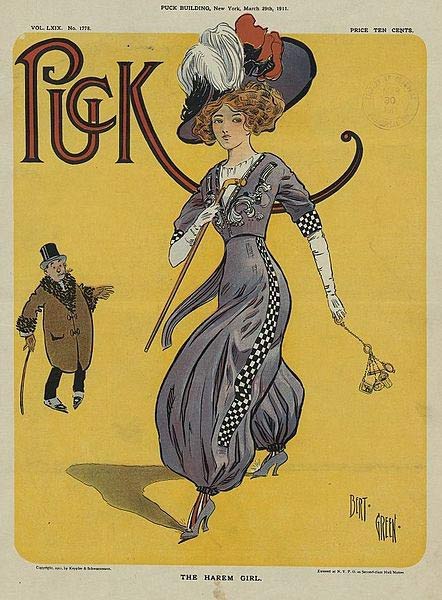
Like bloomers, harem pants garnered a fair amount of backlash. These stylish pants were seen as too sexual for the average woman and remained in the confines of “celebrity fashion.” Like bloomers, the trend came and left, not quite making the jump to everyday wear.
In the mid-1900s, World War II created a need for women to wear pants. As more than 16 million American soldiers shipped off to Europe and the South Pacific, businesses hired women to fill empty positions. The nature of many of these jobs made wearing dresses not only impractical but dangerous. Thus, thousands of working women found themselves wearing pants every day in support of the war effort.
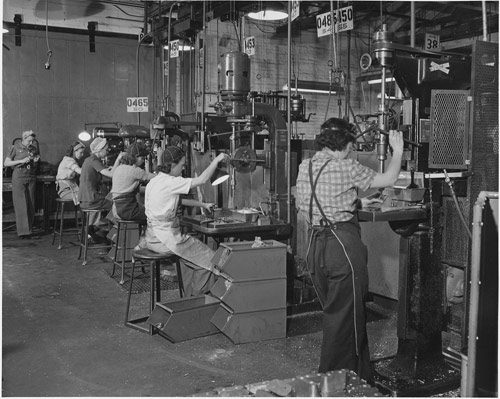
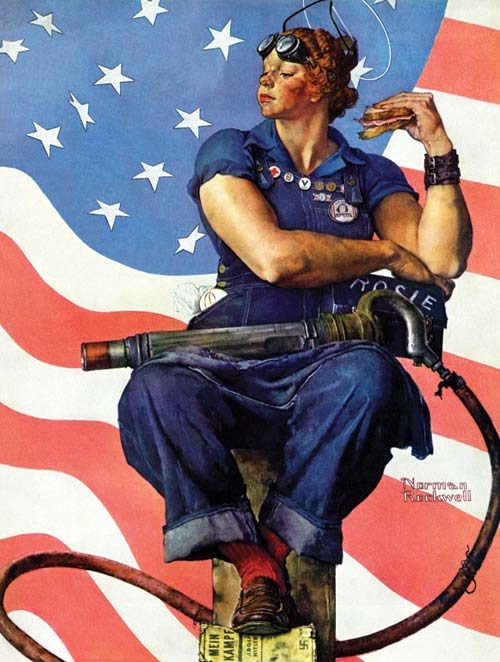
But with little stable ground for this trend to build upon, it largely faded away again after the war ended. Pants no longer seemed necessary for domestic wives.
Lasting change finally came in the 1960s and early ’70s. For young people, rebellion was a way of life, and the perfect opportunity for pants to take center stage again. During the feminist movements of this time, fashion began to cross gender lines. The word unisex made its first appearance in print, and men and women alike sported T-shirts, ponchos, and wide-leg denim pants.
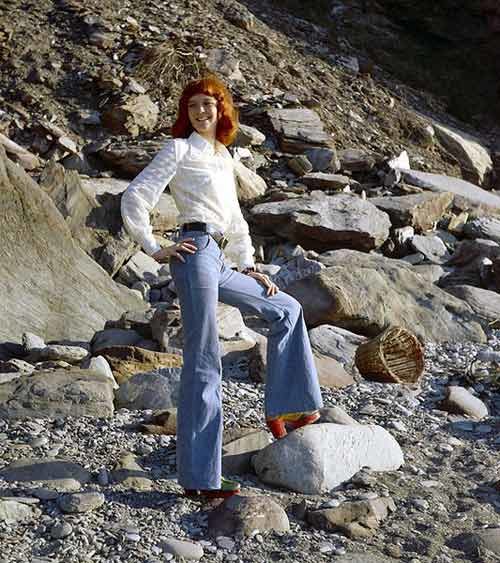
While women in pants became more common in public in the 1960s, acceptance at the highest levels of government was slow in coming. It would be another 30 years before women would be allowed to wear pants in the U.S. Senate. In the beginning of 1993, a number of female senators wore pantsuits in protest of an ancient rule of the official Senate dress code, and it was finally amended later that year.
Modern Fashion Statements
These days, Hillary Clinton is practically synonymous with pantsuits. During her 2016 presidential campaign, she wore them to practically every public event and was rarely seen in a skirt. Her attire became a symbol among her devotees, and even spurred the creation of “Pantsuit Nation,” a Facebook group of 3.9 million Clinton supporters.

Today, women from all different backgrounds wear trousers daily. This trend has become so popular that a new era of menswear-inspired fashion for women has become a high-demand look embraced by celebrities like former Spice Girl Victoria Beckham and singer Rihanna.
Women took hits for years for even wondering what it would be like to wear pants. Today, the simple wonder for many women is why they were not given such rights of function and fashion in the first place.
Women such as Miller, Bloomer, and Stanton pushed for change that led to the social acceptance that we take for granted today. As insignificant as the right for women to wear pants may seem now, it is a historical symbol of women’s perseverance over adversity and pursuit of equality.
Heroes of Vietnam: Soldier of Peace
 This article and other features about America in Vietnam can be found in the Post’s Special Collector’s Edition, The Heroes of Vietnam. This edition can be ordered here.
Originally published December 3, 1966.
to recruit volunteer teachers to help refugees learn to read and write. (Courtesy Doug Hostetter)
—Originally published in Fellowship magazine, Spring 2014—
“The path of return continues the journey.”
—Thich Nhât Hanh
Soon after graduating from Eastern Mennonite College in Harrisonburg, Virginia, I volunteered to do my Alternative Service as a conscientious objector … in Vietnam, working for the Mennonite Central Committee (MCC) in the middle of the war zone, in the middle of the Vietnam War. I understood that as Mennonites we recognized no one as our enemy, and were called to use love and truth as our weapons in the struggle to build a just and peaceful world.
Our Mennonite vision of the world clashed sharply with the vision of our government. The U.S. government designated the North Vietnamese government and the guerrillas active in South Vietnam as the enemy. When I arrived in 1966, hundreds of thousands of U.S. military personnel were already deployed on the air, land, and sea in and around Vietnam.
I was sent to Tam Ky, a village in Quang Tin province in central Vietnam, about 100 miles south of the Demilitarized Zone. Two years before I arrived, the U.S. military had lost control of most of Quang Tin province. With the exception of Tam Ky and two other small towns near the coast along Route 1, the NLF controlled the province. The U.S. military strategy at the time was to drive the civilian population out of the areas controlled by the NLF and into the towns controlled by the U.S. military and the Saigon government. When I arrived in Tam Ky in late 1966, it was teeming with refugees.
My mission was to try to find what the refugees in Tam Ky needed and then help them to get it. To my surprise, the refugee families wanted most for their children to be able to read and write. I was teaching English in several of the high schools in Tam Ky while developing my Vietnamese language skills well enough to be able to do something more productive. It was obvious to me that I was ill-equipped to teach literacy in Vietnamese. If I were going to organize classes for these refugee children, I would need to find local Vietnamese to be the teachers. I was able to use contacts in the high schools to find students who would be willing to work as volunteer teachers for classes of refugee children, starting at first on weekends and summer vacations, and later expanding to full-year classes. The program was quite successful. By the end of my three years in Tam Ky, we had 90 high school students teaching over 3,000 refugee children how to read and write.

Tam Ky was in the middle of the I Corps Tactical Zone, the much-fought-over northernmost military section of South Vietnam. I remember the briefing given to me by the CIA when I first came to Tam Ky. The agent explained, “You can go a kilometer east or a kilometer west of Tam Ky. Beyond that, you are in V.C. territory. We control Route 1 north and south of Tam Ky during the day, but at dusk, that also reverts to V.C. control.” The U.S. government officials and military officers in Tam Ky all lived in heavily guarded military compounds with guard towers, encircling high walls topped with barbed concertina wire and protected by land mines.
I rented a small bungalow in the center of the village. It was just across the street from a high school where I taught. When I first moved in, my landlady told me, “The National Liberation Front often takes over Tam Ky. I have only a four-foot wall around the house, but if you get yourself a few rolls of concertina, a sturdy steel gate, and a .50-caliber machine gun for the front yard, you should be able to hold off the NLF until the Marines can come and rescue you!” I explained to her that Mennonites not only do not use weapons, we don’t even set up defenses for ourselves. “We try to trust God and live at peace with all peoples,” I said. I did put up a sign with a peace dove, a cross, and the name of our organization in Vietnamese so people would know where I lived. But I never put a gate in that four-foot wall, and everyone knew that I owned no weapons.
During my three years in Tam Ky, the NLF did take over the village about a dozen times. Usually the takeover would be for only an hour or so in the middle of a moonless night after a brief exchange of fire with the local Army of the Republic of Vietnam (ARVN) soldiers of the Saigon government. During the Têt Offensive in 1968, however, the NLF, likely with the help of some North Vietnamese soldiers, took over and stayed in Tam Ky for more than a week. It was always very frightening during a takeover. There would be a firefight in the street, and you could clearly hear the ARVN soldiers firing their U.S.-manufactured M-16 rifles and the NLF guerrillas firing their Russian-made AK-47 rifles. People in their homes would crawl into a bomb shelter if they had one, and if not, get on the floor and stay as low as possible. After some time, there were usually fewer shots from M-16s, and more from the AK-47s, and finally the M-16s would disappear completely, and we knew that the NLF was in control of the streets of Tam Ky. The NLF always attacked the military compounds where U.S. government–related officials stayed: the U.S. Agency for International Development, the Military Advisory Command–Vietnam headquarters, and the “U.S. Embassy” compound where three or four CIA agents lived. The MCC staff were the only Americans who chose not to live in a military compound, and although easily accessible, our house was never attacked.
It is fear that drives much violence. In combat, soldiers often kill out of fear of being killed. When a peacemaker renounces weapons, and even the ability to defend himself, it can diminish the fear that propels violence — yet volunteers in Vietnam knew that commitment to nonviolence was never a guarantee of safety. Three pacifists lost their lives during the Vietnam War: Daniel Gerber, a Mennonite, was abducted in Buôn Ma Thuôt, Vietnam, 1962, and never heard from again; Ted Studebaker, from the Church of the Brethren, was killed in Di Linh, 1971; and Rick Thompson, a Quaker, died in a plane crash in Quang Ngai, 1973. In the end we knew that our survival depended on common sense, careful planning, and God’s grace.
Despite my good intentions, and my attempt to make wise decisions on the best advice from my most trusted friends, I did feel vulnerable. I realized that I looked very American to most Vietnamese, and I was in the middle of a combat zone in the middle of an American-initiated, ill-fated war against the people of Vietnam. I was greatly thankful for God’s protection during my time in Tam Ky, and quite frankly, at the end of my three-year assignment, I felt relieved and a little guilty that I had survived a war in which so many friends had died.

Three years ago, one of the high school students who had been a teacher in my literacy program in Tam Ky emigrated to the U.S. He came to visit me in New York. We caught up on old friends, and he filled me in on what happened in Tam Ky when the war finally ended in 1975, six years after I had returned to the U.S. I learned of many mutual friends who had died, and others who had survived, during that long and difficult war. But perhaps the most surprising bit of information was this: I had had a guardian angel.
Le Dinh Sung, an artist who lived in Tam Ky, had been an advisor and my closest friend while I was there. I had been introduced to his younger sister and his mother, and I knew that his father had been killed by South Korean troops working with the U.S. military, but he had never mentioned a brother. When the war ended, neighbors discovered that Le Dinh Sung’s older brother had been a high-level official in the NLF during the war. At war’s end, he was given the top position in the new government of the province. When I learned this information from my former student, I realized that my closest friend in Tam Ky was probably in regular touch with his brother in the National Liberation Front, and that God may have had some help in protecting me when the NLF took over Tam Ky.
Postscript: As director of the Mennonite Central Committee’s United Nations office, the author returned to Vietnam in January 2013, invited as part of a group of U.S. anti-war activists to come to Hanôi to commemorate the 40th anniversary of the signing of the Paris Peace Accords. While in Vietnam, he returned to Tam Ky. Le Dinh Sung had passed away by that time, but he reconnected with two of the artist’s children who are now grown and have children of their own.
Lucille Ball: The Making of a Comic
A 2012 People magazine poll voted I Love Lucy the best TV show of all time. But when it premiered in 1951, there was no indication it would be anything more than another forgettable, career-killing sitcom. Until then, Lucille Ball, tall and pretty, had been cast as a showgirl or trouble-making hussy. In this May 31, 1958, interview with the Post, she explained why she made the move to television and comedy:
Why TV? It really wasn’t a big decision. I was tickled to death, for two reasons: I wanted a baby and I was never very happy in pictures. Don’t get me wrong. I’m grateful for what pictures did for me. If a girl wants to be an actress and she’s paid good money for 16 years while she learns, she’s a jerk if she’s ungrateful. But with the exception of one or two pictures, I’ve never done anything I liked. You’re cast in pictures for what somebody thinks you look like, and the general idea seemed to be that I resembled “the other woman” or a colorful and too-dashing showgirl. What I felt like was a station-wagon housewife from Connecticut. I’d always leaned toward the homey bits in a script, and it was those bits that led up to I Love Lucy. That series began to take form and shape when I started having disputes with my movie studio, Columbia, about roles and finances.
When I was finished with Columbia, I had no other commitments except having a baby. Television was coming in, so I sat home with Desi, and we dreamed up I Love Lucy. I told Desi, “I want you to play my husband,” but my talent agency didn’t approve. The people there said the public wouldn’t believe I was married to Desi. He talked with a Cuban accent, and, after all, what typical American girl is married to a Latin? American girls marry them all the time, of course, but not on TV.
Unhappily, I lost that baby, and to get my mind off my loss, I said to Desi and the agency, “We’ll try out our proposed TV act in vaudeville.” We did, and the public accepted our Cuban-American marriage in spite of the doubts of the talent-agency people.
It was mostly husband-and-wife situation comedy. Mixed in with it was a little music, dancing, gags, and serious stuff. I became pregnant again, so we couldn’t continue our tour, but we were convinced we were on the right track and we sold Desi to CBS as my TV husband. I don’t remember the business details. I was pregnant and happy, and I knew I would be available eventually, and that’s all I recall.
Make ’em Laugh
Most comedy successes stem from long-standing inferiority complexes, and I had mine. My father died when I was four. Mother married again, and for seven or eight years I was with my stepfather’s Swedish parents. Until I was nine it was tough going. My step-grandparents had stern, old-country ideas. They treated other children the way I wanted to be treated, but not me. They did that to discipline me, but for me it was the wrong way to bring up a child. It gave me a feeling of frustration and of reaching-out-and-trying-to-please. I found the quickest and easiest way to do that was to make people laugh.
The principal of my school recognized my urge for approval. He saw to it that I had a part in school plays and operettas. My mother and my stepfather also encouraged me to act, dance, and sing.
When I was 14, I persuaded mother to send me to the John Murray Anderson–Robert Milton Dramatic School, in New York. I was so shy I was terrified. Bette Davis was the star pupil. I can see her now, starring in plays while I hid behind the scenery. And I took elocution, and Robert Milton made me repeat “water” and “horses” because I pronounced them “worter” and “haases.” I was so miserable mother brought me home, and I spent the next few months writing poetry.
The following summer, mother arranged for me to visit friends in New York. This time I wanted to be in vaudeville, but I never met anybody who knew how to get in vaudeville, so I decided to be a showgirl and I answered a call for an Earl Carroll tryout. I was tall and thin, but measurements weren’t the whole bit then. I rehearsed for two weeks, then a man said to me, “Miss Belmont!” (That’s who I’d decided to be.) “You’re through.” I found out later I was so young and so dumb I wasn’t contributing anything. I don’t know why they picked me in the first place.
Meeting Desi
married to Desi.
I met [Desi Arnaz] at the RKO studio in May 1940. We were filming Too Many Girls, the stage show in which Desi made his first big hit. He asked me for a date that very night, and pretty soon we were married — in spite of the way he drove a car. The first time I drove with him, although he slowed to 80 miles an hour at corners, I thought he was a maniac. When I said, “Mother wouldn’t like this,” he slowed down.
He frightened me. Marrying Desi was the boldest thing I ever did. I’d achieved some stability in Hollywood, while Desi seemed headed in another direction.
Being Pregnant on TV
In 1953, we were in the middle of a very successful TV show, which was a thing no one would want to drop. I was suddenly pregnant again and we faced the question: Should I stop working for months or stay on the job? Desi told me, “If you want my vote, we’ll stay on until you have the baby.”
The idea was a startling one, but he went to work on it. First he got permission from the network. He said, “We think the American people will buy Lucy’s having a baby if it’s done with taste. Pregnant women are not kept off the streets, so why should she be kept off television? There’s nothing disgraceful about a wife becoming a mother.” The furor it all caused was a revelation to me.
Hundreds of thousands of women all over the country who were pregnant along with me wrote me encouraging notes, and after our baby was born, I received 30,000 congratulatory telegrams and letters. Our first child, Lucy, had been born by caesarean section. Little Desi was delivered by caesarean too. If you know your baby is going to be a caesarean baby, it helps you call your shots.
[Desi Arnaz added:] “We didn’t want to do anything that would upset the public. I called the heads of the Catholic, Protestant, and Jewish faiths in Los Angeles and asked them to assign representatives to keep an eye on our shows. So for eight weeks, a rabbi, a Protestant minister, and a Catholic priest checked every foot of film we shot. There was nothing we had to throw out except the word pregnant. CBS didn’t like that, so we used expectant. CBS thought it a nicer word.
—“I Call on Lucy and Desi” by Pete Martin, May 31, 1958
News of the Week: Snowstorms, Lady Doritos, and People Who Do Weird Things with Books
Winter Nights
It’s snowing hard as I type this, flakes the size of quarters, the wind making the trees across the street sway. We’re supposed to get an inch or two an hour, and then it’s going to turn really cold tonight. I love it.
I’ve been seeing a lot of travel commercials lately, the ones where they show people shoveling or covering up their face as they walk through the snow and then show scenes of bathing-suit-clad people running on beaches and jumping into pools and enjoying cocktails with little umbrellas in them as the sun goes down at some warm locale. I find that all depressing. New Englanders, you want to live some place where it’s warm all the time? Fine, move to Miami or San Diego or Austin and leave the people who actually don’t like the summer alone with our winter.
I’m not a mailman or construction worker or pizza delivery guy, so I don’t really care if icicles form. I’ve got my love to keep me warm (and by “love” I mean a comforter, a TV set, and hot chocolate). It helps that I work from home, of course, but believe me there are downsides to that. But I love the winter weather, especially winter nights, and tonight’s plan involves pasta, some wine, a pine-scented candle, and a good movie. That’s after I shovel, of course.
Let me know in the comments if you’re a summer person or a winter person. And don’t say you love spring or fall. That’s just wishy-washy cheating.
Food for Thought
Here are three food-related headlines from the past week. Two of them are real, and one I made up. Guess which one.
- Doritos to Make Lady-Friendly Chips That Don’t Crunch as Much
- McDonald’s French Fries Might Cure Baldness
- Disneyland Is Now Selling Alcohol-Infused Donuts
Okay, I lied. They’re all real.
The Disney donuts are for adults and are being sold at a rooftop bar, and McDonald’s fries probably aren’t going to give you Matthew McConaughey-level hair (sorry, fellow bald-headed men). What I really want to talk about are the “Lady Doritos.”
In a recent podcast interview, PepsiCo’s CEO Indra Nooyi said that the company was going to launch a line of snacks “designed and packaged differently” for women. She says that women don’t like to crunch on things too loudly in public and don’t like to lick their fingers after eating Doritos.
Of course, social media lit up after news of the new product got out, and now the company says that it’s not happening after all. I don’t know if they shelved the idea because of the backlash or if they weren’t serious in the first place (I’m going with the former), but I for one am glad it’s not going to happen. Not only is it insulting to women and their eating habits, but Doritos that crunch less are just stale Doritos.
My favorite take on this is from Steak-Umms. This is pretty snarky for the official Twitter account of a steak-related sandwich product:
I thought about pitching a new line of Lady Steak-Umms just for women but then I remembered I’m not an idiot
— Steak-Umm (@steak_umm) February 6, 2018
Play Ball! (Faster!)
Last year, right about this time, I told you about big changes Major League Baseball was thinking of bringing to the summer game. Now comes confirmation that the changes are indeed coming, and you might want to start watching soccer.
The Associated Press has obtained an MLB report that outlines the new ideas, which include starting a runner on second base at the start of the 11th inning of an All-Star game and in the 10th inning of spring training games, and setting time limits for batters.
I guess it’s comforting that the league isn’t going to make these changes to regular season games, though I would assume that if these changes are successful and popular, they’ll give serious thought to doing it in all games. But baseball doesn’t need these changes. It’s supposed to be a long, slow sport, one you watch on a lazy, warm summer night. What’s next, two strikes instead of three? Six innings? Maybe the batters can wear heavy boots so they can’t run fast and will get thrown out quicker?
Oh God, I just gave them more ideas.
Book ’Em, Danno
How do you place books on your shelves?
This may sound like an odd, unnecessary question. After all, how many ways are there to put books on a shelf? You stand them up with the spine facing you, and the bigger books you might lie flat. Apparently there is a third way! And, well, it’s insane.
The Wall Street Journal reports that many people store their books on the shelves with the spines faced inward, which means the pages are facing out and it’s just a sea of white and cream. You can’t tell which book is which because the titles and authors are hidden.
In what world does this make sense? It’s even worse than those people who stack their books on the floor in some stylish pyramid or monument-like pile. At least with that you can still tell what the books are.
This seems like the design choice of people who have a lot of books but don’t read that much.
RIP John Mahoney, Dennis Edwards, Mickey Jones, and Ann Gillis
John Mahoney is known to TV viewers as Frasier and Niles’ ex-cop dad on Frasier, but he was also an acclaimed stage actor and appeared in dozens of movies, including Say Anything, Moonstruck, Eight Men Out, The Hudsucker Proxy, and Tin Men. He died Sunday at the age of 77.
Here’s a nice post on Mahoney from writer Ken Levine, who worked with Mahoney on Frasier and Cheers.
Dennis Edwards replaced David Ruffian as lead singer of The Temptations in the late ’60s and sang some of their most famous songs, including “Papa Was a Rolling Stone,” “Ball of Confusion,” and “I Can’t Get Next to You.” He died last Friday at the age of 74.
Mickey Jones was a veteran character actor who appeared in dozens of movies and TV shows, including Home Improvement and Justified. He died Wednesday at the age of 76.
Ann Gillis was an actress you saw in such movies as The Adventures of Tom Sawyer, Little Orphan Annie, Beau Geste, Abbott and Costello’s The Time of Their Lives, and 2001: A Space Odyssey. She died last week at the age of 90.
The Best and the Worst
The best: As a bit of a space geek, I’d have to say the best news of the week has to be the launch of the SpaceX Falcon Heavy rocket. I’m not sure what’s more impressive, that it was the most powerful rocket launched from the U.S. in decades, the fact that the two rocket boosters came back to Earth and landed upright (!), or the fact that there’s now a car flying around our sun.
The worst: The worst news comes from Best Buy, which is going to stop selling compact discs on July 1. I don’t know why this is a “worst” because I have to admit that, while I do still buy a lot of CDs, I buy them online and not at Best Buy, which means I’m part of the problem. In related news, Target is making demands to suppliers, which is probably the first step to those stores getting rid of CDs too.
This Week in History
The Day the Music Died (February 3, 1959)
You know that Buddy Holly, Richie Valens, and J.P. “The Big Bopper” Richardson (along with the pilot) died in a plane crash on the way to a concert, but did you know that Waylon Jennings was almost on the plane? He swapped places with Richardson and took a bus to the next concert venue.
Another famous star got his start because of the crash. Fifteen-year-old Bobby Vee and his band filled in at the concert Holly and the others were supposed to play.
The Blizzard of ’78 (February 5–8, 1978)
Despite what I said above, I realize there are limits to how much winter you can enjoy. That limit is called “The Blizzard of ’78.” There have been storms that have dumped more snow and caused more flooding since that blizzard, but it remains a special storm in history. It was the perfect combination of snow, wind, flooding, and general disruption that doesn’t happen that often. I was 12 when it hit and was out of school for an entire week. There was so much snow we couldn’t get out of our house. We had to run and jump over the wall at the front of the yard. Cars got stuck and were abandoned on Route 128, the major highway in Massachusetts, and there was a ton of coastal damage to homes.
This Week in Saturday Evening Post History: Norman Rockwell Born (February 3, 1874)
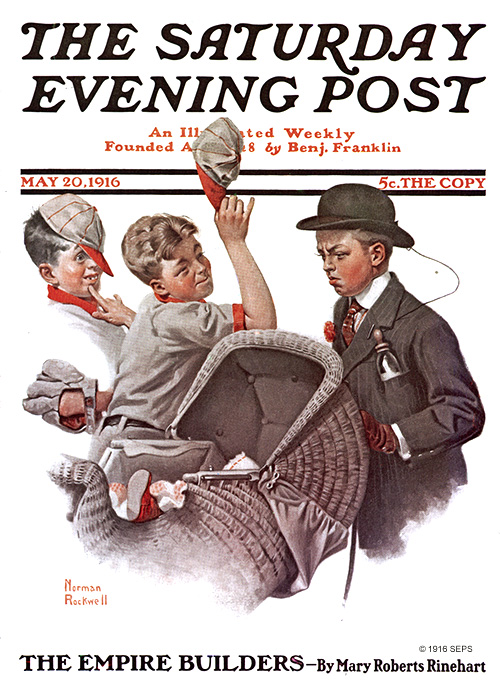
Norman Rockwell
May 20, 1916
The man we call America’s Artist was born in New York City. He’s the person most associated with the Post and the artist responsible for arguably some of the most famous artwork in American history, including Runaway and Four Freedoms. His first Post cover, The Baby Carriage, appeared on the May 20, 1916, issue — and then again 100 years later.
Here’s a nice remembrance of Rockwell from his granddaughter Abigail.
National Pizza Pie Day
I have good news and bad news. The bad news first: You missed Shape Up with Pickles Week, which was the first week of February. I won’t try to define what that is. I really don’t want to know. Instead, I’ll give you the good news: Today is National Pizza Pie Day.
You’re probably used to picking up the phone (excuse me, going online or to an app) to order takeout pizza, or maybe you’re a frozen pizza type of person. That’s all well and good, but how about taking the time to make your own one day of the year? Here are three recipes from chef Curtis Stone: a Mozzarella, Cherry Tomatoes, and Pesto Pie; a Tomato-Kalamata Olive Pizza; and some Grilled Flatbreads with Garlic-Rosemary Oil.
Pizza’s good on a cold winter night, too.
Next Week’s Holidays and Events
Mardi Gras (February 13)
I knew it was also known as “Fat Tuesday” and “Shrove Tuesday,” but I didn’t realize it was also called “Pancake Tuesday.”
Valentine’s Day (February 14)
This is the day when loving couples buy each other flowers and candy, go out to dinner, and reaffirm their love for one another. If you’re single, it’s just Wednesday.