4 Apps for Leaf Lovers
These free apps will help you enjoy fall foliage near and far.
Foliage Leaf Peepr (yankeefoliage.com): Crowdsource the best fall foliage in the country.
Leafsnap (leafsnap.com, iPhone only): Identify a tree species from photos of its leaves.
Autumn Wallpaper APK (appsapk.com/autumn-wallpaper, Android only): Dress your phone for fall with vibrant backgrounds, including live ones with 3D falling leaves.
Fall Foliage Puzzles (allfreeapk.com): Assemble 50-plus-piece puzzles and enjoy the view.
This article is featured in the September/October 2017 issue of The Saturday Evening Post. Subscribe to the magazine for more art, inspiring stories, fiction, humor, and features from our archives.
Broadway All-Stars: The Dream Team that Conceived West Side Story
Sixty years ago, the curtain at the Winter Garden Theatre on Broadway rose to reveal the Jets, a teenage gang, snapping, kicking, and rumbling with the Sharks, a rival Puerto Rican gang. It was the opening night of West Side Story, a musical remake of Romeo and Juliet that combined the talents of Broadway big-wigs Leonard Bernstein, Jerome Robbins, Arthur Laurents, and Stephen Sondheim. Their show opened with Larry Kert, Carol Lawrence, and Chita Rivera in starring roles.
The next day, Pulitzer-winning critic Walter Kerr wrote, in the New Herald Tribune, “The radioactive fallout from West Side Story must still be descending on Broadway this morning.” The musical became famous for its electric choreography and timely story of gang violence in New York, running for 732 performances with six Tony nominations. In 1961, the film adaptation won 10 Oscars and was later preserved in the National Film Registry.
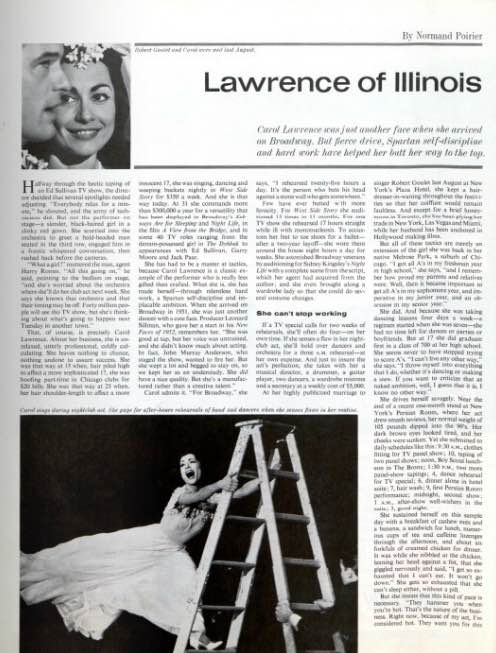
Carol Lawrence and Larry Kert sang their intimate number, “Tonight,” on the Ed Sullivan Show in 1958, spending most of the song in a tight embrace. Despite their ages, 25 and 27, respectively, the star-crossed pair was able to convince audiences they were two teens in the throes of youthful passion.
In 1964 the Post covered Lawrence and her workaholic approach to show business in “Lawrence of Illinois.” Normand Poirier wrote, “Few have ever butted with more ferocity. For West Side Story she auditioned 13 times in 11 months. For one TV show she rehearsed 17 hours straight while ill with mononucleosis.” Poirier noted that during the taping of the 1958 Ed Sullivan Show performance Lawrence used the short tech breaks to chat with the orchestra about their upcoming club show. Since she would be using the same guys, she wanted to make sure their timing would be perfect.
Lawrence wasn’t the only perfectionist in the original Broadway production either. According to Humphrey Burton’s biography of Leonard Bernstein, the composer was constantly at odds with Robbins and Laurents, fighting to keep his sweeping, dramatic music in the show that Robbins was intent on making a hallmark of dance theatre. Despite, or maybe because of, their struggle, both were successful in creating a musical that delivered on all fronts. Sondheim made modest contributions in the way of lyrics, but he would go on to become undisputed Broadway royalty.
Though it was thought to be, perhaps, too dark for Broadway audiences at the time (“Who wanted to see a show in which the first-act curtain comes down on two dead bodies lying on the stage?” Leonard Bernstein told The Rolling Stone), West Side Story is now a classic of musical theatre. Performances, from high school productions to Broadway revivals, are still staged prolifically. The tale of young love is supposed to star teenagers anyway, as long as they can nail the tricky note intervals in “Maria.”
As American as Pizza Pie: How Pizza Has Changed Since 1870
There’s something about pizza that seems to fire the human imagination. Today, Americans have nearly unlimited choices of crusts and toppings.
If pizza lovers are willing to travel, they can get a pizza that’s deep fried in New York, or one that has a sweet potato crust in Los Angeles. Around the country, imaginative pizza artisans (pizzologists? pizzeristas?) are adding caviar, sushi, tandoori chicken, eggplant, pancetta, and smoked reindeer to their creations. And they’re offering unusual combinations, too, like strawberries and chicken, shrimp and guacamole, peaches and prosciutto, and caramelized onions, apples, and goat cheese.
Even pizza delivery has been upgraded. Impatient customers now can track the progress of their delivery by GPS, and Domino’s is testing delivery via driverless car.
All this creative thinking was inspired by a food that, for centuries, was just a flour crust with tomato slices and seasonings. The Saturday Evening Post has been tracing the evolution of the humble pizza for nearly 150 years.
The lowly tomato pie is first mentioned in our November 21, 1835, issue in a column from The Rural Economist trying to convince readers of the tomato’s merits: “There are few who relish it at first sight.” Despite Americans’ apparently chilly reception to the tomato, the author soldiers on: “Some will give a decided preference to a dish of tomato sauce or a tomato pie, when properly prepared, to any thing of the kind in the vegetable kingdom.”
Thirty-five years later, in 1870, the tomato-in-crust makes another appearance, although this recipe for tomato pie is most definitely more “pie” than “pizza.”
TOMATO PIE-Take two large ripe Feejee or other tomatoes of the same size, drop them into boiling water to remove the skin, then, with a sharp knife, cut them into thin slices, put the crust in an ordinary pie-pan, as for berry pie; cover the bottom with a layer of the tomatoes, then a layer of sugar and butter, then of tomatoes, then of sugar and butter as before; flavor with either lemon, orange peel, or nutmeg, to the taste. Cover with the top crust, bake, and bring to the table hot — (cold tomato pie is not good).
—October 8, 1870
This recipe was offered among several others, including cold partridge pie and chow chow. The author’s judgment is not to be trusted, however, based on his or her condemnation of cold pizza.
One of the earliest toppings of modern pizza was anchovies. Here is one recipe described in 1927:
A typical Tuscan menu was prepared and served by Giovanni Pisani, capo cuoco, or top chef, of one of Florence’s leading hotels. He started off with Pizza alla Paesana:
Prepare a large, flat brioche, unsweetened, about ten inches in diameter and an inch thick. Place the brioche in a shallow baking pan. On top of brioche place a layer of sliced tomatoes. Scatter on top of the tomatoes about ten or fifteen filets of anchovy. Over all place thin slices of cheese similar to Mozzarella. Spray a little olive oil over it, season with salt and pepper and cook in oven for about twenty minutes.”
—“A Cook’s Tour,” by restaurateur George Rector, December 3, 1927
The author notes that mozzarella was a cheese native to Italy and unlikely to be found in America.
Pizza might have remained an obscure Italian dish if American soldiers hadn’t discovered it during World War II. By 1948, it was even appearing in Post fiction. It now had a thinner crust, but it still had those anchovies:
The little old man stood behind a counter, kneading a ball of dough. Presently he began to stretch it with light, deft fingers until it was large and round and paper-thin. He brushed it with olive oil, sliced bits of hard white cheese over the surface and poured on a thick tomato sauce. Then he arranged anchovy fillets across the top and sprinkled freshly ground pepper and oregano over everything. With a long-handled, flat wooden shovel he lifted it up and slid it into the huge oven behind him. …
Tony fed the juke box another nickel, and they danced some more, until the pizza was baked to a delicate melting brown. Then Papa Joe slipped it onto a big tin plate and cut it quickly into large sections, and Tony showed her how to eat it, flipping the tip of the triangle back over the filling and holding it over a paper napkin.
—“The Low-Brow and the Lady,” by Gertrude Schweitzer, October 2, 1948
That same year, the Post’s sister publication, Country Gentleman, ran an article on backyard barbecuing and offered a recipe for “Campfire Pizza.”
Add ⅔ cup of milk or water to 1 cup of prepared biscuit mix, and beat 1 minute. Spread in a well-greased 10-inch skillet.
Cover with 1 cup of cooked tomatoes, and sprinkle with ½ cup of cubed American cheese, cup of grated Parmesan cheese and 4 cups of salad oil. Season with salt and pepper.
Cover and cook over a rather slow fire 20 to 25 minutes, or until lightly browned on the underside, and the cheese is melted. Cut into pie-shaped pieces for serving. Serve while still hot to 6 hungry campers.
—“Cook It Outdoors,” by Sara Hervey, September 1948
Ten years later, America had finally figured pizza out. A Post article by Richard Gehman in November 30, 1957, rhapsodizes over pizza,
…that wondrously flavorful, smoky-crusted, crisp or chewy pie of Neapolitan origin, bubbling with hot melted cheese and rich sauce from Italian plum tomatoes, dotted with bits of sizzling, succulent sausage or laced with soft, salty anchovies, sprinkled with parsley or oregano and dusted with musty Parmesan cheese.
Pizza had swept the nation, particularly Los Angeles, where restaurateur Patsy D’Amore prospered: “His restaurant, where Joe DiMaggio wooed Marilyn Monroe with pizza, is highly esteemed by movie stars. Frank Sinatra, whose fondness for pizza is almost legendary, goes there several nights a week.”
From such primitive beginnings, pizza has continued to evolve. The cooks of 150 years ago likely wouldn’t recognize the modern pizza, with toppings like rhubarb and barbecue sauce. And who knows what tomorrow’s adventurous chefs have planned? What we can predict is that if you have the perfect, crisp crust and some juicy, vine-ripe tomatoes, you can’t go too far wrong.
Featured image: Pizzeria in Napoli, circa 1910 (Wikimedia Commons)

7 Game-Changing Athlete Protests
In the hyper-competitive world of high-stakes athletics, an injection of politics or social justice can inspire annoyance or rousing support; but it always starts a conversation. For over a century, these athletes have used the field, court, or track to express a broader view of how the world ought to be.
Peter O’Connor
1906 Olympics
The Irish Olympian won gold and silver medals in the 1906 games. O’Connor was registered with Great Britain since Ireland lacked an Olympic Committee. At the medals ceremony, the Union Jack was raised, so O’Connor climbed a flagpole and hoisted an Irish flag while his teammate fought off guards below. His act of resistance was likely the first time an Irish flag was seen at an international sporting event.
Taiwanese Athletes
1960 Olympics “Under Protest”
Taiwanese Olympic athletes marched into Rome’s 1960 opening ceremony behind a sign reading “UNDER PROTEST.” The team was vexed at their committee’s decision to enter the games under the island’s western name, Formosa, instead of the Chinese Nationalist Party’s preferred designation, Republic of China.
Muhammad Ali
Vietnam War, 1967
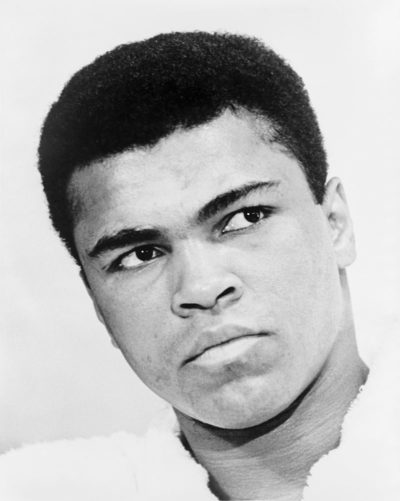
In 1967, Muhammad Ali was stripped of his world heavyweight title and had his boxing license suspended after he refused to step forward at his scheduled induction into the military. Ali said, “No, I will not go 10,000 miles from here to help murder and kill another poor people simply to continue the domination of white slave-masters over the darker people of the earth.” After an appeal to the Supreme Court, Ali’s conviction was dropped by a unanimous decision in 1971.
John Carlos/Tommie Smith
1968 Olympics
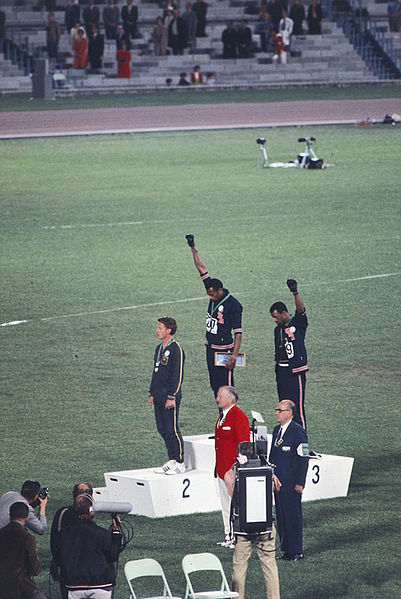
Mexico City’s 1968 games came in the midst of a tumultuous year for the U.S. (assassinations, Vietnam War protests, and constant racial tensions). After black athletes John Carlos and Tommie Smith earned bronze and gold medals, respectively, for the 200-meter dash, they used their medals ceremony as a platform for what was perhaps the most iconic sports protest in history. As the U.S. national anthem played, the runners bowed their heads and raised their gloved fists into the air. The San Jose State University students returned from the Olympics to myriad criticism and even death threats over their gesture, perceived to be one of black power radicalism. Smith described it as “a cry for freedom and for human rights,” saying, “we had to be seen because we couldn’t be heard.”
“Black 14,” 1969
Football coach Lloyd Eaton dismissed 14 African American players from the University of Wyoming team when they asked to wear black armbands during their upcoming game against Brigham Young University. The players planned the act of solidarity after BYU students had allegedly uttered racial slurs at them in past matches. They had also learned of the Mormon policy of disallowing African Americans from priesthood. After the “Black 14” were kicked off UW’s football team, a nationwide press controversy ensued. The previously undefeated team lost its last four games in the season, and Coach Eaton was fired the next year.
Mahmoud Abdul-Rauf
NBA, 1996
During the Denver Nuggets’ 1996 season, Mahmoud Abdul-Rauf, a Muslim, refused to stand for the pregame national anthem, saying, “My duty is to my creator, not to nationalistic ideology.” Abdul-Rauf was immediately suspended, but later allowed to play when he compromised that he would pray with his hands over his face while standing for the anthem. The player was booed routinely by patrons (72 percent of people in Denver disagreed with Abdul-Rauf, according to a poll). Two Denver radio deejays even faced charges for entering a mosque in Abdul-Rauf jerseys playing the national anthem with instruments as a stunt.
Carlos Delgado
God Bless America, 2004
After growing up in Puerto Rico, where the U.S. Navy used the island of Vieques as a weapons testing ground for 60 years, Toronto Blue Jay Carlos Delgado was decidedly skeptical of U.S. military occupation. After the invasion of Iraq in 2003, Delgado refused to stand for the routine seventh inning stretch rendition of “God Bless America.” His antiwar protest went largely unnoticed since he remained in the dugout during the song. Delgado saw little backlash even though the Iraq War was overwhelmingly popular among Americans at the time. It was even, apparently, popular among Canadians, since the Toronto Skydome played the song at their games until 2004.
The Woes of John Wayne
This is an abridged version of an article that appeared in the in the October 27, 1962, issue of The Saturday Evening Post. You can read the complete original article in the flipbook, below.
This article and other features about the stars of Tinseltown can be found in the Post’s Special Collector’s Edition, The Golden Age of Hollywood. This edition can be ordered here.
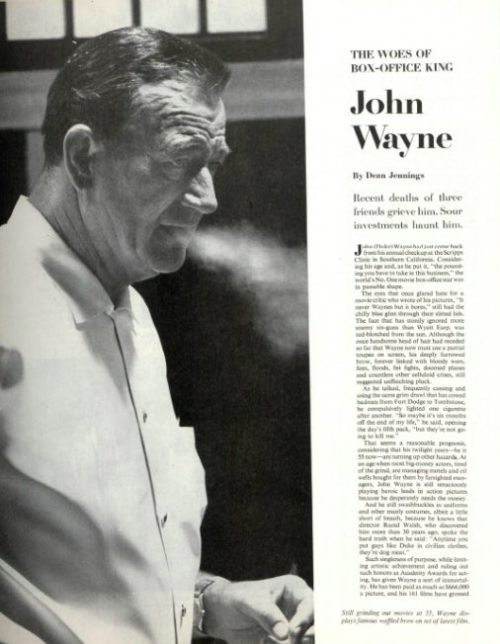
John (Duke) Wayne had just come back from his annual checkup at the Scripps Clinic in Southern California. Considering his age and, as he put it, “the pounding you have to take in this business,” the world’s number-one box-office movie star was in passable shape.
The eyes that once glared hate for a movie critic who wrote of his pictures, “It never Waynes but it bores,” still had the chilly blue glint through their slitted lids. The face that has stonily ignored more enemy six guns than Wyatt Earp was red-blotched from the sun. Although the once handsome head of hair has receded so far that Wayne now must use a partial toupee on-screen, his deeply furrowed brow, forever linked with bloody wars, fires, floods, fist fights, doomed planes and countless other celluloid crises, still suggested unflinching pluck.
As he talked, frequently cussing and using the same grim drawl that has cowed badmen from Fort Dodge to Tombstone, he compulsively lighted one cigarette after another. “So maybe it’s six months off the end of my life,” he said, opening the day’s fifth pack, “but they’re not going to kill me.”
Although he may not be worried about his health, his twilight years — he is 55 now — are turning up other hazards. At an age when most big-money actors, tired of the grind, are managing motels and oil wells bought for them by farsighted managers, John Wayne is still tenaciously playing heroic leads in action pictures because he desperately needs the money.
Such singleness of purpose, while limiting artistic achievement and ruling out such honors as Academy Awards for acting, has given Wayne a sort of immortality. He has been paid as much as $666,000 a picture, and his 161 films have grossed about $350,000,000, a record that Hollywood historians expect to stand for all time. “Most films are money in the bank,” one associate says, “when you’ve got good ol’ Duke in there banging away.”
But if Duke does well for others, he has trouble doing well for himself. The recent deaths of three close friends have sapped him, and despite the small fortune he has made, Wayne today is just barely breaking even. His distress extends to the world at large, which he considers to be run by a band of fuzzy minds who probably would have sneaked out a back archway at the Alamo.
Possibly to dispel the gloom brought on by those thoughts, Wayne absorbs a formidable amount of alcohol without getting drunk. In every angry moment he risks a flare — up from the ulcers that plagued him in earlier days, and he is so sensitive about the printed word that he now insists — though it did not apply to this article—on approving every line written about him before granting an interview.
A Rough Reputation
One time, Frank Sinatra had hired screenwriter Albert Maltz, one of the “unfriendly 10,” who served jail sentences for contempt of the J. Parnell Thomas House Un-American Activities Committee, and reporters called Wayne for an opinion. Wayne snapped, “I don’t think my opinion is too important. Why don’t you ask Sinatra’s crony, who’s going to run our country for the next few years, what he thinks of it?”
Wayne’s dig at President Kennedy appeared in print and generated so much heat that Sinatra was forced to fire Maltz. Shortly afterward at a Hollywood benefit show, Sinatra stalked off the stage when Wayne came up to the microphone.
“Frankie,” Wayne said to Sinatra later, “What the hell did you walk away from me for?”
“Well, you cried,” Sinatra said. “You blasted off your mouth.”
“You mean the Maltz thing?”
“Yes,” Sinatra replied.
“You want to talk about it?” Wayne asked him in reply.
“Some other time,” said Sinatra. “Duke, we’re friends, and we’ll probably do pictures together. Let’s forget the whole thing.”
This is typical of Wayne. Although he sits on the far right, he has many friends among Hollywood liberals. When Robert Ryan’s wife and children received a bomb threat last year, because Ryan had read part of Robert Welsh’s John Birch Society “Blue Book” on a Los Angeles radio station, Ryan and Wayne were in France, working on the Longest Day. Wayne was the first to offer help. He wanted to rush home and help Ryan find the would-be bombers and beat them to a pulp.
In recent years, Wayne has indeed had many things on his mind, most of them calculated to bring on insomnia. Although he shouldn’t have to worry about being overdrawn at the bank, Wayne claims his millions have mysteriously slipped away in the night.
“I suddenly found out after 25 years,” he said sadly, “that I was starting out all over again. I just didn’t have it made at all. Until last year I had a business manager who didn’t do anything illegal, but we were involved in many unfortunate money-losing deals. I would just about break even if I sold everything right now.”
Wayne says he invested $1,200,000 of his own money — all the cash he could scrape up — in producing the ill-fated Alamo. Friends, including Texas millionaire Clint Murchison, also invested huge sums of money. Wayne is confident they won’t wind up losers, but the picture must gross $18,000,000 before there is a profit, and Wayne’s chances of getting all his money back are about the same as falling an inside straight.
Despite it all, Wayne continues to live well. His home is a five-acre estate in Encino, where the hot San Fernando Valley sun warms an Olympic-size swimming pool and vast reaches of green grass. An electric eye controls the gate into the long, curving driveway to the big ranch-style house. Inside, Wayne and his third wife, former Peruvian actress Pilar Palette, are waited on by three servants, also from Peru.
To keep up all the payments, Wayne works in picture after picture. Recently he has been making them at a rate of three a year. In the past 12 months he has appeared in The Man Who Shot Liberty Valance, Hatari, and The Longest Day. He has just finished Donovan’s Reef for Paramount, and he will make three more pictures in 1963. He has also joined the cast of The Greatest Story Ever Told.
Wayne’s frenetic filmmaking may eventually cure his money ills, but his deeper woes defy remedy. Gone are three of his closest friends: actor Grant Withers, who committed suicide; actor Ward Bond, who dropped dead of a heart attack in 1960 at the height of his TV fame in Wagon Train; and Bev Barnett, Wayne’s longtime press agent. “Oh, God,” Wayne said of Barnett’s death, “that’s a tough one.”
The deaths of these close friends, the near death of his 74-year-old mother, Mrs. Sydney Preen of Long Beach, in an auto accident, and two wrenching divorces have drained some of the violence out of Wayne. In the early days of his career Wayne’s muscular figure (six feet four, 220 pounds) was a challenge to folks who thought they could lick him. “I found out once,” he says, “that some of the toughest men I knew, when they really get mad, have a little smile and a look and they’re talking low. This is the way I get mad. But it happens very seldom anymore. I really like people. Unless people go out of their way to insult me, they’re going to have a hard time having any trouble with me. My last street fight was with a couple of boilermakers, but that was years ago.”
Some subjects still trigger a flare-up. One is politics. Television is another. “Television,” Wayne says, “has a tendency to reach a little. In their westerns they’re getting away from the fact that those men were fighting the elements and the rawness of nature, and didn’t have time for this couch work. For me, basic art and simplicity are most important. Love. Hate. Everything right out there without much nuance.”
This article and other features about the stars of Tinseltown can be found in the Post’s Special Collector’s Edition, The Golden Age of Hollywood. This edition can be ordered here.
Sandra Day O’Connor: Breaking the High Court’s Glass Ceiling
On September 25, 1981, Sandra Day O’Connor was sworn in as the first woman member of the Supreme Court.
That distinction alone would have earned her a place in the American history books. But Justice O’Connor also proved to be memorable for several of her judicial opinions, which had far-reaching consequences. For example, she was the pivotal vote in Bush v. Gore, which resolved Florida’s disputed presidential election results and decided the presidential election of 2000.
Though generally conservative in her opinions, O’Connor would occasionally show an independent streak when she sided with the court’s more liberal judges. She provided the crucial swing vote in Planned Parenthood v. Casey in 1992, which upheld the Court’s earlier opinion in Roe v. Wade.
In our 1985 article, “Her Honor: The Rancher’s Daughter,” writer Joan S. Marie presents a more personal side of O’Connor, including the morning aerobics classes she organized at the Supreme Court, stories of her childhood on an Arizona ranch (bobcat included), and the antics of Family Olympics Day. Typical of “working woman” profiles of the era, Marie spends as much time showing how O’Connor managed her family as she did her caseload, and even works in a recipe (crab enchiladas).
But O’Connor’s determination to excel at her profession shines through. She shares how hard she had to work to even get into the legal profession. When she graduated from law school in 1952, she had difficulty even finding work because no law firm was interested in hiring a woman. She eventually opened her own law firm, became Arizona’s assistant attorney general, a state senator, a superior court judge, and a judge on the Arizona Court of Appeals. In 1981, the call came from the Reagan White House.
In the 1985 article, O’Connor anticipated that America would soon see more women on the bench: “In our law schools today, at least half the students are women. I fully expect to see the percentages of women in the practice reflected in the roughly similar percentages on the bench and in other activities in which lawyers are generally engaged. So I certainly do think we are going to see that reflected — not only here but in judicial offices across the nation.”
O’Connor served on the Supreme Court for 25 years, until her retirement in 2006. She was the first woman Supreme Court justice, but, of course, she wasn’t the last. Clinton nominee Ruth Bader Ginsberg and Obama nominees Sonia Sotomayor and Elena Kagan followed in her path.
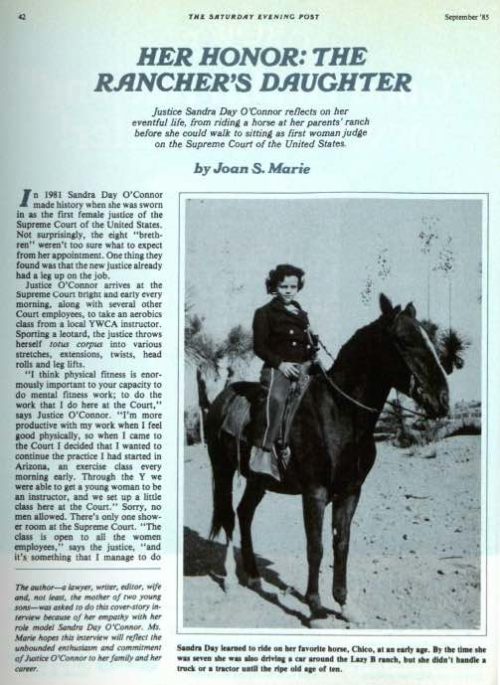
Featured image: Sandra Day O’Connor being sworn in by Chief Justice Warren Burger in 1981 (White House Photographic Office, National Archives)
America’s Shifting Attitude Toward the Mormons
For Joseph Smith, founder of the Latter-day Saint movement, September 22 was a noteworthy date. From 1823 to 1826, he allegedly met with an angel named Moroni near his home in Manchester, New York, each year on that day. When the next September 22 rolled around in 1827, exactly 190 years ago today, Smith retrieved the golden plates on which was inscribed the Book of Mormon. According to Smith’s translation from an ancient language, the plates told the story of two civilizations that inhabited the Americas around and before 600 BC.
Joseph Smith’s profound legacy is one of religious fervor, persecution, and mystery. Smith, as a self-proclaimed prophet, began a movement that now claims a global membership of around 16 million people. According to the LDS Church itself, since 1996, there have been more Mormons living outside the U.S. than U.S. members.
Despite the modern Mormon practice of proselytism, the religious group spent many years in Utah in relative isolation. The evolving American sentiment toward Latter-day Saints throughout the 20th century can be seen in the archives of The Saturday Evening Post.
In 1905, a harsh critique of Mormon ambitions (“The Mormon System” by H.C. Williams) claimed the tradition had “no genesis save the cataleptic or hysterical visions of Smith and the Prophets who succeeded him.” While skeptical of the Mormon faith, Williams was more anxious about the perceived political and economic threat that the large Utah group posed as they began to integrate with mainstream society: “As the assumption of inspiration is the cornerstone of the system, and belief in it is sincere in the minds of 80 percent of the Mormon population, democratic ideals and practice are reduced to nothingness, and assertions that Utah is governed by American political institutions are mere sham.” The report came only nine years after Utah was admitted into the U.S. and only one year after Mormon leader Joseph F. Smith (nephew of the founder) publicly announced a ban on plural marriages in the church.
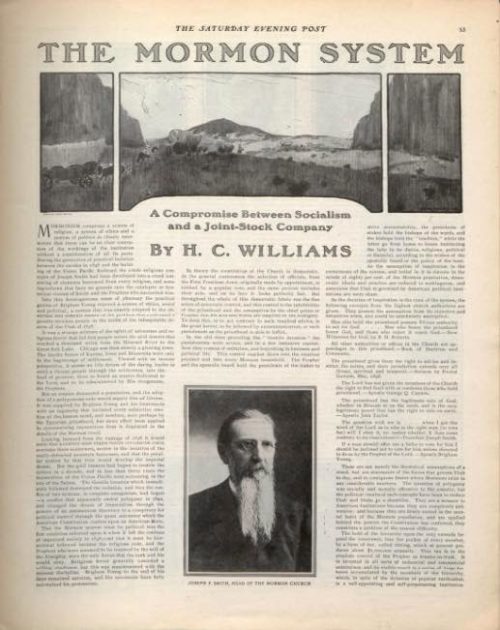
In 1922, Joseph Hergesheimer chronicled the story of the Mormons in his Post series, “The Magnetic West.” Hergesheimer’s history covers the Latter-day Saints from Smith’s revelations to the group’s westward journeys. The article is far less inflammatory than Williams’ 1905 piece; Hergesheimer remains lukewarm toward the LDS Church while considering their circumstances:
The Mormon migration had not been from choice, they had not voluntarily left an ungodly world for the pure but sterile desert. No, the truth was that, until they settled beside the Great Salt Lake, they had been driven from place to place, from state to state. This, they proclaimed, was the result of religious persecution; and the murder, at Carthage, of the Smiths, gave them that claim to martyrdom inseparable from beginning religions. The Latter-Day Saints laid their unpopularity to persecution; but the various regions, the people, that knew them for various but short periods, denying this, asserted that there were civic and political and social reasons for the forced removals. The Republicans, it seemed, would welcome the Church cordially, and vote it against the Democrats; and, in turn, the Democrats, generally speaking, would greet it as a barrier opposed to inordinate Republican ambitions; but in the end both national parties invariably united against the saints. (December 9, 1922)
Throughout the 20th century, Mormonism would side invariably with the Republican party. The Mormon values of family, abstinence, and work ethic were largely revered in the onslaught of the turbulent ’60s and ’70s. In 1950, the Post published “Good Mormons Don’t Go Broke,” a profile of the Mormon owner of the Hot Shoppes franchise. And in 1980 came “The Mormons: Healthy in Body and Soul,” which asked, “Could it be that family stability, physical fitness, abstinence, hard work, and self-reliance are not outmoded virtues after all?”
Over the course of a century, the Latter-day Saints had found national admiration where there used to be enmity. Mitt Romney’s 2012 campaign for president as the Republican nominee was a “major ‘Mormon Moment’ in America” according to Deseret News. The Mormon story is a purely American one, with drama, scandal, and ultimately, prosperity. Joseph Smith has been named among the most influential and significant Americans by both The Atlantic and Smithsonian magazine, and his movement permanently shaped the American West in its formative years.
Dr. Richard Lyman Bushman, a practicing Mormon and professor of history at Columbia University, has authored several acclaimed texts on Joseph Smith and Mormonism that seek to understand how the 19th-century treasure hunter began a worldwide religion. In the PBS documentary The American Prophet, Bushman gives a possible explanation for Smith’s potential for influence: “Joseph said I am another one of those prophets. … Joseph said we will build the new Jerusalem. In a Bible culture, to use those powerful Bible words and make them literal enabled the people of his time not just to read the Bible, but to live it.” If Smith was able to launch a movement by appealing to his constituents’ desire for immersive faith, the Latter-day Saints expressed a steadfast patience over decades to regain the approval of mainstream America.
Movies for the Rest of Us with Bill Newcott: The Toronto International Film Festival, Part 2
Award-winning film critic and writer Bill Newcott has been covering Hollywood for more than 40 years. He is the creator of AARP’s Movies For Grownups franchise and the movie critic for The Saturday Evening Post.
Join our movie review video podcast, Movies for the Rest of Us with Bill Newcott. This week, Bill takes us to the Toronto Film Festival, where he reviews Victoria and Abdul starring Judi Dench, Battle of the Sexes, Darren Aronofsky’s Mother!, George Clooney’s Suburbicon, and one of Bill’s all-time favorite films, The Shape of Water.
News of the Week: Hello Autumn, Goodbye Cassini, and Yes, Virginia, There Is Cheese Tea
Fall Begins
I was trying to find a poem about fall that I could mention here, but most of the poems I found are rather depressing. They talk about the sadness of the light of summer dying, or how the leaves are changing and it’s a bad thing, or how autumn is just a precursor to winter, which we all know is the worst season of all. But I actually love fall — and winter for that matter — so I didn’t include one.
Today is the first day of fall, and I’m glad that summer is over. I’m ready to replace my iced tea with hot, my shorts with jeans, my T-shirts with sweaters, and my screen door with glass. I’m also looking forward to fall because maybe, just maybe, the cold weather will drive away the people who hang out at the base of my stairs, leaving their coffee cups and other refuse.
The Cassini Crash
We told you back in May about the stunning pictures the spacecraft Cassini was sending back from Saturn. No more pictures will be coming from Cassini, as this week it crashed onto the surface of Saturn.
But don’t be sad! The spacecraft spent a successful 20 years sending back photos and other data from Saturn and its many moons. Cassini took one last photo before crashing just north of Saturn’s equator.
Sitting Is the New Smoking
If you’re sitting there reading this… stand up!
Suddenly, sitting down is incredibly bad for you. Based on a recent study and many past studies, doctors are actually saying that sitting is the new smoking. The longer middle-aged and older people sit, the more likely they are to have problems with obesity, diabetes, and heart disease. Of course, like most studies, the data is incomplete and might not tell the whole story. But it wouldn’t hurt to get up from your desk to walk and stretch once in a while.
This sounds like one of those health things that, well, isn’t that easy to fix. Sure, we can walk around more and make sure we exercise in general, but sitting is what we do, at home and at work. It’s like telling someone that standing is really bad for you and you should sit more. Yeah, okay, but it’s hard to go places if you can’t stand up. If sitting is bad for us, how dangerous is lying down and sleeping eight hours a night?
I was wondering why I’ve been seeing so many commercials for those standing desks and treadmill desks.
The Happiest State Is …
A question for all of our readers in Minnesota: Are you happy?
You should be, because your state came in first in a study conducted by WalletHub. The site takes data and ranks the states in categories like Emotional and Physical Well-Being, Work Environment, and Community and Environment. Minnesota was number one, followed by Utah and Hawaii. Sorry, West Virginia, but you came in dead last. Sad!
Of course, I don’t know how accurate this study is, so I wouldn’t recommend you suddenly get depressed just because you live in a state that’s low on the list. I mean, I don’t feel like I live in the 19th-happiest state. It feels more like top 10. Certainly top 15.
Cheese Tea Is a Thing, Apparently
Some food combos make a lot of sense. There’s peanut butter and milk chocolate, bagels and cream cheese, and of course peanut butter and jelly. But how did anyone think of putting cheese in their tea?
The Daily Mail says it’s an Asian trend that is coming to New York and Los Angeles. It’s the popular bubble tea, hot or cold, only topped with a sort of whipped cream cheese. This is becoming one of those trends that you are about to hear a lot about but will probably never actually experience yourself, like planking or winning the lottery.
I’m addicted to tea — it’s 11 a.m. and I’m already on my third cup — but this is something I just have no interest in trying. I mean, I’m not even a big fan of teas flavored with fruit, so I’m not going to top my tea with the same stuff I top my nachos with.
I like chocolate chip ice cream and I like onions, but I’m not going to combine them.
The Man Who Carved Mount Rushmore
This week, the National Park Service finally recognized the work of Italian immigrant Luigi Del Bianco, the chief carver of Mount Rushmore. Here’s a report from Jim Axelrod of CBS Sunday Morning.
RIP Harry Dean Stanton, Jake Lamotta, Frank Vincent, Lillian Ross, Grant Hart, Stanislav Petrov, J.P. Donleavy, Mike Hodge, Bobby “The Brain” Heenan, and Mark Lamura
Harry Dean Stanton was one of the great character actors, appearing in so many movies and TV shows that you’ll have to take a few minutes to read his IMDb page. He has the lead in the new movie Lucky and was recently seen in Twin Peaks: The Return. He died last Friday at the age of 91.
In 2013, Lawrence Grobel interviewed Stanton for the Post.
Jake Lamotta was the brawling boxer who inspired the classic Martin Scorsese film Raging Bull. He died earlier this week at the age of 95.
Frank Vincent was an actor who appeared in Raging Bull but is probably best known for his role as Phil Leotardo on The Sopranos. He also appeared in such classic films as Goodfellas and Casino. In the 1970s, he was in a band with fellow actor Joe Pesci. Vincent passed away last Wednesday at the age of 80.
Lillian Ross was an acclaimed writer and journalist who, except for a short break in 1987, worked at The New Yorker from 1945 until 2012. She authored several books, including Here but Not Here and the 2015 collection Reporting Always. She died Wednesday at the age of 99.
Grant Hart was the drummer and one of the lead singers of the rock group Hüsker Dü. He died last week at the age of 56.
Stanislav Petrov saved the world in 1983 when, while working as a military officer at a Russian nuclear early-warning center, he got information saying that the United States had launched several nuclear missiles. He decided to check things out instead of retaliating, and it turns out it was a false alarm. Petrov died in May at the age of 77.
J.P. Donleavy was an author known for several novels, including The Ginger Man. He died on September 11 at the age of 91.
Mike Hodge was an actor who appeared in many TV shows and movies. He was also the New York local president of the Screen Actors Guild-AFTRA. He died Saturday at the age of 70.
Wrestling fans will remember Bobby “The Brain” Heenan. He was the colorful manager of such wrestlers as Andre the Giant, Rick Rude, and King Kong Bundy. He died Sunday at the age of 72.
Mark Lamura was an actor known for his many years playing Mark Dalton on All My Children. He also appeared in several other shows, including The Sopranos, 30 Rock, and Star Trek: The Next Generation. He died last week at the age of 68.
This Week in History
Earthquakes Hit Mexico City (September 19, 1985)
The earthquake that hit Mexico City on Tuesday came on the anniversary of the first of two earthquakes that hit the area 32 years ago, which killed thousands and caused billions of dollars worth of damage. The second earthquake hit a day later.
“Yes Virginia, There Is a Santa Claus” Editorial (September 21, 1897)
Don’t worry, you haven’t fallen asleep for three months. It’s still September and way too early to talk about Christmas. But the answer to the famous letter from 8-year-old Virginia O’Hanlon was published in The New York Sun this week in 1897. Some interesting trivia: O’Hanlon was the cousin of George O’Hanlon, the actor who did the voice of this guy.
This Week in Saturday Evening Post History: Norman Rockwell’s Runaway (September 20, 1958)
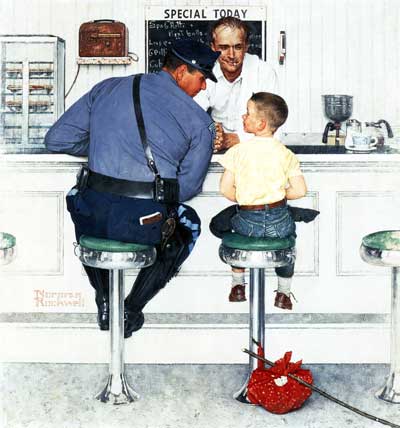
I think we can all agree that this cover is the most famous Norman Rockwell work, right? Well, it’s certainly up there with Freedom from Want. Here’s a 2011 interview with the Massachusetts state trooper and little boy who posed for the painting, Dick Clemens and Ed Locke (Clemens passed away in 2012):
Get Ready for the Return of Pumpkin-Spiced… Everything
The start of the fall season means it’s the start of pumpkin spice season. If you haven’t noticed, everything is pumpkin-spiced now. Not just the drinks at Starbucks, but also cereal, butter, pizza, and, of course, dog cologne. We were promised jet packs and flying cars but instead we got Facebook and pumpkin-spiced everything.
A lot of people hate pumpkin spice and dread all of the products that include it. As someone who actually likes the flavor (within reason), I really don’t mind the onslaught of pumpkin-spice-flavored drinks and cookies and cakes. A thousand recipes caught my eye, but I’d go with these Pumpkin Chocolate Chip Squares from Recipe Girl.
By the way, I just checked my high blood pressure medication, and guess what? Pumpkin spice flavored.
Next Week’s Holidays and Events
Oktoberfest (September 23–October 8)
This is billed as the world’s biggest fair, but we all know that when you hear the word Oktoberfest, you think of beer.
National Good Neighbor Day (September 28)
Do people still borrow cups of sugar from their neighbors? I was thinking of that before coming across this day started by Lakeside, Montana, resident Becky Mattson in the 1970s. Why do people always run out of sugar and not eggs or milk or bread? Will people some day borrow pumpkin spice?
Movies: What to Watch This Fall
Noted film critic Bill Newcott reviews movies that appeal to more than just 14-year-olds.
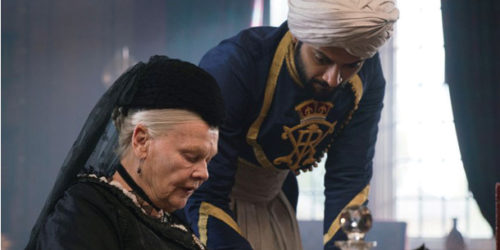
Victoria and Abdul (Sept. 22)
Judi Dench is Queen Victoria; Bollywood superstar Ali Fazal is the young clerk from India who, against all odds, becomes the old queen’s closest friend and confidant. As you’d expect in this true story, the denizens of the Court of St. James are not amused.
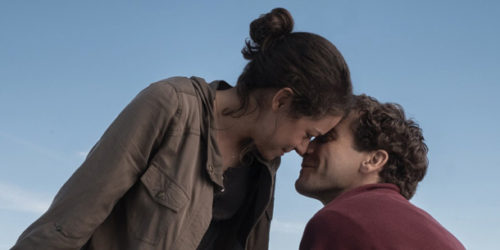
Stronger (Sept. 22)
It was one of the most harrowing images of the Boston Marathon bombing: Jeff Bauman being rushed from the scene in a wheelchair, both of his legs missing. Jake Gyllenhaal plays Bauman, whose life took several unexpected turns after that fateful day.

Blade Runner 2049 (Oct. 6)
Thirty years after the original, Harrison Ford is back as Rick Deckard, only this time instead of hunting down renegade robots in a dystopian Los Angeles, he’s the one being sought by a young cop (Ryan Gosling) who needs Rick’s help to save what’s left of society.
Follow Bill Newcott at saturdayeveningpost.com/movies or at his website, moviesfortherestofus.com.
This article is featured in the September/October 2017 issue of The Saturday Evening Post. Subscribe to the magazine for more art, inspiring stories, fiction, humor, and features from our archives.
A Wandering
Lita stepped off the steel curlicue of the taxi’s riding board and entered the cool moving air of the apartment complex. Five in the evening, fresh from another nasty day at the Harper Gazette. Outside everything was still and stubborn, wilting in the humidity. She ascended the stairs barefoot, high heels in her hand. The rattling metal fans in the hallway were her only reprieve from the refrain of the piano.
As soon as she set down her purse and shoes, she could hear him in the apartment above. His fingers crept up the piano scale and eased back down, a graceful rise and fall. The same meandering song, the one he always played. A melody somewhere between recurring dream and insanity.
Lita imagined it was a waltz that would drive the feet of ballerinas, but the pink-clad dancer in her mind had only three moves that she repeated ad infinitum: first a graceful step; then a tilt as she sweeps from one foot to the other; a little twirl with a deft movement of the wrist; and then she pauses until the refrain repeats. He ended each coda with a contemplative silence during which Lita hoped the music would stop altogether, but inevitably he played it again without alteration or novelty. She longed for an ordinary neighbor that would argue with a wife or pound nails into a board all day.
Lita went to the icebox and poured herself a glass of milk. She had nothing to eat for dinner, and the cupboards were all but bare — part of her effort to move out, which had begun a year ago and gone nowhere. She removed the only occupant of the fruit bowl, a bruised pear, and climbed through the window. There was no breeze on the fire escape. Engine sounds from the traffic drifted up, and the downtown train rolled along the bridge in a rhythm like a drumline. People on the sidewalks below plodded miserably along in the heat.
Lita ate the pear and then lit a cigarette. Hal’s window was open; his playing was even louder out here than it was in her apartment. Not that it was too loud — he played softly, like a lounge pianist. Eternally in the background, in the periphery. But his damn melody was drilled into her head. She hoped her cigarette smoke would bring him away from the piano, and it did.
“How much longer are you planning on keeping that up?” Lita asked the drowsy evening.
“Why don’t you buy a radio?” he called from inside. “Tune me out.”
“I told you, I’m moving out.”
“Still?” She could hear him take his usual position with his elbows on the windowsill.
“Besides, you’re not half bad. Just wish you’d play something else.”
The melody was still playing in Lita’s head. Hal began to whistle it almost inaudibly with his front teeth.
Lita blew a long stream of smoke. “I said something else. That song is going to drive me crazy.”
Hal was silent for a moment before he pushed off the sill and his voice receded: “All right, Lita, I’ll play you something different.”
She heard the scrape of his piano bench and then the clunk of the fallboard. Ash fell from the cigarette between her fingers and spun on a breeze too weak to really feel. Hal’s thrift store piano came back, this time up-tempo and jazzy. He hopped between chords and sprinkled in glib notes, a song that sounded like romance and cocktails.
She stabbed the remains of her pear into the dirt of the empty planter beside her and added her cigarette butt. “I’m starving, Hal,” she said.
He kept playing.
“Starving,” she said, louder.
The piano went unsteady and the music evaporated. Hal counted himself back in with four taps of his foot and picked it back up. “I have dinner left over,” he said, trying to balance talking and playing. “You bring me something to drink, and I’ll feed you.”
“That’s not what I meant,” Lita said, but she didn’t have the energy to be heard over his lively playing. She stepped back through the window and snatched the bottle of Cabernet off the counter on her way upstairs. The music had stopped. Hal’s door swung open before she knocked, and he gestured her in. Hal had blond hair and eyes that made him look as though he were always concentrating on something, even when he smiled. He went to get glasses from the cupboard and hastily tucked in his shirt.
“No need for formality,” Lita said. As she perched on the chaise, she glanced at her stocking feet. “Hope you like warm wine.”
“Just right for cold supper,” Hal said. He brought two juice glasses, and Lita filled them. He drank his while making up a plate for her at the stove: tomato bisque and French bread with basil. He set the dish in front her. It was not cold at all, and the aroma made her stomach growl.
“This looks delicious! Is that what you do when you aren’t playing that same song over and over? You’re a world-class chef?”
“It gives my fingers a rest. Chopping vegetables, stirring the pot.” Hal brought his piano stool over so he could sit across from Lita at the coffee table. There was only room for her dish, but she ate rapidly. She tore up the bread to immerse in the soup.
“I’m not the prying sort,” Lita said, “but you’ve never given me a straight answer. Why that song?”
“It’s only part of a song,” Hal said.
“Where’s the rest of it?”
He clutched the stool under his arm, crossed the room, and deposited himself in front of the piano as if in a trance. With his left hand he played half of the song, only the low parts. Something about that rough sketch of it was even more haunting.
“I’m lost,” Hal said, and he watched his left hand meander the keyboard. “Playing this helps me feel closer to something.” The music stopped and he let his hand fall. “I’m not sure what, but something.”
Lita finished her meal. It was delectable, and it made her wonder why she’d only been to Hal’s place once or twice. There had been a Christmas when they’d been snowed in and instead of visiting family they drank bourbon on the fire escape in the cold. Hal came downstairs for Thanksgiving once, and Lita cooked for him — now that she knew how good a cook he was, she realized how charitable he’d been about her dry turkey. Beyond that, she knew little about him. He worked at the library downtown but was always evasive about his exact role. She assumed he was a librarian, or maybe he swept floors and felt embarrassed about it, but one thing she never thought he could be was lost.
Lita ran a few possible responses through her head — how can you respond to that? She discarded them one after the other, the way the editor-in-chief had done at the Gazette during her first week. She had an indelible image of Mr. Meyer standing over her desk and sweeping her pages one by one into the wastebasket. “These are trite. This is cliché. Your copy needs to fly off the page! It needs zing!” That had been the first time she cried at work. It was most assuredly not the last.
“The wine helps a little, I hope,” Lita said, just to fill the silence. In her mind’s eye, Mr. Meyer shook his head.
Hal nodded. “Thanks. It does, I think.” He placed his empty glass on the high back of the piano and began playing again. “I’ll play the whole thing, start to finish.”
Evening brought little weak breezes that hardly pierced the apartment windows. Hal played a somber melody, and Lita tried to drown it away with wine. The refrain was waiting somewhere inside the song, and she couldn’t help but listen for it. It gave her the same morbid fixation as scanning the room at a party to look for an ex-boyfriend — hoping you’ll see him, wishing you won’t. Notes here and there pricked her ears through the diaphanous melody. Something subliminal told her the refrain was about to begin, and she rose from the chaise.
Lita leaned over Hal and lifted his right hand off the keyboard. “It’s lovely, really — but if you play that part one more time, I’ll scream.”
Hal hadn’t heard her cross the apartment, and for a second he was shocked. The left hand played a few more notes on its own before he stopped it. “Sorry, I didn’t mean to upset you.”
Lita retracted her hand. “I’m not upset. I’ve just been hearing that same song in my mind for weeks on end. If you’re lost, you’ve dragged me down with you.”
“I didn’t realize. At this point, even when I’m playing it, sometimes I don’t hear it anymore.” He looked away and held his hands in his lap.
“Well, if you’re lost, you can’t keep wandering in circles,” Lita said. She pushed onto one end of his tiny piano bench and touched the ivory keys. Her fingers were poised like a dancer awaiting the return of the refrain. Hal quickly mimicked her positioning one octave down the keyboard.
Three glasses of wine made it a little hard to remember the two piano lessons she’d taken a decade ago, but she pressed a few keys at random and came away with something charming. Hal pressed his keys in the same unsteady tempo but then played it over and smoothed it out. Lita tried to repeat the notes but couldn’t find them again. Hal followed her lead, adding a flat to cover a sour outlier.
Lita removed her fingers, and Hal played both exercises together. “What is that?” he asked. “These are just notes.”
“It’s called music.” Lita held her thumb and middle finger slightly apart, as if she were about to pick up a domino, and pressed keys in a few different places. “You can’t get lost if you’re trying something new; that’s called exploring.”
Once the phrase left her lips, she made an effort to remember it, though she knew she wouldn’t. It sounded like the kind of thing that might stand a chance of impressing Mr. Meyer. Nonetheless, it gave her a little confidence, which seemed to help her abysmal piano playing.
Following the trail of chords Lita had played, Hal added some flourishes and sustain with the pedals. He played through the whole sequence she’d outlined and smoothed it here and there like he was ironing a shirt. When he reached for a higher note, one her hands were covering, he hesitated. But then he placed his hand over Lita’s and played the key with her finger. His face was, for a moment, nearly blank. His mind seemed to go off somewhere else while he played.
“Still feeling lost?” she asked.
“A little.” He removed his hand from hers and played an idle scale with the other. Then both of his hands left the piano and landed on his thighs. “Is my playing the reason you want to leave? Or is it the reason you stayed?”
Lita chuckled and played a few more keys at random. But the doleful look on Hal’s face told her he wasn’t making a joke. To name only a few, Lita was unsatisfied with her job and the city itself and the long drives to see her family. Hal’s playing wasn’t a deciding factor, but maybe he thought it was. He must have had some other reason for endlessly playing the piano and having dinner for two ready-made.
“If you want to get a girl’s attention,” Lita said, “playing the same song over and over isn’t the best way.”
Hal gave her a fleeting smile. “But you still came over, didn’t you?”
Without the warmth of the piano, the apartment building fell quiet. Metal fans buzzed on the other side of the wall. The smell of sun-beaten asphalt was replaced by the evening, heavy and humid, smelling of wine on breath and thrift store piano and tomatoes with basil. Lita searched Hal’s eyes for a long time, but she could not find what he had been so long seeking.
With a scrape of two piano bench legs, she rose. “Thank you for the dinner and the lovely time. I should be going.”
Hal shot up. “Yes, of course. It was so good to have you over. I should clean up these dishes,” he said, snatching the glasses from the top of the piano, his and hers. He moved to close the piano, but Lita held the fallboard.
“Sit down, Hal. Keep playing,” she said. “Something new, something different.” As he sat down again and began feeling the keys, she opened the door and said, “I’ll bill you later for the piano lesson.”
“Right,” Hal said with a bright smile. She could feel his eyes still fixed on her after she closed the door. She stood for a moment smiling as wide as he had, and as she paced to the top of the stairs she was still looking at the door.
The music didn’t begin until she was halfway down the stairs. She stepped slowly and quietly and strained her ear past the buzzing metal fans. In her apartment, she lay on the bed in her clothes listening to the music float through the window and descend from the ceiling. He folded her two-finger chords and haphazard notes into a lovely fugue. Her vague description of a song disappeared into a melody built for it, built from it. A dream of her. The suffering of a humid night was ornamented with music.
When Hal went to bed, Lita was left to roll and languish in silence, which faded into the low hiss of the city. She was not, for once, at the mercy of the refrain trapped in her skull. She was lost. Trapped even by the sound of the word as it rang in her head, each peal setting the stifling air to tremble. Notes from the fugue reassembled themselves in the shape of that dormant refrain, which then grew louder and louder in the darkness.
Lita knocked until he cracked open the door. His blonde hair looked dark in the weak light of the moon.
“Please let me in,” she said. “I can’t sleep. I know you can’t either.”
“I think I was sleeping. Why are you up here?”
“Please. Just play a little more for me. I can’t stand the quiet.”
Hal let the door swing open on its crooked hinges. Lita came eagerly into the dark room and joined him on the piano bench.
“I don’t know if I can play,” Hal said, stifling a yawn.
Hal’s yawn made Lita yawn, too. “Come on,” she said, tapping a key. It was unexpectedly loud. “Just play something. It’ll help me fall asleep.”
Hal’s fingers were impossibly light on the keys as if he were playing the piano with feathers. He played a slow, blue song that sounded like a country river in the moonlight. Lita was immediately drowsy. She settled her head on Hal’s shoulder, and in a moment her breathing matched the slow rise and fall of his chest. He was playing only the chords now and humming the rest, soft and gentle.
“I’m lost,” Lita murmured.
“We’ll get there,” Hal said. “We’ll get there.”
When Henry Cabot Lodge Told Us We Were Winning in Vietnam
Viewed from a half-century away, the outcome of the Vietnam War seems like an inevitability. Surely the U.S. government saw it was wasting money, weapons, and men on a war it couldn’t win.
A major driver of the conflict was the ever-present Cold War and a pervasive fear of the proliferation of communism. American statesmen were desperate to contain its spread in Southeast Asia — and avoid any association with failure. One of these men was Henry Cabot Lodge, the former Massachusetts Senator and ambassador to Vietnam.
In his article in the July 29, 1967, issue of the Post, “We’re Winning in Vietnam,” Lodge explains why, despite what our readers might have heard in other media, the U.S. was making progress in the war.
Lodge points out that the Vietnam War wasn’t like World War II. It had none of the signs of progress of traditional wars. So he explains the “solid achievements” that led the U.S. military to believe it was winning the war:
- South Vietnam now had increased control of the country’s waterways and roads.
- North Vietnam’s supply lines were being disrupted by American bombers.
- Recent elections had been held in South Vietnam despite Viet Cong efforts to disrupt it through terrorist attacks.
- Even the Viet Cong admitted they were losing their grip on the South Vietnamese people.
- “They cannot win,” Lodge confidently declares, “and we cannot be pushed out.”’
What Lodge doesn’t mention is the price America was paying for its gains. The month before this article appeared, 830 Americans had died in combat, and the month before that, 1,223.
And Lodge didn’t know the North Vietnamese and Viet Cong had already begun planning the Tet Offensive, which they launched in January of 1968. It would send 85,000 communist troops in a country-wide assault on five major cities, dozens of military installations, and scores of towns.
When it was over, the North Vietnamese and Viet Cong fell back, leaving 33,000 of their dead behind. It was a tactical defeat for the communists, but it was a psychological defeat for Americans, who saw their combat deaths rise to 1,200 in January and over 2,000 in February. Nearly 17,000 American soldiers died in 1968 alone.
America might have been winning tactical battles, but public support wasn’t there. According to “The U.S. Army in Vietnam” by Vincent Demma, intricate historical, political, cultural, and social factors all played a part in how the war ended: “A new humility and a new sophistication may form the best parts of a complex heritage left to the Army by the long, bitter war in Vietnam.”
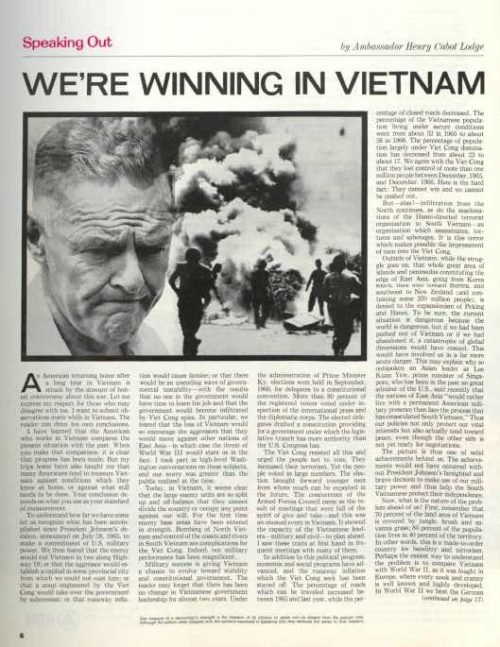
Featured image: Photo collage from “We’re Winning in Vietnam” by Henry Cabot Lodge, from the July 29, 1967, issue of the Post.
North Country Girl: Chapter 18 — The Sixth and Seventh Circles of Junior High Hell: Home Ec and Gym
For more about Gay Haubner’s life in the North Country, read the other chapters in her serialized memoir. The Post will publish a new segment each week.
Wendy and I were the epitome of pre-teen girl best friends: we spent hours debating whether boys we had crushes on even knew if we were alive, slept over every weekend, in Wendy’s tiny apartment or at my house (bigger TV but annoying little sister looking for an audience for her “Let Me Entertain You” strip tease), and talked on the phone for hours about nothing until my dad, infuriated, would stomp over to the kitchen phone and click down the lever, hanging up on Wendy, without even giving me a look or a chance to say good-bye.
On Saturdays, Wendy and I took the bus downtown to cruise through Glass Block and Orech’s and Maurices, looking at the clothes in the Junior Department, which were usually the exact same ones that were there the week before. We would drop in at Woolworth’s to paw through the racks of cheap makeup, once in a while pulling a crumpled dollar from our pockets to buy a Yardley Slickers beige lip gloss or Evening in Paris talcum powder.
We ate cheeseburgers and French fries at the counter of the Carib, even though that yellow-and-green Formica and tiled diner gave me the creeps. Driving back one night from a gargantuan Thanksgiving dinner at my grandparents, I looked into the glass front of the Carib, which was garishly lit from within, the only light on a block where every other business was dark. There were few grey men spaced evenly apart on stools along the counter, each hunched over an equally gray plate of food, and I was struck with a pang of loneliness and despair no 10-year-old should feel. I never could really enjoy my burger there; the ghosts of those solitary men sat around me.
Unlike Becky Sweet, Wendy did not demand a monogamous relationship. Junior high kids flowed and reassembled like amoebas in the halls and classrooms of Woodland. Wendy and I had only one class together, where we were constantly under threat of expulsion. I’m sure Mr. Peleski’s orchestra would have sounded better if Wendy and I had been allowed to whisper instead of scratching away at our violins.
I met Kathy O’Dell in art, where three times a week we perched on high stools next to each other and made charcoal drawing after charcoal drawing of an apple, a pear, and a water jug. Kathy was a willow blonde as pretentiously egg-headed as I was. I am positive that by eighteen she was stunning, but back then she was like me, a smart girl who wore glasses, and therefore a seventh-grade pariah.
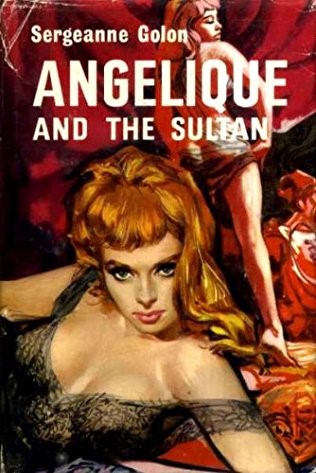
Kathy was a romantic who was obsessed with a series of French novels: Angelique, Angelique and the King, Angelique and the Pirate, Angelique and the Sultan, and a bunch more. These were ur-bodice rippers: the unworldly beautiful Angelique, blonde and green-eyed (like me!) has rapturous sex with her husband, and, after she thinks he is dead, with a few other special men, and semi-rapturous non-consensual sex with man after man, all of whom are overwhelmed with a throbbing, not-to-be-denied passion for her. One of her captors was a dashing pirate with an eye patch who stars in my sex fantasies to this day. Kathy thrust these books in my hands and we discuss every one with the intensity of Talmudic scholars. Kathy generously shared with me her daydream of being Angelique, feted at the court of the Sun King, captured by Mediterranean pirates, wed to a Sultan, forever being torn from the arms of her swarthy, handsome husband and true love, and then joyfully and sexily reunited. I would read those books all over again if I could find them, and I have looked.
My other friend, Karen Ringwald, was calm, quiet, smarter than me, and unaffected by any teenage madness. Karen and I were the only girls in advanced math, where we were treated as if we were just funny-looking boys. For an hour each day, I was in the blissful state of feeling accepted by a junior high group, the smart, funny boys. Unlike other classes, in math we all rushed to sit at the front of the room, where we could be first to jump up to the chalkboard, yell out the answers, and entertain the rest of the class. Our teacher, Mr. Abrams, was as smart and funny as we were; he didn’t mind the wisecracking as long as all the work was done, and since we were all a bunch of nerds who loved math, that wasn’t an issue. Two of the smart boys in math, the handsome Steve Olson and Rick Bryers, were also jocks in training. All of us seventh grade girls sighed over them, drew hearts with our initials joined by a plus sign (quickly scribbled over so no one could see), and fixated over which of us they liked. Steve was blonde and friendly and quick to smile, Rick was dark and serious and had a baby Burt Lancaster chin cleft. If either of them spoke to me in class, (“What did you get for problem C?” “Do you have an extra pencil?”) I would repeat their exact words to Wendy, and we examined them like the entrails of a chicken, searching for hidden meanings. The other boys in math were funnier, but most of them had yet to outgrow the oversized noses and Adam’s apple of preteen boys. Some, like the appropriately nicknamed Turkey, never did.
Math class was where I had my first period. Between my mother’s vague hints about where babies come from and the mythology imparted at summer camp, I was aware that eventually I would start bleeding from somewhere between my legs. I had seen the mysterious Modess vending machines in ladies rooms, and ads in Seventeen boasting that with Tampax you could swim and horseback ride all month long. I didn’t grasp the reality of this until I was sitting in math, wondering why my seat felt wet. I hoisted myself up a few inches, looked down, saw a tiny pool of dark red blood, and sat back down. Mr. Abrams was scrawling something on the chalkboard and all eyes were on him, as my own had been only seconds before. I was wearing a wool plaid skirt in black, red, and green. I squirmed in my seat, yanking up the skirt’s waistband and twisting it around, while furtively wriggling my butt. I kept doing this, wiping up the blood with my skirt every time I felt it seep through, until the bell rang for the end of class. I jumped up, made sure there was no blood on the light laminate wood of the chair, and ran for my locker and coat. I went to the nurse’s office, told her I felt sick, and asked her to call my mother.
My mother hated it when the school called. It was always on her day to deliver toothpaste to the wilds of Hermantown with the Women’s Dental Auxiliary, or to take my baby sister to the pediatrician, or to fill little cups with nuts and chocolates for her bridge party. She was not pleased to have to stop what she was doing and pick up a sick kid from school. (My mother did not approve of any of us being ill, ever. When we did get sick, we were banished to our rooms with green jello and a glass of lukewarm Seven-up on a tray until we saw the error of our ways.)
I waited in the dim nurse’s office, scared to sit or lie down, until my mother finally rushed in, dragging a crying baby Heidi by one arm, and ready to bawl me out for catching the stomach flu. I burst into tears; the nurse patted my shoulder and whispered to my mom. Once home, mom gave me a ridiculously huge pad, a sanitary belt, which was an elastic band with two sharp grommets to hold the pad in place, and minimal instruction, then left me alone to figure out how to keep that wad of cotton from migrating north to my ass crack.
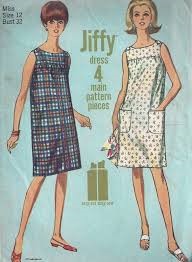
It’s too bad I couldn’t have gotten my first period in home economics. It might have earned me some sympathy from the teacher, who looked upon me as hopeless and helpless. I got the first D of my life on invisible hems: the concept escaped me completely. I had to be safety-pinned into my A-line dress (two seams, no collar, no sleeves, no trimming, all too visible hem) for the home ec fashion show or it would have fallen apart on the gym floor.
We moved quickly past basic sewing to embroidery, learning dozens of decorative stitches that have certainly been lost to the sands of time by now. We crocheted scarves, a simple enough task that I got a B- (I couldn’t figure out what to do when the scarf was long enough). Knitting was a disaster for me: getting the yarn on and off the needles, casting off, dropping stitches, and what is a purl anyway?
I did not fail so spectacularly at cooking, as it did not require small motor skills and we were not making Beef Wellington, Chicken Cordon Bleu, or even the humble Minnesota hot dish. Our home ec teacher took us through biscuits (beat the hell out of them), muffins (gently fold the ingredients together), and Rice Krispie Treats (in those pre-microwave days, try not to inflict first degree burns on yourself or your classmates while melting butter and marshmallows together on the stove or pouring the boiling hot mess over the Rice Krispies). We worked, and were graded, in groups, and as long as we didn’t burn our biscuits or overbeat our muffins, we all passed.
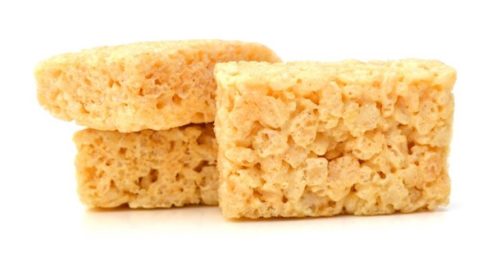
The home economics curriculum must have been created in a prelapsarian age, preparing us for an adulthood where we would spend our days monogramming tea towels and whipping up baked goods. The message was clear: girls were meant to be decorative and pleasant, as shiny as a skein of embroidery thread, as sweet as a Rice Krispie Treat. Boys had their No Girls Allowed shop class, where they used real tools to make useful things out of wood.
***

Junior high gym class was also segregated by sex. It was as if the terrifying apparatus in Congdon’s gym had followed me to Woodland: once again, the horse loomed up ahead of me, daring me to approach. I managed to haul myself up to the top of the climbing bars, where I dangled from a wooden rung, unable to do a single pull-up, while the gym teacher looked at her stopwatch and shook her head.
Each gym activity went on for interminable weeks and weeks. Gymnastics was followed by basketball, then swimming, then volleyball, in an endless cycle of despair. Our gym grade (which so unfairly counted in our grade point average) was also based on the presence and condition of our gym uniform. This uniform must have been created by a monster who hated preteen girls: it was a blue button-up one-piece romper, like a toddler would wear, made of the world’s scratchiest, most uncomfortable synthetic. We were required to take our uniforms home once a week to be laundered. With my mind on higher things (Will Rick Bryers talk to me today?) than remembering to bring my gym suit back to school, I got a lot of zeros in clean uniforms.
But thanks to swimming lessons in the frozen lake at Camp Wanakiwin, I managed to boost my gym grade to a B during the weeks we spent in the school’s over-chlorinated indoor pool. I loved swimming, because I could do it, and because it drastically truncated our gym hour. First, every girl, even those unfortunates who still had the physique of a nine-year-old, claimed to have her period, and had to be personally vetted by the gym teacher, who did everything short of checking for Kotex to make sure they weren’t malingering. We then changed into hideous black wool swimsuits that fit no one, and white swim caps, making sure that every strand of hair was tucked inside the rubber, a process again checked personally by the gym teacher as we entered the showers. We had to shower again after getting out of the pool, and change back into our school clothes. I think we spent about five minutes in the pool.

The Evolution of the Microwave from Exotic Gadget to Ho-Hum Appliance
Like computers, cell phones, and Furbies, microwaves have seen a drastic price decrease since their introduction to the public. If you wanted to be among the first American households with a tabletop microwave oven 50 years ago, it would have set you back $495 (over $3,600 today).
The first model on the market was the Amana Radarange. This revolutionary appliance was more than just a box to nuke your Easy Mac. In 1968, a color ad in the Post showed the Radarange with the bountiful spread it was capable of creating: an entire turkey, lobster, pork loin, and a whole eggplant. “No more slaving over a hot stove. No more scrubbing pots and pans. No more need to prepare food hours in advance,” the promotion boasted.
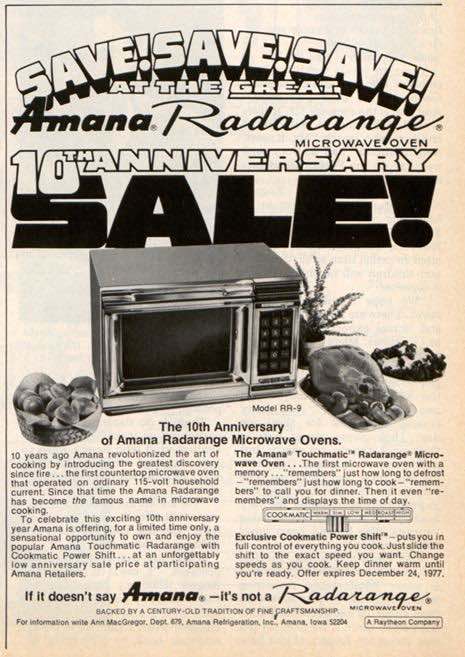
Despite its ambitious intentions, the microwave oven never completely replaced traditional cooking methods. Home chefs have found the charring and crisping capacity of flame to be unrepeatable in a microwave. The gadget has become a mainstay in the American kitchen, though. From 1986 to 2001, the percentage of U.S. households with microwaves jumped from 25 percent to over 90.

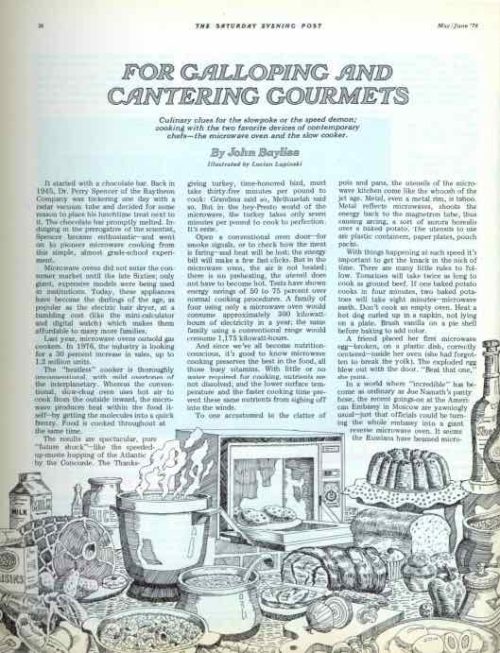
In 1976, the Post published an explainer on the microwave oven, saying “the ‘heatless’ cooker is thoroughly unconventional, with mild overtones of the interplanetary.” After all, the 1945 invention of the space-age oven is credited to Raytheon engineer Percy Spencer. He was working with the radio waves of a magnetron and discovered the radar component was melting a chocolate bar in his pocket. After isolating the waves in a metal box, Spencer found the radio waves could be used efficiently to heat food, or, rather, the water molecules in the food.
The Post’s 1976 article also warned of the “taboo” of metal in microwave ovens: “Metal reflects microwaves, shoots the energy back to the magnetron tube, thus causing arcing, a sort of aurora borealis over a baked potato.” The write-up concludes with two microwave recipes for readers to try: Teriyaki Sirloin Strips and Chinese Rice Crab.
The preferred appliance of college dormitories is quite capable of cooking Asian rice recipes and ramen noodles, but these days microwave cake in a mug and microwave potato chips are some nuking favorites. Perhaps the best feature of microwave ovens is that, after 50 years, the price has gone from $495 to free. Due to the indestructible nature of the contraptions, it seems there is always one to be inherited.
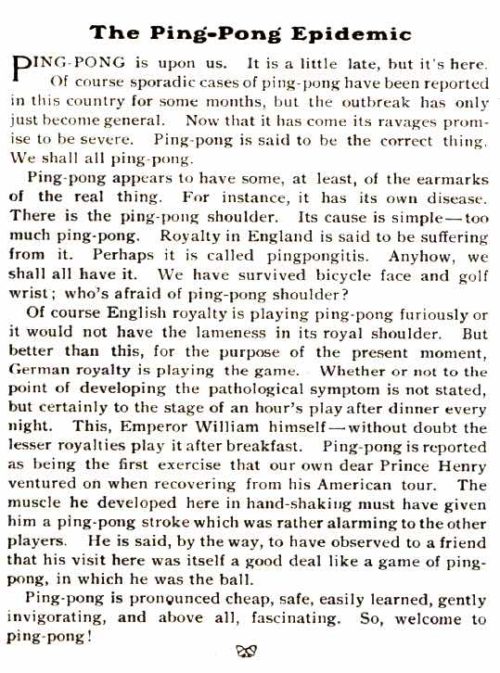
The 20th Century’s First Big Craze: Ping-Pong
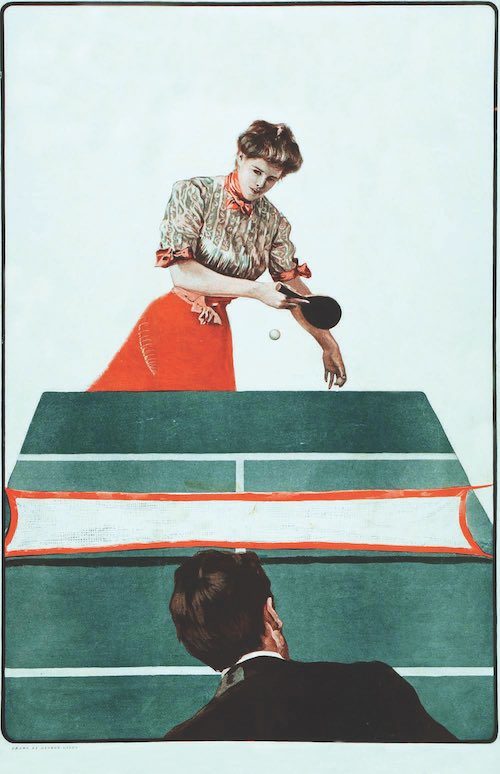
Séances, bicycles, automobiles — they’d all been fads. But at the turn of the century, America had lost its mind over Ping-Pong, a game Post editors called “cheap, safe, easily learned, gently invigorating, and fascinating.” The following editorial appear in the Post on April 5, 1902.
Cover Collection: Trophy Life
Silver goblet or fluttering blue ribbon, winning a trophy feels great, whether it’s for tennis, golf, or horseback handiwork.
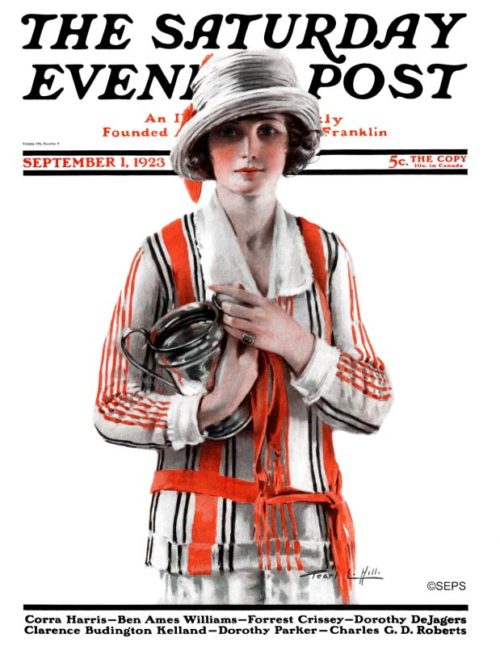
Pearl L. Hill
September 1, 1923
This lovely woman from the flapper era has won a silver goblet, but for what? Golf? Tennis? A cunning jacket?
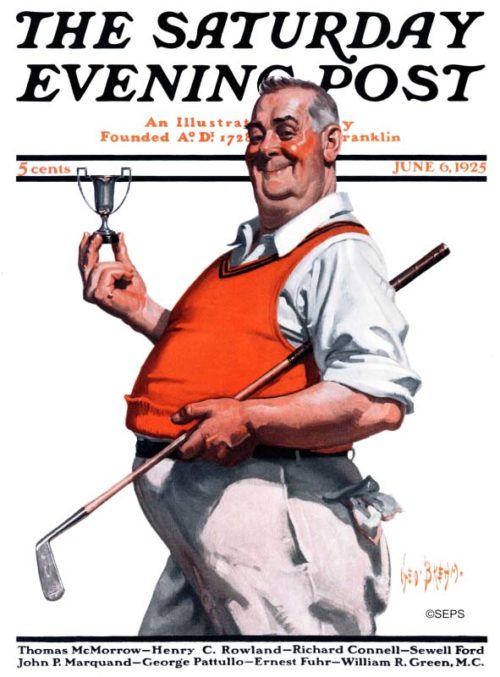
George Brehm
June 6, 1925
Artist George Brehm perfectly captures the absolute satisfaction of a golf game played well. It’s even sweeter if a trophy (or better yet, money) is in the mix.
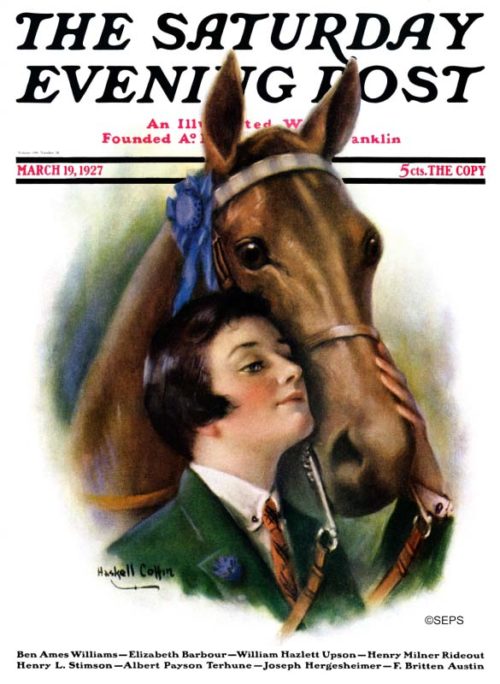
W.H. Coffin
March 19, 1927
Horse and rider share a subtle hauteur that comes with winning that blue ribbon. (Actually, horses look like that all the time.)
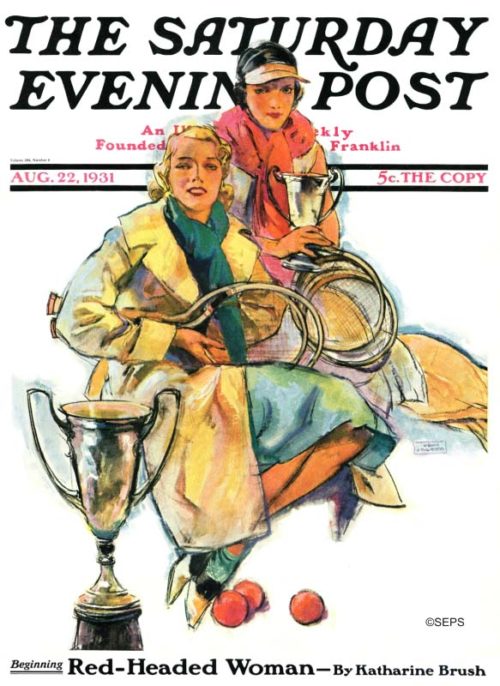
Alan Foster
August 22, 1931
Artist Alan Foster was fond of illustrating moments in sports, whether hockey, baseball, or tennis. Many of his covers had a humorous twist, but he painted this winning women with the significance the moment deserved.
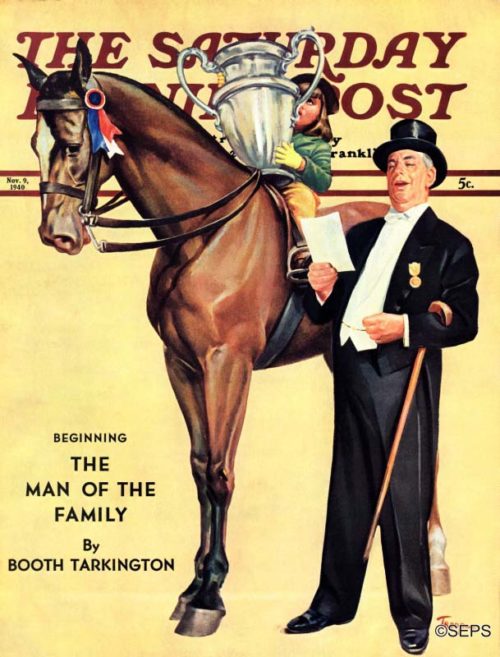
Mariam Troop
November 9, 1940
The winner looks like she’s more interested in riding horses than hoisting trophies, but discomfort be damned: the MC is going to finish his speech!
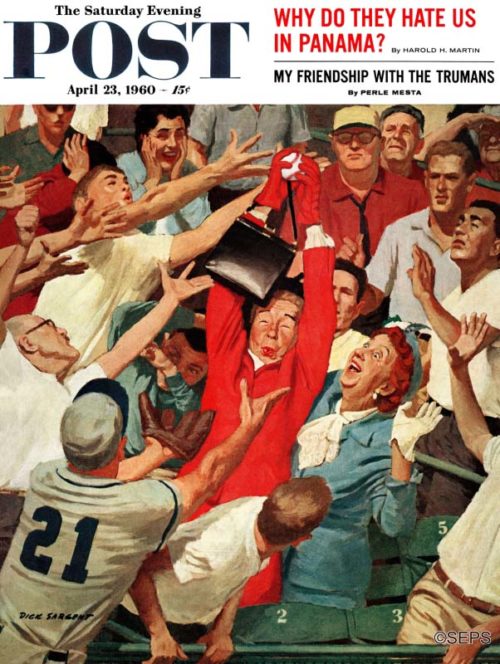
Richard Sargent
April 23, 1960
Not all trophies are shiny goblets, and not all victories are on the field. Here’s to ol’ ladies at the ol’ ballgame!