Screen Sirens of Hollywood: John Cheever Interviews Sophia Loren
This article and other features about the stars of Tinseltown can be found in the Post’s Special Collector’s Edition, The Golden Age of Hollywood. This edition can be ordered here.
Naples is a city where you can, on a principal street, change into your bathing trunks and dive into the sea, and it is on the sea that the monuments of statesmen, generals, kings and gods have set their eyes. One leaves the Palazzo Municipale, seat of the local government, and goes up a narrow street, much older than the majestic and linear boulevards of the Bourbons. The air smells of roasting coffee, new bread, wine dregs and the sea. At the head of the street there is a 17th-century palace whose gates are topped by two enormous mermaids. Time and the weather have spared their breasts, but one of them has lost an arm. In front of the gate is a crowd of a hundred Neapolitans. Now and then they shout, “Sophia! Sophia! Sophia!” Two policemen push aside the crowd, and when the gate within the gate is opened, you slip in like a trout and slam it shut.
She is there for the shooting of a movie, THE BEST HOUSE IN NAPLES. She is what used to be known as an eyeful. She stands on the cobbles, her feet apart, her hands on her hips. She wears scuffed shoes and a threadbare dress designed, I was told, by a Neapolitan couturier and produced to some specifications established by Dior. It is difficult to take one’s eyes off her front, but there seems to be no exploitation involved. She takes a strand of hair and playfully pulls it down along her nose. Then she gives her head a rousing toss. Her legs seem to gleam. Some actresses exist only as they appear on the screen, but Sophia Loren has a margin of vivacity and beauty that escapes the camera.
Behind the cameras, women with groceries and babies come and go. A rooster who lives in the palace crows loudly, and the crowd outside the gates continues to shout, “Sophia! Sophia! Sophia!” Renato Castellani, the director, is harried, disheveled and gentle with his star. Sophia is a natural actress, and her performance on the sixth take is spontaneous and breezy.
When Castellani is satisfied with the scene, I go over and introduce myself. I light her cigarette with an overloaded Zippo that goes up like a torch. “My God,” I say, “did I burn off your eyelashes?”
“No,” she laughs. “I hear you’re a professor.”
“I used to be,” I say.
“Well, perhaps you can teach me something,” she says. “When we’re finished here, I’m going to have lunch with my grandfather in Pozzuoli, but I can see you at the hotel at 4.”
Her biographical facts have been published repeatedly in every known language, but there is more continuity in Italian life than there is in less traditional societies, and Sophia, in the Excelsior hotel, is what she was. She was born out of wedlock in a charity hospital in Rome and taken by her mother to Pozzuoli near Naples to live with her grandparents. Without a father to provide any sort of support or status, her beginnings were grueling, even for a poor Neapolitan. She was 7 years old when the three-year bombardment of Naples began during World War II, and she and her mother suffered the hazards of poverty and war. She speaks with great affection of her mother. “She is very beautiful. She looks like Garbo, but she has a beautiful body. Garbo has a body like a horse … .” Excepting Garbo, she speaks affectionately of every name mentioned: Marilyn Monroe, Charlie Chaplin, Barbra Streisand, Michelangelo Antonioni. Jayne Mansfield and the Queen of England. The picture she is making, THE BEST HOUSE IN NAPLES, will be her 38th. The double entendre of the title is wasted, since she plays, humorously, the poor and virtuous wife of Vittorio Gassman, and the house of the title is a haunted Neapolitan palace.
“I don’t want to know your opinions on politics, religion, motherhood, marital fidelity, miniskirts or spaghetti sauce,” I said. “I want to know what you like.”
“What do I like? What do I like? I like thunderstorms,” she exclaimed. “I love thunder and lightning. Waterfalls depress me … .” Her English is unaccented, Fluent and musical. Her skirt is short, and her legs are luminous and elegant. Her arms and legs seem to lead a spendthrift life of their own. “I like all kinds of smells,” she said. “I like the smell of the sea, and I like Patou’s Joy, and I love the smell of stables. I like the smell of stables, I think, because it reminds me of the milk my mother got for me during the war. It kept me alive. I like bright colors. They all have meanings for me. Red is the color of courage and love. Black is the color of pain. I think of names as colors. Loren is orange. Ponti is blue. [Carlo Ponti is Loren’s husband.] I would like a good part in a play, but they are hard to find. I like [playwright Edward] Albee. I like [playright Tennessee] Williams. I did not like AFTER THE FALL. It was a bad play. The only character in the play was poor Marilyn. She was the only one you remembered. A play would be very different from films, of course, but it must be exciting to have a new audience every night. I would like to do a tragedy. This might be for me a death leap, but I know about tragedy, and I would like to try. I like in a performance to have the sense of giving something. I am always frightened, and I am never confident that I have been successful. I like to sing. This frightens me because I am a perfectionist and I know my voice is limited, but I could not live without singing. I sang a song in a television show, and some critic said that I was no Barbra Streisand, but when I met Barbra in London, she told me not to worry. She said that if she looked like me she wouldn’t bother to speak.”
I saw Sophia on location the next day, but they were shooting in a confined area, crowded with technicians, and there was no chance to talk. She did wave to me. I had flown to Naples to see her, but so had 15 or 20 other journalists who were milling around an anteroom, waiting to ask about her miscarriage, her religion, her opinion of miniskirts and her choice in spaghetti sauce. A few days later, just before we both were to leave Naples, she called, and I went to her room to say goodbye.
A Change in Perspective
“You know some of the things I like,” she said. “What I don’t like is harder. I don’t like tranquilizers. I don’t like pep pills. I don’t like tape recorders. I always say something that shouldn’t be published, and they always publish it. I wouldn’t want a conversation with my grandfather to be taped. I don’t like foolish propositions. I don’t like people who would use me to help themselves. They are dangerous. I don’t really not like premieres—that sort of thing—but when I hear people say, ‘There goes Sophia Loren,’ I always think they are talking about someone else. I did not like being poor and hungry, but it is still more real, more vivid to me than having money. Compared to pain, money is never very real. I still dream about the war… .”
In some women, we find that uncommon beauty like Sophia’s can be a crushing burden, the cause of broken homes, sloth, drunkenness, improvidence and despair. The Sex Goddess herself becomes hooked on gin, amphetamines and promiscuity, which so often results in a tragic ending. But there is nothing like that here, nothing like it at all. Here, our leading lady wears no perfume or makeup, her dress is simple, and there is no trace of notoriety or gossip in her presence. She seems sincere, magnanimous, lucky, intelligent and serene. I lighted her cigarette with my overloaded Zippo again.
“My God,” I said, “did I burn off your eyelashes?”
“No,” she laughed. “Why do you worry?”
“I always worry about burning off eyelashes.”
Then her secretary came in to say it was time to go. “I have to put on my wig,” Sophia said, and she walked me to the door as the bells of Naples rang noon. Her walk is lithe, youthful and difficult to forget. One might say that she walks like a dancer, meaning that she walks like someone who loves to dance. At the door I asked if I could kiss her. “Of course,” she said. So I did.
The Eagle Watch
“Glen, is that you?” The frail-looking woman lying in the hospital bed beside a dim light said to the man at her bedside. He had been hoping she would wake up and talk to him; it had been a few days since she seemed strong enough.
“No, honey, I’m Ellis. Glen’s father. Don’t you remember me?”
“I don’t remember you, but I sure like you.”
“Thanks, honey, I like you too.” Ellis stood up and brushed the hair from his wife’s eyes and gave her a gentle kiss on the forehead. It pained him so much to see his beautiful, strong, and loving wife like this.
Ellis, now retired, had worked most of his life onboard nuclear submarines as an engineer for the U.S. Navy. “Six months of bliss every year,” a recruit had said when he enlisted. If he didn’t get along with his family, the months at sea would be a welcome relief, and the months at home would be hell. Conversely, if he had a wonderful home life, the months at sea would be agony. But Ellis never saw things that way. He loved his work and his family, Glen and Cathy, equally.
There was a lot of spare time to be had at sea. Some sailors took up board games and eventually memorized all the answers to Trivial Pursuit, then when new sailors boarded, they would play them for money and clean house. Ellis took on the hobby of watchmaking. He loved to restore old pocket watches, to open them up and find out which gears and components needed to be replaced or, as often happened, needed to be rebuilt for a watch to ever work again. It took patience to fix them, but he found it greatly rewarding.
Ellis and Cathy had just one child, who would also become a naval engineer, working on nuclear-powered ships. At Glen’s graduation, his proudest day as a parent, Ellis had given his son a restored 150-year-old pocket watch, with a design of an American Eagle painted on it, and engraved on the inside: To my greatest pride and joy, love, Dad.
The sad thing was that not much more than five years after he graduated from the Ivy League school, Ellis and Cathy lost him to cancer. Pain, grief, and even anger followed. The idea that his high-stress job with the Navy had put him at risk for the devastating illness that claimed his life at such a young age was never far from their minds. A few weeks after he passed, the Navy sent them Glen’s belongings. The box still sat in their basement, unopened.
The next morning, Ellis woke up and leaned over to give his wife a good-morning kiss.
“Honey?” he said, loud enough so she could hear him if she were in the bathroom.
No response. It took a few moments for him to realize that Cathy wasn’t home. She had been in the hospital for four weeks, hanging onto life by a thread. He gathered himself, got dressed, made a simple meal of tea and toast with marmalade, and then closed his eyes. How could he face the world all by himself? He had always had his Navy shipmates or his dear wife with him. His mind flashed back to yesterday’s meeting with Cathy’s oncologist:
“Doctor, you asked me to stop in and see you today?”
“Yes, Ellis, please have a seat.”
“If you’re going to tell me my wife is going to die and that you can’t do anything about it, then say it to me while I’m standing.”
“Ellis, what I have to say is never an easy thing to say. Do sit down, though, not everything is hopeless right now.”
“Are you saying you can help Cathy?”
“Ellis, five years ago I wouldn’t have been able to help your wife. The tumor she has on her kidney is stage 2. It used to be that kidney cancer was almost always fatal, but there have been some significant advances in Germany with a doctor by the name of Heinlen. The trouble is that he is so effective that right now he is limited by the number of patients he can help, unless …”
“Unless I can afford to pay huge fees?”
“Yes, he charges about $200,000 U.S. to perform the surgery in Germany. Sadly, the surgery might not be covered under your military insurance plan. Do you have the means to raise that much money?”
“I don’t. I don’t know … we put everything into Glen’s education — we wanted the best for our son. I never made much in the Navy and never thought anything like this could happen again. Can I have some time?”
“There isn’t a lot of time. Do your best and come back to me in a week. I don’t know what we can do, but if I come up with any ideas, I will phone you.”
“Thank you, doctor.”
“Please, call me Warren. And feel free to phone me any time you need to.”
“Thank you, Warren, that means a lot.”
How was he going to come up with $200,000? Ellis opened his eyes. He recalled that there might be some papers about their insurance in the basement and went downstairs to see if he could dig them up. After looking through a few boxes, he spotted the box that came when Glen passed away. He decided that now would be the best time to open it.
Inside were a few things: an extra uniform, a Zippo cigarette lighter from the crew he oversaw one year. Then he saw it. The watch that he had given his boy. It was beautiful, gold-plated, and the repainted eagle on it had turned it from a relic into a keepsake. But there was something odd about the timepiece. He held the watch up to his ear. By some crazy coincidence, it was still ticking. It wasn’t keeping time, though. The secondhand seemed to be the only thing moving, as though it had missed a gear and was trying to tick a second forward, then ticked one back. Ellis held the winding crown on the side of the watch and gave it a few turns, but the secondhand kept doing the same thing. Ellis made a mental note to look at it later, maybe if he went to his watchmaking room it would help him think. He slipped the watch into his shirt pocket and went upstairs to fix lunch.
While eating his sandwich, he could feel the watch ticking inside his shirt. It seemed so strong — it wasn’t like the ticking of any watch he had known. It was almost like a heart beating next to his own. He thought of Glen, of Cathy, and took out the watch and pulled the crown to stop it from moving, then walked to the front door to check the mail.
He was surprised to see the mail carrier on his front porch with just three letters in hand. When he was gone at sea, Cathy would write to him almost every day, and when they got mail on board, there was always a stack waiting for him and he would pore over every word.
“Hi, Jack,” Ellis said. The mail carrier didn’t move. “What kind of a game is this?” When Jack didn’t respond, Ellis didn’t think much of it, assuming his old friend, a well-known prankster, was playing a joke. He closed the door and went back inside to read his mail.
There was a letter from Cathy’s sister, an electricity bill, and a check from a friend who was returning part of the money Ellis had lent him. He decided to take the electric bill and check to the bank to cash one to pay the other. When he pulled out of the driveway, Jack was still poised motionless at the front door and Ellis chuckled.
But when he turned the corner, he noticed something incredibly strange. There were people as he went, as always, but none of them were moving. Still as stone, just as Jack had been. Cars were stopped in the middle of the street. And then, as he went farther down the road — having to do some drastic obstacle avoidance — he noticed that the watch in his pocket was heating up. Ellis pulled his car over and took out the watch. He pushed in the crown, and the watch began to tick again. All at once, cars moved, people were people again, not statues, and everything seemed to carry on just as normal. It had to be the watch!
When Ellis got to the mall, he tried a few experiments. He went into the food court, stopped the pocket watch, and watched all the people freeze. He checked to see if any of them could see him, waving his hand in front of their eyes, taking their French fries. Nothing. No reaction.
He started the watch again and went to the bank to pay his bill and deposit his check. While he was there, he watched two armed guards go into the safe and come out with heavy bags. $200,000 to save my wife’s life, he thought. He took out the watch, walked outside, and waited for the guards.
When Ellis got home, he yelled for joy and threw the money up in the air. Then he carefully put all the bills together again and counted them: $34,000. He could do this a few more times and everything would be okay again. He fixed himself a celebratory drink and, after a few hours, ordered a pizza and sat down to watch TV.
“Breaking news today,” the teaser said. “Two armed guards are being charged with the theft of over $30,000 stolen from their own truck.” Suddenly, Ellis felt horrible, sick to his stomach. He knew after seeing this that he couldn’t keep the money. He couldn’t use this method to save Cathy. There had to be another way. He stopped the watch, put the money back in the bag, and dropped it off at the police station with an anonymous note. He worried they would somehow figure him out, but he knew that if he were careful, he could stop time and make an escape.
Ellis sat wracking his brain. There must be something he could do for Cathy. Though he was only in his late 50s, he felt old and powerless. He had hoped Cathy and he would have been able to travel, to see inland America like they had dreamed of for so long. All the run-down, makeshift roadside museums and curiosities from coast to coast. This would have been a perfect year to do it, too. While he sat, he thought for a moment about something and picked up the phone.
“Hello, Warren?”
“Yes. Is this Ellis?”
“Yes, it is. I wanted to ask you something about Cathy.”
“Sure, anything. Go ahead.”
“If her cancer had been caught in time, what would her prognosis be?
“Well, it’s hard to say. I would say if we had tested her six months ago, we might have been able to use alternative therapies that would have given her a much better chance.”
“Thanks, Warren, you may not ever find out how, but that helps a lot.”
“Ellis, think nothing of it. And call me any time.”
“I will, goodnight.”
“Goodnight.”
Ellis took the eagle watch into his hobby room where he kept his tools and spare gears and such. Cautiously, he opened the back of the watch and took out his magnifying glass to get a good look at the clockwork. Everything looked normal, but one small gear. It was a jeweled gear, and it had an important role in the watch mechanism. It adjusted the date indicator and only worked in one direction. If he wanted to change the date back a day, he would have to turn the crown forward 30 days. Time consuming, but normal for watches this old. Carefully, meticulously, he removed the gears that blocked access to the jeweled one. He took out the gear, studied it closely, and then put it in backward and carefully reassembled the watch.
He had no clue as to whether or not this would work, but Ellis went into the kitchen where the wall calendar was. He pulled the crown of the watch and began to roll it forward. The date moved back just as he had hoped. He turned and turned the mechanism and then looked up at the calendar. The past weeks’ appointments disappeared. He turned the crown again with renewed vigor. The sun went down, the sun went up, and time slipped away. A great feeling of excitement rose in his heart when the appointment with Cathy’s oncologist, Warren, disappeared and another person was suddenly buzzing around the house at high speed. When he was sure six months had been erased, he pushed the crown back in.
“Good heavens! Where did you come from?” Cathy, who was now standing in the kitchen making supper, said with a start.
“The stork brought me. What are you making?”
“Steak and baked potatoes. With sour cream and onions.”
“Cathy, I wish I could explain how much I love you.”
“Wow, I should make you steak more often!” Cathy said with a laugh.
“You don’t have to do anything; just be the sweet and wonderful person you are. Oh, and one more thing …”
“Yes?”
“I’m taking you to the doctor tomorrow for a full check-up, like it or not.”
“Okay dear, anything you say.”
Ellis ate his meal mostly in silence, with a sense of joy and accomplishment. This must have been the best meal he had tasted since Cathy went in the hospital. He had stopped caring about food, he had just seen his meals as a reason to stave off hunger. Cathy had always been such an incredible cook.
The next day, Ellis drove Cathy to her appointment and they got a referral to have a cancer screening done. At first, the doctor said it wasn’t necessary, but after Ellis insisted, he complied. On their way home, they looked at motorhomes, bought some road maps, and considered buying a tent and a decent-sized car to take on the highway. All options were open — they could afford either mode of transportation. They just knew they wanted to start their dream trip as soon as possible.
At Cathy’s screening, they found the early signs of kidney cancer. She went into treatment, and Ellis visited her every day. When she started getting better, and it seemed everything was going to work out, Ellis squeezed her hand and told her that Glen would be there for her release. She looked puzzled, but she wouldn’t be for long. As he left the hospital, he patted his pocket. Today he was going back to get their son.
News of the Week: Superheroes, James Bond, and the Woman Who Leaves Mysterious Notes
Comic-Con 2017
As this is a pop culture column, I feel that I have to at least mention this year’s Comic-Con convention in San Diego, which just ended. But I really don’t know what else to say except THERE ARE MORE SUPERHERO MOVIES COMING. There are always more superhero movies coming.
Time has a rundown on all the big trailers and interviews from the convention, while Gizmodo has a list of the winners and losers.
I have to admit I didn’t realize that Scrooge McDuck was going to be one of the big hits of the convention.
Bond 2019
We finally have a release date for the next 007 movie: November 8, 2019. That seems like a long time to wait, but at least we know another one is coming. What we don’t know yet is the title or whether Daniel Craig is going to play Bond once again. The New York Times is reporting that he has indeed signed for one more film, but there’s no official word yet from the studio.
In the meantime, there are plenty of Post pieces about the secret agent, including this piece on the 50th anniversary of the movie series and this terrific 1964 Pete Hamill interview with Sean Connery.
Fake (Shark) News
Okay, look: I didn’t really think that swimmer Michael Phelps and a shark were going to be in the water next to each other in their own swimming lanes, starting at the same time to find out who would win a race. I don’t think most people thought that. But I also didn’t think that Phelps was going to swim by himself and the shark would be represented by computer animation, and the “race” would actually be just a comparison of what the shark’s results “would have been” with “speed based on scientific data.” That’s kind of goofy, and I think a bit of a cheat.
Phelps says that it’s not his fault if people thought he was actually going to race a great white shark. If that’s the case, then why in this video does he dive down to meet real sharks in a cage, and why does one of the experts talk about the safety measures they’re taking because we “wouldn’t want to see him get eaten up by a shark”?
Next month, I’m going to try to outrun a 747. We won’t be in the same place and I’ll use stock footage of a 747 flying through the air, but the results will be really interesting!
RIP John Heard, June Foray, Barbara Sinatra, Chester Bennington, Red West, Jim Vance, Clancy Sigal, Danny Daniels
John Heard was probably best known as the dad in Home Alone, but he had so many other roles over the past 40 years. Heard was found dead in a hotel room at the age of 71.
June Foray was the voice of many great characters you remember, including Rocky J. Squirrel and Natasha on Rocky & His Friends, Tweety Bird’s Granny in Looney Tunes cartoons, Cindy Lou Who in the animated How The Grinch Stole Christmas, and Mattel’s Chatty Cathy doll, plus voices in movies like Cinderella and Mulan, and too many others to mention, in a career that started in 1943. She died Wednesday at the age of 99.
Barbara Sinatra was Frank’s wife for the last 22 years of his life. She was also a former entertainer, a philanthropist, and author of the memoir Lady Blue Eyes. She passed away Tuesday at the age of 90.
Chester Bennington was a singer for the group Linkin Park. He committed suicide last week at the age of 41.
You’ve seen Red West in a gazillion movies and TV shows over the years. The actor, stuntman and songwriter was also a close friend and confidant of Elvis Presley. He died last week at the age of 81.
Jim Vance was a longtime news anchor at NBC4 in Washington, D.C. He died Saturday at the age of 75.
Clancy Sigal was the author of several books, including the influential novel Going Away, and was also a former Hollywood agent who counted Humphrey Bogart as one of his clients. Sigal was later blacklisted and moved to New York City and eventually London to work. He died July 16 at the age of 90.
Danny Daniels was a veteran choreographer and actor who made his screen debut at the age of 14 in the Bing Crosby film The Star Maker and won several Emmy and Tony awards. He died earlier this month at the age of 92.
Books and Bombs
Librarians have to deal with a lot on their first day of work: learning new computer and filing systems, how to deal with kids at the front desk, maybe even budgetary problems. Oh, and they also might have to deal with Civil War artillery shells, like this woman in Massachusetts. She found them at the bottom of a closet with a helpful note that said they might be live shells.
Notes on Trees
Here’s the feel-good story of the week (unless you count the Comic-Con news above as “feel-good”). This woman leaves anonymous notes on trees to help inspire people who may be going through hard times. She’s left over 1,000 notes on trees, on pay phones, in airports, and in grocery stores.
This Week in History
Detroit Riot Begins (July 23, 1967)
A new movie about the infamous riot, Detroit, opens next Friday. Here’s the trailer.
That wasn’t the first time there was a riot in Detroit.
Jacqueline Bouvier Born (July 28, 1929)
The woman who would become Jackie Kennedy was born in Southampton, New York. Jimmy Breslin wrote this piece for the December 14, 1963, issue of the Post, about her last moments in Dallas with President Kennedy.
This Week in Saturday Evening Post History: “Unwelcome Pool Guests” (July 22, 1961)
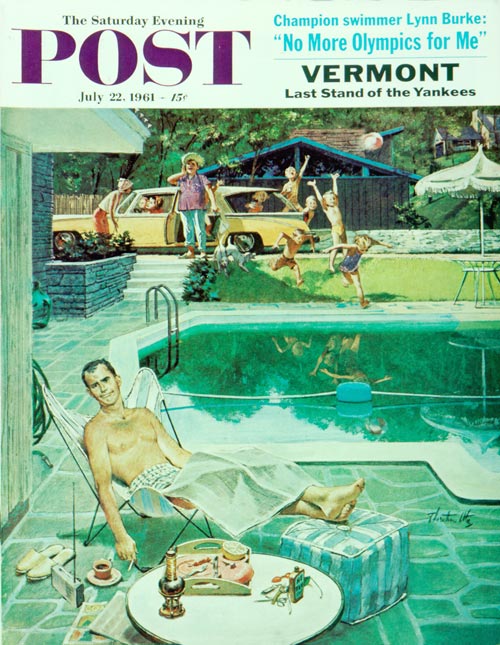
Thornton Utz
July 22, 1961
I love this Thornton Utz cover for two reasons. One is the detail that shows what this guy had planned for the day. He’s in his lawn chair, he has his paper and his tray of food and his coffee and a radio to listen to the ball game, and here comes the damn family to interrupt things. Can’t I get one afternoon alone?
The second thing I love is the sitcom dad–like expression on his face as he breaks the fourth wall and looks at us.
National Milk Chocolate Day
The old M&Ms slogan says that they melt in your mouth, not in your hand. I found out this week that when it’s this hot and humid, that’s not exactly true. The candy coating sort of melts and leaves your hands sticky. If it’s as hot where you are as it is where I am, you might want to keep your milk chocolate in the refrigerator.
At least until you make these recipes for National Milk Chocolate Day, which happens to be today. Epicurious has these Milk Chocolate Brownies, while AllRecipes has a Fudgy Milk Chocolate Fondue. Or head on over to the Hershey’s site and try one of the many desserts you can make with their chocolate bars. I’d like some of that Our Gal Sundae Pie.
By the way, James Bond loved milk chocolate too.
Next Week’s Holidays and Events
International Clown Week (August 1-7)
A lot of people think that clowns are happy and fun! Others think they’re dark and scary. For you people who fall into the former category, here’s the official site for International Clown Week. For those of you in the latter category, here’s the trailer for the remake of Stephen King’s It, which opens on September 8.
Coast Guard Day (August 4)
This commemoration celebrates the day in 1790 that Alexander Hamilton founded the United States Coast Guard. Hamilton, of course, went on to become a talented singer and dancer and to star in the critically acclaimed Broadway show that bears his name.
Girl Scout Techies
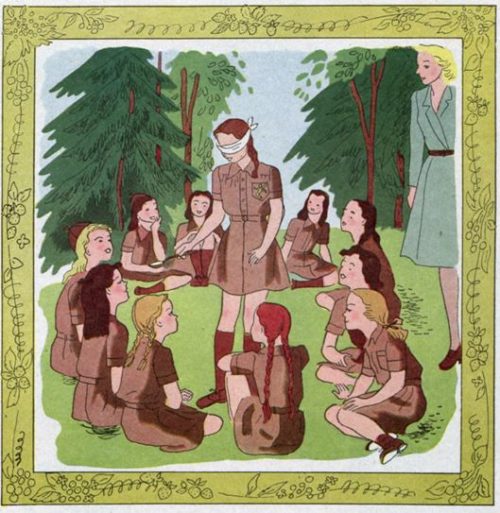
The Girl Scouts of the USA is upgrading its offering of badges. After more than 100 years of teaching respect, loyalty, and honesty, the program is ready to build robots.
Fifteen new badges that focus on science, technology, engineering, and math (STEM) will have the next generation of Cadettes blogging and coding and new Brownies building spring-powered machines.
Sylvia Acevedo, the new CEO of GSUSA, was a Girl Scout herself before working as an engineer for NASA and later for IBM and Dell. She believes the recent badge rollout — the largest in almost a decade — will familiarize more girls with science and mathematics fields and afford them confidence to pursue skills and careers in male-dominated spheres.
According to a 2009 study from the U.S. Department of Commerce, American women made up 48 percent of the workforce but only 24 percent of STEM jobs. When it comes to computer sciences specifically, the gap is worse: only 18 percent of all undergraduate degrees in computer and information sciences are going to women.
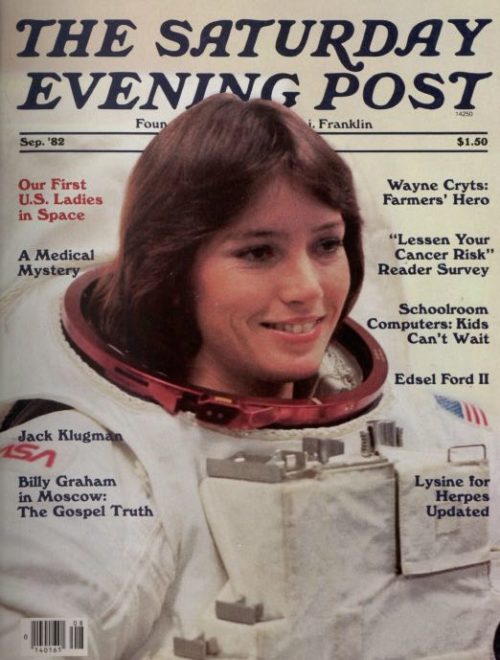
Despite the dismal odds, trailblazing women like Sally Ride and Mary Cleave have demonstrated where studies in STEM can land them: into space. The Post’s 1982 article “Make Way for the Ladies in Space” profiled them among other female scientists before Ride’s historic flight aboard the space shuttle Challenger. “With Sally Ride’s April ascent into space, it will become apparent that — potentially, at least — space travel is for everyone,” the report concluded.
Each of the women expressed their own challenges with getting ahead in a man’s world: seemingly small, constant slights and snubs that add up over time. “‘We do the same work as our male colleagues,’ explains Shannon Lucid, biochemist from Oklahoma, ‘yet nobody asks them about their families, or how their kids feel about their work.’”
Mary Cleave noted the unorthodox nature of her interest in aviation when discussing her childhood idol, John Glenn: “Here’s this little girl looking at a strong, crew-cut pilot and saying, ‘I want to be just like him!’ I think my parents would’ve taken me straight to a psychologist!” In the same scenario nowadays, a new solution arises: Parents can take their little dreamers straight to the Girl Scouts.
Korea: 64 Years of Neither War nor Peace
The Korean War is unique: we never really entered it, and we never really left.
When President Truman sent U.S. troops into South Korea to help combat an invasion by North Koreans on June 27, 1950, he acted without a declaration of war. Instead, it was called a “police action.” With or without the designation of a war, the conflict involved 328,000 Americans, killing 36,000 and wounding 103,000.
The Korean Armistice Agreement was signed on July 27, 1953. But as General Maxwell Taylor reminded Americans, it was not a peace treaty, just a suspension of hostilities. It only ended the shooting as North and South Korea negotiated their differences. America wouldn’t leave “until peace and stability have been restored to Korea.”
When Rafael Steinberg wrote “The Lonely Line of Armistice” in the July 27, 1963, issue of the Post, the demilitarized border that divides North and South Korea at the 38th parallel was still, in effect, a war zone. GIs were constantly on guard against North Korean infiltrators and attackers.
In the five decades since that article, tensions have remained high. North Korean troops have repeatedly crossed the border, sometimes attacking American and South Korean troops. In 1966, with the American military focused on Vietnam, North Korea initiated a number of border confrontations. They even sent a commando team into South Korea to assassinate its president: 43 Americans and 299 South Koreans were killed in thwarting the mission.
Beginning in 1974, a series of tunnels from North Korea to South Korea was discovered. The first two were over half a mile long and were found by accident. The third tunnel, whose location was disclosed by a defector in 1978, was 5,200 feet long and 240 feet below ground. The fourth, found in 1990, was 476 feet underground.
Today, the South Korean side of the border is guarded by Swedish and Swiss guards. But the U.S. still keeps 28,000 American military personnel in the country, ready to meet any sudden action from the North.
Is the armistice still in effect? In 2013, North Korea said it was invalidating the armistice in retaliation for United Nations sanctions against it. But the UN countered that North Korea could not unilaterally abandon the agreement. Meanwhile, North Korea claims it is developing a missile system that can drop nuclear warheads on America.
Which makes the Korean armistice not only the longest in history, but also potentially the deadliest.
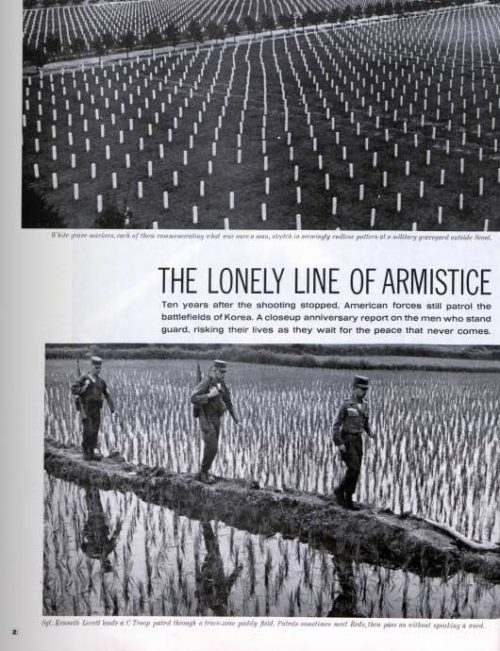
Featured image: Office of the Command Historian
Predictions: Can Diet Prevent Heart Attacks?
By the 1960s, research was already showing that the typical American diet increased the risk of heart attack. This article from the January 25, 1964, issue of the Post shared new studies about attempts to reduce the risk.
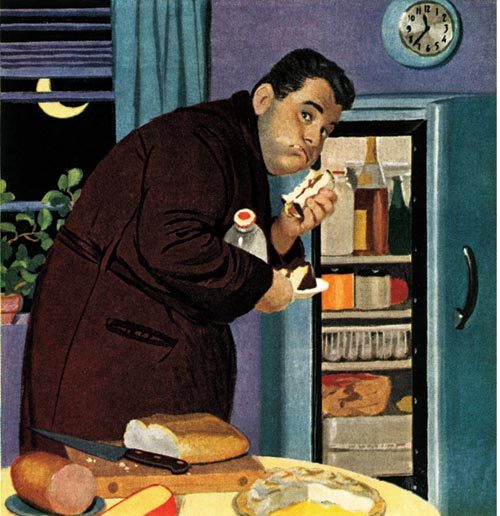
The great hope and challenge lie in the facts that any man can control the risks of heart attack by controlling his living habits. There is no guarantee that by reducing each risk he can escape or postpone a heart attack, but there is a mounting mass of evidence that he can build some protection. Controlling even one of these hazards should boost the chances for longer life. Control them all, and your heart, in a sense, gets nine lives.
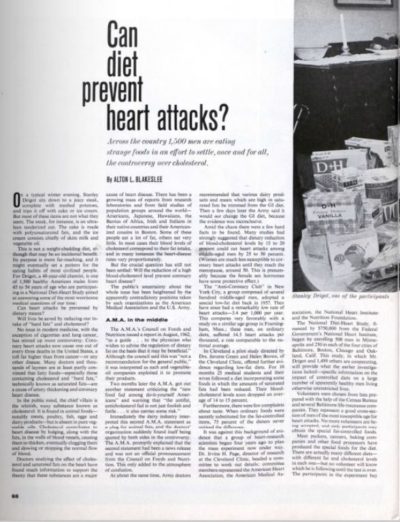
This article is featured in the July/August 2017 issue of The Saturday Evening Post. Subscribe to the magazine for more art, inspiring stories, fiction, humor, and features from our archives.
You’ve Got Shark Mail
Coastal Americans are 75 times more likely to be struck by lightning than to perish in a shark attack, but that doesn’t quell the seemingly endless fascination with the sharp-toothed creatures of the deep. Depictions of sharks in the movies range from classic thrillers like Jaws to the absurd cult flick in which a cyclone sucks the predators into the air and onto the streets of Los Angeles. For the record, Sharknado maintains an 82% rating on Rotten Tomatoes.
With Shark Week underway, television audiences are devouring daily programming on the Discovery Channel, where the longest-running cable television event is in its 29th year.
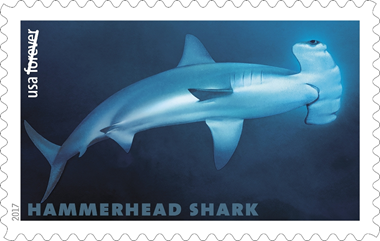
The only logical next step is to commemorate the aquatic killers with the ranks of U.S. presidents and Disney villains, and that is exactly what the U.S. Postal Service has done. Sharks Forever stamps are available this week with five different species that lurk in American waters.

Although their popularity stems from their perceived monstrous hostility, USPS’s Jeffrey Williamson reminds shark enthusiasts of their pertinent place in nature: “As apex predators, sharks keep other marine life in balance, and by doing so, they play a critical role in regulating our largest ecosystem — the oceans.” Sharks have been patrolling the deep for a long time: about 450 million years. That’s twice as long ago as the appearance of dinosaurs. Since the Silurian period, sharks have developed some striking adaptations, including regeneration of teeth as needed and electroreceptors that sense electricity for navigation and hunting prey.

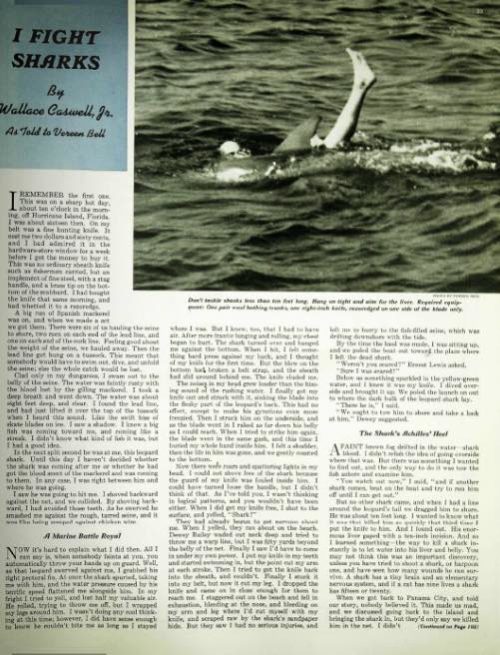
Despite these terrifying abilities, people incur more damage to shark populations than the fish could ever redress. In 1941 fisherman Wallace Caswell, Jr. detailed his combat tactics against sharks in the wild in the Post story “I Fight Sharks.” It is highly discouraged that anyone follows Caswell’s advice to experience “the satisfaction in killing these villains in bodily contact,” but the report sheds light on a bygone era that vehemently glorified Man’s struggle against nature. Much has been learned since 1941 regarding a shark’s anatomy, and, contrary to Caswell’s claim that “a shark has a tiny brain and an elementary nervous system,” his combat opponents have been found to possess large, complex nervous systems. Given long-standing misconceptions regarding sharks, the USPS hopes to contribute to a deeper and wider appreciation of these fascinating fish with its new stamp series.
The Sharks Forever series features the mako, thresher, great white, hammerhead, and whale sharks in illustrations by Brooklyn artist Sam Weber. Collectors and ocean enthusiasts can purchase the postage stamps immediately, and they’ll soon be swarming the country on snail mail.
Cover Gallery: Tee Time
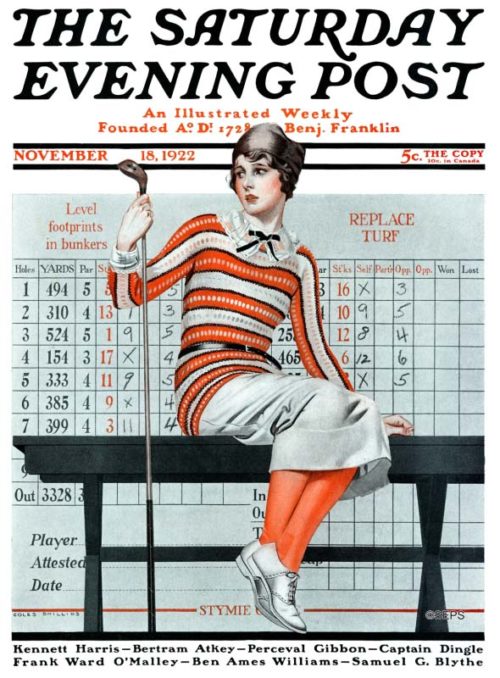
Coles Phillips
November 11, 1922
Coles Phillips began drawing when he was just six years old. Phillips caught his big break as an artist after drawing only the ankles and feet of a person’s body while working at an “assembly-line” advertising firm. His depictions were so detailed that national companies wanted to identify him. Phillips is now recognized as the singular artist of his generation who invented the “fade away” style. His models, like this first-time lady golfer, brought such an elegant grace to the twentieth century’s rising tide of wealth and parties.
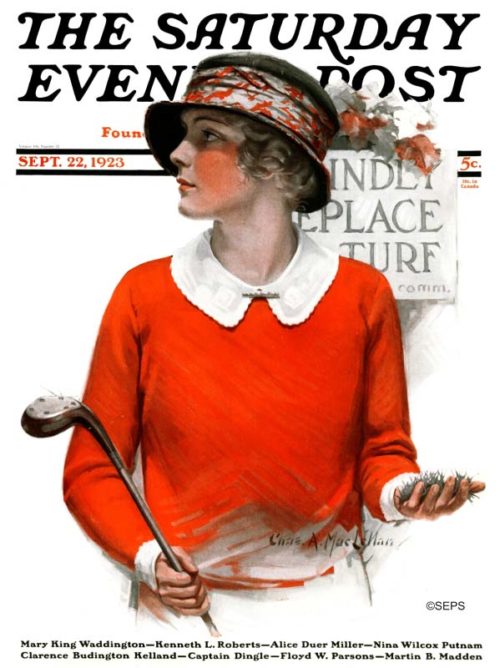
Charles A. MacLellan
September 22, 1923
Charles A. MacLellan started creating art for the Post during a time when narrative illustrations dominated the covers. His most memorable covers were those with children, typically boys. Often these boys were in some kind of trouble, but it’s the kind of trouble that makes their viewer smile. In his portraits of women, MacLellan nearly always drew them in action and often gave his models a prop, such as this woman holding a golf club—as well as a divot showing she couldn’t quite do it right.
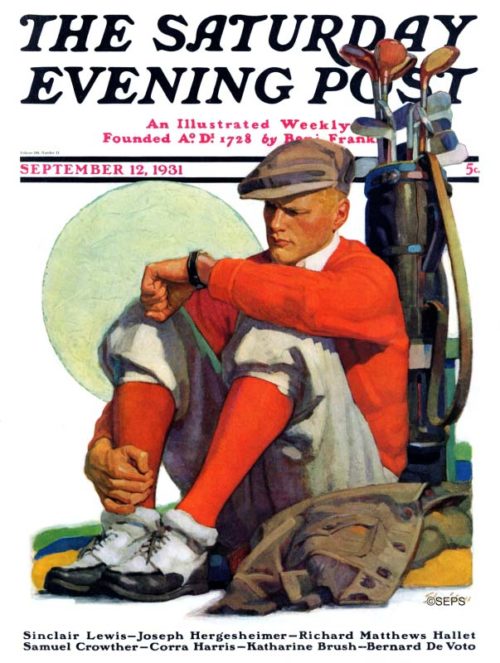
John E. Sheridan
September 12, 1931
John E. Sheridan’s 14 covers for the Saturday Evening Post ran from 1918 to 1939. The covers are mostly sports related. The artist chose to focus on the greatness of American institutions such as baseball and the military, or in this cover’s case, golf. The artist’s style became less and less popular on the cover as other Post artists gained national recognition. Toward the end of his career, Sheridan accepted a teaching position in New York City at the Cartoonist’s and Illustrator’s School, also known as the School of Visual Arts. Today, his work is remembered as era-defining American sports and military.
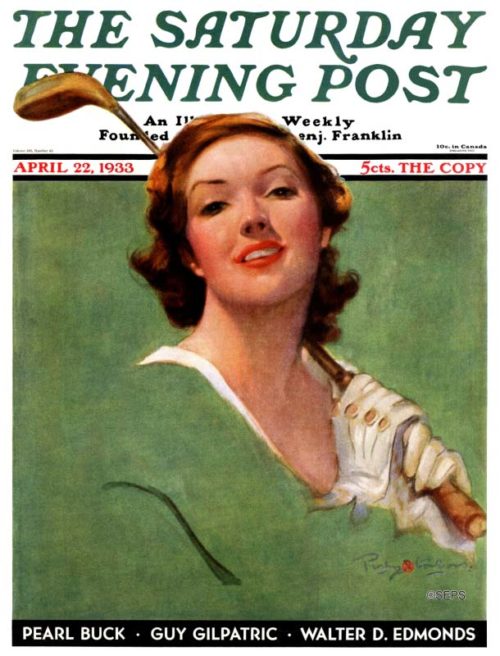
Penrhyn Stanlaws
April 22, 1933
Penrhyn Stanlaws’ first cover with the Saturday Evening Post was in July 1913. He typically painted women dressed in their finery, and as color started making its way into many illustrations, Stanlaws usually added a singular element to punctuate the piece. The element, like this woman’s golf club, let the viewer explain the action on their own terms. His brush often added a soft illusion that gave a dreamy appeal to the characters he portrayed.
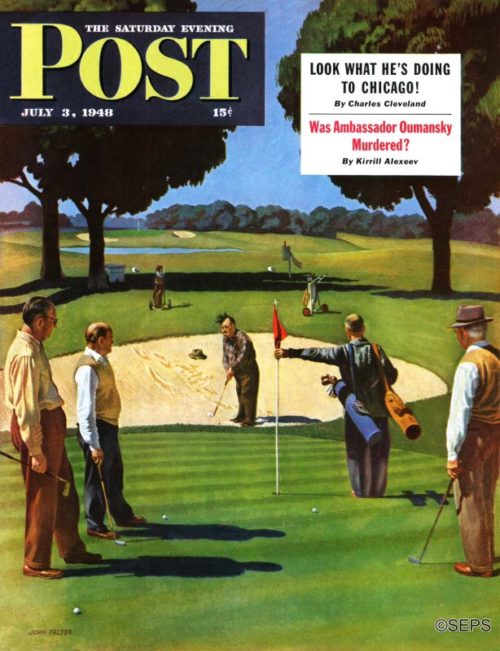
John Falter
July 3, 1948
The men John Falter used as models for his golf painting will be surprised at what has happened to the course. The golfers were playing a course near Phoenix, Arizona. Falter added trees he thought would look more general. Falter thinks all the men he painted are giants of industry, and we would identify them but for the fact that Falter probably moved faces and figures around. The trouble with a picture like this is that it leaves everybody wondering if the sand-trapped gent got out. If an artist can take liberties with the scenery, then we can give you the ending. He laid that shot right into the cup, making the rest of them look like amateurs.
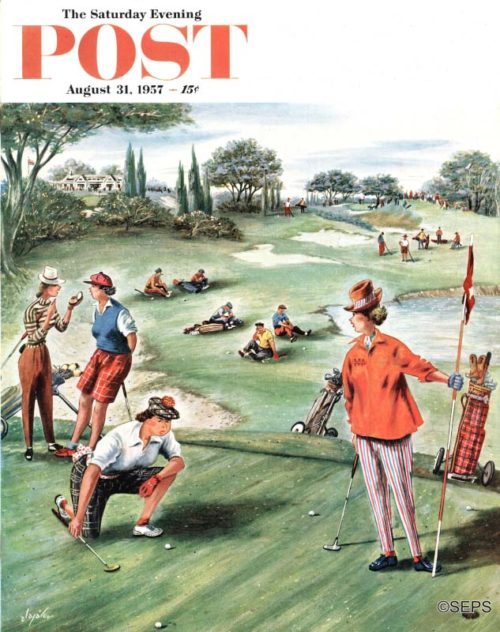
Constantin Alajalov
August 31, 1957
Men play golf too intensely; it is unhealthy to get all lathered up about how many swats it takes to get a ball in a hole. Linksmen should sit down occasionally and soothe their nerves by contemplating the loveliness of nature—the placid ponds, the golden sands, the enchanting wilderness beyond the fairways. Oh, let’s change the subject. Alajalov wants to say that while those ladies are slow-pokes all right, some men golfers are even slower pokes—in fact, some women poke the ball faster than most men. He also wants to say that he didn’t design those clothes; he sketched from life and saw the pantaloons two fairways away. Alajalov plays golf, but when asked about his score, he said to tell you that his voice faded away because of telephone-circuit trouble.
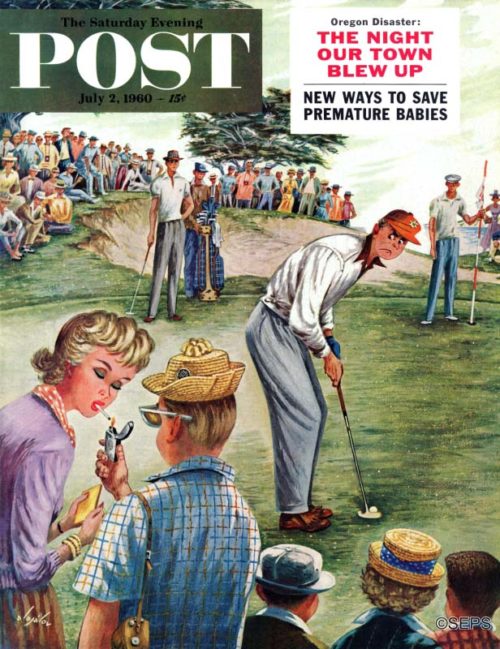
Constantin Alajalov
July 2, 1960
“Golfe” was outlawed during its infancy in Scotland because too many archers, on whom the defense of the land rested, were golfing when they should have been on the archery range. Today it’s possible to play golf and shoot arrows (or daggers, at least) simultaneously; witness the baleful glare of the sourpuss on our cover. Artist Constantin Alajalov, who shoots in the high 80’s, sympathizes with sourpussses whose games are sabotaged by Sunbonnet Sam and his ilk. Sam is the so-and-so in the foreground who is loudly striking up an acquaintance while our jittery’ golfer asks himself, Isn’t that the chowderhead whose noisy, blankety-blank camera shutter cost me a stroke on the last green? Which helps explain why certain golfers appear to have a stroke every time they drop a stroke.
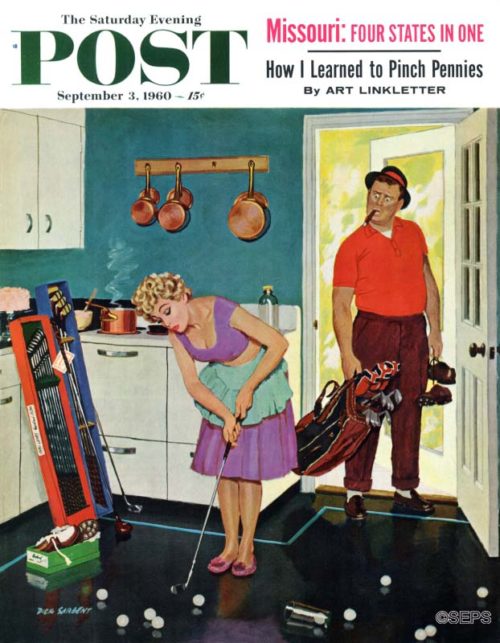
Richard Sargent
September 3, 1960
Question: “Is this the right way to hold the stick, dear?” Answer: “Oh, my achin’ back!” Male golfers have had to put up with this sort of thing ever since Mary, Queen of Scots, became addicted to the game more than four centuries ago. It’s unlikely, of course, that our cover lady will sink many long putts with the iron she’s holding. But there’s nothing wrong with her approach. (See cake at left, designed to repair her husband’s crestfallen expression and aching back.) Artist Dick Sargent informs us that we are in debt to his wife, Helen, whose example inspired this week’s cover. Mrs. Sargent splurged on a set of golf sticks a year ago and at last count had played a total of fifty holes. The total number of swings the lady took to play those holes is not a matter of public record.
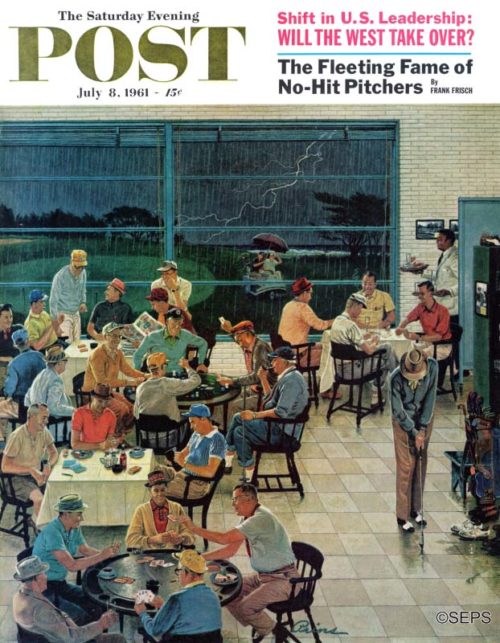
Ben Kimberly Prins
July 8, 1961
How do you like that? On Saturday afternoon-prime time at any golf club-comes the deluge. Well, that’s par for the course, we suppose, and the course in this Ben Prins cover belongs to The Dunes Club of Myrtle Beach, South Carolina. That wave in the background is a fringe of the Atlantic Ocean. not the crest of an oncoming flood. The three-wheeled vehicle under the umbrella is what is known as a caddy car, and its occupants are either fair-weather athletes scurrying toward the indoor recreation of the nineteenth hole, or spirited souls bent on challenging their fellow duffers to a game of motorized water polo. At any rate they’re not slowing down at the putting green. The weather being what it is, they’re probably less concerned about sinking putts than about sinking, period.
North Country Girl: Chapter 10 — The Return of Miss Ritchie
For more about Gay Haubner’s life in the North Country, read the other chapters in her serialized memoir. The Post will publish a new segment each week.
The August before fourth grade, when we returned from a back-to-school Minneapolis shopping trip, there was the letter from Congdon with my class assignments. “You have Miss Ritchie again for fourth grade,” reported my mother.
A miracle! In the age-old tradition of Congdon Elementary, teachers picked a grade and stuck with it. They taught the same grade in the same classroom until they retired or dropped in the harness. But I had a second year with Miss Ritchie, another year of being singled out for my excellent work and good behavior, of having my book reports and stories read aloud, my clumsy shoebox dioramas given pride of place.
Perhaps Miss Ritchie, with her seniority, had been allowed to cherry pick among the students. All the smartest kids were in her fourth grade class, and none of the unruly boys.
But the post-Sputnik changes in education finally began to creep into our 1930’s style schooling, into those sickly green painted plaster and chalk boarded school walls.
Early in the school year, we were escorted one by one into the library, where a serious young woman administered IQ tests. I was thoroughly enjoying myself until we got to the section on spatial thinking. These questions had no words or numbers; they were a series of connected squares. The multiple choice answers were four shapes: pick the one the squares would make when put together. I got the first one, which was a plain six-sided cube, after that it was pure guesswork. It felt like there were hundreds of these stupid problems, pages and pages of squares becoming more and more complicated with ever more terrifying, hundred-sided completed shapes to choose from. I was sure that this stone-faced lady thought I was an idiot.

Our fourth grade classroom boasted the latest in educational technology: a brand new SRA Reading Lab and a box of color-coded “cards” (actually four-page booklets). As the smarty-pants class, we all started a few shades up from the bottom, assigned a color based on our Iowa Reading Test scores from the year before. During “reading” or whenever I had free time, I selected a card from my assigned color. I read the little story, or more often, fairly boring non-fiction article, and then answered questions about it. This measured my reading comprehension at each level. I tore through those booklets, heading for the twinkling silver category at the top. To my disappointment when I got there, the silver cards contained the dullest readings of all. I recall slogging through a biography of Roger Bannister, the man who broke the four-minute mile, and only slightly more interesting, an article about how the movies used subliminal advertising to get people to eat more popcorn.
Math was still done out of battered textbooks, long division and decimals solved on the blackboard and on smudged blue mimeographed worksheets. Social studies and science were also taught directly from the textbooks. Miss Ritchie was still not overly fond of either subject.
Our student teacher that year specialized in music appreciation. She took us through each section of the orchestra — strings, reeds, brass, and percussion — instrument by instrument. She had it easy; most of her lessons were playing records that featured different musical instruments and trying to get us to identify them. This request was met by shrugs from the male half of the classroom, who were disappointed that the lights remained on, unlike last year’s art studies, when they could misbehave in the dark until the looming shadow of Miss Ritchie rose from her desk to end their hijinks. For her final class, the student teacher finally got around to playing real music; she played “Peter and the Wolf” and “Sorcerer’s Apprentice” for us on Congdon’s crappy, tinny record player, urging us to name the instruments in our head while we listened.

In my ongoing role as biggest geek in Congdon, I was enthralled and decided I loved classical music. The soundtrack at home was non-stop Broadway show tunes; my father was a frustrated Robert Goulet. My sister and I marched around the house singing, “The Rain in Spain” and “Seventy-Six Trombones.” I had watched Music Man and Bye-Bye Birdie on TV, but the plots of the other “Original Cast Albums” I had to figure out from the one-paragraph synopsis on the back of the record sleeve. I was stunned when I finally saw My Fair Lady that “I Could Have Danced All Night” wasn’t about Eliza’s night at the ball. One of the few Original Cast albums my father didn’t have was Gypsy, which might have been too racy for his Catholic upbringing. When NBC in a daring move ran Gypsy on Saturday Night at the Movies, my sister and I, faithful weekly viewers unless it was a Western, were spellbound. For weeks after seeing Gypsy, Lani, who weighed about 40 pounds and vanished if she turned sideways, practiced stripping down to her panties in front of our bedroom mirror, while belting out “Let Me Entertain You.” My mother was amused, but I don’t think she ever told our dad about these performances.
***
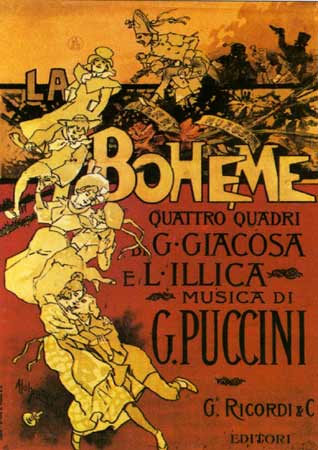
Around the same time I discovered classical music, my mother’s best friend, Karin Luster, had her brush with fame, Duluth style. In those years, the touring company of the Metropolitan Opera made it all the way up to the high northern latitudes of Duluth to do two performances in the Denfeld High School auditorium. That year it was La Bohème, and the company was in need of a local poodle for Musette. Karin volunteered her chocolate toy poodle, named, of course, Fifi. Karin longed for stardom; she was always the first and the loudest at the piano bar. She was thrilled that Fifi would be appearing on stage with the Metropolitan Opera. Karin, my mom, and I went to the Friday night performance, my first exposure to opera. When Musette swanned on stage in Act I, ready to launch into her song, there was little Fifi towed behind her on a leash, frantically scrabbling away from the stage lights, and finally showing his displeasure at being there by peeing all over the floor. The next night Musette entered sans dog.
My mother was delighted to cater to my highbrow inclinations. “I always wanted a daughter who played the harp,” she sighed. She truly believed that behind the book, behind the glasses, there lurked inside me a germ of talent for something. I took piano lessons from a grey old lady whose house smelled of lavender and cat piss. I hated sitting next to her on the bench, her sticky, wobbly skin touching my arm, the metronome ominously ticking away, and I hated practicing at home even more. I managed to forget to go to enough lessons (which had to be paid for anyway) while showing so little improvement (never advancing beyond the first John Thompson’s Modern Course for the Piano with its bright red cover and charming line illustrations) that I was finally allowed to quit.
I have vague memories of being dragged to dance lessons as a four-year-old in Hawaii with a bribe of shaved ice afterwards, and of quitting in a snit when a twelve-year-old was cast as Cinderella in the big recital, a part I thought belonged naturally to me. My mother did not give up hope that I could be taught to dance. A few years later she found yet another older, overweight spinster who once a week moved all the furniture in her living room aside and gave tap dance lessons. Again, I failed to thrive, having constant doubts about which was my right foot and which my left. The teacher believed that the solution was to stand next to me in the line of tiny dancers in black leotards, grab my upper arm in her iron claw, and shove me back and forth while howling either “Shuf-fle STEP! Shuf-fle STEP!” or “WAY down UP-on the SWAN-ee RIV-er!” I manage to soon escape that hell, although not without considerable bruising.
I was not going to be a talented wunderkind like Pamela Nishus, the pork-faced, noxious, same-age daughter of one of my mother’s friends who went to Holy Rosary, thank goodness, so I heard about her a lot more than I had to actually see her. Pamela sang, Pamela danced, Pamela was always the star of any play or recital, her proud parents beaming in the front row. Didn’t I want to go see Pammy’s show? No. Pammy could go to hell.
Despite my complete lack of talents, thanks to the student teachers who dropped down on us for a few weeks at Congdon, I became an art appreciator. I could identify the artists, name the instruments, recognize the composer. I liked going to museums and concerts; didn’t performers need audiences? (With the exception of Pamela Nishus.)
The Art of the Post: The Post’s Rockwell and MAD’s Drucker: Two Great American Artists
Two great American magazines — The Saturday Evening Post and MAD magazine — studied each other across a wide gulf of respectability.
Each was an important cultural institution. The Post was the bastion of respectable middle American values, designed for a traditional and patriotic audience. MAD was a subversive humor magazine designed to appeal to the mischievous children of the Post’s readers.

In 1958, MAD satirized the Post in a feature article, “The Saturday Evening Pest.”

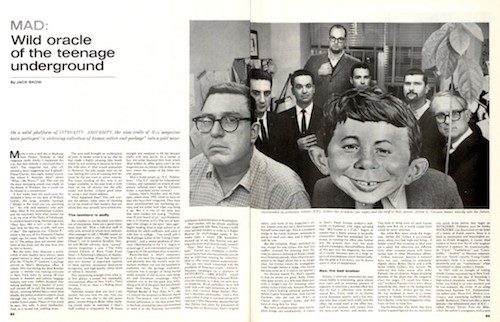
The Post, on the other hand, labeled MAD magazine the “Wild Oracle of the Teenage Underground” in their December 21, 1963, issue:
Despite their obvious differences, the two magazines had several parallels. Both had millions of subscribers and were hugely influential. Both attracted top writers and illustrators. And both came to be known for a special artist who spent most of his career with the magazine, becoming the face of the magazine to the public.
For the Post, that artist was Norman Rockwell. He dedicated most of his life to the Post, painting 322 covers over 47 years. His familiar look and style became synonymous with the Post for millions of Americans.
At MAD magazine, Rockwell’s counterpart was Mort Drucker, who worked for MAD for more than 50 years. Drucker became internationally known and respected as a genius of American humorous art, just as Rockwell became known as a genius of traditional American illustration. In the book, MAD’s Greatest Artists: Mort Drucker (Running Press, 2012), famed film director George Lucas says, “Mort Drucker’s …. caricatures are the best, and he is the artist that defines MAD for me.”

Through many years, through all kinds of trends, fads and political shifts, Rockwell and Drucker recorded opposite sides of the great American parade with brilliance and insight. They created countless pictures of politicians, movie stars, and everyday American scenes.


The two artists weren’t so different. Rockwell worked with a cartoonist’s sensibility, always looking for a humorous situation for his Post covers to provide a snapshot of American life. Drucker was something of an illustrator, a formidable draftsman who was able to draw and paint with great accuracy in addition to his funny caricatures.
Both artists worked in a benevolent, humanistic style. When I interviewed Drucker for this column, he explained why he tried not to make his caricatures angry or mean: “If someone has a big nose and you focus just on that, then you’re really cheating because you’re not getting to the nitty-gritty of the person. You’re taking just a negative feature and building on that and I don’t see the point in it.” During periods when it was fashionable to be cynical, this caused critics to accuse Drucker and Rockwell of being “corny.” But both artists chose a more buoyant, optimistic approach to their subjects. They both seemed to recognize that, in the words of Thoreau, “The only way to speak the truth is to speak lovingly.”

Their empathy may be the secret of their miraculous staying power. They remained popular for decade after decade while other artists came and went.
Most importantly, both Drucker and Rockwell were driven perfectionists. They maintained high standards decade after decade, working hard to do the best they possibly could, and filling their pictures with extra touches long after other artists would consider the picture finished.
As a young artist starting out, Rockwell painted “100%” in gold numbers on his easel to remind himself that he should never succumb to the temptation of getting by with less than his very best. Similarly, Drucker told me, “When you get adulation from people who want to be artists, you can’t let them down by not being the best you can be. Because they’re looking at you to be the artist that they can be. So you strive to be good to get that knowledge to them so that they will be the best they can be.”

Neither artist dreamed of taking shortcuts just because they worked for a commercial magazine printed on inexpensive paper rather than for a fancy art gallery. As a consequence, their work transcended their commercial platform and is admired around the globe today.
In view of the parallels between Rockwell and Drucker, it is not surprising that two of the greatest visual storytellers of the modern era, Stephen Spielberg and George Lucas, singled out both Rockwell and Drucker for praise. Spielberg and Lucas collect the original art of Rockwell and Drucker, and both speak enthusiastically about the importance of the two masters.
When Spielberg and Lucas loaned their Rockwell collections for public exhibition in museums, NPR reported, “Lucas and Spielberg have hung Rockwell’s pictures all over their homes, offices and in storage….”
The two directors explained to NPR what they loved about Rockwell:
“He wasn’t cynical. He wasn’t mean-spirited,” Spielberg says.
“He captured the American ideal of what we wanted to believe we were,’ Lucas says, finishing Spielberg’s thought. ‘We weren’t any better then than we are now, but by having the ideal out there — what we aspired to — it made it so that we could try to be more than what we were.”
Despite the fact that MAD poked fun at American institutions, Drucker was never “cynical” or “mean-spirited” either. In MAD’s Greatest Artists: Mort Drucker, Stephen Spielberg said, “Mort Drucker’s timely sense of parody mixed with commentary first made me aware of the culture of our generation. Mort’s irreverent and historical caricatures have never been nor will they ever be equaled.” George Lucas said, “Mort Drucker’s signature artwork captures and exaggerates the world around us and the people in it in a way that makes them more real…. When I had to choose an artist for the American Graffiti poster, Mort was the first and only person who came to mind.”
Even though the Post and MAD saw the world from very different perspectives, their two great artists shared artistic values that transcended those differences and helped to build lasting reputations for the artists and their magazines.
The Legacy of Les Paul’s “Crazy” Music
On the anniversary of Bob Dylan’s controversial introduction of the electric guitar to the Newport Folk Music Festival, we recall one of the pioneers of the electric guitar.
In 1953, there was nobody on Billboard’s Top 30 list who sounded like Les Paul and Mary Ford.
Their music was a unique combination of swing, country, boogie-woogie, and rock-and-roll, all wrapped in a sleek, heavily produced sound with airless acoustics. Their songs featured lightning-fast guitar playing, curious sound effects, and a whole chorus of Mary Ford’s voice all singing the same notes.
This was electronic music, developed by Les Paul, a relentless innovator and one of those rare musicians with technical skill and musical talent. He pioneered recording techniques that would become standard today: multi-tracking, reverb, and overdubbing.
Not only did he bring musical sound into the modern era, he was (pardon the pun) instrumental in developing the electric guitar. Despite the legends, it was not invented by Les Paul. As the Post article from January 17, 1953, “Craziest Music You Ever Heard,” explains, that credit goes to Leo Fender. But Les, working with the Gibson Guitar Corporation, led the development of solid-body electric guitars.
Between 1951 and 1955, he and his wife, Mary Ford, recorded 13 songs that made Billboard’s Top 10 lists. But just as quickly as they achieved notoriety, they lost it. After “Hummingbird,” in 1955, there were no more chart-topping hits. The two divorced in 1964.
But Les Paul’s reputation never faded. Long after this article appeared, fans convinced Paul to return to performing at the age of the age of 69. He was still performing at the age of 88, despite having a right arm bent permanently at a 90-degree angle — the result of an auto accident in 1945 — and an arthritic left hand that only allowed him to use his ring and pinky fingers.
Today, Les Paul’s contributions to the music industry can be heard in the work of artists like Paul McCartney, Eddie Van Halen, Eric Clapton, Jimmy Page, Jeff Beck, George Benson, and Al Di Meola. All have acknowledged their debt to Les, both for his innovations in guitar style and his recording techniques that gave music its modern sound.
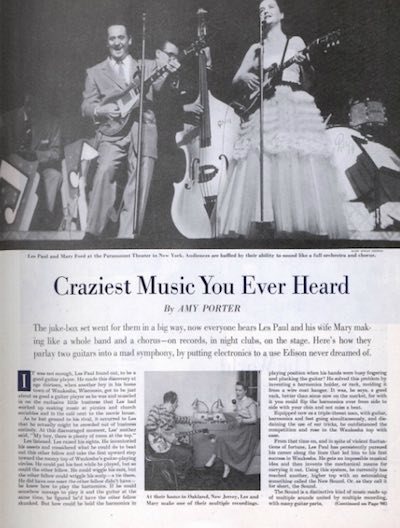
Featured image: Les Paul and Mary Ford at the Paramount Theater in New York. (Photo by Hans Knopf for the January 17, 1953 issue of the Post)
Three Poems by Dorothy Parker
Ballad of Understandable Ambitions
Fame and honor and high degree,
Jeweled scepter and throne-room plot —
Yellow primroses, they, to me;
Milder longings are mine, God wot.
Smooth and simple I’d have my lot;
I’d depart on another tack.
At my aim give me just one shot —
All I want is a lot of jack.
Fond communion with field and tree,
Bread and cheese in an ivied cot;
Sweet and clean though the thought may be,
I subscribe to it ne’er a jot.
Other yearnings my heart make hot,
Other cravings my spirit rack.
In my dreams to my goal I trot —
All I want is a lot of jack.
On the pages of history
Ne’er my name shall I sign and blot;
I’ll go down to posterity Neither scholar nor patriot.
Cloaks of Shelley and Keats and Scott
Ne’er will fall on my humble back;
Immortality ask I not —
All I want is a lot of Jack.
L’Envoi
Prince, or Rover, or Rex, or Spot,
Ere I die let me take a crack
At the wish which I’ve never got —
All I want is a lot of jack.
(January 27, 1923)
Song of a Contented Heart
All sullen blares the wintry blast;
Beneath gray ice the waters sleep.
Thick are the dizzying flakes and fast;
The edged air cuts cruel deep.
The stricken trees gaunt limbs extend
Like whining beggars, shrill with woe;
The cynic heavens do but send,
In bitter answer, darts of snow.
Stark lies the earth, in misery,
Beneath grim winter’s dreaded spell—
But I have you, and you have me,
So what the hell, love, what the hell!
The wolf, he crouches at the sill,
And, grinning, bares expectant fangs,
While heavy o’er the house, and chill,
The coming of the landlord hangs.
Each moment, on the shrinking door,
May sound his knocking’s hideous din.
And more and more, and ever more,
The eager bills come trooping in.
The milkman clamors for his due,
The grocer and the cook, as well—
But you have me, and I have you,
So what the hell, love, what the hell!
(February 24, 1923)
Song of the Wilderness
We’ll go out to the open spaces,
Break the web of the morning mist,
Feel the wind on our upflung faces.
[This, of course, is if you insist.]
We’ll go out in the golden season,
Brave-eyed, gaze at the sun o’erhead.
[Can’t you listen, my love, to reason?
Don’t you know that my nose gets red?]
Where the water falls, always louder,
Deep we’ll dive, in the chuckling foam.
[I’ll go big without rouge and powder!
Why on earth don’t you leave me home?]
We’ll go out where the winds go playing,
Roam the ways of the brilliant West.
[I was never designed for straying;
In a taxi I’m at my best.]
Minds blown clean of the thoughts that rankle,
Far we’ll stray where the grasses swirl.
[I’ll be certain to turn my ankle;
Can’t you dig up another girl?]
We’ll go out where the light comes falling—
Bars of amber and rose and green.
[Go, my love, if the West is calling!
Leave me home with a magazine.]
(March 3, 1923)
Second Chapters: Write or Flight
Maria Langer doesn’t dread Mondays. She says, “If you love what you do, Mondays are never an issue.” Then again, Langer’s Mondays are often spent in a Robinson R44 helicopter near the Cascade Mountains in Wenatchee, Washington, where she runs her own charter and tour business. As an accountant turned tech writer turned helicopter pilot, Langer says, “People make a lot of excuses for why they can’t do something.”
Langer grew up in Cresskill, New Jersey in a working class family with no aviators. Her first time airborne was at age 7, and she says she’ll never forget it: “We were up in Maine camping. There was a guy on the side of the road with a helicopter and a sign that said ‘Rides: $5.’ My mother and sister were cowards, but my dad and I went. To this day, I remember that flight.” She recalled the way swimming pools looked like little blue rectangles from the air, the lines of white where the surf was breaking on the waves of the Atlantic. “It was maybe 50 years ago and I still remember it like it was yesterday.”
After attending Hofstra University, Langer worked in the New York City Comptroller’s Office, but she didn’t see herself as an office worker. In 1990, she was hired to write a course in auditing, and the next year she was a ghostwriter on Dvorak’s Inside Track to the Mac.
As it turned out, Langer got in on tech writing at an opportune time. She quickly made a career writing computer how-to books, but even the best-sellers didn’t stay relevant for long. Langer wrote 86 books, mostly about Mac OS, Microsoft Office, and various other programs. She said that, after 2004, the market for instructional books on computers started to fall, and, by 2012, it was dead.
This wasn’t a death blow for Langer, however, because she had already been looking into a new profession. Looking up, to be exact.

“It was a whim,” Langer says of her decision to start flying helicopters. “I never expected to do it for a living.” In fact, Langer says several pilots told her she wouldn’t be able to make a living flying helicopters when she started in 1997.
In 2001, she formed her tour and charter company, Flying M Air, LLC, and in 2004 she began flying for a tour company in Arizona. Langer, who flew over the Grand Canyon 13 times a day, recalls the tricky weather conditions that accompanied each season: spring brings heavy winds, summer heat strains the aircraft and causes wildfires that can fill the canyon with smoke, and then the heavy rains come in late summer.
The variety of difficult weather patterns proved a valuable learning experience for an unseasoned pilot, but Langer faced the worst flight of her career over the canyon.
About six weeks into working with the touring company, Langer was flying with a full cabin of sightseers when a man jumped from the aircraft at an altitude of about 7,500 feet. She said they were coming out of the canyon, and the man opened the door while she was adjusting a narration playback machine. “By the time I realized the door was open, he had thrown his legs around. I instinctively reached out and grabbed his waistband. Then I thought: ‘What if this guy grabs at the controls and forces us to crash?’ I wasn’t necessarily thinking about the other passengers; I was thinking about me. I’m no hero. I thought, ‘This guy apparently really wants to die.’ I let go of him, and he jumped out.”
Langer said she hasn’t talked about the incident much. She never even told her parents, although she thought about it every day for about two years. “Any time there was a weight shift, any time someone’s camera strap caught on their seatbelt and made a snapping noise, I would think of him. It put me into alert mode. That’s just me. What about the other people on that ride, how did it affect them?”

After taking a day off, Langer returned to the job, to the surprise of some of her coworkers. The experience was traumatic, but it couldn’t dim Langer’s passion for flying.
She started splitting her time between Arizona and Washington. In Wenatchee, where Langer stays during the summer, she found agricultural work that demanded a helicopter: cherry-drying. For an 11-week season, she awakens in the morning and waits by her Robinson R44 to see if it will rain on the cherry orchards. If it does, Langer flies low and slow over the trees to shake the water off the fruit. The purpose is to ensure water doesn’t collect in the stem cup — the dimple where the stem meets the cherry — where it will be absorbed into the fruit and split the delicate skin.
A similar process is used for frost control on almond trees in California. With higher, faster flying, contracted helicopter pilots hover at the edge of the natural thermal inversion and suck the higher, warmer air down to the trees.

Langer still loves the tranquil perspective of flying and enjoying the scenery of the Pacific Northwest. She has taken up many other hobbies over the years: beekeeping, photography, gardening, and tweeting about politics. By attaching a GoPro camera to the nose of her helicopter, Langer found that she could capture her own breathtaking stills of the landscape. She has recently dabbled in drone photography as well. Langer’s blog, An Eclectic Mind, is regularly updated with her thoughts on an assortment of topics, from wildflowers to the current president to the Federal Aviation Administration’s regulations.
Contracting a charter flight with Flying M Air isn’t cheap, but Langer gives rides at community events for a lower rate. These customers are typically first-time helicopter riders. She hopes some of these families might include future aviators who remember their first time flying as long as she did.
Screen Sirens of Hollywood: Lauren Bacall
Other features about the stars of Tinseltown can be found in the Post’s Special Collector’s Edition, The Golden Age of Hollywood. This edition can be ordered here.
This article was originally published in the Post on May 21, 1966.
At 8:30 P.m., on the drizzly New York evening of March 16, 1942, the opening-night curtain rose at the Longacre Theater on a play called JOHNNY 2 x 4, a noisy melodrama set in a 1926 Greenwich Village speakeasy, which involved a confusing number of gunshots, trumpet solos and dead bodies falling out of telephone booths. The following morning, the New York critics stomped all over JOHNNY 2 x 4, and it swiftly folded, remembered now only for the fact that listed fourth from the bottom in the play’s dense cast of 66 was one Betty Bacall, a 17-year-old hopeful who was making her Broadway debut as a walk-on extra.
“It was a rotten play,” admits Betty Bacall, who is, of course, now known professionally as Lauren Bacall—the ersatz label Lauren, a name she loathes, having been tagged on her by Warner Brothers some 15 months after the demise of JOHNNY 2 x 4. “But, rotten or not, I was terrifically excited to be in it. From as early as I can remember, I’ve been wildly stagestruck. As a kid I never even considered being in the movies, a second-rate medium, I thought, strictly for Priscilla Lane and Kay Francis. My dream was to star in a Broadway hit, to be another Katharine Cornell.”
From that bleak debut in 1942, the curtain now descends to denote the passage of 23 years, 8 months and 22 days, rising again to reveal the evening of December 8, 1965, when CACTUS FLOWER, a farce adapted from French by Abe Burrows, directed by Burrows and starring the aforementioned Miss Bacall in the role of a spinsterish dental nurse, opened in New York at the Royale Theater.
The following morning the New York critics fell all over themselves in praise of CACTUS FLOWER and Miss Bacall, after which the play rapidly ran up an advance ticket sale of $600,000. Thus, after only slightly less than a quarter of a century, Miss Bacall has at last had her dream come true—she is the season’s reigning Broadway female star in the town’s biggest new hit.
“It may have been a long time coming, but it feels good anyway,” Miss Bacall remarked cheerfully the other day, slouched in an easy chair in the high-ceilinged living room of her 12-room apartment in the Dakota, New York’s oldest and perhaps most elegant cooperative apartment house, at Central Park West and 72nd Street. She lives there now with her second husband, the actor Jason Robards Jr.; her two children by her first husband, the late Humphrey Bogart—a son, Stephen, 17, and a daughter, Leslie, 13; her child by Robards—a son, Sam, 4; a nurse; a cook; and a beagle named Benjamin.
In her familiar deep-throated voice, Miss Bacall explained that she was offered CACTUS FLOWER last summer while languishing in Hollywood, after having completed harper, a recent suspense film in which she is co-starred with Paul Newman.
On Life and Love
“The nicest things in life always seem just to happen by themselves, without one chasing after them,” Miss Bacall observed, settling again into the easy chair and lighting a filter-tipped cigarette. “It almost seems as though my entire life has been a trip to get to this point, to cacTus Flower. But, with one thing and another, I sure took the long way around, a long detour, and I traveled by roller coaster, a roller coaster on which the highs were as high as anyone could ever hope to go. And the lows! Oh, those lows were lower than anyone should ever have to go — ten degrees below hell.”
If Lauren Bacall’s journey to CACTUS FLOWER undeniably had its violent ups and downs, there is little argument that, after one or two early false starts, her acting career certainly started at the top of the roller coaster with TO HAVE AND HAVE NOT, the 1944 film in which she was co-starred with Bogart. And, curiously enough, her appearance in JOHNNY 2 x 4 led to the movie.
While none of the critics noticed Miss Bacall in her walk-on appearance, an eagle-eyed editor of HARPER’S BAZAAR had spotted her prowling gracefully into the speakeasy on the stage and had seen in her the makings of a high-fashion model. Before long, the young Betty Bacall was gazing languidly out of the pages of HARPER’S BAZAAR virtually every month, and in March 1943, she appeared on the magazine’s cover.
Then director Howard Hawks, in the midst of preparing a film for Warner Brothers of Ernest Hemingway’s TO HAVE AND HAVE NOT, saw one of Miss Bacall’s HARPER’S BAZAAR covers and brought her to Hollywood to play opposite Bogart.
Hawks began filming TO HAVE AND HAVE NOT in the late fall of 1943, and in the spring of 1944, the film was shown at a sneak preview in Huntington Beach, California. The audience went wild over newcomer Lauren Bacall and started her trajectory toward becoming the best-known young movie actress in the country.
Another result of the lm was the budding romantic relationship between Miss Bacall and Bogart. The two married on May 21, 1945, and Miss Bacall frankly remembers the first years of her marriage to Bogart as the happiest years of her life. “We were absolutely wild about each other,” she said recently. “When I was away from Bogie for even three or four hours, I couldn’t wait for the moment I saw him again, and he felt the same way about me. Luckily, we were almost always together, day and night, at home and at Warner Brothers, especially when we were working together in the same picture. In our eleven and a half years of marriage, until Bogie died in January 1957, I think we spent more time together than most couples do in 25 years of marriage.”
Though Miss Bacall’s private life was close to idyllic in the years immediately following her marriage, her lm career, with the exception of the movies she made with Bogart, went steadily downhill. In one picture after another, she was once again called upon to play essentially the same role she’d played in TO HAVE AND HAVE NOT— the slinky temptress with the sultry come-hither look.
The only one in Hollywood who suspected her natural talent for comedy was Nunnally Johnson, who in 1953 cast her in a comic role in HOW TO MARRY A MILLIONAIRE, in which many of her friends feel she gave the best performance of her career. Nevertheless, after HOW TO MARRY A MILLIONAIRE she was back again in come-hither roles.
By early 1956, the Bacall roller coaster, which had been pretty much riding the heights, despite her shaky career, for nearly a dozen years, began its descent to “ten degrees below hell,” when it was discovered that Bogart had cancer of the esophagus. For the next 10 months his health declined, until his death in the early hours of the morning of January 14, 1957.
The night before he died, Bogart knew that the end had arrived. Each evening before he went to sleep, he kissed his wife and said good night, but on that final evening, Bogart’s doctor later reported, he merely grasped Miss Bacall’s arm, gazed up at her and, in his imperishable Bogie voice, said only two words — “Goodbye, kid.”
At this point, her personal life had hit at a decidedly low point, and her career was pretty much at a low ebb too. It continued that way for the next several years. “By the summer of 1965, six weeks or so before CACTUS FLOWER came along, I was in the real doldrums. I was feeling about as low as I’d ever felt, but then, on July 14, I went a lot lower, all the way down to the bottom of the roller coaster. Adlai died.”
Miss Bacall was speaking of Adlai Stevenson, who was one of her great idols in life and one of her three or four closest friends. “I’d fallen in love with Adlai on television, when he’d made his acceptance speech at the convention,” Miss Bacall remembers, “but I fell even more in love with him when I met him. When Bogie died, Adlai was one of the people who helped get me through. I saw a great deal of him while he was ambassador to the U.N. He could always make me laugh and feel good again.”
Thankfully though, after that low point, the Bacall roller coaster began to rise again, a circumstance that has brought a new gleam into her eye. “I guess the essential fact about me right now is that I’m happy, really happy, for the first time in years,” she says. “For a long time, too, I’ve been living my life too much in retrospect, dwelling on the old days with Bogie, but I’ve stopped doing that. I live for now, and, with CACTUS FLOWER, now is a lot of fun. This is the year that I’m the star of a Broadway hit, and, dammit, I’m loving it while it lasts.”
News of the Week: Fired Muppets, Snortable Chocolate, and Michael Phelps vs. a Great White Shark
It’s Not Easy Being Green
Is it possible for a puppet to get fired?
In the case of Kermit the Frog, it is. Specifically, the voice behind the Muppet has been fired. Disney has canned Steve Whitmire, who has provided the voice of the popular Sesame Street character for almost 30 years, after taking over the role from creator Jim Henson.
The reason? Whitmire says that two Disney executives told him it was because he sent notes that were too detailed, which made people uncomfortable, and also because of a contract dispute regarding a video project that Whitmire declined to do. Whitmire says that he’s upset, because he’s put three decades into the job and it’s his “life’s work.” He sees it as a betrayal. In a press release, Disney says they let Whitmire go because he displayed “repeated unacceptable business conduct” over the years.
Matt Vogel will take over the role of Kermit. Miss Piggy, who has been romantically involved with Kermit in the past, could not be reached for comment.
Nose Candy
I know what you’re thinking: You love chocolate, but you’re tired of consuming it the old-fashioned way, via the mouth. Surely there must be a way to get chocolate into the body in some other way?
There is! It’s called Coco Loko, and it’s chocolate in powder form that you can snort! Apparently it has been popular at European parties for years, but now it’s here in the United States, and people are wondering if it’s legal to sell or even safe to eat, if “eat” can even be used to describe what you’re doing with it.
Coming soon: Chocolate in liquid form that you take intravenously. You don’t get the pleasure of experiencing the taste of the chocolate but you still get the rush and calories.
Michael Phelps Is Going to Race a Shark, for Some Reason
Actually, the reason is because it’s part of the Discovery Channel’s annual Shark Week. It’s called, appropriately enough, “Phelps vs. Shark.” The Olympic gold medal winner will race against a great white this Sunday, July 23, at 8 p.m. And no, Phelps won’t be in a cage. Both he and the shark will be in open water. But since the show was taped weeks ago and Phelps is doing interviews for it this week, we can safely assume he wasn’t eaten. No word yet on who won.
RIP Martin Landau, George Romero, Bob Wolff, Harvey Atkin, and John Bernecker
Martin Landau was a fine actor who had some great movie roles over the years, in such films as North by Northwest, Crimes and Misdemeanors, and Ed Wood, for which he won the Best Supporting Actor Oscar for playing Bela Lugosi. He also appeared in TV shows like Mission: Impossible, Space: 1999, and a million others since the 1950s. Landau died Saturday at the age of 89.
His first job was as a cartoonist for The New York Daily News, and he turned down the role of Mr. Spock on Star Trek.
If you like The Walking Dead you partly have George Romero to thank. He wrote and directed the classic 1968 horror flick Night of the Living Dead and its many sequels. He also directed Creepshow, The Dark Half, and a 1974 documentary titled O.J. Simpson: Juice on the Loose (which might be a good movie to watch this week to coincide with Simpson’s parole hearing). Romero passed away Sunday at the age of 77.
Speaking of The Walking Dead, the show was temporarily shut down this week after the death on the set of stuntman John Bernecker. The 33-year-old also did stunts for movies like Logan and Fantastic Four as well as TV shows like Memphis Beat and The Vampire Diaries.
Bob Wolff was the longest-running sportscaster in TV and radio history. He’s not only the only person to have announced the championship games in each of the four major sports, he interviewed Babe Ruth. Wolff died Saturday at the age of 96.
Harvey Atkin played the camp director in the classic comedy Meatballs, was a regular on Cagney & Lacey, and acted in such shows as Law and Order: SVU and many cartoons. He died earlier this week at the age of 74.
Town Honors World War II Vet with No Family
What happens when a World War II vet with no close relatives dies? Hopefully the community comes together to honor him. That’s exactly what the citizens of Pembroke, Massachusetts did when former Marine Malcolm Phillips, who died at the age of 92.
Moon Dust
Nancy Carlson likes space so much that she paid $995 for a bag used on the historic Apollo 11 mission. The forgotten bag was auctioned off yesterday at Sotheby’s, and she got a great return on her investment ($1.5 million). But she almost lost the bag in a legal fight with NASA.
After Carlson bought the bag, complete with moon dust still inside, she sent it to the space agency to make sure it was authentic. NASA said it was indeed a real bag used during Apollo 11, but she wasn’t getting it back because it shouldn’t have been sold in the first place! She sued and won but decided it would be safer to auction it off than keep it in her home.
This Week in History
Apollo 11 Lands on the Moon (July 20, 1969)
The NASA mission that included that bag happened 48 years ago yesterday (it’s not a coincidence the Sotheby’s auction took place yesterday). Neil Armstrong, Buzz Aldrin, and Michael Collins took off from the Kennedy Space Center on Merritt Island, Florida, on July 16 and landed on the moon four days later. Armstrong was the first to step foot on the surface, followed by Aldrin (Collins stayed on board the command module to pilot it). Here’s how CBS covered it:
Ernest Hemingway Born (July 21, 1899)
The acclaimed author never wrote for the Post (he submitted but we didn’t accept — sorry!) but he did appear on the March 12, 1966, cover.
This Week in Saturday Evening Post History
“Doing Dishes at the Beach” (July 19, 1952)
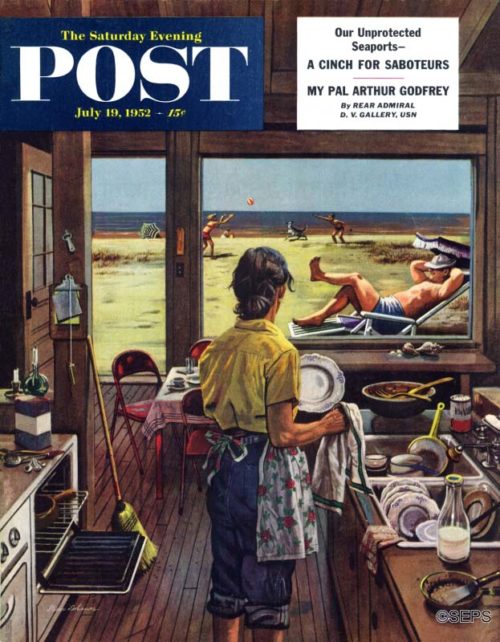
July 19, 1952
You can look at this Stevan Dohanos cover two ways. It could be a funny picture — oh, that wacky husband and kids of mine, having fun on the beach while I’m stuck doing dishes just like at home! — or you could look at it as kind of sad, for the very same reasons. I lean toward the latter. I think it’s the way Dohanos shows her only from the back, looking off into the distance at her family having fun while she works, face unseen.
Today Is National Junk Food Day
At first, I thought I wasn’t going to be able to link to any recipes for this day. How do you find recipes for “junk food”? It’s usually just something we buy at the supermarket or fast food place, right? But this is the web, so …
Here are instructions on how to make a homemade version of a Big Mac, and here’s a recipe for your own version of the Chick-Fil-A Chicken Sandwich. If your junk food tastes run more toward snacks and desserts, here are recipes for homemade versions of Oreos, Hostess Sno Balls, peanut butter cups, and Goldfish Crackers.
Or if you’re feeling lazy, you could just go out and buy them.
Next Week’s Holidays and Events
National Parents’ Day (July 23)
The day was established under President Bill Clinton in 1994.
National Talk in an Elevator Day (July 28)
This is the day you have permission to talk to random strangers you meet on the elevator, about anything you want. Anything! Talk to them about politics, about the weather, about movies, even talk to them about your collection of elephant figurines or the history of cheese. They’ll love it!
Wait!
The shop window had become a black-tinted mirror in the darkness of the November evening. I could see the passersby almost as well as the jacket that had caught my attention. Distracted, I let my eyes shift from the herringbone tweed to the passing crowd until a familiar reflection made me forget the jacket completely. My brain did a double-take, thinking it recognized Daria. This proved to be one take too many for she was already half a block away before I could react, too far to hear me call,
“Daria, wait!”
“Wait!” is actually how our last conversation had ended, but I’m not sure she heard me that time either over the not-quite slam of my apartment door. The words I’d said before that, as well as hers to me, had followed the ritual formula of all our fights. Although the cause of our arguments changed, our method had an inevitable sameness born of long habit.
As kids, we’d end our squabbles with an exchange of,
“Did NOT!”
“Did TOO!”
that would have continued eternally if our mother hadn’t stopped us once she, not we, tired of the bickering. Neither of us had grown less stubborn as we grew up. The years merely expanded our vocabulary and contracted our patience so that the battle of wills ended with a single chorus of,
“Oh, get serious!”
“No, you get serious.”
before one of us added something like,
“Look, I have nothing more to say to you. I doubt I ever will.”
Then whoever happened to be in the position to do so left the arena with an air of offended dignity.
I’ve always blamed the rut our disagreements had fallen into on our being too close in age. A mere 15 months separated us, and we’d been raised more or less as twins without that us-against-the-world complicity real twins have. There was a big sister and a little sister in our equation, but the boundaries were seriously blurred. The roles switched with abandon leaving no one in charge of this sistership, which led to a mutinous struggle for power until we reached our teens and discovered our tastes in everything — clothes, boys, books, hobbies, you name it — went unshared. Rather than provide a further source of conflict, the differences finally liberated us from the bonds of our false twinhood and eventually allowed us to forge a friendship. We grew up without growing apart despite, or perhaps because of, lifestyles that were diametrically opposed. Therefore, sibling rivalry had nothing to feed on and we managed to go months without even a hint of a misunderstanding. But once one cropped up, the situation quickly degenerated into the old familiar pattern.
It didn’t take much either. Our last fight had been over a dinner Daria was planning. She’d invited me and stopped by a few days beforehand to borrow my food processor. I asked who else would be there — an innocent question to which Daria innocently replied,
“Ted and Sandy, Jason and Ellen, and Roger.”
“Ah,” I said. “I think I’ll skip this one, if it’s all the same to you.”
“But why?” Daria asked, though she knew very well the reason was Roger. He’s a friend of Dan’s I’d met at a party, and spent the better part of the evening talking to — more to please Dan than Roger. He simply wasn’t my type, and I’d politely declined when he invited me to the movies, a refusal Daria had found stupid. She and Dan, though not legally married, co-habited blissfully, and Daria could never understand that I might actually enjoy living alone, or at least be in no hurry to change the situation.
“Roger’s boring,” I repeated what I’d told her after the party.
“No, he’s not. He’s very nice.”
“That’s a matter of opinion,” I shrugged, provoking a tsk of exasperation from Daria.
“Look, it’s still no reason not to come. After all, no one’s asking you to go out with him. This is a dinner. There’ll be eight of us. You don’t even have to speak to Roger.”
“Except that everyone else is a couple which makes a couple of Roger and me.”
I hoped my logic would nip the brewing argument in the bud. Daria, however, ignored my perspicacity and began round two with,
“Oh, cooome on!”
The gauntlet was down. We were off for a good hour of theme with very little variation except that a few personal insults crept in, and poor, old Roger went from boring to being,
“… the biggest jerk I’ve ever met in my entire life!”
That’s when Daria said,
“Oh, get serious!”
And I said,
“No, you get serious — and get yourself another sister because I won’t be there.”
It took Daria perhaps 30 seconds to collect her things — and my food processor. But that was long enough for me to have second thoughts, wishing I’d told her,
“Fine, see you Friday,” and simply canceled out at the last minute, which is why I said the “Wait!” that went unheard.
We hadn’t made up yet, and I turned to follow her in the crowded street because I wanted to do that, although making up face to face would break a tradition. After one of our disputes, Daria always phoned. Our record for not speaking had been one month, but more often she’d call within a few hours, once she figured we’d both had time to cool off. The phone’s remoteness allowed us to have a conversation where only the words counted since neither of us could look for meanings hidden in facial expressions or body language. Instead, we’d rationally dissect the cause of our argument, finally making the effort to see the other’s point of view until tolerance led to teasing as we forgave each other — friends again.
I needed us to be friends again, so I hurried after Daria to get things settled, but she had always walked faster than I and my progress was slowed even further by the 5 p.m. pedestrian rush hour. I thought I’d lose her completely when she crossed one street just before the light changed. Luckily the cars weren’t moving any faster than the people and I managed to cross against the light, suffering no more than the honks and curses of a frustrated commuter. The breach had widened, however. Determined, I picked up my pace, weaving a path with one shoulder then the other, but Daria kept moving easily through the crowd while I seemed to be mired in the tide of foot traffic. Frustration battled with determination as the pursuit began to take on the proportions of a bad dream. I was tempted to abandon it, but I couldn’t. In one last effort, I lowered my head and plowed forward only to plow directly into a man with the broadest shoulders I’ve ever seen. He grabbed my narrow ones to steady me, laughing,
“We’ve got to stop meeting like this.”
Any other time, I would have laughed too, but the man’s width blocked my view. In a panic, I apologized and pulled away. By the time I managed to push around him, however, Daria was gone. I stood there getting bumped by passersby, feeling as if I’d run up against a wall. Actually I had, yet the wall was reality. I’d just spent 15 minutes chasing Daria despite knowing oh too well that she was dead.
Two weeks after our argument, Daria had been killed when a driver ran a red light. That had happened more than a year ago — a sufficient mourning period if one listened to the experts, but not sufficient for me.
After the accident, I had gone through denial, convinced each time I answered the phone, I’d hear Daria opening negotiations with her habitual,
“I think we should talk.”
Although I’d eventually stopped expecting to hear her voice, I didn’t progress much further. Anger at her not having made the call before she went and got herself killed tried to surface, but that emotion was false and I knew it.
For reasons I would never be able to know, Daria hadn’t phoned a few hours, or even a few days, later. Initially, I’d simply felt relief at having the perfect excuse to avoid Roger. Not until the evening of the dinner safely passed did I begin to anticipate rather than dread Daria’s call. What I couldn’t have anticipated was that my mother, not Daria, would call first, to tell me my sister was dead. The fact that both Daria and I had been at fault for letting the argument go unresolved proved to be no consolation whatsoever. The wound remained open, and I now found myself chasing a ghost to tell her I was sorry — so, so sorry — in an effort to close it.
Suddenly bereft of what I had actually believed to be a second chance, I kept walking around, grateful for the rain that began to fall and hid my tears while I tried to accept Daria’s death once and for all, as well as the reality that nothing I could do would change what had happened. Yet I merely felt a resurgence of the remorse that had tormented me at first. I kept walking but my energy ran out before the anguish did. The only thing I could do was to take it home with me and try to learn to live with it.
Resignation replaced desperation as I turned to retrace my steps and found myself in front of a billboard advertising a new movie. The title was: All Is Forgiven. It stopped me in my tracks. The surrounding graffiti, however, was what held me mesmerized despite the steadily falling rain. For there on the wall, beneath the billboard like a signature, someone had spray-painted the name Daria.