Breaking Ice News: The 1950 Report on Global Warming
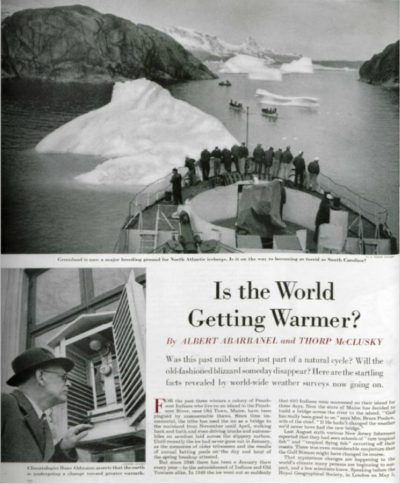
The Antarctic Peninsula’s Larsen C ice shelf was reduced in area by more than 12 percent in the last few days when a chunk of ice broke off, a phenomenon called calving. The newly-formed iceberg is one of the largest ever recorded — bigger than Delaware, at more than 2,200 square miles. The Saturday Evening Post reported on the thawing of the Antarctic ice shelves back in 1950, although scientists’ conjectures about the warming earth differed from current theories. Polar exploration was relatively new, but the results were coming in: “Considerable evidence that Antarctica is thawing out already exists. Not so long ago, the largest iceberg ever reported — 150 miles long — was seen drifting hundreds of miles north of the towering ice barrier that surrounds the continent. Over the years, polar expeditions have reported a steady shrinkage of the vast ice pack.”

Today, scientists are able to monitor the Antarctic with much more precision. Project MIDAS is a research team that has monitored the rift in the ice shelf for many years. Scientists on the team say that the calving event “puts the rest of the ice shelf in a very vulnerable position.” The rift-induced collapses of Larsen A in 1995 and Larsen B in 2002 provide models for the possible disintegration of Larsen C, which would compromise the Antarctic Peninsula. Project MIDAS says it will take years or decades for this to happen if it does.
The calving was monitored with satellite imaging for several months before scientists confirmed the iceberg broke off completely this morning. The rift cannot be directly attributed to rising global temperatures since iceberg calving is a natural event that has occurred for millions of years. However, according to the Times, “the breakup of ice shelves in the peninsula region may be a preview of what is in store for the main part of Antarctica as the world continues heating up as a result of human activity.”
The 1950 Saturday Evening Post report, “Is the World Getting Warmer?,” speculated that rising solar energy output was the cause of global warming — a nonpolitical term at the time. Greenhouse gases were not yet a commonly understood trigger for climate change, and quicker, more epic events were theorized: “Is the sun throwing out more heat, perhaps getting ready to explode and snuff out all life on earth in a matter of seconds?”
Scientists in 1950 were already monitoring the Antarctic ice shelves, although with much less accuracy and technology. Years of advancement and data have afforded scientists the ability to ascertain many irreversible effects of climate change, but a timeline for the fate of Antarctica — and of the Larsen C ice shelf — is still unclear. Today’s calving event may prove to be the tip of the iceberg for future collapse on the continent.
The Post Remembers Artist Andrew Wyeth on His 100th Birthday
Andrew Wyeth is known today as an American master, a realist painter with a genius for capturing the land and the people he knew.
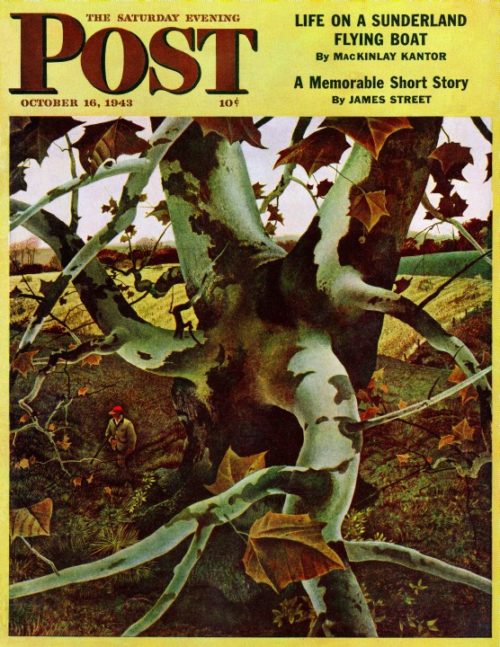
But back in 1943, the 26-year-old Wyeth was still doing illustrations for magazines. One of his paintings graced our cover in October of that year. He would have been aware that his father, N.C. Wyeth, had painted several Post covers back in the 1900s.
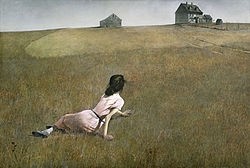
While N.C. gained a national reputation for his illustrations, Andrew went on to become a fine artist, best known for his 1948 painting, Christina’s World, one of the best known mid-century American paintings, depicting a woman lying on the ground in a treeless, mostly tawny field, looking up at a gray house on the horizon.
A proponent of regionalist, realist style, Wyeth is associated with the prestigious Brandywine School, which also was the artistic home of Howard Pyle, Frank Schoonover, Harvey Dunn, and Clifford Ashley, among many other artists and illustrators.
Wyeth was the youngest child in a talented family and led a sheltered childhood. His father gave Andrew the only art instruction he ever received. He also gave him the advice to trust his artistic instinct and not to paint for recognition or approval.
It was good advice in light of the harsh criticism he faced. His 1987 National Gallery exhibition of his portraits of Helga Testorf was roundly attacked by critics.
One reviewer wrote that Wyeth’s paintings were lifeless, with no intrinsic value, and that he was incapable of creating the magic found in all great art.
Yet, like Norman Rockwell, Wyeth remains extremely popular with the public, despite the critics. His “Christina’s World” is the painting most visitors to the Museum of Modern Art ask to see.
This disagreement between the critics’ and the public’s opinion of Wyeth is so wide, one art critic called Wyeth the most overrated and underrated artist of the 20th century.
If some art critics take issue with Wyeth, he is still hugely popular with the public for his evocative, atmospheric landscapes and his realism.
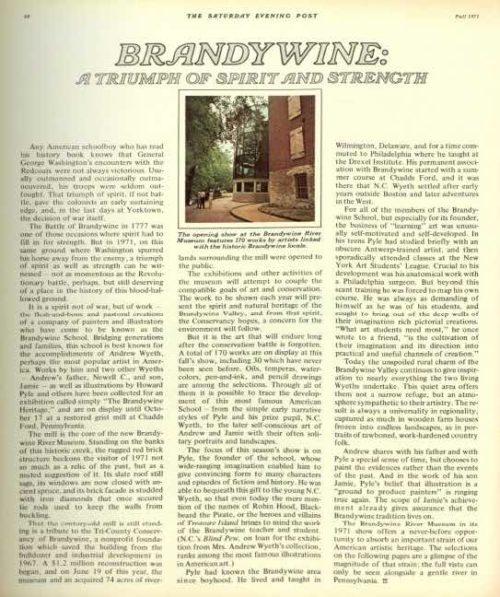
This article from the Post, covering the opening of the Brandywine River Museum, offers paintings from three generations of Wyeths: Andrew (1917–2009), father Newell Convers (1882–1945) and son James (b. July 6, 1946).
Dear Mr. Thoreau…
What would Henry David Thoreau, born 200 years ago today, make of our modern society, brimming with on-demand, instant-response, electronic incivilities at every turn? In 1854, Thoreau believed that “Our life is frittered away by detail. Simplify, simplify.” And so he did, living alone in the woods to think, write, and step to the music he alone heard.
In 1968, the Post editors similarly speculated what Thoreau would make of their modern era, and whipped up this faux-correspondence between the philosopher and an ambitious book editor hungry for a bestseller.
From the October 5, 1968, issue of the Post.
In 1854, when Henry David Thoreau’s Walden was first printed, fewer than 2,000 copies were sold. Would his book fail today? Probably not. A modern publisher’s correspondence with Mr. Thoreau might read:
Dear Mr. Thoreau:
I am pleased to inform you that Flimbind and Shipp is accepting Walden for publication. Please sign and return the enclosed contract. Your book should be a real seller, as back-to-nature books are big this season.
Sincerely yours,
JAMES TRUSLOW FLIMBIND
Dear Mr. Thoreau:
Thank you for the prompt return of the contract. Your check for $200 advance payment is enclosed.
Work on Walden is moving ahead. I have assigned “Slash” Hartman, one of our best rewrite men, to you.
Sincerely yours,
JAMES TRUSLOW FLIMBIND
Dear Mr. Thoreau:
I regret that my last letter upset you. We rewrite all our manuscripts before publication, but only to heighten effect and tighten up the prose. As to your fears concerning Mr. Hartman: “Slash” refers not to Mr. Hartman’s editing technique, but to a scar on his face, a souvenir of his reporting days.
I am enclosing a preliminary cover for your inspection. We feel that the woman in the mist will enhance the book’s pull.
Sincerely,
JAMES TRUSLOW FLIMBIND
Dear Mr. Thoreau:
My patience is wearing thin, H.T., after your last diatribe. I do not rewrite books out of malice but because I know what the American public wants. I feel that your comment, “flaunting a naked woman on the cover of a serious philosophic work,” is unjust. The mist covers her up pretty well. If you wish, I’ll have the artist thicken up the fog around the breasts.
Sincerely yours,
JAMES TRUSLOW FLIMBIND
Dear Mr. Thoreau:
Hank, I’m not going to attempt to answer the charges in your last letter. The revised version of Walden has been sold to Amalgamated Films for $50,000. A check for your share, $2,500, is enclosed. That should keep you in Indian meal for a while.
Amalgamated will probably title the musical either I Was a Teen-age Recluse or Walden, Baby. Verna Lush has been signed for the female lead.
Sincerely yours,
JAMES TRUSLOW FLIMBIND
Dear Mr. Thoreau:
I think that the near hysteria of your last letter is unjustified. Verna Lush will play the barmaid, an addition made by Slash to give the book more impact. However, the love scene in the woods will not be in the film, as every effort is being made to keep it a family picture. The big dance number on ice, Walden Is a Winter Wonderland, will be filmed on location at your pond. As for the payment, five percent on movie rights is standard for new authors.
To quote a line from your original manuscript, “Money is not required to buy one necessary of the soul.”
Sincerely yours,
JAMES TRUSLOW FLIMBIND
Dear Mr. Emerson: I appreciate your writing so frankly about Mr. Thoreau’s tragic death. Although none of us at Flimbind ever met him, we felt that we knew him well.
The movie-making activities on the ice of Walden Pond could not have hastened Mr. Thoreau’s death. Any author having the opportunity to see his work come to life as an Amalgamated production should have been spurred to recovery rather than lapsing into the decline that you described.
One final matter. I have scanned a couple of your latest books, and I think that Anemia Press has not done well by you. There is now a slot open at Flimbind for one philosophy author. Why not come aboard, Ralph?
Sincerely yours,
JAMES TRUSLOW FLIMBIND
North Country Girl: Chapter 8 — Teacher’s Pet
For more about Gay Haubner’s life in the North Country, read the other chapters in her serialized memoir. The Post will publish a new segment each week.
My bookworm tendencies paid off at school, where I was the smallest and the youngest, but definitely the smartest, doted on by all my teachers at Congdon and especially by Miss Ritchie.
On the first day of third grade, I walked into the classroom wearing a new red and black plaid dress with puff sleeves and a dainty smocked top. These Polly Flinders dresses were the height of girlhood fashion; my mother hoped that since I couldn’t make friends, maybe my dress could. The old wood and cast iron desks, with their ancient carvings, slamming seats, and finger-pitching tops, desks that had been welded to the floor since the beginning of time, were gone. In their place were rows of modernish, moveable laminate and metal desks and chairs. The new desks were basically lidded drawers; mine quickly became a rat’s nest of crumpled papers, broken pencils, bits of eraser, and somewhere, the pair of safety scissors I had been issued but lost immediately.
The state of my desk and my awful handwriting were the only things about me that disturbed the adoration of my third grade teacher. Miss Ritchie was white-haired and pink-skinned, with the chest of a pouter pigeon. She wore old-fashioned floral dresses, belted where her waist might have been, thick white stockings and sensible shoes, and smelled of lily-of-the valley toilet water.
I was the undisputed teacher’s pet, Miss Richie’s imaginary daughter or dream pupil or maybe both, and I gloried in it. I was at the top of the class in every aspect of our admittedly unchallenging curriculum: no science to speak of; a smattering of math, mostly multiplication and fractions; something called “Social Studies”, and lots of English, where I shone. Most of our school day was spent on grammar, spelling, vocabulary, reading in our English textbook, and writing. Congdon’s old maid teachers believed the ideal classroom was one where thirty small heads were bent over workbooks, the only sound the scratching of No. 2 pencils or the soft rubbing of pink trapezoid erasers. Since I was happiest with my nose in a book or writing my own stories, this was my ideal too. I was always the first one chosen to read my writing, and the most lavishly praised. No one else in the class had a chance of taking messages to the principal’s office; the other students were relegated to the lowly tasks of erasing the blackboard and emptying the pencil sharpener. I was especially glad to be relieved of that job, as I always ended up dumping about a pound of shavings on the floor trying to wrestle the sharpener off the wall.
Miss Ritchie chose me as one of five students from her class to audition for the school choir; upon hearing me sing, the choir leader’s eyebrows shot upward, and she ordered me back to the classroom. I hate to suspect that it may also have been Miss Richie who condemned me to Remedial Speech. My r’s were certainly not robust and rolling, but they were definitely not w’s. Yet once a week I was pulled away from the glories of books and fractions and sent off with the three stupidest boys in the class, all of whom had terrible lisps. We sat miserably around a table in the school library, while the perky speech therapist played card games with us, making sure that my cards always included the red, red robin and the three dumbos got dealt pictures of slides, snakes, and snow. I don’t know if I was cured, or the speech therapist moved away, or if someone took pity on how unhappy that hour made me, but I only had to endure one year of moronic games featuring words starting with R.
Other then the new desks, Miss Ritchie stuck to the classics. We started every day with the Pledge of Allegiance, followed by “My Country Tis of Thee,” “God Bless America,” “America the Beautiful,” or on dreadful days, the unsingable national anthem. Once or twice a week, Miss Ritchie would pass out songbooks and take us through “Shenendoah” or “Alouette” or “My Old Kentucky Home.” There were no objections to the line “Twas summer, the darkies were gay” as few of us Duluth children had even laid eyes on a real black person. That was the music curriculum. For art we made seasonal classroom decorations, drew illustrations for our weekly book reports, and occasionally and wonderfully, instead of a crayon drawing, brought shoeboxes from home to create dioramas depicting a scene from our book.
Once a year, all classroom work was suspended for the Iowa Tests of Basic Skills; I went into a zen state, a blissful inner peace penciling in those tiny ovals, knowing I’d score in the high 90s on every subject. There was no test prep; we were told what day the tests would be and mildly threatened not to be absent that day and so inconvenience the entire school by having to take a make-up test.
We began the school year decorating the room with leaves cut out of orange, yellow, and red construction paper. When the leaves were replaced with thirty practically identical jack o’lanterns, it was time to pick out a Halloween costume.
The traditional Congdon Halloween school parade was the only time anyone could actually admire your costume; trick-or-treating at night in Duluth required at least a coat, and more likely hat, scarf, and mittens as well. Wearing a costume to school felt like the height of transgression. And how to choose? Sleeping Beauty? Cinderella? Alice? Which plastic mask you could barely see out of, with elastic that snapped off of the staples almost immediately, which scratchy, glittery dress?
Each class in turn paraded through the school, showing off their costumes to the twelve other rooms: two classes in grades 1 to 6, and one kindergarten class split between morning and afternoon sessions. When we returned to their own classroom there was an orgy of cupcakes, frosted cookies, and bowls of sickening candy corn to gorge on, courtesy of the class mothers.

For the most part, homemade Halloween costumes were looked down upon, but one year my sister, probably tired of having to always wear my hand-me-down store-bought costume (complete with busted elastic), insisted on going as a ghost. After finally locating a white sheet, my mother draped it over Lani, cut enough off the bottom so she wouldn’t trip, and then carefully scissored out holes for Lani’s eyes and mouth. Lani toted the brown paper grocery bag she thought contained her ghost costume to school, only to discover that what she had was a white sheet with a girl-sized hole in the middle. When Lani’s class paraded into our room, I tried to shrink under my desk at the sight of her bravely wearing her teacher’s eyeglasses, necklace, and cardigan, dressed up as the child whose mother couldn’t be bothered.
The orange construction paper jack o´lanterns came down, and up went the multi-colored turkeys, looking more like the NBC peacock than barnyard fowl. Immediately after Thanksgiving, turkeys were replaced with paper Christmas trees decorated with a mixture of Elmer’s glue and shake-on glitter; glitter ended up embedded on our new desks, and I would find sparkles of gold and red in my dress pockets for weeks after.
The time between Thanksgiving and Christmas were devoted to that juggernaut, the Congdon Christmas concert, then we were sprung for two glorious weeks of vacation, which meant unlimited if boring daytime TV watching, hours spent reading anything I could get my hands on, and punching my sister until my mother lost it, bundled us both up to the gills, and kicked us outside.
When we trudged back to school in January, the classroom walls were unadorned, and remained so until February, when it was time to break out the red and pink construction paper and add bits of cut up white paper doilies to the palimpsest glued to our desks. Valentine’s Day, like Halloween, was a time of heightened excitement at Congdon. Miss Ritchie assigned a team of girls (led by me, of course) to decorate a large cardboard box, which would hold the class’s Valentines. We devoted hours of classroom time to this pleasant activity. Even more fun was selecting which Valentines to give out. This was done in two stages. First there was the trip to Woolworth’s, that fascinating emporium, permeated with the smell of roasting nuts. There were endless racks of greeting cards to be perused, a rotating display of fascinating gags (Fake vomit! A fly in a plastic ice cube! Sneezing powder!), a pet section in the back, offering rodents, birds, fish, and turtles (plus pink and blue dyed chicks for Easter, two of which showed up in my sister’s and my baskets one year), and an alluring silver lunch counter along the side, which my mother was convinced was filthy and dangerous to eat at. Starting February 1, there would be a special section for Valentine Day Cards. The cards were garish illustrations with punning captions (“I can’t ‘bear’ to be without you” “You’re ‘egg-sactly’ what I like”) to be punched out of thin cardboard sheets, four or five cards per sheet. They came in a box wrapped in clear acetate, so you had to make your decision based on the cards on the top sheet. Some years there would be Hanna-Barbera themed cards, some year Disney. The height of the craft was the card with a candy heart already glued on, a tiny pastel “Be Mine” attached to a smiling bee.

Part two was the selection of a card for each classmate. It was an unspoken rule, completely taken for granted, and never to my knowledge broken: every kid gave a Valentine’s Day card to every other kid. I carefully punched out each card (the ones that ended up ripped got mended with scotch tape and addressed to my least favorite classmates), spread them out on the floor, and started the selection process: who got what card?
I had to determine the best one, to be addressed to my beau ideal, Jim Deere, who was blond, white-toothed, good at sports, and almost as smart as I was. I needed him to read “Let’s be sweethearts” and be struck with the inevitable: we were meant for each other. Then came my favorite girls, the other goodie-goodies: Nancy Erman (my closest academic rival; I had to admit she was better at math than I was), Betsy Strauss, and Debbie Sawyer. After them, came almost albino pale John Bergman, potential boyfriend runner-up (I tried to put out of my mind the fact that his father, my pediatrician, had seen me in my underwear), and the rest of the girls in the class.
My least favorite classmates, Tom Madson, who wore always smeared glasses and was freckled and sweaty, and Billy Shaw, troublemaker nonpareil, got the slightly ripped ones or the small hearts stating simply “Happy Valentine’s Day” that filled out every card collection. The selection process complete, I signed my name on the back of the card, addressed the small white envelope, and licked it shut.
On Valentine’s Day, all the girls dressed in red and pink and all the boys acted as if it were the worst day of their lives, rolling their eyes and barely tolerating the Valentine card ceremony. Having deposited our cards there only a few hours earlier, the Valentine box was torn open, and the cards distributed. Now it was my turn to examine each card as if it were the Rosetta Stone, trying to decipher a secret message of love from the one signed “Jim Deere.” Finally came the feast of pink iced cupcakes and cookies, thanks again class mothers.
Halloween and Valentine’s Day were the Carnivals of the school year, the riotous occasions where all the usual rules were suspended. The other disrupter was the rare and precious snow day. In the face of Duluth winters, school rarely closed, never because of freezing temperatures (just put on another layer!); a full white-out blizzard would be required before the school board would give in to human weakness in the face of the elements. What bliss to be sitting at the kitchen table, eating cornflakes and dressed for school, to hear the radio announce that schools were closed. During one blizzard, the Duluth newspaper ran a photo of my dad heading to his office on our snowmobile, determined to pull teeth no matter what the weather.
Spring brought us third graders a soon-to-graduate-from-college student teacher, who came bearing a stack of slide carousels. This girlish 21-year-old was like an exotic creature who had wandered into our classroom. We had never before seen an elementary school teacher under the age of fifty; we wouldn’t have been surprised if she had to go into deep freeze for the next thirty years before being allowed back into a classroom. Despite her four years of teachers college, she aimed to instruct eight and nine-year-olds in art history. In our darkened classroom, while the boys napped or threw spitballs or snapped rubber bands at each other, the student teacher clicked through hundreds of years of Western Civ, from Rembrandt to Picasso. We were regularly quizzed on identifying artists from their paintings. I had my hand raised and flailing for every slide and got them all right, except for Manet and Monet, who I still get mixed up.
By April, it stopped snowing and the sun struggled to appear a few minutes at noon. The piles of snow left by the plows on the sides of the street shrank day by day, until eventually I could see over the top on my way to and from school. Soon nothing would be left but small humps of sludgy ice along the street gutters. The class cloakroom stopped smelling like wet wool. The beginning of the end of the school year was the first time we were sent outside for gym. Miss Ritchie, who always led gym reluctantly, began by organizing baseball or kickball games, but soon sat back and let us run wild, interfering only when someone (usually me) got decked by a dodgeball to the head.
“Nature, Inc.” by Sinclair Lewis
This is not the history of the bland Professor Tonson, but of a man who became flamboyantly ridiculous and then became human, and along the way learned something of love, the intensive culture of the string bean, and Mystic Powers; and in the end discovered that if he was not afraid of being completely unreasonable he could make life glorious.
Professor Tonson was not a professor of anything or at anywhere, but he made a specialty of knowing everything. His prize subjects were Hindu metaphysics, and the food value of the humble but earnest peanut, and the most expeditious methods of extracting fortunes from elderly ladies of high moral tendencies. He looked a good deal like an English major with a white horseshoe mustache and a weakness for mixing drinks. Whereas Mr. William Packard, of the Cape Realty Development Company, knew nothing at all about dietetics or theosophy — though he was one hundred percent efficient at the methods for getting elderly ladies’ fortunes back into circulation.
Mr. Packard was built like Mr. Jess Willard, the distinguished autobiographer and physical culturist, and wore his five-dollar hat at an impertinent angle on his mighty and baldish head.
He had symptoms of tobacco heart, coffee heart, motor heart, cocktail heart, poker heart and musical-comedy heart. He kept six different physicians expectant of his becoming violently ill with six or more ailments, though he always felt well after 10 a.m.
He met the professor when the latter pussy-footed into Packard’s real-estate office with a preposterous offer for two hundred acres on Cape Cod for the establishment of an enlarged plant of the Nature and Guidance Colony — Inc. The professor teetered and Packard pounded on the desk, and the scene looked stormily tragic; and then they quite amiably agreed on a price and went out to lunch together.
The professor took a Black and White Lunch — he called it that; the waiter called it a crime — consisting of asparagus without dressing, ripe olives, and a modicum of Bar-le-Due — he called it a modicum. Packard took a beefsteak and kidney pudding, a baked potato, plum pudding, two pots of coffee and a cigar. The professor gently, stickily tried to persuade Packard that he ought to give up meat, tobacco, coffee, and most of the other things for which that well-to-do bachelor lived.
“Yes,” said Packard; “but, canning all that back-to-Nature dope, what plans have you got for the erection of your buildings? I’m president of the Barnstable County Construction Company; I’ve put up most of the hotels and really classy houses that have gone up on the Cape in the last five years; and I’ll make you an attractive proposition.”
The professor took the attractive proposition; and five months later Packard motored up to Nauset Harbor to examine progress on the buildings of the Nature and Guidance Colony.
Though he made most of his money out of Cape Cod, Packard knew it only by motor car. He had never met a native who said “‘Twa’n’t!” and he had the simple-hearted rule of staying only at hotels whose rates were six dollars a day or more.
He did not know a sand dune from a Swampscott dory, unless he saw one in a blueprint. He regarded the shellbacks and the kindly summerites, together, as one vast bog of cranberries, which he plucked, but with which he did not associate.
Consequently he was bored when he entered a tract of barren uplands, the grass dried to wheat-gray and mulberry color, beyond which was a steel-blue inlet and a barricade of gray dunes. His car staggered on a sandy road and he beheld a line of cottages like bathhouses, without even a board walk and a shower bath in front of them.
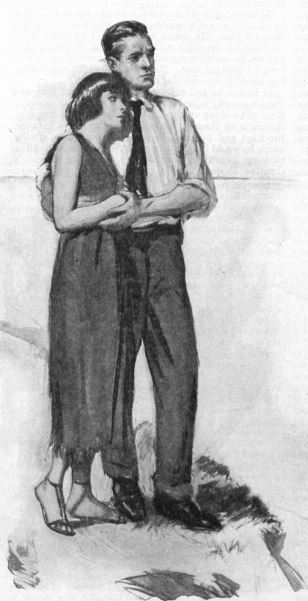 Professor Tonson met him with bouncing enthusiasms. Every time he said “Wonnnnnderful!” or “Llll-Lovely!” it sounded like a hand drawn over the bottom of a whisk broom. The professor, who had worn a frock coat and a white waistcoat in the city, was neatly clad in a straight linen robe like the old-fashioned nightgowns that respectable gentlemen who parted their whiskers used to wear. He also had sandals and carried a book about the size of a tombstone. But Packard paid small attention to him, because in the professor’s wake was a girl of 24 or 25, like a little silver image, with bobbed hair of shining ash-blond. She wore a garment like a gunny sack; but she had the grace of a girlhood ivory-skinned, eternal.
The raising of Packard’s hat was a study in sprightly graciousness. It was a perfect thing, like Matty’s pitching or a Futurist cut-out puzzle by Matisse. He skipped from the car and was introduced to the professor’s lieutenant, Miss Beulah Atkinson.
While the professor returned to his class in Upstirrings Toward the Infinite, which had already begun in the half-finished Tabernacle — a wooden Greek temple of the First National Bank order of architecture — Packard was conducted about the grounds by Miss Beulah. Packard slid, in his nine-dollar tan oxfords, down the baking side of a dune; he kicked his way through long beach grass and thick cranberry patches; but he was oblivious of his martyrdom.
He had had a shock that turned all his briskness into exalted humbleness, for Miss Beulah’s light-swimming eyes were raised to the clouds with worshiping exaltation; her low voice was intense with the happiness of the Colony’s finding a place where they could be free and “real.” Her hands, smooth-finished as enamel, touched his arm to herald the sea vista of silver-and-blue water, edged with gold-green downs. He finally got it through his head that this girl, whom he took very seriously, actually believed in the Colony, which he had despised.
As suddenly as though the touch of her fingers were a charm, he found the Colony — peanuts and linen gowns and all — a highly important and interesting discovery. He had been quizzing her about the small meanness of the colonists’ cottages and the grandeur of the professor’s new home; he had cynically learned that the Colony members gave one-tenth of their fortunes to the Colony. But now he stopped, threw back his head, expanded his huge chest, and drew in all the exhilaration of the sea breeze, while he volunteered:
“Well, it really is a beautiful place here — by golly! I’m more used to Washington Street; but there is something
“Something won-derful!”
“Yuh! Wonderful! Sea and landscape — Say, is there any good fishing here?”
“I really don’t know; but — ” Miss Beulah flung out both her arms. Her baggy sleeves fell away and her arms shone bare and exquisite. “We are fishing for human souls!” she cried. “Don’t you know the city transforms people into machines — into machines for digesting meat and doing silly, useless work? We want to make them free.”
Packard trembled “Y-yes!” like an awed small boy. He wanted to kiss her hand. His regular rule for handling women customers — “Kid every chicken you meet” — seemed unutterably sordid in her presence. He stammered and drew in a full breath again.
“Don’t you feel tired and useless first thing in the morning?” she demanded.
“Why, yes; don’t you?”
“Never!”
“Wish you’d show me the trick.”
“Nature has shown you the trick. It has given us the sea and the air and the nourishing vegetables.”
“I wish it’d given me you to show me how.”
“Perhaps it has.”
“Would you show me the trick if I stayed down here?”
She flushed. Uneasily: “Why — why, if I could. But it’s — it’s Professor Tonson who shows us all.”
“Oh! Him! I’d rather have your version.”
“I’m only a silly child, compared with him. It’s he who has the Guidance, in Revelations that tell us what the Colony shall do — the Natural Food, and all.”
“Yes,” said Packard meekly — 206 pounds of meekness that moved its feet carefully and tried to look like a gentle lover of Natural Food who preferred a lunch of Brussels sprouts to roast beef any day.
They sat on a dune looking to sea. Sometimes she was a very mature person who awed him by scraps of knowledge about metaphysics. Sometimes she was an eager girl who whispered “Look! Oh, look!” when a plover ran along the shore. The wind blew her grotesque garment into delicate lines and her bobbed hair fluttered constantly. She cried:
“Have you a bathing suit? No? Wouldn’t you like a swim? It would give me an excuse! I’ll get the professor to lend you one.”
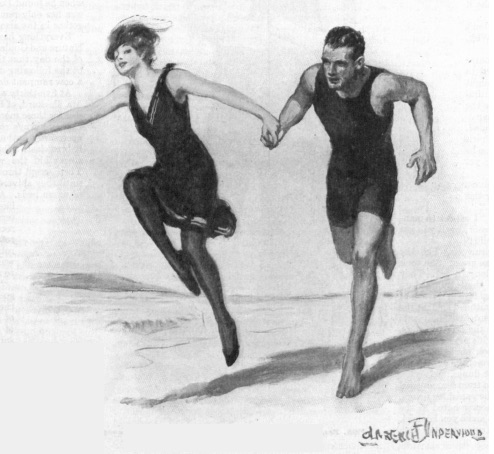
She herself changed to a coquettish garment of silk with a flounced skirt and a quite un-Natural bow of coral-hued satin. She led him plunging out into the surf, her white shoulder muscles flowing like ripples on an inland stream. As they breasted a breaker together he suddenly — and apropos of everything — knew that he was in love with her. And that love stood the test of her taking him to the professor’s last class for the day — a class in the Hydraulics of Natural Food — and to the Colony supper, an original combination of old string beans and new corn mush.
An hour afterward, as he sat down to an English mutton chop and other things not included in Natural Food, at the Santequisset Inn, he kept shaking his head and muttering: “Well, I’ll be darned!” And when his calm was so shaken that he was diverted from his fascinated interest in food and expectant of being darned during meals, then he was stirred indeed.
Mr. Packard, broker and constructor, builder of castles in Spain, in the air, on sand and on tidal flats, had ideals. They were mostly filed away under “I” in back files. covered with dust; but the thought of Beulah, his vision of the flame of life as it flickered in her eyes, represented to him those ideals. He saw her as a victim of the professor’s Revelations; but, for the first time in his years of selling shacks to people who wanted to get near to the primitive, he was willing to admit that there really might be something interesting in the life of barren shores — and more barren suppers.
More and more the decorative ladies who had cheered his city bachelor life seemed shoddy beside Beulah, after that day. He motored to the Colony once a week or oftener. The life there came to seem almost reasonable. He even felt satisfaction when the Colony membership grew to 30 — 30 lean gentlemen and agitated old ladies — and he did not protest so very violently when the professor broke Beulah’s heart by making her change her silk bathing suit for a garment that looked like a holland summer covering for a large chair. He had caught from Beulah her faith in the Colony.
She, the daughter of a dreamy New Thought clergyman, had all her life been accustomed to take cobwebby theories seriously, and on her father’s death had become the lieutenant of Professor Tonson. Emotions, enthusiasms, theories, trust, were to her real things. She never grinned when she read in New Thought magazines the advertisements of gentlemen who offer for an insignificant sum to cure baldness by Thought Power, or to initiate you into recently discovered mysteries of the Tibetans that will increase your bank account and keep your cook from leaving. She could not convert Mr. William Packard to her theories, but she did convert him to a belief in herself.
On an October day, when the line of silver poplars and cottonwoods that shouldered across the hills back of the Colony was high-colored, when the sea breeze had an entrancing nip, and ducks hurled across the sky, and the course tide roared on the bars of Gosnold’s Rip, Packard sat beside her on the dove-gray sands. His tie was as gay as of old, but he wore black sneakers and khaki trousers smeared in crosshatchings with motor-boat grease. His voice was not flippant, but quiet with friendship and a deep affection more genuine than any feeling he had known before in his bustling life. “Well,” he said, “I guess our party’s all over now. Buildings are done.”
“Yes.”
“And I’ll have to go back to the city.”
“Yes.”
“Well, Beulah, it’ll be kind of too bad to leave — ”
“Yes; when you are coming to understand our simplicity here — ”
“Yes; but I wish you could see Boston. Be fine! Art galleries and opera and music and stuff — and, say, it wouldn’t hurt you to be comfortable for a while! You’d enjoy it here all the more when you got back.”
“Yes; but the sea — ”
“Yes; but the streets — ”
“Yes; but — Oh, Bill, you aren’t going to go back and stay, and lose all the simplicity here, and lose — lose — ”
“Lose you?” He stopped fencing. “No, no; I won’t! Why, you absurd littleness, I could hold you in one hand and I could put one finger round your neck, and yet already you’ve become my boss. Will you marry me if I come here and live? I — ”
“Yes.”
He picked her up and cradled her in his arms. For an instant their lips blurred together as the waves met and blurred with the sands. Holding him off, she said, lucidly and quaintly as a child talking to a beloved uncle:
“Come, then; we’ll get Professor Tonson to marry us this afternoon according to the rites, and then we’ll drive right down to Orleans and be married again — to make it legal.”
“T-this afternoon! Why, little girl, don’t you want to be engaged for a while? Why, gee, I’ve never heard — ”
“Oh, no, Billy. You see, I’ve had a course in Conversion of the Worldly-Minded to Higher Thought; and the professor taught us that when a man yields to the Natural Force of Love he’ll be willing to follow the Clearer Feminine Light of the Woman — at first. But then he’ll get old-minded, and want to go back to his worldly Spirit Habits and still try to keep his love; so he must be shown the way while there is yet light.”
“Well, gee, honey, I thought a business man would be able to put it all over this Higher Thought bunch; but you win.”
“Oh, yes, dear,” she said serenely. “I expect to manage you, as a humble aid to the professor, until you get trained in the Higher Life. Come, child!”
She sprang from his lap. Her spring was like the swallow’s darting flight along the sedge grass. She took his hand and led him toward the Colony… They crossed the long flat sickle of beach; they stumbled up through the loose sand and the tangled brown selvage of grass roots to a dunetop; they were outlined against the angry sky — her hair blowing out like the delicate filaments of mist that were flicked along with the storm clouds. They turned back to face the sea and his arm was about her, his chin was high. Then she took his hand again. He followed her like a meek but enormously overgrown boy and they disappeared beyond the dunes.
Two pearly-breasted terns, flying in from sea, preened themselves on the sand and watched the vanishing lovers.
“Haw!” laughed one raucously, hoarse-noted as the surf. “There go two fools! Doesn’t it make you landsick to see a 15-foot horse mackerel trying to play with a herring like that?”
“You’re a fool — and a young fool!” said the elder tern. “All you know yet is food. Don’t you understand that everyone laughs at lovers because a laugh is the tenderest thing in the world? Come on! The sperling are running.”
It was not only that his simple taste preferred a steak sprinkled with mushrooms to a tulip-bulb salad, but, furthermore, Packard considered it an insult that Professor Tonson should lecture him on the merits of the beans that he himself had raised. Oh, Packard — Brother Packard — had raised the beans, all right! For seven months now he had been a tremendously married member of the Nature and Guidance Colony, and he had brought those beans up by hand, according to the Montessori method.
He had fed them and watered them and called them religious-sounding pet names, and almost dandled them on his knee and taught them Chopsticks on the piano. He had weeded them daily — he knew nothing about botany and he could not have told you the Latin name of a single weed, but he had little names of his own for every one of them. There was the bunch of casual grass that stuck to the ground like your last stamp to a misdirected envelope. There was the flat, sneaky weed that sprawled like a fawning dog, with a lying and treacherous smile on its shiny leaves, and had to be yanked out by hand.
Clad in a straight linen robe and sandals, and a Peter the Hermit haircut, with his poor patient desk-trained back contorted to a stoop, his tender neck slowly broiling to one red smear of unhappiness, Packard had weeded, and weeded, and weeded — he, the immaculate, whose diagonally striped ties, and club-barber haircuts, and manicured nails, and suits with a faintly distinctive pattern, once had made him as sleek as a newly groomed race horse! Now he had actually got used to his incredible linen Colony robe, which flapped with a sneaky sheepishness about his plump ankles.
He had been so wistfully good. He had not made one sign of wanting to beat the professor; he had not quarreled with him — well, had scarcely quarreled with him at all. But now, when the professor came nickering round at Colony supper, suave among the workhouse-gray benches and bare tables; when he praised the succulent bean as though Packard had never even heard of a bean before, Packard growled: “Y’ ought to weed them!” And under the shelter of the table he bent a fork double. The professor merely smiled and flowed away.
After supper the colonists were instructed to retire to their cottages for Instructive Reading. Though he had not become particularly instructed, Packard had obediently read several pounds of books about Spirit Impulses and about sages who lived a long while ago and wore beards. The books all sounded so much alike that Packard would unintentionally skip from Yogi Trance, on page 223, to Navajo Concentration, on page 226, without knowing he had missed anything in between. And he had kept himself from smoking, though every 10 minutes during the evening a bright realization would come to him that he wanted something new and exciting, and wanted it right now — and that something new would always prove to be the same old thing, a smoke.
 The women sat across from the men in the Hall. Packard hastened across to where Beulah’s silken hair and the lovely little curve of her chin were brilliant amid the discreet gray of earnest old women. As he approached her, as she looked up like a white verbena blossom tilted by a breeze, the resentment that he belonged to this ridiculous Colony left him, and his smile was radiant when he whispered:
“I’m going out to try and meditate on the dunes. Be right home.”
His whisper was a vocal caress; but he was lying, passionately, devotedly, for Packard was not as yet in such a state of Natural Grace that he really cared much for sitting on a damp dune and meditating about the ethics of the Bhagavad-Gita. He was not going to go out and try to get into any such state of grace, either. He was going to have a smoke. And he concealed his vile object from his wife partly because he did not want to hurt her feelings and partly because — oh, any married man will understand!
He carted his huge form out among the dark dunes as delicately as a lone lorn fern frond, lest he be discovered by chronic Meditators and be invited to join in a real Meditation bee. He stole into a clump of pines and laurel and scrub oak — and luxuriant poison ivy, which gratefully parted to make it easy for him to get right into the midst of it — and after cursory fumbling reached his new hiding place for a box of 1,000 cigarettes and 2,000 matches, his last thoughtful purchase before taking a year’s leave of Boston and his business. He felt in a nonexistent trousers pocket for a match safe he no longer carried. He took a match from the box, and as he scratched it on his shiny linen robe he mourned:
“This is a — of a pair of pants for a Pride’s Crossing Club man to wear! Gee, the prof might let us wear pyjamas, anyway!” He clumped toward the cubicle they called home, with its sparse furniture and the Futurist paintings that appealed to Colony taste. But he forgot his troubles when he found Beulah in the golden silk kimono which was her only remaining vanity; when they curled together in the armchair.
Everything has a symbol — at least if you live in a Nature and Guidance Colony. If beans were the symbol of the day that the historian has just chronicled, then of the following day twain were the symbols — fog and a cow rampant on a field slippery.
At 5:30 a.m., the hour at which the well-to-do Mr. Packard, of Boston, had been wont to turn over in bed for three more hours of conscientious slumber, the Colony always rose and had a unanimous, though not necessarily enthusiastic, swim before breakfast — call it breakfast. This morning of fate a fog like a snowstorm hid the world, presaged vague dangers Out There, crept through clothing, and chilled the colonists until they shivered and moaned as they hesitated out of warm beds. A foghorn down on the Point moaned like an orphaned calf at such regular intervals that Packard kept listening for its recurrence as he put on his damply stiff robe instead of his bathing suit. The robe felt like a new towel used as a washcloth, but it was divinely preferable to a bathing suit this morning.
“Thank the Lord, we won’t have to go swimming anyway!” he sighed to the nose-tip of Beulah — the only part of her that had as yet dared to slip out of the pillow into which her head had snuggled.
“Yes!” she said devoutly, and burrowed again.
Packard went to stand on their doorstep. He wrapped a table covering about his shoulders. He felt like a man catching a 3 a.m. train for the first time in his life as he stared at the bleary fields and the blanket of mist. He wanted to smoke. He wanted to devour beefsteak and coffee. And, with a longing that passeth the understanding, he wanted to go back to bed.
A suspicion of abominations and treachery chilled him still more. Down the row of cottages came Professor Tonson in a bathing suit, his lanky shanks of a gristly bareness beyond any ordinary white and rounded nudity. And the colonists were falling in behind him. Packard tried to present an impersonation of an influential and cheery broker as he called:
“Guess it’s too foggy for a swim this morning — eh, professor?”
The professor retorted:
“Certainly not! I have a Revelation that, no matter what the weather is, we must not give up our communion with the strength of the sea. Quit ye like men; be strong! Into your bathing suit at once, brother!”
The stringy-necked men and women who followed the professor, like a string of broken-down horses with the springhalt, all sniffed at William Packard’s towering beef as though they did not really care so very much for quitting them like men, but, anyway, they were stronger than this lump. The flapping scarecrows disappeared into the fog like a fantastic chorus recruited from soggy November cornfields.
The fog hid the shore, hid even the dunes; but Packard could fairly feel the sea. He was sure that it had never been so wet as it was that morning. He turned back into his house, looking for sympathy from Beulah. He was going to encourage her to stay in her comfortable nest and defy the professor; but he found her already struggling with the canonical Colony bathing robe for women — her ivory shoulders, like those of a priceless statue, partly covered with snuff-colored denim.
“Why, Billy, you must hurry! Didn’t you hear the professor?” she said wonderingly.
Finally, his bathing suit had not dried properly overnight. It was probably the clammiest thing in the fog-swathed unhappy universe.
On the shore, gray, weary waves rolled from under the gloomy curtain of fog, and nearer now was the foghorn’s yawping warning that perils innumerous were lurking out there.
He plunged into the breakers like a whale and splashed a good deal to show that he was not afraid; but he was afraid, and when he came dripping out his heart was no longer God’s little garden, but weedy with resentment against Beulah and hatred for the professor.
It was as he sat at a breakfast of corn chips, milk of a faint lavender hue, oat cakes, and nice sugared hot water to take off the chill of the swim, that Packard realized he almost hated Beulah, too, as she absorbed the long droning observations on the Symbolism of Mist with which the professor made breakfast jolly and gay. Her devotion to the professor threatened to destroy the sacred tenderness and respect for her that was his religion. He had to get her away from here if love was to survive… And incidentally he wanted a breakfast table with a silver coffeepot and fatly sentimental buttery muffins, and a Beulah who, just risen, would praise her big brave boy for having dared to go out and swim in the fog.
Clearly though Packard saw the danger to their love, he forgot it in the early afternoon, during the affair of the cow.
He was sent out to fetch a cow, which had been grazing in an upland pasture. As he crossed the rolling moors; as he saw the colored hillsides with their patches of lichengreen and rose, and a yellow like the essence of sunlight; as he gazed over a sea that was clear of fog now and shone in dark blue waves, with a schooner on the far sky line — Packard was happy. He trotted uphill without a trace of the smoker’s feeble panting. He felt as strong as a locomotive; his blood ran gloriously; he laughed with well-being.
Then he realized that a curious itching between his fingers had been bothering him more and more all day. He stopped and spread his fingers wide, and his massive face puckered with childish discontent. He was poisoned with poison ivy.
Occasionally scratching one hand with the other, he trudged up the next hill. In his eyes the ocean now shone no more than a pile of musty hay. His trusting heart had been deceived again. So he came like sulky Achilles to where the cow grazed; and, flourishing a rope halter, he growled at the animal:
“Come here, you son of a mush-faced rabbit!”
The cow turned and slumped gently away. It seemed to suppose that it was a colt in a pasture. It stopped now and then, and with its ludicrous hoofs coyly patted the earth before humping itself on again. Packard was too much engaged in paddling after it, in shaking his big red fist and bellowing illimitable curses, to see a silent-running motor car stop on the State Road, at the farther side of the field.
His name was called. He stopped. In the car were two brokers he had known in Boston. They were smoking large cigars; they were wearing hats like chorus men in a Palm Beach musical comedy; they looked insultingly well-fed; and they were accompanied by two girls of the sort who had always sighed “Oh, Mr. Packard!” at him.
He turned away in dignity. He paid no attention to their shouts. He — William Packard, who had stalked down Tremont Street looking every man in the face — hid in a patch of weeds until the motor car had driven away. And for hours he fancied he could still smell the incense of those large Olympian cigars, still catch some aroma of the biggest steak in the world, simply wallowing in onions.
And he still had a cow to catch; in fact, any time during the next half hour it might truthfully have been noted that he still had a cow to catch.
When he reached home, expecting Beulah to comfort him, she was in tears… A female neighbor, a lady of more ideals than bosom, had complained to Professor Tonson that Beulah’s pet vice, the silken robe she wore for Packard, was a Stumblingblock; and the professor had had a Revelation that Beulah must give it to be sold for the Nature Gospel Fund.
Packard began:
“Why, the rotten old scoundrel! I’ll make him give back your pretty. I’ll make him eat — ”
Beulah interrupted in a manner of horror:
“Bill! You are sacrilegious!”
He went to sit on the miserable pine doorstep and brood of a future in which his beloved would drive him away by her childish faith in Predigested Nature. The fog was again creeping over dune and sea.
It was an hour before their supper, and it was Thursday. Thursday supper always consisted of lentil chops, chicory salad and lukewarm coffee substitute, a repast that could scarcely be trusted to make him to leap like the young roe or the dancing doe, with Optimism Invincible, or any of the other standard brands of optimism in which the professor dealt.
He could not stand it, he felt. And he would not stand it! But the awe of love was on him; he was afraid to kick Beulah’s idol. He would never be able to revolt if he hesitated for one single minute. He made himself lumber up from the step like a great brown bear unwillingly rising from a blueberry bush. He trotted through the sneaking fog, his linen robe rustling against his legs.
As he ran he had a joyous vision of finding Professor Tonson secretly enjoying a steak or a smoke; of exposing him; of breaking up the Nature Colony; of returning to Boston with Beulah; of eating all the chops between Brockton and Portland in one enormous gorge, during which he would laugh at the professor — but he found the professor beautifully meditative and reading Bergson’s Creative Evolution. His mustache shone with silver. He was a saintly sight. His poise was so perfect that Packard felt like an iceman.
“Say, I want to see you!” he said.
“And you do, brother,” beamed the professor.
“Say, you! Look here! Whatyuhmean by — ”
“Ah! The little matter of Sister Beulah’s vain gauds?”
“I don’t know anything about her gods, and don’t spring that mystic dope on me again. D’yuh hear?”
The professor and Packard were equally aghast at the snarl with which the last words came out. It was as though the old Bill Packard, the unredeemed, had come stamping in, seized the conversation and shaken it by its ratty neck. Packard expected to be answered with a flood of the professor’s contempt. He would bluff it out. He tried to remember how much stronger than the professor he was. He stood big and red and fist-clenched — feeling like a fool.
But the professor answered timidly:
“Very well; I’ll r-r-r-return the robe at once, B-Brother Packard.”
“Oh, you will, eh? Say, do you know what you’re going to do next? You’re going to have a Revelation that Beulah and me are to return to Boston and eat meat and smoke our — smoke my head off! You’re going to have one of the overpoweringest Revelations you ever had that what Beulah needs is — oh, music and all that highbrow stuff — or darn near anything else that she can’t find outside the city. Get me, Tonson? If you don’t feel symptoms of that Revelation coming on pretty quick sudden, I’m going to beat you till your right ear and left foot change places!”
Packard banged his fist on the professor’s light reading table as once he had banged it on desks and things in offices. The table split in twain. The professor put his hand to his breast. Again Packard roared: “I’ve been getting into very decent ringside shape, and if — you — don’t — have — that — Revelation — ”
“But if I do?” piped the professor with the voice of a much smaller and less dignified man than himself.
“It’ll be worth five hundred dollars to you!”
“I’ll take you!” said the professor. “If it wouldn’t be too much trouble for you to make out just a little memo. of that agreement? Of course, my dear friend, if the Revelation isn’t granted to me the agreement’s off; but if it does come — ”
“D’you find you feel any Telepathic Premonitions of its coming, heh?”
“Why, seriously, I think I do,” said the professor with quiet gravity.
Packard scribbled the agreement and handed it over with a curt:
“Here y’are.”
“Thanks! . . . Say, Packard, what the devil made you take so long in coming down to business?”
“D’you mean to say I could have bought out Beulah and me any time?”
“Why, sure!”
The two men grinned at each other.
“Have a cigar?” said the professor.
As they both lighted up the professor continued:
“By the way, of course I know you’re planning to do me out of the five hundred dollars you’ve agreed to, and probably you could do it. And I’ll tear it up if you’ll put three thousand dollars into stock in my plant here. Paid 18 percent last year. See the books if you want to.”
“You’re on!” said Packard. “Give you a check any time — after the Revelation. Say, make the Revelation so it won’t hurt Beulah’s feelings, you know — so’s the poor kid’ll really be glad to go to Boston, you know.”
“Oh, sure!”
“Say, prof, when you come up to town, how about a little dinner, eh? Like dinner at the Victorian?”
“A’ right! Glad to. And I’m due in town pretty soon, Packard. I’m about at my limit on vegetables.”
“Say, old hoss, I got a hunch! Wouldn’t we make a little on the side if we opened a sort of summer Chautauqua here?”
“Not a bad idea,” blandly considered the professor. “Be willing to go in on it?”
“Sure!”
“We’ll talk it over. Anything I can do for you after I get the Revelation?”
“Yes, by gum, there is! You can give me a pair of pants.”
When he first returned to Boston Packard started to make up for lost time in all his pet ways of poisoning himself. He slept until nine and he had two cocktails for lunch, and the only exercise he took was lighting cigarettes. He wore yellow chamois gloves, and could not have been pushed into the vicinity of a cold bath by anything less powerful than a hydrostatic press.
He delighted in all the aspects of business, from files to telephone calls. He managed to get so much pleasure out of worrying about office details which, from the distant Colony, had seemed negligible that his work was as much of a poison as his dissipations.
But he no longer telephoned to ornate young ladies and he no longer ran races with himself to see how late he could stay up nights. He was always tenderly conscious of Beulah; eager to blunder out with her to concerts, picture exhibitions, lectures; considerably more eager to take her to the restaurants where the head waiters knew his sleek portliness; content just to stay home and listen to her enthusiasms — though the enthusiasms grew vaguer and vaguer, now that she was no longer under Guidance.
For a month the excitement of resuming his old life continued. Then it seemed to him as though he had never been away, as though he had always, without break, been going along Washington Street to the Imperial Grill for his heavy lunches.
Within two weeks after his return he was again accustomed to waking with a taste like quinine in his mouth. Within three weeks he had to have a cigarette before he got the energy to dress in the morning. And by the time he was quite accustomed to being back he was beginning to feel dissatisfied with everything except Beulah.
His greatest tenderness for her played about the fact that she was still under the sway of Professor Tonson. Though she had no more communications from him, no Revelations, she was to be found unhappily reading his books — books in black covers, apparently printed by the office boy and bound by the porter; books with titles like Soul-Breathing, and The Occultism of Optimism. Packard was so pitiful toward her unchanged faith that it became horrible to him that he should be in partnership with the professor to make money out of the virtue of fools. He broke off the partnership abruptly in a short dictated letter.
Tonson came up to Boston to protest. Packard told him — you know, of course, where the simple-hearted Packard told him to go; and he said:
“I’m going to have my hands as clean as I can, now, Tonson. And don’t smile that hyena smile of yours, or it’ll cost me a 10-dollar police-court fine — and money’s tight just now.”
Packard went home and told Beulah the full truth about Tonson and himself.
She heard him out dumbly, her eyes averted. Then, “Thank you for telling me,” was all she said; and she went to her room… For the first time since, as a child, she had begun to potter about theories with her pervasively credulous father, she had no prophet. And she was convinced of Tonson’s frauds. She was keen enough, once she had the clew.
Packard’s life with her had been easy enough hitherto. He had merely to agree with her enthusiasms. Now she had no enthusiasms and he could not create them for her. While she patiently and changelessly smiled, he tried to interest her in motoring, in the theater of the Tired Business Men. Sometimes she seemed aroused by his suggestions. Then he was happy. Betweenwhiles he hammered at his office work. There, at least, he could get results.
But when spring came even this last comfort departed. Packard constantly pictured the shore line and the dunes at the Nature Colony; he imagined the stimulus of a plunge in the surf; he hated the stale air of the city.
So at last, though he still wore the uniform of Mr. William Packard, captain of business, he envied the ridiculous Brother Packard and almost cried like a small boy for the impossible return of the happy days of the Colony.
And his humble attitude toward Beulah changed. A small thing began it — though for weeks he had been saying: “I’ve got to do something for the little girl.”
When he came home to their apartment on an April evening with a smell of spring creeping through the musty city as a lavender bag scents a bureau drawer, he found Beulah at a closed window, pressing her temples with both hands.
“Why, honey bird,” he said, “why don’t you open the window? You that are so crazy about fresh air! And shure an’ a foine large avening it is!”
“Oh!… So much bother,” she said.
“But, gee, don’t you care for fresh air now?”
“Oh!… Yes… I must go dress now.”
“No; but straight! Don’t you?”
“Oh, yes, yes; I suppose so. I was too lazy — just looking out — dusk.” She sighed as she trailed away.
At dinner he insisted again, with the boyish whining of a man hungry for simpler and surer love:
“But say — about that window: I was just thinking — Don’t you really like outdoor sports and all that, like you used to?”
“No — yes — oh! I don’t know. . .. Oh, don’t worry about me, you old angel! I’m tired tonight.”
Nothing more — but all the evening, while they played at cooncan, which they detested and kept returning to, and all the next day, while part of his brain was busy in the office, he was absorbed in thinking: “The kiddy. needs to go back to plain grub and cold swims, and a belief in somebody.” As he was going home he meditated: “Why, by golly, that’s what I need too! Think of Bill Packard wanting to do the primitive, like a 50-dollar-a-season renter on the Cape!… Gee! Wonder if Beulah will want to go back now! Well, I guess I’ll have to make her.”
When he entered the apartment she was again standing listlessly by the window. He blurted:
“Honey, we’re going back to the Cape; and we’re going to live in a shack, and swim, and eat every dern thing that’s good for us — except maybe beans… We’ll stay there four or five months, and then we may turn farmers and stay for good. How does that sound to you? Pretty good, eh? Pretty fine?”
“Oh, I — Oh, I don’t know! . . . I don’t think I care to go back now.”
“Sure you do, old honey! You’ll feel fine after you’ve got a little tan on. Come on; let’s start to plan our packing. Where’s my big old trunk? In the basement?”
“No, no; really, Billy! I’m sorry, but I couldn’t go now. I hate the city, but I’d hate the shore or the country worse. I — I haven’t any prophet now that’ll guide me. Perhaps you don’t understand what I mean, though.”
“Yump; I understand. I’m going to be our household prophet from now on, and I’m giving a lecture on How to Take Life Easy this evening. Come on; we’ll look up that trunk.” He picked her up from the chair and replied to her indignant “Well, really!” with a kiss.
When sundown turned the low-tide flats into plates of polished copper two children in scanty bathing suits — two brown, deep-breathing, bright-eyed children — dug for clams and skipped across the flats — Tack and and Beulah.
“We’ll have that chicken tonight,” he said. “I’m hungry.”
“Gee!” she said, quite unself-consciously. “So’m I.”
“Now sit down on a nice soft pool and we’ll have my evening lecture. No; let’s have naturalization examination for your second papers, first: Who’s the greatest living naturist?”
“Professor Bill Packard,” she said meekly.
“And who’s going to teach Professor Bill Packard to become a farmer next spring?”
“Mrs. Beulah Foolish Packard.”
“And who’s going to be Professor Bill Packard’s successor as head of the Packard Nature Colony, Incorporated and darn Limited?”
She answered shyly, as she always did at this point in their game: “Billy Packard, Junior — unless Billy turns out to be Beulah.”
Screen Sirens of Hollywood: Marilyn Monroe
This article and other features about the stars of Tinseltown can be found in the Post’s Special Collector’s Edition, The Golden Age of Hollywood. This edition can be ordered here.
I asked Flack Jones in Hollywood, “When did this business of her making those wonderful Monroe cracks start?” Jones—not his real name—is a Hollywood publicity worker who put in several years at Marilyn Monroe’s Hollywood studio before opening his own public relations office. And since it is unfair to quote a publicity worker by name, I called him Jones. And since “flack” is Hollywood slang for publicity man, I called him Flack Jones.
“You mean when somebody asked her what she wears in bed and she said, ‘Chanel Number Five’?” Jones asked. “You will find some who will tell you that her humor content seemed to pick up the moment she signed a contract with the studio, and that anybody in the department who had a smart crack lying around handy gave it to her.”
Flack Jones paused for a long moment. “I’m sorry to disagree with the majority,” he said firmly, “but she makes up those cracks herself. Certainly that ‘Chanel Number Five’ was her own.”
When I told Marilyn about this, she smiled happily. “He’s right. It was my own,” she said. “Somebody was always asking me, ‘What do you sleep in, Marilyn? Do you sleep in P.J.’s? Do you sleep in a nightie? Do you sleep raw, Marilyn?’
It’s one of those questions that make you wonder how to answer them. Then I remembered that the truth is the easiest way out, so I said, ‘I sleep in Chanel Number Five,’ because I do. Or you take the columnist Earl Wilson, when he asked me if I have a bedroom voice. I said, ‘I don’t talk in the bedroom, Earl.’ Then, thinking back over that remark, I thought maybe I ought to say something else to clarify it, so I added, ‘because I live alone.’”
“Give her a minute to think and Marilyn is the greatest little old adlib artist you ever saw,” Flack Jones insisted. “This girl makes her own quotables. She’ll duck a guy who wants to interview her as long as she can, but when she finally gets around to it, she concentrates on giving him what he wants—something intriguing, amusing and offbeat. She’s very bright at it.”
With that in mind, when I sat down to talk to Marilyn, I asked about another well-known story:
“What happened in 1952, when the studio sent you to Atlantic City to be grand marshal of the annual beauty pageant? Did you mind going?”
She smiled. “It was all right with me,” she said. “At the time I wanted to come to New York anyhow. There was somebody I wanted to see here. This was why it was hard for me to be on time leaving New York for Atlantic City for that date. I missed the train, and the studio chartered a plane for me, but it didn’t set the studio back as much as they let on. They could afford it.”
How a story gets started
Flack Jones had told me that story too. “They’d arranged a big reception for Marilyn at Atlantic City,” he said. “There was a band to meet her at the train, and the mayor was to be on hand. Marilyn and the flacks who were running interference for her were to arrive on a Pennsylvania Railroad train at a certain hour, but Marilyn was late, and when they got to the Pennsylvania Station, the train had pulled out. So there they were, in New York, with a band and the mayor waiting in Atlantic City. Charlie Einfeld, a Fox vice president—and Charlie can operate mighty fast when he has to—got on the phone and chartered an airliner. The only one available for charter was a 46-seat job—it was an Eastern Air Lines plane as I recall it—and they all went screaming across town in a limousine headed for Idlewild.”
Despite the harried last-minute readjustments, Flack Jones said that Marilyn and her outriders were only three minutes late for the reception for Marilyn on the boardwalk. There she was given an enormous bouquet of flowers, and she perched on the foldeddown top of a convertible, to roll down the boardwalk with a press of people following her car.
But, Flack Jones explained, the rest of the event wasn’t to be drama-free, either. “There was one publicity thing that broke which wasn’t intended to break. It was typical of the way things happen to Marilyn without anybody devising them,” he said. It started innocently enough:
“When when each potential Miss America from a different part of the country lined up to register, a photograph of Marilyn greeting her was taken. Pretty soon in came an Army public-information officer who brought with him four young ladies from the Pentagon. There was a WAF and a WAC and a lady Marine and a WAVE. The thought was that it would be nice to get a shot of Marilyn with ‘the four real Miss Americas’ who were serving their country, so they were all lined up. It was to be just another of the routine, catalogue shots we’d taken all day long, but Marilyn was wearing a low-cut dress that showed quite a bit of cleavage—quite a bit of cleavage. That would have been all right, since the dress was designed for eye level, but one of the photographers climbed up on a chair to shoot the picture.” Jones said that when the shot of the four service women posing with Marilyn went out across the country by wire, editors took one look at it and dropped it into the nearest wastebasket because they had much better art from Atlantic City
“But then, that night the Army PIO officer drifted back to the improvised press headquarters set up for the Miss America contest,” Flack Jones said. “He took one look and sent out a wire ordering that the picture be stopped.”
According to Jones, every editor who had junked that picture immediately reached down into his wastebasket, drew it out and gave it a big play. “In Los Angeles it ran seven columns,” he said, “and it got a featured position in the HERALD EXPRESS and the NEW YORK DAILY NEWS. All the way across country it became a celebrated picture, and all because the Army had killed it.”
He was silent for a moment; then he said, “Those who were with her told me afterward that it had been a murderous day, as any day is when you’re with Marilyn on a junket,” he went on. “The demands on her and on those with her are simply unbelievable. But finally she hit the sack about midnight because she had to get up the next day for other activities. The rest of her crowd had turned in too, when they got a call from the U.P. in New York, asking them for a statement from Marilyn about ‘that picture.’
“‘What picture?’ our publicist-guardian asked, and it was then that they got the story. They hated to do it, but they rousted Marilyn out of bed. She thought it over for a while; then issued a statement apologizing for any possible reflection on the service girls, making it plain that she hadn’t meant it that way. She ended with a genuine Monroeism: ‘I wasn’t aware of any objectionable décolletage on my part. I’d noticed people looking at me all day, but I thought they were looking at my grand marshal’s badge.’ This was widely quoted, and it had the effect of giving the whole thing a lighter touch. The point is this: A lot of things happen when Marilyn is around.” He shook his head. “Yes, sir,” he said. “A lot of things.”
Cover Gallery: Travel Nightmares
Stevan Dohanos
July 31, 1948
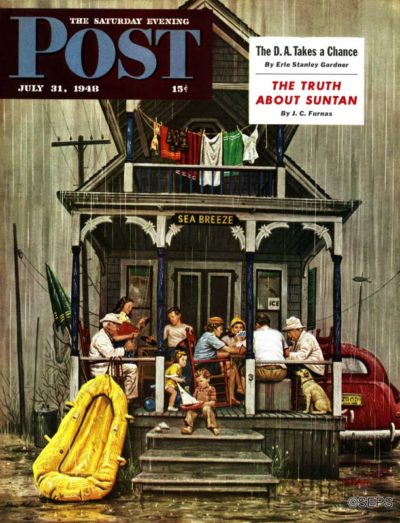
[From the editors of the July 31, 1948 issue of the Post] While most of the country was sitting around complaining about the rain, Stevan Dohanos was watching the sky anxiously, wondering if we would ever get over a stretch of good weather. He started this cover while taking a vacation in Martha’s Vineyard, Massachusetts. Friends posed for him, the sun was shining brightly. Dohanos went home to Westport, Connecticut, sure that whole summer would be fair. “I had a marvelous break,” he said. “It rained for three days straight. I could go out any hour of the day and get rain research.” He added gratefully that “one man’s nuisance is an artist’s gain.” We hope readers who get soaked will remember that while it may be raining rain to them, it is raining research to an artist.
Stevan Dohanos
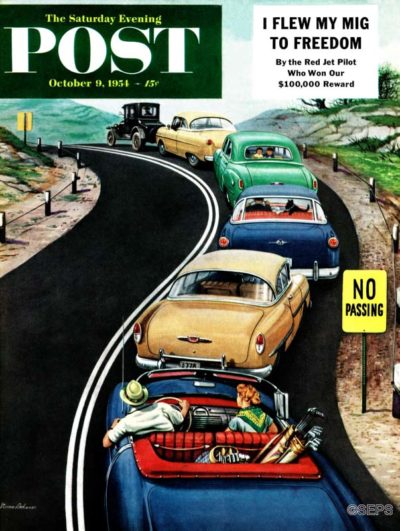
October 9, 1954
[From the editors of the October 9, 1954 issue of the Post] Grandpa and Grandma Chugchug, bless their elderly souls, are hurtling along on a holiday joyride. To which the subsequent motorists might well add, “And more power to them!” Oh, well, let the dammed-up itinerants repress their damns, for they’ll fetch loose in time, though not when the no-passing zone ends, for them fourteen vehicles will approach from the other direction. Now, who is right in this clash of desires: the people who want to get someplace, or the two who are where they want to get, out in the green land leisurely absorbing the beauty of the placid hills? Maybe both conditions have virtue—like the time Mr. Dohanos got stuck while trying to catch a train. He thought up that cover while awaiting the next train.
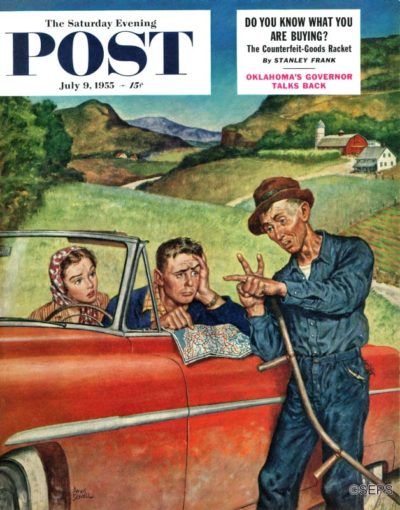
Amos Sewell
July 9, 1955
[From the editors of the July 9, 1955 issue of the Post] John J. Pathfinder is lost, and his wife is accompanying him. With the gallant pioneering instinct which has made America great, he took a short cut between Points A and B, and see what soul-soothing scenery he has found. The helpful scyther is telling him to turn cast beyond the second creek, then bear south just past a pasture of black and white cows, hut Pathfinder is still lost, having forgotten how Scyther said to get to the second creek. If he had heeded his wife’s counsel that short cuts tend to be long cuts, Mr. Sewell wouldn’t have had a cover; besides, men don’t do that anyway. Well, as lost souls wander in circles. Pathfinder probably will come out at Point A where he started, and won’t that send him into gales of laughter!
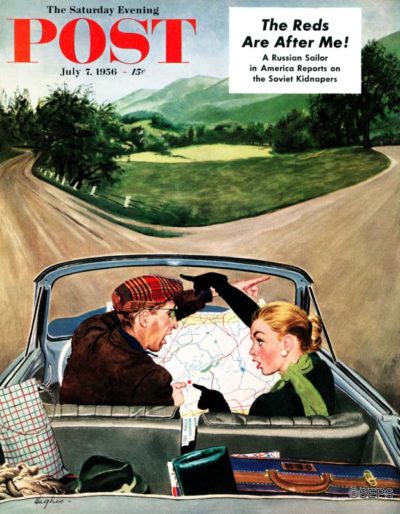
George Hughes
July 7, 1956
[From the editors of the July 7, 1956 issue of the Post] The way for a loving husband and wife to resolve a conflict like this is to toss a coin; then, when they find they are on the wrong road, both can talk to the coin, which has a phlegmatic personality and won’t care. Unhappily, one of these helpmates will prevail over the other; then, after the road proves wrong, conversation will be renewed, a total of two conflicts. Shouldn’t that man do the steering and let his wife navigate, in as much as nobody can think clearly under a cap like that? Anyway, let us hope that after they’ve been lost a while longer, they will see the drollery of their predicament, and laugh, and savor its humor, but this is a forlorn hope. As those people aren’t illustrator and Mrs. G. E. Hughes, what they are doing with G.E.H.’s suitcase is incomprehensible.
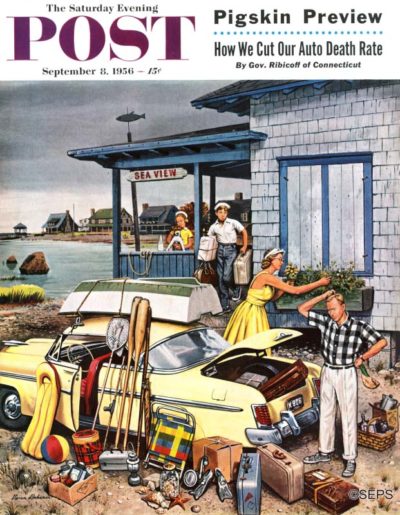
Stevan Dohanos
September 8, 1956
[From the September 9, 1956 issue of the Post] A vacation is wonderful, except to come home from. Well, pop, skip the head scratching; whisk the stuff in, and let’s go. Time’s a fleeting; 175 miles wend ahead on the road map; and if that sky isn’t cooking up an all-day precipitation, maybe there’ll only be a brief nor’easter with gusts up to fifty mph. When pop gets home, will he find his grass eight inches tall? That’s a mean, heartless thought, which is hereby withdrawn with apologies. Kind thought: happily it hasn’t occurred to mother that if she transplanted her flowers into peach baskets, they might bloom at home for many a day. Why doesn’t pop turn that boat over, dump all the debris in there, batten raincoats over it, and stop fooling with his head? Because then Steve Dohanos wouldn’t have a cover.
George Hughes
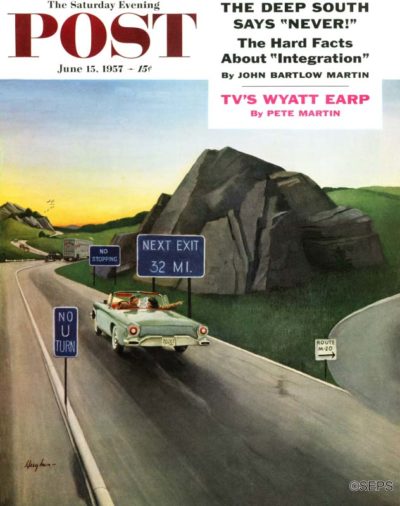
June 15, 1957
[From the editors of the June 15, 1957 issue of the post] High-speed pikes are wonderful inventions, except for a few bugs that need to be ironed out, such as exit signs moving by too fast. To go along with George Hughes’ trouble-making, let’s assume that Mr. and Mrs. Tripp ran low on petrol some miles ago, had to exit into the hinterland to raise a gas pump, and now are unfashionably late as guests at the home of Mr. and Mrs. Waite, away over that away via Route M-20. Should Mr. T. back up, thus enraging pilots of gasoline thunderbolts behind him, and mayhap landing himself a ticket? Should he, with keen regret, proceed ahead 32 miles? Or should he throw cautionary signs to the winds, turn right beyond the rocks, drive gallopy-gallopy across the greens ward, and beat it hell-for-rubber up old M-20? Real moot questions, eh?
Richard Sargent
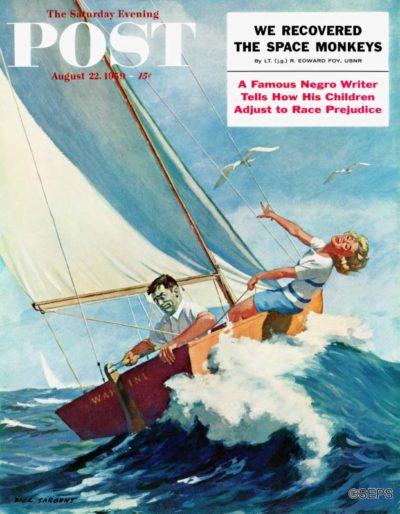
August 22, 1959
[From the editors of the August 22, 1959 issue of the Post] “A life on the ocean wave, a home on the rolling deep.” She is having the time of her life, but he is not at home there at all. Indeed, Mr. Tiller is not in good health, and the smartest tack he can take is to tell his lady fair he just remembered an important business appointment on shore. Artist Dick Sargent heartlessly churned up those waves to turn his man gray-green, for when Dick sketched a sailor on Long Island Sound, the water was humane, and the man looked fine—so did a pretty model who was with him. After they landed, the girl turned gray-green—and that’s a switch. Originally Mr. Tiller was located on the far side of that boat, but Sargent moved him for fear he’d tip the whole shebang over. Dick’s a good sailor; he didn’t get sick painting this.
John Falter
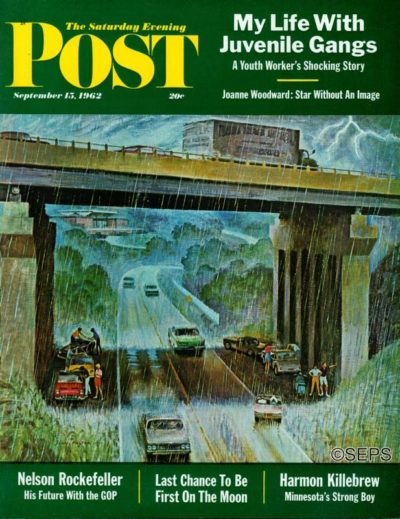
September 15, 1962
[From the editors of the September 15, 1962 issue of the Post] Part of the fun of owning a sports car stems from coping with minor inconveniences such as having to put up your top in a sudden rainstorm. Artist John Falter approached this “fun” with feeling. Once he owned a sports car himself—a 1947 English Singer Drop-Head Coupe with self-canceling trafficators. It wasn’t waterproof.
News of the Week: Punch Clocks, Pun Contests, and the Picking of Blueberries
Old Technology, Young Students
There are lots of ways for teachers to teach students about history. They can do it the usual way, through the reading of books and taking of tests, or through pop culture and even by showing students the history of food. Another way to do it is with technology, which is how Stephen Scully is doing it.
The Westford Academy teacher is letting his kids get hands-on with old technology to show them what the world was like before iPads and smartphones. The kids are using manual typewriters, rotary phones, punch clocks, inkwells, and even a German Enigma machine that teaches them about codes and World War II.
I think my favorite part of the story is that Scully plans to teach them about bomb shelters by packing them into the school’s janitor’s closet and have them eat freeze-dried food. Now that’s hands-on.
The World of Puns
Puns can be painful, but reading about them doesn’t have to be. Fast Company’s Joe Berkowitz has a new book out titled Away with Words: An Irreverent Tour through the World of Pun Competitions. I bet you didn’t even know there were “pun competitions,” but they exist. They range from the Punderdome (sigh) 3000 in Brooklyn, New York, to the O. Henry Pun-Off World Competition in Austin, Texas.
I guess there are competitions for everything.
The book’s title is a pun itself, a play on the phrase “a way with words.” Wordplay in the titles of books about puns and punning is so common — a quick search turned up The Pun Also Rises, Have a Little Pun, and It’s a Punderful Life — that I have to wonder if it might actually be a law, and whether there’s a special police farce to enforce it.
Olivia de Havilland vs. FX
I mentioned a few weeks ago that I was really enjoying Feud, the FX drama that looks at what went on behind-the-scenes of the Bette Davis/Joan Crawford movie Whatever Happened to Baby Jane? A lot of people like the series. Olivia de Havilland isn’t one of them.
The Gone with the Wind actress is suing the network and producer Ryan Murphy for how she is portrayed in the show. De Havilland is played by Catherine Zeta-Jones, and the real de Havilland doesn’t like how the network “appropriated Miss de Havilland’s name and identity and placed her in a false light to sensationalize the series and promote their own businesses.”
In other Olivia de Havilland news, she celebrated her 101st birthday on July 1.
How Do You Like Your Steak?
Well done. I like my steak well done. You have a problem with that?
I once had a friend look at me sideways with a shake of the head when I told him I liked my meat well done. He couldn’t understand how anyone could like their meat “burnt.” But here’s the funny thing about food: You like it the way you like it. It’s not “burnt” to me; it’s the way I think it tastes best. I’m not sure how people can think it’s okay to be the food police and dictate how you should prepare something. You even get it from cooks in restaurants (and I can testify to this because I worked in restaurants for several years), because cooks seem to know how their customers should eat their food.
I’m in the minority, though. According to data gathered from Longhorn Steakhouse from May 2016 to May 2017, most people like their steak cooked medium, followed by medium-well, medium-rare, well done, and then rare.
Americans eat 25 billion pounds of meat a year, a statistic that surprises me. And I bet most of that was consumed this past Tuesday.
RIP Skip Homeier, Barry Norman, Van Amburg, and Loren Janes
Skip Homeier was a veteran actor who started as a child under the name “Skippy” Homeier. He won acclaim in the stage and movie versions of Tomorrow, the World!, in which he played a Nazi youth who came to live with a family in the United States. He had roles in hundreds of movies and TV shows over the years. He died on June 25 at the age of 86, but his children announced his death just this week.
Barry Norman was an acclaimed movie critic and TV host in Britain. He hosted the BBC show Film for over a quarter century, wrote for The Guardian, The Observer, and The Times, and was the author of many books. He passed away last Friday at the age of 83.
If you lived in the Bay area in the 1970s and early ’80s, you know Van Amburg. He was considered the Walter Cronkite of the area, a solid, well-loved anchor for KGO-TV. He died on June 22 at the age of 86.
Loren Janes appeared in every single movie ever made. Okay, that’s an overstatement, but not by much. Janes was a stunt man who performed in hundreds and hundreds of movies, from 1955’s Jupiter’s Darling to 2002’s Spider-Man. He did stunts in many Steve McQueen films, including doubling for McQueen in the famous car chase in Bullitt. Janes died June 24 at the age of 85. Here’s his IMDb page for all of his credits.
This Week in History
Thomas Jefferson and John Adams Die (July 4, 1826)
That’s right, both Jefferson and Adams not only died on the same exact day, that day just happened to be the Fourth of July. Not odd enough for you? Well, both Jefferson and Adams were also born on the same day: October 30, 1735!
P.T. Barnum born (July 5, 1810)
The famous showman was well-known for the phrase “There’s a sucker born every minute,” which might be why you believed me when I said that Adams and Jefferson were born on the same day. (Jefferson was actually born on April 13, 1743.)
This Week in Saturday Evening Post History: “Fork in the Road” by George Hughes (July 7, 1956)
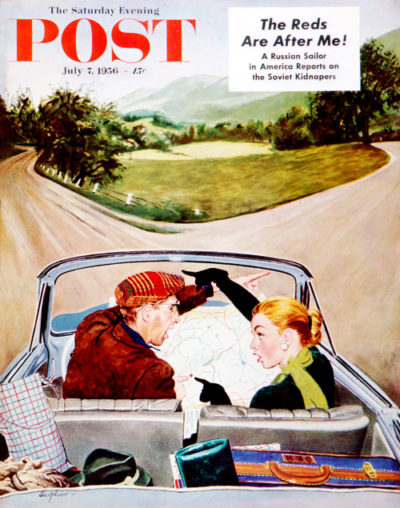
George Hughes
July 7, 1956
A lot of families are hitting the road for vacations this month, much like the couple in this George Hughes cover. Only today they wouldn’t be arguing over an unfolded map. More likely than not they would be yelling at the GPS voice about which way to go.
Pick Blueberries Day
Picking fruit is something I don’t think about. I know a lot of people go apple-picking in the fall, but the only picking I do is when I go to the supermarket and pick apples and oranges and blueberries out of the produce bins. (This paragraph makes you believe I eat a lot more fruit than I actually do.)
This Monday is Pick Blueberries Day. It’s probably way too hot where you are to eat hot soup, so how about this Special Chilled Blueberry Soup from Chef Scott Jenkins? Or if you don’t mind turning on your oven, you can make Blueberry Buckle or this Blueberry-Oatmeal Breakfast Cake.
And here’s Fats Domino singing “Blueberry Hill.” There aren’t enough blueberry songs.
Next Week’s Holidays and Events
Barbershop Music Appreciation Day (July 13)
This is one type of music that isn’t appreciated these days. The only time you hear it is if someone is making fun of it or performing it ironically. There should be a barbershop quartet supergroup, maybe with Bruno Mars and Justin Bieber. That would get barbershop music on the charts, and kids would download barbershop songs to their iPhones.
Bastille Day (July 14)
It marks the day in 1789 when the Bastille Prison in Paris fell. It became a national holiday in 1880.
Hack
I hadn’t seen Andrea in a while, but I hadn’t forgotten her. Sweet, gullible Andrea, like so many others before her. It had been four months exactly; I paid close attention to these time lines. I wasn’t supposed to run into her again for another two months, but there she was, working behind the counter at a new coffee shop in my neighborhood. I acted well under pressure, though. I pretended to be pleasantly surprised to see her, called her by the wrong name, and feigned interest in what she’d been up to. There was no precedent for this in my plan, but it might have been an improvement.
I had been enacting my little plans since time immemorial; I can’t even recall when it started. Sweet, gullible Andrea was the latest on the list. She’d never even know what hit her.
Our affair had been brief but passionate, as they all were. She was shy and quiet, and her low self-esteem made her grateful for my attention. We broke up about two years ago, a messy break-up, a confusing one, so that we wouldn’t keep in touch but she wouldn’t entirely hate me either. The only contact we had before the coffee shop was one random email I had sent her, something affiliated with her interests to garner a curious reply from her. I didn’t respond. That was last year, around Christmastime. The next step was scheduled for June, but I had to recalculate.
I took to social media, remarking how nice it was to see her again, to which she responded in kind. The perfect way to spark that interest again, make her curious about how I was doing without her and then wonder why all her pleasantries fell flat when I failed to reply again. She would remember my less than gentlemanly moments, and she’d go back to thinking about me only with a weird feeling of ambiguity.
Then the time came to nudge her with another email, a nice note about the spam I was getting from her address. Maybe her account was hacked? Of course the spam didn’t exist, but these girls were always so malleable. She was open to my instructions, just as I thought, following my well-intentioned advice to rectify the problem. Within the hour, Andrea changed her email password, and all her others, because of course she used the same one everywhere. And my little watchdog program caught the changes, recorded them, and opened up all those accounts as easily as she used to open her legs. I’d tap into them bit by bit, using them just as I pleased, burning my paper trails before moving on. She’d never suspect a thing, assuming my message came too late and some other random hacker was delving into her accounts. After all, I had just tried to help her. She’d never suspect a thing.
There was never much to leech, but it added up quickly, especially when wisely invested. A little bit here, a little bit there. Bit by bit, I could build myself an empire from all these bleeding, broken hearts. I was in it for the long haul; good things came to those who wait.
Hunched over my keyboard, monitoring the details of Andrea’s various accounts, it was easy to forget the world around me. In those numbers, I saw the past, remembering our time together with a faint smile. I may have been there all night if it hadn’t been for the arm that suddenly draped over my shoulder, a warm body pressing against me.
Irene.
Sweet, gullible Irene. I pulled myself away slowly, reluctantly, meeting her physical intrusion with a soft, inquiring hum. The glow of the computer screen cast her round face in an alluring light, a curtain of hair falling from her shoulder as she tilted her head.
“Whatcha doing?” she asked.
I reached over to turn off my monitor, showing her that I was ready to devote the whole of my attention to her. “Nothing much,” I said. When she smiled, wide and innocent, I smiled back. It started off as a feigned expression, but it was easy to infuse genuine warmth into it when I met her inquisitive gaze. “Just a little business, that’s all.”
Irene laughed, kissing me gently, then much less so. Her mouth was always so warm and welcoming, and I accepted her desperation happily. “You’re always working,” she said, sighing when she pulled away to catch her breath. “I wish I understood even half of what you do. All that technical stuff just makes my head swim.”
“Yeah, I know.” Patting the small of her back, I chuckled, my chest filling with the sense of pride that went along with everything falling into place. Irene and I were still a few steps away from the decline, my second favorite part of the whole cycle. In a few more weeks, I’d plant the first seeds of decay, the beginning of our destruction. We’ll stop talking, we’ll break up, a messy break-up, a confusing one, one where we wouldn’t keep in touch but she wouldn’t entirely hate me either. And then she’d get that random email, out of nowhere. Something pertaining to her interests, just enough to get her thoughts wheeling back to me. Maybe, considering how things went with Andrea, I might even have to drop in on Irene in a few years, out of the blue, just to remind her of my face, my smile, those lips that she so eagerly kissed, distracting me from all that baffling tech business.
Sweet, gullible Irene. Like so many others before her and so many more to come. “Come on, babe,” I said. “I think I’m ready for a break, anyway.”
I slipped out of my chair, reaching for her hand and guiding her away to the bedroom. The part of the plan I enjoyed almost as much as the money.
Almost.
Poor, sweet, gullible Irene. She’ll never even know what hit her.
8 Most Embarrassing Presidential Family Members
Some presidents have had the good luck to be surrounded by relatives who helped build their public image. Other presidents aren’t so lucky. They continually wonder what their wife, child, brother, or in-law will next do to poach the news cycle and embarrass the administration.
Here are eight presidential family members who proved more of a liability than an asset.
(The Metropolitan Museum of Art)
1. John Payne Todd, Dolly Madison’s son from her first marriage, seemed to have been trouble from the start. John was often jailed for assault, disturbing the peace, and “shooting incidents.” He also had a serious gambling problem that landed him in debtor’s prison until his stepfather, James Madison, bailed him out.
President Madison gave John a chance to prove himself when he sent the young man with a diplomatic team to Russia in 1812. Diplomacy didn’t interest Todd. Women did. He ceased contact with his parents and spent his time with a countess. When the diplomatic team moved on to Germany, Todd decided to go to Paris instead. For the next three months, he spent a fortune at restaurants, casinos, theaters, and other places of Parisian entertainment.
He came home in 1815 after staying a year in Europe without doing anything except piling up $10,000 in debt.
2. Mary Lincoln was a complex character. She undoubtedly helped promote Abraham’s career, prodding him to pursue higher offices and playing the hostess at party gatherings. But Mary also craved luxuries. In Springfield, Illinois, it might have been easy to control her spending, but when she and her husband arrived in Washington, things got out of hand. At a time when many Americans faced the hardships of life during the Civil War, she began an extensive redecoration of the White House, overspending her budget by 30%. She also blew a small fortune on her wardrobe and feared if her husband wasn’t re-elected, he’d have time to see her bills.
Insiders also claimed she stole from the White House. “Stealing was a sort of insanity in her,” said a lawyer who knew the family. She billed the government for materials she kept and even billed for a nonexistent employee so she could pocket the income.
Had Lincoln lived, she would have come under scrutiny for her lavish self-indulgence, but in the wake of the assassination, the country was ready to forgive her anything.
(Library of Congress)
3. It was clear to America that Alice Roosevelt was certainly the daughter of her impetuous, noisy, and attention-seeking father, Theodore. After arriving in Washington, she soon earned a reputation for her rebellious spirit, flirtatious manner, reckless behavior, and talent for shocking people. She smoked cigarettes in public and was seen placing bets with a bookie. Attending receptions in gowns of her own personal color, “Alice Blue,” she would flirt with men while her garter snake wriggled on her blouse. Far from being a gracious, sweet-tempered first daughter, she was witty or, as some said, she had “quite a mouth on her.” At parties, she would say to newcomers, “If you haven’t anything good to say about someone, come and sit by me.” After repeatedly walking in to the Oval Office to give her dad political advice, Teddy told an advisor, “I can either run the country or I can attend to Alice, but I cannot possibly do both.”


4. Brother to President Lyndon Johnson, Sam Houston Johnson had a problem with alcohol. It became Lyndon’s problem because brother Sam, when intoxicated, spoke freely with anyone, particularly reporters. After leaking confidential information once too often, Johnson brought Sam into the White House, which he was unable to leave without the Secret Service following him and his conversations.
5. Donald Nixon, Richard’s brother, had dreams of becoming a fast-food king. In 1957, with his hamburger stand in trouble, Donald borrowed $200,000 to shore up his business. The lender was Howard Hughes, a major defense contractor. Richard Nixon had trouble convincing anyone that he, then vice-president, had not traded favors with Hughes for the loan. During the Watergate investigation, investigators learned that Donald had been a conduit for illegal campaign contributions to Richard. Yet Richard didn’t trust his brother and ordered the Secret Service to monitor Donald’s phone calls.

6. Probably no brother caused a president more embarrassment than Billy Carter, who was nearly the complete opposite of his brother, Jimmy. Billy was a beer drinker of Olympian status who was always available to the press for a regrettable comment, or shameful behavior, like public urination at the Atlanta airport. His fame for beer consumption led a brewer to create Billy Beer. The brewer soon went bankrupt. To raise money, Billy opened his own diplomatic relations with Libya, hosting Libyan officials while they visited the U.S. Two years later, the Justice Department discovered the Billy was a paid lobbyist for the Muammar Gadaffi’s government and had accepted nearly a quarter million dollars for his services.
7. Roger Clinton Jr. is Bill Clinton’s half-brother but a complete embarrassment. When Bill was Arkansas’ governor in the 1980s, Roger served a year in prison for dealing cocaine. When Bill was president, Roger spent much of his time vainly striving to become a rock singer or movie star. (You may not remember him from such films as Pumpkinhead II: Blood Wings, Spy Hard, and Bio-Dome.) As Bill neared the end of his presidency, Roger was also under FBI investigation for allegedly accepting money to get brother Bill to pardon six drug felons. Fortunately, Bill pardoned Roger’s drug conviction before he left office. Unfortunately, Roger was arrested for DUI one month later.
8. And then, there’s Neil Bush, son of one president, brother to another. He was accused of insider trading and selling his influence with presidential relatives. While brother George was president, he received $2 million in stock and $10,000 every time he attended a board meeting at Grace Semiconductor. Since Neil admitted he knew nothing about semiconductors, it was believed that Grace had hired him to influence his presidential relatives.But he is perhaps best remembered for his connection to Silverado Savings and Loan. After it collapsed in the late 1980s, Silverado was taken over by the government, which arranged a $1 billion bailout. Neil was eventually charged by the FDIC with negligence and conflict of interest and required to pay a $50,000 fine. He was also banned from the banking industry.
Featured image: Alice Roosevelt Longworth, daughter of Theodore Roosevelt, launching the USS Theodore Roosevelt on October 3, 1959. (U.S. Navy)
Top 10 Summer Reads for 2017
Every month, Amazon staffers sift through hundreds of new books searching for gems. Here’s what they chose especially for Post readers this summer.
Fiction

The Late Show
by Michael Connelly
It’s not often that you have the opportunity to get in on the ground floor of a new series by a proven author. Connelly’s latest novel introduces Renée Ballard an LAPD cop who works the tough night shift known as “the late show.”
Little, Brown, and Co.
The Lying Game
by Ruth Ware
Ware has proven her caliber as a writer of eerie, compelling thrillers with The Woman in Cabin 10 and In a Dark, Dark Wood. In her new novel, four women are brought together on coastal England following a grisly discovery.
Gallery/Scout Press
See What I Have Done
by Sarah Schmidt
Axe-murderer Lizzie Borden gets the literary treatment in a novel that shifts perspectives between four characters, including Lizzie, and slowly reveals the events leading up to one brutal act.
Atlantic Monthly Press

The Hidden Light of Northern Fires
by Daren Wang
During the Civil War, escaped slave Joe Bell collapses in a secessionist town north of the Mason-Dixon Line in a barn owned by Mary Willis’ father. The event connects Mary an Joe as the country tears itself apart around them.
Thomas Dunne Books
Nonfiction
Woolly
by Ben Mezrich
Can we create our own version of Jurassic Park? That’s the real-life question that Mezrich explores as he follows a team of American geneticists, a genius Russian scientist, and a famous conservationist who are trying to bring herds of mammoths back to the planet.
Altria

Jane Austen at Home
by Lucy Worsley
On the eve of the 200th anniversary of Jane Austen’s death, historian Worsley revisits the many homes and schools that Austen inhabited during her life, describing how they helped shape her as a person and a novelist.
St. Martin’s Press

Everything All at Once
by Bill Nye
Nye has been driven his entire life by a relentless curiosity. In his new book, he explains how he has harnessed his inquisitiveness to change his own life, and how you can do the same for your life and for the world around you.
Rodale
Reading with Patrick
by Michelle Kuo
After two years in rural Arkansas as a Teach for America volunteer, Kuo left, but she returned when a former student was jailed for murder. The result is a beautiful story of race, love, and education.
Random House
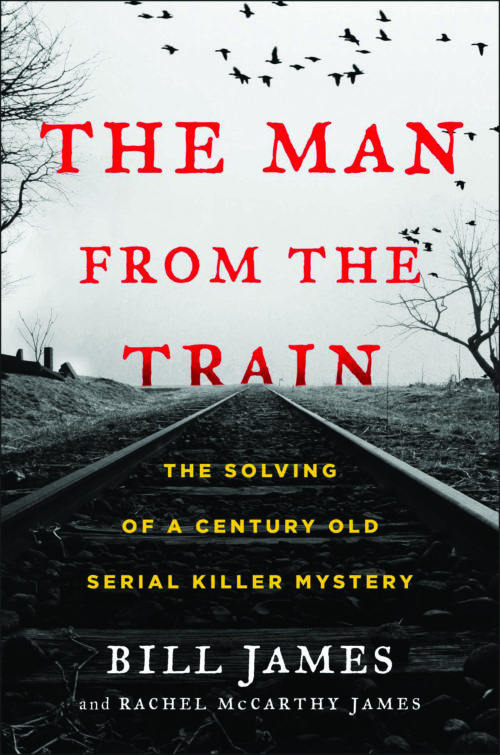
The Man from the Train
by Bill James
A statistician and baseball writer studies a series of unsolved murders and, using his analytical skills, uncovers the connection that eventually reveal the identity of one of America’s deadliest serial killers.
Scribner
North Country Girl: Chapter 7 — We Have Ice Cream in the Fridge
For more about Gay Haubner’s life in the North Country, read the other chapters in her serialized memoir. The Post will publish a new segment each week.
TV, board games and toys, and school were indoor activities. But year-round, with the exception of raging blizzards, my mother ordered me to put down my book and go “play outside.” We had enough kids on Lakeview and Vermillion for a good game of Spud (very few cars went down our single-block-long street) or freeze tag. I had a particular fondness for “Mother May I;” little prig that I was, I delighted in sending kids back who forgot to ask permission. “Red Light, Green Light” was too prone to cheating, and always ended up as “I saw you move!” (a lie) countered by “I didn’t move!” (another lie). Once a summer, the ice cream truck magically found its way to our block to interrupt our street games, and I would lose my mind with desire for a Nutty Buddy only to by informed by my mother that if I wanted ice cream we had some in the fridge.
My mom was stingy with treats, doling them out occasionally and always one at a time. Each year we went to the Norshor theater to see the annual Disney feature, missing only “Bon Voyage” as it was condemned by the Catholic church for having a scene where the harried American dad is accosted by a Parisian hooker. Going to the movies was treat enough. Getting popcorn or Junior Mints from the snack bar would be gilding the lily.
It was the same at the Northland Country Club pool. Once in a great while I would be allowed to buy a frozen Snickers or Milky Way at the snack bar, at the exorbitant price of fifteen cents, five cents more than the going rate. Mostly we arrived at the pool after lunch and were forced to exist on grapes from home. But once or twice a summer my mom, my sister Lani, and I would sit up on Northland’s gracious veranda, looking out over the pool and first tee, and order divine hamburgers and golden French fries with brown crispy ends. I would slather everything on my plate with ketchup; Lani would leave most of her food for my mom and I to finish up. I later found out that my mom was afraid my dad would be mad about her minor country club charges; he was too busy losing hundreds of dollars in the never-ending Northland poker game to even notice our once a month lunches on the bill.
We were allowed hot chocolate when skiing at tiny Mount du Lac, but that bordered on a life saving measure when we came out of the zero degree cold with soggy wool mittens and frozen-over ski boot laces. The Mount du Lac “chalet” was a squat square concrete building, with window seats overlooking the three ski slopes (beginner, with the jerky tow rope that yanked me forward, landing face in the snow; intermediate, with the impossible to balance T-bar that dumped me on my back; and advanced, where I never managed to set ski on). The chalet had a jukebox and a pinball table, both of which I was dying to play (probably to postpone my return outside). Putting a dime in either of these machines was regarded by my mom as the height of wastefulness. When I finally got to play pinball, with my own dime, I was astonished at how quickly and surely the silver balls tumbled to the bottom and down the hole, failing to set off even a single bell of pinball success.
Why anyone would put money in a jukebox baffled my mother. “You can hear the same songs for free on the radio!” Pinball was even worse in her eyes: not only did you throw away a dime that could have bought an ice cream cone, candy bar, or bottle of pop, your brain cells curled up and died when you played such a stupid game.
Since all my mother’s efforts to transform me into the outgoing, cute, popular girl that she had been had failed, my mother turned her attention to protecting and improving my one asset, my smarts. She regarded comic books (except for the tedious Classics Illustrated) and Mad magazine as insidious destroyers of children’s intelligence: “If you read comics it will make you so stupid you won’t be able to read anything else.” I couldn’t get enough of that forbidden fruit. A neighbor girl stopped asking me over to play because I could not be budged from her older brother’s breathtaking collection of Mad magazines.
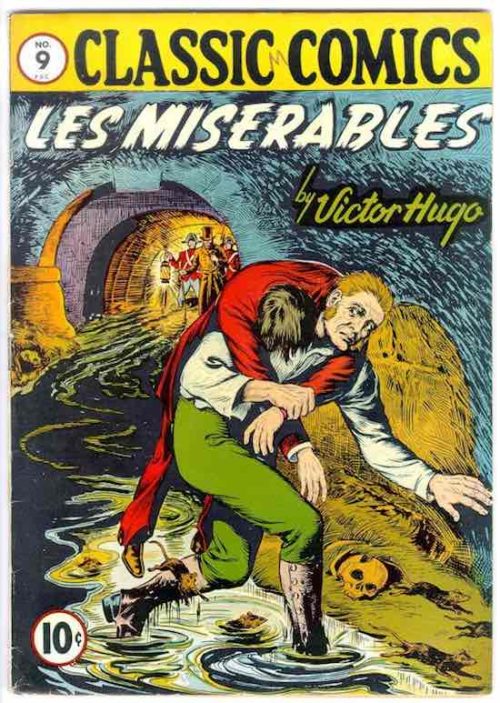
My preferred reading was definitely lowbrow, but I would read anything. When I ran out of library books, I resorted to our World Book Encyclopedia, or the lavishly and gorily illustrated children’s bible (heavy on the Old Testament) that somehow washed up on our living room bookshelf. There were also a few ancient children’s books that I read over and over: The Story of Live Dolls, The King of the Golden River, The Five Little Peppers, and Alice’s adventures both in Wonderland and through the Looking Glass. Eventually my mother realized that I was not to be bullied off of the couch and into the clique of popular Congdon Elementary girls. If I was going to have my nose in a book every waking hour, it should be a book that would improve my mind.
One glorious day I came home from school and found a brown box from the Classics Book Club addressed to me. Getting anything in the mail with your name on it was thrilling. I had long pleaded for my own subscription to Highlights for Children just for that reason, but that was not going to happen while my father could bring home the torn, scribbled-on old Highlights from his office. Inside this book-shaped box was a book, Shakespeare’s Comedies, the plays printed in mouse type on tissue thin paper nicely bound in gilded imitation leather. I started right in on The Tempest, reading the Miranda part out loud and understanding maybe a tenth of what was going on.
The next month brought the Tragedies. I had figured out how to skip the boring parts of the plays, which were everything except the lead female role: I dragged my finger down the page until I found lines for Juliet and Cleopatra and Ophelia, which I declaimed aloud from my sofa stage. The following month the Histories arrived which I barely cracked. Henry, Henry, Henry. Where were the good female roles?
Then came the dunning letters. Which were also addressed to me. My mother had thoughtfully put the subscription to the Classic Book Club in my name, but she had never bothered to pay for it. According to them, I owed $36.00 and my membership would be revoked and I would never receive the next book in the series — Plato’s Republic— unless they received payment in ten days. Where was I going to get the astounding sum of $36? I went to my mother in tears. She looked at the letter, crumpled it up, and tossed it in the garbage. Even more than she hated wasting money, my mother loved getting something for nothing; we had the books already, so why pay for them? But the letters kept coming, informing Miss Gay Haubner that the Classics Book Club was about to take legal action to recoup their money. For months, I expected someone to show up at the door and arrest me.
A President’s Secret Operation, Discovered 24 Years Later
One hundred years ago today, a U.S. president had major surgery on his jaw for cancer. He successfully hid that fact for 24 years.
In 1893, the U.S. economy was sliding into a depression. Panicked, the country looked to its new president, Grover Cleveland, to see what he’d do. His Democratic supporters believed he could minimize losses by ending the Treasury’s policy of purchasing silver, which was fueling a run on gold.
“Mr. Cleveland is about all that stands between this country and absolute disaster,” wrote one financial editor, “and his death would be a great calamity.”
What that editor didn’t know was how close President Cleveland had been to death. When a Philadelphia paper reported that doctors had had secretly performed surgery on the president for a cancer of the jaw on July 1, 1893, the story was met with widespread doubt. The story was dismissed as another false alarm about cancer. It was also interpreted as a fake news story planted by supporters of the silver-purchasing program.
Two months after the surgery, the president seemed in excellent health. He was travelling, giving speeches, and showing no signs of weakness.
President Cleveland went on to halt the Treasury purchasing of silver, finish his term, lose re-election, run again four years later, and win back the presidency.
He lived another 15 years beyond the reported surgery—a surprisingly long time for a cancer survivor in those days.
Questions about the surgery remained unanswered for 24 years, until the Post ran a confirming story by one of the attending physicians. “The Surgical Operations on President Cleveland in 1893” from our September 22, 1917, issue, gave details of the procedure, which was performed on a yacht off the shore of Long Island. The operation described by the author, Dr. Keen, involved the removal of large section of the jaw and even parts of the skull.
But by 1917, the politics of silver and the depression of 1893 were far in the past. Americans were now focused on the world war they’d just entered.
Shorn of its political implication, and supported by the Post’s credibility, the story was generally accepted as true at last.
Featured image: Illustration of Grover Cleveland from The Saturday Evening Post
9 Fireworks Facts to Blow Your Mind
1. The color of a firework is determined by the elements present. Iron creates golden hues, Lithium produces red, and copper is used to achieve the elusive blue. Chemical compounds are combined with fuels and oxidizers to give a breathtaking splash of color in the sky that is really just idiosyncratic air pollution.
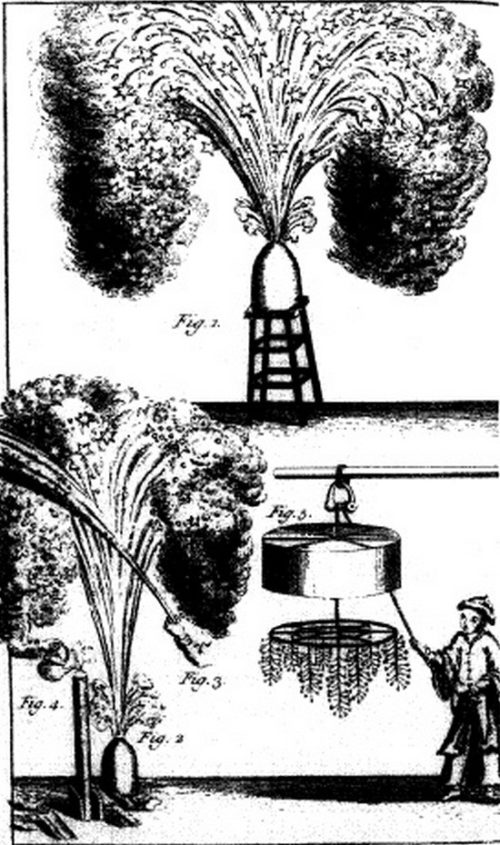
2. Unsurprisingly, the first fireworks were ignited in China between 600 and 900 A.D. These early pyrotechnics were bamboo shoots stuffed with saltpeter, charcoal, and sulfur, and they were probably used to ward off evil spirits and bring good luck to the igniter. Although this ancient Chinese secret spread to the West in no time, China is still the world leader in production of fireworks.
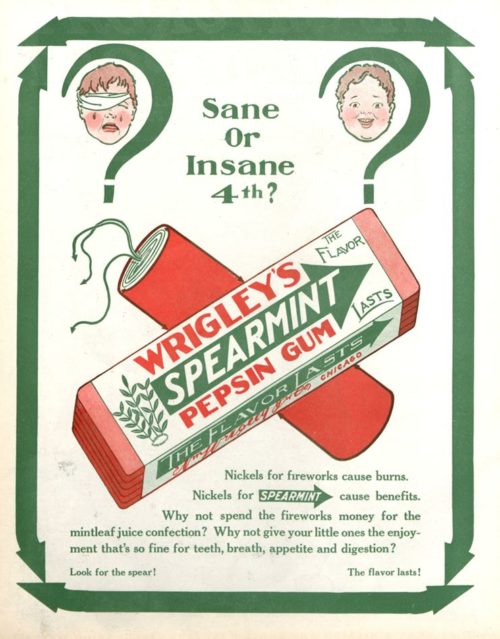
3. 2015 saw the most American firework-related injuries that resulted in emergency room visits so far in the new millennium – about 11,900. Only about one percent of those injuries were sustained by people 65 years old and up.

4. Sparklers can burn at 2,000 degrees Fahrenheit. It is cute to use camera effects to spell a sentiment or draw a smiley with the things, but perhaps it would be wise to exercise discernment before handing a child what amounts to a blow torch.
5. Dogs and anxious people alike can take refuge in Delaware, Massachusetts, and New Jersey. These three states ban the sale of all consumer fireworks.
6. Fireworks are used to celebrate different holidays around the world. In the United Kingdom, Guy Fawkes Night is celebrated on November 5th with pyrotechnic shows. Bastille Day in France — July 14th — sees the Eiffel Tower illuminated with an explosive display as well.
7. The world’s largest fireworks display took place during a downpour. 810,904 fireworks were set off at New Year celebrations in Ciudad de Victoria Bocaue Bulacan, Philippines on January 1, 2016. This record is sure to change as soon as another location decides to take the title. Previous record-holders include Norway and Dubai.
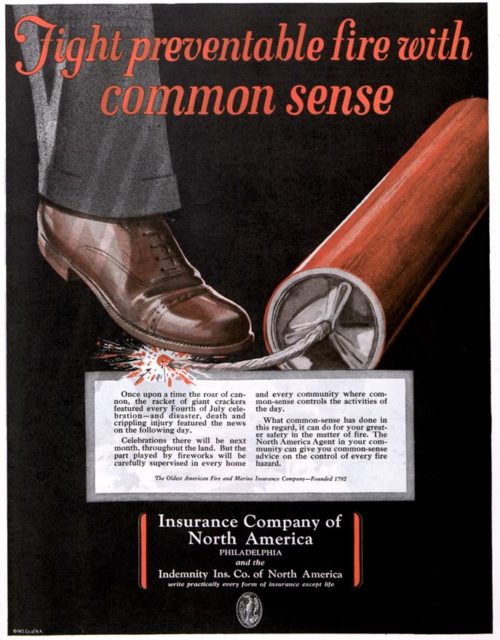
8. Consumer fireworks have really taken off in the 21st Century. In weight, we’re blowing up more than double what we did in 2000: about 244 million pounds in 2016.
9. The first Independence Day in 1777 saw fireworks in Philadelphia and Boston. John Adams, in a letter to his wife in 1776, predicted that July 2nd would be a celebrated holiday, with “illuminations from one end of this continent to the other from this time forward forever more.” Although Adams was two days off, he was dead on in regards to nationwide “illuminations” that seem to grow brighter each year.
The Time the Johnsons’ House Caught Fire
When the Johnsons’ house caught fire — the second time that day — the entire neighborhood came to watch. The disquieting mass of black smoke that billowed from the top floor of the Tudor, with its gable roofs and timber framing, was a bleak beacon that summoned the residents of Birchwood Village to gather together. And gather together they did — a stray few at first, folks already on their constitutionals, after supper, around 7, on such an otherwise pleasant mid-April evening, curious as to what that rolling dark cloud was. Then, as word spread, and the suffocating dense smell of burnt, just burnt, blanketed the area, more and more people arrived, and more after that, and even more, and more still, until eventually nearly everyone had emptied from their homes, with screen doors smacking, light sweaters thrown on, stumbling into flip-flops and sneakers, jumping onto bikes, pushing baby strollers, pulling at yipping dogs on leashes, excited chattering, nervous murmuring. All of Birchwood Village turned out that day when the Johnsons’ house caught fire a second time.
The first question among the burgeoning group of looky-loos was whose house was it? because surely it couldn’t be the Johnsons’ house. Not again. Those poor Johnsons. Their house had already caught fire earlier in the afternoon, witnessed then by only a fraction of those who were streaming toward it now — mostly stay-at-home moms, and retirees, and a scattering of others who for whatever reasons had no particular place to be in the middle of the day, 2:30-ish. Of course no one wanted it to be the Johnsons’ house, not again, those poor Johnsons, but if it wasn’t the Johnsons’ house that was on fire, whose house was it, and did that mean there was a serial arsonist on the loose burning down houses one after the next?
Fortunately, although not so much for the Johnsons — in fact, it was downright unfortunate for the Johnsons — the house on fire was indeed the Johnsons’ and twice today of all things. Those poor, poor Johnsons. On the bright side, if there was one, as soon as the residents began to gather together, so too did the first responders — or would they be considered second responders under the circumstances, this being their second trip to the Johnsons’ house within the span of only hours? Three shiny red fire trucks from the nearby districts of St. Martins, Chester Hills, and Limerock burst onto the scene, along with a Metro ambulance, a Metro police cruiser, and police cruisers from the other nearby districts of Ridgeland and Rollingway. There was even some guy who came screeching up in a Jeep, narrowly avoiding the Thingstons’ empty recycling bin that they were always dilatory in retrieving from the curb, outfitted in what looked to be his very own firefighting gear — no doubt a volunteer who had heard the call on his scanner.
It quickly became quite an event, with the jumbled pattern of asynchronous flashing lights from the various vehicles, and the bustle and ruckus as the first responders — or were they second responders? — darted to their designated positions. Two burly firefighters lumbered down from the Limerock fire truck and went to work unspooling the thick yellow hose and connecting it to the hydrant that stood at attention at the intersection of Swan and Forest. That hydrant had been there for as long as anyone could remember, although no one could remember when it had been used last — most considered it merely decorative, akin to the flower beds at the four corners that sprouted blooms of fuchsia and deep purple — and yet here that hydrant was used twice today. A couple other firefighters grabbed the other end of the hose and ran off with it in the opposite direction, making a beeline for the Johnsons’ house. When the hose inflated, which Mary Ellen Pomeroy later complained had caused an alarming drop in the water pressure to her kitchen sink while she was doing the dishes, one especially brave firefighter, slight of build, wrestled with the nozzle to direct the powerful jet of water in the general vicinity of the volatile amalgam of bright orange and yellow and crimson flames that lapped away at the second story.
The neighbors stood in awe, mouths agape, hands on hips or chins, while the mission to save what remained of the Johnsons’ house proceeded with military precision. Some debated what part of the house that was, consumed by the blaze, wondering aloud if maybe it was the master bedroom as many of these older homes, and the Johnsons’ house was probably built in the ’40s like most of the other homes on the block, had their masters on the top floor. Others opined that it could have been the study for shelves crammed full of musty dusty books would most assuredly ignite as instantaneously as this fire had. And others questioned if the Johnson children were still young enough for a playroom and, if so, was that where it was — those poor Johnson children losing their playroom in such a jarring manner. Since none of those involved in the discussion had actually ever stepped inside the Johnsons’ house, the issue as to the specific location of the inferno therein, while intensely debated, ultimately remained unresolved.
Another, and not unrelated, topic of conversation, and one that should have properly been the primary concern, was where were the Johnsons anyway? There had been vague speculations but, as with the previous topic, no definitive conclusion. Ted Robinson, a DJ for the local public radio station who hosted a program of blues standards during the overnight shift from 11 to 3, postulated that Mr. Johnson, an attorney for a prominent personal injury firm who typically pulled late hours, was at work. Ted then tried to lighten the mood, as he was apt to do on his radio program according to those insomniacs and blues standards aficionados in the crowd who tuned in from time to time, by cracking a joke based on the premise that Mr. Johnson, like a lot of the lawyers in town, had his office in the tower on Market Street that many thought resembled a penis. But Mrs. Shuttleford, who did not suffer fools gladly and who, at age 88, prided in cutting her grass herself, and with a push mower, stopped Ted before he could reach the punch line, scolding that such bawdy humor was wholly inappropriate, with the whereabouts of the Johnsons largely unknown.
It was around then when one of the police officers, the police officer from Ridgeland who was contracted out by Birchwood Village to patrol the streets in his off-hours to curtail any shenanigans and suspicious activity and, of particular import, to make certain that members of the Wheelmen (and Wheelwomen) Cycling Club obeyed the traffic laws when they pedaled through the neighborhood on their weekend group rides, overhearing the conversation, interjected that everyone in the Johnson household was accounted for, having all absconded to Mrs. Johnson’s mother’s house in Butchertown after the first fire and not returned. With that bit of relief, Ted tried to retell his joke about the “irony” of lawyers working in an office tower that resembled a penis, but the moment had passed, and he gave it only a half-hearted attempt before sulking away to ready for his overnight shift — whatever that entailed, perhaps putting on a fresh shirt — playing blues standards from 11 to 3 on the local public radio station.
After 45 minutes, give or take as no one was minding the time, too engrossed by the hubbub, the firefighters appeared to have the fire well under control, save for some stray, dangling ribbons of soot curling and dribbling from the second-floor windows. The flames of bright orange and yellow and crimson had been extinguished and in their stead a soggy, dripping mess. Nonetheless, people continued to drop by, to have a peek, to see what was what, lingering about in front of the Johnsons’ house and on the lawns of the houses across from it. Young Billy Milner, an enterprising 10-year-old who already had his summer buzz cut even though school did not let out for the summer for another month, took advantage of the situation, as he lived in one of those houses across from the Johnsons’ where people were lingering, and set up a lemonade stand fashioned from a stack of TV trays he carried from his father’s rec room in the basement. Young Billy charged 50 cents for a Dixie cup of store-bought lemonade he precariously poured with two hands from a plastic gallon jug he snuck from the fridge. Mrs. Patterson, who lived next door to the Milners in a quaint Cape Code she shared with her ill-tempered — although some referred to the animal as simply plain hateful — Maltese, Koukla, mingled about with a platter of homemade chocolate chip cookies and a straw basket of her grandchildren’s leftover Easter candy, mainly loose jelly beans and malted milk eggs, which she offered gratis, and those were snatched up and gobbled down with haste.
Before long this gathering of concerned — if not concerned, certainly inquisitive — citizens escalated into a full-blown block party, even while the Johnsons’ house barely smoldered and the two burly firefighters had begun to respool their thick yellow hose and pack it away with the rest of their equipment. Beach chairs and blankets had been set about, people lounged and relaxed. A group of renters who shared a two-bedroom suite at the Stonemill Apartments at the end of Blanchard next to the park, with their shoulder-length hair and bushy beards and, observed Mrs. Shuttleford, “all sorts of tattoos — just everywhere,” showed up with their guitars and bongo drums and tambourines and staged an impromptu concert, singing songs no one had heard of, but no one seemed to mind either. Even Mrs. Shuttleford tapped her feet in rhythm. The starting lineup of the St. Martins Dragons, the reigning regional Little League champs, returning from practice at the field where the old Sears used to be, played games of run-down and pepper next to the Baxters’ white ranch that sat on the corner. A circle of college students, on a break from studying for finals, kicked around a hacky sack, and Old Man Williams brought out his bocce balls, and he never brought out his bocce balls before Memorial Day.
This kept on as the sun set and night approached. Gasoline generators were revved and throttled to power industrial-sized flood lamps so the firefighters could check for hot spots and structural instability. Cast in that harsh, artificial light, with shadows angled in jagged shapes, the Johnsons’ house was a shell of what it had been, a wooden cut-out backdrop from a movie set. One of the firefighters made his way into the attic and started cutting away at the roof with a chainsaw to ventilate the inside. The low dim humming of that chainsaw melted into white noise as attention to the Johnsons’ house waned. People had split and divided into groups and clusters to discuss sports and politics and current events, rumors and innuendo, to exchange business cards and recipes and the names and phone numbers of babysitters and handymen, to generally chuckle and guffaw and shoot the breeze.
Chip Caruthers, cradling his sleeping infant son, Chip Junior, tightly against his chest as he rocked slightly back and forth, to the requisite oohs and aahs of those he approached, including the police officer from Chester Hills, a stern individual who offered an uncharacteristic albeit heartfelt coochie-coochie-coo to the boy, remarked how this was better attended than the Fourth of July cookout held each summer on the grounds of the Birchwood Village Church. Everyone laughed and agreed because it was one of those funny comments that was also true. Then Tom Canari, the self-proclaimed “high roller” who would boast of frequenting the casino across the river for private games of baccarat cordoned off from the general public by a velour rope, added how “we should do this more often,” which was met with a very awkward and stilted silence until he clarified, “without the two fires to the Johnsons’ house of course.” Folks agreed, but the response was still tepid as no one much cared for Tom Canari as he was rather full of himself.
By about 10, the police cruisers and the ambulance and all but one of the fire trucks — the firefighters from Limerock lagging behind to keep an eye out for hot spots — had gone, as had most of the people. It was, after all, a weeknight. There were a few stragglers, those who for whatever reasons had no particular place to be and did not need to wake up early in the morning. A 20-something couple no one could place kissed passionately beneath the weeping willow in Mrs. Patterson’s yard, much to the consternation of her hateful Maltese, Koukla, who barked at them incessantly from inside the house through the living room window until Mrs. Patterson drew the shades. Some people planned to meet up sometime for lunch, or for cards, or just promised to “see ya around.” There was talk of bringing casseroles and salad and a cold-cut platter from the Kroger deli to the Johnsons, with an assortment of desserts — pies and cobblers and seasonal berries — and maybe some clothes and toys for their children as soon as it was ascertained how old their children were. In any event, all promised to check in on the Johnsons since that was the neighborly thing to do.
And at the end, everyone returned to their homes, and retreated silently inside, to do whatever it was they normally did when there wasn’t such a commotion, and Birchwood Village settled down once more, and everything went back to how it had been, except for the Johnsons, those poor Johnsons, the time their house caught fire, the second time that day.
News of the Week: McEnroe’s Comments, Martha the Dog, and the Man Who Predicted Selfies
Serena Williams vs. John McEnroe
John McEnroe is known for saying things. He used to be known for yelling things, but he’s quieter now, though probably no less opinionated.
During an interview with NPR about his new memoir, But Seriously, the 7-time Grand Slam Singles winner said that if 23-time Grand Slam Singles winner Serena Williams played with male tennis players, she probably wouldn’t be in the top 700. Of course, this is the part of the interview that everyone has latched onto — which is probably good for book sales — and it got a reaction from Serena herself on Twitter (where everyone releases official statements now, apparently).
Dear John, I adore and respect you but please please keep me out of your statements that are not factually based.
— Serena Williams (@serenawilliams) June 26, 2017
I've never played anyone ranked "there" nor do I have time. Respect me and my privacy as I'm trying to have a baby. Good day sir
— Serena Williams (@serenawilliams) June 26, 2017
Serena gets points for using the phrase “Good day, sir.” We need to use that more.
Now, to be fair to McEnroe, it’s not like he brought this up out of the blue to insult Serena. He simply said during the interview that Serena Williams was the best female tennis player of all-time (in fact, he has said that Serena is one of the best athletes in history, period), and the interviewer asked him why he had to say “female” and not just “best” including men. What an odd thing to ask. Men and women are different (I realized this the first time I went to the beach) and that also extends to professional sports, too. Why can’t we talk about how good or bad an athlete is by separating them into different categories when the very sports themselves separate them?
Even Serena (and it’s funny how we simply call her by her first name, that’s how iconic she is) said during an interview with David Letterman that she couldn’t beat a man, someone like Andy Murray, because the women’s game is different than the men’s game. Men are stronger and faster. So I don’t think we can say that McEnroe is “wrong,” and he certainly wasn’t being misogynistic.
I do take issue with the number 700 though. She wouldn’t have a chance against someone ranked so low that nobody knows who he is? With her serve and mental strength, I bet she’d be in the match.
And the World’s Ugliest Dog Is …
There seems to be two types of dogs that compete in the World’s Ugliest Dog contest in Petaluma, California, every year. They’re either big and slobbering or goofy or small and, well, rat-like. This year’s winner is Martha, a 3-year-old Neapolitan Mastiff that weighs 125 pounds and clearly falls into the former category.
Come on, she’s not really ugly, she’s just … droopy.
RIP Gabe Pressman, Michael Bond, and Michael Nyqvist
Gabe Pressman was a legend of New York news, starting out his six-decade career at several newspapers, including the Newark Evening Sun and New York World Telegram and Sun before moving on to a long TV career at WNBC in New York. Except for eight years in the 1970s where he worked for WNEW, he was with WNBC from 1956 until his death. The Emmy-winning journalist died last Friday at the age of 93.
Michael Bond was the author who created Paddington Bear. He also was the author of a series of novels featuring Detective Monsieuer Pamplemousse. Bond died earlier this week at the age of 91.
Michael Nyqvist was so good at playing the bad guy, in movies like Mission: Impossible — Ghost Protocol and John Wick. He also played the lead in the Swedish Girl with the Dragon Tattoo movies and appeared in a cool sci-fi ABC show a few years ago, Zero Hour, that really should have lasted longer. He died Tuesday at the age of 56.
World Asteroid Day

It’s funny how we go about our lives and hardly ever think about what’s going on in the skies above us. I don’t want to alarm anyone, but there’s a chance an asteroid could hit us.
Today is World Asteroid Day, which is a good day for scientists and world leaders to think about doing something about the problem. NASA actually has a Planetary Defense Coordination Office, which sounds like an organization from a sci-fi movie. Last December a NASA scientist warned that the world really isn’t 100 percent ready for an asteroid or comet hitting our planet, though we are getting better at it. It’s probably best not to think about it.
In related news, CBS’s Salvation, a new summer series about a group of scientists who band together to stop an asteroid from hitting the earth, premieres on July 12. Perhaps you’ve seen one of the 50,000 commercials for it that the network has been running every day for the past two months?
People Really Dig Salvador Dali
It doesn’t seem fair to have no control of your body after you die. There you are, in the ground resting, your life on Earth over and done with, and all of a sudden people are digging you up and bringing your body back to the surface so they can examine it.
That’s what’s happening to surrealist artist Salvador Dali, whose body is going to be exhumed by order of a Spanish judge to settle a paternity suit brought by a woman who claims to be his daughter. The woman says that Dali had an affair with her mother, who worked as a nanny near Dali’s home.
Dali’s estate is worth hundreds of millions of dollars, but the woman says it isn’t about the money, it’s about finding out who she is and revealing the truth for her mother.
The Best Game Shows of All-Time
Well, look at this: an internet list that isn’t terrible.
Newsday has picked the 25 best game show of all-time, and it’s really a well-balanced list. Yes, I could argue — and I will argue — that shows like Love Connection, Deal or No Deal, and The Dating Game don’t deserve to be on any kind of best game show list, I’m impressed that most of the list is taken up by truly great, classic shows like The Price Is Right, To Tell The Truth, Password, The $64,000 Question, Jeopardy, Wheel of Fortune, and What’s My Line?
To replace the shows that shouldn’t be on the list I’d probably add Remote Control, Tic Tac Dough, Truth or Consequences, Scrabble, maybe Blockbusters, and how about Battle of the Network Stars, which came back to ABC last night?
We need more game shows on television. Just get rid of talk shows like The View and celebrity shows like Access Hollywood and they’ll be plenty of room.
Charles Schulz Predicted Selfies
The frequent Saturday Evening Post contributor was ahead of his time in many ways, including when it comes to picture-taking.
https://twitter.com/Peanuts_comics/status/878993191705296896
This Week in History: Jack Dempsey Born (June 24, 1895)
The world heavyweight champion boxer actually wrote an article for the August 29, 1931, issue of The Saturday Evening Post, on what happened behind the scenes before his losing battle with Gene Tunney.
This Week in History: Korean War Begins (June 25, 1950)
This Week in Saturday Evening Post History: “Peachtree Street” by John Falter (June 25, 1960)
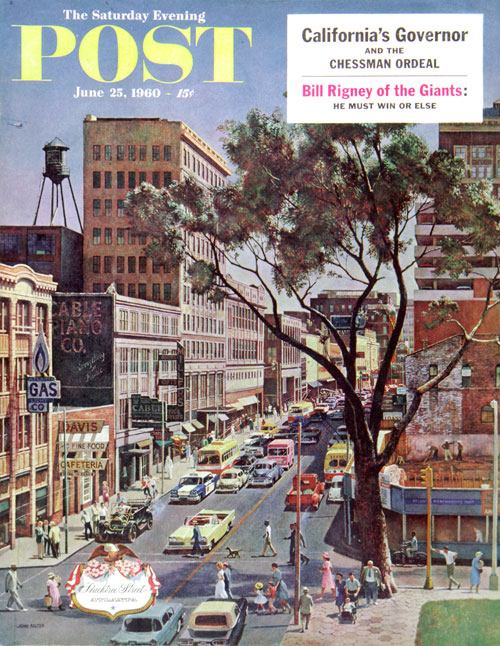
John Falter
June 25, 1960
If I wasn’t a writer I’d want to be an artist or cartoonist, but I don’t have the skill for it. Even my stick figures look kinda funny. I mean, I can’t even begin to understand how John Falter created the way that he created, the mix of color and shadow, the way he gets the perspective right. There’s so much going on in this picture, so many places to look and explore, that it’s rather mesmerizing.
July Is National Ice Cream Month

With that Falter cover you know that I have to link to a recipe for peach ice cream, right? It’s from Southern Living and it’s officially called Summertime Peach Ice Cream. It looks easy to make too, just evaporated milk, condensed milk, half and half, sugar, and vanilla instant pudding mix.
Oh, and peaches. Don’t forget the peaches.
Next Week’s Holidays and Events
International Joke Day (July 1)
Here’s my favorite joke:
Knock-knock
Who’s there?
Interrupting cow.
Interrupting co …
MOOOOOOOOO
Wimbledon Begins (July 3)
Because she’s pregnant, Serena won’t be able to play the 700th man in the world or anyone else, but McEnroe will be one of the commentators when the tennis tournament kicks off on Monday, a week later than usual. You can watch the action live on ESPN (and on tape on Tennis Channel at night).
Independence Day (July 4)
In between the eating of burgers and the watching of fireworks, take a look at this collection of classic Saturday Evening Post covers that celebrate the day.