Is the Working Class Getting Soft?
 A booming economy had business leaders fretting that employees were living in luxury and the country was growing soft and spoiled
For two years hardly a champagne cork has popped east of the Alleghenies but it has been attended by a sigh over the appalling effeminacy of the Teamsters’ Union and the Amalgamated Association of Freight Handlers. Luxury has engulfed the country; but above the flood, like Noah on Ararat, we see bands of stern and impervious patriots who never think of mere creature comforts — having carefully provided themselves with a butler, a housekeeper, a valet, a lady’s maid, two footmen, four parlor maids, six chambermaids, a cook, two second cooks, and three chauffeurs to think of those base subjects for them.
The only sure way to escape being enervated by luxury in the United States, it seems, is to spend a hundred thousand dollars a year.
—“A Few Sound Spots Left,” Editorial,
March 10, 1917
This article is featured in the March/April 2017 issue of The Saturday Evening Post. Subscribe to the magazine for more art, inspiring stories, fiction, humor, and features from our archives.
News of the Week: Chuck Berry, Changes with Monopoly, and Costly Comma Mistakes
RIP Chuck Berry, Jimmy Breslin, Chuck Barris, David Rockefeller, James Cotton, Derek Walcott, Colin Dexter, Lawrence Montaigne, Robert Day
What else do you need to say about Chuck Berry except that he was one of the inventors of rock ’n’ roll? When you think of rock in the ’50s one of the songs you think about is probably “Johnny B. Goode,” later made famous for a younger audience in Back to the Future. His other classics include “Rock and Roll Music,” “Sweet Little 16,” “School Day,” “No Particular Place to Go,” and many others.
Berry died Saturday at the age of 90. He has a new album coming out on June 16. It’s his first in 38 years, and it’s titled Chuck.
If Berry was the classic rock ’n’ roller then Jimmy Breslin was the classic newspaperman. The Pulitzer Prize winner wrote a column for The New York Daily News for 50 years, focusing on the everyday workers of New York City. It’s a cliché to say that we probably won’t see another guy quite like Breslin, but we probably won’t see another guy quite like Breslin. He wrote for The Saturday Evening Post too, including this 1965 humor piece about credit cards and this account of Jackie Kennedy’s final moments with JFK in Dallas.
Breslin passed away Sunday at the age of 88.
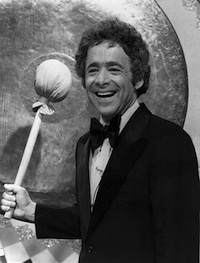
You’ll remember Chuck Barris as the host and creator of the bizarre ’70s game show “The Gong Show.” He also produced “The Dating Game” and “The Newlywed Game” and wrote a book, Confessions of a Dangerous Mind, that became a movie directed by George Clooney and starring Sam Rockwell as Barris. He passed away Tuesday at the age of 87. A new version of “The Gong Show” is coming to ABC.
Barris was also a songwriter and wrote a song you might remember.
David Rockefeller was a billionaire, philanthropist, banker, and member of one of the country’s most famous families. He ran the family bank, Chase, for many years, and along with his brother Nelson, governor of New York, was instrumental in getting the World Trade Center towers built. He was the grandson of Standard Oil founder John D. Rockefeller. He died Monday at the age of 101.
James Cotton was a legendary blues harmonica player who performed and recorded with Muddy Waters, Howlin’ Wolf, B.B. King, Santana, the Grateful Dead, Keith Richards, and many others over his seven-decade career. He passed away last week at the age of 81.
Derek Walcott was an influential Caribbean poet who won the Nobel Prize in Literature for his work. He died last Friday, March 17, at the age of 87.
Colin Dexter created the popular detective Inspector Morse, hero of a series of popular books and TV series. He passed away this week at the age of 86.
Lawrence Montaigne was an actor who appeared on several shows, including two episodes of the original Star Trek, where he played both a Vulcan and a Romulan. He was actually going to replace Leonard Nimoy in the second season if Nimoy had accepted an offer to join Mission: Impossible, but Nimoy decided to stay (he joined Mission: Impossible when Star Trek ended). He also appeared on shows like Batman, The Outer Limits, Lassie, I Spy, The Fugitive, and Dallas, as well as movies such as The Great Escape. Montaigne passed away last week at the age of 86.
Robert Day was a veteran movie and TV director. He directed the films First Man into Space, The Haunted Strangler, Two-Way Stretch, along with four Tarzan movies, and TV shows like The Adventures of Robin Hood, The Buccaneers, The Avengers, The Invaders, The F.B.I., Bracken’s World, The Streets of San Francisco, and Matlock. He died last Friday at the age of 94.
How Does a Thimble Become a Dinosaur?
I haven’t played Monopoly in years, but like most people I wanted to be the race car. I mean, who, if given a choice, would want to be the thimble? Maybe someone who sews.
If you didn’t care for the thimble, you’re in luck. After a poll, Parker Brothers has replaced that piece, along with the wheelbarrow and the boot. Instead of those pieces — hey, I kind of liked that boot! — we’re going to see a T-Rex, a rubber duck, and a penguin (and no, I have no idea why they call it a “rubber” duck and not just a duck). They’ll join the surviving pieces: the car, the dog, the top hat, the battleship, and the cat, so you might have a dinosaur and battleship square off, which I’m sure will be the basis for that Monopoly movie.
And if a big-screen film isn’t enough for you, the board game is also going to be musical.
‘Daniel at Breakfast’
I’m reading a book of essays by Phyllis McGinley titled Sixpence in Her Shoe. It came out in 1963 and was a response to what people like Betty Friedan and other feminists were saying and publishing at the time. McGinley was a housewife and proud of it, and actually celebrated domesticity and suburban life. She also happened to be an acclaimed poet, winning the Pulitzer Prize in 1961 for her collection Times Three and writing several children’s books and poetry for The New Yorker, The Atlantic, and she wrote quite a bit for The Saturday Evening Post. It’s a shame that her books have gone out of print and she’s pretty much forgotten now (even though she was on the cover of Time at one point). But one of her books is remembered and celebrated every December: She wrote the original story for The Year Without a Santa Claus, the basis for the animated holiday TV classic of the same name.
Her birthday is March 21, which also happens to be World Poetry Day. On that day CNN anchor Jake Tapper posted this on Twitter. I don’t know much about poetry, but I like McGinley.
A poem by Phyllis McGinley, born on this day in 1905. #WorldPoetryDay pic.twitter.com/KUIikWk5mk
— Jake Tapper (@jaketapper) March 21, 2017
The Dangers of Not Using the Oxford Comma
We’ve all read examples of how omitting an Oxford (or serial) comma can lead to misunderstandings. One of my favorite examples is on a Tails magazine cover from a few years back that had the headline “Rachael Ray Finds Inspiration in Cooking Her Family and Her Dog.” They didn’t just forget that last comma, they forgot all of them — which makes me not want to eat at Rachael Ray’s house.
Forgetting it can also cost you a lot of money, which a Maine dairy company found out this week. Three truck drivers looking for overtime compensation filed suit against the company and could win a judgment of up to $10 million because of the way a contract was written.
Meet Julia
The iconic children’s show Sesame Street has debuted a new character. She has orange hair and her name is Julia. She also happens to be autistic.
I grew up watching Sesame Street and I learned a lot from it, not just basic knowledge like words and math and why some puppets like to live in trash cans, but also how to treat people. A character like this could really help kids understand.
Julia was already a character in Sesame Street books and stories, and producers decided to also add her to the TV show, which now runs first on HBO and then on PBS several months later.
This Week in History
Patrick Henry’s “Give Me Liberty” Speech (March 23, 1775)
Here’s the full text and the story behind Henry’s famous “Give Me Liberty or Give Me Death!” speech. It was given at St. John’s Church in Richmond, Virginia.
Harry Houdini Born (March 24, 1874)
When I was a kid I was obsessed with Harry Houdini. I read every book I could find on the magician, and at one point even thought of becoming a magician like Houdini (without all of the “escape from a milk container filled with water while handcuffed” stuff). Check out Saturday Evening Post Archives Director Jeff Nilsson’s article on Houdini and “The Art and Crime of Illusion.”
This Week in Saturday Evening Post History: First Crocus Cover (March 22, 1947)
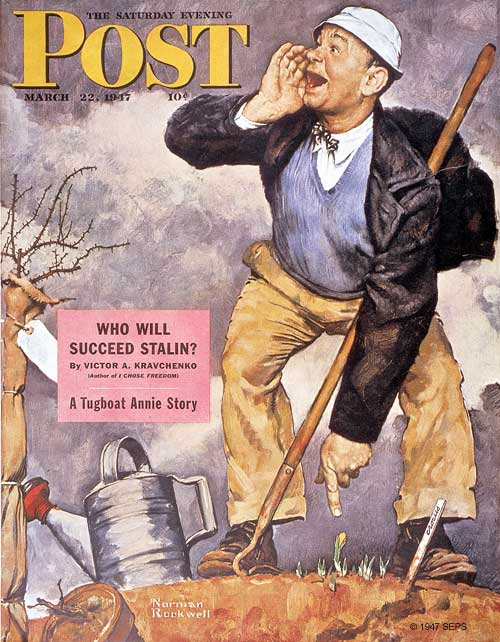
Norman Rockwell
March 22, 1947
I’m not entirely sure what a “crocus” is. It almost sounds like a car. Introducing the Ford Crocus, new for 2017! Anyway, 50 years ago this week the Norman Rockwell work appeared on the cover of The Saturday Evening Post. Read the story behind the cover here.
Pecan Day
Pecans? Not a fan. Almonds? Sure. Peanuts? Yup. Cashews? Great! But I never got a taste for pecans, really. I was going to make a joke that someone should do an ad campaign for pecans with the slogan “YES PECAN!” but something like that already happened.
Tomorrow is Pecan Day. Here’s two recipes for shortbread cookies that include pecans, and here’s one for a crunchy sweet potato casserole.
Maybe I’ll try these sugar-coated pecans. Even though I’m not a pecan fan, I find that most things are improved when you cover them in sugar.
Next Week’s Holidays and Events
National Doctors’ Day (March 30)
This is the day when we honor the men and women who keep us alive. If you happen to have an appointment on this day, maybe you can bring your doctor some of those sugar-coated pecans.
World Backup Day (March 31)
If you’re like me, you often forget to back up the files you have on your computer (I once lost an entire novel I wrote because I didn’t have another copy). Today’s the day to remember to do that. Well, every day is the day to remember that, but maybe after an official day to remind us, we’ll actually start doing it. And I don’t mean just a cloud backup.
Before I Go

Maudie wants to kill a hare. Even in her bell-clear moments she hangs onto the idea with something like a death grip. Maudie’s in a death grip now herself. Death’s grip. The doctor and the people from the hospice take turns telling me it’s just a matter of time now — as though for the past 66 years it had been a matter of something else.
I sit by Maudie’s bed, sometimes all night. She heaves herself and thrashes and calls out to Thomas and to Mama and to me. “Make him give me that ax. Make him let me do one.” And then when she’s awake, she reasons with me, slivered in between the fretting and the rambling. She couldn’t kill a rabbit. She couldn’t heft a kitchen knife. I saw her try to pull a comb across the fuzzy tufts of down that have just started to grow back. She can’t lift a thing. I feed her. Have for weeks.
“Let me kill one rabbit,” Maudie says.
“When you get your strength back.”
“When you’re rested.”
“When you’re fresher.”
Maudie scowls at me. My sister’s not a fool.
I kill all the rabbits now. I have been killing things for my whole life. Time was we had pigs and ducks and geese and tame game hens, but nowadays all the fowl that lays in plastic cellophane down at the A&P comes here in big mud-splattered trucks from warehouse stores in other states. You don’t know if those chickens ever were alive. So nowadays it’s just the rabbits that stand in all but pure defiance between us and total expendability.
Rabbits. Lapin. Until she got sick, Maudie hand-printed the labels: LAPIN, in black calligraphy. I kill and clean and package them in cellophane and drive them into town to sell them to the Frenchman. He sells hard bread rolls and liver spreads and salads, ready-made, in what was the hat shop, next door to the bank. He buys our rabbits. Lapin. That’s his word. Gives us $3 a pound, sells some in the store, ships out all the rest.
When our brother Thomas was sick for the last time, Maudie and I phased out the birds. Maudie begged me, Don’t you tell Thomas the birds are gone, he’ll get his mind in one huge uproar, and carry to the grave the worry we might starve, which even then I doubted seriously. I think worry is the first thing a person doesn’t carry with him when he goes. I cannot make myself believe a person dies and then the next day wonders about who will pay the light bill or the money to the feed store. I think a person looks down from heaven, shrugs his shoulders, figures everything will probably be all right.
Or it won’t.
“Just one puny rabbit.” Maudie’s voice gets whiny, like it did when we were girls.
Maudie’s never killed a thing. Papa let her go off in the house every time we did the hogs, and she would crawl underneath that metal bed and lie straight as a board until I ran upstairs singing out, “It’s finished. They’re all done,” as I moved slowly around the room, pretending to search bureau drawers and closets until I found her always in the same place — moving slowly, leaving in my wake my scent, that smell of outdoors and animals and blood. “You can come out now, scaredy-cat. I know you’re there.”
It’s evening now. Maudie’s time of day. This whole day’s got away from me somehow. The kitchen’s gone all dark while I’ve been sitting here, but when I pass out through the screen door to the back porch, there’s still light enough to see the wind move through the trees. I drop down on my Richmond chair beside the railing and lean way back to look up at the sky.
I will lift up mine eyes unto the hills; from whence cometh my help?
I read that verse a thousand times before I ever saw the question mark was there.
I groan the words out a second time, out of habit more than anything. I know where’s my help tonight. She’s dying and for sure there is no succor residing on any mountain I’m aware of.
When Maudie and I were small, our father would take us up that big hill, there, behind the slaughterhouse. The ground was full of rocks, all sizes, so there was always a firm piece jutting out to make your footing sure, a thousand different sharp or rounded steps to make the climb secure. At the top was one big rock, as wide across as three or four fat sows, all fed up ready for the slaughter, and my father told us, Maudie and me, that our grandmother was buried underneath that stone. He told us that was why no one in our family could ever leave this place, because we could not move away from her. He said it was a two-way street. We kept faith living here, and this woman, dead long years, watched over us, protected us from every ill and evil.
Maudie told me one night as we lay in bed that that dead grandmother was what all the killing was about. The animals we killed were sacrifices, Maudie said, appeasements to her spirit. The next day she showed me a verse in the book of Hebrews that said without the shedding of blood, there could be no remission. I asked her what remission was, and she gave me a look and said what did it matter what it was. For a time I had it worked out that remission was that part of the tractor that made it go, but then Maudie told me that was transmission. Trans, which I heard as trance, which only served to muddle me up further.
Off and on for years Maudie and I would argue the particulars. Like two old Jesuits or Jews. Discussed the thing to death. I knew that in the Bible Israelites had sacrificed goats and sheep and doves to God. Not rabbits, though. For sure not pigs. No cloven hoofs. Unclean. I knew that no Jew, not even one in West Virginia, could eat a pork chop or a piece of bacon even if he starved to death. So it hardly figured that my father butchered swine for sacrifice to his dead mother; in addition to which, this woman wasn’t God, which, I argued, would make her an idol if you did sacrifice to her, which would mean hell for certain, and very likely extra punishment on top of that.
Personally, I think the reason Maudie hid underneath the bed every blessed time there was a slaughter was her sheer and certain terror that one day my father would decide to make a switch to human sacrifice and grab him any person who happened to be handy. He had a certain fiercesomeness.
My own concerns were otherwise: I worried that at any time the old grandmother buried on the hill would take it in her head to roll the swine-humped stone away and come tearing down the mountain hell-bent for leather — or perhaps retaliation, long-considered, even justified. I saw her in a long white nightgown, hair in two thick gray braids, and in her hand a torch like the Statue of Liberty. So if it took the sacrifice of a few chickens to keep that woman happy and contented to stay put lying there, well, to my way of thinking, that was livestock well-invested.
I give my head a serious shake. I came out here tonight to think of Richmond — not dead grandmothers, not dead lambs or pigeons. Richmond. I’ve had my mind on Richmond just about forever now. Sweet Richmond. I look down at my lap. It’s dark now. I can’t even see me. But I know that I’m still right here.
I get me up and walk inside; I let the screen door slam. The last one who would care was buried years ago. Maudie used to slam the thing a hundred times a day. I light a fire and put the kettle on.
It was in the third grade that I got this thing for Richmond. Before that, I was going to Africa to be a foreign missionary. Then Mrs. Lowe, the new librarian, moved to the farm just up the road. Mrs. Lowe hated that farm like malaria, and every Tuesday when I would go in to change my books, Mrs. Lowe would tell me about Richmond, her hometown, the place she was a stupid fool to have ever left. I made my mind up that same summer to go off to Richmond the second I was grown, and did my worst to make up Lucille Harris’ mind to go with me.
I dump some dried sassafras in the teapot and splash the scalding water on.
I was in high school when my mother first started in with her nerve problem. By the time I graduated, we were calling it M.S. Miss, we always said. Like, I wish this Miss had missed us, say, or, How’s the Miss today?
And what do you think? Lucille Harris ended up in Richmond. Married a salesmen, like in the stories, a man from Richmond. Lucille lived there all her life. She told me once when she was home to visit, that Richmond wasn’t what you’d think. Now what would Lucille Harris know about what I would think?
“Go for a visit,” Mama would say. “Go see the place.”
But I didn’t want to dip my toe in, I didn’t want to see it just from the outside. I wanted to belong there, to go and live forever. I pour some tea and catch a whiff. I love that bitter smell. When Mama did, after forever, die — I was just 32 — I sat down and wrote Lucille Harris one long letter, and I said, would she consider a paying houseguest, just till I could get set up on my own. Lucille never answered me. I never heard from her again. I saw her cousin in the post office late last year; she told me Lucille had just died. A fast cancer, the cousin said.
Sixty-seven days.
After Mama, someone was always getting sick and dying, or getting sick and recuperating, which would take even longer. My brother Thomas got T.B. — was sick with it for 20 years — then Papa, who begged and begged me not to leave. He always did hang onto everyone. Kept his own mother underneath a rock, and I remember Mama saying once, toward the end, she wanted so to die, but Papa never would let her go anywhere.
But I’m not nearly 70. I read a story in a magazine about a lady who at the age of 67 met up with her childhood sweetheart after he was widowed, and she married him and had a rich, full life. No children, of course. Of course no children, but a rich, full life. Now myself, I don’t have any childhood sweetheart to meet up with. No one in my family ever had much luck in that department, but anything gets possible once I start to think of Richmond.
“It isn’t fair. It isn’t fair at all.” Maudie is all tangled in the sheets. She is sweated wet.
“Nancy will be here today,” I say. “The nurse you like. The one with good bones, Mama would have said. I made the custard you’re so partial to.”
“Just one stupid rabbit.” Maudie’s drifting off again. “Just one, Papa.”
“It’s not unusual to get these ideas at the end. To get fixated on one thing. Go along with her as much as possible,” the doctor tells me. Dr. Julio, who is without a doubt the shortest grown-up person I have ever seen, not counting any dwarfs. “She can take the medicine for the smallest reason. I’ve told her that. She acts like she needs to make it last, to stretch it out. And don’t forget the aspirin.” He shuts the door, and fresh cold air moves in to take his place.
A person dying can be like some child who commences in to whine at breakfast time and has the wherewithal to keep it up all day. That bored tenacity, that cumbersome embarrassment of time.
Myself I think a person has a right to peevishness when she’s caught up in dying. She’s got a right to lightning-white outrage, if it comes to that, and rancor, and frank spite, and brittle incredulity. Besides, if you can concentrate yourself on one small single fret, it might supplant, or at least, for the time, forestall your bumping blunt and inadvertent up against the idea of your beginning now to end.
“Oh dear Lord in heaven,” I say to myself, “What am I going to do?”
In fact, I know exactly what I’m going to do. I’m going to sell up after Maudie’s gone, clear out the rabbit hutches and blunt axes and chopping blocks and 12-inch knives. A lifetime of possessions, four lifetimes, five, if you count mine. I’m going to sell up the lot for hard cash and move myself to Richmond. Desire waits a long time, the thing can travel underground for years. I’ll never once look back. Not like the story in the Bible of Lot’s wife. She’s the one I always wanted the most not to be. I would be Job with boils, or Samson without a lick of energy before I would be her. When Maudie dies I’m moving to Virginia, just like I was supposed to with old Lucille.
“How’s your sister?” everybody asks.
“Fair,” I say. “Just fair.”
I first get the idea of the guillotine from a mention of the French Revolution in a magazine, and the next time I take in a load of rabbits, I ask the Frenchman and he draws me a careful diagram on a torn-off piece of brown wrapping paper. He doesn’t even think the what-for question. A foreigner, a person from another place, will take you at face value every time. He has had to take entirely seriously any number of queer, harebrained ideas to get where he has come to be.
We have a whole shed full of hardware, old wood, and blades to every purpose, but the manufacturing of any contraption, the simplest apparatus, will never once conform to your idea of how the thing’s to go. First off, the blade is not supported properly and drops and nearly takes my hand off at the wrist. Then the wood frame lists to one side so the blade jams halfway down. I finally finish it well after midnight, working against time, or up against its brevity.
You’d think a person would be all wore out after that, but I am wide awake. I’m not a fool. I know full well what Maudie’s on about with all her fretting. Fixing it so she can kill the rabbit is just the same as pulling out the plug on one of those hospital life-support machines. This is the last night my little sister and I will both occupy this planet. She still believes the stories we made up to scare ourselves. No surprises there. A person’s childhood can hang on for dear life, cling clawing like some sharp-toothed creature that you can’t shake loose, no matter how you try.
I know I will not sleep tonight. It is my sister’s wake. That’s what the word means. I wander room to room. Maudie’s snore follows me, an ugly rasping thing. I go into the room we slept in when we were just girls, before our lives. It’s cold, damp smelling. I walk over and bend down beside the little bureau Mama painted that sad shade of blue, a bureau with a single drawer that Maudie has kept locked for her whole life. I used to say at routine intervals that she could stop with all the secrecy and protest. I told her that I had already looked inside and seen her stupid treasures there. For ages then she’d wear the key to the bureau drawer on a chain around her neck, till finally, in the end, the thing got lost. I bet that drawer has sat there locked up 30 years.
I go fetch the screwdriver that I keep for the sticky window in the bathroom, but when I go to pry the darn drawer open, it slides out easy, opens with a touch. It wasn’t locked at all, a fact which for some reason makes me spitting mad. At Maudie? At me? I get down on my knees to have a look inside. My heart does the little thing it does.
And what was all the fuss about? Her stupid treasures. A little pink leather change purse with a click clasp and four pennies inside: 1921, 1917, 1914, another 1921. A white bead bracelet my mother wore, an empty book of savings bond stamps with an unshaved Uncle Sam glowering on the wrinkled cover, a blue marble, a little tablet of paper with the picture of a bird on every page, a feather, a couple gray stones, a 50-year-old pine cone, a blue ribbon with JESUS SAVES in blood-red letters. I pull the drawer out, upend the whole thing into the trash. I am that disappointed. An old blue envelope falls to the floor. I pick it up. June 11, 1959, the postmark, and the return address reads Mrs. Lucille Harris Wilson, 209 West Winton Street, Richmond, Virginia.
I pull myself to standing. The basket slips out of my hand, spilling Maudie’s trash across the floor.
I open up the letter:
My dear friend,
Of course you can come, yes come. You can live with us forever. Bill says so too, and bring a pillow for yourself. You write when you’re coming. We’ll be ready. Love you,
Your friend Lucille
I turn the envelope over, and written in Maudie’s tight round hand: Forgive me. It’s like writing a note to God in the hopes He’ll find it on the morning of the final judgment day. Hoping it catches Him in a forgiving mood. Now whatever made Maudie keep this souvenir of treachery?
There is secrecy and there is treachery and they are not the same, they are not distant relatives. Violence can be such a quiet thing, one slender little sin that keeps another person from her life.
Maudie would have known that I’d be on the midnight train the day the letter came. Maudie, Maudie. You’ll need more than the blood of rabbits for that one, old girl. More than the blood of many rabbits for remission of that sin.
Suddenly I’m all played out. I’m sleepy, sleepy like I’ve had a sleeping pill. I fall into bed still fully clothed.
As I drift off, I imagine I will dream tonight of fitting Maudie’s skinny neck into the guillotine with not an inch of space to spare and letting fall the ax blade weight to take off Maudie’s head.
“It is a fitting punishment.” I hear those words. I’m running down an empty street and crying this. I’m all alone in a big city and it’s the middle of the day, but the whole town is vacant.
“Lucille. Lucille.”
I shout out loud, but there is no one left alive to hear, and then I realize it’s the end of the world and I’m the last person left alive. Up in the distance I see something black that moves across the road. A raccoon, I think, but I run up to it to find it’s only Mitsy, the cat we had when we were girls. A fat cat, raccoon-shaped, and pregnant half the time. “Oh, Mitsy.” I try to pick her up, but off she goes, and I am running after her so fast it hurts my side, and then I’m at the farm, back home, and I see Mama hanging out the wash, Papa cutting wood, Thomas circling on the gravel on his old green bike. “I thought the world had ended,” I cry out. “Oh, no,” Mama says. “It didn’t end. They just changed it.” And I run into the house, screaming, “Maudie, Maudie.” I thunder up the stairs. Somehow I know she’s hiding. Underneath the bed. “Maudie, girl, come out now. The world didn’t end. It didn’t end at all.”
The dream circles the kitchen while I make tea. I dress, then I wrap Maudie up and wheel her to the shed. There has never been a slaughter in the house. There won’t be one today. The ground is rough, the paving stones uneven. Once, the wheelchair tips and all but empties Maudie on the ground.
“Now you just pull out this wood support when I say. I’ll hold the hare,” I say.
“Quit telling me. I understand,” Maudie says. “Don’t tell me anymore.”
I wheel Maudie across the raised wood frame of the threshold, a bounce and drop proposition.
“I’ll get up,” she says.
“You sit,” I tell her.
In the end she has to raise herself and take two steps ahead while I lift the metal wheels across the frame.
“Now sit,” I say.
I wheel her over to the table.
“That’s it?” she says.
“That’s it,” I say.
“Humph.”
When Maudie was a little girl, she said “Humph” just like it’s written out, as fully formed as any word. I haven’t heard her say it in I bet 40 years.
Maudie struggles and stands.
I grab the fattest rabbit, sluggish, old, and hold its head beneath the blade, and Maudie raises up out of the chair and reaches out and grabs the ax from the table at her side. She can’t support the weight. The metal head drops like a two-ton anchor pointed at the ground. She stands there without moving, then lifts the old ax inches at a time and brings it down with one clean cut across the rabbit’s neck.
“Fair’s only fair,” she says and slumps back in the chair. She looks awful. She looks dead.
“I ask forgiveness, but I am not sorry.” Maudie glares at me. “I’d do the same again.”
She makes a noise that I don’t like the sound of. Her next words come as gasps, in little puffs of putrid air. “All I ever wanted in this lifetime was to keep you near. Now you go.” She shuts her eyes. “You hear me?”
I look down at the dirt floor and then at the ceiling beams. I don’t look at the rabbit.
“I said, you hear me?” Her left arm starts its thumping twitch.
“I hear,” I say. “I hear.”
Another snippet of my dream. I’m standing on the stone that keeps my dead grandmother firmly underground, up on the mountain out back, and it is the highest mountain in the world. I can see the whole Earth at one time, the splashing ocean, Richmond — a little flyspeck on the plain — and then our farm and it’s enormous.
I float down from the mountain, closer to see me and Maudie sitting with our heads together on the back porch steps. Maudie is about 10 years old, which means I’m 8 or 9 depending on what month it is. We’re dressed in red-and-blue plaid cotton dresses with round white collars and limp ties tied in back. Our shoes, brown Buster Browns, scuffed and dusty, our brown hair, straggly. We’re sitting with our heads together. Maudie’s humming, but we’re in dead earnest, sitting there. We’re making something with our hands. It will have been our lives.
Linda McCullough Moore is the author of the novel The Distance Between (2010) and the short story collection This Road Will Take Us Closer to the Moon (2011). Her writing has appeared in numerous publications, including O the Oprah Magazine, House Beautiful, and The Boston Globe. Her last story for the Post was “People in My Life” in the July 2014 issue. For more, visit lindamcculloughmoore.com.
This story is featured in the March/April 2017 issue of The Saturday Evening Post. Subscribe to the magazine for more art, inspiring stories, fiction, humor, and features from our archives.
A Troubling View from Vietnam: 50 Years Ago
 In the years since the Vietnam war, the U.S. has repeatedly sent its military into conflicts around the world. But the human and economic toll of these other conflicts is minor when compared with Vietnam.
That war, which was still ramping up 50 years ago, brought about several changes in American thinking. The failure of the Vietnam mission forced the administration to reconsider how it would oppose communism. The endless, seemingly pointless deaths of recruits gave many draft-age Americans a hostile attitude toward their government and authority in general. This attitude, in turn, produced a rift between American youth and its elders. The older generation, which had brought victory to the U.S. in World War II, couldn’t recognize how much had changed in 25 years.
It was the members of that generation who were developing the strategy for the Vietnam War. They believed in the invincibility of our military and the inevitability of American victory. Their faith led them to keep pouring men and money into the fight that achieved little or no progress. By 1967, 8,694 Americans had died in the war, and it hadn’t even reached its hardest years. Before the U.S. withdrew from the country, another 38,000 Americans would be lost.
Not all military personnel were blind to the actual course of the war. You can hear some of their voices in the article “The President’s Next Big Decision,” from the March 25, 1967, issue of the Post. Reporter Stewart Alsop visited a vulnerable, isolated unit near the Demilitarized Zone with guns pointing in all directions. The Marine battalion commander who led him around commented, “Looks kind of like Custer’s last stand, doesn’t it?”
The article shows that some reporters and soldiers already saw that Vietnam wasn’t going to be the short, decisive, or victorious war that Washington expected.
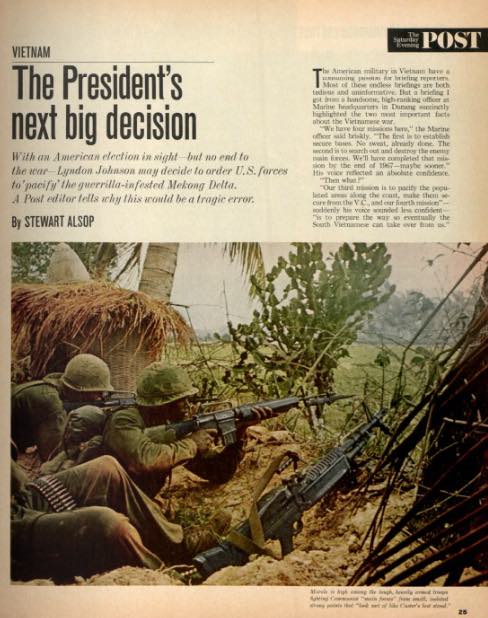
Featured image: From “The President’s Next Big Decision” from the March 25, 1967, issue of the Post. Photo by Michel Renard
Are You Smart Enough to Be a Citizen?
Are you smart enough to be a citizen? That question was posed 71 year ago by Robert M. Yoder. He realized that democracy in the postwar world needed well-educated voters.
In the past, he wrote, there had been little demand for Americans to be well informed. The average American “didn’t have to think hard four times in his lifetime.” The country enjoyed a steady run of breaks that allowed it to “muddle along pretty well even with a population of sleepwalkers.”
But the postwar world brought complicated questions that required thoughtful answers: How could the U.S. feed the starving people of Europe and Asia; how would we face the communist threat; and what were we supposed to do with this mysterious new creature, the International Monetary Fund?
The problems were both “terrifically important and terrifically dull. They may kill, but they don’t interest.” Americans would need to study hard, Yoder wrote, “and it is dry stuff.”
If smart voters were needed in 1946, they’re certainly in demand now. International hacking conspiracies, intricate healthcare proposals, and thorny foreign entanglements are the types of complex problems that average citizens are required to comprehend today. So how have American citizens, and voters, done in educating themselves? Not very well, according to the reports.
In 2010, a report from Yale University uncovered these discouraging facts:
- fewer than 50% of Americans had read any fiction or poetry in the preceding year
- only 57% had read any nonfiction work
- 49% of adults didn’t know how long it takes the Earth to circle the sun
- more than 50% of Americans didn’t know Genesis is the Bible’s first book
- 10% believed Joan of Arc was Noah’s wife
In 2011, Newsweek asked 1,000 American citizens to take the citizenship test. Nearly 40% failed.
- 29% couldn’t name the vice president
- 73% couldn’t correctly explain the Cold War
- 44% were unable to define the Bill of Rights
- 6% couldn’t point to Independence Day on a calendar
Just how difficult are the questions?
Before answering that question, note that the “civics test” is only one of four different tests an applicant must pass before citizenship is granted.
Applicants must first be able to speak sufficient English to a U.S. Citizenship and Immigration Services officer during an eligibility interview. Next, they must prove an ability to read English by reading aloud one of three sentences correctly. Then they must write out one of three sentences to prove an ability to write in English. Last, they must answer 6 out of 10 questions taken from a list of 100.
Below are 10 questions from the big list. If your citizenship rested on your ability to correctly answer 6 of them, would you be able to vote in the next election? Click here to see the answers.
- What does the Constitution do?
- What do we call the first 10 amendments to the Constitution?
- How many amendments does the Constitution have?
- What is the economic system in the United States?
- Who makes federal laws?
- The House of Representatives has how many voting members?
- We elect a U.S. Senator for how many years?
- Under our Constitution, some powers belong to the states. What is one power of the states?
- What happened at the Constitutional Convention?
- Name one U.S. territory.
Too easy? See all 100 questions.
Featured image: A naturalization ceremony at Grand Canyon National Park, September 24, 2010 (Wikimedia Commons, Grand Canyon National Park via Creative Commons Attribution 2.0 Generic)
.jpg)
The Art of the Post: How Magazines Revolutionized the Art World
We are pleased to introduce the first of a biweekly column on art and illustration by art critic and historian David Apatoff. David will share exciting and interesting illustrations, reveal colorful stories about Post artists and their methods, and offer insights into why art and illustration are such an important part of our culture. We hope you enjoy it!
For 10,000 years, artists were hired by the wealthy and powerful. Kings, priests, pharaohs, and popes commissioned art for cathedrals, palace walls, sacred caves, and public spaces.
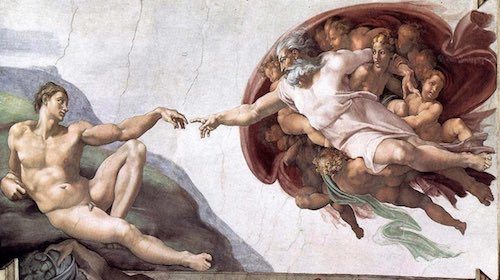
Then, gradually, this market for art faded away. Kings began to vanish from the Earth; churches stopped commissioning altar paintings and chapel ceilings; princes no longer hired artists for flattering portraits or murals of glorious military victories. Their castles were handed over to public trusts in exchange for tax deductions.
Artists had to find new places to sell their art.
Fortunately, a new breed of sponsor arose to replace those historical patrons of the arts. The growth of capitalism and the invention of the corporation gave private citizens the wealth to commission art. Businesses began purchasing “commercial art.” Even more importantly, new technologies for mass-producing pictures and distributing them to wide audiences enabled working families — whether rich or poor — to enjoy great art in their homes. Rather than compete to become a royal painter, artists could now publish millions of copies of a picture and sell them to large numbers of customers for pennies apiece.
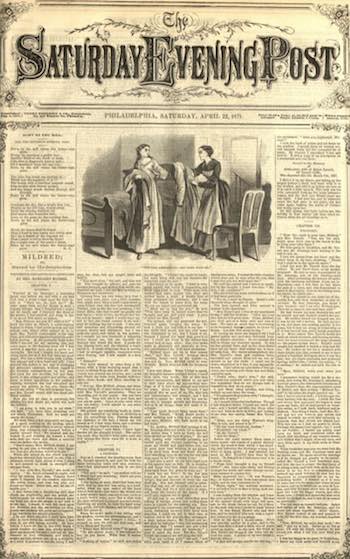
In the 19th century, The Saturday Evening Post was one of a small handful of American magazines, along with Harper’s Weekly, Century, and Life, that were densely printed black-and-white periodicals with wood engravings for illustrations.
By the 20th century, the magazine industry had blossomed into dozens of popular and well-designed color periodicals. Historians have dubbed this the “magazine revolution.” The quality of reproductions, and the newly sophisticated vehicles for delivering them to the public, transformed the economics of art and inspired new bursts of creativity. Public enthusiasm for new pictures grew dramatically as technology for reproducing pictures in magazines improved.
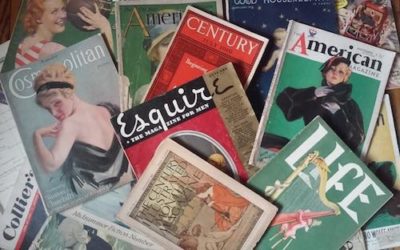
The Post soon became the most widely circulated magazine in America. This was largely due to editor George Lorimer’s vision of taking advantage of the newly available technologies for printing images.
The most talented artists learned they could become wealthy by creating pictures for the new mass audiences. Illustrators such as Norman Rockwell, Maxfield Parrish, J.C. Leyendecker, and Charles Dana Gibson received handsome sums illustrating magazines. Their covers became a popular topic of conversation across the country. The art inside the magazines — ranging from story illustrations to imaginative advertisement pictures — shaped popular taste, too.
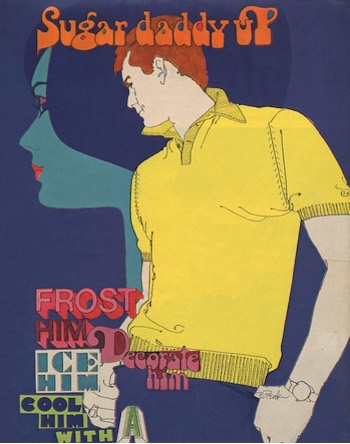
Several of the images created by these illustrators became cultural icons. In this way, the modern magazine became one of the world’s greatest platforms for art.
Great painters of the era aspired to be magazine illustrators. In letters to his brother, Vincent van Gogh praised the quality of illustrations in magazines such as Harper’s Weekly and Illustrated London News, and he clipped out their drawings and pasted them in portfolios for further study. The great abstract expressionist Willem de Kooning came to America to become a commercial artist.
As the technologies continued to evolve, the next generation of illustrators was able to make images that moved and spoke. At animation studios such as Disney and Pixar, they painted with computers rather than brushes. Today, illustrators are pioneers in computer games employing virtual reality. But no matter how advanced the technologies become, illustrators continue to look back and gain inspiration from their artistic roots in magazine illustration.

With all these changes in the landscape of art, it’s fair to ask: Who was the greatest art patron of the 20th century? If we measure by the size of the audience and the influence of the art, one good candidate is The Saturday Evening Post.
The Post’s circulation in the first half of the 20th century was far greater than the audience enjoyed by any museum or private collection of the period. Every week, the Post delivered a cornucopia of pictures, not just to audiences in big cities but to people in small towns with no museums, libraries, or televisions. Many of its illustrators recognized this fact and took their artistic obligations seriously. Post illustrator Robert Fawcett said, “We represent the only view of art and beauty that millions of people get a chance to see. If we do less than our best, we cheat them.”
For many years, the weekly audience for the Post was larger than the audience for Picasso, Matisse, or any other giants of 20th century modern art. Furthermore, the art in the Post’s illustrations had more of an impact on day-to-day lives, shaping cultural identity and political beliefs in ways that museum artists never did. They drove consumer choices, sold war bonds, persuaded young men to join the army (“Uncle Sam Wants You!”), and affected our standards of beauty, patriotism, love, and ethics. And as Lionello Venturi, the foremost historian of art criticism, has pointed out, “What ultimately matters in art is not the canvas, the hue of oil or tempera, the anatomical structure and all the other measurable items, but its contribution to our life, its suggestions to our sensations, feeling and imagination.”

Several fine art critics of the 20th century have argued that in order to be accessible to a wider audience, illustrators sacrificed avant garde art principles, making illustration a lesser art form. But the passage of time has caused experts to re-examine that view. Today, illustration is increasingly respected by museums, academics, and collectors. Meanwhile, so-called “fine” art is viewed by many as esoteric, self-absorbed, and irrelevant. Noted writer and art critic Tom Wolfe said in a speech at the National Museum of American Illustration, “I feel very comfortable predicting that art historians 50 years from now … will look back upon illustrators as the great American artists of the second half of the 20th century.”
As Shakespeare proved, broad appeal to a popular audience is not incompatible with greatness.
A wealth of 20th-century illustration lies behind us, largely unexamined and underappreciated. It is one of my great pleasures to help unearth that art and consider its qualities afresh, on a level playing field with other art forms. I hope you will join me here for an interesting ride.
7 Icky Germs Living on Your Body Right Now (and Why They’re Not So Bad)
Also be sure to read Contrariwise: Dirt Is Good for You from the March/April 2017 issue of the Post.
At any given time, the human body is home to trillions of microbes. It might be unsettling to think you’re hosting scores of bacteria, flora, and even insects, but few actually do you harm. Here is a list of seven microbes with which you (usually) peacefully coexist.
-

Escherichia coli, Public Health Image Library Esherichia coli, or E. coli, bacteria add to the amazingly diverse microbiome of your intestinal tract. There are many types of E. coli, and only a handful will make you sick. Proper food handling will ensure that only the necessary E. coli reside in your gut.
-
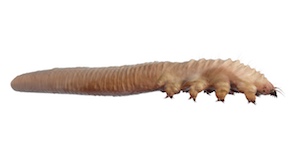
Demodex mite, Shutterstock Demodex mites live in your glands and hair follicles. Infestation of these parasites is common among adults, but – apart from a correlation with rosacea – there aren’t any harmful symptoms. You probably don’t even notice them making a home out of your eyelashes.
-

Malassezia furfur, CDC Malassezia furfur lives on your torso and consumes fat and oils secreted from your skin. This yeast typically doesn’t cause any problems, but in larger numbers it can cause skin discoloration, itchiness, and dandruff.
-
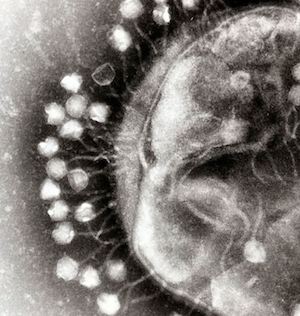
Bacteriophages attached to a bacterial cell, Dr. Graham Beards Bacteriophages infect bacteria, and they exist everywhere on Earth. These viruses are found in and on your person, and sometimes they’ve been placed there for good reason. Phage therapy has been used for decades to successfully treat bacterial infections. These guys can be used to target pathogenic bacteria and leave harmless bacteria well enough alone.
-

Staphylococcus, Shutterstock Staphylococcus bacteria cause harmful “staph infections” in those with weakened immune systems or untreated wounds, but are likely present on your skin and in your respiratory tract right now. Antibiotics can fight staph bacteria, but MRSA (Methicillin-resistant Staphylococcus aureus) is a special type that resists many treatments and causes a nasty infection.
-

Varicella-zoster virus, Shutterstock Varicella-zoster viruses causes chickenpox and then sits dormant in your nerves. VSV, a type of herpes virus waits until you are weaker, and usually older, to reactivate and cause shingles.
-

Candida spores, Wikimedia Commons Candida fungi exist commonly in your intestinal tract as well as in the outside world. These yeasts are harmless unless they overgrow causing Candidiasis. Candidiasis is called “thrush” when it affects the mouth and “yeast infection” in the female reproductive system. Candida yeast aren’t the types used to make wine, but they can sneak in on grapes and spoil a batch. It is recommended that you abstain from spirits if you are experiencing Candidiasis as wine and beer can exacerbate the infection.
Cover Gallery: 1920s Fashion
The dramatic changes for women in the 1920s – the right to vote, the spread of middle-class affluence, and a rejection of Victorian mores – vividly influenced fashion.
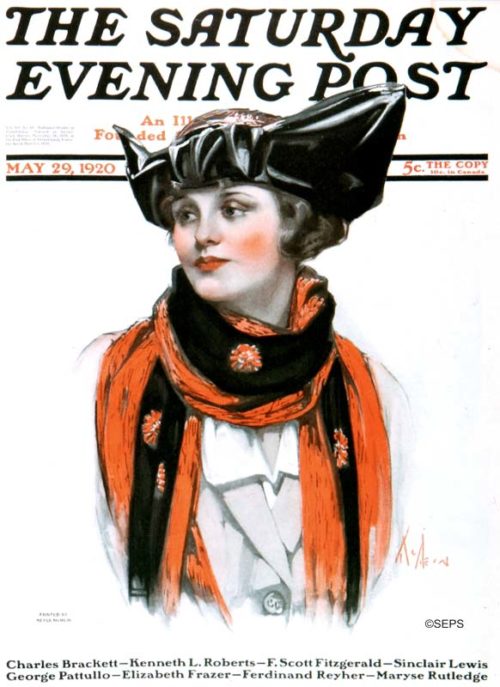
Neysa McMein
May 29, 1920
This bi-corn hat style was popular in the early 1920s and this woman wears a particularly dramatic version of it. Artist Neysa McMein often drew confident, modern women for McCall’s, The Saturday Evening Post, Collier’s, and many others. This was her 28th cover out of 62 she painted for the Post. McMein was quite the modern woman herself; for her volunteer work in Europe during World War I, she was made an honorary non-commissioned officer in the Marine Corps, one of only three women to receive the honor. When she painted this cover, women had not yet won the right to vote; that wouldn’t occur until August of 1920.
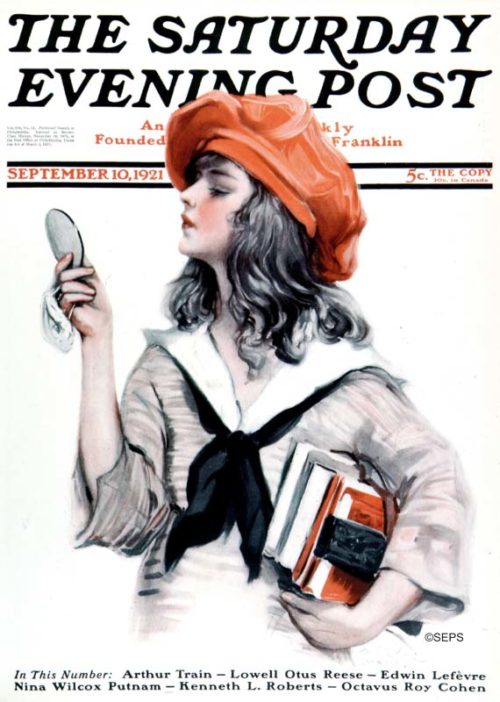
By Paul Stahr
September 10, 1921
Paul Stahr painted five covers for the Post throughout the 1920s, all featuring attractive women. This girl’s middy blouse (named after midshipmen from whom the look was derived) was a popular fashion in the ‘20s, inspired by World War I and co-opted by fashion designer Coco Chanel. The nautical look never really went out of style, but seemed to have its strongest influence around World Wars I and II.
By Coles Phillips
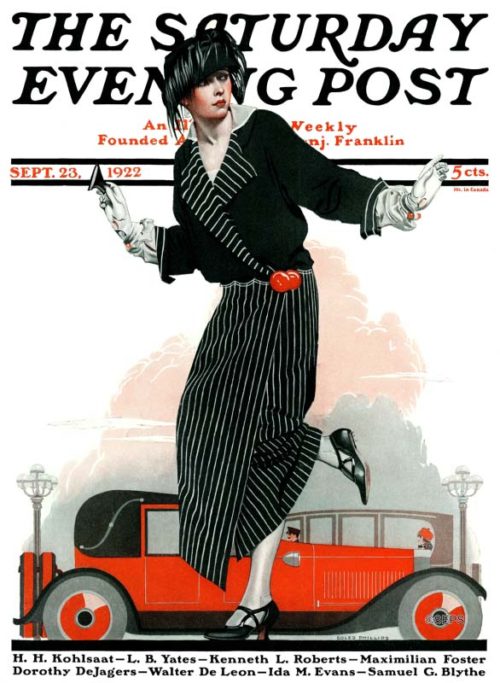
September 23, 1922
Here, painter Coles Phillips depicts the dropped waist and above-the-ankle length that defined women’s fashion in the 1920s. Phillips made an excellent living with his illustrations, but he was often critical of other artists. He called the art of Norman Rockwell too commercial and bland. His comments didn’t bother Rockwell, who responded, “I didn’t lose any sleep over his criticisms. He didn’t like Howard Pyle. Or Rembrandt. Or Degas. Or Leonardo da Vinci… In fact, he didn’t like anybody and couldn’t understand why an artist would want to paint anything but pretty girls.”
Coles Phillips
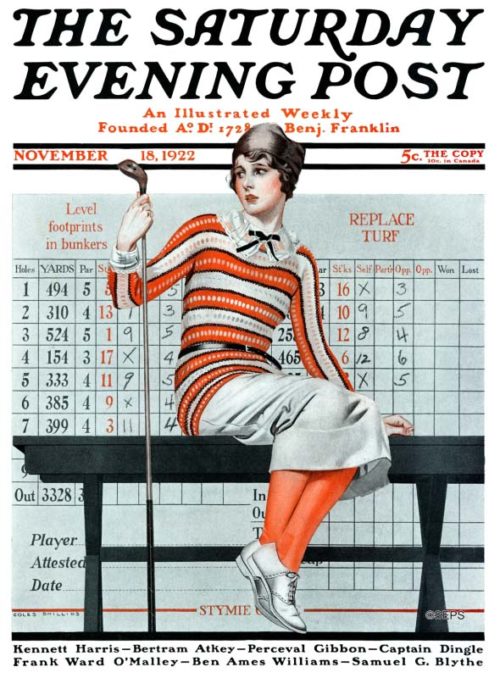
11/18/1922
As prosperity spread to the middle class, golf became the sport of the day, doubling in popularity between 1916 and 1920. This was reflected in the Post, which featured ten golf-themed covers in the 1920s. One of the most visually interesting was this cover by Coles Phillips, featuring a well-dressed but dubious-looking golfer with her subpar scorecard displayed in the background.
Pearl L. Hill
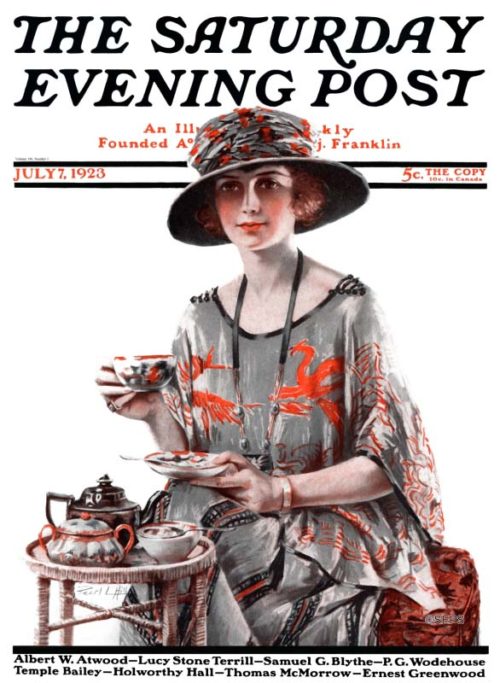
July 7, 1923
1920s America was fascinated with the Far East, and this was reflected in the clothing of the day. This woman’s shift features vibrant red cranes, a popular motif.
Artist Pearl L. Hill painted eight covers for the Post in the 1920s, all featuring rosy-cheeked, bob-haired beauties.
Guernsey Moore
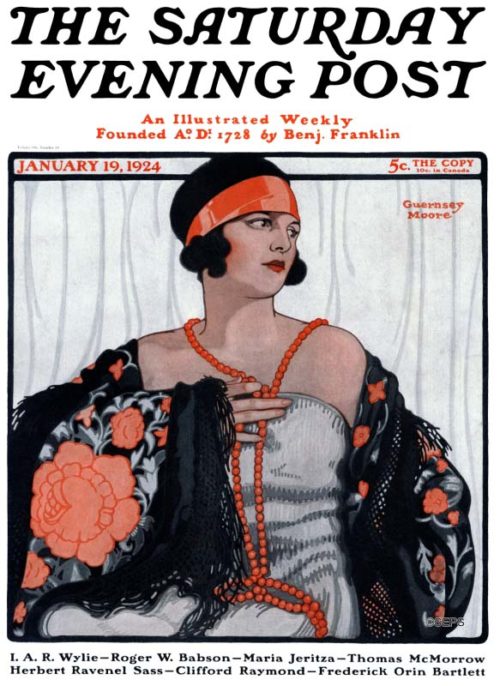
January 19, 1924
This is the last cover (of 63) that Guernsey Moore painted for the Post. The cover is representative of his heavily outlined Arts and Crafts style. The large, brightly-colored flowers once again borrow from motifs of the Far East.
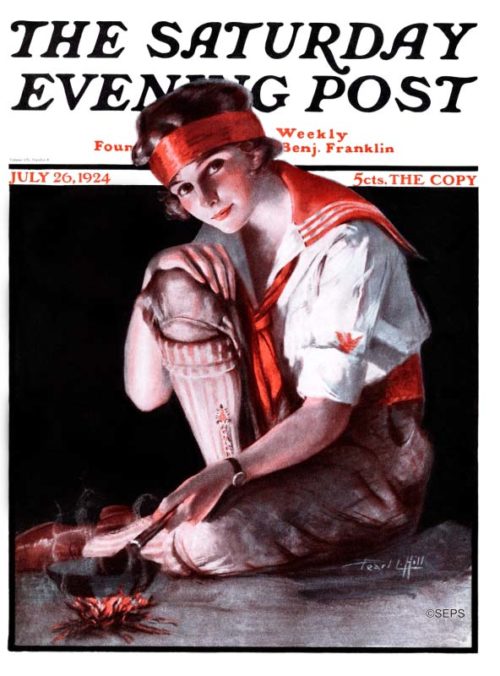
Pearl L. Hill
July 26, 1924
The Camp Fire Girls was created in 1910 as a sister organization to the Boy Scouts of America. Their purpose was to provide outdoor activities for girls. Artist Pearl Hill may have taken some liberties with her painting, as this image seems to depart from the loose, dark bloomers that were part of the uniform in the ‘20s.
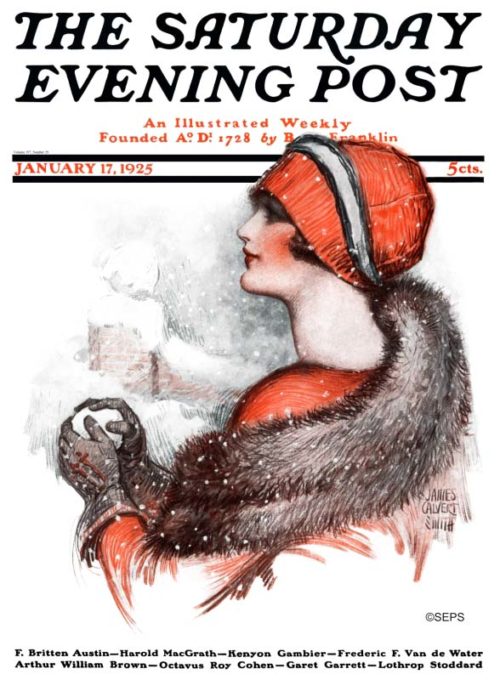
James Calvert Smith
January 17, 1924
This cover by James Calvert Smith features an iconic fashion item from the era: the cloche hat, which was invented in 1908 by milliner Caroline Reboux. In addition to covers for the Post and other magazines, Smith also painted murals in the American Museum of Natural History in New York and the Library of Congress.
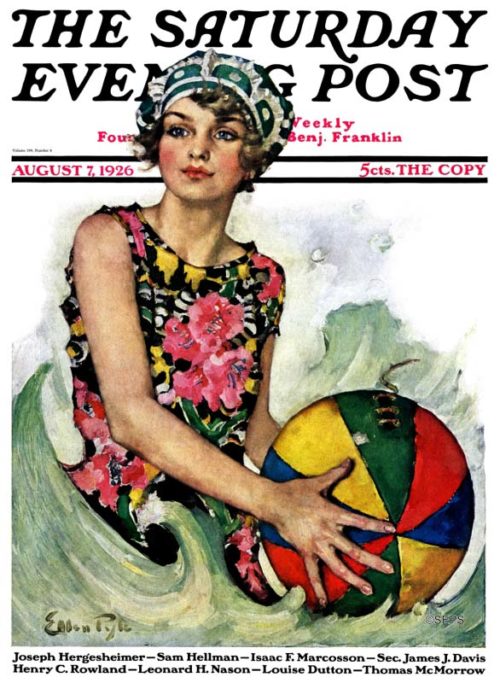
Ellen Pyle
August 7, 1926
Ellen Pyle painted 40 covers for the Post, and this wise-eyed and not-quite-smiling woman was typical of her portraits. Pyle wrote, “The girl I am most interested in painting is the unaffected natural American type, the girl that likes to coast and skate in winter, who often goes without her hat, and who gets a thrill out of tramping over country roads in the fall.”
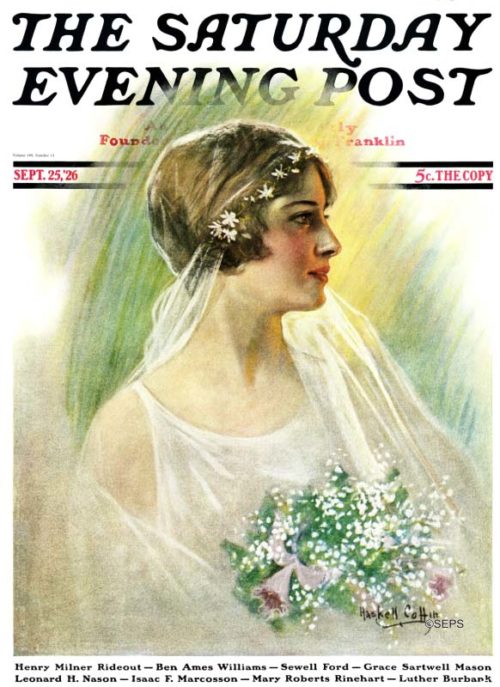
W.H. Coffin
September 25, 1926
William Henry Coffin specialized in images of women, and his Post covers often featured women grasping a pet, book, fan, bouquet, or other object. This was his only picture of a bride. Her close-fitting veil perfectly captures the style of the era.
Contrariwise*: Dirt is good for you
Also be sure to read 7 Microbes That are Living on You Right Now by Nicholas Gilmore.
I am not the neatest of people.
I shade more toward Oscar Madison than Felix Ungar. Don’t get me wrong: I don’t cover myself with slime, but I don’t want to live in a scrubbed-down, super-hygienic world. That’s why I’ve observed my fellow Americans’ cleanliness obsession escalate over the years with something between dismay and horror.
It’s hard even to get dirty anymore. In many public spaces, Purell dispensers seem to be replacing potted plants for decor. My pet peeve is the sanitary wipes installed at supermarket entrances, presumably so you can wipe down the handle of your cart. Really? We’re afraid of getting a few stray microbes on our hands?
This is wrong. Look at the way babies explore the world by sticking things in their mouths, says The New York Times science reporter Jane E. Brody, arguing that the practice may provide an evolutionary advantage. “Researchers are concluding that organisms like the millions of bacteria, viruses, and especially worms that enter the body along with ‘dirt’ spur the development of a healthy immune system,” she writes.
Dr. Joel V. Weinstock, the director of gastroenterology and hepatology at Tufts Medical Center, told Brody, “Children raised in an ultraclean environment are not being exposed to organisms that help them develop appropriate immune regulatory circuits.” There’s evidence that germ-free child rearing may be behind the rise in immune system disorders like MS, type 1 diabetes, inflammatory bowel disease, asthma, and allergies.
This is not to deny that public health measures of the last century, like eliminating contamination in water and food, have saved countless lives, but clearly we’ve taken a good idea and run with it to the point of absurdity.
It’s all about balance. Mary Ruebush, Ph.D., a microbiology and immunology instructor and author of Why Dirt Is Good, writes, “The typical human probably harbors some 90 trillion microbes. … The very fact that you have so many microbes of so many different kinds is what keeps you healthy most of the time.”
So, let’s stop trying to disinfect the world. It’s time to welcome a little dirt into our lives.
—Jorge Jetsohn
*“Contrariwise,” continued Tweedledee, “if it was so, it might be; and if it were so, it would be; but as it isn’t, it ain’t. That’s logic.”
This article is featured in the March/April 2017 issue of The Saturday Evening Post. Subscribe to the magazine for more art, inspiring stories, fiction, humor, and features from our archives.
6 Surprising Exceptions to Freedom of Speech
Subscribe to The Saturday Evening Post for more articles, cartoons, art, inspiring stories, fiction, humor, and access to our archives.
Although the First Amendment to the Constitution states, “Congress shall make no law… abridging the freedom of speech,” Americans don’t have the luxury of always saying whatever they want. Your right to free speech is limited by where you are, what you say, and how you say it.
Here are six areas where your talk can make you liable in criminal or civil court.
1. Obscenity
Most of the legal cases that concern sex and free speech have involved publications (a form of speech as far as the courts are concerned). Obscenity is not protected by the Constitution, but it has been difficult to define what is obscene. In 1973, the Supreme Court, in Miller v. California, came up with a three-part definition of obscene material. A work is legally considered obscene if
- an average person, applying contemporary community standards, would find that the material appeals to prurient (appealing to sexual desire) interest.
- the work depicts or describes, in an offensive way, sexual conduct or excretory functions, specifically defined by applicable state law.
- taken as a whole, the material lacks serious literary, artistic, political, or scientific value.
This limit on obscene speech also applies to broadcasting. The FCC controls what is allowed on air, so you can’t broadcast sounds or images that could be offensive to your audience or use language inappropriate for children.
However, the Supreme Court has, so far, kept the internet free of obscenity restrictions. You can make whatever statements you want on social media sites, but the owners of those sites have the freedom to censor or delete your content if they find it offensive.
2. Lies
Lying is covered by the First Amendment, except when it’s not. You can be prosecuted for lying under oath in court (it’s called perjury). You can also be charged with misleading authorized investigators. Remember Martha Stewart’s conviction in 2004? She went to prison for lying to investigators about her stock trading.
It is also illegal to run dishonest advertisements. And if you deliberately tell lies about people, you can be hit with a lawsuit in civil court for either libel (if published) or slander (if spoken).
Politicians, on the other hand, have broad protections against being prosecuted for lying, and citizens largely have free rein to criticize their governments, even if the comments are false. Luckily for late night talk show hosts, the First Amendment allows citizens to satirically mock a public figure.
3. Violence
You can’t make offensive remarks or personal insults that would immediately lead to a fight. You also can’t threaten violence to a specific person unless you’re making an obvious exaggeration (for instance, “I’m going to kill my opponent at the polls”). Finally, you can’t knowingly say things that cause severe emotional distress or incite others to “immediate lawless action.”
In 1951, the Supreme Court concluded in Dennis v. United States that the First Amendment doesn’t protect the speech of people plotting to overthrow the government.
4. Students’ Speech
Students have limited rights of free speech while in school. In 1986, Bethel School District v. Fraser upheld the right of a school to suspend a student for making an obscene speech. Hazelwood School District v. Kuhlmeier, 1988, supported a school’s right to censor student newspapers. However, many states are now passing laws to grant broader First Amendment protections to student speech.
5. Offending Your Friends and Coworkers
You don’t have the right to say whatever you want in someone else’s home or other private setting. And, as an employee, believe it or not, you have no free-speech rights at your workplace. The Constitution’s right to free speech applies only when the government — not a private entity — is trying to restrict it. For example, an employer can legally fire an employee whose car bears a campaign bumper sticker he doesn’t like.
It’s a different matter for government employees. In Elrod v. Burns, the Supreme Court ruled in 1976 that the Constitution prohibits government employers from discharging or demoting employees for supporting a particular political candidate.
The law also prohibits speech that shows clear intent to discriminate or sexually harass.
It also prevents employees in medical or financial fields from discussing confidential information outside of work.
6. Expressing Your Political Views
The law has never permitted Americans to protest in any way they wanted. While the government can’t control what you say, how you say it must be subject to what the courts consider an appropriate time, place, and manner.
Legal authorities have a responsibility to protect the safety of attendees at political gatherings and to protect protestors themselves. If authorities think you pose a sufficient risk, you can be restricted to a Free Speech Zone. These have been used since the 1980s, principally to contain protestors at political conventions.
House Bill 347 authorized Secret Service agents to arrest anyone protesting in the president’s or vice president’s proximity. They also have this authority at National Special Security Events. These events have included state occasions, of course, but also basketball championships, the Academy Awards, Olympic events, and the Super Bowl. A conviction can result in up to 10 years in a federal prison (another place where your freedom of speech is limited).
Featured image: Shutterstock
“His Wife” by Alice Duer Miller
A suffragist and poet foremost, Alice Duer Miller experienced success as an author of prose as well. Her collection of verse Are Women People? called attention to women’s suffrage in 1915. Miller published several stories and serials with the Post including “His Wife,” a short story about a prominent politician whose wife grasps the opportunity to make a first impression with his cohorts in a satirical way. “His Wife” offers characters that subvert feminine roles and behaviors at the turn of the century.
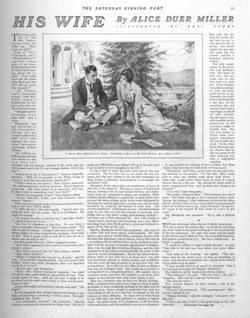
“The great question is,” said Mrs. Delany, setting down her coffee cup: “Must I ask his wife?”
Cries of “No!” “Certainly not!” “Why should you?” rose from various parts of the room, but her husband was at length heard saying above the tumult: “You really must ask her sometime, Rose, and why isn’t this an excellent occasion?”
“Oh, Gilbert, you’re absolutely wrong,” cried Mrs. Fraile, making a bound from her corner to the very center of the hearthrug.
“Margarita never encourages wives, does she?” said a voice.
Margarita was not distracted by this interruption. Putting the last speaker aside with a mild “As if I ever minded the creatures,” she went on, addressing Gilbert Delany:
“No, Gilbert, no. If Rose asks his wife once there’s no reason why she shouldn’t ask her always; whereas if she never asks her the woman may think it’s our strange custom. Don’t you see?”
“And is she so out of the question?” someone languidly inquired. “Will she be dreadful in the White House or wherever it is they are politically headed for?”
“That’s what no one knows,” Rose Delany answered. “No one has seen her, so far as we know. That’s what’s so unnerving. She never seems to go anywhere with him. So there must be something, don’t you think?”
“Doesn’t he ever speak of her?” Jerry Spelacy asked.
“Never,” said Mrs. Fraile; and other feminine voices echoed “Never.”
There was a long pause while everyone meditated deeply, and at last Mrs. Delany spoke.
“I shall ask her,” she said sternly. “And if she’s too awful he won’t let her accept. He is so intelligent. He could be trusted.”
“He mayn’t be able to prevent her,” said Mrs. Fraile. “I mean if you write to her — “
“Ah, but I’d telephone to him first. Do you think I have no foresight, Margarita?” Rose Delany wailed. “He will be able to manage. Though if she does accept — and I always believe in being prepared for anything — what shall we do? Who, I mean, shall we toll off to take her in to dinner and be kind to her?”
Another pause followed. Then a suggestion came:
“Isn’t Jerry supposed to have rather a knack with other people’s wives?”
“Not when you want him to,” Mrs. Delany replied.
“How about Gilbert?”
“Gilbert is philanthropic but not at all kind,” said his wife. “You couldn’t depend on him. But how about John Fraile? Don’t you think, Margarita, that your husband would do it for us?”
“Not for me,” said Margarita.
“Well,” Mrs. Delany murmured helpfully, “we could tell him it was a great political opportunity for him. That would appeal to him. After all, the man is going to be governor, and he might take a fancy to John and do something for him.”
John’s wife smiled rather grimly, but she only said: “He might.”
In the meantime Mrs. Delany had seated herself at her desk and had begun resolutely to write a note. The sight maddened Mrs. Fraile.
“I’m unalterably opposed,” she protested. “Martin Gorham was perfectly contented as things were. He never made any difficulties about dining with us in the past, and I see no point at all in dragging in his wife.”
It was a risk in which she more than anyone else was concerned. For the first time in ten years she was not bored, and this new interest in life she saw threatened by Rose Delany’s obstinate determination to encourage the candidate’s wife.
Margarita Fraile was a type not uncommon, at least on this side of the Atlantic. She was a woman of brains and beauty, leading a life of conventional fashion, and underneath eaten up, consumed by energy and ambition. With abilities amply sufficient to enable her to excel on her own account she was a willing victim to the belief inculcated in her since her earliest days that a woman can only be truly successful by inspiring the success of some man. The obvious ambitions — position and money — she had attained early by the then not too easy process of marrying John Fraile, who at that time — young, good-looking, athletic — had been not a little competed for. But John Fraile at twenty-seven, handsome and promising, was a very different thing from John Fraile at forty, stout and inclined to spend all his time at the club.
Besides, Margarita herself had progressed. She wanted a wider field and more serious achievements. She had taken a good deal of trouble with a secretary of state with the idea that diplomacy was her future, but in this even as a mouthpiece Fraile had failed her, for he declined to leave New York for an even temporary appointment in Bogota. After that she had discovered Leo Grayling, and the first recognition of his poetry was undoubtedly the result of her wise and careful arrangements. But he had almost immediately fallen in love with her in an intractable way, and had absolutely refused to discuss meters and publishers with her until she had promised to go and live with him in Guadalupe. Love did not solve Mrs. Fraile’s problems; hers was not a hungry heart. She would have yielded to nothing short of a conquering general. She wanted only a vicarious career, and men who wanted to cut short their careers on her account were worse than useless to her.
Then on a fortunate day she had met Martin Gorham. With a political future just in that stage at which it might be helped by a few accidental meetings in the right kind of drawing-room, clever enough to appreciate her, and too cool-headed to fall in love with her, he seemed to her the solution of every difficulty. He came two or three times to tea with her, and then suddenly it became a regular habit. He spoke freely of his prospects, of all the inner twists and turns; and his confidence was never misplaced. Not only did she keep his secrets but she had the art to hide and the wit to advise. She looked ahead and saw herself someday the power behind a national administration.
The only uncertainty in the situation was Gorham’s wife. She knew he had one, but she could find no one who had ever seen her. From Gorham himself she could get no clew. He never spoke of her at all. Generally she would have considered this a bad sign. In her experience she had usually found that a man began to talk of his wife — recounting her sound valuable qualities just in proportion as his conscience began to trouble him. She did not want to think that Gorham’s conscience did not trouble him at all. On the other hand, there was just the chance that he did not speak of his wife because she was a negligible quantity.
It was toward the solution of this problem that Rose Delany was hurrying her with such reckless speed.
“Margarita,” said Rose, laying down her pen and turning seriously to the speaker,
“It’s like this: Men — some men at least — are terribly weak about their wives. I mean they would rather leave them at home in a good temper than in a bad one. My asking her might make it easier, pleasanter for him; and one does want things to be pleasant.”
“It’s a risk,” said Margarita.
“Not really,” returned Rose. “The Gorhams live out of town. This letter will get to her tomorrow before noon. During the morning I shall telephone to him at his office, and he will have three or four hours before he goes home to make up his mind what to do. Don’t be stupid, Margarita. Of course if she doesn’t do him credit he won’t let her come.”
But Margarita only repeated: “It’s a risk, a hideous risk.”
II
The next afternoon when Martin Gorham came home — it was a warm November day — he found his wife lying flat on her back on the grass looking up at the cloudless sky of the late afternoon. He came and stood with his hands in his pockets and looked at her; she rewarded attention, and seemed accustomed to it. She was a Southerner. At length he grinned.
“I would be willing to wager a small amount,” he said, “that this is the way you have spent your entire afternoon.”
“And some of the morning,” she replied.
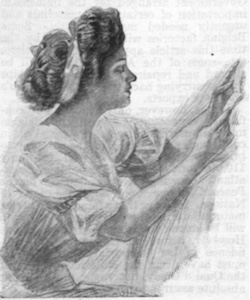 “The gardener sent for me about noon, to look at something or other — you know how gardeners are — and it never seemed worthwhile to go in again.”
“I may as well tell you at once,” he returned, “that I do want you to accept the Delanys’ invitation.”
She rolled her lovely head on its chintz cushion.
“The Delanys?” she said. “Who are they? Oh, yes, I remember. But I haven’t had any invitation.”
“She said she wrote.”
Mrs. Gorham flapped her hand toward a pile of unopened letters.
“Oh, yes,” she murmured. “The morning mail. But I haven’t opened it yet.”
“Helena Gorham,” said her husband, “you are a very lazy girl.”
“I don’t see why it isn’t a very good thing to be,” she observed.
“In a way it is,” he answered, sitting down cross-legged on the grass beside her, “but there are occasions when one must rouse oneself.”
“I can rouse myself when necessary,” said she, yawning.
“Well, this is an occasion.”
“Why do you want me to dine with these people, Martin?”
“In the first place because they are influential. They are, as I understand it, more than fashionable. They have flung themselves through fashion and come out on the other side, greedy to be in touch with real life, eager for a new field. They would like to have their fingers in politics — some of the men actually have. They might be able to help me; they could certainly harm me.”
Helena nodded.
“All excellent reasons why you should go.”
“Please come, Helena.”
“Oh, life is very hard on a poor woman,” cried Mrs. Gorham, clasping her long arms under her head. “Most men want their wives to stay in the home, but you are always driving me out.”
“Trying to drive you out, Helena. But there’s another reason for your going.” He stopped abruptly.
Mrs. Gorham sat up and looked at him and looked at him.
“Martin,” she said, “do you mean to say you need to be rescued again?”
“No, no,” answered the future governor eagerly; “it’s nothing of that kind. But these people — how shall I describe them? They are like a band of cheerful pirates. I should like to have your advice, your wisdom — ”
“You would like,” said Helena, “to let it be generally known that there is an able-bodied woman prepared to look after you. But couldn’t you just explain that, without my having to appear personally?”
He shook his head. “I never dare mention your name,” he said. “Sometimes it rises to my lips, Helena, but I bite it off. I don’t dare talk of you as if you were young, attractive and tolerably dear to me or people would make your life a burden, wanting to come to see you and ask you to dinner. One woman — a Mrs. Fraile — did ask me point-blank what you were like, and I said very distinctly, ‘I won’t tell you.’”
“Ha, ha!” said Helena.
“I said that, but I must own, Helena, that I gave the idea that I wouldn’t tell because you were too dreadful. It was in my tone — it sounded loyal and sad. Most of the people who know I have a wife are, I believe, under the impression that you are mentally deficient or physically unpresentable — perhaps both.”
“Fortunately neither impression would be hard to dispel,” said Mrs. Gorham, rising to her feet. “Very well, then, I will go. I will dine with these friends of yours; but it’s not to be regarded as a precedent, Martin, remember that. And — oh dear!” she murmured as she walked away with two cushions clasped in her arms, “things were very different in Alabama.”
He watched her across the lawn, and as she was about to disappear into the house it occurred to him to call out: “You’re no helpmate, you know.”
She did not turn, but wagging her head replied: “Wait and see.”
III
Martin, who thought his wife always good-looking, expected her to do something notable on the occasion of the Delanys’ dinner. He found himself looking forward with pleasure to the effect she would produce. But on the evening in question she was already in the cab when he came down the steps of the little hotel where they were staying; and so he did not see her until she was actually entering the Delanys’ drawing-room.
Something notable had certainly been done. He looked twice to be sure it was she. She had made herself look, as he put it, not only a sight but just what her hostess had most fearfully anticipated.
She had drawn back her hair so tightly that her head looked like an egg, and from a small knot at the top a purple feather waved. From some unimaginable source she had obtained a maroon-colored silk dress made very full and so short as to show completely a pair of flat patent-leather ties turned up at the toes. Her gloves were spotless, it is true, but so much too large for her that little spirals of suède projected beyond her fingertips. She wore innumerable silver bangles, three strings of colored beads, and she carried a very dirty white feather fan.
If Martin had been inclined to anger — and he really had nothing but a passing thought that she might have told him what she was up to — he would soon have lost the feeling in admiration of her performance. A first-rate comic actress had been lost in Helena.
Before dinner she was reserved — merely pursing her lips and rolling her eyes; but at table she began to unbend, and Martin soon found it was impossible for him to listen to what his neighbors were saying, so eagerly was he catching the fragments that reached him from across the table. Both Mrs. Fraile and Mrs. Delany — he sat between them — were as kind and polite as possible. He saw, indeed, that this pity for him was as sincere as any emotion they had ever shown. He had a hysterical desire to ask Mrs. Fraile what she thought of his wife, now she had seen her.
But he knew he would never be able to get through the sentence, particularly as at that very instant he heard Helena saying: “Onions? Oh, no; Mr. Gorham and I never eat onions. We think them so unrefined; and I may be peculiar, but I hate anything unrefined!”
There was, however, one spectator present on whom Helena had not reckoned, and that was Thomas Baxter. Baxter was the member of the party committee who had opposed or who at least was cold to Martin’s nomination. Mrs. Delany had asked him in the hope of doing the candidate a good turn. Now Baxter had once met Helena, though she did not remember it. He had sat behind her a whole evening in a box at a political meeting; and he remembered her as one of the most charming people he had ever known.
Arriving at dinner early he had soon been made aware of Mrs. Delany’s attitude of mind toward her unknown guest. But he had told her nothing, promising himself the more amusement when Mrs. Gorham appeared in all her beauty. At first he had not believed it was the same woman; but as he watched her the real facts began to dawn on him, and by the time the men came out from the smoking room he was thoroughly in the mood.
Helena by this time had passed beyond all bounds. During the earlier part of the evening her performance though realistic had been restrained, but now as she saw the moment of departure approaching she gave herself a larger scope. Firmly seizing the reins of conversation from the hands of her hostess she talked without allowing anyone else to insert a word.
When the men came in she was launched on a description, room by room and article by article, of what she persisted in referring to as “our cute little house.” Whether she had ever seen such a place as she described Martin, listening to her, could not decide; but as he heard her speak of sweet embossed mustard-colored papers, plush dadoes and crayon portraits he felt that if it was in truth a work of the imagination the creative as well as the histrionic genius had been granted to his wife.
Her narrative was heightened, too, by its terrible effect on her hearers, whose white faces actually quivered with exhaustion and irritation — not decreased as Helena stopped now and then to patronize Mrs. Delany’s own priceless porcelain and pictures.
Baxter found himself standing with Gorham near the door.
“Your wife — ” he began, but could get no further.
With a common motion both men stole into the hall and shut the door tightly behind them. There, covering their faces with their hands, they shook with laughter.
After a few minutes Gorham regained sufficient composure to say: “My wife — ”
But he, too, was not able to go on. They had become hysterical like schoolgirls.
Once when the door opened something about a “cunning little gasolier” floated out to them; so that finally they sat down on the stairs and gave up.
Because a man’s wife has a turn for light comedy is not a good reason for nominating him for governor, but as the two men sat there it became quite evident that any real opposition between them was quite impossible. A stronger power than their own had made them friends.
It is improbable that Helena felt any alarm at this absence. Forgetting her former acquaintance with Baxter she supposed he and her husband were talking politics. She had just decided to add a snuffle to her manner of speech, and it was going off very well.
Suddenly the door opened and the two men entering arm in arm announced in unison: “Mrs. Delany, we have come to denounce one of your guests.”
Mrs. Delany turned very calmly. “Dear me,” she said, “what do you mean?”
At this point Helena rose and saying hastily that she had had a very pleasant evening moved to the door, but they blocked her.
“This is the masquerader,” said Martin.
“Isn’t she really your wife?” someone asked.
“Yes, and no,” he replied.
“Let me explain,” said Baxter. “This lady is Mrs. Martin Gorham, but not in her real aspect. She is a travesty, a deliberate hoax. She is really lovely and charming, but she has chosen for her own wicked purposes to appear as she now does. She has been, in fact, ‘putting up a game on us.’”
It is not surprising that Mrs. Delany, as the truth reached her, was angry.
“Oh, I see,” she returned quietly. “I’m afraid I haven’t much taste for practical jokes, especially when they spoil an evening which was hospitably intended. Good night, Mrs. Gorham.”
Helena under her lashes glanced in her husband’s direction, but saw at once she could expect no help from him. She put up her hands and loosened her hair to its natural softness, and then she said in the most melting tone that Alabama ever produced: “Will no one undertake my defense?”
Yes,” said Jerry Spelacy, uncoiling himself from a sofa, “I will, for I think you are being badly treated. I was here, Mrs. Gorham, when the idea of asking you to dinner was first canvassed, and I can assure you that the invitation — ”
“Jerry, will you be silent!” said Rose Delany.
“No,” he answered, shaking his head, “not while my client’s interests demand that I should speak. Or, rather, I will ask you this question, Rose: Was your invitation to Mrs. Gorham offered with that simple hospitality that you have just assumed or was it in the blackest, most definite hope that she would refuse and leave Mr. Gorham free to — ”
“Jerry!” wailed his hostess.
“You see,” he went on, “your terror convicts you. No, no, you’re not the openhearted innocent that you would like to appear, Rose. You two ladies may part as friends or as enemies; but at least your guilt is equal. So far as wickedness goes there’s not a pin to choose between you.”
Helena with a courage rare in those who are completely in the wrong made a motion toward her hostess.
“I’m really sorry if I spoiled the party,” she said. “Only I enjoyed it immensely.”
“And I,” cried Martin and Baxter.
“And I,” said Jerry.
Before anyone had time to grow angry again Baxter had made everyone promise to dine with him the next night.
Baseball: For the Love of the Game
April 16, 1910
Anton Otto Fischer
This article and other features about baseball can be found in the Post’s Special Collector’s Edition, Baseball: The Glory Years. This edition can be ordered here.
In this anonymously written article from 1911, a young man gives up a career as a shoemaker in order to play ball.
I am not sure now whether I went into professional baseball because of the money or because I liked the game; probably it was both. I was 22 years old and I had been working five years in a shoe shop. Baseball was my recreation.
In the factory I had seen handwork supplanted by machine work until the only hand process left was cutting the leather for the vamps and uppers. I realized that less and less of the workman’s intelligence was called into play; more and more he was becoming a mere human machine. The work was so monotonous. A fellow with imagination couldn’t get up any mental excitement wondering what was to become of the shoe he was working on. I demanded some occupation where my imagination wasn’t reduced to sole leather. I wanted to be able to show what folks now call initiative — thinking out a problem for myself, without the help of anybody else, before anyone else.
Right here my mother enters the grandstand, so to speak. When I tried to decide whether to quit the shoe shop and make my living at baseball — our living, I should say, because I was supporting my mother — I found the old lady was strong for my making the change. She was the greatest fan you ever saw — is today at 72. Her big argument was something like this: “Who hears of a man in a shoe shop, Nealie?” she said to me. “Who hears of the superintendent unless there is a strike — and you’re far from being a superintendent, me boy. Now a ball- player gets his name in the paper every day he plays and his picture once a week. I want me boy to be known all over the country. He will be if he goes on the diamond to stay — for you’ve the making of a great player, Nealie. But me boy won’t be heard of if he sticks to his last.”
So I told the boss to fill my place the first of March. That was in 1884. The time came and the boss asked me to stay another week. He said there wouldn’t be much work, but that he wanted me to help take stock. I replied: “I have worked my last day in a shoe shop.” It was a kiddish remark, especially as I hadn’t landed a base- ball job; but probably it was just as well to cut loose and make a base hit or strike out in my chosen profession. Anyhow I never went back. I have stuck to baseball from that day to this, and mother is forever saying: “What did I tell you, me boy? You were born with a baseball in the back of your head, which is the next best thing to coming into the world with a silver spoon in your mouth.”
— “The Making of a Ballplayer,” Anonymous, Oct. 28, 1911
Top 10 Spring Reads
Every month, Amazon staffers sift through hundreds of new books searching for gems. Here’s what Amazon editor Chris Schluep chose especially for Post readers this spring.
Fiction
A Piece of the World 
by Christina Baker Kline
The best-selling author of The Orphan Train returns with a novel based on Andrew Wyeth’s mysterious painting Christina’s World.
William Morrow
Celine
by Peter Heller
A Brooklyn woman who specializes in finding lost family members heads to Yellowstone to investigate a missing photographer.
Knopf
 The Tea Girl of Hummingbird Lane
by Lisa See
The best-selling author explores the lives of a mother from a remote Chinese village and her daughter, who has been adopted by American parents.
Scribner
 Beartown
by Fredrik Backman
The new novel from the Swedish author of the delightful A Man Called Ove revolves around a small town that needs to win a junior ice hockey championship.
Atria
 Mississippi Blood
by Greg Iles
A modern-day Southern epic, this final installment in the Natchez Burning trilogy delivers with a story of love and honor, hatred and revenge.
William Morrow
Nonfiction
 Homo Deus
by Yuval Noah Harari
Two years ago, Harari’s book Sapiens: A Brief History of Humankind took the nonfiction world by storm. Homo Deus expands on the final chapters of that first book, exploring what it will mean to be human in the times to come.
Harper
 Dodge City
by Tom Clavin
Get a closer look at one of the most turbulent towns in the West, featuring a who’s who of famous characters: Wyatt Earp, Bat Masterson, Jesse James, Wild Bill Hickok, Billy the Kid, Doc Holliday, and many more.
St. Martin’s Press
 South and West
by Joan Didion
This book from the master of the contemporary memoir is different from her normal fare. It consists of her research notebooks from trips to the U.S. South and West, offering an illuminating glimpse into her writerly mind.
Knopf
 The Rules Do Not Apply
by Ariel Levy
New Yorker writer Levy was pregnant, married, and financially secure when she left for Mongolia in 2012. A month later, none of that was true. How does a person deal with that kind of loss? How can she pick up the pieces?
Random House
 Killers of the Flower Moon
by David Grann
The author of The Lost City of Z has written a supreme example of narrative nonfiction, weaving a tale of 1920s oilmen, Texas Rangers, Native Americans, a nascent FBI, murder, intrigue, and conspiracy.
Doubleday
News of the Week: March Madness, Mad Men Ads, and Meatballs of the Swedish Variety
Is Your Bracket Busted Yet?
There are many things I don’t understand: how the pyramids were created, the size of the universe and how we fit into the grand scheme of life, the popularity of Steve Harvey. I’d add to that list the mania that surrounds March Madness and college basketball in general.
It’s not that I don’t understand why people like basketball (though I’m a tennis and baseball guy myself), I just don’t understand the annual craziness of the NCAA men’s basketball tournament. There are people who dedicate weeks if not months to filling out their bracket, and many of these people are people who have no interest in basketball at all the other 50 weeks of the year. Who really cares about these teams, unless you go to the school, you’re an alumnus of the school, or you have a kid who goes to the school? At least in pro basketball you probably live in the city of a particular team or like certain players.
But hey, if you enjoy it and plan on watching it I don’t want to be a buzzkill. Here’s a handy bracket that you can print out from CBS, which will be airing the tournament for the next couple of weeks. I just can’t wait until it’s over and we can get back to regularly scheduled programming.
Pass the Heinz
AMC’s Mad Men is probably my favorite TV drama of all-time. Besides the sheer brilliance of the acting, writing, and directing (I know that’s not an in-depth analysis but it happens to be accurate), I always thought that many of the companies that Don Draper’s advertising agency worked for should actually take the campaigns used on the show and use them for their products in real life. Now, one has.
Heinz is going to use the idea Don came up with, to show the foods that Heinz ketchup would be used on—burgers, fries, etc.— without actually showing the Heinz bottle. In the show Heinz didn’t go with Don’s idea, but now they like it! We’ll see billboards in New York City and print ads too.
Here’s Don’s pitch:
RIP Robert James Waller, Joni Sledge, Christopher Gray, Jay Lynch, and Jack H. Harris
Writer Robert James Waller is best known for his novel, The Bridges of Madison County, which was made into a film starring Clint Eastwood and Meryl Streep. He also wrote several other novels, including Border Music, Slow Waltz in Cedar Bend, Puerto Vallarta Squeeze, and the sequel to The Bridges of Madison County, A Thousand Country Roads.
Waller passed away last week from cancer at the age of 77.
Joni Sledge was part of the group Sister Sledge, famous for songs like “We Are Family,” “My Guy,” and “He’s The Greatest Dancer.” She passed away Saturday at the age of 60.
Christopher Gray was an expert on architecture and a historian who wrote the popular “Streetscapes” column for The New York Times. When the column ended in 2014 after 27 years, Gray continued to write it on Facebook. He passed away last Friday at the age of 66.
Jay Lynch was an important figure in the underground comics scene of the 1960s and ’70’s. Besides creating the comic strip Nard & Pat and starting magazines like Bijou Funnies, he also drew for Bazooka Joe comics, Garbage Pail Kids, and Wacky Packages (something I collected when I was a kid, probably one of the first “alternative” or semi-subversive things a kid at that time could get into). Lynch passed away earlier this month at the age of 72.
Beware of the Blob, it creeps, it crawls! Fans of classic monster movies will remember that line from the opening of The Blob, one of the many movies produced by Jack H. Harris. He also produced Dark Star (the first feature film directed by John Carpenter), The Eyes of Laura Mars, 4D Man, the 1988 remake of The Blob, and other films. Harris passed away Tuesday at the age of 98.
By the way, another remake of The Blob is currently in development.

“You May Want to Marry My Husband” Essayist Dies
Just two weeks ago, The New York Times published an essay that went viral titled “You May Want To Marry My Husband.” It was written by Amy Krouse Rosenthal, who was diagnosed with ovarian cancer and only had a short time to live. Rosenthal passed away this week. She was only 51 years old.
Rosenthal wrote more than 30 books in her short time, including children’s books like Duck! Rabbit!, Uni the Unicorn, I Wish You More, and Bedtime For Mommy. She was also a filmmaker and essayist and wrote a really terrific memoir titled Encyclopedia of an Ordinary Life. Her most recent book was 2016’s Textbook Amy Krouse Rosenthal, where she actually encouraged readers to send her text messages.
The Biggest Threats to the Web (According to the Guy Who Invented It)

When the inventor of something has an opinion about that something, you should probably listen to him.
Sir Tim Berners-Lee created the very thing you’re looking at right now, the World Wide Web. It turned 28 last Sunday, and Berners-Lee wrote a letter for The World Wide Web Foundation outlining what he sees as the three biggest threats we face in the online world.
You can probably guess what they are. One is that we’ve lost control of our personal data, one is that false information can spread quickly and easily on the web, and the other is the dangers of political advertising. These are all major problems that, well, let’s face it, will probably never be solved since people want easy access to information, convenience, speed, and they want to live on social media.
My pick for the biggest threat to the web? Auto-play videos.
This Week in History
Coca-Cola First Sold in Bottles (March 12, 1894)
The first glass bottles of the popular soft drink (invented eight years earlier by Dr. John Pemberton) were sold at a soda fountain in Vicksburg, Mississippi.
President Andrew Jackson Born (March 15, 1767)
It’s the 250th birthday of our seventh president, who was called a brawler, gambler, drunk, thief, and adulterer by supporters of rival John Quincy Adams.
This Week in Saturday Evening Post History
“St. Paddy Cake for Policeman” Cover (March 16, 1940)

March 16, 1940
Magazines don’t do covers like this anymore, do they? It’s such a bold, specific image. I love the attention to detail in the bowl. The artist, Albert W. Hampson, could have just drawn an empty bowl but he left some cake batter in there and you can see the scrapes on the inside.
Use Your Noodle
Some weeks I wonder if I should even mention what food month it is. If it’s at the start of the month, sure, they’re well worth highlighting. But if it’s the last week of the month it’s probably too late. Here we are on March 17. That’s still early enough to mention what food month it is, isn’t it?
March is National Noodle Month! There are many things to make beyond chicken noodle soup, like this Broccoli Cashew Casserole, these Soba Noodles with Kimchi, or maybe Betty’s Swedish Meatballs, which ideally should be served over egg noodles.
Betty, by the way, would be Betty Draper, Don’s wife. That recipe is from the fantastic Unofficial Mad Men Cookbook. I don’t know if Heinz ketchup would be good on Swedish meatballs and noodles but give it a try.
Next Week’s Holidays and Events
National Cherry Blossom Festival (March 18)
Because of this week’s east coast snowstorm, the official opening of the annual Washington, D.C. festival has been pushed back to March 18. It runs until April 16.
First Day of Spring (March 20)
It’s probably not going to feel like it in many parts of the country, but the Spring Equinox begins in the northern hemisphere at 6:28 a.m.
Danger: Live Bear Trap
Ron Canby saw the bear first. On Saturday morning, he trudged up the driveway to collect the morning newspaper. In the quaint coastal village where he had spent the last three decades, traversing a driveway was the equivalent of a steep hike. Ron’s house perched on the side of a mountain. Cedar trees lined his property except to the west which faced the ocean. Ron wore the blue cotton pajamas his wife had given him the Christmas before she died. He missed Dot, but he did not mind being a widower. His new girlfriend lived in the city. Leona was a yoga instructor. She made him eat sushi.
Ron was not a tall man, nor was he distinguished. He walked with his shoulders rounded and his stomach protruding. His moccasins flapped against his bare feet, the leather heels long since worn. Running was out of the question, not that it occurred to him to do so. Until that morning, he had always fancied himself something of a risk-taker. He had researched bear encounters and envisioned how he would react on such an occasion. Appear confident. Make noise. Frighten said bear.
All plans vanished when Ron reached the top of the driveway. A black bear stood less than 10 feet away, its massive head lowered threateningly. The Saturday newspaper, bulkier than the weekday editions, rested in the open space between man and beast. Ron was out of breath. He clutched his pajama top as if to prevent a heart attack. He thought, I should lie on the ground and play dead. Then, I’ll fall on my face trying to get into position and the bear will maul me. Finally, I have nothing on underneath these pajamas. God! What was I thinking?
He eyed the newspaper, rolled and stuffed in a protective plastic bag, a feeble weapon not likely to withstand a swipe of the bear’s huge paw. One of Ron’s great joys in life was a leisurely perusal of the weekend edition while he sipped his morning coffee. In the slim event he survived the attack, the newspaper had better stay put.
As Ron considered his options, the bear opened its mouth and snapped its jaw. Ron’s heart skipped a beat. Unlike grizzlies, black bears often ate their victims. They also climbed trees, ripped apart cars and ran as fast as racehorses. These facts came to Ron in panicked bursts. Here was a life or death situation. Either he would survive with a thrilling story to relate or he would become a grim statistic on the evening news. Although he rather liked the idea of his photograph flashed across a television screen while his favorite news anchor said his name, the choice was obvious. He began a slow, terrified retreat. The bear watched him go. To Ron’s relief and disappointment, the animal did not follow.
Later that day, long after the bear had scampered up the mountain, Ron ventured outside to retrieve the newspaper. His next-door neighbor was busy washing his convertible. Ron called out hello. Phil Berdine nodded, gave him a non-committal wave and a vague smile. Ron persisted. “I saw a bear this morning,” he said. “Big male. Scared me half to death.”
Phil was not a man easily impressed. He played the stock market and made enough money to keep his wife clothed in Prada and Versace. Raised in a family of boasters however, he loved nothing more than a big fish story. So the old guy had seen a bear … Phil dropped the garden hose and crossed his arms against his chest. “Really?”
Ron smiled. He hurried onto the Berdine property where he told his story. Phil whistled under his breath. “You’re damn lucky. We heard the dogs barking, and we wondered what was up. My wife Shelley — she’s at the window, give her a wave — peeked out. I guess we just missed it.”
“Fortunately you missed it,” said Ron. He had never been this close to the Berdine house. In fact, he could not remember if he had ever spoken to anyone who lived there. They were a busy, working family. Ron had retired years ago.
“Well,” said Phil, “watch yourself. No berries up the mountain. It’s a bad year.”
Ron registered the dismissal and the tinge of disdain in Phil’s smile. “A bad year,” he agreed, and he cast furtive glances in the windows of Phil’s house as he backed away.
The next day, Ron lingered at the end of his driveway until he spotted Lindsay Kellerman leaving her house. “Had a bear encounter,” he said. “Scared the bejesus out of me.”
Lindsay planted her hands on her hips and nodded. “The big male? I’ve seen him.”
Ron frowned. “At a distance maybe, but —”
“I was walking my dogs and there he was not 30 feet away.”
“Thirty feet?” Ron hurried across the street. “That’s nothing. I could practically feel his breath on my face.”
“Kiwi, my old girl, barked like mad, and wouldn’t you know it, the bear lopes toward us.” Lindsay smiled. It was a good story, and she knew it. She had already emailed the relatives back east. “Ever had a black bear running toward ya, a full-grown male to boot? Not an experience I’d like to repeat.”
“What happened?” asked Phil Berdine. He had been climbing into his car when he noticed the two neighbors talking. Feeling sociable and not in the mood to attend his daily fitness session, he approached.
Lindsay touched her hair. The velour tracksuit was a bit much, but Phil had the bluest eyes. “I was just saying that the bear came after me and my dogs.”
“Ha,” said Phil. “Bet you’ve got streaks in your underwear.”
It was dumb joke, but Lindsay laughed loud and long. “Let’s just say I should’ve bought a lottery ticket because luck was on my side.”
“You ran,” Ron concluded.
“I did not,” said Lindsay. “The bear kept coming. Kiwi was barking, and I was sure we had a fight on our hands. I had nothing to lose so” — she paused for effect, smiling as the two men leaned forward in anticipation — “so I yelled.”
“What did you yell?” asked Phil.
“Scat.”
Ron could not hide his sarcasm. “You yelled scat at a full-grown bear?”
“It worked,” said Lindsay, and to her delight, Phil chuckled. “Sounds good to me,” he said.
They were silent for several minutes, their eyes on the wilderness that loomed behind the Kellerman house. “I should probably report it to the village office,” said Ron.
“Oh, don’t bother,” said Lindsay. “I already did.”
Later that day, a live bear trap appeared on the Exton Road cul-de-sac. It looked like a giant blue oil drum turned onto its side with wheels on the bottom. A metal grate covered one end, a trip door the other. Lindsay took a picture of her dogs sitting in front of it. She had her head in the doorway, inspecting the quart of molasses put there as bait when Ron approached. She jumped when he spoke.
“What day did you see it?” he said.
“Saturday evening. Right after dinner.”
“Saturday morning for me. I guess I saw it first.”
Lindsay shrugged. She motioned to the molasses. “I expect we’ll find the bear in there by morning.”
“I expect so.”
“Do you want me to take your picture?”
“Okay.”
With a quick glance at the wilderness that ringed most of the cul-de-sac, Ron stood in front of the bear trap. He smoothed his hair and regretted he had not worn a nicer shirt.
“That’s a bad place,” said Lindsay. “Step to the right. You’re covering the danger sign.”
Ron frowned, but he obeyed. He would frame the photograph and present it to Leona. He would tell her the bear was inside and mad as hell. She wouldn’t know the difference.
“Smile,” said Lindsay.
“I am.”
“Not much.”
“It’s as good as I’ve got.”
“If you say so,” and Lindsay snapped the picture. “When it’s developed, I’ll drop by your house. You can make me a cup of coffee.”
She whistled for her dogs. The animals emerged from the bushes at a run. “I should go.”
“Me too,” said Ron.
They both stared at the danger sign, each noting the telephone number of the local wildlife conservation officer. “Guess it won’t be long now,” said Lindsay.
Ron nodded. He waited until she left before he inspected the bear trap himself.
Over the next few days, the trap sat in the cul-de-sac. Other neighbors inspected it, photographed it. Ron told them about his encounter with the bear. “I saw it first,” he said. “Scared the bejesus out of me.”
Every morning he checked the trap, but the bear did not reappear. The molasses attracted flies, racoons, and Lindsay’s dogs. To speed up the process, Ron took a jar of pancake syrup from his pantry cupboard and poured it around the cul-de-sac. He searched for animal tracks. Most belonged to Lindsay’s dogs.
To Ron’s chagrin, Phil caught him there one afternoon. Ron was on his hands and knees examining a strand of coarse black fur when he heard the car engine.
“Still waiting for your bear?” said Phil with a chuckle.
Ron scrambled to his feet. Since when had it become his bear? “I found something,” he said.
“Aha.”
“This,” and he held out the strand of fur.
Phil raised his eyebrows. “Looks like a piece of Kiwi to me.”
“Her fur is lighter.”
“No. Don’t think so.”
“Anyway.” Ron crossed his arms against his chest. He gazed at the mountain, wishing Phil would take the hint and keep driving.
“Lindsay got her pictures developed.”
“You saw them?”
“Looking pretty tough there in front of that bear trap.”
Ron blushed. He uncrossed his arms and in doing so slipped the strand of fur in the car. Phil did not appear to notice. He adjusted his mirrored sunglasses and tapped his fingers on the steering wheel. “Shelley got a kick out of it too. Said you looked like a real hillbilly.”
“Is that so?” Ron wondered when this gathering of neighbors had taken place.
“You’re out here a lot,” Phil continued, “waiting for that bear. Lindsay says you’re widowed.”
“Dot died two years ago.”
“Not much to do?”
“I keep busy.”
“You ought to ask Lindsay out.”
This was unexpected. To his horror, Ron blushed again. “She’s married.”
“Divorced.”
“Even still.”
Nearby, a branch snapped. Ron gazed at the bushes hopefully. A raven hopped out, let out an angry caw, and flew away.
Phil laughed the laugh of man who understands women better than the rest of his sex. “She talks about you a lot.”
“I have a girlfriend,” said Ron. He tried to remember her name, but all he could think about was Lindsay’s absent husband.
“She didn’t mention that.”
“She wouldn’t. They’ve never met.”
“Right then.” Phil shifted gears. “Good luck with the beast.”
“Leona.”
“You named the bear?”
“No. My girlfriend. Her name is Leona.”
“Right. Take it easy, eh.”
Ron stepped back as the car sped away. He noticed then that Lindsay had listened to the whole exchange from her front porch.
The next morning, it rained. Ron trudged up his driveway later than usual. Since the bear encounter, he always dressed before going out. When he reached the road, he found Lindsay standing in the cul-de-sac with her dogs. “It’s gone,” she said.
Sure enough, there was no sign of the bear trap.
Ron stooped to retrieve his newspaper, using the movement to mask his awkwardness. When he faced Lindsay, he kept his gaze averted. “Is that so?”
She moved closer. “It was me who called. That bear came right up your driveway and you didn’t even know it.”
“Is that so?”
“Officer Gordon said it was the biggest male he’d ever seen. He told me I’m damn lucky to be alive.”
“Well,” said Ron, “that’s something.” He tapped the newspaper against his thigh, at a loss for what to say.
Lindsay smiled as if she’d read his thoughts. “They spotted a mountain lion near the village two nights ago. I have the awareness brochure back at the house if you’re interested.”
Ron dropped the newspaper and hurried over to her. “No kidding?”
Alien Enemies: America’s Persecution of German Citizens During World War I
The news in early March of 1917 wasn’t good. Americans learned that German submarines were going to resume their attacks on all ships heading to England. Just days later, the U.S. government released the text of the Zimmerman Telegram, an intercepted message from Germany to Mexico. If the U.S. entered the war, it read, and Mexico declared war on the U.S., a victorious Germany would force America to return the territories of Texas, New Mexico, and Arizona to Mexico.
Even before these news items, American opinion had generally turned against the German cause. It had been Germany, after all, who sank the Lusitania. And it was probably Germany who blew up an island in New York Harbor where the U.S. had been storing ammunition.
Now, as war drew closer, the country was growing more apprehensive about spies and saboteurs working for Imperial Germany. Many Americans suspected their German neighbors of being foreign agents. Pro-war propaganda in the newspapers helped to further demonize all Germans in Americans’ eyes. The public’s fears were shared by the federal government, which pondered how it would handle aliens from an enemy nation.
It was a problem that the U.S. would struggle with in subsequent conflicts.
In “Alien Enemies,” an article from the March 17, 1917, issue of the Post, author Melville Davisson Post describes how Great Britain developed its approach to handling German aliens. Based on Britain’s experiences, he recommends the U.S. take aggressive measures against anyone of German ancestry in America, including stripping naturalized German Americans of their citizenship and subjecting them to military justice. He also urges the forcible relocation of all resident aliens away from areas of military significance.
When war did come, President Wilson signed orders that labeled all Germans in America “enemy aliens.” He barred them from working in or near military facilities or Washington, D.C. This caused so many Germans to lose their jobs that the Labor Department feared a serious shortage of manpower.
All Germans had to register with the Post Office and carry identification papers at all times. German business owners had to open their account books to authorities. In several states, the attorney general ordered that Germans’ bank accounts be made public.
Several orders appear to have been motivated more by profit than national security. Late in the war, Attorney General A. Mitchell Palmer seized the assets of German companies in the U.S., which were then sold to Americans. And just days before the war ended, the U.S. confiscated the patent rights of Germans, which included the patents to valuable industrial chemicals and medicines.
The enemy alien laws affected 250,000 German men and 6,300 German women. Out of this number, the Justice Department’s Enemy Alien Registration Section incarcerated 2,048 Germans. Some, like Karl Muck, the conductor of the Boston Symphony Orchestra, left America when released from camp and refused to ever return.
Those Germans who avoided detention endured harassment and vandalism from Americans throughout the war.
In later years, it became clear that the government’s actions against Germans had been excessive and did little to protect the country from enemy sabotage or subversion. Yet America was destined to repeat the mistake 25 years later with its Japanese citizens during World War II.
The author discusses Great Britain’s solution to the problem with German citizens living in England while it was fighting Germany. Though the U.S. wasn’t yet in the war, he believed German agents were already in America and recommended rigorous methods for isolating both Germans citizens and naturalized citizens from Germany.
Featured image: Photo from Brown Brothers, New York City, from “Alien Enemies” in the March 17, 1917, issue of the Post.