The Liberation of Irma Ruger
Irma Ruger, wearing a white blouse with blue tailored skirt and matching jacket — almost a uniform — entered the classroom among, but not with, a gaggle of other second-grade girls in bright dresses and pinafores.
As Irma demurely took her seat, she was watched intently by Izzy Mahler. Izzy was far from being the only 7-year-old boy with eyes on Irma and her long blonde hair. Andy Shore, for one — Izzy’s nemesis — practically leered at Irma.
Izzy drifted into a daydream, in which Irma Ruger, screaming soundlessly, was dragged into a dark woods by a gang of boys with black masks and hoods, while Izzy came running to save the day, leading his own squad of boy-heroes.
“IZZY!” intruded the contralto rumble of Mrs. Peony Boggs. “Stand up. Face the flag.”
All his classmates were on their feet, hands over their hearts. Izzy jumped up and joined in reciting: “I pledge allegiance … to the flag … of the United States of America … one nation … indivisible … with liberty and justice for all.” George Washington and Abraham Lincoln presided from black-and-white portraits in the lofty front corners of the room.
The students’ bottoms had barely touched their seats when Mrs. Boggs broached a new topic.
“Look at this, boys and girls,” she said, holding up a white paper tag that dangled from a string. It was shaped like a shield and bore the words, “I VOTED — DID YOU?” in red and blue letters.
“There’s an election coming, children —”
“For president!” shouted Andy Shore, bolting to his feet.
“Sit down, Andrew,” said the leathery old teacher. “Yes, for president, among other offices.”
Izzy knew all about the coming election. For weeks he had seen the signs: “I LIKE IKE,” and “MADLY FOR ADLAI.”
“Your parents will be voting — and when they leave the polls, they will each be given one of these tags that they can wear to encourage others to come out and vote as well.”
The children stared blankly at their teacher. Two or three were already squirming in their seats.
“But there’s more!” boomed Mrs. Boggs. “The Jaycees are sponsoring a contest for school children. Just collect these tags on Election Day, from your parents, your relatives, your adult friends and neighbors — and whoever gets the most tags wins this bicycle.” She held aloft a color photo of a cherry-red Schwinn Hornet, a 26″ boys’ model.
Now she had their attention.
Who wouldn’t want that? thought Izzy. He didn’t know what Jaycees were, but if they gave out bikes like this, they must be okay.
His dream of rescuing Irma replayed, with instant edits: Now Izzy arrived on a bright red bike, red-and-white streamers flowing back from its handlebars in the breeze generated by his terrific speed. The bad guys were routed in no time at all, and Irma planted on Izzy’s cheek a sweet, chaste kiss.
After school, Andy Shore, untangling his bike from a hundred others parked at the school’s bicycle racks, called out to Izzy.
“Hey, Izzy!” shouted Andy. “You gonna win the big contest?”
Izzy nodded. “What about you?” he asked.
“Me?” said Andy. “What do I need some contest for, dummy? Already got my English racer.” He struck a pose beside his thin-tired Raleigh, its frame festooned with cables from the hand brakes and shift lever.
“But your dad didn’t get you a bike, did he?” Andy taunted.
“Well,” said Izzy, rather lamely, “he’s waiting till I learn to ride.”
“Hah! See? You couldn’t balance a two-wheeler, even if you had one!”
Izzy fumed as Andy rode off toward his sprawling brick house in Oak Hills. Inwardly he resolved not only that he would win the contest, but that he and his new, cherry-red Schwinn would leave Andy and his English racer in the dust.
In a tidy bungalow on Lundy Street, Irma Ruger sat erect on a low chair while her mother, a lumpy woman in her mid-40s, brushed Irma’s long golden hair.
“I wish I could be more like them, Mutti,” said Irma. “I feel so … different.”
Ilse Ruger, who spoke good but accented English, clucked.
“You are different, Mäuschen. You are German.” She counted the brushstrokes under her breath.
“But why do we have to be German? Why can’t we be American, at least a little?”
“Maybe someday,” said Ilse. “But so far, we are German. And that’s nothing to be ashamed of, whatever anyone may say.”
With one finger, she flicked a small drop of moisture from Irma’s cheek.
“There,” said Ilse. “Einhundertfünfzig. All done.”
She put down the brush, grasped Irma fiercely by her thin shoulders, and stared firmly into her deep blue eyes.
“Remember,” she said, “being German is nothing to be ashamed of.”
Andy Shore zoomed straight toward Izzy on his English racer. At the last moment, he threw his leg over the bar for a trick dismount, and came to a jarring stop practically in Izzy’s face.
“Hey, you Commie!” said Andy. “Why’n’t you get outta the way?”
“I’ve seen you do that before,” said Izzy. “I knew you’d stop. And don’t call me a Commie.” Izzy didn’t know what a Commie was, and he was pretty sure Andy didn’t either, but he didn’t like it.
“You still gonna win that contest?” asked Andy.
“Sure,” said Izzy.
“No you ain’t, ’cause I’m gonna win.”
“I thought you couldn’t be bothered,” said Izzy, dismayed.
“My dad told me it’s wrong not to try, so I’m gonna win it,” Andy explained.
All teachers attended PTA meetings. Most parents also came, and they brought their children with them. The kids played games under a teacher’s supervision in Grant School’s ground-floor gymnasium, while the adults sat on folding chairs in the second-floor rotunda, discussing the children’s education.
Mr. Warner, the principal, in his gray gabardine suit, stood beside bald Harvey Lemming, smiling president of the Jaycees. A large sign mounted on an easel said, “I VOTED — DID YOU?” Beside it stood another easel, with a large photo of the cherry-red Schwinn.
“Whoever collects the most tags — from parents, neighbors, relatives, and friends — will win the bike,” said Principal Warner.
Izzy’s parents, Harold and Alice Mahler, took this news calmly. Nearby, Jack Shore beamed, imagining his Andy awarded the prize and duly photographed by a Speed Graphic from the Daily Times-Press. Jack’s wife, Miriam, wearing a cherry twist hat with a small veil, smiled complacently.
“By the way,” added Harvey Lemming, “do remember to go to the polls November 4 and cast your own vote, to set an example for your children and to add your tags to their totals for the contest!”
In the back row, Ilse Ruger sat stiffly with her husband Heinz, a slim, gray-haired man of near 60, wearing a corduroy jacket of prewar cut. As the Jaycees’ president spoke of bringing tags home from the polls, the Rugers exchanged a rueful glance.
In the gym, girls and boys played table tennis, kicked balls around the floor, or stacked building blocks, depending on their ages.
Second-grade girls jumped in and out of the spinning arc of a rope, while the rope’s twirlers chanted “I had a little puppy, his name was Tiny Tim …” Irma, in skirt, jacket, and blouse, smiled faintly as she watched.
Izzy sidled up and, with all the savoir-faire he could master, poked Irma’s shoulder.
“Hello, Izzy,” said Irma.
“You know that red bike?” said Izzy, in a rush. “Well, I’m going to win it!” This was information he knew Irma needed, so she could rest assured of a speedy rescue, whenever she might happen to be dragged into a dark thicket by a sinister gang in black outfits.
“That’s nice,” said Irma. “I’m happy for you. I wish I could join the contest.”
What a strange thing to say, Izzy thought.
“But you … I mean … I guess you can enter the contest … if you want to.”
“No, Izzy,” said Irma. “My parents can’t vote. They’re from Germany.” She watched his face closely. So far, whenever she mentioned this fact to children her age, she had met blank stares. They didn’t know what “Germany” was, let alone the grim story of war, separation, and hardship that Irma’s little family had endured. Even she didn’t know much about that, having emigrated as an infant; but she knew it was painful and sorrowful, a kind of thing that boys like Izzy and Andy could not know about.
Something, however, dawned in Izzy’s eyes, as if a missing answer had been supplied.
“That must be,” said Izzy, “why you’re so —”
“Strange?” Irma supplied.
“No,” said Izzy, frowning. “I was going to say so … well, beautiful.”
Nobody but her father had ever called Irma beautiful. But this did not alter the facts at hand.
“My parents can’t vote,” she insisted sternly.
“But you can ask other people for their tags, and that counts, too.”
“It does?” said Irma, stunned.
“In came the doctor, in came the nurse, in came the lady with the alligator purse,” chanted the girls on the jump rope, as Irma struggled to absorb the implications of Izzy’s remark.
Izzy trudged LaSalle Street, soliciting voter tags door-to-door. Some residents had not given much thought to the election; these he encouraged to go vote, and bring him the tag. Others, especially older women who were deliberate and unfailing voters, readily agreed to save their tags for Izzy. He gathered pledges of more than 20 tags, not counting those his parents would bring home on November 4.
An Indian summer Saturday brought forth a late-season picnic. Trudy Holmes, a middle-aged widow, Izzy’s mother’s aunt, had a house with a large side yard perfect for family gatherings.
“Somethin’ wrong with the potato salad, Iz?”
Emerging from a fog, Izzy saw that Aunt Trudy had sat down beside him.
“You ain’t touched a thing on your plate. What’s wrong?”
“Uh —”
“’Tain’t the food, is it?”
Izzy stammered, “I was just thinking —”
“About a girl, I expect.”
“How did you know?” asked Izzy, astonished.
Aunt Trudy smiled, and the smile reached the corners of her eyes.
“I’ll bet you don’t know how to get her to notice you,” she said.
“I know it all right,” said Izzy. “I just can’t do it.”
“Do what?” said Aunt Trudy.
“Ride a bike,” Izzy replied. “A two-wheeler.”
“Oh, pshaw! Why didn’t you say so?”
She led Izzy around to her garden shed and dragged out an old black bicycle. She stood it up in front of Izzy.
“Hop on, Iz! I’ll teach you.”
Izzy looked askance.
“It’s a girls’ bike,” he pointed out.
“Don’t matter,” said Aunt Trudy. “A bike’s a bike, they all ride the same way.”
Izzy stood on the pedals while Aunt Trudy held the bike by its handlebars and seat. Grandma and Grandpa LaChance and several uncles and cousins gathered round and looked on with interest.
“I’ll run alongside and hold you up,” Aunt Trudy explained.
“Don’t let go!” shouted Izzy.
“Don’t worry,” said Aunt Trudy. She ran the bike swiftly across the yard, Izzy’s feet flying up and down, pushed by the pedals, which seemed to have a manic will of their own.
Izzy was thrilled by the feel of wind in his face.
“You can let go now!” he shouted recklessly. Receiving no reply, he looked around and saw Aunt Trudy standing 20 feet to the rear, grinning. The wheel jinked to the left, and Izzy fell, heels over handlebars, on the forgiving grass.
“You said you were going to hold on!” he sputtered.
“You did it, Iz!” replied Aunt Trudy. “You turned the pedals 10 times all by yourself!”
Sunday afternoon Izzy stood on the sidewalk near Irma’s house, trying to work up the nerve to ring her bell. He had already mentioned to Irma his impending victory in the Jaycees’ bike contest. Now it only remained to point out the staggering implications, in terms of quick rescue.
Before he could approach the house, the front door opened, and out stepped Andy Shore. He came striding up the walk, a smile on his face.
“Hey there, Commie!” Andy hailed with good cheer as he collected his bike, which had been left at Irma’s front gate.
“Andy!” said Izzy. “What are you doing?”
Andy frowned in puzzlement.
“I mean,” Izzy explained, “what are you doing here?”
“Just leaving,” said Andy. “Irma likes me, you know.” His face glowed with a raffish imitation of trustworthy virtue.
“Hey, are you still working on that bike contest?”
Izzy nodded.
“Kid stuff!” said Andy.
“What do you mean, ‘kid stuff’?”
“I mean I’ve got better things to do, dummy,” said Andy. “If you know what I mean.”
“Uh … not really,” said Izzy.
“Enjoy riding your bike,” said Andy. “I guess a cherry-red Commie bike’s better than nothing … if you can’t have an English racer.”
Why had Andy once again abandoned the contest? Izzy shook his head in confusion as he watched Andy race away. Then he went to Irma’s front door and knocked.
Irma’s mother — an old lady, Izzy saw with surprise — opened the door. Making a great fuss over Izzy, Ilse Ruger led him into the front parlor — one could hardly call it a “living room” with its Victorian settee, doilies everywhere, and fragile-looking knickknacks covering nearly every surface.
She placed Izzy beside Irma on the settee and brought from the kitchen two glasses of milk and a tiny tray of cookies, which she set on the coffee table in front of them.
“So nice of you to come, Izzy,” said Irma, as casually as if she spent part of each day taking tea with lords and ladies.
“Such a nice boy,” echoed Ilse; and she added, in a stage whisper meant for Irma, “Not like dass Lausebengel Andy.” Then she went back to the kitchen.
“What’s a ‘louse-bangle’?” said Izzy.
“Never mind,” said Irma. “Andy’s okay.”
“I guess so,” replied Izzy, dubiously. “But I’m going to win the contest.”
“I wish I had a bike,” said Irma. “Then I’d be more like the other girls.”
Izzy was flabbergasted.
“Why would you want that?” he cried.
“It’s lonely being so different,” she replied. “Anyway, I can’t really win that contest.”
“Why not?” said Izzy. “It doesn’t matter whether your parents can vote or not.”
“Well,” Irma sighed, “I don’t know other people to ask for their tags.”
“Do what I do,” said Izzy. “Just go from one house to the next and ask them.”
Irma stared at Izzy as if he had just arrived from Planet Orkulon to share the secret formula for mogsplortz.
“Oh, I couldn’t do that,” she said. “Not with people I haven’t been introduced to.”
On Tuesday, November 4, Harold and Alice Mahler, Jack and Miriam Shore, and most other townspeople went into curtained voting booths, marked their paper ballots, slipped them through the slot in the top of the ballot box, received their “I Voted — Did You?” tags, and took the tags home for their own children or for those other children who had spoken for them.
As it turned out, more people liked Ike than were smitten madly with Adlai. That was irrelevant to Izzy as he skipped from door to door, collecting his pledged tags.
Students filled the rotunda as Principal Warner and Harvey Lemming prepared to announce the winner. Teachers hushed their pupils, and the principal stepped forward.
“Well, the election is over!” he declared. “General Eisenhower will become President Eisenhower next January 20.”
The children applauded and shouted raucously — not out of partisanship, but simply as an expression of innocent joy on a patriotic occasion. The people had spoken, and the republic would go on.
“And the winner of the Jaycees’ bike contest,” shouted the head Jaycee, “is —”
A loud roll burst forth from the snare drum of sixth-grader Marty Siedentop — a flourish so prolonged that Principal Warner finally stepped across the floor and waved his hands at Marty to put an end to it.
“The winner,” resumed Mr. Lemming, “is … Irma Ruger!”
A moment of stunned silence, then something like a collective gasp rolled through the massed students as Irma stepped up to meet her moment, winning a new Schwinn bicycle — a pink, girls’ model — that was wheeled out by Mrs. Boggs.
As Irma claimed the prize, Izzy’s eyes met those of Andy Shore. Neither was surprised that Irma had won. As Izzy glanced around the room, it was clear that several other boys were also unsurprised.
After school, Irma retrieved her new bike from the racks, where she had parked it immediately after the ceremony. Several other girls gathered around Irma to express their oohs and ahs and to congratulate her on winning the prize.
Izzy, watching from a distance, saw and heard Irma calmly but graciously accept an invitation from Patty Osborne, reigning queen of the second grade, to go riding together later that afternoon.
When the girls had dispersed, Irma climbed on her bike and was about to leave when she saw Izzy watching her.
“Oh! Hi, Izzy!” she said.
“Hello, Irma.”
“Thank you for helping me,” Irma said. “I wouldn’t have this bike if you and some others hadn’t given me your tags.”
“You’re welcome, Irma. I hope you enjoy the bike.”
Irma nodded, put her foot on the pedal, and then looked up again.
“Izzy, you could borrow it sometimes,” she said. “I know you don’t have a bike.”
Izzy gave a small frown as he thought about borrowing Irma’s bike.
“Or …” she said, “I guess you wouldn’t want to ride a girls’ bike.”
Izzy laughed.
“Actually,” he said, “I learned on a girls’ bike, my Aunt Trudy’s. But don’t worry about it, Irma. Now that I know how to ride, I’ll just nag my dad until he buys me one.
“It was more important for you to win this one.”
Irma smiled. On impulse, she leaned forward and kissed Izzy on the cheek. Then she mounted her bike and rode away.
Read more about Izzy Mahler’s adventures in Larry F. Sommers’ “Nickel and Dime.”
News of the Week: Super Paper, Super Bald Men, and Super Bowl Recipes for Sunday
Paper Rules
Someone once asked me what my favorite app was, and I told them pen and paper. It’s true. I don’t use a smartphone, and I don’t 100 percent trust “the cloud,” so I’m very old school when it comes to taking notes and keeping things organized. I can’t live without my Moleskine and Field Notes notebooks and my Uni-ball 307 pens. I love the Kindle but I prefer print books. I’m a paper guy.
This BBC article about the joys of paper and the resurgence that it’s having made me smile (a real smile, not an emoji). And it’s not just older people clinging to nostalgia; it’s also millennials and younger people who grew up as digital-first natives. Studies show that people who actually write things down remember them better. There’s something about paper that is vital, necessary, something that will make it last, even if we constantly hear that print books and newspapers are going away and everything is digital digital digital. Or, as my friend William Powers puts it, paper is eternal. [PDF]
How important is paper? Try going to the restroom without it next time. There’s no app for that.
By CBS Television (eBay itemfrontback) [Public domain], via Wikimedia Commons
Hair Is Overrated
I’m not saying this because I’m bald, even though I am, well, bald. I’m saying it because it’s science!
According to a University of Pennsylvania study, bald men are seen as more dominant, stronger, and even taller. Considering my height, I don’t really understand the “taller” part of that study, but I’ll take dominant and stronger.
The study also showed that men who are balding should just go ahead and shave off what hair they have left instead of using hair restoration products or doing that horrifying comb-over that isn’t fooling anybody.
The Best Airport in the World Is In…
Come on, guess! Is it in England, Japan, Australia, Switzerland, China? Nope, the best airport in the world is right here in the United States (and no, it’s not in New York or Chicago or Los Angeles).
It’s in Pittsburgh! It’s Pittsburgh International Airport. This is according to Air Transport World magazine, a publication that has been picking the best airport for the past four years. Previous winners are London’s Heathrow, Hong Kong International, and Singapore’s Changi.
I think airports instantly sound more important if they have “international” in their title.
RIP John Hurt, Barbara Hale, John Wetton, Mary Webster, Harold Hayes
John Hurt was an acclaimed veteran actor who appeared in such classic movies as The Elephant Man, Alien, Midnight Express, A Man for All Seasons, Indiana Jones and the Kingdom of the Crystal Skull, The Osterman Weekend, Watership Down, Rob Roy, and Tinker, Tailor, Soldier, Spy, plus several Harry Potter films. On TV he had roles in I, Claudius, The Storyteller, and Doctor Who. He will be seen in four movies later this year. Hurt passed away from cancer last Friday at the age of 77.
Barbara Hale was best known as Perry Mason’s assistant Della Street on the classic series Perry Mason and dozens of TV movies. She also had roles in movies like Airport, Gildersleeve’s Bad Day, The Boy with Green Hair, and The Window, as well as TV shows like Adam-12, Ironside, Playhouse 90, Lassie, and Walt Disney’s Wonderful World of Color. Her death at age 94 was first reported by her son, actor William Katt, star of The Greatest American Hero.
Musician and producer John Wetton was the lead singer and bassist for the supergroup Asia, who had hits like “Heat of the Moment,” “Don’t Cry,” and “Only Time Will Tell.” He was also in the bands UK and King Crimson and had stints in Roxy Music and Uriah Heep. He also released several solo albums over the years. He passed away after a long battle with cancer at the age of 67.
Mary Webster co-starred in one of my favorite movies, the 1957 Anthony Perkins/Henry Fonda western The Tin Star, as well as Jerry Lewis’s first film without Dean Martin, The Delicate Delinquent. She was also in the Vincent Price sci-fi adventure Master of the World and TV shows like The Twilight Zone, Perry Mason, Dr. Kildare, Father Knows Best, Route 66, and The George Burns and Grace Allen Show. She passed away Monday at the age of 81.
Harold Hayes, a true American hero, was the last surviving member of a group of Army medics and nurses who escaped from Nazis during World War II. He was on a plane with 29 others when it was hampered by bad weather and German attacks, forcing it to land in Albania. All 30 of them — one with a badly injured knee — survived the 600-mile trek through hostile territory to freedom. Hayes passed away at the age of 94.
One Last Thing about Mary Tyler Moore
Did you see CBS’s hour-long tribute to Mary Tyler Moore? No? Good. You didn’t miss much. The show was all about Oprah Winfrey and Gayle King, as the two talked and talked about how The Mary Tyler Moore Show affected them and how Moore went on Oprah’s show that time and how she empowered women. It looks like it was put together too quickly by someone who learned about Moore by reading Wikipedia. I thought it was more like The Oprah Winfrey Show than a real tribute to Moore, and when I checked Twitter, someone else thought the same thing:
I enjoyed getting a glimpse of Mary Tyler Moore on the @Oprah Winfrey Show tonight @CBS
— Dick Van Dyke (@iammrvandy) January 27, 2017
That’s officially my favorite tweet of all time.
Earlier, Van Dyke was interviewed on CBS This Morning, and it’s better than that special, even if Charlie Rose does pronounce the character’s name wrong (it’s PET-rie, Charlie, not PEET-rie):
This Week in History
Prohibition Begins (January 29, 1919)
It lasted until December 5, 1933. Maybe you can remember Prohibition by making some moonshine.
Black Student Sit-In at Woolworth’s (February 1, 1960)
Four students sat in the whites-only section of the Woolworth’s lunch counter in Greensboro, North Carolina, and were refused service. They came back later with more protestors, and the sit-in eventually grew to 300 people, which forced Woolworth’s to change its policy.
This Week in Saturday Evening Post History: Norman Rockwell Born (February 3, 1894)
When you think of The Saturday Evening Post, you also think of artist Norman Rockwell. Here’s a look back at our Rockwell birthday issue from 1984, and here’s a terrific remembrance from his granddaughter Abigail, which includes a gallery of classic Rockwell Post covers.
Super Bowl Recipes
Super Bowl LI is this Sunday. It airs on Fox and starts at 6:30 p.m. ET. Believe it or not, the pre-game starts at 1 p.m., so you have approximately 5 1/2 hours to “get ready” to root for the New England Patriots or the Atlanta Falcons (as a Bay Stater, I have to put the Pats first in this sentence).
One of the things you can do during the afternoon is make food for the big game. Now, I’m going to assume that because this is the Super Bowl, you’re not going to want Beef Wellington or ceviche or a big plate of Papparelle with Sea Urchin and Cauliflower. You want football food. Stuff that’s probably not that great for you and requires a bunch of napkins.
How about these classic chili recipes from Emeril Lagasse? Chips and dips are big on Super Bowl Sunday, so how about this recipe for guacamole? And for drinks and dessert, go on over to the Today show website and get some recipes for root beer floats and Rice Krispies treats that look like football jerseys.
Me? I’ll be watching the game, but only for the commercials.
Next Week’s Holidays and Events
National Weatherperson’s Day (February 5)
Four days ago the local meteorologists here said we were only going to get a dusting of snow today. Then, suddenly, yesterday’s forecast changed to 3 to 5 inches and I had to shovel. Maybe this is why we shouldn’t have 5- or 7- or 10-day forecasts. They’re never right.
But people dump on meteorologists all the time, so maybe this is one day we can send them a box of chocolates or an umbrella instead.
Safer Internet Day (February 7)
The safest internet is the one you never log on to, but if that’s not an option for you, you can read our tips for being a smart cyber citizen, learn how to prevent identity theft, and learn how to keep your kids safe when they’re online.
America’s Last Massive Immigration Ban: 100 Years Ago
 One hundred years ago, the U.S. Senate passed a law that put unprecedented restrictions on immigration to America.
The Immigration Act of 1917, which passed despite President Wilson’s veto, introduced three major hurdles to aliens. First was a long list of characteristics that would disqualify immigrants from entry:
…all idiots, imbeciles, feeble-minded persons, epileptics, insane persons; persons who have had one or more attacks of insanity at any time previously; persons of constitutional psychopathic inferiority [homosexuals]; persons with chronic alcoholism; paupers; professional beggars; vagrants; persons afflicted with tuberculosis in any form or with a loathsome or dangerous contagious disease … persons who have been convicted of, or admit having committed, a felony or other crime or misdemeanor involving moral turpitude; polygamists, or persons who practice polygamy or believe in or advocate the practice of polygamy; anarchists, or persons who believe in or advocate the overthrow by force or violence of the Government of the United States.”
Second, the fortunate candidate who avoided falling into any of these categories would next meet a literacy test. Any alien over the age of 16 had to read 30 to 40 words in the language of their choice — English was not required. Interestingly, immigration authorities could exempt aliens from the literacy requirement if they were seeking asylum from religious persecution.
Third, the Immigration Act imposed a blockade on any immigrants from the Asiatic Barred Zone, a rule with parallels to President Trump’s executive order banning travel from seven Muslim-majority countries for 90 days.

This barrier stretched across the globe from the Pacific to the Mediterranean. Immigrants would not be admitted from Polynesian islands, Southeast Asia, India, southern Russia, or any middle-eastern country up to the banks of the Suez Canal.
There were several motives behind the law. One was Americans’ resentment of Asian immigrants, who would work for lower wages than white employees. The rising number of Chinese and Japanese immigrants played on Americans’ fears that U.S. culture was being replaced by foreign influences. The fear and resentment of Asian immigrants grew over generations into something called “The Yellow Peril,” which cast Asia as a threat to Anglo-Saxon civilization.
The Post wasn’t buying any of it. And it used the occasion of a 1904 editorial to puncture the paranoia that is always so easily stirred by demagogues.
The “Yellow Peril” Again
All our truly great journalists, statesmen, and volunteer thinkers agree upon the existence of the “yellow peril”; but they radically disagree as to what the yellow peril is.
Some hold that the triumphant Japanese will set the teeming millions of the Orient at work manufacturing cheap goods with which they will flood the Occident. Others hold that the yellow peril is military — the Japanese arming the teeming millions aforesaid and flinging them upon the Occident in such wars as those that submerged ancient Rome.
Happily, both perils cannot coexist. If the teeming Orient millions are at home manufacturing cheap goods they cannot be away from home making war. Further to allay fear, if the Orient sends forth floods of cheap goods the millions of buyers of those goods will, at least, survive the inundation — else, how could goods be sold? Finally, if Japan means civilization—and who now doubts that she does? — then she does not mean war; for civilization means peace, except in the minds of boy-men, who remain forever at the blood-and-thunder-novel stage of life.
“Yellow peril” is not a bad subject for debating societies; but as a serious proposition it ranks with a pumpkin-shell with eyes, nose, and mouth cut in it and a candle inside.
Editorial, July 30, 1904
The law was also spurred by a fear that a flood of immigrants, fleeing the European war, would sweep into the U.S. In an editorial published a month after the law’s passage, the Post editors predicted immigration would continue at the high levels seen from 1912 to 1914.
Immigration
As against the theory that immigration would be of negligible proportions for many years after the war, even if we put no restrictions upon it, the fact that our net gain in alien population in 1916 was greater than in 1914 may have some significance. As compared with 1915 the number of immigrants increased by a hundred thousand in spite of all the obstacles raised by a second year of war, while the number of aliens departing from the country was smaller than in the year before by over a hundred thousand.
Departures, in fact, were but little over one-fourth the average for 1912, 1913, and 1914. If any inference can be drawn from decidedly increased arrivals and decreased departures in the second year of war it is not that immigration after the war will be negligible.
But if we assume that immigration will be negligible for many years, to say that we will admit only those who on the whole are most likely to make desirable additions to the population is still sound principle. It overthrows the theory that we are morally bound to hold an open door for whoever seeks residence here — a theory which, in fact, we have never practiced, for we have always put restrictions upon immigration.
Editorial, March 17, 1917
But the war-refugee flood never came. Total immigration dropped from 1.2 million in 1914 to 316,700 the following year, and didn’t rise above this number for the next seven years.
The 1917 Immigration Act remained on the books until 1952, when it was replaced by the McCarran-Walter Act, which finally allowed immigrants from the Asiatic Barred Zone to become naturalized citizens.
Featured image: Shutterstock
50 Years Ago: JFK Conspiracy Coverup?
Three years after the Warren Commission released its report on the death of President Kennedy, many Americans didn’t buy its conclusion. The Post’s editors believed a new study would put the matter to rest
The last thing the country needs is a spectacular sequel to the Warren Commission, with reporters and cameramen swarming around, with every bit of evidence spread out before the public, and with all the conspiracy-mongers crying out their dubious speculations. Publicity and politics are both dangers to such an inquiry. It would be difficult to find anyone totally immune to the pressures that would inevitably arise — pressures to suppress the unpleasant, to cover up any mistakes, to leak conflicting versions of the evidence. Nonetheless, it would be a total rejection of our society to assume that we cannot create a fact-finding committee of indisputable impartiality, skill, experience, rectitude, and concern for the truth.
—“A New Warren Commission?” Editorial, January 14, 1967
Can the Electric Car Make a Comeback? 50 Years Ago This Week
In 1900, more than a third of all cars on the road were electric. Gasoline-powered cars at the time were loud, smelly, and much more difficult to operate. That is, until Henry Ford’s cheap and easy-to-use Model T took over the car market. The discovery of large oil reserves and the marked improvement of roads finally spelled the end of the early electric car.
When an article on electric cars appeared in the January 28, 1967, issue of the Post, the major auto manufacturers were starting to noodle with battery-powered vehicles again. Author Roy Bongartz set out to find himself an exhaustless, gasless, noiseless electric car. He never really succeeded.
The problem with electric vehicles in the 1960s was primarily the batteries: lead-acid batteries were heavy, sodium-sulfur ones were noxious and flammable, and silver-zinc batteries were expensive and short-lived. None had the oomph to give vehicles the needed range. (GM was developing a van with a range of 150 miles that could go 70 miles an hour, but without “luxuries” like heat and air conditioning.)
The author finally found a drivable non-production electric car but was warned not to accelerate too quickly, or he’d blow the fuses.
By the end of the article, Bongartz never did get his car, but he imagined great things were in store:
Rules can be broken with the electric, and my head is exploding with all kinds of possibilities: self-service taxi fleets, tiny cars bundled aboard trains for vacations, exchangeable battery packs ready at every corner, highways alive with power imbedded in the concrete. But somehow I’ll have to cool my impatience because for today, anyway, I still cannot buy an electric that will get me to Providence and back.
It would be 40 years before auto companies would finally make production electric vehicles. Independent auto maker Tesla sold the first highway-legal, serial-production, all-electric car in 2008. It was soon followed by Mitsubishi, Nissan, GM, and others.
As batteries improve, range anxiety lessens, and features such as ludicrous acceleration and self-driving capabilities tantalize customers, electric cars may finally be having their moment.
It Clicks, It Hums — It’s Supercar!
By Roy Bongartz
Photographs by Dan Wynn
 For some reason I have always been daffy about electric cars. Maybe it’s because they seem to move by magic. They don’t steam, puff, roar, backfire, or spew out a jet stream. They just give a contented hum and an occasional click. As a kid I rode to its end every trolley line in Dayton, Ohio; today, if I am set at liberty near the Dodg’em cars in an amusement park, I am a loss to the outside world until the current is shut off for the night. I’m thinking of taking golf lessons, so I can ride in an electric cart. I even like slot cars.
The lovable feature of the electric is what it hasn’t got: It hasn’t got troubles. There is hardly anything in it or on it to wear out or go on the blink. The absence of gasoline, for example, means no tank, no gas cap or lock, no gas line that can freeze. Gone with the engine itself are motor oil, filter, pump, and pressure gauge; pistons and rings; generator, distributor (with its timing adjustments and frail points), spark plugs, air filter, radiator, water pump, hoses, antifreeze, fan and fan belt. There is no driveshaft — thus no hump in the floor — no transmission, no starter motor, no exhaust pipe, and — of course — no exhaust.
When Ford and General Motors announced this fall that they were working on new electric cars, and Sen. Warren G. Magnuson (D., Wash.) introduced a bill to spend $10 million developing such a vehicle, I was galvanized into action and made Detroit my first stop. I have long wanted to buy one of these gentle smokeless carriages, but I could never find a good one. Now, I thought, my fortunes were changing.
Electric vehicles are used in various places in the United States and abroad; trucks, some of them vintage models, are used in stop-and-go delivery of many items; golf carts move such sportsmen as former President Eisenhower over the fairways. The state-owned French Renault company has an electric-car project; the city of Osaka, Japan, is converting its 1,900 buses to battery power. In England, which has 40,000 electric delivery trucks, the British Electricity Council foresees a million electric cars within 10 years — “given enterprise, courage and swift action.” The Tennessee Valley Authority is testing an electric car as a potential market for electricity.
Of course, long before I got my first driver’s license in 1938, the last of the old electrics had disappeared from my family’s Ohio neighborhood. It wasn’t until six years ago that I finally drove one myself — a Volkswagen Karmann-Ghia with its insides scooped out and replaced with half a ton of storage batteries and an electric motor. Its owner, another fanatic named H. Drake Harkins, a retired Atlantic City Electric Company executive, used to drive it tirelessly around a dirt track. He and I drove it in traffic, too, scoffing at the fuming gasoline cars, glancing haughtily at the anachronistic gas stations. The trouble was that you couldn’t keep it up for long before the batteries died.
This was the trouble that killed the electric in the first place. There was little to be done about it; piling on more batteries doesn’t help because a car fails to gain extra power when the weight of its batteries reaches more than 45 percent of its total weight, according to an empirically determined law of diminishing returns. Though standard lead-acid batteries are now 75 percent stronger than they were 25 years ago, they still can’t give a car much range. No matter how much I loved that forthright getaway and that cheery hum, I had to face the fact that an electric just could not make it from my house to town and back — some 50 miles. Sadly, I decided to forget it.
But now Ford and G.M., as well as Senator Magnuson, are talking about brand-new power sources. Fifteen Federal agencies are already paying for 86 different research projects on batteries, and Senator Magnuson wants the government to build the electric cars to go with them.
The “glassed-in drawing room on wheels,” as the electric used to be called, is waking up like Sleeping Beauty. The magic kiss may be simply the ugly fact that tons of pollutants are streaming into the American air every year. Sen. Edmund S. Muskie (D., Maine) and Representatives Richard L. Ottinger (D.,N.Y.) and Paul G. Rogers (D.,Fla.) have sponsored electric-car bills similar to Senator Magnuson’s, and the power companies, battery firms and conservationists are also eager to bring back the electric car.
If the electric car makes a comeback, it won’t be very much like the old one, which had so little power that a strong man could keep it from moving if he pushed on the hood with one hand. One oldster recalled, “It became identified with lady drivers and older people who were not concerned with dash and dreams of glory. Like its upholstery, its public image was dove gray.” The first electric vehicle in the United States was a tricycle built by Philip W. Pratt in Boston in 1888. The first car was built by William Morrison of Des Moines in 1890, and within 10 years electrics outnumbered gasoline cars. They weren’t all dove gray, either; in 1902, Walter Baker’s electric caused one of the world’s first fatal car accidents: his oilcloth-and-basswood racer, the Torpedo, hit a row of spectators and killed two of them at a 1902 race on Staten Island. Undaunted, he later set the world’s record of 120 miles per hour; the car hit top speed just once, and then the batteries failed.
When Senator Magnuson introduced his bill, he asked the automobile makers what, if anything, they were doing about developing the electric. First to reply was Ford president Arjay Miller, who announced a new battery “that we expect could offer tremendous improvements in range, performance and cost.”
Hoping to be on hand for Sleeping Beauty’s golden moment, I went to Detroit for the official presentation of Ford’s sodium-sulfur battery, said to be 15 times more powerful than ordinary ones. Set up in a glass tube, a single cell made of sodium, sulfur and alumina-soda successfully spun a three-inch wheel on a stand. Ford scientists said all they had to do now was make a bigger one and put it into a car. Dr. Michael Ference Jr., vice president for scientific research, said, “The development of a feasible electrically powered vehicle will continue to be one of the primary assignments of our scientific research staff and indeed the entire Ford Motor Company.” Ford has in mind a small City-Car to be designed by its British affiliate and tested with ordinary batteries next spring; a 500-pound sodium-sulfur battery should be ready for it within two years. Among the obstacles to be overcome is the danger of handling noxious sulfur and flammable sodium at 500 degrees F.
A bit let down at not having had an actual ride in an electric, I took my quest to the other automobile makers. A Chrysler spokesman said it wouldn’t be worth the trouble to visit them, although they have a battery called a fuel cell, which runs a 10-inch car around a track. Their chief engineer for basic-sciences research, Dr. C. R. Lewis, said, “These present fuel cells are at the same stage of development as the piston engine was during the Wright brothers’ first flight.”
General Motors wasn’t ready to talk when I called. Then, before a month had gone by, G.M. called me at my home in Foster, Rhode Island, to say they had a new electric truck, an electric car, and a revolutionary battery to boot ! Out to Detroit I went again. It turned out that G.M. had actually been working on electrics for two years. Executive Vice President Edward N. Cole described their display as a “milestone event.” Dr. Craig Marks, assistant engineer-in-charge of the power-development department, told me about his early research on the new car: “The things we had taken for granted as advantages of an electric car became our major problems. Smooth, quiet, and reliable! We had mechanical vibrations, and electrical noises, and electronic-circuit reliability problems such as we had never dreamed of.”
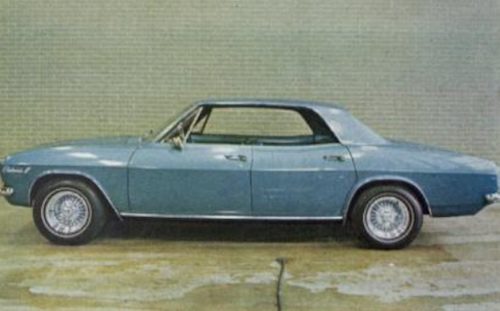
Outside, a pretty blue Corvair called Electrovair II drew up alongside a lagoon, where fountains played in the wind. I got into it, and a voluble young engineer with a crew cut checked me out on the specifications — electronic controls, 115-horsepower motor weighing only 130 pounds, and parts unknown in more prosaic electrics: a cooling system of circulating oil with a pump, fan motor, fan and radiator. We pushed off in a fine swing of increasing speed, with that solid, low-keyed humming I like so much. We hit 60 in just 16 seconds — top speed is 80. Though it weighs 800 pounds more than the Corvair, the car was engineered to equal Corvair performance except in range: Electrovair II’s range is only 80 miles. That would be enough to get me to town and back. But then we got out, and I looked at the batteries filling the front and rear compartments — silver-zinc batteries, worth $15,000, that wouldn’t last six months in regular use.
I inspected the new lithium-chloride battery that could turn out to be 10 to 20 times more powerful than standard batteries; it, too, is in an early stage. Then came the electric truck, called the Electrovan, “the most advanced electric automotive vehicle ever built,” according to Marks. It is the first road vehicle ever to run on a fuel cell which, instead of storing power, makes current out of fuel as needed. Hydrogen and oxygen work best. It functions silently and efficiently, with no moving parts.
Inside the Electrovan were some 2,000 cells, developed for G.M. by Union Carbide. Each is like a thin battery, a sixth of an inch thick, with a hydrogen chamber on one side and an oxygen chamber on the other. They are fueled from three spheres, two for hydrogen and one for oxygen (the end product is H2O). The van develops 125 horsepower, has a range of 150 miles, and can go 70 miles an hour. It can hit 60 in 30 seconds; like the car, it was built to equal the performance of its model, the G.M.C. Handi-Bus, though it weighs twice as much.
It will be “ten to fifteen years before there’s any wide use of these power sources,” Vice President Cole said. “We have to start with what we have today — electric golf carts that make eighteen holes if you’re lucky. We’re not contemplating building any low-power car, without a heater or air conditioning. A lot of things are going to come before the electric car: for example, better control of emissions from gasoline engines.”
Even so, I felt that things were looking up. Ford’s battery, though not very big, looked promising, and my appetite for another ride in an electric was sharp. I had once met an executive of the Electric Storage Battery Company in Philadelphia, an electric-truck enthusiast named Morrison McMullan. I called him, and it turned out that he drives his own electric car to work every day. He invited me down to see it.
McMullan — “Mac” to friends — is a tall, graying man whose blue eyes, peering over half-lensed glasses, light up when he talks about electrics. And it’s not just because he works at a battery factory, either; he loves them. Seated in his ground-floor office, he gazed fondly at the roof of his car just outside; he had snaked a cable from the car through the window and plugged it into an outlet beside his desk.
The car is a refitted Renault Dauphine dubbed the Henney Kilowatt by its makers, the Eureka Williams Company of Bloomington, Ill. A colleague of Mac’s, Jim Norberg, has bought one too (they cost $3,500). The Kilowatt was the only electric car actually for sale to the public, but production is now suspended. Its makers say, “Tuneups are unnecessary, freezeups impossible, and motor breakdowns virtually eliminated. A major overhaul amounts only to cleaning the contact points and replacing the brushes.”
Mac opened trunk and engine compartments; six batteries sat in each. The rear also held a steel cylinder about the size of a water-cooler jug — the electric motor. This is geared into the rear axle. When it is turned on, the wheels go around. Its simplicity is its beauty. The dashboard has a speedometer, a voltmeter and a tiny switch, like one on a flashlight. When the switch is in the center position the car is off; up, the car is ready to go forward; down, backward. A pedal operates standard hydraulic brakes. Steering, lights and signals are all conventional. The only tricky item is the accelerator, which Mac said I’d learn about while driving.
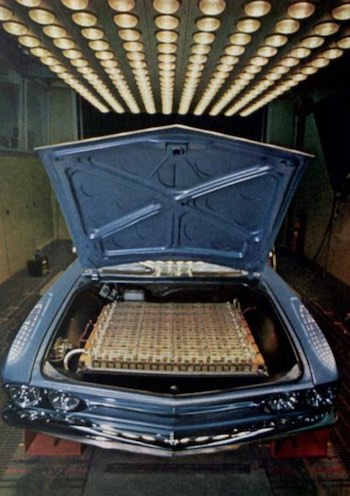
I got behind the wheel, Mac got in beside me, and I pressed down on the pedal. As we moved out into the busy traffic of Rising Sun Avenue, the car click-clicked forward, going boo-bee-baalm-buzz like a circumspect trolley car. (The metal-on-metal clicks come when electric relays close magnetic switches in sequence as the accelerator is pressed.) It had a kind of doughty strength as it pushed through its six power levels to a top speed of 40. We passed a car and drew no attention to ourselves; there is nothing about it to show it’s an electric, except for the missing tail pipe. But Mac’s wife is so proud of it that she put a sign in the rear window: ELECTRIC. The 900 pounds of batteries gave us plenty of momentum, and braking at a stoplight came a bit hard. Climbing a hill, Mac warned, “Keep it at full speed, but be sure you press the pedal slowly enough to click through each stage in order from a stop, or you’ll blow the fuses.”
We stopped again at a light, and everything was automatically off. Mac gave a superior look at a throbbing car beside us. The electric motor works at its very best from a dead stop; its hefty torque — power to the wheels — makes it ideal for stop-and-go use, especially now, when in the centers of large cities traffic moves no faster than the horse-drawn vehicles of another era. Going downhill the car used no power, and Mac says that electrics can be wired for “dynamic electric braking” that would very slightly recharge the batteries at every stop. At the very least this would make a nice phrase for an advertisement.
The speed kept it up with the traffic; going at full tilt is good for the electric.
Mac would like to hook up an electric drag racer with silver-zinc batteries — these are the expensive ones, but they’re powerful — and run the car wide open. “I know we’d break 200 miles an hour within that quarter-mile,” he says. “Then the batteries would die, but that dragster would be famous.
Mac figures he uses three quarters of a kilowatt-hour per mile, which can be more or less expensive than gasoline, depending upon local electric rates. He increases the 20-mile traffic-driving range by charging up during the day as well as at night. As for repairs, in two years he has replaced two light bulbs and the contact points. The batteries cost $500 and last about five years.
An odd feature of the electric is that its batteries gain back a little power when the car stands still. This is the same phenomenon that lets you run down a starting battery, wait an hour, and find it able to turn the motor over a few more times. When I asked Mac if he had ever run out of electricity, he said he had, but could use the recuperative power to get to a service station. When he gets there he asks for an outside electric outlet to “refuel my car.” He offers a quarter for “a nickel’s worth of current,” then all business stops and everybody surrounds the car, stares at the batteries and asks questions.
Mac tells of a tougher challenge. In 1960 he demonstrated an electric truck to post-office officials in Washington, D.C., on behalf of the Cleveland Vehicle Company, which at the time was making electric trucks in cooperation with the Electric Storage Battery Company. When Mac took the truck out of the garage, he found that the mechanic had forgotten to plug it in overnight. It had only half a charge. Mac set out anyway, bravely clicking and humming his way to pick up a mailman and a load of mail for a test run over a hilly suburban delivery route. Carefully timing his stops, and resting at the crests of hills, Mac finished the route just as the batteries gave out. But it was still another mile back to the post office. “I’ll never leave a truck; it’s very bad, psychologically, with prospective customers,” he says. He got out, made a show of scratching his head, kicked the tires, and peered under the truck, where there was nothing to be seen but the underside of the floor. He suggested that the mailman hike to the top of the next hill and wait. After a few precious minutes had gone by, the truck had recharged itself enough to move again. Mac picked up the mailman, coasted to the bottom of the hill, and came to within half a block of the post office before the truck died again. “Drive her on in,” the mailman said. Mac said no, he wanted to be sure there was a parking place. This ruse — walking over to the parking lot and back — killed another two minutes. The truck then obediently made it into the lot behind the post office. Mac rushed a cable to its starving connectors. And later, post-office officials ordered five electric trucks, which are in use today in Washington, New York and Miami; more are being considered.
Vintage electric trucks are still used in various cities; their big nickel-iron batteries often last a dozen years. The only manufacturer today in the United States is Paul Hafer, who has a body shop in the Pennsylvania Dutch country, where in partnership with the Electric Storage Battery Company, he makes Battronic trucks.
Electric companies themselves are naturally interested in the future of electrics. They would more than double their output if road vehicles went electric. This could cut the rates, but eventually they would have to go up by a quarter to a third for road taxes.
By now I was tempted to give up my odyssey in search of the perfect electric. These rare Henney Kilowatts and delivery vans did not quite fill the bill for a reawakening Sleeping Beauty.
But then I recalled a challenge to the Ford battery that I had seen in the papers. It came from Gulton Industries, of Metuchen, New Jersey, claiming a battery twice as good as Ford’s. So I invited myself down to meet Dr. Leslie K. Gulton. At 65, Gulton is a big, expansive man with a broad smile and the trace of a Viennese accent. That silver-zinc battery, because of the high price of silver, is just a curiosity, he said. The Gulton entry, a lithium-nickel halide battery, will be light in weight — lithium is twenty times lighter than the lead used in present batteries. It could run a small car 150 miles on a charge. he said, and its materials are cheap and available. “With this battery we have vindicated Edison,” Gulton boasts.
Thomas Edison once had a small laboratory here on what later became the Gulton firm’s grounds. Edison, in 1905, told Walter Baker, “If you continue to produce your present quality of electric automobile, and I my present battery, the gas buggy won’t stand a chance.” Nine years later Edison tried to build an electric with Henry Ford, but they failed at it. If perhaps Gulton hasn’t yet quite vindicated Edison, maybe the Ford Company will beat him to it and vindicate Henry.
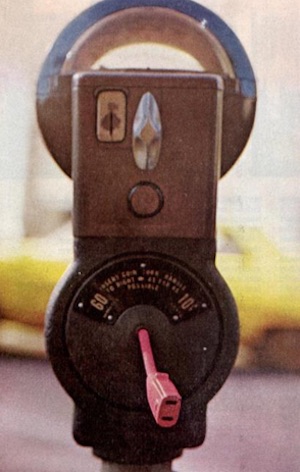
Gulton says, “Don’t talk about electric, it won’t be electric, it will be the electronic car.” He has many ideas about this car but has no plan to build one — only the battery for it. He suggests that parking meters could be wired to recharge cars; his battery will take a quick charge. But it is still in the laboratory stage. Gulton adds, “If the Government took the interest in transportation on earth that it takes in space, we could have our electronic car, built from the ground up, in six months. There is one Government electric-car project — for travel on the moon !”
Many amateurs have built fairly successful electric-car prototypes. One, designed by an Illinois Institute of Technology graduate student named Marnie Averitt, is called “Sparky.” Priced at $900, it weighs 1,000 pounds and carries an 800-pound load, plus two persons. Six-volt “golfer” batteries run its five-horsepower motor (electric motors need only a fifth to a quarter the horsepower of gasoline engines to develop the same power). Its speed is 30, range 60 miles; the cab opens from the front like a clam.
In Bethesda, Maryland, scientist John Hoke has adapted a two-passenger King Midget car to run on six auto batteries. It goes 40 miles an hour and costs two thirds of a cent a mile to run.
Rules can be broken with the electric, and my head is exploding with all kinds of possibilities: self-service taxi fleets, tiny cars bundled aboard trains for vacations, exchangeable battery packs ready at every corner, highways alive with power imbedded in the concrete. But somehow I’ll have to cool my impatience because for today, anyway, I still cannot buy an electric that will get me to Providence and back.
I’ll be the first one to my electric-car dealer when he opens, but meanwhile I’m killing the time by looking around elsewhere. And I found out there’s this steam turbine no bigger than an office typewriter that could easily outpower a modern car engine. It’s built by a man named Danny Bogni up in Montpelier, Vermont, and all it needs is to have money put into it. Maybe I can get to like a nice sharp, steamy hiss just as well as that monotonous old electric hum. I’m heading north tomorrow.
Cover Gallery: Love
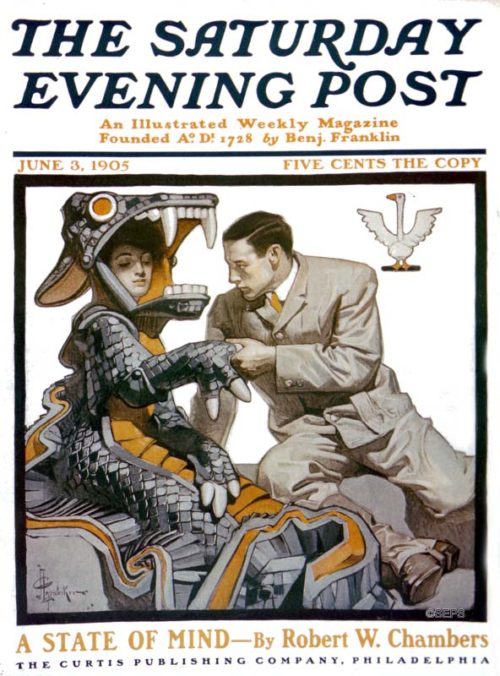
J. C. Leyendecker
June 3, 1905
Nothing says “I love you” like dressing up in a dragon costume.
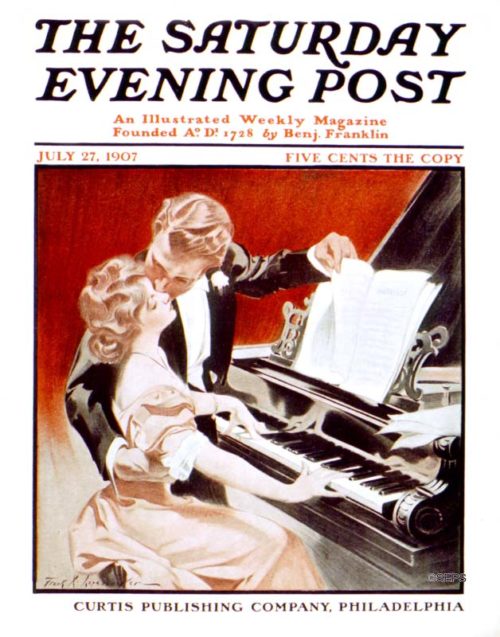
Frank X. Leyendecker
June 27, 1907
Make his heart skip a beat with a beautiful song.
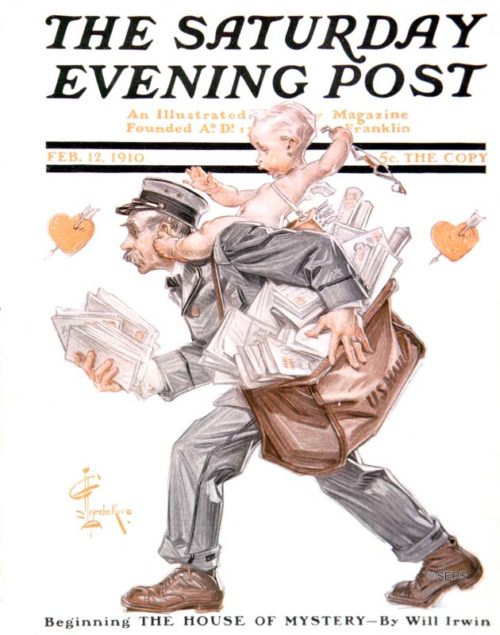
J. C. Leyendecker
February 2, 1910
As Valentine’s Day nears, the Postman and his partner do their best to deliver your love letters on time.
J. C. Leyendecker
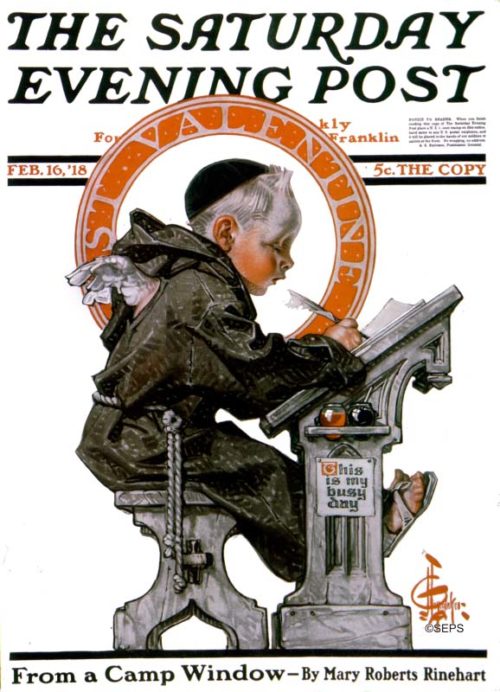
February 16, 1918
Love letters don’t write themselves. St. Valentine pens the perfect poem for your paramour.
Tom Webb
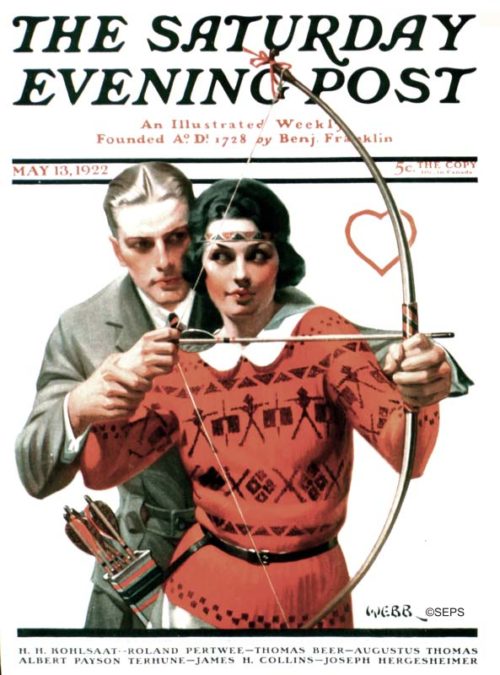
May 13, 1922
This love struck couple doesn’t need cupid to pierce their hearts.
Norman Rockwell
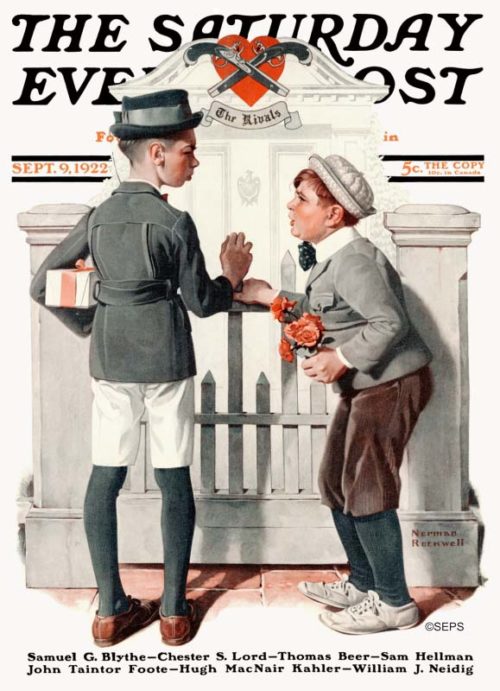
September 9, 1922
Lining up for love is one of many life lessons these lads will encounter.
Neil Hott
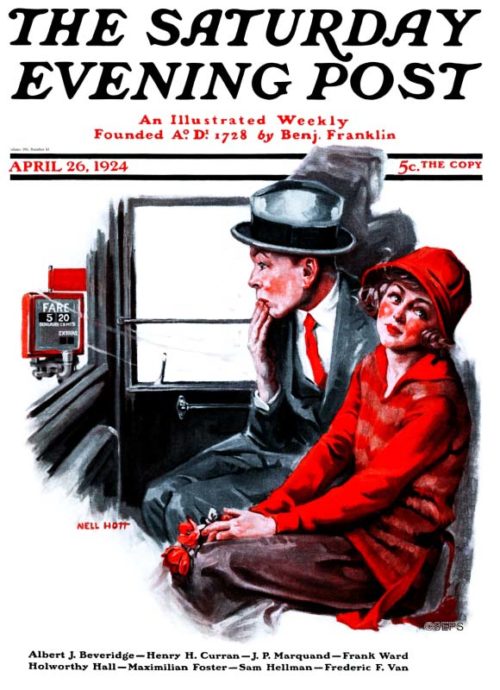
April 26, 1924
Stretching your last dollar is a simple sacrifice for a romantic night on the town.
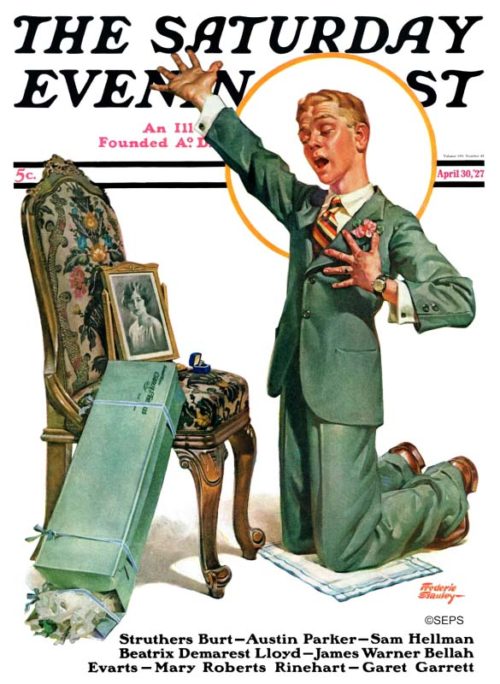
Frederic Stanley
April 30, 1927
Popping the question requires the utmost preparation.
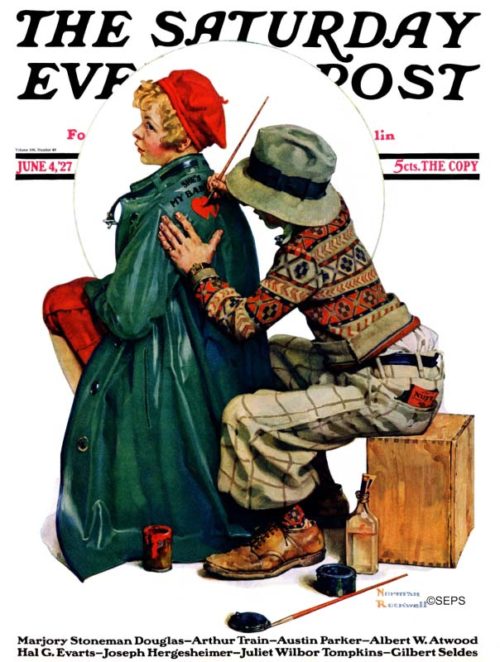
Norman Rockwell
June 4, 1927
This young man hopes to paint his way right into her heart.
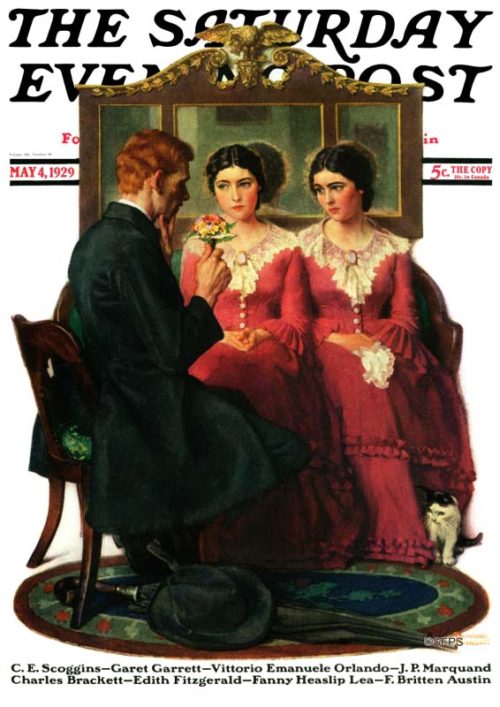
Norman Rockwell
May 4, 1929
A love triangle calls for pretty flowers, but perhaps he should have brought a second bouquet!
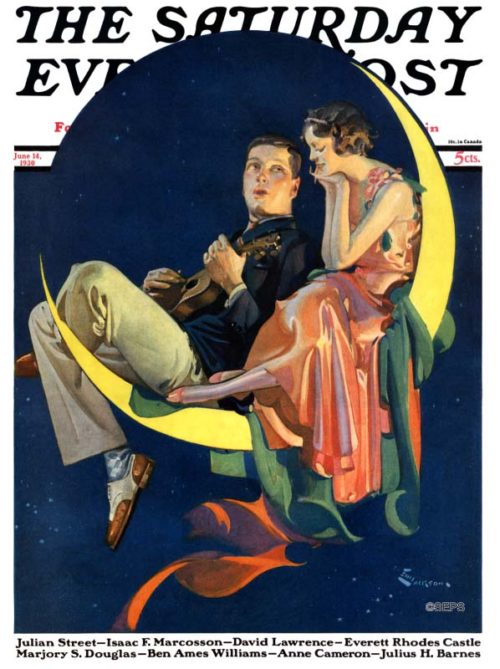
M. Jackson
June 14, 1930
A serenade so stunning, she was over the moon.
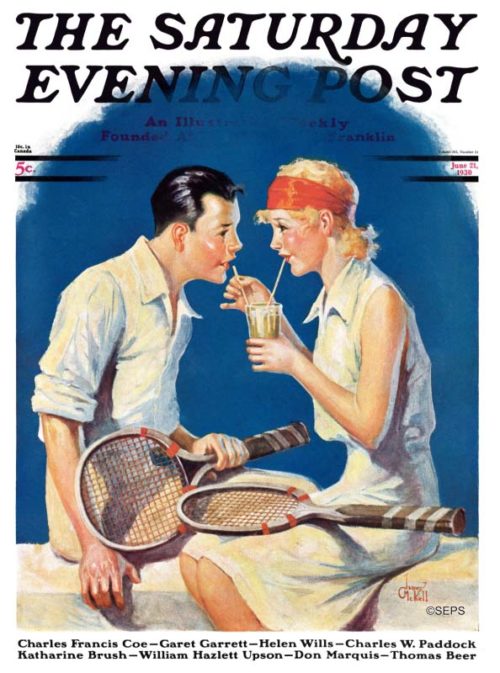
James C. McKell
June 21, 1930
A sweet treat to top off a playful tennis match.
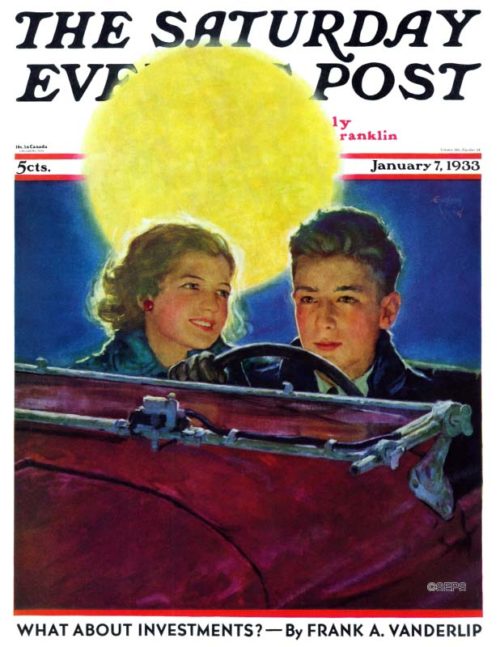
Eugene Iverd
January 7, 1933
The boy of her dreams is even more breathtaking under the glowing moon.
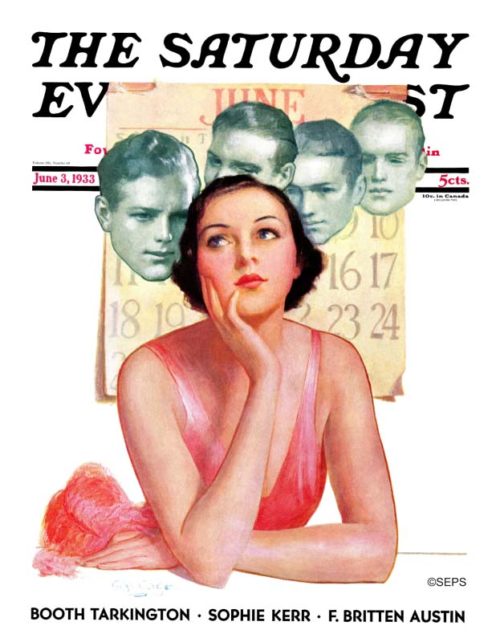
George W. Gage
June 3, 1933
With so many suitors, it’s easy to see why this beauty is beyond vacillating among valentines.
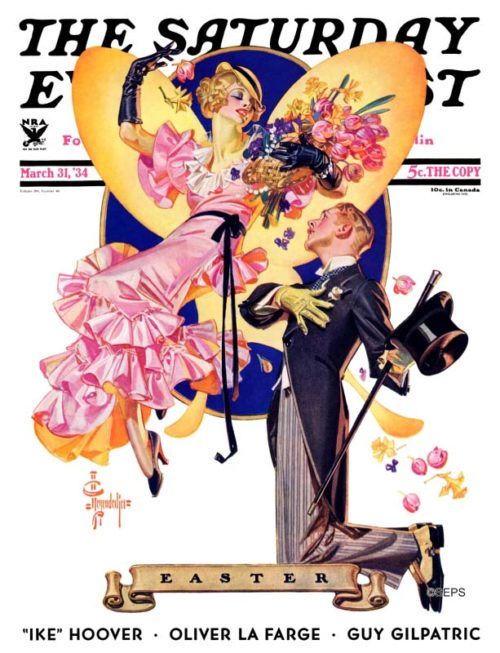
J. C. Leyendecker
March 31, 1934
A pretty pink dress, fresh flowers, and a gentleman with a top hat — the makings of a rousing rendezvous.
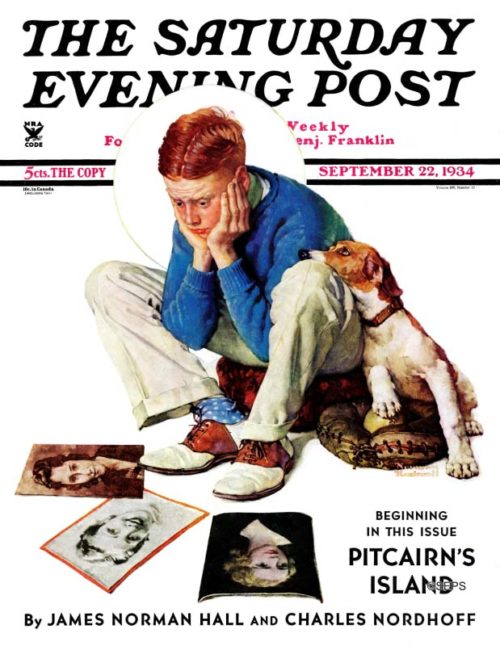
Norman Rockwell
September 22, 1934
A bounty of beauties has left this lad with a lot to think about.
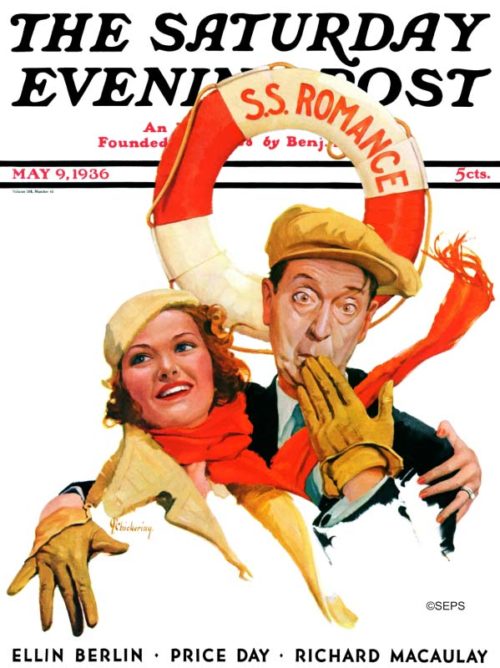
Charles R. Chickering
May 9, 1936
Nothing says a scenic getaway for two like a sea-bound voyage.
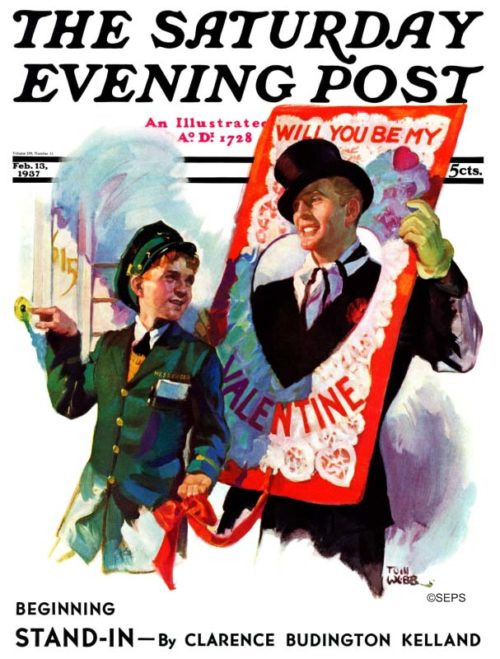
Tom Webb
February 13, 1937
For this well-dressed fella, finding true love starts with a colossal card.
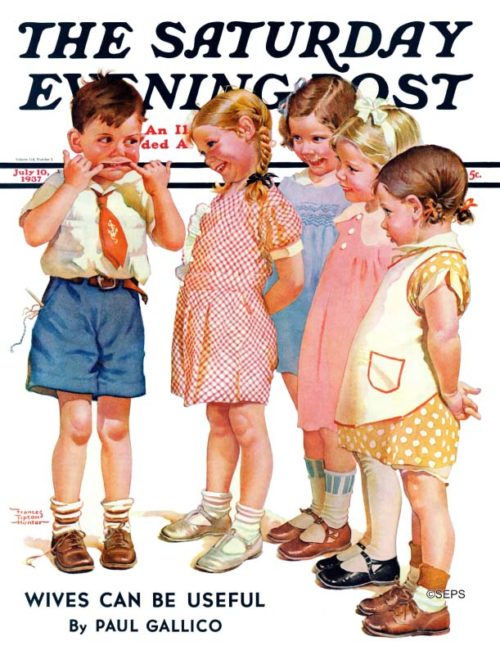
Frances Tipton Hunter
July 10, 1937
Making faces works wonders when you’re five, but soon our larkish lad will need to find new ways of wooing.
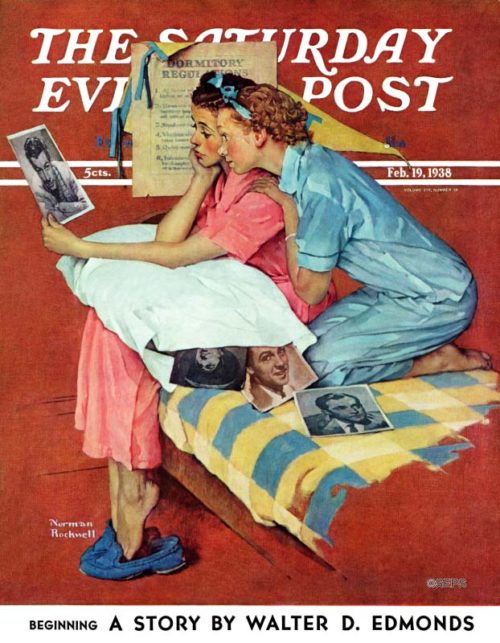
Norman Rockwell
February 19, 1938
Gawking over a gorgeous guy is always sure-fire entertainment for any sleepover.
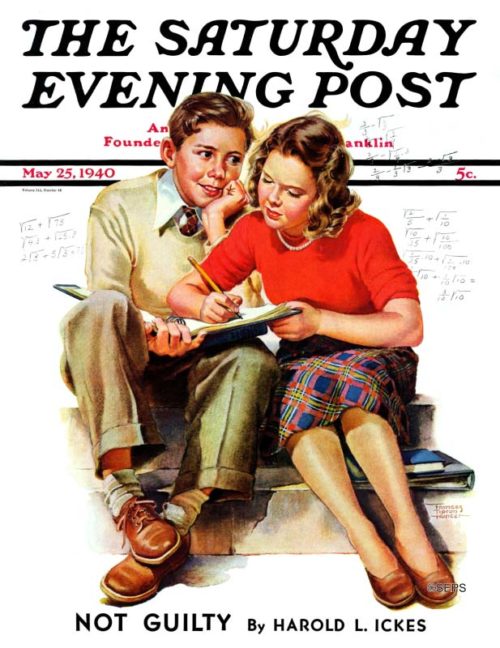
Frances Tipton Hunter
May 25, 1940
This boy is doing more longing than long-divisioning.
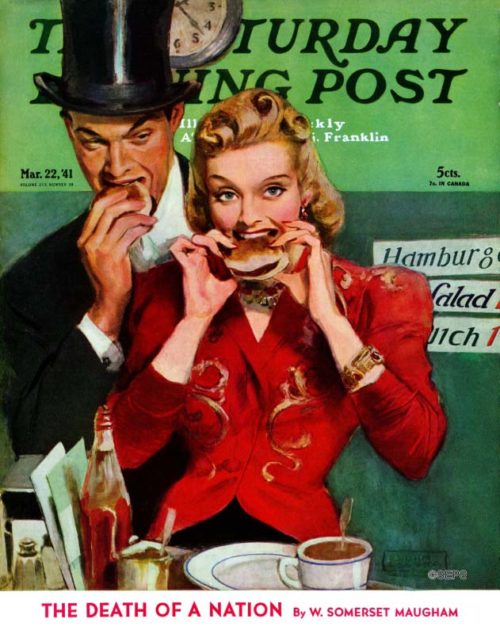
John LaGatta
March 22, 1941
This well-dressed duo dashes off to a diner for a cup of joe and juicy burgers.
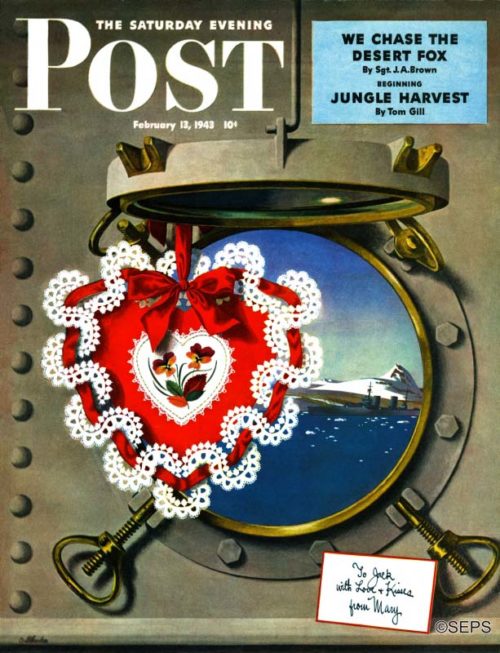
John Atherton
February 13, 1943
Distance makes the heart grow fonder, especially when you’re separated by nothing but sea.
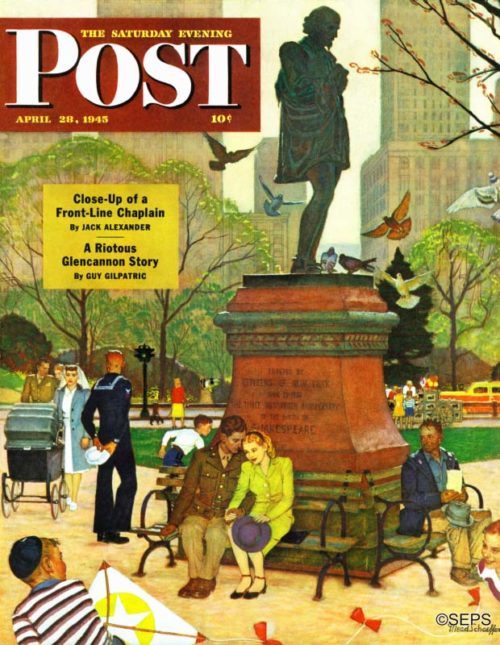
Mead Schaeffer
April 28, 1945
Forget the extravagant getaways — an afternoon stroll in the park works perfectly for this lovely pair.
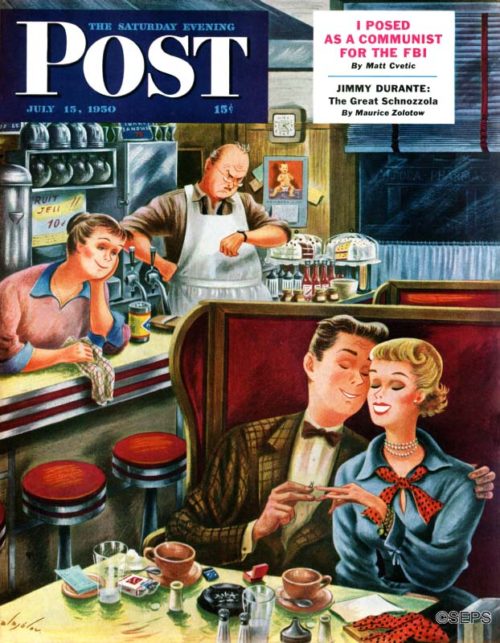
Constantin Alajalov
July 15, 1950
After doors are locked, this lad and his lady linger, perhaps a bit too long.
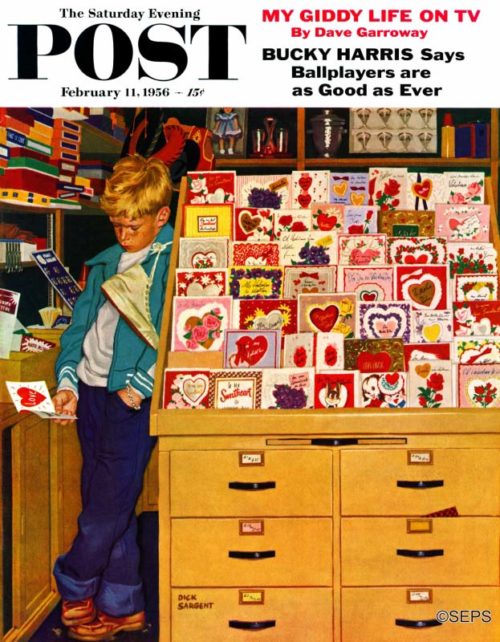
Richard Sargent
February 11, 1956
Picking a V-Day card takes time, especially when she’s your first love.
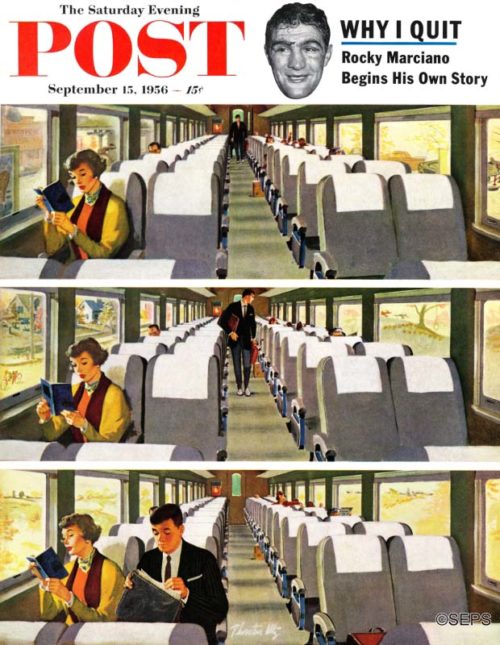
Thornton Utz
September 15, 1956
This gentleman wasn’t shy about chasing down his dream girl.
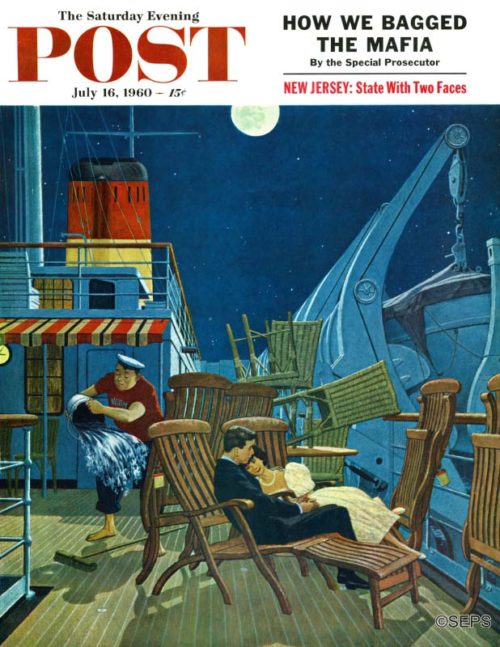
James Williamson
July 16, 1960
This crew member is about to make this crowded corner is a less-than-ideal location for these love birds.
Conflicts of Interest: The Post’s Solution
Conflict of interest has been a frequent topic in the news, as people debate the ethics of President Donald Trump’s foreign and domestic business dealings.
The principle of “conflict of interest” is clear: It’s the difference between personal interests and official responsibilities. Conflict-of-interest laws have been established, as Justice Antonin Scalia put it, to ensure each lawmaker will use his influence and his vote “as trustee for his constituents, not as a prerogative of personal power.”
What is less clear, though, is how to know when a politician has chosen personal gain over public good. How can you judge a senator’s personal intentions when he or she votes?
The problem of divided loyalties reaches back to the early years of our republic. Thomas Jefferson knew the money of special interests would tempt lawmakers. When he presided over the Senate in 1801, he established a rule that said, “Where the private interests of a member are concerned in a bill or question, he is to withdraw.”
Whenever a congressman did not recuse himself from matters touching on his personal interests, the law continued, his arguments and his vote should be tossed out.
It would be hard to say how faithfully Congress followed Jefferson’s law. But we know that, just seven years after Jefferson’s death, Senator Daniel Webster was selling his services to the Bank of the United States. Webster was on the committee that was considering the bank’s charter at a time when President Andrew Jackson wanted to shut it down. Webster strongly supported the bank, but not for free, it appears. In 1833, Webster wrote the bank president, “I believe my retainer has not been renewed or refreshed as usual. If it be wished that my relation to the bank should be continued, it may be well to send me the usual retainers.”
By 1874, the House of Representatives had fallen even further from Jefferson’s strict adherence. In that year, it passed a law that allowed congressmen to vote in their private interests so long as the measure benefitted others — presumably their constituents. The law was promoted by Speaker of the House James Blaine. At the time, Blaine was offering his services to the Little Rock and Fort Smith Railroad in exchange for stock.
By 1962, corruption scandals prompted Congress to pass Title 18, Second 208 of the U.S. Code. This law barred legislators from participating in matters in which they, their families, their business partners, or their associations could financially benefit.
When the legislators wrote the law, they made it apply to all public officials in the federal government except the president and vice president.
The law hasn’t resolved all the questions about conflicted interests. Enforcing the law requires investigators to prove that a legislator intended to benefit himself, and it’s hard to prove intentions.
While the Post editors welcomed the 1962 law, they expected further problems with congressional corruption. So they offered a simple solution, one which would resolve questions of who benefited from what: disclosing personal finances.
Disclosure: An Antidote for Conflict of Interests
Last fall Post editors Ben Bagdikian and Don Oberdorfer explored in depth the problem of conflict of interests in the Congress of the United States. They reported that while the Congress forbade government officials and judges to hold private financial stakes which might conflict with their public duties, there was nothing to prevent members of the legislative body from doing that very same thing themselves. Bagdikian and Oberdorfer concluded that “one possible solution to the problem of hidden interests is for every member of Congress, or every candidate for Congress, to reveal his finances to his fellows and the public.”
Several members of Congress had already taken this step. Sen. Joseph Clark revealed his wealth last fall, and his fellow Pennsylvanian, Sen. Hugh Scott, followed suit. Sen. Stephen Young of Ohio sold his stock in two sugar companies and an airline when committee assignments gave him special powers in these fields. He also disclosed his stock holdings.
Recently Sen. Jacob Javits of New York revealed his stock holdings on the floor of the Senate. His colleague, Sen. Kenneth Keating, announced his intention to publish a list of his securities holdings and introduced a bill to require such disclosure by members of the House and Senate. Congresswoman Edith Green of Oregon has proposed establishment of a 15-member commission on legislative ethics to study the conflict-of-interests question. She has introduced bills that would require, among other things, a full disclosure by congressmen of their financial interests.
Congress should pass such legislation. It would accomplish two important objectives: First, it would eliminate the double standard that now prevails by putting Congress on the same ethical footing with the executive branch of the Government; second, disclosure would be the most effective means of preventing members of Congress from taking advantage of the public trust that their public offices imply.
Editorial, April 6, 1963
Unfortunately, disclosing finances doesn’t end all questions of conflicts of interest. Last September, Donald Trump filed a 104-page financial disclosure, but he didn’t share his tax returns. For critics, many concerns remain.
Featured image: Shutterstock
“The Inhabitants of Venus” by Irwin Shaw
Originally published on January 26, 1963
He had been skiing since early morning, and he was ready to stop and have lunch in the village, but Mac said, “Let’s do one more before eating,” and, since it was Mac’s last day, Robert agreed to go up again. The weather was spotty, but there were a few clear patches of sky, and the visibility had been good enough for decent skiing most of the morning. The téléférique was crowded, and they had to push their way in among the bright sweaters and anoraks and the bulky packs of the people carrying picnic lunches and extra clothing and skins for climbing. The doors closed and the cabin swung out of the station, over the belt of pine trees at the base of the mountain.
The passengers were packed in so tightly that it was hard to reach for a handkerchief or light a cigarette. Robert was pressed, not unpleasurably, against a handsome young Italian woman with a dissatisfied face, who was explaining to someone over Robert’s shoulder why Milan was such a miserable city in the wintertime. “Milano si trova in un bacino deprimente,” the woman said, “bagnato dalla pioggia durante tre mesi all’anno. E, nonostante it loro gusto per l’opera, i Milanesi non sono altro cite volgari materialisti the solo it denaro interessa.” Robert knew enough Italian to understand that she was saying that Milan was in a dismal basin which was swamped by rain for three months a year and that the Milanese, despite their taste for opera, were crass and materialistic and interested only in money.
Robert smiled. Although he had not been born in the United States, he had been a citizen since 1944, and it was pleasant, in the heart of Europe, to hear somebody else besides Americans being accused of materialism and a singular interest in money.
“What’s the Contessa saying?” Mac whispered above the curly red hair of a small woman who was standing between him and Robert. Mac was a lieutenant on leave from his outfit in Germany. He had been in Europe nearly three years and, to show that he was not just an ordinary tourist, he called all pretty Italian girls Contessa. Robert had met him a week before in the bar of the hotel where they were both staying. They were the same kind of skiers, adventurous and looking for difficulties; they had skied together every day, and they were already planning to come back at the same time for the next winter’s holiday, if Robert could get over again from America.
“The Contessa is saying that in Milan all they’re interested in is money,” Robert said, keeping his voice low, although in the babble of conversation in the cabin there was little chance of being overheard.
“If I was in Milan,” Mac said, “and she was in Milan, I’d be interested in something besides money.” He looked with open admiration at the Italian girl. “Can you find out what run she’s going to do?”
“What for?” Robert asked.
“Because that’s the run I’m going to do,” Mac said, grinning. “I plan to follow her like her shadow.”
“Mac,” Robert said, “don’t waste your time. It’s your last day.”
“That’s when the best things always happen,” Mac said. “The last day.” He beamed — huge, overt, uncomplicated — at the Italian girl, who took no notice of him. She was busy now complaining to her friend about the natives of Sicily.
The sun came out for a few minutes, and the cabin grew hot, with 40 people jammed into such a small space, and Robert half-dozed, not bothering to listen to the voices speaking French, Italian, English, Schweizerdeutsch and German, on all sides of him. Robert liked being in the middle of this informal congress of tongues. It was one of the reasons he came to Switzerland to ski whenever he could take time off from his job. In the angry days through which the world was passing, there was a ray of hope in this good-natured, polyglot chorus of people who smiled at strangers, who had collected in these shining white hills merely to enjoy the innocent pleasures of sun and snow.
The feeling of generalized cordiality that Robert experienced on these trips was intensified by the fact that most of the people on the lifts and runs seemed more or less familiar to him. Skiers formed a kind of loose, international club, and the same faces kept turning up year after year in Mégève, Davos, St. Anton, Val d’Isére, so that after a while you had the impression you knew almost everybody. There were four or five Americans in the cabin whom Robert was sure he had seen at Stowe at Christmas. The Americans had come over in one of the chartered ski-club planes that Swissair ran every winter on a cut-rate basis. They were young and enthusiastic, and none of them had ever been to Europe before, and they were noisily appreciative of everything — the Alps, the food, the snow, the weather, the peasants in their blue smocks, the chic of the lady skiers and the skill and good looks of the instructors. They were popular with the villagers because they were so obviously enjoying themselves. Besides, they tipped generously, in the American style, with what was, to Swiss eyes, an endearing disregard of the fact that a service charge of 15 percent had been added automatically to every bill before it was presented to them. Two of the girls were very attractive, in a youthful prettiest-girl-at-the-prom way, and one of the young men, a lanky boy from Philadelphia, the informal leader of the group, was a beautiful skier who guided the others down the runs and helped the dubs.
The Philadelphian, who was standing near Robert, spoke to him as the cabin swung high over a steep, snowy face of the mountain. “You’ve skied here before, haven’t you?” he said.
“Yes,” Robert said, “a few times.”
“What’s the best run down this time of day?” the Philadelphian asked. He had the drawling, flat tone of the good New England schools that Europeans use in their imitations when they wish to make fun of upper-class Americans.
“They’re all OK today,” Robert said.
“What’s this run everybody says is so good?” the boy asked. “The — the Kaiser something-or-other?”
“The Kaisergarten,” Robert said. “It’s the first gully to the right after you get out of the station on top.”
“Is it tough?” the boy asked.
“It’s not for beginners,” Robert said.
“You’ve seen this bunch ski, haven’t you?” The boy waved vaguely to indicate his friends. “Do you think they can make it?”
“Well,” Robert said doubtfully, “there’s a narrow, steep ravine full of bumps halfway down, and there are one or two places where it’s advisable not to fall, because you’re liable to keep on sliding all the way if you do.”
“We’ll take a chance,” the Philadelphian said. “It’ll be good for their characters. Boys and girls,” he said, raising his voice, “the cowards will stay on top and have lunch. The heroes will come with me. We’re going to do the Kaisergarten.”
“Francis,” one of the pretty girls said, “I do believe it is your sworn intention to kill me on this trip.”
“It’s not as bad as all that,” Robert said, smiling at the girl.
“Say,” the girl said, looking with interest at Robert, “haven’t I seen you someplace before?”
“On this lift, yesterday,” Robert said.
“No.” The girl shook her head. She had on a black, fuzzy, lambskin hat, and she looked like a high-school drum majorette pretending to be Anna Karenina. “Before yesterday. Someplace.”
“I saw you at Stowe,” Robert confessed. “At Christmas.”
“Oh, that’s where,” she said. “I saw you ski. Oh, my, you’re silky.”
Mac broke into a loud laugh at this description of Robert’s skiing style.
“Don’t mind my friend,” Robert said, enjoying the girl’s admiration. “He’s a coarse soldier who is trying to beat the mountain to its knees by brute strength.”
“Say,” the girl said, looking puzzled, “you have a funny little way of talking. Are you American?”
“Well, yes,” Robert said. “I am now. I was born in France.”
“Oh, that explains it,” the girl said. “You were born among the crags.”
“I was born in Paris,” Robert said.
“Do you live there now?”
“I live in New York,” Robert said.
“Are you married?” the girl asked anxiously.
“Barbara,” the Philadelphian said, “behave yourself.”
“I just asked the man a simple, friendly question,” the girl protested. “Do you mind, Monsieur?”
“Not at all.”
“Are you married?”
“Yes,” Robert said.
“He has three children,” Mac added helpfully. “The oldest one is going to run for President in the next election.”
“Oh, isn’t that too bad?” the girl said. “I set myself a goal on this trip. I was going to meet one unmarried Frenchman.”
“I’m sure you’ll manage it,” Robert said.
“Three children,” the girl said. “My! How old are you, anyway?”
“Thirty-nine,” Robert said.
“Where is your wife now?” the girl said.
“In New York.”
“Pregnant,” Mac said, more helpful than ever.
“And she lets you run off and ski all alone like this?” the girl asked incredulously.
“Yes,” Robert said. “Actually I’m in Europe on business, and I’m sneaking off for 10 days.”
“What business?” the girl asked.
“I’m a diamond merchant,” Robert said. “I buy and sell diamonds.”
“That’s the sort of man I’d like to meet,” the girl said. “Somebody awash with diamonds. But unmarried.”
“Barbara!” the Philadelphian said.
“I deal mostly in industrial diamonds,” Robert said. “It’s not exactly the same thing.”
“Even so,” the girl said.
“Barbara,”. the Philadelphian said, “pretend you’re a lady.”
“If you can’t speak candidly to a fellow American,” the girl said, “who can you speak candidly to?” She looked out the plexiglass window of the cabin. “Oh, dear,” she said, “it’s a perfect monster of a mountain, isn’t it? I’m in a fever of terror.” She turned and regarded Robert again. “You do look like a Frenchman,” she said. “Terribly polished. You’re definitely sure you’re married?”
“Barbara,” the Philadelphian said forlornly.
Robert laughed, and Mac and the other Americans laughed, and the girl smiled under her fuzzy hat, amused by her own clowning and pleased at the reaction she was getting. The other people in the car, who could not understand English, smiled good-naturedly, happy, even though they were not in on the joke, to be the witnesses of this youthful gaiety.
Then through the laughter Robert heard a man’s voice say, in tones of quiet, cold distaste, “Schaut euch diese dummen amerikanischen Gesichter an! Und diese Leute bilden sich ein, sie waren berufen, die Welt zu regieren.”
Robert had learned German as a child from his Alsatian grandparents, and he understood what he had just heard, but he forced himself not to turn to see who had spoken. His years of temper, he liked to believe, were behind him, and, if nobody else in the cabin had overheard or understood the words, he was not going to be the one to force the issue. He was here to enjoy himself, and he didn’t feel like getting into a fight or dragging Mac and the other kids into one. Long ago he had learned the wisdom of playing deaf when he heard things like that, and worse. If some bastard of a German wanted to say, “Look at those stupid American faces. And these are the people who think they have been chosen to rule the world,” it made very little real difference to anybody, and a grown man ignored it if he could. So he didn’t look to see who had said it, because he knew that if he picked out the man he wouldn’t be able to let it go. This way — as long as the hateful voice was anonymous — he could let it slide, along with many other things that Germans had said during his lifetime.
The effort of not looking was difficult, though, and he closed his eyes, angry with himself for being so disturbed by a scrap of overheard malice. It had been a perfect holiday up to now, and it would be foolish to let it be shadowed, even briefly, by a random voice in a crowd. If you came to Switzerland to ski, Robert told himself, you had to expect to find some Germans. But each year now there were more and more of them, massive, prosperous-looking men and sulky-looking women with the suspicious eyes of people who believe they are in danger of being cheated. Men and women both pushed more than was necessary in the lift lines, with a kind of impersonal egotism, an unquestioning assumption of precedence. When they skied they did it grimly, in large groups, as if under military orders. At night, when they relaxed in the bars and Stüblis, their merriment was more difficult to tolerate than their dedicated daytime gloom and Junker arrogance. They sat in red-faced platoons, drinking gallons of beer, volleying great bursts of heavy laughter and roaring glee-club arrangements of student drinking songs. Robert had never heard them sing the Horst Wessel song, but he had noticed that long ago they had stopped pretending they were Swiss or Austrian, or that they had been born in Alsace. Somehow to the sport of skiing, which is, above all, individual and light and an exercise in grace, the Germans seemed to bring the image of the herd. Once or twice when he had been trampled in the téléférique station he had let some of his distaste show to Mac, but Mac, who was far from being a fool under his puppy-fullback exterior, had said, “The trick is to isolate them, lad. It’s only when they’re in groups that they get on your nerves. I’ve been in Germany for three years, and I’ve met a lot of good fellows and some smashing girls.”
Robert had agreed that Mac was probably right. Deep in his heart he wanted to believe that Mac was right. Before and during the war the problem of the Germans had occupied so much of his waking life that VE Day had seemed a personal liberation from them, a kind of graduation ceremony from a school in which he had been forced to spend long years trying to solve a single boring, painful problem. He had reasoned himself into believing that defeat had returned the Germans to rationality. So, along with the relief he felt because he no longer ran the risk of being killed by them, there was an almost-as-intense relief that he no longer had to think about them.
After the war he had believed in establishing normal relations with the Germans as quickly as possible, both as good politics and as simple humanity. He drank German beer and even bought a Volkswagen, although he would not have favored equipping the German army with the hydrogen bomb. In the course of his business he had few dealings with Germans, and it was only here, in this village in the Graubünden where their presence was becoming so much more apparent each year, that the idea of Germans disturbed him anymore. But he loved the village, and the thought of abandoning his yearly vacation because of the prevalence of license plates from Munich and Düsseldorf was repugnant to him. Maybe, he thought, from now on he would come at a different time, in January instead of late February. Late February through early March, when the sun was warmer and shone until six o’clock in the evening, was the German season. The Germans were sun gluttons, and they could be seen all over the hills, stripped to the waist, sitting on rocks, eating their picnic lunches, greedily absorbing each precious ray of sunlight. It was as though they came from a country perpetually covered by mist, like the planet Venus, and had to soak up as much brightness and life as possible during their short holidays in order to endure the harsh gloom of their homeland and the conduct of the other inhabitants of Venus for the rest of the year.
Robert smiled to himself at this tolerant concept and felt better disposed toward everyone around him. Maybe, he thought, if I were a single man I’d find a Bavarian girl and fall in love with her and finish the whole thing off.
“I warn you, Francis,” the girl in the lambskin hat was saying, “if you do me to death on this mountain there are three juniors at Yale who will track you down to the ends of the earth.”
Then he heard the German voice again. “Warum haben die Amerikaner nicht genügend Verstand,” the voice said, low but distinctly, near him, the accent clearly Hochdeutsch, not Zurichois or any of the other variations of Schweizerdeutsch, “ihre dummen kleinen Nutten zu Hause zu lassen, wo sie hingehören?”
Now he knew there was no avoiding looking and there was no avoiding doing something about it. He glanced at Mac first, to see if Mac, who understood a little German, had heard. Mac was huge and could be dangerous; and, for all his easy good nature, if he had heard the man say, “Why don’t the Americans have the sense to leave their silly little tramps at home where they belong?” the man would have been in for a beating. But Mac was still beaming placidly at the Contessa. That was all to the good, Robert thought. The Swiss police took a dim view of fighting, no matter what the provocation, and Mac, enraged, would wreak terrible damage in a fight and would more than likely wind up in jail. For an American career soldier stationed in Frankfurt a brawl like that could have serious consequences. The worst that can happen to me, Robert thought as he turned to find the man who had spoken, is a few hours in the pokey and a lecture from the magistrate about abusing Swiss hospitality.
Almost automatically Robert decided that when they got to the top he would follow the man out of the car, tell him quietly that he, Robert, had understood what had been said about Americans, and swing immediately. I just hope, Robert thought, that whoever it is isn’t too damned big.
For a moment Robert couldn’t pick out his opponent-to-be. There was a tall man with his back to Robert, on the other side of the Italian woman, and the voice had come from that direction. Because of the crowd Robert could see only his head and shoulders, which looked bulky and powerful under a black parka. The man had on the kind of black cap that had been worn by the Afrika Korps during the war. Beneath the cap the blond hair, which was thick and very low on the back of his neck, was plentifully streaked with gray. The man was with a plump, hard-faced woman who was whispering earnestly to him but not loudly enough for Robert to hear what she was saying. Then the man said crisply in German, replying to her, “I don’t care how many of them understand the language. Let them understand,” and Robert knew that he had found his man.
A tingle of anticipation ran through him, making his hands and arms feel tense and jumpy. He regretted that the cabin wouldn’t arrive at the top for another five minutes. Now that he had decided the fight was inevitable he could hardly bear waiting. He stared fixedly at the man’s broad, black-nylon back, wishing the fellow would turn and show his face. Judging by the man’s height and the width of his shoulders he was at least 20 pounds heavier than Robert, but Robert was wiry and in good condition, and in the days when he still got into fights he had been a stubborn performer with a punch surprisingly damaging for someone his size. He wondered if the man would go down with the first blow, if he would apologize, if he would try to use his ski poles. Robert decided to keep his own poles handy, just in case, although Mac could be depended upon to police matters thoroughly if he saw weapons being used. Deliberately Robert took off his heavy leather mittens and stuck them in his belt. Bare knuckles would be more effective. He wondered fleetingly if the man was wearing a ring. He kept his eyes fixed on the back of the man’s neck, willing him to turn. Then the plump woman noticed his stare. She dropped her eyes and whispered something to the man in the black parka, and after several seconds he turned, pretending that it was a casual, unmotivated movement. The man looked squarely at Robert, and Robert thought, If you ski long enough you meet every other skier you’ve ever known. At the same moment he knew that it wasn’t going to be a nice, simple little fistfight on top of the mountain. For the first time in his life he wanted to kill a man, and the man he wanted to kill was the one whose icy blue eyes, fringed with pale, blond lashes, were staring challengingly at him from under the black peak of the Afrika Korps cap.
It was a long time ago, the winter of 1938, in the French part of Switzerland, and he was 14 years old. The sun was setting behind another mountain, and it was 10 below zero, and he was lying in the snow with his foot turned in that funny, unnatural way, although the pain hadn’t really begun yet, and the eyes were looking down at him.
He had done something foolish, and at the moment he was more worried about what his parents would say when they found out than about the broken leg. He had gone up alone, late in the afternoon when almost everybody else was off the mountain. And even so he hadn’t stayed on the packed snow of the regular runs, but had started bushwhacking through the forest, searching for powder snow that hadn’t been tracked by other skiers. One ski had caught on a hidden root, and he had fallen, hearing the sickening, dry cracking sound from his right leg even as he pitched forward.
Trying not to panic, he had sat up, facing in the direction of the normal track, seeing the markers 100 meters away through the pine forest. If any skiers happened to come by they might just, with luck, be able to hear him if he shouted. He did not try to crawl toward the line of poles, because when he moved a queer feeling flickered from his ankle up his leg into his stomach, making him want to throw up.
The shadows were very long in the forest, and only the highest peaks were rose-colored now against a frozen green sky. He was beginning to feel the cold, and from time to time he was shaken by spasms of shivering.
I’m going to die here, he thought. I’m going to die here tonight. He thought of his parents and his sister comfortably seated this moment, probably having tea, in the warm dining room of the chalet two miles down the mountain, and he bit his lips to keep back the tears. They wouldn’t start to worry about him for another hour or two yet, and then when they did, and started to do something about finding him, they wouldn’t know where to begin. He had known none of the seven or eight people on the lift with him on his last ride up, and he hadn’t told anyone what run he was going to take. There were three different mountains, with separate lifts and numberless variations of runs that he might have taken, and finding him in the dark would be an almost hopeless task. He looked up at the sky. There were clouds moving in from the east, a high black wall covering the already darkened sky. If it snowed that night there was a good chance they wouldn’t even find his body before spring. He had promised his mother that no matter what happened, he would never ski alone, and now he had broken the promise, and this was his punishment.
Then he heard the sound of skis coming fast, a harsh, metallic sound on the iced snow of the run. Before he could see the skier he began to shout with all the strength of his lungs, frantically, “Au secours! Au secours!”
A dark shape appeared high above him for a second, disappeared behind a clump of trees, then shot into view much lower down, almost on a level with the place where he was sitting. Robert shouted wildly, not uttering words anymore, just a senseless, passionate, throat-bursting claim on the attention of the human race, represented, for this one instant at sunset on this cold mountain, by the dark, expert figure plunging, with a scraping of steel edges and a whoosh of wind, toward the village below.
Then, miraculously, in a swirl of snow, the figure stopped. Robert shouted. The sound of his voice echoed hysterically in the forest. For a moment the skier didn’t move, and Robert shook with the fear that it was all a hallucination, a mirage of sight and sound, that there was no one there on the beaten snow at the edge of the forest, that he was only imagining his own shouts, that despite all the fierce effort of his throat and lungs he was mute, unheard.
Suddenly he couldn’t see anything. He had the sensation of something sinking somewhere within him, of a rush of warm liquid inundating all the ducts and canals of his body. He waved his hands weakly and sank slowly over in a faint.
When he came to, a man was kneeling over him, rubbing his cheeks with snow. “You heard me,” Robert said in French. “I was afraid you wouldn’t hear me.”
“Ich verstehe nicht,” the man said. “Nicht parler Französisch.”
“I was afraid you wouldn’t hear me,” Robert repeated, in German.
“You are a stupid little boy,” the man said severely, in clipped, educated German. “And very lucky. I am the last man on the mountain.” He felt Robert’s ankle, his hands hard but deft. “Nice,” he said ironically, “very nice. You’re going to be in plaster for at least three months. Here — lie still. I am going to take your skis off. You will be more comfortable.” Working swiftly, he undid the long leather thongs and stood the skis up in the snow. Then he swept the snow off a stump a few yards away, got behind Robert and put his hands under Robert’s armpits. “Relax,” he said. “Do not try to help me.” He picked Robert up. “Luckily, you weigh nothing. How old are you — eleven?”
“Fourteen,” Robert said.
“What’s the matter?” the man said, laughing. “Don’t they feed you in Switzerland?”
“I’m French,” Robert said.
“Oh.” The man’s voice went flat. “French.” He half-carried, half-dragged Robert over to the stump and sat him down gently on it. “There,” he said, “at least you’re out of the snow. You won’t freeze — for the time being. Now, listen carefully. I will take your skis down with me to the ski school, and I will tell them where you are and tell them to send a sled for you. They should get to you in less than an hour. Now whom are you staying with in town?”
“My mother and father. At the Chalet Montana.”
“Good.” The man nodded. “The Chalet Montana. Do they speak German too?”
“Yes.”
“Excellent,” the man said. “I will telephone them and tell them that their foolish son has broken his leg and that the patrol is taking him to the hospital. What is your name?”
“Robert.”
“Robert what?”
“Robert Rosenthal,” Robert said. “Please don’t say I’m hurt too badly. They’ll be worried enough as it is.”
The man didn’t answer immediately. He busied himself tying Robert’s skis together and slung them over his shoulder. “Do not worry, Robert Rosenthal,” he said. “I will not worry them more than is necessary.” Abruptly he started off, sweeping easily through the trees, his poles held in one hand, balancing Robert’s skis across his shoulders with the other hand.
His sudden departure took Robert by surprise, and it was only when the man was a considerable distance away, almost lost among the trees, that he realized he hadn’t thanked the man for saving his life. “Thank you,” he shouted into the growing darkness. “Thank you very much.”
The man didn’t stop, and Robert never knew whether his cry had been heard or not. Because after an hour, when it was completely dark, with the stars covered by the clouds that had been moving in from the east, the patrol had not yet appeared. Robert had a watch with a radium dial. Timing himself, he waited exactly one hour and a half, until 10 minutes past seven, and then decided that nobody was coming for him and that if he hoped to live through the night he would have to crawl out of the forest somehow and make his way down to the town by himself.
He was rigid with cold by now, and suffering from shock. His teeth chattered in a frightening way, as though his jaws were part of an insane machine over which he had no control. There was no feeling in his fingers anymore, and the pain in his leg came in ever-enlarging waves. He had put up the hood of his parka and let his head sink as low on his chest as he could, and the cloth of the parka was stiff with his frosted breath. He heard a whimpering sound somewhere around him, and it was only after what seemed like several minutes that he realized the whimpering sound was coming from him, and that there was nothing he could do to stop it.
Stiffly, with exaggerated care, he tried to lift himself off the tree stump without putting any weight on his injured leg, but at the last moment he slipped and twisted the leg as he went down into the snow. He screamed twice and lay with his face in the snow and thought of just staying that way and forgetting the whole thing, the whole intolerable effort of remaining alive. Later on, when he was much older, he came to the conclusion that the one thing that had kept him moving was the thought of his mother and father waiting for him, with an anxiety that would soon become terror, in the town below.
He pulled himself along on his belly, digging at the snow with his hands, using rocks, low-hanging branches and snow-covered roots to help him, meter by meter, out of the forest. His watch was torn off somewhere along the way, and when he finally reached the line of poles that marked the packed snow and ice of the run he had no notion of whether it had taken him five minutes or five hours to cover the 100 meters from the place where he had fallen. He lay panting, sobbing, staring at the lights of the town far below, knowing that he could never reach them, knowing that he had to reach them. The effort of crawling through the deep snow had warmed him, though, and his face was streaming with sweat, and the blood coming back into his numbed hands and feet jabbed him with a thousand needles of pain.
The lights of the town guided him now, and here and there he could see the marker poles outlined against the small, cozy, Christmasy glow of the lights. It was easier going, too, on the packed snow of the run. From time to time he managed to slide 10 or 15 meters without stopping, tobogganing on his stomach, screaming occasionally when his broken leg banged loosely against an icy bump, or twisted as he went over a steep embankment to crash down on a level place below. Once he couldn’t stop himself and fell into a swiftly rushing small stream and pulled himself out of it five minutes later with his gloves and midsection and knees soaked with icy water. And still the lights of the town seemed as far away as ever.
Finally, after he had stopped twice to vomit, he felt he couldn’t move anymore. He tried to sit up, so that if the snow came that night there would be a chance somebody might see the top of his head sticking out of the new cover in the morning. He was struggling to push himself erect when a shadow passed between him and the lights of the town. The shadow was very close and with his last breath he called out. Later on, the peasant who had rescued him said that what he had called out was “Excuse me.”
The peasant had been moving hay on a big sled from one of the hill barns down to the valley, and he rolled the hay off the sled and put Robert on instead. Then, braking carefully and taking the sled on a path that cut back and forth across the run, he brought Robert down to the valley and the hospital.
By the time his mother and father had been notified and reached the hospital, the doctor had given him a shot of morphine and was already setting the leg. So it wasn’t until the next morning, as he lay in the gray hospital room, sweating with pain, his leg in traction, that he could get out any kind of coherent story for his parents about what had happened.
“Then I saw this man skiing very fast, all alone,” Robert said, trying to speak without showing how much the effort was costing him, trying to take the look of shock and agony from his parents’ set faces by pretending that his leg hardly hurt at all, and that the whole incident was of small importance. “He heard me and came over and took off my skis and made me comfortable on a tree stump, and he asked me what my name was and where my parents were staying, and he said he’d go to the ski school and tell them where I was and to send a sled for me, and that he’d call you at the chalet and tell you they were bringing me down to the hospital. Then after more than an hour — it was pitch dark already — nobody came, and I decided I’d better not wait anymore and I started down and I was lucky and I saw this farmer with a sled and — ”
“You were very lucky,” Robert’s mother said flatly. She was a small, neat, plump woman with bad nerves, who was at home only in cities. She detested the cold, detested the mountains, detested the idea of her loved ones running what seemed to her the senseless risk of injury that skiing involved, and she came on these holidays only because Robert and his father and sister were so passionate about the sport. Now she was white with fatigue and worry, and if Robert had not been immobilized in traction she would have had him out of the accursed mountains that morning on the train to Paris.
“Now, Robert,” his father said, “is it possible that when you hurt yourself the pain did things to you and that you just imagined you saw a man and just imagined he told you he was going to call us and get you a sled from the ski school?”
“I didn’t imagine it, Papa,” Robert said. The morphine had made him feel hazy and heavy-brained, and he was puzzled that his father was talking to him that way. “Why do you think I might have imagined it?”
“Because,” his father said, “nobody called us last night until ten o’clock, when the doctor telephoned from the hospital. And nobody called the ski school either.”
“I didn’t imagine him,” Robert repeated. He was hurt that his father seemed to think he was lying. “If he came into this room I’d know him right off. He was wearing a white cap, he was a big man with a black anorak, and he had blue eyes. They looked a little funny because his eyelashes were almost white, and from a little way off it looked as though he didn’t have any eyelashes at all.”
“How old was he, do you think?” Robert’s father asked. “As old as I am?” Robert’s father was nearly 50.
“No,” Robert said. “I don’t think so.”
“Was he as old as your Uncle Jules?” Robert’s father asked.
“Yes,” Robert said. “Just about.” He wished his parents would leave him alone. He was all right now. His leg was in plaster, and he wasn’t dead, and in three months, the doctor said, he’d be walking again, and he wanted to forget everything that had happened last night in the forest.
“So,” Robert’s mother said, “he was a man of about 25, with a white cap and blue eyes.” She picked up the phone and asked for the ski school.
Robert’s father lit a cigarette and went over to the window and looked out. It was snowing. It had been snowing since midnight, heavily, and the lifts weren’t running today because a driving wind had sprung up with the snow and up on top there was danger of avalanches.
“Did you talk to the farmer who picked me up?” Robert asked.
“Yes,” said his father. “He said you were a very brave little boy. He also said that if he hadn’t found you you couldn’t have gone on more than another fifty meters.”
“Sssh.” Robert’s mother had the connection with the ski school now. “This is Mrs. Rosenthal again. Yes, thank you, he’s doing as well as can be expected,” she said, in her precise, melodious French. “We’ve been talking to him, and there’s one aspect of his story that’s a little strange. He says a man stopped and helped him take off his skis last night after he’d broken his leg, and promised to go to the ski school and leave the skis there and ask for a sled to be sent to bring him down. We’d like to know if, in fact, the man did report the accident. It would have been somewhere around six o’clock.”
She listened for a moment, her face tense. “I see,” she said, and listened again.
“No,” she said, “we don’t know his name. My son says he was about 25 years old, with blue eyes and a white cap. Wait a minute. I’ll ask.” She turned to Robert. “Robert, what kind of skis did you have? They’re going to look and see if they’re out in the rack.”
“Attenhofer’s,” Robert said. “One meter seventy. And they have my initials in red up on the tips.”
“Attenhofer’s,” his mother repeated over the phone. “And they have his initials on them. ‘R.R.’ In red. Thank you. I’ll wait.”
Robert’s father came back from the window and doused his cigarette in an ashtray. Beneath the holiday tan his face looked weary and sick. “Robert,” he said with a rueful smile, “you must learn to be more careful. You are my only male heir, and there is very little chance that I shall produce another.”
“Yes, Papa,” Robert said. “I’ll be careful.”
His mother waved impatiently at them to be quiet and listened again at the telephone. “Thank you,” she said. “Please call me if you hear anything.” She hung up. “No,” she said to Robert’s father, “the skis aren’t there.”
“It can’t be possible,” Robert’s father said, “that a man would leave a little boy to freeze to death just to steal a pair of skis.”
“I’d like to get my hands on him,” Robert’s mother said, “just for 10 minutes. Robert, darling, think hard. Did he seem — well — did he seem normal?”
“He seemed all right,” Robert said, “I suppose.”
“Was there any other thing about him that you noticed? Think hard. Anything that would help us find him. It’s not only for us, Robert. If there’s a man in this town who would do something like that to you, it’s important that people know about him before he does something even worse to other boys.”
“Mama,” Robert said, feeling close to tears under the insistence of her questioning, “I told you just the way it was. Everything. I’m not lying, Mama.”
“What did he sound like, Robert?” his mother said. “Did he have a low voice, a high voice, did he sound like us, as though he lived in Paris, did he sound like any of your teachers, did he sound like the other people from around here, did he — ”
“Oh,” Robert said, remembering.
“What is it? What do you want to say?” his mother said sharply.
“I had to speak German to him,” Robert said. Until now, what with the pain and the morphine, it hadn’t occurred to him to mention that.
“What do you mean, you had to speak German to him?”
“I started to speak to him in French, and he didn’t understand. We spoke in German.”
His parents exchanged glances. Then his mother said gently, “Was it real German? Or was it Swiss German? You know the difference, don’t you?”
“Of course,” Robert said. One of his father’s parlor tricks was giving imitations of Swiss friends in Paris speaking first French and then Swiss German. Robert had a good ear for languages, and, aside from having heard his Alsatian grandparents speak German since he was an infant, he was studying German literature in school and knew long passages of Goethe and Schiller and Heine by heart. “It was German, all right,” he said.
There was silence in the room. His father went over to the window again and looked out at the snow falling like a soft, blurred curtain outside. “I knew,” his father said quietly, “that it couldn’t just have been for the skis.”
In the end, his father won out. His mother wanted the police to try to find the man, even though his father pointed out that there were perhaps 5,000 skiers in the town for the holidays, a good percentage of them German-speaking and blue-eyed, and that trains arrived and departed with them five times a day. Robert’s father was sure that the man had left the very night Robert broke his leg, but during the remainder of his stay in the town Mr. Rosenthal prowled the snowy streets and went in and out of bars searching for the face that would answer Robert’s description of the man on the mountain. He said it would do no good to go to the police and might do harm, because once the story got out there would be plenty of people to complain that this was just another hysterical Jewish fantasy. “There are plenty of Nazis in Switzerland, of all nationalities,” Robert’s father told his mother in the course of an argument that lasted for weeks, “and this will just give them more ammunition — they’ll be able to say, ‘See, wherever the Jews go they start trouble.’”
Robert’s mother, who was made of sterner stuff and who had relatives in Germany who smuggled out disturbing letters, wanted justice at any cost, but after a while even she saw the hopelessness of pushing the matter further. Four weeks after the accident, when Robert finally could be moved, as she sat beside her son, holding his hand, in the ambulance that would take them to Geneva and then on to Paris, she said in a dead voice, “Soon we must leave Europe. I cannot stand to live anymore on a continent where things like this are permitted to happen.”
Much later, during the war, after Mr. Rosenthal had died in occupied France and Robert and his mother and sister were in America, a friend of Robert’s, who had also done a lot of skiing in Europe, heard the story of the man in the white cap and told Robert he was almost sure he recognized the man from the description Robert gave. It was a ski instructor from Garmisch, or maybe from Oberndorf or Freudenstadt, who had a couple of rich Austrian clients with whom he toured each winter from one ski resort to another. Robert’s friend didn’t know the man’s name, and the one time Robert got to Garmisch it was with French troops in the closing days of the war, and of course nobody was skiing then.
Now the man was standing just three feet from him, on the other side of the pretty Italian woman, his face framed by the straight black rows of skis, looking coolly, with insolent amusement, but without recognition, at Robert from under his almost-albino eyelashes. He was approaching 50 now, and his face was fleshy but hard and healthy, with a thin, set mouth that indicated control and self-discipline.
Robert hated him. He hated him for the attempted murder of a 14-year-old boy in 1938; he hated him for the acts he must have condoned or collaborated in during the war; he hated him for his father’s death and his mother’s exile; he hated him for what he had said about the pretty little American girl in the lambskin hat; he hated him for the impudence of his glance and the healthy, untouched robustness of his face and neck; he hated him because the man could look directly into the eyes of someone he had tried to kill and not recognize him; he hated him because he was here, bringing the idea of death and vengeance into this silvery bubble climbing through the placid holiday air of a kindly, welcoming country.
And most of all he hated the man whose cap was black now because the man betrayed and made a sour joke of the precariously achieved peace that Robert had built with his wife, his children, his job, his comfortable, easygoing, generously forgetful Americanism since the war.
The German deprived him of his sense of normality. Living with a wife and three children in a clean, cheerful house was not normal; having your name in the telephone directory was not normal; lifting your hat to your neighbor and paying your bills was not normal; obeying the law and depending upon the protection of the police was not normal. The German sent him back through the years to an older and truer normality — murder, blood, flight, conspiracy, pillage and ruin. For a while Robert had deceived himself into believing that the nature of everyday things could change. The German in the crowded cabin had now put him to rights. Meeting the German had been an accident, but the accident had revealed what was permanent and non-accidental in his life and in the life of the people around him.
Mac was saying something to him, and the girl in the lambskin hat was singing an American song in a soft, small voice, but he didn’t hear what Mac was saying, and the words of the song made no sense. He had turned away from the German and was looking at the steep stone escarpment of the mountain, now almost obscured by a swirling cloud. He felt confused and battered, and the images that raced through his mind were shadowy, veiled, like his glimpses of the mountain through the cloud — the man in the black cap lying in the snow, in a spreading red stain, himself standing over the man with a pistol in his hand (where could he find a weapon on this peaceful mountain?), the man struggling beneath him, the feel of the crushed, gasping throat between his strangling hands, the last terrified look of recognition and understanding, the man in the black cap sliding, skis flailing, hands clutching at the icy surface, going toward the brink, screaming as he went over and whirled down toward the rocks below.
And he himself? What? The plotter of a perfect crime? The joyous murderer? The just executioner? The prisoner in the dock, explaining his justifiable crime? Condemned and waking, morning after morning for the rest of his life, in a prison cell? Or exonerated and going back, as though nothing had happened, to his neat white house and ordering his wife and children to believe that nothing had changed, that although there was blood on his hands he was still the same husband, the same thoughtful father he had always been?
Murder. Murder. Men killed every hour for much less reason. They killed in the course of burglaries in which the loot was no more than 10 or 15 dollars. They killed in bars for differences of opinion. They killed in support of abstract political ideas; they killed for love, for religion, jealousy, out of exasperation.
In other times men had killed for a slight, for a glass of wine thrown in the face. Was he civilized beyond the point of avenging slights? What had to be thrown in his face before he acted, what sneers was he prepared to endure?
Was it cowardice that made him hesitate? Was he like his father, holding back because he was worried about the opinion of neighbors who said Jews made trouble wherever they went?
Other Jews had killed without compunction, careless of all opinion. The Stern gang terrorists in Palestine, Jewish gangsters in the United States. Not all Jews were like his father.
And in Europe and Africa and Asia there was constant slaughter — Algerian revolutionaries shooting policemen on the bustling streets of Paris, a student in Japan running a sword through a political leader, Congolese sergeants bayoneting tribal opponents. After all, murder was a commonplace event. Even in the United States, every hour of every day in the year, a murder was reported to the police.
During the war he had been ready enough to kill — for an ideal, for a country, for the safety of men who wore the same uniform he did. But it was harder to think of killing for himself, to avenge a wound out of his own past. Was it modesty on his part? Did he feel that he was not important enough for so grave and irrevocable an act? Was he finally the victim of his mother’s fussing and tender love, of nannies saying “Naughty boy,” of polite schools, of rabbis dreaming about Jerusalem, of children’s books, of coaches on long-forgotten athletic fields talking about fair play, of that vague, comfort-shaped, false, all-pervading doctrine by which Americans lived, whose key word was “arbitrate”?
What was there subject to arbitration between him and the man in the black cap who had left him on the mountainside to die?
It was not even a terribly special case. In the world of hatred and agony that the Germans had created, meetings between persecutors and victims were unavoidable. There had been so many persecutors, and for all their zeal they had left so many victims alive. There were the stories, so frequent in Europe, of men who had been in concentration camps who had confronted their torturers after the war and turned them in to the authorities, and had the satisfaction of witnessing their execution. But to whom could he turn this German over — the Swiss police? For what crime, under what criminal code?
He could do what an ex-prisoner had done in Budapest three or four years after the war when he had met one of his former jailers on a bridge over the Danube and had simply picked the man up and thrown him into the water and watched him drown. The ex-prisoner had explained who he was and who the drowned man was and had been let off and treated as a hero. But Switzerland was not Hungary, the Danube was far away, the war had been finished a long time ago.
Robert moved tensely in the crowded cabin. He could feel the sweat running unpleasantly down his ribs under his heavy sweater. The presence of so many people, chattering away with nothing on their minds but lunch or how to perfect the new Austrian ski technique, disturbed him and made it difficult for him to think. And he had to think. In a few minutes they would be on top of the mountain and a decision would have to be made, a decision which would change the course of his life.
No matter what he did, he had to get rid of Mac. This was something he could only solve alone. With Mac out of the way he could follow the man and wait for events to push him to one action or another. He might even surprise the man alone somewhere on the slopes and contrive a murder that would look like an accident. Maybe the man would insult him, enrage him to a point where instinct would take over, swamping all hesitation.
Whatever he did that day, Robert knew that he was not going to make it any kind of a duel. It was punishment he was after, not a symbol of honor. He closed his eyes and envisaged himself finishing the man off in some isolated place, hidden from all eyes by the enveloping cloud — how the finish would come he didn’t know. Somehow. Then he would pull the body off into the forest, leave it there for the snow to cover, for weeks, months (VICTIM OF SKIING ACCIDENT DISCOVERED BY FARMER TWO MONTHS AFTER DISAPPEARANCE), then get out of the country fast, divulging nothing to anyone.
Robert had never killed a man. During the war he had been assigned by the American Army as part of a liaison team, to a French division, and, though he had been shot at often enough, he had never fired a gun in Europe. When the war was over he had been secretly thankful that he had been spared the question of whether or not he was capable of killing. Now he understood — he had not been spared. The question was still open. His war was not over.
And if he didn’t kill — then what? Get the man alone, beat him to the ground, kick in his head with the big, heavy ski boots, leave him disfigured, marked for life with a broken face to bear witness to the vengeance he had so thoroughly deserved?
Maybe that, Robert thought; maybe that. Let him go to the police and complain. I would like that. He had a feeling that no matter what happened, the man would keep the police out of it if he could.
So, Robert decided, follow him. See what develops. Don’t let him out of your sight. Let what happens happen.
And swiftly — it had to happen swiftly, before the man realized that he was the object of any special attention, before he began to wonder about the American on his tracks, before the face of the skinny 14-year-old boy on the dark mountain in 1938 emerged in his memory from the avenging face of the grown man before him now.
“Say, Robert.” It was Mac’s voice finally breaking into his consciousness. “What’s the matter? I’ve been talking to you for thirty seconds and you haven’t heard a word I said. Are you sick? You look awfully queer, lad.”
“I’m all right,” Robert said. He made a great effort to make his face look like the face of the man Mac had skied with every day for a week. “I have a headache. That’s all. Maybe I’d better eat something, get something warm to drink. You go ahead down by yourself.”
“Of course not,” Mac said. “I’ll wait for you.”
“Don’t be silly,” Robert said, trying to keep his tone natural and friendly. “You’ll lose the Contessa. Actually I don’t feel much like skiing any more today. The weather’s turned lousy.” He gestured at the cloud that was blanketing the mountain. “You can’t see a thing. I’ll probably take the lift back down.”
“Hey, you’re beginning to worry me,” Mac said anxiously. “I’ll stick with you. You want me to take you to a doctor?”
“Leave me alone, please, Mac,” Robert said. He had to get rid of Mac. If it meant hurting his feelings he’d make it up to him someway later. “When I get one of these headaches I prefer being alone.”
“You’re sure now?” Mac asked.
“I’m sure.”
“OK. See you at the hotel for tea?”
“Yes,” Robert said. After murder, he thought, I always have a good tea. After murder — or whatever. He prayed that the Italian girl would put her skis on and move off quickly once they got to the top so that Mac would be gone before he started off after the man in the black cap.
The cabin was swinging over the last pylon now and slowing down to come into the station. The passengers were stirring, arranging clothes, testing bindings in preparation for their descent. Robert stole a quick glance at the German. The woman with him was knotting a silk scarf around his throat with little wifely gestures. She had the face of a cook, splotchy, with a red nose. Neither she nor the man looked in Robert’s direction. I will handle the problem of the woman when I come to it, Robert thought.
The cabin stopped, and the skiers began to disembark. Robert was close to the door and was one of the first out. Without looking back he walked swiftly away from the station and into the shifting grayness of the mountaintop. The mountain dropped off in a sheer, rocky face on one side of the station, and Robert went over and stood at the edge, looking out. If the German for any reason happened to come near him, to see how thick the cloud was on that side or to judge the condition of the snow on the Kaisergarten, which had to be entered farther on, but which cut back under the cliff lower down where the slope became more gradual, there was a possibility that a quick move on Robert’s part would send the man crashing down to the rocks 100 meters below, and then the whole thing would be over. Robert turned and faced the station exit, searching the crowd of brightly dressed skiers for the Afrika Korps cap.
He saw Mac come out with the Italian girl. He was talking to her and carrying her skis, and the girl was smiling warmly. Mac waved at Robert and then knelt to help the girl put on her skis. Robert took a deep breath. Mac, at least, was out of the way. And the American group had decided to have lunch on top and had gone into the restaurant near the station.
The Afrika Korps cap was not to be seen. The German and the woman had not yet come out. There was nothing unusual about that. People often waxed their skis in the station where it was warm or went to the toilets downstairs before starting down the mountain. It was all to the good. The longer the German took, the fewer people there would be hanging around to notice Robert when he set out after the man.
Robert waited at the cliff’s edge. In the swirling, cold cloud, he felt capable, powerful, curiously light-headed. For the first time in his life he understood the profound, sensual pleasure of destruction. I think I can do it, he thought; I really think I can do it. He waved gaily at Mac and the Italian girl as they moved off together on the traverse to one of the easier runs on the other side of the mountain.
Then the door to the station opened again, and the woman who had been with the German came out. She had her skis on, and Robert realized that they had been so long inside because they were putting their skis on in the waiting room. In bad weather people often did that so they wouldn’t freeze their hands outdoors on the icy metal of the bindings. The woman held the door open, and Robert saw the man in the Afrika Korps cap coming through the opening. But he wasn’t coming out like everybody else. He was hopping, with great ability, on one leg. The other leg had been cut off at mid-thigh. To keep his balance the German had miniature skis fixed on the ends of his poles, instead of the usual thonged baskets.
Through the years Robert had seen other one-legged skiers, veterans of Hitler’s armies who had refused to let their mutilation keep them off the mountains they loved, and he had admired their fortitude and skill. But he felt no admiration for the man in the Afrika Korps cap. All he felt was a bitter sense of loss, of having been deprived at the last moment of something that had been promised him and that he had wanted and desperately needed, because he knew he was not strong enough to murder or maim a man already maimed, to punish the already punished, and he despised himself for his own weakness. Now he understood something else too. He understood why the German had been so carelessly loud in expressing his contempt for the Americans in the cabin. His severed leg conferred on him a cripple’s immunity, and, cynically, he had enjoyed it to the full.
Robert watched as the man made his way across the snow with crablike cunning, hunched over the poles with the infants’ skis on their ends. Two or three times, when the man and the woman came to a rise, the woman got behind the man silently, and pushed him up the slope until he could move under his own power again.
The cloud had been swept away, and there was a momentary burst of sunlight. In it Robert saw the man and the woman traverse to the entrance of the steepest run on the mountain. Without hesitating, the man plunged into it, skiing skillfully, overtaking the more timid or weaker skiers who were picking their way cautiously down the slope.
Dully Robert watched the two of them descend the mountain, the man hideously graceful, wounded and invulnerable, and soon the couple became tiny figures on the white expanse below. Now Robert knew there was nothing to be done, nothing more to wait for except a cold, hopeless, everlasting forgiveness.
The two figures disappeared out of the sunlight into the solid bank of cloud that cut across the lower part of the mountain.
Then Robert went back to where he had left his skis and put them on. He did it clumsily. His hands were cold because he had taken off his mittens in the téléférique cabin in that hopeful and innocent past 10 minutes ago when he had thought the German insult could be paid back with a few blows of a bare fist.
He went off fast on the run that Mac had taken with the Italian girl, and he caught up with them before they were halfway down. It began to snow when they reached the village, and they went into the hotel and had a hilarious lunch with a lot of wine, and the girl gave Mac her address and said he should be sure to look her up the next time he came to Milan
An Automobile Genius on the Secrets of Innovation
This article and other features about the early automobile can be found in the Post’s Special Collector’s Edition: Automobiles in America!
This year the company for which I work — General Motors — is celebrating its 50th anniversary. For 40 of those years I have been a consulting inventor for the company. We sometimes hear it said that necessity is the mother of invention. If that were true, then it might be said that for the last several decades I have been working my head off because of necessity.
I can’t go along with this maxim altogether. Necessity was certainly not the mother of the airplane. At the time the Wright Brothers were inventing the airplane there was no widespread clamor to fly. People did not believe it was necessary. The Wright Brothers just thought they knew how they could do it and so they went ahead and thereby opened up a huge new field.
It might be argued that it has not been necessary to invent the automobile or to improve it through many inventions in the last 50 years. We would have lived with no more than the horse and the buggy. But I believe we are all thankful for 50 years of improvement in the automobile, and I am sure we will keep trying for more improvement just as hard in the next 50 years.
I am a little afraid of reminiscing. But to measure the possibilities of the next 50 years, it may be worth looking back over the last 50. It is amazing what the invention and development of the automobile and its applications have done to influence the habits and customs of our people in this period. Since 1908, manufacturers in this country have produced 160 million motor vehicles, and today the automobile creates 10 million jobs in highway-transport industries, more than one of every seven existing jobs. It has created a quarter of a million businesses like motels and service stations, and influenced the building of 2 million miles of roads. It has made deep changes in how people travel, how farmers grow and market crops, and where schools are built.
The automobile industry pays about $8 billion a year in taxes. Almost one quarter of the retail price of each vehicle is tax money. This is an enormous burden, yet the automobile industry has produced the greatest transportation system the world has ever seen. One of the most important reasons for this growth has been the industry’s willingness to change its product and its production methods to suit customers’ demands. The industry has been willing every year to design and build new tools which can produce more and better cars.
I do not advocate change for the sake of change, nor do I say that a new thing is necessarily better because it is new or suddenly popular. But if there is one thing the automobile has taught Americans in the last 50 years it is to expect constant improvement in the product. In America we must constantly change and improve or fade away.
Too often people believe that change comes about through the simple process of handing a problem to a research laboratory where an answer is produced mysteriously but promptly. There is no such magic in research. Discovery and invention come only by hard work, disappointments, innumerable failures, and very often the consumption of much time and money. Research is based on patience, skill, and practice and more practice. A theoretical physicist may develop an accurate formula for the curve of a baseball in flight, but it takes a pitcher years of practice to control the curve.
Since its inception the automobile industry has worked and practiced to lift the automobile from the status of a rich man’s toy. It was only a few years before General Motors was born that Ransom Olds discovered one of the secrets of mass production — progressive assembly. And it was just 55 years ago that Henry Leland, who was then head of Cadillac, demonstrated that automobile parts could be made interchangeable. These two developments were basically important to the automobile, but they alone did not make the product a perfect one. Leland understood this very well.
At that time the automobile was cranked by hand, which was not a job for women and usually meant they were relegated to the backseat as passengers. Hand-cranking was not popular with men, either, since there was a constant risk of broken arms. Leland disliked this imperfection and when a dear friend of his died as the result of an accident during hand-cranking, he sent me an invitation to visit Detroit and discuss the problem of making car-starting a safer operation.
This was one time when I might agree that necessity mothered an invention, because in a moment of weakness I told him that I thought a car might be cranked with an electric motor driven from a storage battery. Having made the rash statement it was up to me to produce it, and I worked for months in my small laboratory which was part of a barn in Dayton, Ohio. Eventually we did produce an electric starter, a modification of which became production equipment on the 1912 Cadillac.
This outraged the electrical-equipment engineers. They looked at their formulas and said that it was impossible, that we would need batteries and an electric motor larger than the engine itself and wires five times as heavy as we used. But they were thinking about continuous-running electric equipment. But we were not planning to transmit current 100 miles or work our electric motors 24 hours a day. We wanted a spasm of power, a big torque for a short time, and after the engine was turned over and started, the little starting system could lie back and rest and be recharged for the next start. So we disregarded the power rules and made driving possible for millions of people who couldn’t or did not want to hand-crank an engine.
Ten years later we could manufacture automobiles at the rate of one a minute, but they were not getting to the customer at that rate. It took one or two weeks to paint the car because the system that had been used on carriages was being applied to automobiles. The increased production resulting from the growing demand for closed cars could not possibly be met by using the old finishing methods.
Eventually the answer was found in the chemist’s test tube, although the you-can’t- do-it boys were on our necks all the time telling us we were wrong. Now, instead of several weeks to paint a car, it takes an hour to spray on the required number of coats of quick-drying, durable, colorful lacquer. The bottleneck to customers’ demands was broken.
In this business of ours you never solve one problem without, nine times out of 10, coming face to face with another one. After we had put electric starting, lighting, and ignition on the Cadillac we became sitting ducks for attacks aimed at us by the people whose toes we had stepped on when we electrified the automobile. In those days the quality of gasoline was hit-or-miss and the quality went down as automobile production went up. Engines began to knock all over the place. Naturally our competitors blamed the increasingly prevalent knock on our new ignition system.
In order to defend ourselves it was up to us to find out what really did cause knock. It was a problem that had also arisen with the Delco farm-lighting systems which I had originally devised so that my parents could have light and running water on their Ohio farm. To do this job we put a fellow inventor, Tom Midgley, to work studying this annoying matter of knock which was keeping us from increasing the compression in our engines. Happily neither Tom nor I was an orthodox chemist or thermal engineer, so we were wholesomely ignorant of the obstacles. We had a fine chance to make some informative errors in this field.
In the period before World War I, we had found out first just when knock occurred in the combustion chamber. It was after the ignition spark; and not before, as everyone had supposed. With this knowledge in hand we started a series of experimental treatments of the fuel. I remember that the first one was the introduction of coloring matter based on the heat-retaining characteristics of a certain flowering plant. We got a promising result, only to learn by checking with another substance that color had absolutely nothing to do with it. Nevertheless we learned something from that, and as we went on to test other additives a pattern of behavior began to appear.
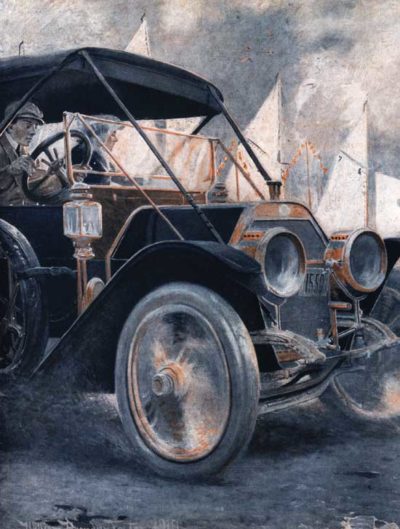
The motoring public will never know how lucky it was that we did not stop in the middle of our experiments. The pattern indicated that the compounds of the heavier elements were most effective in squelching knock. We found two or three that were so good we might have been satisfied with their performance if it had not been for one thing — they smelled terrible. They smelled so bad and the odor was so lasting that the men in the laboratory who handled them were on the verge of becoming involuntary hermits. They didn’t dare go to the movies. But with the pattern leading us in the direction of the heavy elements, I suggested that we take a big leap and try the very heavy metal — lead.
The result of that leap was a whole bookful of trouble — and tetraethyl lead antiknock gasoline, which Midgley and his boys worked out and which is now known as Ethyl to everyone. Before we perfected Ethyl for widespread use, we had to develop a method of extracting huge quantities of the element bromine from the ocean. The chemists again told us this was impractical, since there is only one-tenth of a pound of bromine in a ton of sea water. But we found a way, and now we extract 120 million pounds of bromine from the sea annually. If you want to put a value on the result of our long hard search, in which the entire oil industry cooperated, you can do so in three ways. The superior fuel made possible more efficient high-compression engines. It permitted us annually to leave 25 billion gallons of fuel in our underground reserves which otherwise would have been burned. And at retail prices of gasoline the American motorist has been saving $5 to $8 billion a year.
You can see from just these few examples that the automobile industry was teethed on trouble. Complacency has no place in this business. You have to break out of the ruts if you want to survive. The fact that of about 2,500 makes of automobiles that have appeared only a handful are in existence today is a good illustration of what can happen if you design to suit yourself and ignore the wishes of your boss — the customer.
I am a great believer in the “double profit” system. The producer must make a profit to keep in business, but the customers’ profit must be ever so much greater. If you don’t believe some of these modern necessities, comforts, and conveniences have a definite value to you, just try doing without them. Suppose you were suddenly deprived of your car, electric lights, and power, or the telephone, radio, or television. What would you give to have them back?
—“Future Unlimited,”
The Saturday Evening Post, May 17, 1958
Floating Toward Ecstasy: How One Man Overcame His Scuba Fears and Learned to Let Go
The fish are fine and all that, but the epiphany is the sensation of floating, of weightlessness. After two days in dive school, I know the term is neutral buoyancy, the state in which you are neither rising nor sinking, but that’s just the science. It’s like explaining why a fish is luminously blue, which doesn’t quite get to the wonder of it. Broad leaves of soft coral bend in the current, bowing in praise of my effort to inhabit their world. I hear the soothing susurrations of my own breath, and submersed just 40 or so feet below the surface, I have a feeling of mindfulness, of intense alertness within this aquatic womb.
“We ourselves see in all rivers and oceans,” wrote Herman Melville in Moby-Dick. “It is the image of the ungraspable phantom of life.” Divers require no explanation. “I live to dive,” my instructor, Steven, liked to say. He was a Dutch expat who came for a visit when he was transfixed by the lapis lazuli sea in Playa del Carmen and decided he’d never leave.
When Steven first told me, I could see the water but I couldn’t relate, because after two days of watching videos and practicing in the pool of the Tank-Ha Dive Center, my first open-water dives made me want to go home. I hadn’t equalized my ears properly and felt the first atmospheric pressure like a vice-grip inside my skull. Once that resolved, an acute thought replaced it, that my life — my parents’ son, my wife’s husband, my children’s father — was hanging on a rubber thread linking my mouthpiece to my tank. One mistake or malfunction would set in motion a lot of logistics, such as how to transport the body and what kind of services and eulogies and, gee, I had meant to increase my life insurance, hadn’t I? It didn’t make me inclined to feel thanks for all the fish, and I even felt unkindly toward the divers who had all promised, every last one of them, “You’re gonna love it!” as if they’d been pledged to repeat the line as part of some fraternal code.
When I climbed back onto the boat 40-some minutes later, I was stressed, tired, and relieved, though the relief passed quickly as the waves started to make the boat, and my belly, surge and roll. Suddenly, even the briny smell of the sea was an unpleasant odor. “I’m feeling a little seasick,” I told Steven.
“You’ll be all right once we get back into the water,” he said.
Would he think less of me if I threw up or broke down? I might do either, or both.
Yet, I am a victim of a long-conditioned impulse to finish what I start, which runs on a continuum from the food on my plate to the ordeals that I enlist in.
Quitting, that is, wasn’t an option.
The Riviera Maya, south of Cancún along Mexico’s Yucatán Peninsula, was more of an ideal than an ordeal. The jungle spread out, dense and rugged, a backdrop to what had been carved out and tamed into a vast playground with a fine white beach for a sandbox and toys such as speed boats and jet skis, mountain bikes and ATVs. At all-inclusive resorts, escapists luxuriate on rafts and chaise lounges, in poolside bars and Jacuzzis.
The biggest town, Playa del Carmen, used to be the jumping-off point for Cozumel, the island that Jacques Cousteau, the father of diving, made famous in his early documentaries. In recent years, though, Playa, as it’s known, attracted those who liked its low-key attitude, and soon enough it had grown its own jamming central district of shops, bars, and restaurants owned and patronized by European and American expats and Mexico City transplants. Deeper in is a pueblo with real people and great prices. Within easy access are Mayan pyramids and ruins, eco-parks and caves, and freshwater pools under caverns called cenotes (see-no-tays) that are unique to the Yucatán.
After my four-day dive course, I decided to take a break from the water. I headed down the coast to Tulum, to see ruins of a once-great Mayan city and catch up with two mates, Macduff Everton and Charles Demangeat, who knew the Riviera Maya since before anyone called it that, when they were touring in a circus in the 1970s, Macduff as the knife-thrower, Charles as the human torch.
“How’s that work?” I asked.
“Trade secret,” one, or maybe both, of them replied.
They arranged rooms at Cabañas La Conchita, a bed-and-breakfast by the sea with thatched palapas around a sandy courtyard whose palm trees stand like architectural columns. There were no phones or TVs, and starting from 10 in the evening, no electricity, only candles and the music of the surf. The bright blue hammock on the patio lured me like a fly into a spider’s web, where once again I experienced that floating sensation. High above, a pair of big birds spread their wings and hung in the sky, as if they liked the view from that spot, and I probably hadn’t drifted off for too long because when I woke up, they were, improbably, still there.
Not too long ago, Macduff had published a splendid book called The Modern Maya: Incidents of Travel and Friendship in Yucatán (University of Texas Press, 2012). Charles, a writer and artist, spoke perfect Spanish and a good Mayan. They befriended a Mayan guide and herbal doctor named Candido, who offered to take us into the Sian Ka’an Biosphere, a 528,000-hectare preserve of tropical forests, marshes, rivers, and lagoons connected by a 15-mile canal cut by Mayans during their 1,200-year reign.
We piled into their rented compact and went in the mid-afternoon with Candido and his wife, Delfina, to a dock where they kept a motorized dinghy that skirted across some gloriously isolated lagoon, through a canal to another lagoon, until we reached a landing, the entrance to a jungle trail Candido bushwhacked for visitors like us.
The ground was soft, and trees, branches, and vines bent, twisted, and wedged into the canopy. Termite colonies grew like big black tumors on some trees. Other flora grew at every angle, along the ground, on other tree limbs, lurching for sunlight that struggled to penetrate the thick cover. The sun’s reflective glow on the foliage suffused the air with an emerald tint. There was a chirrup and steady crackle of insects, a busyness in this self-contained universe that you hardly noticed until it was broken by a coarse rustle, probably of some small animal, and that was followed almost instantly by a flutter of birds. What we were most aware of, though, were our own footsteps and the sound of branches brushing against one another as we pulled them back to carry on.
For all the shade, there was still hardly any reprieve from the moist heat, and the lagoon looked like a big refreshing pool as we sat on tree stumps and Candido told how the jungle was the raw material of the society. The wide leaves of palm trees provided housing, the roots and barks and tendrils gave medicine, and the world a context for rituals and customs. He was amused by the matapalo tree, or strangler fig, which attaches itself to mature trees with two arm-like vines and hugs the tree — to death. “Like a wife!” he teased. Delfina laughed, hugging him for a photo, like a matapalo.
We climbed back into the dinghy and retraced our route across the lagoon to another canal. At the entrance was a stone ruin that was once a Mayan customs house. It was one of 23 archeological discoveries in this UNESCO World Heritage site. Some date back as much as 2,300 years. Traces of blue-green paint on the wall, faded but visible, and small decorative flourishes carved into the walls were signs of the life that was here once.
On the way back, Candido showed us how to lay out our life vests flat like lawn chairs and drift on our backs in the current. He said he’d meet us down the canal. We flopped out of the boat and floated, just us and the fish, a gnarled mangrove to our left, a grassy savannah to our right. The world was in harmony. The late afternoon sun shared the sky with an almost full moon. The temperature of air and water was harmonious.
“I’m worried,” I said. “I’m so relaxed, I could fall asleep and drown.”
“Life,” Charles said sagely, “is full of worries.”
The plan was to hire a fisherman and see the Tulum ruins from the sea at sunrise, but in the morning the surf was churning, and I didn’t have any Dramamine. Then, good news. The fisherman, thank God, had twisted his ankle and couldn’t go, and I returned to drift in my hammock until the ruins opened.
We arrived ahead of the tour buses, so we had the walled complex of temples and palaces to ourselves and wandered around the perimeter on a rocky bluff above the sea. The Maya who dominated the region for more than 1,200 years were advanced, like many other ancient but later conquered people. They built massive pyramids, such as Chichén Itzá and Cobá, which for the Maya were temples rather than tombs as they were for the Egyptians. Their hieroglyphs show that they acquired a deep knowledge of abstract mathematics and of astronomy, producing a 365-day calendar based on their observation of the sun. Tulum, the only Mayan seaport ever excavated, was inhabited when the Spanish arrived in the 16th century.
Pale traces of colors still speckle some of the murals and frescos that once adorned the walls, giving hints of its past glory. On one lintel is a figure tumbling from the clouds. The signpost calls it the “Descending God.” Divers have called it the “Diving God,” though the Mayans cannot claim credit for scuba. I squint at it from behind a rope 15 feet away.
“You see the head?” Charles says, tracing the outline in the air. “There’s the body. You see it?”
“Yeah, yeah. I think so.”
“You can see it better on the internet.”
It’s hot, and we cool off with a pre-noon chelada (lime juice, beer, and ice; chela is a Yucatán slang for beer). Then we go to Gran Cenote. All the region’s rivers are underground, and as the water travels through limestone toward the sea, it forms the cenotes. The Maya regarded them as sacred, and so do many divers. They say the water is so clear that other divers look like they’re floating in mid-air, but this is cave diving, the sport’s equivalent to skiing’s double-diamonds, with a real risk of wandering into inadvertent darkness, and it takes some mastery to manage it safely. The more doable alternative is to snorkel in the caverns that have air pockets, and of these, Gran Cenote is considered among the best. You’re basically swimming in a hollow with decorative speleothems, natural stalactite formations on the walls and ceiling that, with some imagination, seem to transform into other shapes.
I was okay with snorkeling in the lighted areas, and even if I had had dive gear with me, I don’t think I could have willed my body to cross into the darkness.
I had, as I said, stuck with the scuba training mainly out of pride about finishing what I started. When I had planned this excursion, I had visions of actually entering the cenotes with scuba gear, but I quickly saw there was no way I was going to achieve anything so ambitious. Indeed, peering into that darkness, I no longer even wanted to. Now my goal shifted to something much more modest. I just wanted to get past fumbling with equipment and my own anxiety so that I could enjoy the diving and understand why people connect to something in the water. So, a few days later, I geared up and went back into the open water at a reef called Moc-Che.
After my third dive there, something clicked and my training earlier in the week started to kick in. I think it began when I realized the equipment was working and that I knew how to work it.
Once that trust was established, I began to feel it, and then the scales fell away from my eyes and I began to see stuff. A shoal of diaphanous white and yellow fish, two huge lobsters under a rock, two flounder playing dead on the sandy floor, an eel poking its face out from a hole in the reef. A big surly-looking creature passed, which was especially exciting later when I found out it was a barracuda.
By the fourth dive, I didn’t see why we had to get out of the water, since I still had at least five minutes worth of air in my tank.
“There were a lot more fish today,” I observed.
“No,” Steven said, “they were here yesterday.”
“Really? I guess I was more comfortable.”
“Listen, you only have to remember one thing, and you’ll be okay,” he said. “Whatever happens, just remember to keep breathing.”
It’s not, now that I think of it, a bad life lesson.
Todd Pitock is a regular contributor to the Post. His last article was “Storm-Chasing on Vancouver Island” in the September/October 2016 issue.
Here the Nazi Butchers Wasted Nothing
In observance of International Holocaust Remembrance Day, we look back at The Saturday Evening Post’s coverage of one of history’s darkest episodes.
Long before Americans had entered World War II, they knew about Nazis’ brutal treatment of Jews. But many weren’t ready to believe the news of death camps and mass slaughter. Reports of the Nazis’ program of exterminating Jews, which began in earnest in 1942, was greeted with skepticism or sheer disbelief. How could a civilized nation actually murder millions?
By 1944, though, American soldiers and journalists were entering the lands occupied by German forces, and they were seeing the Holocaust first-hand.
In this article from the October 28, 1944 issue of the Post, Edgar Snow wrote of what he’d seen at the Majdanek death camp and confirmed the unthinkable to Post readers. He was astounded to see how the Nazis conducted barbaric mass murder with scientific order, writing that the camps perverted “the very virtues of a once great people into the service of a machinery of crimes almost too monstrous for the human mind to accept.”


Sherry at the Knights of Columbus
She smells their sour exhalations in the velveteen darkness, hears their involuntary animal noises: coughs, sighs, rear-ends squirming in wooden seats.
“The trick is to keep the baffles moving, no matter how slow or how small the movement,” Rusty Nail had taught her. “Constant motion, like you never stop breathing. Breathing is the key. Don’t take those big gulps and then collapse. Slow and steady, so’s you hardly look like you’re breathing at all. And smile, smile, smile. Smile till it hurts and then smile, smile some more.”
She was rehearsing “Fly Me to the Moon” when the light in the basement room suddenly dimmed, and a large, rounded shadow fell across the music on the stand. She lost her place, her fingers faltered, the accordion wheezed open.
Gary Junior, in the window, his pants and undershorts down around his ankles, the pink-white cheeks of his ass pressed up against the windowpane.
“Father, it’s been one week since my last confession.”
Father Durham’s stale breath wafted through the mesh screen. “And how have you sinned, my child?” His voice was tubby and intimate in the tiny cubicle.
“I called my brother a demented pig.”
Father Durham sighed. “Siblings can be such a trial,” he said in a weary singsong. “I suppose the Good Lord puts them on Earth to test our faith and humility. Three Hail Marys and prayer.” He paused. When his voice returned, it was low and furtive, a near whisper. “Tell me, do you still play the piano?”
Sherry was shocked, but not too shocked. She and Father Durham went back a long way. Besides, things were loosening up. Fish on Friday was optional. “No, we sold the Bösendorfer. I play the accordion now. Why, Father?”
“The accordion! That’s even better. Listen, the Knights of Columbus have their annual talent contest next month. On the 15th, that’s a Saturday night. This year promises to be as dreadful as last year. We always get the same ones — the twirlers, the rock bands, this one terrible comic.” He clucked in despair. “I remembered how you used to play the piano, that recital you gave in the Parish Hall. The Mozart sonata in particular.”
“But Father, I’ve never …”
“There’s a cash prize and the winner goes on to the state quarter-finals in Camden and then, God willing, to the semi-finals in Union,” Father Durham continued in a rush. “The finals are in October in Newark. From there, for the winner, it’s on to Radio City Music Hall and a spot on The Ed Sullivan Show!”
He paused, out of breath from excitement. But when he spoke again, his voice was at a lower pitch. “We’ve never had anyone from this parish even reach the semis. It’s embarrassing: Every year the animal clubs do better than we do.”
“Animal clubs?”
“You know: the Elks, the Moose, the Lions. Of course, as I remind the archbishop, the animal clubs can bring in a ringer, and nobody knows the difference, whereas we are bound by our rules about who’s a Catholic and a Knight of Columbus. They’re necessary rules, of course. We can’t just take in anybody off the street. But the truth is, Sherry, we’ve never had anyone with real talent enter in the first place.” His voice brightened. “But an accordionist, and a good one! Think of it, Sherry! It’s not impossible. God willing, with a little effort, you could be on national TV!”
The stall didn’t feel as claustrophobic anymore. “My mother signed me up for secretarial school in the fall,” she confessed, in a sudden gush of emotion. “She paid a $100 deposit.”
“Well, first prize happens to be $150.” He paused, then added primly: “And, of course I’ll be one of the judges.”
“How many numbers should I work up, Father?”
“No more than two, but make them your best two.”
“Da dum da dum da da dum dum dum. Third finger then first then second. That’s right. Very good. Now do it again, this time in tempo.”
Her life, it seemed to her, had been dictated by her fingers. Long and thin and agile, they made up not quite lovely hands, she believed — too pale, too utilitarian. She’d discovered them, as if quite by accident, at the age of 6, when Mrs. Penny sat her at the old Bösendorfer upright in the living room. A John Thompson primer was open on the stand to page one. Within a year, Thompson gave way to Hanon and Hanon to Scarlatti and Scarlatti to Chopin. By age 9, her hands shook if they were away from the Bösendorfer for too long. Her fingers were calmed only by the greasy, supple touch of ivory, a bench fat with music beneath her bottom.
“Da dum dum dum da dum dum dum, yes, one and three and one and three.”
Now every Saturday, Sherry gave lessons on the Baldwin in Mrs. Penny’s living room, while Mrs. Penny sat on an orange stool at the minibar, chain-smoking and drinking martinis. Mrs. Penny’s black hair was dyed and swept up in a cone, her cheeks were rouged, and she had great purple eyelids, like two enormous bruises. She wore violet-and-red Harem pants and sparkly paisley blouses. Her husband had left her five years before, had vanished into Manhattan one sultry summer evening and had never returned, not even for his clothes.
“Dum de dum dum. First then fourth then third then first.”
Today, the house smelled as if Mrs. Penny had accidentally tipped over a bottle of Calgon and had forgotten to clean it up. In the bathroom, where Sherry washed her hands between lessons, the various perfumes clashed noxiously: Jean Nate, Tigress, tuberose, My Sin.
“It doesn’t mean anything unless you do it with the metronome, Janey. Have you been practicing? Well, maybe you will for next time.”
Right on cue, Mrs. Penny drifted off her perch toward the piano, clutching a cigarette in her hand, purple lids half-closed, smiling widely for the girl. “See you next week, honey,” she said in a merry gravel voice. As soon as the screen door slammed, she said to Sherry, “My God, she’s an ugly runt, isn’t she?”
“I suppose so.” Sherry drew in a breath. She rubbed her hands together nervously. “Mrs. Penny, I think it’s time we gave the Baldwin a good tuning.” She paid Mrs. Penny 25 percent of her fees for use of the spinet and the living room. In Sherry’s opinion, the tuning was Mrs. Penny’s responsibility.
Mrs. Penny blew a gout of blue smoke above Sherry’s head. “Oh, what does it matter? Those monkeys can’t tell the difference anyway.”
“But it sets a bad example, Mrs. Penny. You always kept it tuned for me.”
“Oh, but you, you … oh, but you were different. You had talent, my dear. Real talent. How can you even compare yourself? Anyway, these monkeys never practice, I can tell, even if you can’t. Their parents don’t make them practice.” Smoke dribbled out of the side of her mouth, like foam. “What do these monkeys know of Beethoven, Sherry? Their parents, either. We’re the last of the breed, you and I.”
“Maybe so, Mrs. Penny. But, still, the piano …”
“Sherry, just think of all the glorious music we made in this room. The Slavonic Dances for four hands, Mozart, Bach. Oh, and Clara Schumann! Beautiful Clara. Why she ever married him, that brute who stole all her ideas. They were all her ideas, you know.”
“Yes I know, Mrs. Penny.”
“She wrote every last note of his piano music and then let Robert take the credit. Out of love. Now he’s immortal and she’s a nobody. That’s what love gets you. Oh, Sherry, Sherry. You were my prize, my Clara, my rare jewel.”
Sherry swallowed around a lump in her throat, a bittersweet, brackish taste. “I don’t know, Mrs. Penny.”
“If I had the money, I would pay your way myself. I swear I would. I would sacrifice myself. I would throw myself on a sword for you. You know that.”
“Yes, Mrs. Penny, I know that.”
The first thing every morning, as soon as the house emptied except for her father, she strapped on the accordion and ran all the chords and played all the scales. She’d decided on a moon song, but she couldn’t decide on what else. She had no idea what they wanted, what would please them. Mrs. Penny knew those sorts of political things, like a kind of sixth sense, but Mrs. Penny didn’t know the accordion and she didn’t know the Knights of Columbus. She knew how to curb the flying pinkie and tame the wild ring finger and how to keep a child’s wrists and dreams of glory from collapsing under immense strain. She knew the art of the Sunday afternoon recital.
That was Mrs. Penny’s milieu: the irritable mothers, the fidgety siblings, the bored fathers, all in their slightly wilted Sunday best, as if church had gone on for hours too long. And Sherry’s peers, her co-competitors: the flouncy, rosy-cheeked, brown-haired girls in taffeta dresses who chewed gum and talked dirty when their mothers weren’t around. They pitied Sherry because she was small and pale and not so pretty and she got nervous and wrung her hands a lot. Mostly, she noticed, she perspired and they did not. For a while she thought it was something glandular, something horribly wrong with her. Mrs. Penny told her, “You sweat because you care. The others don’t care.”
The senior audition was held in an art gallery in Newark. First prize was a scholarship to Marlboro College. Second prize was failure and obscurity. The piano was an 1872 square grand. It was bought by one of New Jersey’s richest dowagers for $10,000 from a European antique dealer who claimed that Franz Liszt had once brushed his fingers over its keys in Vienna. The old woman died and willed the piano to the art gallery.
Sherry was third in line, a fatal position, as it turned out. Before her was a chubby girl who played expert but listless ragtime and a towheaded boy who executed three of Chopin’s most difficult études with the tip of his tongue poking out of the side of his mouth. By Sherry’s turn, the piano was completely out of tune, because, as Mrs. Penny later lamented, the old woman had been taken by the antique dealer. By the time Sherry began the first of Schumann’s Kinderszenen, the notes were not where they should have been. Mechanically, her fingers kept moving, but everything was wrong: the air, the light. The pictures on the wall were askew, the silent, frowning crowd too close. Perspiration streamed down her brow into her eyes and blinded her; the keys disappeared into one another, black into white and white into black. She was drowning. At last she came to some kind of ending and fled, pursued by a thin titter of applause. Backstage, she wept while Mrs. Penny boiled and paced and swore revenge.
The towheaded boy won. Soon after, Sherry’s father lost his job and her mother sold the piano. “Learn something practical,” her mother snapped as they hauled it away, “learn to play an adding machine.”
The adding machine remark, Mrs. Penny said, was like a stake through her heart.
The first time Sherry picked up an accordion, in Moe’s Melody Shop, she was surprised by how light it was and yet so dense. All those tiny black and white buttons, the miniature keyboard, the pleated baffles that opened and closed. It was sitting in Moe’s showcase window, off to the side, crowded out by fancy electric guitars, but sleek and bright and friendly even in their midst.
“You should see one of these things gutted. What a contraption! It’s like brain surgery fixing one up,” said Moe. He was balding with a florid face. He played the drums. Sherry had known him for a very long time. He liked to disappear into the back room where he had a drum set and play along with Glenn Miller records.
Rods and levers and reeds. Cotton swatches, tunnels and vents and tubes. Its ornateness fascinated her. The baffles were made of cardboard, folded and pleated, brown and gold, with soft leather gussets in each corner, reinforced by calico strips of plastic and rounded chrome caps to protect the cardboard. Odd that such a crucial moving part would be made out of paper, she thought, but it felt as tough and supple as hide. Her fingers moved over the unfamiliar buttons and keys in an idle yet knowing manner. It was, in essence, a portable piano. You could strap it on and take it anywhere you wanted. Have accordion, will travel. The tag said $300. “Aah, it’ll never move at that price,” Moe told her. “Two bills and it’s yours.” A week later, she put $50 down and took it home.
Mr. Rusty Nail had red hair, of course, a short, fat, sloppy man, with his belly tumbling over his belt, pinstriped shirt untucked in back, suspenders. Red nose, chalk-white cheeks. Sherry thought it strange that an entertainer could care so little for his appearance.
In the daylight, the Skyview lounge looked seedy and forlorn, with the lights off and the chairs up on the tables. The bandstand was carpeted in pea green, and smelled of beer. On stage, a microphone, a black stool, and a portable organ decorated with two dozen hats, masks, and dolls, including Kermit the Frog and Barbie in black garter belt and stockings, with a tiny whip in her hand. On the organ bench was an accordion, closed up tight, like a compact, brown-and-white suitcase.
“You wouldn’t want to know some of the places I’ve played,” Rusty Nail said. “Strip joints, porno houses.” He rolled an eye toward her to see how she reacted to this. “Worked the lounges around Camp Lejeune, just for example, along the coast of North Carolina, the largest Marine compound in the world. Wall-to-wall Marines and every damn one of them hornier than Hugh Hefner.” He coughed and a little redness intruded upon his cheeks. “Excuse my French, little girl, but I didn’t make the world. The point is, a certain moment would come and go and they didn’t like nothing I played. Nothing. You name it: Vic Damone, Elvis, Pat Boone, the Big Bopper, Frankie V. They took offense at it, even if it was one of them requested it. Wanted to punch my lights out.” For a second his face took on an expression of faraway, puzzled hurt. His mouth curved downward and his lower lip rose into a grotesque pout. His bloodshot eyes opened wide, seemed to probe Sherry’s eyes for the answer to an ancient mystery. Then his expression collapsed into a bent, cynical grin. “I kept a baseball bat in the backseat of my car for years.” He chuckled. “That’s how you learn to play the accordion, little girl, in the face of fear and insults.” He took out a wrinkled red-and-white hanky and gave his nose a honk, hawked something up from his throat.
“First thing you do is learn the polkas. When they’re dancing, they ain’t listening too hard. First law of the circuit. Listening too hard to music makes people ornery, ever notice that? Especially in a bar. When they’re drunk, everybody’s a critic. They always think they got a better idea of a tune than you.
“I learned all the polkas right off the Man himself. That’s right, Frank Yankovic, the King of the Polkas, they call him. Better than that stiff Lawrence Welk uses, Myron Floren. Ever notice Floren’s got a hairlip? Well, there’s the ‘Beer Barrel,’ of course. ‘Hokey-Pokey Polka,’ ‘Milwaukee Polka,’ ‘Acapulco Polka,’ then that great one. Even sung by Elvis himself, ‘Just Because.’”
He winked at Sherry and strapped on the accordion for the first time. It looked smaller bumped up against his big belly. His fingers moved over the plastic keys once playfully, but then the bellows began to move in and out. Music emerged as if by a miracle and he sang, “Just because you think you’re so pretty …” in a surprisingly beautiful voice. But he stopped right away, self-conscious, and the melody hung in the air, incomplete. “I used to be what they called an Irish tenor, before I smoked too many of those things.” He nodded over to a pack of Lucky Strikes on the organ. “Cancer sticks. I always tell them young guys now: ‘You got a choice. You can sing or you can smoke but you can’t do both.’”
He got down to business. “Now the way these buttons are arranged, you got two rows of bass notes and three rows of chord buttons, divided into the four chords for each key: major, minor, seventh, and diminished. Remember your music theory? You got to know a little to work an accordion. Not a lot. But the most important thing is, you got to keep her breathing. Squeeze in, squeeze out. It don’t matter how fast your fingers are moving if she ain’t getting any air.”
At first it sounded like Gary Junior, outside her door, pounding a roll of caps with a hammer against the cement floor. But the caps always went off in a steady, maniacal rhythm, and this sound was tentative, hesitant. Plus it was Tuesday, a school day. It took her a minute to identify the sound as her father, tapping on the old black Royal with the purple ribbon and the cracked T and E keys, making another stab at his science-fiction novel. He tapped with his two index fingers and he wasn’t very fast. He gave up after half an hour.
That day they had a picnic lunch by the side of the road, near a culvert and a large overpass. The Garden State Parkway roared above them. The river was brown and sluggish, half the surface covered with yellow soap bubbles. The sun was strong and baked Sherry’s neck as they sat on the large beach towel and ate ham-salad sandwiches.
“New Jersey used to be a pretty state, believe it or not. Even the Rahway River, before it became the Raw-Sewage River. We used to fish this stretch as kids. Now anything you catch you’d better throw back. I wonder if there’s anything alive in there anymore. Maybe a few dead Gambinos with cement shoes on.”
The longer he was out of work, the more eccentric her father became. He grew a beard for a while, ate mayonnaise straight out of a jar with a spoon; he became addicted to puns, said things like: “Accordion to your mother, dinner is served.” For a solid week he spoke everything in a fake-Cockney accent, like Dick Van Dyke in Mary Poppins, until one night at the dinner table, Sherry’s mother asked him none too pleasantly to please knock it off.
“You know, one summer as a boy I built a boat,” he went on now. “Took me all summer, too. Huge thing, a monster, about the size of a small car. Made out of these old planks, these heavy, heavy two-by-sixes I took out of an abandoned shed Uncle Chuck had out on his right-of-way. They were coated with lead paint, I remember. Used to flake off in a cloud of silver specks, made me sneeze. But I didn’t care because I was determined, boy. It made me mad that Frankie Tilley and his brothers slapped together these boats out of a sheet of plywood and inner tubes, tied on with rope, then they’d buy these plastic oars out of their big allowances. I didn’t think that qualified for a real boat.
“Mine, though, had a bow and a stern and a rudder,” he continued, “and a nifty fake-cabin structure, with a steering wheel made out of an old bicycle rim. It was like a huge sled, really. Oh, you should have seen it. Painted it white. I named it the S.S. Jersey, had it stenciled on the bow. Then one morning I called Frankie and told him it was finished. He came right over with his brothers to see. I could tell even he was impressed. We dragged the darn thing down to the river that morning, more than a mile from the house, must have taken us close to an hour, and launched it. It was me and Frankie on board, with his brothers pushing us away from the shore. It’d rained the night before and the current was running swift and strong. I was elated, I felt on top of the world. As soon as his brothers let go of us, though, the thing rolled right over and sank. We were lucky we didn’t drown; it went down so fast.”
For a long time, Sherry just stared at her father, appalled. When she spoke, her voice trembled with indignation. “But you said it was made of wood, Dad. Wood floats. For Pete’s sake, why didn’t it float?”
He gave her a puzzled, slightly wounded look. “I guess it was too heavy, honey. Wood or no, it had no buoyancy.” He took a bite of his sandwich and shook his head, gazing far down river. “Could have been that lead paint, I suppose,” he said after he swallowed. “Or all those 20-penny nails. I must have used several hundred, maybe even a thousand. Never could hammer a nail straight, so’s soon as one would start to bend, I’d just pound it in horizontal and start again with another. What’s one more nail? I thought, never figuring. I kept pounding them in, one by one. That’s the trouble, never figuring, never thinking. Too busy dreaming. It’s the little stuff that slips you up, again and again.” By now, the tears had arrived, brightening his pale blue pupils. He looked at her in silence, beseechingly.
One Sunday, Gary Junior was outside the door of the basement room, simultaneously belching and pronouncing “Eat me!” over and over. The words came through the door with perfect clarity, like a bullfrog mocking human speech.
Sherry’s face and the back of her neck stung with rage. She set the accordion down and, elbows flailing, charged the door. She whipped it open.
He was leaning over with his hands on his knees, his little pig-eyes nearly crossed in an ecstasy of concentration. For a second, he gazed up at her in blissful surprise. Then he took off up the stairs three at a time, slamming the door behind him at the top.
She stood in the doorway and stared at the spot where he’d been. The cellar smells of sewage and heating oil overwhelmed her. She felt clammy and debased, the incarnation of all the invisible effluences surrounding her. Squares of pale light emerged through a skinny, trisected window. The light penetrated the gloom, but only a scant few inches before dying abruptly in midair. Below it, she felt in a hole as vast as all eternal darkness.
She flexed her fingers, and it came to her: “The Beer Barrel Polka!” A showpiece, a chance to execute some fancy button work with her left hand and show off her dexterity on the keys with her right. Sixteenths. She could smear the last chord in the turnaround and modulate up a half-step for the final chorus, so that the song would end up sounding brighter than it had begun.
On the morning of the 15th, she and her father visited the Knights of Columbus to check out the stage. The building looked like an armory, made of ugly red brick, built low to the ground. The crucifix that hung on the back wall behind the stage was made of stained cedarwood and was very graphic. Jesus Christ bearded, bare-chested, in a loincloth, nails in his palms and ankles, vivid rivulets of blood dripping from his temples, hands, feet. At that moment, he looked very dead and very alone. Beside him were two flags: one American, one for the state of New Jersey. Further downstage was an upright piano with its guts exposed, its keys yellowed and cracked. Long lines of masking tape marred the pattern of squares on the parquet floor, with Magic Marker instructions: “Jesus,” “Mary,” “Joseph,” “Colonel Pomerini,” they read. Overhead were three banks of stage lights.
Sherry decided to stand where Colonel Pomerini had stood, although who he was or who he was supposed to be in relation to the other three, she had no idea. She unsnapped the bindings from the accordion and lifted it up, strapping it on. She toed Colonel Pomerini’s line. She wondered if anyone were around; felt foolish and self-conscious.
“Go on, honey. Go ahead and play,” said her dad. His voice sounded unnaturally boomy and authoritative in the large, empty room.
She obeyed, as if it were a command from God, and began the chords for “The Beer Barrel Polka.” The music overwhelmed the room, seemed to fill its four corners beyond its capacity, bouncing back to her slightly off-key.
She is halfway through “Fly Me to the Moon” when the first doubts arrive, the inkling that this might all be a mistake, that her fingers, those once reliable soldiers, are about to betray her, are about to turn and flee in the face of incoming fire. Her smile wilts, the bellows gasp for air and she fumbles through the bridge and the final chorus. There is only scattered, indifferent applause — no more, really, than that received by the twirler, the rock band, the girl who did a Groucho Marx impression with a plastic nose and glasses and a plastic cigar.
Mrs. Penny, Rusty Nail, Father Durham — she smells their disappointment in the darkened rows of seats before her, imagines her mother’s impatient sigh, her father’s wan and helpless smile. She senses Jesus twisting on his cross on the wall behind her, his eyes suddenly alive and filled with pity for her. She launches into “Beer Barrel” with little hope for redemption. She closes her eyes and lifts her face toward the hot lights. Sweat streams down her forehead, over her eyelids and cheeks.
“You sweat because you care,” Mrs. Penny had told her.
By the second chorus of “Beer Barrel”, the crowd is clapping along with her. When she modulates, they roar with delight. When she finishes, they stand and applaud and stomp and whistle. She opens her eyes and smiles and lets their love and approval wash over her.
She feels anointed.
News of the Week: Mary Tyler Moore, the Last Jedi, and Resolutions We Didn’t Keep
RIP Mary Tyler Moore, Butch Trucks, and Mike Connors
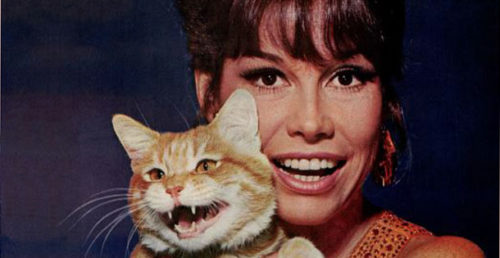
The girl who could turn the world on with her smile has passed away, and a big part of pop culture is gone too.
Mary Tyler Moore, famous for playing Laura Petrie on The Dick Van Dyke Show and Mary Richards on The Mary Tyler Moore Show, died Wednesday at the age of 80. She had been dealing with many health problems for decades, including type 1 diabetes and brain surgery in 2011.
Moore also earned an Oscar nomination for her role in Ordinary People and had a memorable role in the comedy Flirting with Disaster. She also appeared in movies like Thoroughly Modern Millie, the Elvis Presley movie Change of Habit, and TV shows like the miniseries Lincoln, 77 Sunset Strip, The George Burns Show, Hawaiian Eye, Frasier, Hot in Cleveland, and other shows where she was the lead, including Mary, The Mary Tyler Moore Hour, Annie McGuire, and New York News. Only her legs were seen in the ’50s series Richard Diamond, Private Eye, where she played David Janssen’s secretary. She won seven Emmy Awards and graced the November 19, 1966, cover of The Saturday Evening Post.
Her production company, named MTM Enterprises and famous for its mewing kitten logo, was responsible for shows like Rhoda, The Bob Newhart Show, Lou Grant, Remington Steele, Hill Street Blues, St. Elsewhere, WKRP in Cincinnati, and many others. She got her start playing Happy Hotpoint in commercials that ran during The Adventures of Ozzie & Harriet.
Many costars and friends are paying tribute to Moore, including Van Dyke, Carl Reiner, Rose Marie, Ed Asner, Cloris Leachman, Larry Mathews (who played little Ritchie Petrie on The Dick Van Dyke Show), CBS chairman Les Moonves, and many others. Fans are also gathering at many of the Minneapolis locations seen in the opening of The Mary Tyler Moore Show.
Butch Trucks was the co-founder of and drummer (along with Jai Johanny Johanson) for The Allman Brothers. He played on such classic songs as “Ramblin’ Man,” “Whipping Post,” “Trouble No More,” and “One Way Out.” He passed away Tuesday at the age of 69. He was inducted into the Rock and Roll Hall of Fame as part of The Allman Brothers in 1995.
Trucks was part of a big musical family. His son Vaylor plays guitar for The Yeti Trio. His nephew Derek Trucks played guitar with The Allman Brothers and also plays with The Tedeschi Trucks Band. And Derek’s brother Duane plays drums for the bands Widespread Panic and Hard Working Americans.
Actor Mike Connors, who passed away Thursday from leukemia at the age of 91, was best known as Joe Mannix on Mannix, the detective drama that ran on CBS from 1968 to 1975. He also appeared in a number of movies, including The Ten Commandments, Sudden Fear, Five Guns West, Day the World Ended, and in TV shows like Tightrope, Gunsmoke, The Untouchables, M Squad, the miniseries War and Remembrance, and Murder, She Wrote. He also portrayed the Mannix character on Here’s Lucy and Diagnosis: Murder and in the 2003 comedy film Nobody Knows Anything. His last role was a 2007 episode of Two and a Half Men.
His real name was Kreker Ohanian, and early in his career he went as “Touch” Connors.
The Last Jedi
That’s the title of the next Star Wars movie. Actually, the official title is Star Wars: The Last Jedi. I don’t want to face the wrath of hardcore Star Wars fans by getting it wrong. Those Trekkies can be unforgiving.
But what does the title mean? Does it mean that Luke Skywalker is that Jedi and he’s going to die? Does it mean that he’ll die and then Rey will be the last Jedi? Is Rey related to Luke? Does it actually refer to Kylo Ren? Does it refer to a character we haven’t even seen yet? Can I ask anymore questions in this paragraph?
As The Telegraph explains, the term “the last Jedi” was used to describe Luke in the opening crawl in The Force Awakens, so it’s a pretty good bet it refers to him. Unless it doesn’t!
Star Wars: The Last Jedi will hit theaters in December. I’d get in line right now.
It's official. STAR WARS: THE LAST JEDI is the next chapter of the Skywalker saga. This December. #TheLastJedi https://t.co/ySkVwQcMTP pic.twitter.com/eHrPgbsRJq
— Star Wars (@starwars) January 23, 2017
And the Nominees Are …
I don’t want to rehash all of the news this week about the Oscars. You can see all the nominations here and read about the 14 nominations La-La Land received, which ties the record set by Titanic and All About Eve, here. It’s more fun to talk about the snubs!
A lot of people thought that Martin Scorsese would get a Best Director nomination for Silence, but neither he nor the film were nominated. Clint Eastwood (Sully) and Denzel Washington (Fences) didn’t get director nominations either (and some are upset that the Academy instead gave controversial Mel Gibson a nomination for directing Hacksaw Ridge), though Washington did get a Best Actor nomination. Taraji P. Henson wasn’t nominated for her role as real-life NASA computer scientist Katherine Johnson in Hidden Figures, though her co-star Octavia Spencer got a Best Supporting Actress nomination. Many people thought that Annette Bening would get a nomination for 20th Century Women, but maybe that movie is getting lost in all of the award talk. Even Tom Hanks wasn’t nominated this year. Isn’t that against the law?
I haven’t yet seen any of the movies nominated, but I’m going to make a bold Oscar prediction anyway. He’s going to be really messy while Felix is going to be really neat.
The Real Story behind McDonald’s
Last April I posted the trailer for The Founder, the movie released last week that stars Michael Keaton as Ray Kroc, the man who made McDonald’s into an international fast food powerhouse. But the title is sort of a nudge-nudge, wink-wink joke, because, as this story from this week’s CBS Sunday Morning explains, Kroc wasn’t really “the founder.”
By the way, Keaton didn’t get an Oscar nomination either.
How Are You Doing with Your New Year’s Resolutions?
We’re almost a full month into 2017. Given up yet?
According to a 2015 poll, 60 percent of people who make resolutions give up on them by the time February rolls around.
Maybe we should start our resolutions in December instead of January, so we won’t have that “new year” pressure and feel like we have to get better and get better quickly. But that wouldn’t work either. You can’t resolve to save money or get in shape at Christmas, when you have to buy new phones for the kids and you’re eating 19 pieces of pumpkin pie.
I can’t say that I’m eating healthier so far this year (I had nachos for dinner the other night), but I’m actually sticking to a couple of other resolutions I made. Yeah, I’m shocked too.
This Week in History
Elizabeth Blackwell becomes first woman M.D. in the U.S. (January 23, 1849)
The British-born Blackwell was also the first woman on the U.K. Medical Register.
Sir Winston Churchill dies (January 24, 1965)
A lot was made recently of the fact that a bust of the former British prime minister was returned to the White House when President Trump took office. Here’s the real story.
This Week in Saturday Evening Post History: “Former Figure” (January 26, 1957)
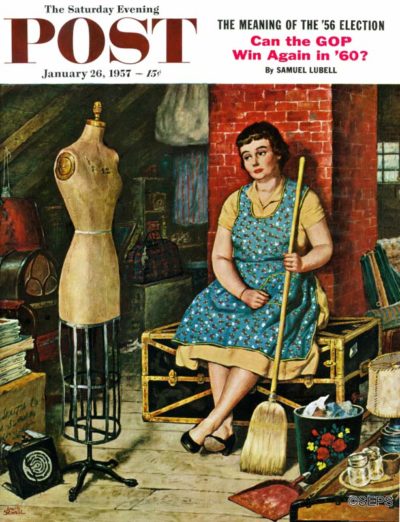
Here’s the cover for the January 26, 1957, issue of The Saturday Evening Post. It’s by Amos Sewell, and it’s called Former Figure. This woman seems to be remembering when she could fit into a dress that could fit on that dress form. Maybe she couldn’t stick to her New Year’s resolution either.
Today Is National Chocolate Cake Day
As Rob explains to Laura in the “Lady and the Babysitter” episode of The Dick Van Dyke Show, chocolate cake is milk cake. You can’t eat it with coffee or grape juice. So make sure you have some milk handy while you make this One Bowl Chocolate Cake, this Perfectly Chocolate Chocolate Cake from Hershey, or this Childhood Chocolate Cake from Alex Guarnaschelli.
And if chocolate cake doesn’t fit into those New Year’s resolution plans mentioned above, but you still really, really want to eat chocolate cake, try this recipe for Chickpea Chocolate Cake. Sure, it still has chocolate chips and sugar and frosting, but it’s gluten-free and made with chickpeas, so you can at least convince yourself that it’s a little healthier.
Next Week’s Holidays and Events
American Heart Month begins (February 1)
February is American Heart Month. And while we should think about our health every month of the year, we have to start somewhere, so it’s a good time to concentrate on our cholesterol numbers, our sodium intake, our stress levels, and having a healthy heart in general.
Groundhog Day (February 2)
You really can’t trust that little critter to give an accurate reading of how many more weeks of winter we have left, or anything else, according to this investigative report from the January 31, 1948, issue of The Saturday Evening Post.
9 Most Scandalous Senate Confirmation Fails
Politics is the usual grounds for rejecting a Cabinet nominee, but candidates have found themselves locked out of the Cabinet for other reasons, including revenge, arrogance, and just plain stupidity.
- Burned bridges. John Tyler made a lot of enemies when he became president. He’d been a member of the Whig party for years but, once in office, he vetoed several bills introduced by his own party. The Whigs responded by kicking him out of the party and rejecting four of his Cabinet nominees. Tyler was so determined to get his treasury secretary confirmed that he nominated him a second and third time on the same day. The senate rejected him all three times.
- Too much sugar. Charles B. Warren was rejected for the Attorney General’s position under Calvin Coolidge because of his ties with the powerful sugar industry. Opponents believed he would not enforce anti-trust laws.
- Bank error. Roger B. Taney was rejected for Treasury Secretary because, at President Andrew Jackson’s orders, he withdrew federal funds from the Second Bank of the United States, which put it out of business. Friends of the bank paid Taney back by rejecting his nomination. (Unfortunately, Jackson appointed Taney to the Supreme Court, where he caused untold trouble with his decision in the Dred Scott case.)
- No vacancy. After Lincoln’s assassination, Andrew Johnson tried to fire Secretary of War Edwin Stanton. Johnson nominated Thomas Ewing to replace him, but Stanton refused to leave and the Senate refused to consider Ewing’s nomination.
- Permanent hiatus. When Andrew Johnson was impeached, his Attorney General, Henry Stanbery, resigned his post to defend Johnson. After the impeachment trial ended, Johnson re-nominated Stanbery, but the Senate was still angry with Johnson and wouldn’t let Stanbery resume his old position.
- Taxi evasion. Tom Daschle, President Obama’s choice for Secretary of Health and Human Services, was criticized for problems with unclaimed income on his taxes, mostly related to free access to a limousine and chauffeur.
- Pompous and circumstance. President Eisenhower’s commerce secretary nominee, Lewis Strauss, was disdainful and condescending to the Senate. Moreover, he insisted on cross-examining witnesses and senators who opposed him, which turned even his supporters against him.
- Home maid headache. At least four nominees withdrew when it was learned they had hired undocumented domestic workers:
- Zoe Baird (Clinton’s Attorney General nominee)
- Kimba Wood (Clinton’s second Attorney General nominee)
- Linda Chavez (George W. Bush’s Labor Secretary nominee)
- Bernard Kerik (George W. Bush’s Secretary of Homeland Security nominee)
- Wine, women, and wrong. Nominated by George H.W. Bush for Secretary of Defense in 1989, John Tower’s reputation was tarnished by accusations of heavy drinking and womanizing. Tower admitted he drank excessively, but vowed to quit if accepted. It wasn’t enough to win confirmation. This was the last time the Senate rejected a Cabinet nominee.
In 2013, Senator Harry Reid changed the rules of the confirmation process (the infamous “nuclear option”). Now, nominees only need the approval of a simple majority vote of 51 instead of the previous 60 required to break a filibuster, likely giving President Trump a clear path to confirmation for all of his nominees.
Vault: Alfred Hitchcock’s Catty Cockney Quotes
Originally published December 15, 1962
Probably the most distinctive thing about Hitchcock is that in an industry noted for executives who gingerly avoid criticizing anything or anybody, he spews a constant stream of delightful Cockney-accented vituperation. Following, listed by subject, are some examples of Hitchcockian curmudgeonry which he expressed to me:
Disney, Walt: “I used to envy him when he made only cartoons. If he didn’t like an actor, he could tear him up.”
Television, Commercials On: “Most are deadly. They are perfect for my type of show.”
Fans, intellect Of: “Most of my fans are highly intelligent people per se, or they wouldn’t be watching my shows. Some, however, are idiots. One man wrote to me, after I had Janet Leigh murdered in a bathtub in Psycho, that his wife had been afraid to bathe or shower since seeing the film. He asked me for suggestions as to what he should do. I wrote back, ‘Sir, have you considered sending your wife to the dry cleaner?’”
Hitchcock, Alfred, Girth Of: “A few years ago, in Santa Rosa, California, I caught a side view of myself in a store window and screamed with fright. Since then I limit myself to a three-course dinner of appetizer, fish, and meat, with only one bottle of vintage wine with each course.”
Actors, Childlike Qualities Of: “There is no question that all actors are children. Some are good children; some are bad children; many are stupid children. Because of this childlike quality, actors and actresses should never get married. An actress, for example, attains the blissful state of matrimony and almost immediately goes to work in a picture with a new leading man. She plays a love scene with him so passionately that after three weeks on the picture she comes home to her husband and says idiotically, ‘Darling, I want a divorce.’ They are children who never mature emotionally. It’s a tragedy.”
Television, Quality Of: “The television set now is like the toaster in American homes. You press a button and the same thing pops up almost every time.”
Star System, Absurdity of: “The movie star is no longer important. The picture is. If you check, you realize that in recent years the biggest stars, like Audrey Hepburn and Marlon Brando, have disappointing records at the box office. The star is no better than the story. In the right picture the star will be as big as ever; put him in the wrong picture and you’re no better off than if you used an unknown. There is a perfect analogy in public affairs. Right after World War II, who could have conceived that the great Churchill — the biggest star on the world stage — could be thrown out of office and rejected by the very people he had saved from disaster? What happened? The big star was in the wrong picture. The script called for a domestic-problems hero instead of a war-problems hero.”
Novak, Kim: “With a girl like Kim Novak you sometimes delude yourself into thinking you are getting a performance. Actually she is just an adequacy. The only reason I used her in Vertigo was that Vera Miles became pregnant.”
Such barbed utterances, in addition to his impudent gargoyle face seen on TV each week, have become two of Hitchcock’s trademarks in the entertainment world. He has others, as well. There is, for example, the Hitchcock practical joke, and, like everything else he says or does, the joke frequently is a sly answer to something that Alfred Hitchcock resents. Not long ago he became incensed over the Hollywood party at which the seating arrangement was as excruciatingly important as that of a diplomatic affair. So Hitchcock threw his own lawn party, complete with delicacies and red-coated waiters from Chasen’s Restaurant. Forty people showed up, but when it came time to sit down for dinner, all the place cards had phony names on them and no one knew where he was supposed to be. Jimmy Stewart’s wife said to him, “My Lord, we haven’t been invited,” and they left. Everyone else shuffled about in embarrassment until Hitch got up and told them it was a gag. They all then sat down at the nearest place, catch-as-catch-can, and we had a wonderful dinner. But Hitch, as usual, had made his point.
Hitchcock’s own training during the golden age of the silent films was as suspenseful and as harrowing as his own pictures, but, as he says, “I learned. There is no mill like this anymore.” He went on to make such classic British thrillers as The 39 Steps and The Lady Vanishes, and then, after being summoned to Hollywood in 1938, he continued to add to his reputation as the master of suspense with Rebecca, Spellbound, Notorious, Rear Window, etc. Today, with his movies, his TV show, and his Alfred Hitchcock mystery books and magazines, he nets close to $1 million a year. He has long since become an American citizen, a designation of which he is extremely proud, and which, he says, “gives me the constitutional right to comment acidly on all the ludicrousness around me.”
Not long ago, in the glow of conviviality engendered by a round of magnificent dinners with Hitchcock in his favorite San Francisco and Los Angeles restaurants, I screwed up my courage sufficiently to ask him to comment acidly about himself, as he had about so many others. He thought for a moment and said, “You know, despite all my bluster and bravado, I’m really quite sensitive and cowardly about many things. You’d never believe it, but I’m terrified of policemen and entanglements with the law, even though I make my living from dramatizing such situations. That’s why I haven’t been able to drive a car since I migrated to the United States. Even the thought of getting a traffic ticket throws me into a panic. Another thing I’m afraid of is going to see any of my pictures with an audience present. I only tried that once, with To Catch a Thief, and I was a wreck. I’m scared of seeing the mistakes I might have made.”
Then, as I took the master of the macabre home (I drove — he has his fear of police entanglements), he concluded with a Hitchcock parable: “I guess I’m like the murderer who is taken to the gallows, and he looks at the trap and says, in alarm, ‘Is that thing safe?’”
—“Alfred Hitchcock Resents”
by Bill Davidson, December 15, 1962
Remembering Mary Tyler Moore
Emmy-winning TV star Mary Tyler Moore died today at the age of 80.
For the generation that remembers her from the 1960s, she’ll always be the perky, sentimental young bride and former-dancer-now-suburban-mom, Laura Petrie, on The Dick Van Dyke Show (1961-1966). Later, she played a single career woman — a television first — on The Mary Tyler Moore Show (1970-1977). Both characters are well remembered, not just for Moore’s Emmy-winning performances, but because they reflected their era so well.
In between these two sitcoms, in 1966, the Post caught up with her as she was preparing to star in Holly Golightly, a musical adaptation of Breakfast at Tiffany’s. Beyond Moore’s own energetic talents, the show featured Richard Chamberlain, heart-throb star of TV’s Doctor Kildare. In “From TV to Tiffany’s in One Wild Leap,” writer John Bower gives readers a sense of Moore’s energy, her motivation, and the stage fright that dogs her whenever she performs.