In 1930s, humorist J.P. McEvoy wrote the Post column “Father Meets Son” presented to readers in the form of letters filled with advice for navigating life’s rocky road. Employing a mix of wry humor and tough love, Dad doled out life lessons on everything from work to women. Readers loved it.
When his son is in the romantic deep end after becoming the focus of the boss’ daughter, Dad offers little help on how to hold off the girl and hold on to the job.
Father Meets Son: The Boss’s Daughter
By J.P. McEvoy
Originally published on May 1, 1937
Dear Son: Your letter received yesterday charmed me and flattered me, disturbed me a little and amused me a lot. It would seem the boss’s daughter is pursuing you and you are giving out delicate cries for help — or are they bids for applause? If you encourage her, her father probably will fire you. If you don’t, the daughter will have you fired anyway. Meanwhile she worries you, you worry her mother, and I am supposed to worry about all of you. Fine chance!
I seem to recall that Gloria has been a problem to you ever since you started driving her father, her mother, and herself. At first she was a spoiled brat — your words — she kept you on the jump, made you fetch and carry, and gave you the business when her friends were around. It was good discipline for you and I am glad you survived it. Now she insists you join up on her parties, even when you know her father would disapprove of your stepping out of character as the family chauffeur; more and more, she monopolizes your time and the family car, putting you in a spot where you have to conspire with her against the wishes of her parents; she expects you to be a good pal with her, but a perfect servant when her mother is around. And the strain is getting you down. Says you.
I suspect you.
I suspect you have forgiven her for the rough handling she gave you at the start. I suspect you rather enjoy your new power over her. I suspect that the spice of adventure and the dash of intrigue she is adding to your job more than compensate for the qualms you profess to have. In short, I suspect you are thinking of yourself as a devil of a fellow in your own way, and you would like for me to know about it.
If this is true, there is little for me to say and less to do. If it isn’t true, it is still your baby. I could point out that your first loyalty is to your employer, but you know that already. I could say, now is the time to be discreet and tactful, and a diplomat with the lady. The last above all, since it amounts to fighting fire with fire, if the classic story is to be believed. You may recall it — the difference between a diplomat and a lady? If a diplomat says “yes,” he means “perhaps”; if he says “perhaps,” he means “no”; if he says “no,” he is no diplomat. While if a lady says “no,” she means “perhaps”; if she says “perhaps,” she means, “yes”; if she says “yes,” she is no lady!
In any case, you are in an adult spot. Your troubles, until now, were mere whooping cough and measles. Come on in, the water’s fine, but it’s way up to here. No use trying to keep your feet on the ground if you are going to swim. And swim you must, because you’ll be out of your depth most of the time. So, learn first to take care of yourself, and second not to fancy yourself a super lifeguard chosen by Providence to rescue all the pretty girls who holler “Help” for, sad but true, they swim better than you.
As a matter of fact, the situation is not nearly so painful as you seem to think. And even if it were, it’s a valuable experience — especially valuable right now when you are starting out. You have stubbed your toe on an old nugget of wisdom. You have learned at a tender age that man is not always the pursuer. That the romantic lead is more likely to be Herbert Marshall than Harpo Marx.
The realization of this profound truth so early in the game will save you a lot of time, money, mental discomfort and spiritual bruises. Men who spend most of their energy on the prowl, trying to impress women, are usually men who are not privately impressed with themselves. They feel unsure about most things that really count, and of women more than anything else. And women are the first to sense this. The aggressive male is always leading with his chin, his guard is down, and he’s as wide open as an oyster on the half shell. Easily lured into a clinch, a quick jolt to the heart does the trick.
But always the champion, in love or war, is quiet because he is sure, and mild in repose because he is deadly in action. He doesn’t need to brag to impress nor bluster to impose, and, above all, he knows he is not compelled to accept every challenge and meet every corner in order to prove how good he is. The prelim’ palooka, on the contrary, meets them all. And because he is always on his toes, he usually winds up on his heels, punch-drunk and slap-happy.
Your problem, to be sure, is different, and more difficult: How to hold off the girl and hold on to the job. I am flattered that you should think I know the formula. Joseph in the house of Potiphar was wiser than all his brethren, and he couldn’t keep out of jail when confronted with a situation somewhat similar. The man who wrote “Hell hath no fury like a woman scorned” was waxing eloquent about the problem, but was silent about the solution.
But, even if I told you what to do, by the time this letter reaches you, you will have done 18, and the girl 23 new things that will have altered the situation entirely. If you don’t like the girl and show it, you will lose your job. If you don’t like the girl and you can hide it from her, you don’t need to take advice — you can give it. If you like the girl, let her handle the father — she’ll do it, anyway, and do it better. If the father likes you and the girl likes you, you’re tagged. If neither the father nor the mother likes you, but the girl does, remember that Roosevelt didn’t carry Maine and Vermont either, but he did all right for himself.
At this point I review what I have just written to you, and the realization that you won’t pay any attention to it comes to me like an old sweet refrain. In consequence, a great wave of apathy steals over me. You and your troubles with your girl friends recede into a misty distance. I hear your voice, like an echo far away, repeating, “Poor old fellow. What does he know about such things? I’ll handle my own affairs.”
Pardon me, while I totter off the field and climb up to my place in the stand with the old grads. It’s your play and you have the ball. And am I glad!
There was a time in the past — and maybe it’s still true for some — when the phrase “bird lover” might have conjured images of a frail, meek, soft-spoken milquetoast toting his binoculars through the woods. That image of birders has been reinforced in popular entertainment, as in the character of Wallace Wimple on the 1940s radio show Fibber McGee and Molly. Usually addressed as “Wimp” by McGee, the timid Mr. Wimple would speak in his soft, mournful voice about his greatest joy in life: watching birds.
But the perception of bird lovers as feeble ecological looky-loos doesn’t come near to describing the full spectrum of active bird lovers. It certainly doesn’t describe men like Edward J. Reimann, who, in the following Post article of May 23, 1942, describes how his love of birds — which began as a love for slingshots — led him from bird watching on the ground to dodging attacks from predatory birds while scaling towering trees and sheer cliffs. Far from a passive pastime, the dangerous and adventuresome ornithological work he and others like him performed, without remuneration, helped track and save bird populations in the United States.
Today, bird lovers don’t suffer so much from that old nerdish stigma. What’s more, a report from the U.S. Fish and Wildlife Service reveals some of the good this avian avocation did for the culture and economy in 2011:
Nearly 50 million Americans readily admitted they watch birds.
Bird lovers spent over $4 billion on bird food, $900 million on binoculars and scopes, and another $970 million on birdhouses, feeders, birdbaths, and the like.
The more enthusiastic birders, who travel to watch birds, spent $15 billion on travel, along with $26 billion on equipment: binoculars, cameras, backpacks, tents, camping equipment, all the way up to boats and campers.
Bird watching created 666,000 jobs and $31 billion in job income that year.
For the most part, bird lovers are content to watch from a distance. Only a few are still doing what Reimann describes here: climbing hundreds of feet up trees and cliffs to tag birds. Unlike the author, though, today’s taggers are now trained, closely regulated biologists who track hatchlings to study bird populations and migration patterns.
But it all started with passionate amateurs like Reimann. There is no doubt that the work he describes doing here contributed to a larger, successful effort to bring back the American bald eagle. Poaching by “eggers,” poisoning by DDT, and human encroachment on eagle nesting sites pushed bald eagles onto the endangered species list in 1967. But efforts and political pressures from individuals and groups were so effective that, on August 9, 2007, bald eagle populations had grown so large and widespread that they were removed from the endangered species list.
Bird Lovers Aren’t Sissies
By Edward J. Reimann as told to Daniel P. Mannix
Originally published on May 23, 1942
In the last ten years I have probably climbed about fifteen miles, straight up. All this distance has been either up the sides of precipices or tree trunks some eighty feet above the ground. For, in common with several hundred other young men, my hobby is banding birds of prey, and those are the places where the great raptors nest.
I first became interested in birds through my early dexterity with a slingshot. My gang all carried slingshots and we used to practice on the glass insulators on the telephone poles.
One day I rashly took a shot at a lineman who was bending over at the top of a pole to fix one of the broken insulators. The buckshot I was using sent up a puff of dust from the seat of his trousers, and I wouldn’t have believed that it was possible for anyone to get down a pole and start after me as rapidly as that man did. In fact, I was so interested in his technique that I forgot to run until it was almost too late. He chased me right under our back porch. After that, some of the neighbors came around to complain to my family: “Why can’t Bud be like other boys and amuse himself harmlessly by shooting the birds in the park?”
I spent many hours after that wandering through the park, keeping a lookout for our feathered friends, but, as time passed, I became more and more interested in the birds for themselves. One day I had such a good time watching a sparrow trying to get an oversized stick into his nesting hole that I forgot all about my slingshot. Knowing what a razzing I would get if the gang heard about it, I took care not to mention my lapse.
Full of repentance, I hurried out the next morning and knocked over several sparrows. But when I came to examine my bag, I noticed that one was different in shape and plumage from the others. I had always reasoned that sparrows were just sparrows. As nearly every member of the gang was collecting either postage stamps or cigar bands, I decided those fields were getting overcrowded, so I would specialize on birds.
Woodland Conversion
While wandering through the woods, adding to my hobby with the slingshot, I often saw the figure of a strange-looking man crawling through bushes or wading streams. All the children in our neighborhood were afraid of him, and I took good care to keep out of his way. But one day while I was preparing to slip the old Mary-Ann to a red-eyed vireo, the stranger shouted at me across a ravine to wait a minute. He explained he was Richard Miller, president of the Miller Ornithological Club. He felt it was a good idea to tell me that both Nature societies and the game commission frowned on shooting songbirds with a slingshot.
I confided to Mr. Miller my great problem — that although I had no great desire to shoot birds, it was a well-known and generally recognized fact that all bird lovers were pantywaists.
Mr. Miller smiled a grim smile. “You come bird banding with me, my boy,” he suggested. “I’ll show you some excitement.”
It seems the Department of the Interior issues little aluminum bands, each one stamped with a number and the request, “Notify Fish and Wildlife Service, Washington, D.C.” Anyone finding a banded bird is asked to send the number of the band and the place where the bird was found to the service. It is up to the bird banders to get these bands around the feet of the wild birds.
This performance is not so crazy as it might seem. Because of bird banding, government zoologists are able to trace the great tides of migration. Our federal and state game laws are the best in the world. They make it possible for any American to hunt who owns a state license, while in European countries hunting has long ago been restricted to wealthy men who could afford to keep private game preserves.
Mr. Miller’s desire to make me an ornithologist was supported by the telephone linemen. One of them even presented me with a pair of climbing irons and I acted as Mr. Miller’s assistant, climbing trees to band young birds in their nests. My specialty was crows.
I had got expert at this and had begun to think that Mr. Miller had exaggerated ideas about bird banding being a dangerous sport. Then the old ornithologist took me with him one day to band young fish eagles.
The fish eagle, or osprey, is one of our largest birds of prey. Only the bald and the golden eagles are larger. This nest was 70 feet up, on the top of an old white oak growing in the middle of a swamp. No bird had ever attacked me yet, and although I saw the parent ospreys flying around suggestively, I was more worried about climbing up 70 feet of smooth bark than I was about their powerful beaks and talons.
I put on my irons and started up. The parent birds were hovering around the nest, screaming at me. I noticed that instead of carrying their long feet neatly tucked up underneath them the way a good bird should, they were letting their legs bang down in an unpleasant fashion. However, I paid little attention to it then.
When I was about 60 feet up, I stopped for breath. It is surprising how much higher a tree seems when you are looking down from the top of it. I could see Mr. Miller far below me, looking like a dwarf with a huge head and no body. From my height I could see for miles over the swamplands, coated with brown marsh grass and veined with narrow waterways. Just then there was a sharp hiss as though a shell had whistled past me, and my hair was blown back by the accompanying breeze.
The female osprey could not have missed me by more than a foot or two. I clung to the trunk and watched her pull out of her dive and go zooming up again. She shot straight up into the air, her wings full spread, sharply etched against the deep blue of the sky. I would have liked to explain to her that I didn’t want to hurt her babies, only to put the bands around their legs.
I saw her turn in mid-air and look down on me. For a few seconds the great hawk hung motionless, studying my position. Then she closed her wings for the dive.
As I clung to the smooth tree trunk, there was nothing I could do. With her wings close against her body, the hawk came dropping down toward me at unbelievable speed. Every second her fierce head grew bigger and bigger. I could hear the moaning of the air through her feathers and at the last moment I ducked my head down into my arms. Again I could hear the rush of the bird’s wings, and I believe that her talons actually passed through my hair. I looked down to see her banking out into the wind as she came around for another stroke.
But I knew why the bird had missed me. I was so close against the trunk that she could not get a fair shot at my head. I suddenly realized that if I could only get up underneath the nest, the bird could not reach me at all. I started up as fast as I could, and then suddenly the strength seemed to go out of my arms.
I had clung to the side of the tree so long that I had wasted my strength. Now my arms felt numb. There was no feeling at all in the fingertips. Even to move my arms was an effort.
But Mr. Miller had been watching me. “There’s a knob on the other side of the trunk!” he called. “As big as a man’s head! If you can reach it, you can hang on long enough to get your strength back!”
A Break with Thoreau
The knob was only two feet away, but my muscles seemed paralyzed. I dragged my heavy arms over the bark until my fingers caught of their own accord, before I dared to shift my hooks. As I worked around the tree the osprey stopped diving at me. Apparently the wind was wrong for her there and she was afraid of dashing herself against the trunk. Slowly, I inched toward the knob until my fingers gripped it and I clung weakly.
After I had recovered somewhat, I was able to climb the last few feet to the nest and band the young birds. When I reached the ground again, Mr. Miller was leaning against the tree.
Very casually he remarked, “I must have been just about your age when I first climbed that tree and the osprey dived at me just the same way.”
“Do you really think it was the same bird?” I asked.
“There’s no way of telling,” he admitted. “But now, with bird banding, we’ll be able to know those things.”
I spent happy hours after that wading through swamps up to my waist looking for osprey nests. Each nest and each pair of birds was a different problem. Some of the nesting trees were so rotten that my spurs wouldn’t hold in the crumbling wood, and sometimes the nests were built out on the end of long limbs where it was almost impossible to reach them. Occasionally I would find the marks of another climber’s irons in a tree and after a while I could even identify certain men by their way of using the hooks.
I had always supposed that bird lovers were either benevolent old gentlemen or sentimental ladies who put out suet in winter with holly wreaths tied around it. But at the end of a couple of months I began to realize that there were ornithologists operating more in the tradition of Legs Diamond than Henry David Thoreau.
Keep ’Em Flying
For some reason known only to themselves, a number of wealthy men have adopted as their hobby the collecting of birds’ eggs. Possibly as little boys they were frustrated during bird’s nesting by some Audubon aunt and have been getting their revenge ever since. As a result of their activities, robbing the nests of rare birds was once quite a widespread business. Today, because of very strict state and federal laws, nest robbing is no longer profitable. It is impossible to sell eggs, and you can be fined as much as $500 for having them in your possession.
The demand for eggs created a group of men who were known as “eggers” and were spoken of with feeling by game commissioners, members of the Audubon societies, and nature clubs. Egging for the most part was strictly illegal, and eggers were simply high-class poachers. But in addition to being expert ornithologists, eggers were usually skillful woodsmen with perseverance and courage. Bird banders don’t wear lavender either, and we are as determined to protect the birds as the eggers were to destroy them.
One day several of us were called into conference by Richard Pough, director of the Hawk and Owl Society. For several years, eggers had been cleaning out the nests of American eagles so systematically that one year not a single young bird was raised in a New Jersey eyrie. “Keep ’em flying,” said Mr. Pough to us. Then he outlined his plan. He wanted one of the banders to climb to each eagle’s nest in turn and stamp the eggs with a rubber stamp dipped in indelible ink. The slightest imperfection of the egg makes it worthless to collectors, so this device would protect the eggs and yet not injure the little eagles growing up within.
Now, although it is many years since a pair of nesting eagles have attacked a climber, that man had to be put together like a cane chair in order to hold the inquest. But the normal danger lies in climbing the giant trees where eagles build their eyries and then crawling over the sides of the huge nests, 80 or 90 feet above the ground. It seemed to me that the ospreys I had been banding had already picked out the biggest and toughest trees to nest in, so I volunteered.
Half a dozen of us left the next morning before daybreak in Mr. Pough’s car. I was carrying a knapsack containing my climbing irons, 200 feet of half-inch rope, an inked pad, and a rubber stamp reading, PROTECTED BY THE NATIONAL ASSOCIATION OF AUDUBON SOCIETIES. We drove along sand trails through the pine barrens until Mr. Pough stopped the car and we started through a jungle I wouldn’t have believed existed north of the Amazon. The green brier was so bad in places that we had to cut our way through with a machete. We struggled through bogs and waded across black mud flats that held you like a mixture of glue and quicksand.
At last Mr. Pough stopped and pointed. “There’s a nest,” he said.
Ahead of us was the biggest sour-gum tree I have ever seen. It must have been more than 100 feet high and some 20 feet around the base. At the top was a pile of sticks nearly the size of a log cabin. Over this were flying a pair of eagles, their white tails and heads gleaming silver in the sun.
The tree was so tremendous it presented almost a flat surface and I couldn’t hook my spurs in. It was like climbing the side of a wall. I tried and tried, and finally had to give up.
“It’s a pity you only have those little lineman’s hooks,” said Mr. Pough regretfully. “I’ll have to buy you a set of lumberjack’s spurs.”
But I had an idea. Beside the sour gum was a tall thin tulip. It was only 40 or 50 feet high, but the two trees were only about 15 feet apart. If I could get to the top of the tulip, I might be able to make a traverse over to the sour gum.
I climbed the tulip as high as I could, and then, when the slender top of the tree began to sway dangerously, I dug my irons in and looked the situation over. Across from me, an enormous branch of the sour gum, as big around as the trunks of most trees, ran off, and I decided to try to rope that branch and swing across.
Coiling up the end of my rope, I tried to throw it over the branch. After half a dozen attempts it went over and the coils dropped on the other side. Then I tried to flip part of the rope I still held around the swinging end and draw it in. This is tricky to do. You have to snap the end of the rope in your hand like a whiplash and try to make it twist around the hanging end and hold long enough for you to jerk both ends in.
When I finally had both ends of the rope in my hands and a loop over the branch, I steadied myself for a moment and then let go with my spurs. I shot across the space between the two trees in a long arc, swinging like a pendulum. Unable to use my hands because I was hanging onto the rope, I struck at the sour gum with my irons and managed to hook them in the great trunk. The channels in the bark were deep enough to give me a finger hold and slowly I worked myself up, clinging like a chipmunk until I could crawl out on the crotch of the branch.
“Stop awhile and get your wind back!” Mr. Pough shouted. But I thought the worst was over and started up toward the nest without waiting for a rest. I came out over the roof of the forest, 100 feet up. The tops of the trees lay below me like a woven green mat. It looked solid enough to walk on, almost. High up in the sky there were two dots — the parent eagles flying about, watching me with their telescopic eyes.
The gigantic mound of sticks that was the nest was so big and stretched out so far on every side above me that there was no way I could get over it. It seemed to be built on exactly the same principle as the round disks put around the trunks of fruit trees to keep squirrels from climbing up and eating the fruit.
The only thing to do seemed to be to crawl along the bottom of the thing upside down, like a fly, until I came to the side, and then climb up that. But the nest was so carefully woven together and the sticks so tightly pressed down by the great weight above them that I couldn’t even get my fingers between them for a grip.
I rested on my hooks and thought the situation over. If I could only throw my rope over the nest itself, then I could go up the rope hand over hand and into the eyrie. After making throw after throw, I finally managed to toss the rope over the nest and snag the dangling end. Then I made a firm loop around the nest, pulled my hooks out of the tree, and began to climb up the side of the eyrie.
Every time I writhed a few inches up the rope a shower of dirt sifted out through the mass of sticks and sprayed over me. The stuff stung my eyes like powdered acid, and in a few seconds I was half blind. My hooks were useless here and it seemed impossible to find even a toehold in the basket weave of the sticks. But I dragged myself up until my fingers could grab the edge of the nest. Then I was up and over, sprawling beside the two big white eggs, trying to rub the smart out of my eyes.
In two weeks we inked every clutch of eagles’ eggs in New Jersey. We did more than $1,000 worth of damage to the eggers’ business.
I had begun to think that bird banding had nothing left to show me when I happened to overhear a fellow bird bander describing the death of a friend of his who had fallen out of his double bowline and plunged 600 feet.
“Six hundred feet! Why, there isn’t a tree that high in the whole country!”
“I know it,” he retorted. “This fellow was banding falcons on the side of a cliff.”
Here was something I’d been missing. “I’d certainly like to band some young falcons,” I said hopefully.
The bander looked at me scornfully and moved away.
I soon found out that my friends would tell me all about their private lives, lend me money and even give me their girls’ telephone numbers, but as soon as the conversation drifted around to falcons’ eyries, all grew mute.
Although falcons nest only on the sides of the highest and most perpendicular cliffs they can find, this does not always protect them. Unfortunately, no two falcons’ eggs are marked exactly alike, and eggers collect the different color patterns as stamp collectors collect stamps for watermarks, cancellations and margins. So any bird bander who knows the site of a falcon’s eyrie is sworn to secrecy.
A friend and I decided to discover our own falcon’s nest. We spent three days searching through the Pocono Mountains. Then while taking a short cut over back roads, we emerged into a lovely hidden valley. Across from us shot up a huge cliff, its base washed by a broad stream. High up on the dark-red face of the cliff showed a few tiny silver vertical streaks. Those streaks could be only the white droppings, or “ mutes,” of a pair of nesting falcons.
At first there were small saplings we could cling to as we pulled ourselves up. Then we reached the bare rock. We worked our way up from ledge to ledge, testing each handhold before we trusted our weight to it. In places the rock was slippery because of trickles of water, each no bigger than a thread. Sometimes several of these little streams met, and the rock would be covered with lichens, as dangerous as ice. Caught in among the crevices were little pockets of earth, holding a few vines and sometimes a tiny bush. It was always a great temptation to grab these bushes, but as they often came right out of the pocket, roots and all, it was a temptation I learned to resist.
Suddenly from the eyrie in the cliff above us, the mother falcon burst out. She circled over the valley, screaming with rage, looking like a giant swallow as she turned and twisted. A passing crow, attracted by the noise, passed close to the eyrie. That was where he made his big mistake. The falcon gave him one terrible blow with her hind talons. The crow gave a scream of surprise and terror and, closing his wings, dropped into a thicket of laurel that fringed the edge of the stream.
When we reached the top of the cliff, we sat on the edge with our feet dangling over the brink of the precipice and caught our breaths. It had taken us two hours to get where we were, and yet all we had to do was to let ourselves go and we’d be down again in ten seconds.
My friend was to lower me over the cliff to the eyrie, so we looked around for a good tree about which he could snub the rope. We picked a hemlock some 20 feet back from the cliff edge. I slung my camera over my back, made sure I had my bands and pliers in my pocket, and got into the double bowline at the end of the rope. Then, lying flat on my stomach, I inched backward off the edge of the cliff, gripping the rope with both hands.
The cliff sloped out slightly here, and I crawled down over the rocks, shouting, “A little more line! A little line!” as I went. He payed off the rope inch by inch. After a few feet, the cliff fell away perfectly sheer. I began to work my way down the face of this wall, my whole weight on the half-inch rope. Above me, the rope groaned as the snub tore into the bark of the tree. It was taut as a banjo string. If it encountered a thin-edged rock set at just the right angle, it would be cut through.
Abruptly, the wall on which I was climbing stopped. I had come to the beginning of the overhang. The cliff was undercut here, and the face I was on projected out like the eaves of a house. From now on I would have to be lowered through space like a spider.
“I’m going to swing clear!” I shouted up. There was no answer. The acoustics of the cliff cut off my voice.
As he was still slowly slacking off the rope, I let go of the rock, and the next second I was hanging in mid-air. It was a horrible, helpless sensation. Slowly the rope started to twist. I began to spin around, going faster and faster. The rope paused, then began to unwind in the opposite direction. I was so dizzy I no longer had any idea which was up and down. Suddenly I felt afraid that I might be leaning too far over on one side. I tried to straighten myself. Instantly my legs shot up into the air and I nearly fell out of the bowline. My exposure meter fell out of my camera case and I saw it hit a rock and explode like a bomb. Then right across from me I saw the eyrie with three little birds like fluffy powder puffs looking at me in solemn amazement with their great brown eyes.
I grabbed desperately at a bit of rock and managed to stop spinning. My friend was steadily lowering me past the eyrie and I yelled until my throat felt skinned. Finally he must have heard me, for I stopped sinking. Then I tried to swing around and get a footing on the nesting ledge.
Swish! A rush of air slashed my face. For a second I was puzzled, and then I saw the mother falcon shooting up for another blow. Remembering the crow, I decided to work fast. I pushed away from the cliff with one foot and started myself swinging. After a couple of pushes I was close enough to get my footing on the ledge. Under the shelter of the rocks the mother falcon couldn’t reach me, and I banded the babies in peace.
Since then I have probably banded more than 100 young falcons and eagles, and many, many ospreys. But someday before I get too old, I would like to say I had banded a harpy eagle. These giant birds are among the largest and most powerful winged creatures in the world. They nest in great trees near the headwaters of the Amazon. Explorers have seen their nests. I have talked to a man who knows where such a nest is. He tells me the nest is in the top of a tree and the first branch of the tree is 150 feet above the ground. The natives say it is impossible to reach a harpy eagle’s nest. But perhaps by shooting an arrow with a long line tied to it over the lower limbs —well, perhaps it wouldn’t work. But someday I would like to go to South America and have a try at it.
In 1930s, humorist J.P. McEvoy wrote the Post column “Father Meets Son” presented to readers in the form of letters filled with advice for navigating life’s rocky road. Employing a mix of wry humor and tough love, Dad doled out life lessons on everything from work to women. Readers loved it.
The Other Fellow is terrible and crazy, Dad writes after his son is in a car accident. But so are you. Not all of life’s problems can (or should) be blamed on someone else.
The Other Fellow
By J.P. McEvoy
Originally published on March 20, 1937
Dear Son: This is a hard letter to write. I have started it several times and thrown it away. I may throw this away, too, before I send it. At first, I was too glad to write. And then I was too mad. Now I don’t know how I feel. I could shake your hand. I could also wring your neck. If you were where I could get at you, I would probably do both. You’re lucky to be out of reach. I want to say, “I told you so,” and I don’t want to say anything of the kind, because I recall that I didn’t. That makes me mad too. Well, there will be plenty of people to say “I told you so,” and probably they have attended to it already, so we’ll skip that.
What you are thinking, I can gather from your letter. You are shaken and sorry and full of remorse. You are also rather flabbergasted that you still have a job. That flabbergasted me, too, until I thought it over a bit and realized what a wise man you have for a boss. The ordinary man would have fired you for taking his car out on a joy ride. What he would have done to you for wrapping it around a lamppost, I don’t know. Certainly he wouldn’t have done what your boss did — rescue you from the police and let you keep your job while you work out the damages. Evidently, he figures you have learned a lesson and will be much more interested in safe driving than a boy who hasn’t had the experience you have just gone through and will continue going through until you have paid for it.
At $10 a week, you will have a little more than 17 weeks to think how sorry you are about his car. Then you can start feeling sorry all over again, until you have paid the city $200 for the lamppost. It would seem that your thrift program has been taken care of for the next few months. By that time you will have formed the habit of putting aside $10 a week. If you keep that up for 20 years, you can retire and wrap your own cars around your own lampposts.
You used up a lot of paper explaining how it wasn’t your fault, and barring the initial fact that you had your employer’s car out without his permission, I can believe you. Since you don’t intend to do that any more, there is no use discussing it. But you are going to continue to drive cars, and a few words on the subject won’t do you any harm. In the 25 years that I have been driving automobiles, I have never met anyone who had an accident through his own fault — it was the car, the road, or the Other Fellow. Mostly, the Other Fellow.
This Other Fellow is worth some study. There seems to be no escaping him. To look at him, you would think he was harmless, but last year he killed nearly 40,000 people and injured more than half a million. I have seen the Other Fellow, and certainly he doesn’t look like a killer. Sometimes he is a young, nice-looking kid like you. Sometimes he is a mild-looking, middle-aged fellow like me. Sometimes he is a gentle sweet little woman like your mother, but that only goes to show that you can’t judge by appearances. He’s a killer, and no mistake, something is going to be done about it — or is it?
Some time ago, the champion safety driver of one of the largest bus companies in the world was given a banquet and a medal. He had completed half a million miles without an accident. When they called on him for a speech, he rose and said: “I ain’t much of a hand at making speeches. I suppose you want to know how I got away so long without any accidents? I’ve got just one rule. I drive like the other fellow was crazy.”
So that seems to explain it: The Other Fellow is crazy. If you cut out of line on a two-lane road, don’t expect him to let you push him into a ditch, so you can cut in again. If you pass a car on a blind curve, don’t expect the fellow coming the other way to be sensible about it and go off the road and out into the field to let you by. He’s just crazy enough to run right into you because you are on his side of the road. If you speed through a main intersection, you will meet a lot of crazy people who think they have the right of way because they are on a through boulevard and you are coming in off a side street. If you like to pass on a hill, don’t be surprised if a car comes over the crest and the driver doesn’t either leap over you or run under you. That would be the sane thing to do, of course, but, you see, he’s crazy.
Yes, he’s crazy, but you are rude — and that’s what makes him crazy. It doesn’t matter so much if you are walking down the street and you are rude enough to push someone aside, but if you are rude enough to push him aside with a three-ton automobile going 60 miles an hour, you’ll kill him. You can elbow your way through a crowd, if you are that impolite, and do no damage at all, but when you elbow your way through traffic with your bad manners stepped up a hundred horsepower, you’re bound to do a lot of damage to a lot of innocent people.
For every accident caused by high speeding, there are a thousand caused by low breeding. Is it coincidence that the nation which leads in fatalities lags in formalities? The American may not be the most uncivil citizen on two feet, but he is certainly the prize terror on four wheels. My boy, you may think it sissy to be polite, but a kiss on a warm cheek is worth two on a cold brow.
Today we put a premium on agility rather than civility. Each year our manners become cruder as our gasoline becomes more refined. Wide roads won’t prevent accidents, so long as they continue to fill up with narrow people. Good brakes on cars are no protection against bad breaks in behavior. The growing problem of automobile fatalities will not be solved around the drafting board but around the family table. Then we can have a monster under the hood, because there will be a gentleman at the wheel.
In 1930s, humorist J.P. McEvoy wrote the Post column “Father Meets Son” presented to readers in the form of letters filled with advice for navigating life’s rocky road. Employing a mix of wry humor and tough love, Dad doled out life lessons on everything from work to women. Readers loved it.
Now that his son has some money coming in, Dad offers his financial advice: Ignore the recommendations of bankers, the government, and businessmen to save your money. Spend it instead. Spending wisely is more difficult than saving wisely, but its rewards are much greater.
Father Meets Son: Invest in Yourself
J.P. McEvoy
Originally published on February 13, 1937
Dear Son: Now that you have started to earn a little money, you are going to be swamped with advice on how to spend it. I hope you won’t mind if I put in my two cents’ worth. I feel unusually qualified to discuss thrift, since I have seldom practiced it. Some people make money by saving it. Others make money by spending it. Fundamentally, this is a matter of temperament. Some people can give till it hurts. Others you have to hurt before they’ll give.
For good or bad, you have inherited or acquired some of my idiosyncrasies. Your complete lack of interest in saving money is one of them. In one way, this distresses me. In another way, it gives me great hopes for you. It distresses me because you are going to run into a lot of trouble that easily could be avoided. It pleases me because too often boys who start out loving money a little grow up to be men who love it too much.
You are going to hear a lot about saving money for a rainy day and investing it for your old age. It may sound like heresy to you, but I don’t believe very much in it. People who worry too much about rainy days can’t enjoy the sunny ones, and people who spend their youth worrying about their old age, wind up spending their old age regretting their youth.
But one should save, you say. Very true. You should save because it is good discipline. You should save in order to acquire a surplus. But what should you do with your surplus? Bankers will tell you to put it in a savings account, where you’ll get 2 percent for it. Businessmen will tell you to put it into a business, where you will get 5 percent with safety and 10 percent with luck. The government will tell you to put it in government bonds. Who am I, to go against all these people?
Not so long ago, I was talking to a friend who is an international authority on finance. I said to him: “Suppose I had $25,0000 to give you to invest for me, and all I wanted to be sure of was that I would get the principal back in 25 years — just my $25,0000, never mind the interest. What would you put it in?” He thought it over for a long time, and then said: “I’ll be honest with you. I don’t know.”
I was in Berlin when I paid a million marks for an umbrella. A few months earlier, this would have been the equivalent of $250,000. A few days later, 5 million marks wouldn’t buy a newspaper. You have lived to see marks and rubles come and go, francs and liras shrink, pounds and dollars act as though they were made of rubber. You have seen stocks vanish, bonds disappear, farms go begging, banks go blooey. All the world over, those who put their faith in money, and money alone, took a terrible beating. Only those who invested their capital in the resources of their minds and the skill of their hands survived with their capital unimpaired.
You will live another 25 years and more, God willing, and you will see a lot of changes over which you will have no control. The only ones you can do anything about are those in yourself. You can control those. You can build up your own capital by investing wisely in your own resources. You can learn trades and skills and professions. You can equip yourself to be of service to your fellow men in a dozen different ways. When a social structure is wrecked, it’s those who have who suffer most, not those who can do. Should that day ever come to you, you will be better off if you have invested your $100 in learning how to lay bricks rather than in stock in a brickyard.
So I say buy stock in yourself. Invest your money in your education. Spend it for culture. Buy knowledge and hope for wisdom. Acquire books, subscribe for magazines. Go to concerts and exhibitions and learn how to hear music and see art. Travel and study the genus homo in all his habitats. One hundred dollars invested in a bond will bring you $3 a year, unless something happens to the bond. But $100 invested in acquiring knowledge or skill will bring you dividends of pleasure and profit as long as you live. Your principal will be invested in a business you control. It will be where you can watch it. Booms can’t inflate it and depressions can’t wipe it out. Thieves can’t steal it. Sharpers can’t snitch it. Relatives can’t borrow it.
What you don’t invest in yourself, invest in others. It sounds cold-blooded, but even from a practical viewpoint, this is the best investment of all. There is no better way to get than to give, especially if you always give with the idea of helping others to help themselves. Give opportunity rather than money. Give money rather than advice. And don’t give advice.
Of course, as far as you and I are concerned, I don’t feel that this is advice. I’m just sort of talking out loud to myself. As I told you before, some people make money by saving it, others by spending it. Learning how to save and learning how to spend are two sides of the same nickel. Learning how to save is again a matter of planning. We talked that over before. How much you should save, or how little, is not nearly so important as saving something — anything — regularly.
You can deliberately acquire the habit of saving, just as you casually acquire the habit of spending, and the one habit can and will displace the other. Learning how to spend is more difficult. There is very little technique involved in deciding whether you should save 10 percent of your salary or 25 percent. But the technique of spending wisely is a lifetime study. You must know standards and appreciate values. You must learn early the difference between spending to acquire and spending to impress. Don’t be like the social climber, who spends money he hasn’t got to buy things he doesn’t need to impress people he doesn’t like.
You can tell by my clothes that it’s true;
Miniature golf is what I pursue.
Have a look at the prize;
You can tell by its size:
The trophy is miniature, too.
Congratulations to Alfred Cross of Sacramento, California! For his winning limerick, Alfred wins $25 and our gratitude for his witty and entertaining poem describing George Brehm’s Golf Trophy (above). If you’d like to enter the Limerick Laughs Contest for our next issue of The Saturday Evening Post, submit your limerick through our online entry form.
Alfred’s limerick wasn’t the only one we liked. Here are some of our other favorite contest entries, in no particular order:
I’m proud as punch of my prize.
It’s so bright, it dazzles the eyes.
It’s true that it’s small,
I wouldn’t have won it at all
But a squirrel kept improving my lies.
—Jean H. Brydge, Lyndhurst, Virginia
According to gossip and chatter
(Although it should not really matter):
This tournament winner
Could be a bit thinner;
The trophy could be a bit fatter.
—Neal Levin, Bloomfield Hills, Michigan
It’s amazing that I could compete
Against flat bellies that I could beat.
When bent over my putt,
Because of my gut,
I could not get a glimpse of my feet.
—Donald Giffels, Venice, Florida
As onlookers judging surmise,
Fulfillment’s not measured by size.
Though some may poke fun
At the trophy I won,
I’m pleased as can be with my prize.
—Michelle Gordon, Airway Heights, Washington
A golfer when trimmer and taller
Was sometimes a big trophy hauler.
Now being more portly,
He finds in his sport, he
Takes prizes proportionately smaller.
—William Dow, Manchester, Connecticut
He huffs and he puffs ’round the links.
He’s quite unaware that he stinks.
His drives are too short,
And I’m sad to report:
When putting, his ball never sinks.
—Rebekah Hoeft, Redford, Michigan
I’m smiling to hide all my woe,
For I don’t want the artist to know.
I can’t tell him at all
That the cup is so small
Because it’s for high score, not low!
—Lonnie Barham, Warwick, Rhode Island
He still can’t believe he’s the winner.
He claims that he’s still a beginner.
He won this award,
Which he truly adored,
But he’d rather be treated to dinner.
—Neal Levin, Bloomfield Hills, Michigan
My trophy may seem to be tiny,
And my cheeks and my nose may look shiny,
But a water-hole ace
Brought a smile to my face
That matches the breadth of my heinie.
As the founder of StoryCorps, a nonprofit organization whose mission is to record, preserve, and share the stories of Americans from all backgrounds and beliefs, I am thankful every single day that I was lucky enough to find my calling as a young man. I was 22 years old and headed to medical school when I fell into public radio completely by accident. The moment I pressed the button on the tape recorder to begin my first interview, I had an overwhelming sense that I had found what I was going to do for the rest of my life. A few weeks later, I withdrew from medical school. It was a terrifying decision, but one of the best I’ve ever made. My fate was sealed.
The theme of work threads throughout StoryCorps’ dozen-year history. The legendary oral historian Studs Terkel, whose most famous book is Working: People Talk About What They Do All Day and How They Feel About What They Do, cut the ribbon on our first StoryCorps booth in Grand Central Terminal. “We know who the architect of Grand Central was,” shouted a stone-deaf 91-year-old Terkel at the launch. “But who were the brick masons? Who swept these floors?” Terkel implored us to celebrate these stories, and we’ve devoted ourselves absolutely to the task since that day.
Many of the 65,000 conversations recorded in StoryCorps booths across America over the past dozen years have dealt with the subject of work. The following are stories of everyday people who have found — and often fought — their way to doing exactly what they were meant to do with their lives. They are the voices of men and women of varied ages, geographies, and backgrounds, driven by a fire from within to find meaning in their work — ignited by hope, love, or defiance, and stoked by purpose and persistence.
The Farmer
Johnny Bradley, 72, talks to his daughter, Kathy Bradley, 52.
Johnny Bradley: My first chore as a very small boy was to get plenty of firewood and stove wood. And as I grew a little bit older, I can recall coming home and taking the turning plow from Dad and breaking land with the mules.
It was a good, quiet life. I remember shortly after we got electricity to our house in 1942 or ’43, we were privileged to get us a Philco radio where we could hear the Grand Ole Opry. All the neighbors gathered round, and we’d listen at it on a Saturday night. They would come in and just fill up the living room, and usually Daddy would have some peanuts or corn for them to shell or something, so we could plant them for seed. All of them just sat there until midnight listening to the radio.
Kathy Bradley: This was not free entertainment; Pa made them work for it.
Johnny: [Laughter] Daddy always had an eye for getting done what he wanted done. And this just seemed like a real good way to do it.
Growing up, I knew we were sharecroppers. When I was about five, I started to pick what we call black-seed cotton. I took Mama’s clothespin sack and went to the cotton field and picked about an 8- or 10-pound bag. And when we gathered our corn, we would take one wagonload and put it in our shed, and take the other wagonload and put it in the owner’s shed. So we knew we had to share, and that we were working on another man’s land.
I remember one time when I was probably 12 years old, this fella Mr. Bowling owned a store right on [U.S. Route] 301. And one day a truck come by and hit one of his hogs; looked like the hog was fit for nothing and was going to die. Mr. Bowling had an old black man named Dale that worked for him, and he told him that he could just have it. Well, Dale took that sow and got her back on her feet, and she made a big hog. But after Dale got the hog well, Mr. Bowling took it back and sold her. Dale didn’t get a thing.
Right then it made me doubt very seriously that you could get too much justice. But that was part of the way it was back then, I guess. Being poor sharecroppers, we were about on the same level as Dale was. We were working for what the boss man would let us have — and that was not a lot. Dad didn’t have a lot of education, but he worked hard and was a very good farmer. Still, we hardly ever had any money left at the end of the year. So I hate to say it, but I wondered if the owners were completely honest.
Kathy: You left the farm when you were about 18 and stayed gone for a long time. And about the time I was ready to go to college, you went back and decided you wanted to farm for yourself. Why did you make that decision?
Johnny: After 18 years in the insurance business, I had the opportunity to buy my uncle’s farm, two miles from the house where I was born. I had left the country, but the country never got out of me. I liked that kind of life: out to myself, working the land, watching the crops grow. It had become a part of me — now even more so than it was then. I’ve just always wanted to be a country boy.
Kathy: But when the economy went horribly south in the 1980s, we all wondered if you would lose the farm.
Johnny: Well, it was a testing time. But my dad had taught me, even back when I was on the farm with him, he said, “Son, you can’t whip a man that don’t quit.” And I just had no intentions of quitting. I remember in one of those years, my brother, being an accountant, said, “Johnny, you went $125,000 in the red this year.” But through perseverance, working with old equipment, and not spending a lot of money, we were able to manage and eventually pay for the land.
You know, if I could live in the house that I really wanted to live in, I’m living there. If I could have married the girl that I wanted to marry, I married her. If I’m in the occupation that I wanted to be in, I’m doing that. I borrowed a lot of money to go back to the farm, but I don’t have to share it with the boss man. I worked hard; I do my own figuring. And for that, I guess I’m pretty fortunate. And very pleased.
You’ll know Ann Morgan Guilbert from her role as Millie Helper, neighbor to Rob and Laura Petrie on The Dick Van Dyke Show. She also played Grandma Yetta (under a lot of makeup) on The Nanny, and appeared on such shows as Seinfeld, Modern Family, Grey’s Anatomy, Home Improvement, Cheers, Curb Your Enthusiasm, Murder, She Wrote, and many others. She recently appeared on episodes of Life in Pieces and Getting On. She appeared on stage many times, and had a critically acclaimed role in the 2007 film Please Give.
When you make a list of the greatest cartoon voices of all time, Janet Waldo would be near the top. She not only did the voice of Judy Jetson on the classic ’60s show The Jetsons (and its ’80s version as well), she was Josie on Josie and the Pussycats. You also heard her voice on The Flintstones, The Smurfs, Battle of the Planets, The Perils of Penelope Pitstop, King of the Hill, and many other shows and movies.
Besides doing voice work, Waldo was an actress who appeared on such shows as I Love Lucy, The Adventures of Ozzie & Harriet, and The Andy Griffith Show, as well as dozens of movies in the ’30s and ’40s.
Waldo was involved in a controversy in 1990. She recorded the voice of Judy Jetson for the big-screen Jetsons movie, but producers wanted to have someone younger and, I guess, “hipper” in the movie, so they re-recorded those scenes with pop star Tiffany. Waldo wasn’t happy about it.
Michu Meszaros played ALF on the 1980s NBC sitcom of the same name. Now, you’re probably thinking, wasn’t ALF a puppet? Ninety-nine percent of the time he was, but if a scene called for the alien lifeform to walk, that was Meszaros in the suit. He also made appearances in Big Top Peewee and other movies and TV shows.
A couple of weeks ago I mentioned that To Tell The Truth was coming back to television on ABC, with Anthony Anderson as host. Well, it premiered this week, and it’s approximately 70 times worse than I thought it was going to be.
While the core of the game remains — celebrities having to guess which one of three contestants is telling the truth — everything else is completely messed up. Everything is really loud, every other joke is sexual, and there’s a live band for some reason (it adds nothing). Even the questioning from the celebrities is different and nonsensical. In previous versions of the show, each person would get a certain amount of time to question the contestants, and then they’d move on to the next person. This new version is more of a free-for-all. Questions are asked randomly, with no order or logic, and sometimes questions aren’t asked at all, only comments are made. At one point, they even changed the later game by using the two imposters from the previous game in the next game because one of them had an interesting secret as well. But that only leaves two contestants to choose from, and … I really don’t get it.
It’s clear that in this modern version, the game isn’t really the important thing. It’s how many smutty jokes Anderson and the cast can get in to make the audience say “oooooooooo!” There’s also no mention of how much money the players get if they fool the panel, and do we really need Anderson’s mother there to keep score and respond to Anderson’s jokes?
In the two episodes that aired this week, there was twerking and even a male pole dancer who put on a show. Sure, it’s great to see Betty White on To Tell The Truth again (even with her usual nudge-nudge, wink-wink jokes that got old a decade ago), but I couldn’t name the other celebrities if you paid me (besides Mike Tyson, who looked like he didn’t even want to be there). I think they were reality show stars and athletes, but I couldn’t say for sure.
I’ll probably keep watching it because it’s only a short-run summer show, and I love game shows. But if it comes back next season (these episodes were actually filmed last summer), I’d want to see a complete overhaul. The original lasted for a couple of decades, so they must have been doing something right.
First Ghostbusters, Now Ocean’s Eleven
When the all-female Ghostbusters was announced, the nerd world went crazy. And by “nerd world” I mean “guys.” For some reason, the project got attacked by a certain part of the male fan base of the original movie. I guess because it’s well known that women can’t fight ghosts.
Now comes word that they’re making a sequel to the Ocean’s Eleven movies titled Ocean’s Eight (early rumors said it was going to be called Ocean’s Ocho). It won’t star George Clooney and Brad Pitt, though. This will be a sequel/spinoff that will have an all-female cast. So far the names attached to the movie are Sandra Bullock, Cate Blanchett, Helena Bonham Carter, and Mindy Kaling. Most of the plot is in the rumor stage at this point, and one of those rumors is that Clooney might make a cameo; Bullock’s character is his sister, who wants to steal jewelry from the Met Ball to frame the bad guys.
There probably won’t be as much of a freak-out over the all-female Ocean’s Eight cast. It’s not in the realm of geeky pop culture like Ghostbusters.
Imagine a Facebook Without Words
There’s one of those weird rumors spreading around the web. This one says Facebook wants to eventually get rid of words and text and go all video. It’s such a ridiculous concept that no one is taking it seriously.
Oh, wait, it’s not a rumor at all. It comes from Facebook itself.
At a tech conference earlier this week in London, Nicola Mendelsohn, Facebook’s operations chief in Europe/Africa/The Middle East, said that in five years, not only will Facebook be mostly mobile, “it will probably be all video.” She also added that “the best way to tell stories in this world, where so much information is coming at us, actually is video.” This will come as a big surprise to the people who have been writing for the past several centuries.
Yes, this idea really is as horrifying as it sounds. But don’t worry, writers! Mendelsohn says that words won’t go away completely because “you’ll have to write for the video.” In the future, the only writing that will exist will be captions.
This lines up with what Facebook CEO Mark Zuckerberg has said in the past, which makes me glad I haven’t gone back to Facebook. You’d think that Zuckerberg would want to put more emphasis on words. After all, this is the guy who discovered books last year.
Imagine a World Without the Period
If words are going away, is the period next?
If I wrote this column without periods, you’d probably be a little confused, a little irritated, and maybe even reach for the Advil at some point. But it might be the wave of the future. David Crystal, a language expert, says that the period is slowly being phased out in communication, especially among millennials. It’s happening in texting, on social media, and in instant messages. Those forms are for speed and getting your point across, not proper sentence structure, I guess. Sometimes I wonder if social media and texting went away tomorrow, would younger people know how to communicate? Soon, all job interviews and romantic interludes will be held on SnapChat.
Think I’m overreacting? Crystal says that not only is the period passé, it might actually be taken as confrontational or sarcastic if you use it. The example he uses is “fine.” If someone answers a text or e-mail with “Fine” (without a period) or “Fine!”, then that’s okay. But if you answer “Fine.” (with a period), people will think you’re annoyed. I’m not making this up. (Personally, I think if someone answers with an exclamation point — “Fine!” — then that would be a sign that they’re annoyed.)
Some people don’t see this as that much of a deal, including Dante Ramos at The Boston Globe, but I beg to differ. Sure, I don’t see the period — or any punctuation — going away permanently. We may use them less in places like social media and texting, but in the places they are needed, they will always be used. But I think it’s a slippery slope. We don’t want to start getting rid of punctuation or certain words or grammar traditions and simply shrug our shoulders.
I do see some people not using periods or proper grammar even in e-mails. I have a relative who sends me e-mails once in a while, and not only does she rarely use periods, she also doesn’t capitalize words, space words correctly, or spell things correctly, often using a mixture of misspelled words and abbreviations. It’s like trying to figure out a code or a text version of Rubik’s Cube.
To Boldly Spend Where No Man Has Spent Before
Is there money in the future depicted in Star Trek? I don’t recall seeing any, but if there is, then maybe we can use these $200 Star Trek insignia gold coins that the Royal Canadian Mint has created. Yup, they’re legal in Canada, though only 1,500 of them were made and they’re already gone — for more than six times their face value. (You can get some other Star Trek collectible coins for the show’s 50th anniversary there, too.)
And no, I don’t understand why the coins are worth $200.
It’s National Candy Month
I’m going to just assume — and I apologize if I’m wrong about this — that you don’t want to make candy from scratch. It’s not easy, and there are so many delicious things you can just buy. And I don’t mean the typical candy you’d find at the supermarket. I’m talking about retro candy that you can buy online from places like Groovy Candies, Retro Candy Online, and Old Time Candy. Yup, you can actually buy the candy you ate as a kid in the ’50s, ’60s, and ’70s (though I’m still waiting for the Marathon Bar to come back).
And if you want to talk about National Candy Month on Twitter, you can probably guess that the hashtag is #NationalCandyMonth.
If you’re on Facebook, well, don’t use any words at all. Just upload a video of yourself stuffing your face.
In 1930s, humorist J.P. McEvoy wrote the Post column “Father Meets Son” presented to readers in the form of letters filled with advice for navigating life’s rocky road. Employing a mix of wry humor and tough love, Dad doled out life lessons on everything from work to women. Readers loved it.
Watching his son grow in his new job as a chauffeur, Dad gives his sage advice on how to study and deal with man’s most important problem: woman.
Father Meets Son: Second Job
By J.P. McEvoy
Originally published on January 30, 1937
Dear Son: First thing you know, I’m going to be mighty proud of you. Fired and hired again, all within a week. Remember how long it took you to get your first job? You were looking for a position then, remember? This time you started out looking for work, and you got it. Then you complained about being a filling-station attendant. Now you are quite matter-of-fact about being a chauffeur. You are growing up.
I gather the job is easy, but the people are difficult — especially the womenfolks. Well, you are going to hear a lot about how difficult it is to get along with women, and if you were a woman you would hear just as much about how difficult it is to get along with men. There must be something to it; it can’t be just a universal whim.
You don’t mind driving the boss, you tell me, but the boss’ wife is too bossy and the daughter is a spoiled brat. I can sympathize with your feelings about the daughter because I have often felt that way about you. Fortunately, a brat is not like an apple. You can’t do anything about a spoiled apple, but you can unspoil a spoiled brat. What you are learning about unspoiling yourself, you can try out on Gloria. There is no better way of learning something than teaching it. Schonberg’s masterly treatise on harmony opens with this simple statement of a profound truth: “Dieses buch habe ich von meinen schulern gelernt.” (This book I have learned from my pupils.)
I saw an interesting example of this process at work in a little mud village in China last summer. This was Ting Hsien, the center of Jimmy Yen’s famous mass-education movement. I visited one schoolroom full of children from 10 to 14 years of age. They were being taught to read and write Chinese characters. As you probably know, they have no alphabet in Chinese. Every one of these characters that look like firecrackers going off at both ends is really a word, and you have to know at least 5,000 of them before you can read a newspaper, and some 25 or 30 thousand before you can read the classics. When I visited the school, the teacher had six characters on the blackboard, in which she was drilling the children. They were all reciting out loud, the way we used to in the little red schoolhouses in our own country.
As soon as the children had learned the six characters, school was dismissed and each child scurried out and gathered a little class of eight or ten younger children, in an alley or under a mat shed, and proceeded to teach these same six characters to her own little class. Well, you never saw such authority and such dignity in your life as were shown by these little 10- and 12-year-old teachers who, only a few minutes earlier, were pupils. Once they were satisfied that their little classes had learned all they had to teach them, they scurried back to the schoolroom and learned six more characters. We like to think that the Chinese are inscrutable, but that is only because they have so many simple virtues. Patience is one, unfailing courtesy is another, and, best of all, they have what we in the West call the ability to take it and come up smiling.
When you were a filling-station attendant, you had to learn how to be patient with your customers, and courteous and pleasant. Now you can teach Gloria how to be patient with you, and courteous and pleasant. You will get a lot more fun out of changing her than you will out of going around muttering into your whiskers. Being young, she will be easier to change — much easier than her mother. I’m afraid there isn’t much to be done about her. If she is very bossy, just interest yourself in trying to find out why. The chances are that the opportunity to boss people came late in her life and she thinks she must be noisy to be effective. It’s the little boss with half a dozen employees who bustles around and makes all the racket. Henry Ford walks through his plant unseen and unheard. When I see a woman who, obviously, never had anything as a girl, and now has a big house and a few servants, and can’t forget it or let anyone else forget it, I think of a delightful old song my father used to sing about the woman in Ireland who had three cows — two cows more than her neighbors — which made her a tremendous figure, in her own opinion. When the boss’ wife gets on your nerves, just sing to yourself:
“Oh, woman of three cows agra,
Why let your tongue thus rattle?
And don’t be saucy, don’t be stiff,
Because you may have cattle.”
The hardest thing about your job, as I see it, is the fact that your boss is inclined to be easy. As you go along in life, you will learn that it is hard to work for an easy boss, because you have to supply all the initiative. That is why relatives and friends who get in on the ground floor usually wind up in the basement; pull can get jobs, but only push can hold them.
Your job is easy. You have a lot of time on your hands. While you are sitting in the car waiting for madame who is playing bridge, or Gloria who is sitting under a drier, you can either learn something about the boss’ business or any other business that interests you. One hour a day of intensive study for a year would teach you more bookkeeping than most bookkeepers know, more salesmanship than most salesmen know, more business law than most businessmen know. Three hundred and sixty-five hours of study is twice as much as any college student puts in on any subject, and most of them don’t want to learn it anyway. Only one hour a day sitting in your car and putting your mind to it, and at the end of a year you could juggle, play a saxophone, be the life of the party doing card tricks. Anything that you want to learn will be better than sitting around learning nothing, if only it teaches you the habit of learning.
Then when madame comes out and brusquely orders you to drive her home, or Gloria snippily sends you over to the country club for her racket, it will be easier for you to relax and study man’s most important problem — woman. You will learn that working for a woman doesn’t make it any easier for you to get along with her. It may even come to you as a bolt from the blue that you are going to be working for women all your life. And really it makes very little difference whether you are driving them around and getting a salary for it, or whether they are driving you around and you are getting nothing for it.
In 1930s, humorist J.P. McEvoy wrote the Post column “Father Meets Son” presented to readers in the form of letters filled with advice for navigating life’s rocky road. Employing a mix of wry humor and tough love, Dad doled out life lessons on everything from work to women. Readers loved it.
Dad remains unmoved by his son’s firing. It’s the war not the battle that counts most, he says, especially if you make a habit of shooting yourself in the foot.
Father Meets Son: Being Fired
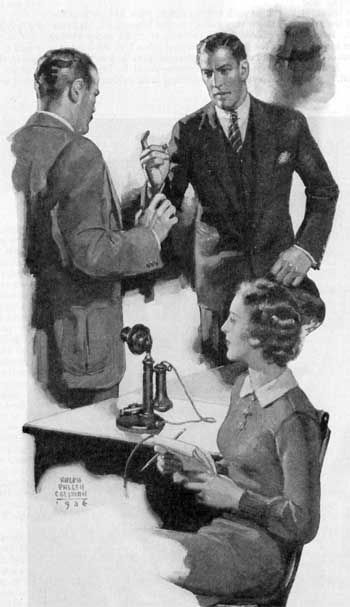
“What you want to do is put over your idea, not win an argument. You have won an argument with your boss, but you lost your job.” Illustrated by Ralph Pallen Coleman
By J.P. McEvoy
Originally published on December 26, 1936
Dear Son: So you have been fired, eh? Well, don’t be downhearted. That’s an experience too. Sometimes being fired is better than being raised, especially if you don’t get emotional about it. Whatever you do, don’t indulge yourself in an orgy of self-pity. Self-pity is a luxury you can afford only after you’ve provided yourself with the necessities of life. And don’t worry about what’s going to become of you.
I can hear you say: “It’s all very well for you to say don’t worry, but I can’t help worrying.” You can and you must. Nothing can worry you if you don’t permit it. When something happens that you feel you should worry about, ask yourself first of all: “Can I do anything to change this condition? Can I improve it?” If you can’t, just forget it. When the thought of it occurs to you, blot it out with another thought — any thought at all. You can’t stop thinking about a thing by making up your mind not to think about it. You stop thinking about it by thinking of something else.
If you can improve the condition, then you ask yourself how; and when you have provided the answer, act upon it. Any kind of action is better than brooding. If it’s not an event but people that worry you, ask yourself: “Can I change these people? Can I make them do things differently?” If you can’t change them or you can’t make them act differently, or you can’t remove yourself from their sphere of activity, don’t worry about them. Short-circuit them. You may have to be there physically, but mentally you can be far away. And as you grow older you will discover that most suffering is mental and practically all of it is unnecessary.
So don’t suffer about losing your job. You can use all that energy reviewing the case and finding out just why you did lose it. You can be sure the reasons you give yourself are not the real ones. People have a gift for making out a good case for themselves by highlighting their own evidence and not listening to the other side. To hear you tell it, the boss was an old fogy who didn’t approve of your new ideas — and that may be true, but that’s not the whole truth. Maybe he’s not such an old fogy. Maybe your ideas weren’t so new. A great many of the ideas a youngster tries to put over when he enters the business world are like the Irishman’s speech in the House of Commons. Commenting on the speech, Richard Brinsley Sheridan, the great dramatist, said: “It was a fine speech. It contained a great many things that were both new and true. Unfortunately, that which was new was not true, and that which was true was not new.”
I was particularly impressed by that part of your letter in which you retailed with considerable relish what you told the boss. And knowing something about life as well as story construction, I didn’t have to turn the page to know that after you told him, he told you.
My boy, there are only a few things in this world you can be sure of, and already you have learned one of them. If you want to go through life being fired from one job after another, you have already learned the technique. Assure yourself first that the boss is an old fogy and doesn’t know what he’s doing. Second, that any idea of yours is better than any idea of his. Third, that he’s got it in for you because he won’t let you run the business your way. Fourth, that he can’t get along without you, but he doesn’t know it. Fifth, that you’re going to tell him, the first chance you get. Sixth, you tell him. But don’t bother writing any more letters to me about it.
Then what is a bright young man to do, granted that his ideas are good and the boss is an old fogy? I refer you to what I have always told you — don’t push! In every business there is a man who pushes the button and other men who answer it. If you are in the position to push buttons, you can push your ideas. If you are one of the other fellows, make suggestions if you wish, but don’t make issues out of them. Here is another situation which you can either do something about or you can’t. If you are the boss, you can dictate. If you are not, don’t try.
But let us take it one step further. Suppose your ideas are good. Suppose they are an improvement over the way things are being done. Suppose you have the interest of the business at heart and really want to do something constructive. What then? Then you go in for strategy. You plan your campaign. What you want to do is put over your idea, not win an argument. You have just won an argument with your boss, but you lost your job. You would be in a much better position now to put over your ideas if you had lost the argument, but held on to the job. Inside the gate you have a chance to do something. Outside, all you can do is read the notices saying: “No help wanted.”
If an idea is really good, it will survive no matter how badly you present it, how ineptly you support it. It will survive you. You may go, but it will remain. Like a good seed in the ground, it will go on growing quietly out of sight, but inevitably it will come to the surface. Don’t be angry at the boss if you come to him with an apple seed and try to convince him that it is apple pie. There are a lot of steps between, a lot of patient work to be done. You should think enough of your apple seed to plant it and graft it and cultivate it and prune the young tree and spray it and watch over the fruit patiently until it ripens. And if all that is too much trouble for you, you can be sure it is going to be too much trouble for anybody else. Every apple pie is a victory in a long campaign which has been crowded with losing fights. Many trees succumbed and many apples rotted. The grower lost a lot of arguments with the elements and the bugs, but he won the campaign. When you get your next job, you will know better than to spend your time and energy in trying to win arguments with the boss. Be satisfied to lose all the battles, so long as you win the war.
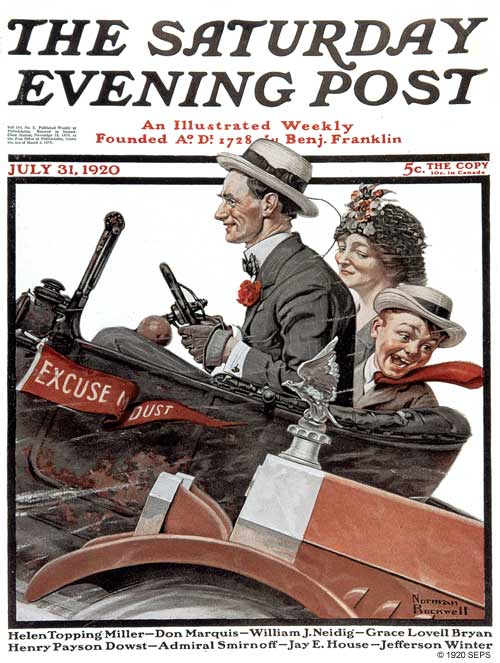
This image may have been splashed on the Post’s cover nearly one hundred years ago, but whether the speed limit is 10 or 80 miles per hour, it would appear many a historical Pop shares the need for speed and an occasionally leaden foot. Mom’s face may not be so cheery if a hidden police car spots them.
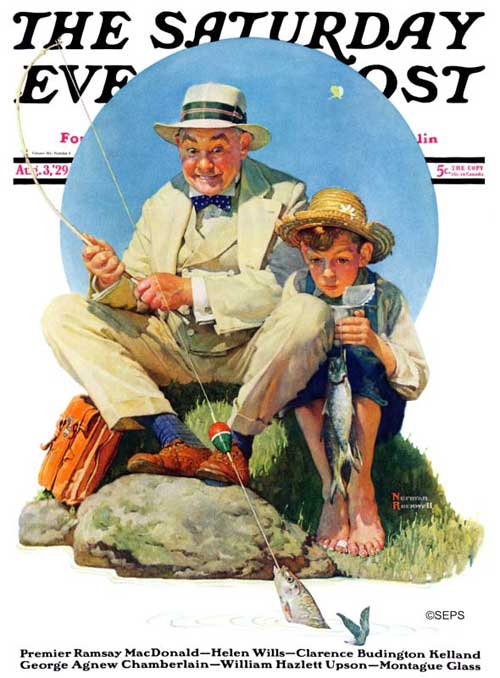
Catching the Big One August 8, 1929
Nothing says Father’s Day in quite the same way as teaming up to tug a gleaming pescatarian feast from the lapping waters.
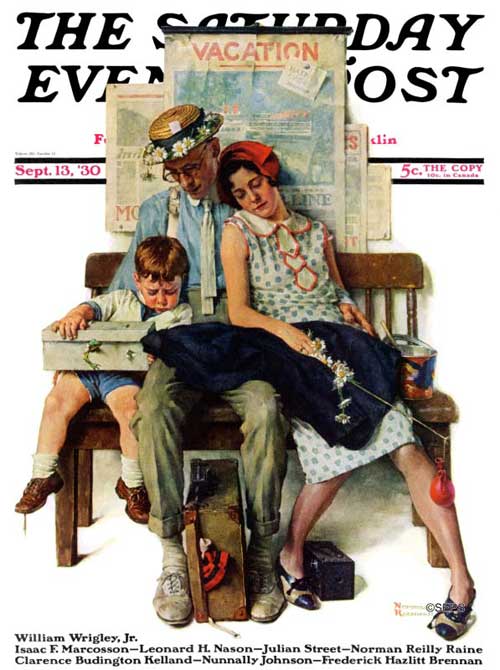
This particular padre is just as wiped out from the family voyage as his wife and tike. They’ll all be catching some extra Zs come nighttime, but for now, an impromptu bench nap can’t hurt.
Even an ocean away, this father takes his parental supervision duties very seriously. His children may have passed him up in height, and they may wander a little further after trading toy popguns for real ones, but the bond remains the same.
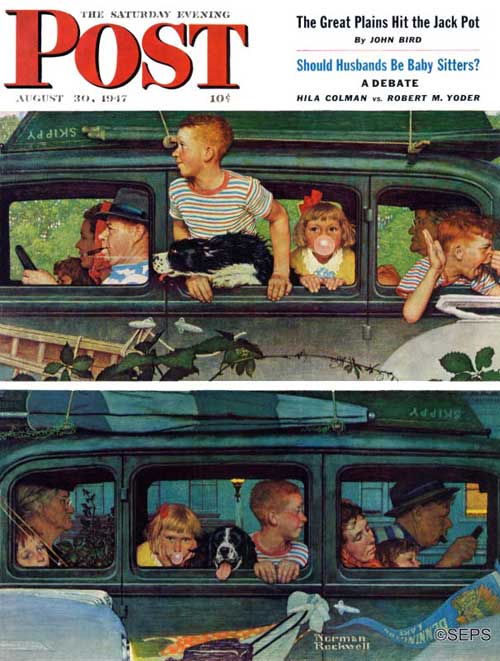
Another cover puts Dad behind the wheel but with considerably less gusto for the open road. The exhaustion of the family trip has weighed heavily on this driver and his bleary eyelids, and it would seem everyone else squashed into the car amidst suitcases and picnic baskets as well.
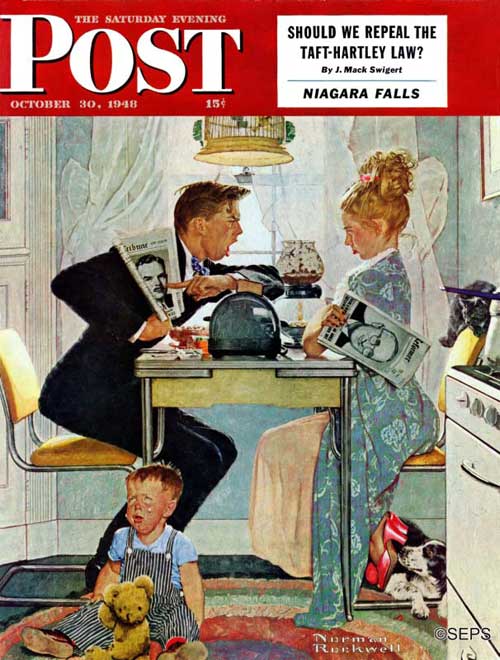
Dad’s just letting off a little steam over the upcoming presidential election, though judging by the choice of candidate in each frazzled parent’s hand, it would seem that father doesn’t always know best.
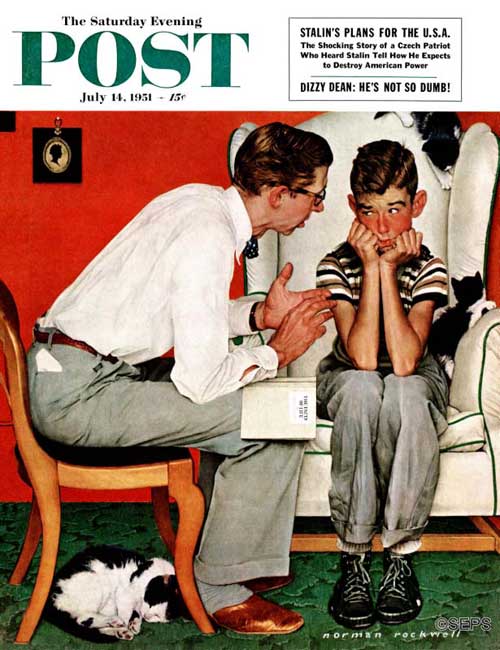
It’s clear neither father nor son especially wants to be here after this kid’s questions about where kittens come from led into a painfully eye-opening discussion on the birds and the bees. The repulsed inquirer may never be able to look at Whiskers the same way again.
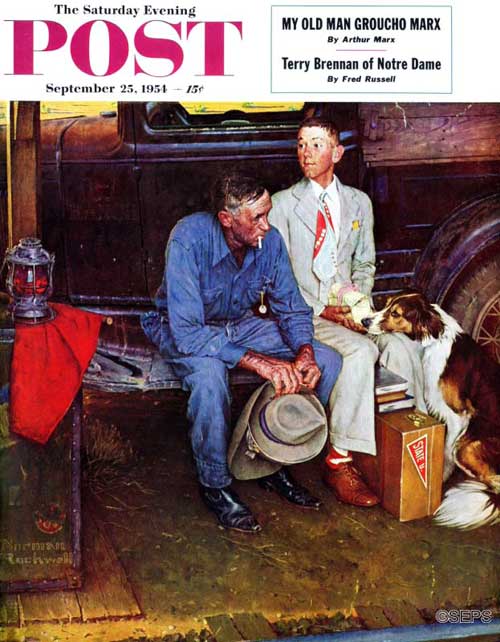
Goodbyes are never simple, especially for a working-class father and college-bound son who appear to already exist a world apart, but this weary farmer’s forlorn grip on the hats of himself and his offspring suggest the send-off has already reached its limit of mushiness.
This kid’s just discovered his father is, in fact, Father Christmas. Undoubtedly the boy has already snubbed the notion that Dad is acting out a holiday myth and instead opted to believe that his parent’s part-time job is delivering candy and joy under every indoor tree in the world.
Slumped into his favorite chair in a nest of newspaper, this dad is hoping to remain inconspicuous in bright crimson robe and slippers from his churchgoing family, choosing to embrace the religion of relaxation.
In 1930s, humorist J.P. McEvoy wrote the Post column “Father Meets Son” presented to readers in the form of letters filled with advice for navigating life’s rocky road. Employing a mix of wry humor and tough love, Dad doled out life lessons on everything from work to women. Readers loved it.
Dad actually agrees with his son for once: Society has changed. However, some things never vary, like how Dad is powerless against his wife and daughter.
Father Meets Son: Times Changing
“Like most American men, I am the victim of a cunning conspiracy.”
Illustrated by Ralph Pallen Coleman
By J.P. McEvoy
Originally published on November 14, 1936
Dear Son: Well, I am rather pleased with you this morning. Your letter came, and it fairly sizzled through the envelope. I am mighty glad that finally you got up enough nerve to answer me back. These loquacious fathers get to be something of a pest, and a little mauling from the cubs is good for them.
Allow me, then, to agree with practically everything you say. Things are different now than they were twenty years ago, when I was such a bear cat — to hear me tell it. They were also different twenty years before that — and another twenty, and so on. I vaguely recall that Benjamin Franklin once walked the streets of Philadelphia looking for a job, and there wasn’t a single opening for a crooner, an auto mechanic, a typist, a soda jerker, or even a mother’s helper. It seems that mothers helped themselves in those days or raised their own helpers. And yet there were many more opportunities in Philadelphia in Franklin’s day than there were in 1492, or 1206, or even 500 B.C.
Someday you may get a letter from a young man telling you what a cinch you had in your day and how tough it is for him. “Things were different back there in 1936, dad,” he will say, and you’ll be kind of floored, because you won’t be able to deny it, but you will probably lash out at him and tell him to get busy and go to work at anything he can find—that’s what you did — and keep on working at it — that’s what you’re doing — and stop squawking — which, come to think of it, is good advice.
I’ll grant you there are more people looking for jobs than there are jobs available, but has it ever occurred to you that new jobs are being invented all the time by bright young men and women who realize the hopelessness of looking for jobs, many of which have disappeared forever? The blacksmith’s son is an auto mechanic. If his son discovers there are too many auto mechanics, he should realize that television is around the corner and start doing something about it. If there is one thing that is typically American, it is the desire for change. The paint is hardly dry on a building before we tear it down and put up a bigger one. Most of the time we don’t even stop to raise the mortgage on the first one — we just slip the other one under it. While the workmen are finishing a two-lane road, another gang is at the other end, tearing it up to make a four-lane one. In your own short lifetime you have lived through a complete revolution in transportation, communication, industrial and rural development, city planning, public welfare, medical science, mass entertainment and politics. Perhaps the last two are interchangeable, but there are many others.
Your complaint that you are in a blind alley interests me. You tell me your friends say you are foolish to be working in a filling station, when you were trained to be a lawyer. Their conclusion being, I take it, that a job in oil can never lead to law. The fact is that any kind of job can lead you into a law office these days. Someday as a lawyer you may be glad you know something about oil. It would be the same if you went to work in a real-estate office. In a bank. In a sardine fishery. There is maritime law too. Life is not a collection of air-tight compartments. All the rooms lead into one another, from the attic to the basement. And the whole place is run on the American Plan, which means you have the run of the house.
Start at anything and, while you are learning all about that, be preparing for something else. If the old opportunities are scarce, discover new ones. If you can’t discover any, invent them. Don’t be satisfied to read about the old pioneers. Be a new one. They were hardy; so can you be. They were fearless. And the principal thing they were not afraid of was work, hard work. They could take it. They could give it. So they got it.
Your last sentence, however, was the one which I am sure you felt would finish the old man. “That was all very noble advice on how to handle women,” says you, “and I hope you will pardon me if I wonder why you don’t practice a little of it on our Dorothy. It seems I get all the lectures and she gets all the gravy. Yes, little sister does all right. Three manicures a week, and now she has a new car. It would be just like her to drive up one of these days and give me a lecture on industry while I wipe her windshield.”
Well, you got me there, pal. But you can’t say I haven’t tried to handle your sister. The spirit is willing, but weary. Like most American men, I am the victim of a cunning conspiracy. From babyhood I have been passed on from one feminine hand to the other — all gentle, to be sure, but each a hand of iron in a velvet glove. Mother passed me to teacher, who cowed me so that my first sweetheart had no trouble at all. From her I was batted like a volleyball from one little tyrant to another, until your mother stepped in and took all rights, titles and interests in and to what was left of me. Nominally, I was the party of the second part, but I lost even that favored position when your sister was born. I think she was about five when she took me over from her mother, and she has been taking me over ever since. I am now waiting with complete resignation for the day when what is left of me will be tossed into the nursery for my first granddaughter to play with.
In 1930s, humorist J.P. McEvoy wrote the Post column “Father Meets Son” presented to readers in the form of letters filled with advice for navigating life’s rocky road. Employing a mix of wry humor and tough love, Dad doled out life lessons on everything from work to women. Readers loved it.
When his son raves about a girl, Dad attempts to explain true love to him, saying it’s like seeing 10-foot-tall daisies, or, even better, like stepping in front of a truck.
Meeting Betty
By J.P. McEvoy
Originally published on October 31, 1936
Dear Son: So her name is Betty, is it? And she’s the most wonderful girl in the world, is she? Sounds quite possible, judging by the meager specifications submitted. Her eyes, her hair, her teeth — it all checks up. When I was young and charming, I met Betty too. Same eyes, same hair, same teeth, but a different name. You say in your letter: “Dad, you don’t know what it is to fall in love.” That’s what you think. Only I never waited to fall — I used to jump right in.
However, I won’t try to rationalize the sensation. In a general way, you can get the same result by casually stepping off the curb any day and being hit by a five-ton truck. Three days or three weeks or three months later you wake up surrounded by flowers. An angel in white is holding your hand and you are asking in an eerie voice: “Where am I?” Dimly you piece together impossible experiences — part of a delicious delirium — but as the fog lifts, you realize that the angel in white is a real flesh-and-blood female and you are engaged to be married to her, or, even more astonishing, you are married to her.
I don’t know just where you and Betty are wandering now in this delirium. And if I did, I wouldn’t try to contact you, because long before Griffith discovered the fade-out and the dissolve in motion pictures, lovers were experts at it. However, if you can still hear my voice, I have a few words of wisdom for you, which needn’t disturb you, because you won’t pay any attention to them anyway. If each generation had cared to climb up on the shoulders of the preceding one, we would be up in the heavens now conversing with the angels instead of digging tunnels under each other’s frontiers.
One paragraph in your letter made me stop short and read it again. You tell me that Betty doesn’t approve of your admitting that you are only a filling station attendant. She is telling her friends that you are “connected with the sales organization,” leading them to believe, if they are saps enough, that you are at least first vice-president in charge of all the territory between the Appalachians and the Rockies. Well, that’s quite a bill of goods, and if you can sell that, you ought to be made head of the sales organization. But the fact is that you can’t sell it and make it stay sold. A lie has the habit of bouncing back and socking you right in the middle of your ecstasy.
You don’t need to tell a lie or try to live a lie just because Betty wants you to. It’s hard for you to say “no” to her now, but it won’t get any easier. You won’t lose her respect by showing character. If she has any to spare, she’ll lavish all the more on you. If she hasn’t any respect for you now, she won’t have any more for you later. A woman’s respect is not based on what you have, but on what you are. Someday you will have a wife, and if she doesn’t respect you in a cottage, she won’t respect you later in a mansion. And if she doesn’t respect you, your children won’t respect you. And when they go out into the world, they won’t respect anybody or anything, and the things that will happen to them will break your heart, if you have any left by that time.
Of course, you want Betty’s respect, don’t you? Then earn it. “None but the brave deserves the fair.” Like all old saws, this has teeth in it. Listen to what she has to say, weigh it carefully, then make up your own mind. Then stick to it. If she coaxes, be charmed but unyielding. If she pouts, be amused but firm. If she cries, don’t get frightened. This, too, will pass. Console her — but stick! If she gets angry, admire her spirit. Tell her she was never so attractive. She’ll hate you, but not for long. The compliment will remain in her mind long after the reason for it is forgotten. But if she dissolves and yields, then you are really in danger. Be alert. Stick. She will come back to the attack again as soon as your guard is down. If you are still at your guns, she will realize you are no ordinary adversary. Now she will turn on everything. She will smother you with charm. She will dazzle you with smiles. She will drown you with tears. Where are you, son? Courage! Stick! Hang on! Ah-h-h, the sun is breaking through. Look! A rainbow. Hark, the lark! The battle is over. You have fought the good fight and victory is yours. And what is the reward? Respect. The girl realizes for the first time that you mean what you say and stick to it.
Of course, in your present condition such fortitude would be nothing short of heroic. But punch-drunk as you are, you might just as well try to clear a little of this rose-colored fog out of your head and stop leading with your chin. Get your guard up or you won’t last out the first round. You’re seeing a lot of pretty stars now and hearing a lot of birds that never sang on land or sea. I close my eyes and recall it all. Butterflies as big as eagles. Daisies ten feet tall. And floating through this supernatural landscape like a cloud shadow on a summer day, a heavenly creature made of swan’s-down and peach fuzz. What a girl!
“Betty,” I hear you murmur. Perhaps! The most wonderful girl in the world is immortal. She comes back in every generation. But even if your Betty is not the most wonderful girl in the world, you can make her so if you wish. Girls are what men make them. Silly with stupid men, frivolous with playboys, extravagant with spendthrifts, frugal with the thrifty, lazy with the loafer, industrious with the worker. If — and that’s the point of this letter — if she loves the man, believes in him, trusts him, and respects him.
In this world of uncertainties there are two things you can bet on: A woman will fly to a man, and flee from a mouse.
I have a theory: We use the technology that we’re most comfortable with. Maybe you’re a writer and you still like using a typewriter. Maybe you prefer vinyl records over iTunes. Maybe you still have a landline because you hate smartphones. You don’t have to be a slave to technology and grab the newest, shiniest thing just because the media tell you to. Besides, that new thing will probably be obsolete in 10 months.
Joe Queenan has a fun piece at The Wall Street Journal about “the shame of loving old technology.” But I don’t think it’s shame at all; it’s pride. I’m old enough to remember when CDs were the new thing that was going to replace vinyl. It was compact! The sound was incredible!
I still actually buy CDs. I refuse to buy everything in bits and bytes and simply live in files and in the cloud all the time. I like to have the physical object, though anyone in their teens and twenties probably looks at CDs the way people my age look at those old AOL discs we used to get in the mail to get online.
Speaking of typewriters (three paragraphs ago, but still), author Frederic S. Durbin has a terrific piece at Tor about his love for typewriters. I still have this dream that Apple will make a line of manual typewriters, in various colors, with the Apple logo on the front. Imagine how hip typewriters would become once again, almost overnight.
New Books
What if We’re Wrong? by Chuck Klosterman
Some new novels and nonfiction for you to read on the beach, or wherever you happen to read books during the summer:
End of Watch, by Stephen King. This is the last book in the Bill Hodges trilogy that started with Mr. Mercedes and Finders Keepers, with the retired cop battling an old foe out for revenge.
Magic & Loss, by Virginia Heffernan. Can the internet (now with a small i) be considered art? That’s the argument made by Heffernan in this long-awaited look at the good side and the bad side of the thing you’re staring at right now and can’t seem to get away from.
But What If We’re Wrong?, by Chuck Klosterman. What if everything we assume to be true now isn’t true, or won’t be true in 20, 40, 100 years? That’s the premise of Klosterman’s new book that looks at rock music, politics, sports, and everything in between. And yes, the cover is supposed to be upside down.
Seinfeldia, by Jennifer Keishin Armstrong. Armstrong wrote a terrific book a few years ago about The Mary Tyler Moore Show titled Mary and Lou and Rhoda and Ted. Now she sets her sites on another classic sitcom, Seinfeld. She goes behind the scenes of the shows and also talks to devoted fans. (Comes out July 5)
Introducing: Tiny Toast!
When was the last time the launch of a new cereal got any attention? I’m sure there have been other new cereals launched in the past several years, but Tiny Toast, the new product from General Mills, is getting some buzz. Maybe because it’s the first new cereal from the company in 15 years, or maybe it’s the name, Tiny Toast!
And it’s exactly what it says: little toast-shaped pieces with real fruit “spread” on them, with no high-fructose corn syrup or artificial flavors. Right now it comes in two flavors, blueberry and strawberry. They should make one that’s butter-flavored.
I haven’t tried them yet, but I know I’m going to. I’ll give a full report in a future column.
The Whopperito
What do you get when you combine Burger King’s Whopper with a burrito? You might get indigestion, but you definitely get the Whopperrito. That’s right, the fast food chain has put together those two products and come up with a new concoction for those late-night munchie runs. It’s not available everywhere yet; Burger King is testing it in several Pennsylvania locations.
They could have gone with a different name that combines both foods, though “The Burper” probably wouldn’t have gone over as well.
Night of the Gun
Writer and media columnist David Carr passed away in February 2015. He was a beloved figure in the media world, not just for his fine work for The New York Times and other publications, but also for his memoir, Night of the Gun, a hard-hitting and unflinching look at his many years of addiction.
Now that book will become an AMC mini-series. The network announced the film this week. Better Call Saul’s Bob Odenkirk will play Carr, and the book will be adapted by Shawn Ryan, creator of The Shield.
Hey, Let’s Spend the Night at Bing Crosby’s House!
I bet you’ve seen a celebrity home on television and wished you could own it. Or maybe you simply just want to visit it and maybe stay for one night? Well, thanks to Airbnb and Luxury Rentals by Homeaway, you can.
For a rather large fee, you can spend the night in the home of a classic celebrity. Want to see how Lucille Ball and Desi Arnaz lived? It will cost you $1000 a night. Want to have a ring-a-ding time at Frank Sinatra’s? That’s $2,450 a night. Too much? You can stay at Ava Gardner’s place for only $85 a night.
It’s Negroni Week
The Negroni is a drink you don’t really hear much about anymore. Have you ordered one recently or heard anyone order one? A lot of people have probably never even heard of it, but it’s really a solid, classic cocktail that should be ordered more. The recipe is pretty simple, and you can make one this weekend for Negroni Week, which ends on Sunday:
1 oz. Campari
1 oz. gin
1 oz. sweet vermouth
Combine ingredients in a rocks glass with ice and stir. Throw in an orange peel or slice if you want.
Goes great with a Whopperrito.
Upcoming Events and Anniversaries
Miranda Warning established (June 13, 1966)
The “You have the right to remain silent…” warning given by police after they arrest you arose from the case of Ernesto Arturo Miranda.
President Harding broadcasts first presidential radio message (June 14, 1922)
EarlyRadioHistory.us has a complete history of the radio address, including a photo that shows where all of the microphones were placed.
Not very long ago, Hoban Cordell moored on the beach at Voter-Gunknut and demanded to speak to the man in charge. The man in charge was a woman named Ani, and Cordell seemed to find her gender important, in a way we found hard to understand.
“You’re not understanding me,” he said. “You don’t understand. But that’s fine. I expected something like this. I need to speak to the man in charge.”
“I don’t think there is a man in charge,” Ani said. She turned to the rest of us, seven altogether, and Kurt and me in particular. “Do either of you two feel like the man in charge?”
Kurt rolled his eyes and went back to work on that evening’s potatoes. I raised my eyebrows and said, “Probably not, no? I suppose I could try it, if you wanted?”
“There,” Ani said. “George is in charge. Speak to George.”
“But, wait,” Cordell said. He had a way of flapping his arms in between words that made me wonder if he’d ever stood at a window and tried to take flight. “Is he really in charge?”
“No,” Ani said patiently. “I am.”
“You can’t be in charge.”
“Good,” Ani said, nodding. “So George is in charge. Speak to George.”
The rest of them wandered off and left me to wait for Cordell to do something. The gentle caress of the waves on my ankles was a pleasant distraction in the meantime. A peekytoe crab surfed past me on a wave and I thought about diving for it. The air was warm, and the sun was pleasant on my naked buttocks. Eventually, Cordell leaned forward, looking unsure, and I raised my eyebrows again.
“Do you want to get off the boat ?” I asked.
“Will you attack me?”
“Why would I attack you?”
He pursed his lips. “Savagery?”
“I’m pretty sure I’m not a savage.” I thought about it. “But who knows, I guess? Do you need help?”
Doing his best to balance in the barely sloping waves, he shooed me away. “No no. I’ve got this.”
I went back to enjoying the water. Cordell gamboled around in the surf like a drunken gull. His oars were trapped in the tangle of his legs, a net was doing its best to crawl up his back, and a box of something, potentially important, was drifting unnoticed into open water. The sand stretched some 30 yards in either direction behind me, sloping toward the water from the raised plateau of our camp. I decided to invite Cordell for supper.
“You don’t need to invite me,” he said. “If anything, I should be inviting you.”
“But I’m already here,” I pointed out. “And Kurt’s the one cooking supper. Do you have supper with you?”
The oars caught up with him at last, and he fell, losing contact with his boat altogether and landing in the water. He flailed for a moment, apparently afraid of drowning. I watched the show, bemused, and waited for him to realize he could sit up. When he did, red-faced and puffy-eyed, he spat a mouthful of debris and looked at me full of reproach.
“Everything on this island, including your supper, belongs to the crown.”
I furrowed my brow. “I don’t think it does.”
“No, it definitely does. I have paperwork.”
“Right,” I said, “but I’m already here on the island, you see. And so are all the others.”
“Illegally here!” he sputtered. “Illegally!” He stood, stumbled toward me, and fell again, eventually managing to haul himself out of the water altogether, lying flat on his back and twitching at the shingles with two hands. I let him be while I looked again for the crab. It had floated away, presumably half-aware that I wanted to eat it. Kurt’s potatoes were nice enough, and artfully grown on such a small plot, but you should never turn down crabmeat. I squatted beside Cordell and asked if he needed help.
“Need it? I demand it!”
“Sure,” I said. I yanked him to his feet and tried a smile. I was thinking about the crab, and whether or not it was Cordell’s fault I didn’t have any. He looked me up and down and seemed to realize for the first time that I was naked.
“And I demand that you put some clothes on.”
I shook my head. “Can’t.”
“Must!”
“But I don’t know where they are.”
“What?”
“My clothes. I’m not sure where they are. Sorry. Do you have any spare?”
“You can’t wear my clothes!”
I looked at him. “They’re probably a little small for me,” I allowed, “but you want me to put on some clothes and I don’t know where mine are. So do you have any? I don’t think Kurt knows where his are either. He wears a little patch, like a sort of sling thing, when he’s cooking. But that just covers up a certain part, and I’d rather not share that with him. If it’s all the same to you.”
“Nudity,” Cordell said, brushing himself down, “is a gross public offense.”
“Is it?”
“It says so right here.”
He produced a scroll, long, tied with ribbon, kept safe in a Ziploc bag. The bag had, at one time, held sandwiches. “On this scroll I have His Majesty’s Code of Laws. One of them, an important one, says public nudity is a gross public offense.”
“Which public is it offending?” I asked. “Everyone else is naked as well.”
“Except for me!”
“Right, well then might I suggest you take your clothes off.”
His eyes grew wide, and I thought for a second they might pop out and dangle around as if on stalks. Which reminded me of the crab again. I turned back to the water to look for some.
“You should be finding clothes!”
I ignored him and knelt in the surf. Eventually a crab would come to me. From up the beach, Ani called down to us to check that everything was all right.
“This man will not put on clothes!”
“I think we burned them,” I said. “When it got cold.”
Ani came toward us, nodded. “That’s right. Made a lovely fire, too. What do you need them for?”
“Because public nudity is illegal. I have here a list of the laws of His Majesty’s Kingdom, to which you have recently been annexed, and it states quite clearly. He can’t just walk around naked.”
He seemed to be ignoring the fact that she was naked too, which was admirable. One problem at a time is an excellent survival method.
“So what should we do to him?” Ani asked. Her eyes were lit up, her cheeks agreeably red. She grinned.
“He must be imprisoned!” Cordell said. “For a suitable time.”
“But we don’t have a prison.”
“Then we must make one!”
“George,” Ani said, “do you mind if we put you in jail?”
I looked around. “Can the jail be here?” I asked. I was certain a crab would be along soon.
“Right here?” Cordell asked.
“Sure. Here-ish?”
He seemed to think about it and then looked pleased. That was fine. “This area is now the jail! I expect it to be appropriately segregated. And I’ll need to sit down with the other man, as he’s now the man in charge, and—” he began sputtering, waving his arms around with serious urgency. “What are you doing?!” he shouted. He was staring at Ani, who stopped what she’d been doing and sighed.
“I was going to help George find a crab.”
“But you can’t go in there,” Cordell explained. “That’s the jail cell. We just established that! Each prisoner is guaranteed a space of no less than 80 square feet. It’s the law. You can’t go in there. You see?”
“I can’t go in there?”
“No!”
“If I catch a crab,” I asked, “can I throw it out there?”
“I don’t see why not.”
“Okay,” I said. “I’ll throw you a crab, Ani.”
She smiled. “Thank you.”
I turned back to the water and scanned the surface. Cordell’s boat was disrupting the surf; little bits of alien flotsam were popping up everywhere and confusing the fish. Behind me, Cordell and Ani walked up the beach and toward our longhouse. I could smell Kurt’s potatoes in the pot, heard one of the others stoking the fire. I didn’t have long to catch my crab before it would be time for dinner. Somebody else padded up behind me, slipping gently into the water and floating on her back.
“Is this the jail?” she asked.
“Yep.”
“It’s nice.”
I nodded. “Roomy.”
“Cordell said I had to come to jail,” she said, “because I forgot to put safety tape around the fire pit.”
“Ah,” I said. “What kind of safety tape?”
“Who knows?” she asked. Jen often started the fires. “Any crab?”
“Not yet.”
We waited together for a while. I caught a handful of whitebait and sent them wriggling into my stomach. I heard Cordell shouting something before I heard more footsteps and a final thump just behind me onto the sand. “Is this jail?” someone asked.
“Yes,” Jen said. “What did you do?”
“I’m not sure. Something about the waterproofing on the longhouse.”
“Why would we want it waterproofed?”
“Who knows?” the new prisoner said. It was Dave, our builder. “No idea where our water would come from if we sealed it up. But you’re to know that, in line with regulations, the jail has been expanded to 240 feet to accommodate its three prisoners.”
“Thanks,” I said. “Did you want a crab?”
“If you find one.”
“Sure thing.”
A set of clouds moved in on the horizon, creeping over the sun. The waves a mile out were frothing threateningly, promising to carry all of the crabs out to sea. I shuffled around and began to poke my head underwater, looking for any crustaceans hidden in the sand. When I came up for air, a fourth and fifth prisoner had been added. They were discussing the new jail which, at 400 feet, was almost half of Voter-Gunknut.
“Doesn’t that make the longhouse part of the jail?” I asked, keeping my eyes on the water.
“Yep,” someone said. “Cordell’s demanded he and the others move to the other side of the island.”
The trick to catching crab is patience. Peekytoe crab are only marginally intelligent, and will eventually walk right into your hands, if you wait long enough without wriggling. A moment passed before two more people crested the little rise, walking down the sand and toward the water.
“Are you in jail as well?” I asked.
“Yes,” Kurt answered. “My cooking pot couldn’t be moved out of prison territory, which meant that I was obstructing the public justice. Emma’s earring isn’t regulation size, and she didn’t want to take it out. We thought we’d join you down here.”
“Sure,” I said. “Are the potatoes done?”
“Yep. Any crab?”
“Not yet.”
I lay out on my stomach, letting my body float on the water. The sun wasn’t so warm on my back anymore, and I shivered, sending tiny waves rippling into the wider ocean. I spotted what might have been a crab some two yards to my right, and swung myself gently in that direction, slipping my face beneath the water and pivoting my arms as gently as I could. There was a commotion behind me that I ignored. Ani called the others back up the beach.
“What is it?” they asked.
“I’ve been placed in jail,” Ani said, “for maintaining that I’m not a man. Apparently I can’t be both a woman and in charge.”
“Why not?” Jen asked.
“I’m not sure. Anyway, Cordell has retreated to the free country outside the jail.”
They all turned to the far side of the island. Cordell sat crouched, drawing a ring around himself in the dirt with a greasy fingertip. Everything inside that ring complied perfectly with the law. He looked very content.
“You all stay in there!” he shouted. “Don’t even think about coming out!”
“Sure thing,” Ani shouted back. Kurt was seasoning his potatoes. Someone else had the fire started. Just as I came out of the water, I heard Ani ask if I’d caught anything yet. I held up a pair of peekytoe crab and grinned while the others applauded my catch.
After supper, I brought Cordell a leftover bowl, brimming with white meat and buttery spuds. I’d like to tell you that he ate, stripped off his clothes, and joined us on our island under the sun. More likely, however, is that Cordell ate nothing at all, fearing food that was not regulation, and starved to death in his little circle of freedom. That’s a little morbid, however, so I’ll let you decide how the story ends.
The secret, as I mentioned, to catching a crab, is to open the palm of your hand, sit very still, and let it catch itself.
Though he is most famous for capturing life in the American Midwest, Norman Rockwell spent much of his on the East Coast, including New York City and nearby New Rochelle before moving to Massachusetts. Rockwell was born in 1894, and as an infant lived at 206 W. 103rd Street near Central Park. One hundred thirty two years later, a sign co-naming the street Norman Rockwell Place will be unveiled thanks to the efforts of a group of New York City high school students.
The students, members of René Mills’ class at Edward A. Reynolds West Side High School, learned Rockwell was born around the corner from their school during a visit to the Norman Rockwell Museum in Stockbridge, Massachusetts, in 2014. On returning, they scoured 103rd Street for a commemorative sign or plaque marking the icon’s presence, only to come up empty-handed. “At that point, we knew we had a mission,” Mills says.
The students formed the Norman Rockwell Place Committee and investigated how to get a secondary street sign. The committee created pamphlets, posters, and T-shirts in an effort to educate the community on the significance of the corner of West 103rd Street and Amsterdam Avenue. After months of work, the committee garnered hundreds of signatures in support of renaming the street.
Two weeks after a New York City Council vote of approval, Mayor Bill de Blasio signed a bill to co-name the corner “Norman Rockwell Place.” The students, who witnessed the signing of the bill on February 25, will see their work come to fruition on Thursday, June 9, when the new sign is unveiled and Norman Rockwell Place becomes official.
As Mills explains, the project grew out of a course study emphasizing local government. “My students were mesmerized by the issues that were presented to the local community board. Getting the Board and the Council’s approval for their proposal was empowering,” she says.
She herself had long been a fan of Rockwell. “Rockwell tells the stories about everyday life as he has exposed the best and worst of our society,” she says. “Rockwell is the visual novelist that moves his audience from frame to frame as they are drawn into the mystique of visual story telling.”
She and her students felt it was important to reclaim the artist as a New Yorker. “I promised my students that if they took this journey with me, it would be bigger than they imagined and their persistence and hard work would be remembered,” Mills says. “Norman Rockwell Place would be part of my students’ legacy.”
In the May/June issue of The Saturday Evening Post, Barry Yeoman asked the question, “What Do Birds Do for Us?” His answer shows how birds provide so much more than pretty songs and flashes of color in the wilderness. Our feathered friends play integral roles in maintaining the ecological balance that protects us from disease and disaster and keeps healthy food on our collective plate.
But America’s birds are disappearing.
According to the U.S. Department of the Interior, nearly a third of all bird species in America are at risk: 67 species of bird in the U.S. are now endangered, and another 184 are showing declining populations. The situation is particularly grim in Hawaii, which is confronting a “borderline ecological disaster,” the Interior Department says. The islands once hosted 113 unique bird species; today, 71 are extinct and 31 are endangered.
In North America, declining bird populations have several causes: Habitats are being lost to business development and urban sprawl, and the water shortages and droughts that affect humans in dry regions are also challenges for nesting birds.
And then there’s global climate change. Birds aren’t waiting around to see who wins the debates about whether climate change is real; several species have already begun moving north to cooler climates, altering the ecological balance at both ends of their migration.
So far, the losses have been minimal. Only nine bird species have become extinct in North America in modern times. But if the drop in population continues, more than 300 species will be extinct by the end of the century.
The fight to save birds from extinction is not new, as this Post article from 1931 shows.
In the 1890s, the long white feather of the egret became a fashion accessory for ladies’ hats. Hunters began slaughtering birds by the thousands to profit from the market demand. Consequently, egret populations all over the world were being wiped out. In the U.S., the problem was particularly acute in Florida.
But when bird lovers asked for protection of birds and their habitats, they were greeted with skepticism. For generations, Americans had been able to help themselves to a seemingly unlimited supply of game. Thankfully, the conservationists prevailed against this traditional thinking: Protection for birds started with the Lacy Act, which outlawed interstate trade in wildlife killed in violation of state laws. In 1901, Florida passed the Audubon Model Law, which made plume hunting illegal.
In her article below, famed conservationist Marjory Stoneman Douglas tells how concerned Americans, united behind the head of the Audubon Societies, stopped the slaughter of egrets in Florida before it was too late. And, as Ms. Douglas relates, when Americans learned of the problem, the aigrette feather suddenly became unfashionable, and the bird could nest without risk of annihilation.
Wings
By Marjory Stoneman Douglas
Originally published on March 14, 1931
Thousands of wings poured up the height and brilliance of the Florida sky; sheets, waves, ribbons, festoons; rushing, airy acres of birds, all shining and turning under the sun. Each to his own kind, they kept their ranks separate, moving each in his own unique manner — little blue herons, great white herons, night herons, black-and-white ibises, Louisiana herons, Ward’s herons, snowy egrets, terns, green herons, water turkeys; here and there a few stately, sailing, great white egrets; and once a flash of pure rose color, brilliant in all that blue and white — a lonely going, roseate spoonbill, the last of his ancient thousands. A few men in a boat below all that, in one of those remote, brackish rivers that wander through the vast reach of mangrove in that last end of Florida, sat spellbound, looking up. The free leap and flight of the great, free birds brought to them the same curious lift and surge of delight. They had come hundreds of miles just to experience that. They said, “Oh!” and “By George, did you ever see anything like it?” and, “Look, look, there come more of them. More of them.”
The lifting and passing and wheeling and settling of the birds went on until the sunset had darkened its great fires. The men went back in silence to their houseboat, anchored in one of the deeper turns of the river.
The Last of the Egrets
But even through dinner they were unable to think or talk about anything but the birds. They were stirred in that curious way men always have been stirred by the sight of many wings, secure above them in that remote and perilous crystal. They were a group of Government officials and their guests, come to inspect that part of Florida as a possible national park, under the charge of Horace Albright, head of the National Park Service. Among them, a short, stocky, vigorous figure, was a man with keen, dark eyes and a tight and fighting jaw, to whom they turned in all the talk about birds; a man who knew every bird that lifted over the mangrove tops, knew every feather on them, knew their habits, their mannerisms, their flight, almost every bird thought that moved in those light, feathered heads. He was T. Gilbert Pearson, LL.D., president of the National Association of Audubon Societies. It had been through his relentless effort, by way of the National Association, that numbers of those birds, notably the ibises and the egrets, were alive at all. The single roseate spoonbill, of a possible 300 left over after the ruthless slaughter of tens of thousands of that rare and lovely creature that had once filled the east coast of Florida with its living color, was alive, probably, through his efforts. But he had not been able to keep the flamingo from deserting the coast of Florida, which it used to visit in thousands during its winter migration. And there were not very many of the long white — the great, plume bearing — egrets. There were a few, and those owed their lives to the work of this man.
He told the others a little of the fight to save the egret, after dinner. And then a startling thing happened. A man came to the boat with news which the captain immediately called Doctor Pearson to hear. A thousand great white egrets — the one which bears on its head and shoulders the exquisite white feathers for which it was once slaughtered by the tens of thousands — had just settled not very far away. That 1,000 was almost the last large flock of egrets left in the United States. And the startling news was that some mackerel fishermen, who had been watching for the settling of the egrets, were waiting down the coast until the houseboat of Government officials should leave the next morning, before they shot up the entire flock. It had been a long time since Doctor Pearson, for the National Association, had gained a hard-fought battle over the milliners and the indifference of lawmakers and the public to make it illegal to wear or sell plumes in this country.
Protection That Fails to Protect
Women have forgotten about wearing aigrettes. The general public and even the people of Florida have taken it for granted that the birds are protected. Yet here was this 1,000 about to be slaughtered. And for all anything anyone there could do or say — Doctor Pearson, or Horace Albright and the members of the National Park Commission, or Ruth Bryan Owen, member of Congress from Florida — it is possible this 1000 was exterminated.
Doctor Pearson immediately hired two wardens to guard them. The government officials burst into hot speech. Doctor Bumpus, formerly president of Tufts College and a man of forceful and honeyed tongue, went over to warn off the mackerel fishermen, who spat over the side and smiled and nodded, and stayed just where they were. Doctor Pearson himself was swept by such anger, bred of his fighting Quaker spirit, his years of service to the birds, and the curious feeling of powerlessness before the unconquerable forces of destruction, that he stumped up and down the deck, uttering words such as these, which I took down on the spot for such use as this:
“Apparently the people of this country are definitely determined to destroy the last egret in the state of Florida for the paltry sum that may be obtained from selling the plumes,” Doctor Pearson said. “The colony these men are preparing to raid after we go is one of the last of the large egret colonies in the state. Today I visited the largest rookery of herons and egrets left in the United States, in the upper waters of the Shark River. I am reliably informed that men engaged in the fishing business have on three occasions shot out this rookery.”
Eight Men Against an Army
“I learn from unquestioned sources that as many as 5000 black-and-white ibises, old and young, have been killed at one time, packed in salt and, with hundreds of heron and ibis eggs, illegally shipped and bootlegged among various settlements of this state. I have this evening made arrangements to employ two men in the hope of being able in a measure to guard these birds. But I am deeply incensed at the lack of interest exhibited by the people in preservation of wildlife in this most magnificent and naturally prolific area of breeding water birds found within the boundaries of the United States. This feeling is based on thirty years of observation and constant work throughout North America as president of our association. We already have expended nearly $40,000 in our efforts to protect plume birds of this state, but it seems to have been largely a matter of love’s labor lost.”
Now, as far as Doctor Pearson and the state game warden know, the guards appointed are vigilant. Eight men in all, including those last two, have similar positions guarding bird colonies, rookeries and reservations in the state of Florida. Named officially as Federal agents, they are paid by the National Association of Audubon Societies. But the difficulty is that they have to cover an enormous territory of Everglades and mangrove swamp land, penetrable for the most part by shallow-draft boats. Eight men against an unknown number of native fishermen, and hunters, and yachtsmen from the North. Egrets, herons, ibises, roseate spoonbills are killed for every reason from food for fishermen’s children to plumes for the plume markets of Havana and Europe or the pleasure of shooting a rare bird and holding it for a few moments, dead in the hands, a part of the lavish treasury of the sky. There is absolutely no way for the wardens or the people of the state of Florida to check on the amount of the destruction still going on.
Yet revealing incidents happen. Last fall, in Miami, a boy was arrested as a housebreaker. In his possession were thirty as beautiful egret skins, or scalps, as any milliner of the old days, or milliner of Europe today, would wish to see. The boy said he had found them in one of the houses he had robbed.
No charge was made against him on the possession of the plumes, because he was found guilty and sent to prison for housebreaking. But someone shot those birds. The plumes were in the height of midnesting condition, which means they were shot with young in the nest. And for thirty such skins discovered in this casual manner hundreds are smuggled out to the Havana market.
As for the fascinating black-and-white ibis, which is the true ibis of the Nile, its tale is uncomplicated by any national history such as the egret possesses. The ibis spends all its time in Florida; therefore, it is a nonmigratory bird and not protected by Federal law.
Boat captains will tell of a boatload of white ibis bodies, shot by visiting sportsmen and later taken to Key West and sold for meat. There are people who have seen salted ibis meat being shipped. And yet it is practically impossible to get affidavits in order to bring the matter to court attention. The Everglades are too large. Only the eight lonely game wardens, or fewer than that in years when the national association is poor, protect the ibis. No one else seems to care.
The Federal Government, which makes the wardens Federal agents on Doctor Pearson’s recommendation, pays no salaries. The state of Florida does not. Like most states, Florida maintains a state game warden, but he is handicapped by the lack of men and money. So the ibises are shot by fishermen and visiting yachtsmen. Their rookeries are growing fewer and smaller. A rookery of black-and-white ibises, with the strange parent birds standing motionlessly on guard beside their huge stick nests, in which the baby ibises squawk and stare — the queerest, fuzziest-headed, most awkward, most fascinating baby birds in the world — is one of the most unusual sights in this country. Yet they are being destroyed relentlessly.
The Long Struggle for Protection
It is unbelievably difficult to combat this seemingly implacable destruction of our rare American birds. Man’s delight in birds seems universal, but so is their destruction. Delight and destruction, destruction and delight — they seem to go hand in hand. But the destruction is the more active and the more lasting.
Nowadays, of course, it is the inertia of the public, which does not pay attention to such things unless sharply prodded, and the greed and thoughtlessness of comparatively small, but very deadly, groups of hunters and sportsmen, that are responsible. But in the days when Doctor Pearson, as secretary of the National Association of Audubon Societies, began the long years of passionate struggle which resulted in even the partial protection of the egret, to take the most noteworthy example, the opposition to protection was definite and bitterly intense. It was of two kinds then — opposition from the plume hunters, who went on killing, and from the milliners. Birds were in those days, to the American public, just about what they are in the Latin countries of Europe today — that is, nothing — “res nullius,” to use the Latin phrase for the old statement of the Latin law, which held that the birds of the air belonged to no one. And so, to everyone.
The struggle to save the egrets, and to make the United States a little more conscious of the real value, to them, of the birds of this continent, began in 1887, when a little group of bird lovers under the leadership of George Bird Grinnell got together in an association under the title of Audubon Society. That, in turn, had been inspired by an organization of professional bird men, in 1886, called the American Ornithologists Union, which had as its purpose the study of the economic value of birds. This union grew into the Bureau of Biological Survey of the Department of Agriculture, at Washington, which has accomplished a work of inestimable value in a series of studies of birds, their feeding habits, their life cycles, their migrations, their breeding grounds. But the first little Audubon Society did very little except to send around cards which they asked the ladies of those days to sign, pledging themselves not to wear feathers in their hats. No one paid dues, so that the society died promptly. In 1898 the Audubon Society of Massachusetts was organized with about fifteen members. Other independent, small groups, calling themselves Audubon Societies, were formed in various states, chiefly for the purpose of meeting and reading papers about birds. There was no particular cohesion between these groups, and not much active force.
Doctor Pearson taught biology at Guilford College from 1899 to 1901. In 1902 he received a call to substitute in biology and geology at the Normal and Industrial College for Women, of North Carolina. He was just a young Quaker, with his head filled with an unusual amount of exact knowledge about American birds and plants, and some ideas about teaching that knowledge. In the three weeks in which he was supposed to substitute at the state college he found that none of the young ladies in his classes, 87 percent of whom were to be public-school teachers, knew the names of the trees outside the classroom window, or the birds in them. He asked permission from the president to take his classes out into the 300 acres of woodland that were college property, which he would use as his laboratory and his textbook. He was told to do what he liked. He remained at the state college for a few years as the inaugurator of a new and startling method of teaching biology; a method which was to become the accepted way of nature study in American schools.
The First Bird Protection Laws
That does not seem to have much to do with the story of the egret, but it began there. For in November, 1902, Doctor Pearson took a bill to the North Carolina legislature which called for the first protection of song and insectivorous birds in this country. It was reported favorably by a subcommittee which invited the keen-eyed young Quaker teacher to address the legislature. He did. He made the first of those addresses which legislatures and Audubon Societies and audiences of all kinds about the country know — unsentimental, brilliant, hard-hitting arguments for bird protection. The law was carried by a vote of only two, but it was carried.
As a result of that, young Doctor Pearson was asked to read a paper before the committee of Audubon Societies of the American Ornithologists Union. He went, clothing his awe at being sent for by such an august body with the only cutaway coat he had, which had been his wedding coat. But when he arrived in New York he was astonished to find that the Audubon Societies were hardly functioning at all, except in a polite, social way. In North Carolina only had any definite legislative steps been taken. He made his address about legislation for bird protection. Nothing happened immediately, except that he was sent for in a hurry to help put some bird laws through the Tennessee legislature. He went to Tennessee in spite of a train wreck and no spare time at all. But with the aid of a private automobile, he arrived at the last moment, made his talk and the laws were passed.
By this time ornithologists and practical bird men had heard that things were stirring. In 1904, Mr. Albert Wilcox, of New York, decided to incorporate an organization for the protection of wild life in America. He heard about the young Quaker teacher in North Carolina, and sent for him. Still wearing the same cutaway coat, Doctor Pearson sat through a meeting in New York in which papers were read on the destruction of the giraffe in Africa. He made his own address, which was full of nothing but facts about the destruction of song birds in America — of robins sold for food in Philadelphia markets, of the wholesale destruction of gulls and terns for feathers, the shipping of gull eggs by the schooner loads to public markets, and finally of the killing of the almost unthought-of egret for the aigrettes that were everywhere then on women’s hats. On the second of January, 1905, the National Association of Audubon Societies was incorporated. Mr. William Dutcher was elected president.
Doctor Pearson began the war on plume hunting and the feather industry almost immediately — a war which was to reach the headlines and front pages of the New York newspapers, a war which resounded from New York to Albany and to Pittsburgh and to Washington, and had its echo in the egret rookeries of Florida, the milliner shops in Paris and London. And it is not over yet.
But it was not until 1910 that the Audubon Societies were able to present a bill to the New York legislature which would stop the sale of plumes. Under Mr. Dutcher’s leadership and with the active efforts and untiring stimulus of Doctor Pearson, Audubon Societies were formed all over the country. Thousands of leaflets on birds and on egrets were written and distributed. School children were organized. The National Association was growing into a body of American public opinion to be reckoned with.
The egret was Doctor Pearson’s most constant concern. Time after time he made trips to Florida to get the facts about them. The truth was all that he wanted, and he found it. He tramped and waded and poled a boat through the almost entirely unknown Everglades of Florida. He slept at the campfires of plume hunters. He nursed a family of fishermen and plume hunters in an epidemic on the West Coast of Florida, and was in turn nursed by them when he broke a hip. He fished with the natives and studied endlessly the fascinating rookeries of all kinds of water birds. His information, so acquired, was exact.
The facts he wrote into Audubon society leaflets and sent about the country. It was almost the first time that the general public had ever heard of the egret rookeries. They knew only aigrettes — the exquisite white feathers which were everywhere on women’s hats, spelling smartness and distinction for those days.
What the leaflets taught them was this: There are two kinds of egret, both of the heron family. They are the large egret, which stands more than three feet high, called the long white; and the small one, called the snowy egret. The plumes of the long white are more than a foot long, and straight. On the snowy egret they are not more than six inches, very delicate, and curving slightly at the tips. They are nuptial plumes, and appear before the nesting season, on both males and females. They are dropped after the young are hatched and are getting bigger. By summer the forty or fifty nuptial plumes on each bird are shed. They are at their height of beauty just after the young are hatched.
The Plumes of the Snowy Egret
Egrets used to breed in large numbers in the swampy regions of the Southern States. But now they are too timid and too few to go far. The heart of the Florida Everglades alone holds their infrequent rookeries. The 1000 that came in at Shark River last year, which may have been shot out, was the largest flock that has been seen in Florida for some time.
Even in the old days, before their greatest destruction began, the egrets were shy and difficult to hunt, except at the breeding season. But then the feathers are at their best. Plume hunters are in the habit of watching a circling flock of egrets for days, because until they are completely ready to settle down and build nests and lay eggs, they never feed where they will eventually nest. And even after they start nesting they are shy and easily frightened off. The plume hunters know all the signs of restlessness. They wait until a rookery is what they call “ripe” — that is, until the parent birds have built their funny stick nests on the flat tops of the mangroves, laid the four or five large, pale-turquoise eggs and then hatched out the queer, fuzzy-headed, young egrets. That is the time when that curious instinct deepens in shy bird breasts which all the higher forms of life seem to know, the time when, no matter how frightened, or even how badly wounded, a mother or father bird will not leave those two or three absurd bundles of awkwardness and wide beaks and pin feathers which are their children.
The Long Fight for the Egret
That makes everything fine for the plume hunters. It is a matter of a few hours to shoot up a rookery of 400 or 500 nesting birds. There is great clamor and confusion, but the parents, even though they spring in the air, always come back. The young are not molested, unless accidentally shot, but with the adult birds gone, it is not long before they all die off quietly, of hunger, or cotton-mouthed moccasins, or fish crows, or red ants, or just squawking themselves over the rim of the nests and into the water. It is, finally, and with a remarkable completeness, the end of those 400 egrets and of their perpetuation. In the high days of plume hunting, the profits on a rookery of 400 or 500 birds were about $10,000. Market prices are lower today, of course, since the American woman has forgotten about aigrettes, but there is quite a nice little business in South America, and the milliner trade in Europe is beginning to use plumes again. Such lovely things as the nuptial plumes of the egret can be sold almost any time — undercover, of course. Tourists to Florida, yachtsmen, curio seekers, amateur students of nature with a gun, sometimes buy them.
But back in 1910, when the National Association of Audubon Societies and Doctor Pearson began the drive to make the selling illegal, 16,000 milliners rose up to declare such a law beyond all bounds of reason. They had $20,000,000 invested in feathers and plumes. They said it was only a bunch of cranks and sentimentalists and schoolteachers who wanted to interfere with a free people’s legitimate business. The milliners went to Albany.
Doctor Pearson also went up to Albany for the Audubon Societies. They had no attorney. He made his addresses. He was granted a hearing by Governor Hughes. And the bill went through without the loss of a vote in either house.
Then the milliners opened branch offices in Philadelphia and the fight was transferred to Pennsylvania. The milliners used the same arguments they had used in New York, and the same methods of attack. But Doctor Pearson went to the legislature in Pennsylvania and the same thing happened — the bill passed without a dissenting vote.
The law in New York was to have gone into effect on the first of July of the following year. In January of that year, on midnight of the day before, Doctor Pearson received word from Albany that the legislature was about to repeal the act. He gathered himself and his forces, took the train to Albany and licked the milliners for the last time, by a few votes. In 1913, the Audubon Society started a move in Congress to prohibit the importation of feathers and the bodies of wild birds, and so, after years of campaigning, there was at last a federal law.
For awhile there was a great deal of public indignation, strange as that may seem now. The customs authorities took the aigrettes off the hats of women returning from abroad. Here and there throughout the country, aroused bird lovers, chiefly women, had a wonderful time speaking to other women about the feathers in their hats. But public sentiment was creeping gradually around to a little feeling of shame about dead birds. Four chests of plumes — meaning thousands of them — were taken from women’s hats by customs officials in the next year. But when the appraisers looked at the plumes, they declared they were all imitation. In that case, of course, the women could have their plumes back. It was so advertised and announced in the papers by the customs authorities. And not a single woman of all that lot showed up to claim them. Aigrettes were at last and definitely unfashionable.
But, of course, laws in New York State and Pennsylvania, or in all the other states which began passing various sorts of laws for bird protection, as well as the Federal laws, were not enough to bring back great flocks of birds. Laws cannot do everything. Protection of a definite and practical character had to be provided for. And that was the endless job of Doctor Pearson, for the Audubon Societies, to secure. That work, of course, began back in the beginning of the National Association work.
In 1905, a law to protect the nongame birds, such as herons and pelicans, was passed in the Florida legislature, through the instigation of the society. Below Sebastian, on the East Coast of Florida, there was a small island which was about the largest pelican rookery on the East Coast. It was well known to fishermen and yachtsmen, who used to send small boats ashore on the island and collect whole boatloads of eggs. Shooting the pelicans for sport was one of the attractions of that part of the coast. And there were even collectors of pelican skins. One wealthy yachtsman, in particular, had 200 pelicans shot, so that a certain small part of the skin and feathers might be taken to make a down robe for his wife. At that rate the pelicans were being thinned out rapidly.
Offending Esthetic Birds
There were, however, no teeth in the Florida law, and no funds with which adequately to protect the pelican rookery. Doctor Pearson, therefore, went direct to President Roosevelt and got him to issue an executive order making Pelican Island a Federal bird reservation, which the Audubon Society would pay to protect with a warden and a boat. This was done. But Doctor Pearson adds a neat touch in telling the story. It seems that he ordered a large sign made and put up on the island, Federal Bird Reservation. It was large and conspicuous, so that it could be seen by passing yachts. But the pelicans themselves did not like it. They left Pelican Island as one pelican, and never came back to it. In the pelican rookeries which were later protected the Audubon Society had to be careful to use small and tasteful signs. And so, after years of campaigning, there was at last a Federal law.
But that was the beginning of the Federal bird reservation idea, which established bird reservations wherever colonies or rookeries were found, always maintained by the Audubon Society funds. Wardens are Federal officers, but paid and equipped by the association, since the Federal Government makes no such provision. When President Roosevelt went out of office he had established by executive order fifty-one bird reservations. The next Presidents followed his example, until there have been more than seventy at one time; the larger number in the Gulf States and Florida, where the herons and ibises and pelicans and roseate spoonbills and ducks and man-o’-war birds breed.
But in Florida, even after the passing of laws, the establishment of bird reservations and the maintenance of game wardens, the war against the egret and the ibis went on. In May of 1913 an attempt was made to raid the rookery of egrets at Alligator Bay, in Florida. Two wardens were guarding it — F.W. Williams and Charles Allen. Before dawn four men made their way into the rookery and commenced shooting at the birds as soon as the light was bright enough. Williams was away at the time, but Allen and another man went in chase of the plume hunters, who promptly started firing at them. Allen returned to shore, got his rifle and crawled through the swamp to a position from which he could fire at the other boat. After about twelve shots the plume hunters left. Seven egrets had been killed and the plumes stripped.
The Battle of Alligator Bay
The next year this rookery at Alligator Bay, the last egret colony of any importance on the southwest coast of Florida, where once the birds nested on all the islands of the bay, and in the mangrove bushes of the shore back to the saw grass, was not protected, owing to a total lack of funds. That year the rookery was shot up and practically all the birds were killed. The next year a warden was maintained and 400 pairs of egrets came back; only a fraction of the great number which had previously nested there.
In 1916, the Alligator Bay egret rookery was destroyed again, and in a most ingenious manner. The society had no funds that year for the maintenance of wardens. Two men voluntarily took possession of the Alligator Bay rookery, stating that if the association would pay them, no harm would come to the birds. Their plan was to camp on the island until the colony became ripe, and then kill the birds. But just before these two men began shooting operations, three other plume hunters arrived. There was a rifle battle and the original two were chased off. The three victors proceeded to shoot up all the birds and completed their work by cutting down all the bushes, piling them up and burning them. The Alligator Bay rookery, therefore, became a thing of the past. About $600 would have maintained wardens.
As a climax to the whole desperate business, two of the Federal wardens, maintained by the association, were killed protecting egret colonies in the next few years. Their killers were never brought to justice. The war was real war; grimmer in Florida even than in the legislatures of New York or Pennsylvania.
It goes on. Last year eight wardens were employed by the association in Florida, two at the Gator Lake ibis rookery — probably the most remarkable bird rookery of any kind in this country — two at Pinecrest, off the Tamiami Trail, which cuts through the Everglades, where numbers of ibises, herons and egrets have been gathering. Then there were the two employed to guard the egrets at Shark River, and two up the state, working under the supervision of Warden Kelsey, the United States game protector for Florida. These eight have done excellent service the past year, as far as they have been able to cover the huge territory. But this year the Audubon Society has no funds to maintain wardens after May first, so that it is quite likely that the destruction will begin again.
And now the battle against the plume hunters has become an international affair. The United States is the only country with adequate laws against the wearing and the possession of egret plumes. In Europe, it is another matter, although England, Holland and Germany are doing splendid work along the line of bird protection of all kinds. But in the Latin countries the tale is not good. There is a marked movement among Paris milliners to encourage the use of plumes on women’s hats. This would directly affect the prices of Florida egret skins and is one of the gravest menaces. At the Geneva conference of the International Committee for Bird Preservation in 1928 the milliners of France, Germany and Austria brought pressure to bear on their delegates to use their influence to force the conference not to go on record against the traffic in feathers, because they felt there were encouraging signs of the industry’s coming back. So, the Geneva conference was unable to take any adequate action against the use of plumes in Europe.
Bird Slaughter in Southern Europe
At the Seventh International Ornithological Congress, held in Amsterdam, in June, 1930, Doctor Pearson showed to the delegates motion pictures of egrets taken in Florida, in an attempt to sell the idea of egret protection to the world. After making a most energetic appeal for concerted international protection, Doctor Pearson obtained only a lukewarm resolution asking the governments of European countries to do something about protection.
In Mediterranean countries there is no protection for any sort of bird, not to mention any restriction on aigrettes. In Italy and Spain, song birds and insectivorous birds are shot and netted by the wholesale. Blinded birds act as decoys for others. Quails are caught in Egypt and shipped to the markets of the Mediterranean, in such quantities that they are rapidly being exterminated as a breeding species. Such books as Axel Munthe’s recent The Story of San Michele describe at vividly unpleasant length the practice of netting birds on the island of Capri, which is typical of the prevailing attitude of mind of Mediterranean countries.
But nearer to us than that is South America and the Caribbean, where bird protection does not exist in any form. Probably the worst example of that, beyond the plume hunters of Venezuela, is the destruction of the flamingo that exists in Cuba. One of the largest rookeries of the flamingos, which do not breed in the United States, but were migrants to Florida until they were hunted enough to make them shy of returning, is on a small island off the coast of Cuba near Camaguey. Flamingo hunters literally herd the rather stupid, breeding flamingos into schooners, take them to Camaguey and neighboring towns, and herd them up the main streets, where they are sold for the equivalent of fifty cents a head and have their necks wrung for the family dinner. The only unmolested flamingos near Florida nest in the uninhabited islands of the Bahamas.
It is undoubtedly true that the United States is much more advanced in the matter of bird protection than any other country, which is a matter of much pride. The National Association of Audubon Societies lists thousands of active members and has been a great force in the attitude toward bird and wildlife protection in this country. It has been active in securing legislation. It distributes more than 5,000,000 pages of educational bird literature annually. It has conducted surveys to discover and protect the breeding colonies of ducks, terns, gulls, herons, egrets, ibises, and so on. It organizes 350,000 school children annually into Junior Audubon Clubs. It sends out exhibits, lecturers and supplies to schools. Its offices serve as a clearing house for information on natural history. It encourages the establishment of bird sanctuaries, Federal or private. It has worked with other agencies to create and guard reservations for valuable game animals such as deer, elk, antelope and bison. It financed the establishment of the 30,000-acre Charles Sheldon reservation for antelope and sage hens in Nevada. It is active in the creation and helps support the International Committee for Bird Preservation, composed of the leading scientific and bird-protection societies in twenty-one European countries.
And it has accomplished many specific acts of bird protection in specific cases. There was the saving of the brown pelican of the Gulf States. The brown pelican is one of the most likable and picturesque birds we have. As an attraction for tourists, it is worth money to states interested in tourist trade. During the war it was stated erroneously that the brown pelican was eating up all the valuable fish of the Gulf, which would do better as food for people. It was urged that a bounty be issued for pelicans in the Gulf States and the species exterminated. Doctor Pearson immediately made a long survey of actual conditions. He was able to report on the actual amount of fish eaten, which was so slight that the idea was immediately dropped and the brown pelicans were unmolested.
Private Bird Sanctuaries
He has conducted an investigation of the bounty offered in Alaska for the killing of the American bald eagle, and is making a special effort to educate the children of Alaska to the value of live birds over dead ones.
In addition, there are a number of fine reservations and bird sanctuaries throughout the country, owned privately and under the care of the association, or presented to the association outright for maintenance. Some of these are the Roosevelt bird sanctuary at Oyster Bay, under the supervision of Dr. Eugene Swope; the Orange Lake sanctuary in Alachua County, Florida; and the magnificent Paul J. Rainey Wildlife sanctuary of 26,000 acres of marshland on the shores of the Gulf of Mexico, west of New Orleans, presented to the association by Mrs. Grace Rainey Rogers, and endowed by her. Here large quantities of grain are fed to tens of thousands of blue geese, lesser snow geese and all sorts of ducks. Fifty-nine other sanctuaries are under the association’s care. Under the indefatigable and intelligent leadership of Doctor Pearson who has been for some years its president, as he is also president of the International Committee for Bird Preservation, the association is constantly trying to widen its activities.
It is urging the creation of the Everglades National Park in Florida, which would solve the problem of the egret, heron and ibis. It is straining every effort to bring other countries into the movement for bird protection. Since, unless it is international, it cannot be entirely effective. So there are forces on the side of the delight in birds, as there are forces for their destruction. The struggle goes on.