News of the Week: Christmas TV, Social Skyscrapers, and the Comforting Taste of Wrapping Paper
Clarence the Angel, Marley’s Ghost, and Some Razzleberry Dressing
It’s that time of year when we ask questions like, is this turkey big enough for eight people? Should I get Uncle Dave tube socks for Christmas? And most importantly, when is that episode of Everybody Loves Raymond on, the one where Ray buys his parents an engraved toaster and they return it?
Yes, it’s time for holiday-related TV programming, from animated classics like A Charlie Brown Christmas and Frosty the Snowman to those Hallmark Christmas rom-coms where a driven career woman comes back to her hometown and falls in love with a hunky guy in flannel.
Christmas TV Schedule has exactly what it says, a day-by-day breakdown of when you can see your favorite Christmas movies, TV episodes, and even holiday cooking shows. Mostly Christmas has their lineup, in case you want to double check if the former site missed anything. And here’s a quick guide to when you can see the most popular movies and specials, so you don’t have to do all that scrolling.
Looking for the holiday schedules for specific networks? Here are the lineups for Me-TV, Hallmark Channel, AMC, and FETV.
(Turner Classic Movies doesn’t have their schedule up yet but they should in the next few days.)
The Empire State Building Needs an Influencer, For Some Reason
Are you on social media a lot? Do you love tall buildings? Well, do I have the job for you!
Thank You for Being a Friend
Lucille Ball has one, and so do other TV stars such as Art Carney, Milton Berle, Rod Serling, Fred Rogers, and Raymond Burr. So why not America’s favorite Golden Girl?
Today Is Also Buy Nothing Day
Yes, today is Black Friday (and tomorrow is Small Business Saturday, and Cyber Monday is coming up next week, plus individual stores and sites have their own sales), but what if you don’t want to buy anything?
Alaska and Hawaii Have Very Specific Tastes When It Comes to Christmas Songs
Look, unlike a lot of people, I don’t hate Paul McCartney’s “Wonderful Christmastime.” It’s a trifle, yet it has grown on me over the years. But is it really good enough to be the favorite holiday song of the people in both Alaska and Vermont?
Apparently it is, according to this map of the favorite Christmas songs in each state.
The most popular song is Mariah Carey’s “All I Want For Christmas is You,” which was probably picked because it’s played non-stop in every state throughout November and December. Other popular songs include “It’s the Most Wonderful Time of the Year,” “Jingle Bells,” and “Run, Rudolph, Run,” which mystifies me because I thought it was at best a niche song.
The only people who like Kelly Clarkson’s “Underneath the Tree” are all of her fans in Ohio.
Hawaii loves Wham’s “Last Christmas.” Come on, Hawaii! You pick that when you literally have your own Christmas song?
Headline of the Week
“Paper-Lickin’ Good! KFC Launches Chicken-Flavored Gift Wrap for the Holidays”
RIP Chuck Woolery, Earl Holliman, Barbara Taylor Bradford, Jim Abrahams, Alice Brock, Andy Paley, David Yaffe, and Reg Murphy
Chuck Woolery was the first host of Wheel of Fortune (after doing the pilot titled Shopper’s Bazaar and after two other failed pilots hosted by Edd “Kookie” Byrnes). He also hosted Love Connection, The Chuck Woolery Show, Home & Family, Scrabble, Greed: The Series, and the original Lingo. Before all that he had a top 40 hit with “Naturally Stoned.” He died Saturday at the age of 83.
Earl Holliman starred in the first episode of The Twilight Zone and had regular roles on Police Woman, Delta, and Wide Country. He also appeared in films like The Rainmaker, Giant, Forbidden Planet, Gunfight at the O.K. Corral, and The Sons of Katie Elder. He died Monday at the age of 96.
Barbara Taylor Bradford was the best-selling author of A Woman of Substance and dozens of other novels. She died Sunday at the age of 91.
Jim Abrahams directed such movies as Airplane!, The Naked Gun, Ruthless People, Top Secret!, and Hot Shots. He also produced those films with David and Jerry Zucker, along with the TV show Police Squad! He died Tuesday at the age of 80.
Alice Brock was the inspiration for the classic Arlo Guthrie song “Alice’s Restaurant.” She died last week at the age of 83.
Andy Paley wrote the theme song to SpongeBob SquarePants. He also worked with such people as Brian Wilson, Elton John, Madonna, Deborah Harry, and The Ramones. He died last month at the age of 72.
Dave Yaffe was a music writer and English professor. He published books on American jazz, Bob Dylan, and Joni Mitchell and wrote for such publications as The Village Voice, New York, The Paris Review, and Air Mail. He died last month at the age of 51.
Reg Murphy was the Atlanta Constitution editor whose 1974 kidnapping made national news. He died last month at the age of 90.
This Week in History
Boris Karloff Born (November 23, 1887)
Sure, he’s a horror movie mainstay, but he’s also known for How The Grinch Stole Christmas!
In related news, Krispy Kreme has new Grinch-themed donuts.
“Do They Know It’s Christmas?” Recorded (November 24, 1984)
This isn’t the favorite holiday song of any state, but it does feature Sting, Boy George, Phil Collins, and many other stars.
Uploaded to YouTube by Live Aid
There’s a new version of the song, but some musicians aren’t happy about it.
This Week in Saturday Evening Post History: Motorola TV (November 25, 1950)
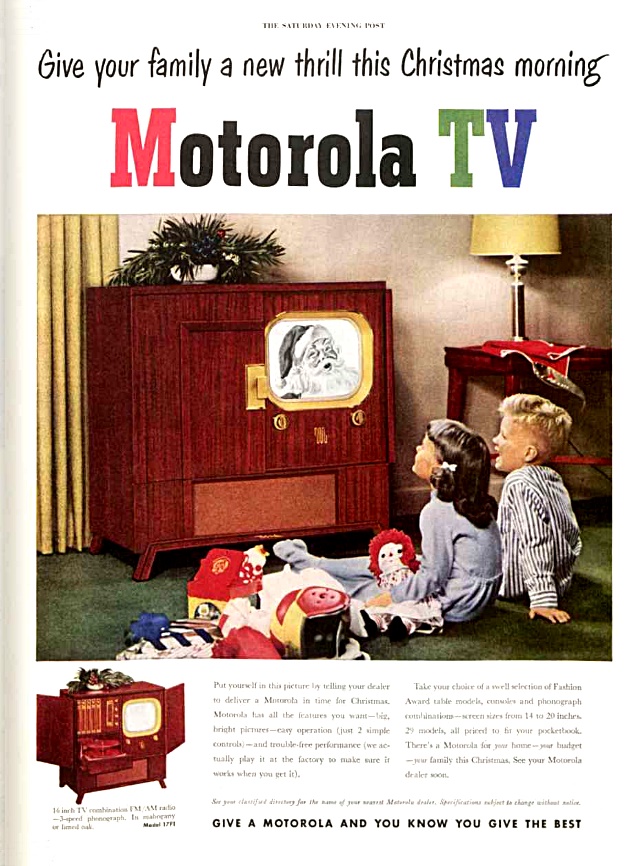
This came with a record player and AM/FM radio.
Tuesday Is National Comfort Food Day
While the definition of comfort food may differ from person to person, depending on what you find warm and cozy, where you live, and what your childhood was like (nostalgia is a big factor), can we all agree that a kale salad isn’t “comfort food?” There’s nothing warm and cozy about salad!
Instead, let’s make Emeril Lagasse’s Kickin’ Chili or this Classic Chicken Pot Pie from Pillsbury. Good Housekeeping has a Classic Patty Melt, while Allrecipes has Phyllis’s Homemade Baked Mac & Cheese. Casseroles are a classic comfort food dish, so try this contest-winning Chicken Broccoli Casserole from Taste of Home or this Tater Tot Casserole from Delish. I love tater tots.
The Pioneer Woman has two comfort food recipes that get raves: her Meatloaf and her French Onion Soup.
And for dessert try these Triple Chocolate Cinnamon Rolls, also from Food Network.
Next Week’s Holidays and Events
Rockefeller Center Tree Lighting (December 4)
It’s finally up and will be lit at 8 p.m. on NBC and Peacock, hosted by Kelly Clarkson with guests the Backstreet Boys, Jennifer Hudson, and the Radio City Rockettes.
Repeal Day (December 5)
You can celebrate by having a drink or two.
Devout
Jody first approached me in early October, after our Canadian Women Writers class ended at three o’clock. I’d noticed her from the first day, a sweltering September Tuesday. Our classroom didn’t have desks, but long rectangular tables in a horseshoe configuration, so students could study each other as much as the course material. Jody was beautiful in looks, but even more so in the prepared, confident way she participated in discussions.
As I packed books and the thick course kit into my knapsack, Jody stood so close I could’ve touched her bare midriff. She dressed like most girls at university; I hadn’t expected to see other students practicing tzniut, modesty of dress, when I started undergrad three years ago. Their uniform was shredded jeans, sagging sweatpants, or leggings that colored, not covered, their anatomy. When I imagined myself wearing those clothes, an image of my outraged parents always followed.
“Hey, Rivka. Do you have another class now?”
I was elated that Jody knew my name. I rarely spoke during discussions.
“No. I’m done for today. “
“Wanna grab coffee?”
“Um … sure.”
Walking to the nearest campus Tim Hortons, I knew we were a mismatched pair. Jody donned a cropped sweatshirt and low-rise khakis. I wore my year-round attire: midi-length skirt and long-sleeved shirt covering my collarbone. Tights, regardless of temperature. Non-Jews sometimes mistook me for a Mennonite.
As we waited for our drinks, Jody talked about class, how she liked Atwood’s short stories better than her novels. We settled at the only available table, and she blurted, “I’m Jewish, too.”
My face must’ve shown my surprise. Jody laughed.
“But … I’m a really bad Jew. We’re talking working-on-Yom-Kippur bad,” she said. “Well, not the one three weeks ago, but only because they didn’t schedule me.”
Now I fought to keep my expression neutral.
She continued, “We’re talking eating-English-bread-pudding-during-Passover bad.”
My effort failed; my mouth dropped open. “Both your parents are Jewish?” Her surname, Rogers, made the paternal side seem unlikely.
“Yeah. My dad’s grandparents were Rothberg when they came over.”
“So …”
She shrugged. “We’re not good at religion.”
My black coffee felt too hot even through the cardboard sleeve, but I couldn’t use the restaurant’s non-kosher milk. Jody took a sip of her mochaccino.
“I couldn’t handle such strict adherence to Judaism, or any religion. But I admire people who can.”
My excitement at Jody’s friendliness deflated. Maybe I wasn’t a friendship candidate as much as an anthropological curiosity. Or maybe she saw me as an opportunity to unload guilt over her failed adherence to our supposedly shared faith.
She didn’t know the turmoil beneath my appearance.
Jody continued. “I’m not putting you on a pedestal. It’s just, it’s hard to make friends in a big university, or you do and then your schedules change. I thought I’d see if you wanted to hang out sometimes after Canadian Women Writers, grab coffee, whatever. Sometimes I go downtown to shop. But no pressure.”
“Yeah. I’d like to.”
* * *
Opening the front door, I heard an unfamiliar male voice coming from the living room. My mother called out, “Come meet David.” It seemed another unwelcome suitor — unwelcome to me, certainly — awaited. Anxiety thick as syrup coated my insides.
The past year, my parents kept bringing up the subject of marriage. They saw it as the appropriate next step after university or even while I was still in school. I also imagined they were scared, after what happened with my sister Meri. My mother had a friend who liked to play matchmaker, knew lots of young men, or so she said, and encouraged me to meet with her. When I’d expressed disinterest, I’d hoped that would be the end of it. Instead, my parents were taking it upon themselves.
I took off my shoes, placed them on the boot tray beside the front door, and carried my knapsack to the living room. My feet dragged despite the smoothness of my tights against the broadloom.
The guy was my age, wearing a black suit tailored to his medium frame. He sat at one end of our leather sofa, and my parents, at the other, smiled too big when I appeared. On the coffee table was a tray of the kosher iced sugar cookies my mother always ordered for entertaining.
A beat too late, the young man stood up for me. The faux pas showed in his nervous grin.
“Nice to meet you, Rivka.”
My “Hi” came out dusted with the disinterest, but then I felt bad; he’d come here thinking he’d meet a marriage-minded girl. “Nice meeting you,” I added. David sat down.
My mother spoke fast, saying how David and I had “so much in common,” like we were the only people in the world reading literary fiction. David’s teeth were so yellow they encroached on orange. What did he do — or not do — to have that color at his age?
I’d been equally uninterested in the guy my parents trotted out last month, though his teeth were nice. But he was nine years older, something that deeply troubled me.
“It’s good when the woman is younger,” my mother had said after the 30-year-old left.
Good for whom? Resentment and fear had log-jammed my mind. My youth as a commodity for childbearing. A much older man laying claim to me when the reverse wouldn’t be allowed.
“We’ll leave you and David to talk,” my mother said now.
“Apologies, David, but I’ve got important reading for tomorrow,” I said quickly, hoisting my knapsack neck high. In my room, I flung the knapsack on my bed and lay down, eyes to the ceiling. A few minutes later, I heard David leave.
* * *
“David loved the cookies. I gave them to him to take home,” my mother told me at dinner.
He shouldn’t eat sugar. Did you not notice his revolting teeth?
With a tiny edge of impatience, my father said, “Bubbeleh, David’s a respectable young man.”
“No doubt. But I’ve told you I’m not ready for marriage.”
“January, you’re 22. That’s old enough.”
“I don’t feel it.” I had trouble swallowing my next bite.
“It’s not a feeling. You just do it when it’s time. You wanted university, you got university, and now you’re almost done. What’s the logical next step?”
“A job.” Reaching across him for the plastic Diet Coke bottle, I emptied the remaining liquid into my glass.
“If you meet someone now, you could be married in the spring,” my mother said. “Perfect time, before it gets too hot.”
I’m not Chana, I’m not Eli, I’m not Ari. “Make wedding plans while I’m drowning in exams and essays?”
“Your mother will handle everything. Please give David a chance.”
Taking a too-big gulp of my drink, I coughed as carbonated liquid stung my nose. “Please … stop. Stop.”
What would happen to me after graduation, if I continued to resist marriage? As I waited for the pain in my nose to subside, the words of the enraged Capulet threatening Juliet popped into my head: “But, as you will not wed, I‘ll pardon you: Graze where you will you shall not house with me…Look to’t, think on’t, I do not use to jest.”
* * *
I have four older siblings: two sisters, two brothers. Chana, married at 19, had her first baby 11 months later. At 30, she had five kids and was again expecting. Eli was almost 29, an accountant who had two sets of twins with his wife; they said they wanted “a couple more.” Ari, at 23, was studying to be a rabbi. He married Wendy, a Reform Jewish girl who became Orthodox, though she sometimes confided in me how much she missed Burger King and Halloween. Only a year my senior, she’d recently announced her second pregnancy. Devotion to Orthodox Judaism fulfilled Chana, Eli, Avi, and their families. They were extremely happy.
Meri was different. She left. She said she changed her name from Miriam because even that never felt right. My parents did phone her on her 27th birthday in June, but Meri told me there was no gift, hadn’t been since she moved in with Kate four years ago. It was rare, but not unheard of, to do what Meri did; it was called going off the derech, off the path. My parents were not so dramatic, so vengeful, to mourn her as if she’d died, something I’d heard of Orthodox parents doing. But I was the only family on Meri’s side at her and Kate’s city hall wedding last year. At the celebratory dinner, I ate a kosher meal Meri’d had delivered to the seafood restaurant.
I visited Meri and Kate with a frequency best kept from my parents. They thought I was having regular dinners with an Orthodox friend; in reality, I hadn’t talked to that girl since high school. I loved my parents, loved the Jewish life they’d given me, loved my siblings, loved waking up Friday mornings in giddy anticipation of the Shabbat family dinner, the self-reflection of the autumn high holidays, the perpetual childhood joy of Channukah, Purim, and Sukkot. Every time I stepped into our synagogue, I felt familiarity and belonging. I loved to learn, and Judaism was a scholarly faith requiring extensive study beyond simple belief. When I graduated from my religious high school, my parents agreed I could go to university after previously saying no. I believed that their change of heart — or change of mind — was somewhat related to Meri. They’d give me some space but were greatly concerned the secular world would dilute my faith.
It was true that on campus there was so much temptation, so many enticing experiences beckoning. Forbidden fashions, forbidden foods, dating based only on attraction and, yes, sex outside of marriage, the most forbidden thing of all. I maintained my “goodness,” at least in behavior. The non-Orthodox Jewish world was forbidden fruit waiting to be tasted.
* * *
Simply put, being around Jody was fun. Her sense of humor was sardonic but not mean, with no shortage of sex jokes which, to my relief, I understood. She dated both guys and girls, spoke of “very chill” parents and a grandmother who “understands me completely.”
When Jody didn’t have to work after our twice-weekly class, we usually got coffee and then went for a long walk around the campus or sometimes to a cheap, early movie. I told my parents I was spending after-school time with a new Jewish friend. That was entirely true, and I always got home by eight.
Wherever we went, people stared at Jody but seemed to look right through me. I hoped it was only due to my modest dress. I wanted to believe I was desirable, capable of attracting someone when the time felt right.
One afternoon, Jody said she needed new, pre-distressed jeans because the hole in another pair got so big one leg ripped off. “Maybe I’ll go for smaller holes this time,” she said as we rode the subway to a downtown department store.
I stood nearby as she examined racks of jeans that, to me, only varied slightly in color or width. Once she’d selected five possibilities, I told her I’d wander around while she was in the change room.
It was early November, and the other side of the store’s fourth floor was a glittering field of green, red, gold, and silver. The beauty was undeniable. As I walked closer, I heard the uplifting holiday music, a siren song for shoppers. I passed between two eight-foot-tall toy soldiers acting as the entrance to the wonderland. Ornaments gleamed, strung lights shone, and heavily bedazzled Christmas trees reached nearly to the ceiling.
It was well organized, too; there were themes. Hanging signs rimmed with faux icicles read Nutcracker Notions, Ever-A-Green Christmas, Santa’s Sleighbells, Canadian Christmas Cabin, and Dandy Dickens. Train sets, sparkling tree-top angels, plush penguins and polar bears, skating and ballet dolls, and miniature Victorian villages begged to be coveted and bought. Many things were so pretty I couldn’t resist touching them.
After some wandering, I found the Channukah section, which was about five percent of the department. It didn’t have a kitschy name, just a corner to itself. On offer was a small selection of metal menorahs on a glass shelf and a rack of dreidels in bubble packaging. The greeting cards were exclusively blue and white. I pictured non-Jewish store buyers, young or young-acting, congratulating themselves on their “diversity.”
Meri and Kate had a holiday tree every year; Kate had been raised Anglican. The first December I’d visited, it felt weird even sitting close to the tree. While Meri had fashioned a chain of Star of Davids from aluminum foil, the other decorations were for Christmas. But now I was much more comfortable visiting in December.
In the homey Canadian Christmas Cabin section, I fingered a palm-size cabin ornament of real wood. Painted-on snow covered the roof, and a teeny front door really opened. But for the loop of red thread attached to the top, you wouldn’t know it was a Christmas ornament. A tiny cabin hardly spelled out Christianity, and I loved its cozy, welcoming vibe. Heart pounding, I decided to buy one for Meri and Kate. Then, I grabbed a second, identical ornament and hurried to the checkout desk.
* * *
The Christmas department reappeared in my mind at inopportune times: during class lectures, when I talked to Jody, at home at dinner. Each overseas-manufactured trinket was like non-kosher food — easily available but off limits to me.
In a dream, I was being married in an Orthodox synagogue, standing under the chuppah. My husband-to-be had his back to me, so I never saw his face. As the rabbi spoke, Christmas decorations covered the canopy of the chuppah, so many that it sagged. The four staves supporting the canopy sprouted tinsel and strings of candy canes. I woke with a jolt, ashamed my subconscious could even conjure such a thing.
* * *
Meri buzzed me into her building. I climbed the steep staircase covered with worn-out broadloom to her and Kate’s second-floor apartment.
“Pepperoni pizza tonight,” Meri teased, meeting me at the door.
“Ha ha,” I replied as she hung my coat and knapsack in the closet. I handed her a reuseable bag with two bottles of her favorite organic orange juice.
“Dairy, actually,” she said. That meant bagels, cream cheese, tuna salad, and egg salad. Meri’s kitchen wasn’t kosher; my parents wouldn’t have eaten there no matter what she served. But I was used to keeping kosher in non-kosher environments and appreciated how Meri always bought kosher food for me.
Kate, setting the table, grinned hello to me. An IT specialist, she earned much more than Meri, who did administrative work for a nonprofit theatre. But Meri insisted on splitting expenses, so they’d remain in their modest apartment until they saved the down payment for a house.
After dinner, we relaxed on the living room sofa. Meri rested her head on Kate’s shoulder, making me feel proud that they felt they could be themselves around me.
“How are they,” Meri asked, referring to our parents. They only spoke with Meri a few times a year. I didn’t know how much contact Meri had with Ari and Eli and never asked. Chana estranged herself from Meri for “tearing ima and aba’s hearts out.”
“Trying to marry me off. They think it’s time.” Because my voice cracked on the last word, I took a deep breath.
“Partly because of me, no doubt,” Meri said. Kate looked sad. “They’re worried about another kid going off the derech.”
“Marriage is scary,” I replied. “To instantly go from daughter to wife. Then, a year later, mother …”
The next thing was hard to say, because I’d never said it out loud: “I’m not sure I even want kids.”
“You’ll contribute to the world in other ways,” Kate said quietly. But she didn’t know my family’s devotion to our faith.
At school, I was surrounded by students with the luxury of options. They studied everything from engineering to acting. Summers, they backpacked around countries I’d barely heard of. They graduated and took jobs in office towers or on tree farms or teaching English overseas. They never spoke of marriage but of partnerships based on attraction and common interests.
I remembered their gift that was in my knapsack. I got up, hurried to the front hall, and returned with the ornament. Meri sat upright. Kate looked almost as surprised.
“Riv … wow. You bought us a Christmas decoration?” Meri reached for the ornament.
“I thought it was nice. It doesn’t seem too Christian.”
They both laughed. “It’s winter-themed,” Kate agreed. “Love the natural wood.” She passed the cabin ornament to Meri, who traced her fingers around the edges.
“You know,” she finally said to Kate. “This is the kind of house we want. A cozy little place where everyone is invited.”
An hour later, waiting at the bus stop outside Meri and Kate’s apartment, I thought of the other cabin ornament I’d purchased, hidden under my bed.
* * *
The next morning, Mom asked if I was coming home right after school. I said yes, thinking nothing of it, but as I was leaving the house, I heard her calling the kosher bakery for a same-day order of sugar cookies.
I tremored with fear and fury all day, barely able to eat lunch or pay attention in my three classes. When Canadian Women Writers finished, I told Jody I was going downtown to shop. She was heading that way, she said, but had to work.
“What are you shopping for,” she asked me on the subway platform.
“I’m not going home right now. I think my parents are trotting out another marriage prospect.” They’d be angry when I pulled a no-show, but I coulkd made up excuses. Transit delay. Had to research a paper I forgot was due. A classmate asked for help.
“Jesus,” Jody said. “I haven’t even decided which gender I prefer. Or if I should go straight into an M.A. program or take a gap year to work.”
The subway roared into the station. In the thundering noise, not even Jody heard me cry out, “Don’t make me get married,” to my absent parents. The breeze from the train rustled my hair around my shoulders, the hair I’d be expected to shave off and cover with a wig when I became a wife.
* * *
In the Dandy Dickens section, I added a plastic model of six cherry-cheeked, Victorian carolers to my shopping basket. I’d already selected a hand-sized Santa figurine donning red velvet, a package of toy soldier ornaments in candy-colored uniforms, and a box of green and silver ball ornaments from Santa’s Sleighbells.
In Nutcracker Notions I set my basket on the floor to examine a boxed Sugar Plum Fairy doll. The costume exposed a woman’s body in an unthinkable way, according to my upbringing. The tutu’s horizontal layers of tulle couldn’t cover the doll’s long legs and arms; the satin leotard was a second skin over its torso and bottom. My parents wouldn’t have let me become a ballerina. Though I’d never had the aspiration, that thought increased my anger. About ten inches high, the doll was $69 before tax, and I added it to my basket. I’d use my remaining textbook money for this semester. Ignoring the Channukah section, I walked to the checkout desk.
* * *
I nearly crashed into the young man exiting through our front door as I was coming in. We made quick eye contact, then he stepped around me and pounded down the porch steps.
My arms shook as I lowered my loaded knapsack to the floor.
My parents stood at the entrance to the living room. On the coffee table behind, the sugar cookies were on their usual tray.
“You said you were coming right home.” My mother’s low voice was scarier than shouting.
My father added, “Benjamin waited two hours.”
A pretend excuse would only make this happen again. I carried my knapsack to my bedroom, slammed the door. Unzipping the bag, I took out my haul, laying everything on my bed. Crouching to retrieve the cabin ornament underneath, I started decorating.
I leaned the Santa figurine against my computer monitor. The Sugar Plum Fairy doll had a metal stand so, after fluffing the tulle tutu flattened by the box, I set it on my dresser. The cabin ornament and the Victorian carolers went beside it.
There was no place to hang the dozen ball ornaments and toy soldiers. Thinking fast, I arranged the soldiers, standing, in a semi-circle around my computer. As my father opened my bedroom door, something I couldn’t remember him ever doing, I dotted the glass ball ornaments over my bed pillows.
He was aghast, his expression frightening.
“What is this … dreck … in my house? What’s wrong with you?”
My mother appeared beside him. Her eyes widened, then watered. After a moment, they walked away.
* * *
In December, I hung the glass ball and toy soldier ornaments on Meri and Kate’s tree. Their cabin ornament took the place of a star while the Victorian carolers and Santa figurine went on the top shelf of their living room credenza. I had decided to keep the Sugar Plum Fairy doll and my cabin ornament; they remained on my dresser. My parents didn’t comment. I saw my mother put the cookie tray in the storage cupboard and hoped matchmaking attempts were over.
That afternoon, sunset would usher in my favorite holiday. I invited Jody, whose family didn’t celebrate Channukah, to be with mine. Maybe she’d decide a little Judaism in her life was okay. Maybe my parents would see options for me besides early marriage. Jody and I were already talking about being roommates after graduation. I was terrified of my parents’ reaction if I moved out. But I knew of an apartment building with wonderful neighbors.
Review: Nutcrackers — Movies for the Rest of Us with Bill Newcott
Nutcrackers
⭐️ ⭐️ ⭐️
Run time: 1 hour 44 minutes
Stars: Ben Stiller, Linda Cardellini
Writer: Leland Douglas
Director: David Gordon Green
Streaming on Hulu
Reviewed at the Toronto International Film Festival
It’s got Christmas, it’s got orphans dancing in a big production number, and it’s got a hard-driving businessman who, with the help of a selfless woman, discovers that only the love of a child can defrost his icy heart. Honestly, even without a cameo from FDR it’s clear the musical Annie lives in the same thematic neighborhood as Nutcrackers, Ben Stiller’s proudly derivative but thoroughly entertaining family comedy.
Stiller plays Michael, a Chicago real estate developer whose sister and brother-in-law, farmers in rural Ohio, have died suddenly, leaving behind four young boys. The first impression they make is worrisome, to say the least: Sitting in the rafters of the barn and sharing their late parents’ rambling farmhouse with pigs and chickens — which they casually slaughter whenever they get hungry — the kids seem to be auditioning for a live production of Lord of the Flies.
Of course, Michael expects to be playing little more than a small supporting role in that drama: He arrives at the farm in his Ferrari, expecting to sign some foster home papers on behalf of his nephews. But a local case worker (Dead to Me’s Linda Cardellini) hits him with the big surprise we saw coming from a mile away: Not only does he now have legal custody of the kids, he is also responsible for all his sister’s considerable debts (I’m not at all sure the law works exactly that way, but, hey, I’ve never lived in Ohio).
Despite the fact that he’s in the final days of a make-or-break deal six years in the making, despite the fact that he is a singularly self-absorbed bachelor, and despite the fact that he heretofore would have crossed a four-lane highway rather than walk on the same sidewalk as a snot-nosed child, Michael rolls up his sleeves and embarks on a well-meaning but usually disastrous crash course in parenting — at the same time shopping the kids around town, hoping to find someone who will provide a foster home for them.
Yes, none of this sounds like the kind of stuff any actual, breathing human being would do, but Stiller, with his hangdog manner of smoldering exasperation, has always had a way of making us swallow indigestible plot lines and actually like it (Exhibit A: All his Focker movies). Many of the laughs to be found in Nutcrackers — Michael falling in the mud as he chases a chicken; Michael home schooling the boys in sex education; the boys wreaking havoc at a high-class Christmas party — seem so pre-programmed we feel that, rather than that Ferrari, Michael should be behind the wheel of a self-driving Tesla. But they are honestly earned laughs, nevertheless.
Stiller is greatly assisted by his young cast, a quartet of actual siblings: Homer, Ulysses, Atlas, and Arlo Janson. Admirably, the four young actors are more than willing to turn us against their hell-raising, anarch-kid characters from the get-go — then spend the rest of the film winning us over, fair and square. And as the woman who helps soften Michael’s attitude, Cardellini goes full-bore Margot Kidder with a warm, encouraging smile and occasional stern word for the guy only she sees as a possible dad-in-waiting.
Director David Gordon Green, known mostly for his horror movie sequels (The Exorcist: Believer, Halloween Ends), seems an odd choice to helm a heartfelt holiday movie, but his instinctive edginess ably navigates the sentiment-versus-mayhem tightrope walk created by writer Leland Douglas.
Occasionally, Green and Douglas call upon Cardellini’s character to gently remind Michael — and us — that at the heart of the story are four children whose parents have suddenly died (although, to be fair, it’s unclear just how much actual parenting was going on when Mom and Dad were still around). To ease their first parentless holiday — and to give the boys some sense of closure — Michael agrees to help them stage a community production of The Nutcracker that their mom, a popular local dance teacher, had been planning.
Of course, things go comically awry, and also of course the Christmas setting and sentimental storyline converge to provide an ending that will soften the steely resolve of every Daddy Warbucks in the audience.
Then again, few people will sit through Nutcrackers wondering if Michael is going to find someone to raise his orphaned nephews. It may be a hard knock life, but the sun will come out tomorrow.
Thanksgiving Appetizer
The Boston Transcript is afraid, if all the states this year have Thanksgiving day on November 6, that “there may not be turkeys enough to go round.”
-November 21, 1868
The clergymen of Massachusetts are signing a petition to the Governor that the annual appointment of a day of fasting, humiliation, and prayer has become a day of much license, disorder, and excess. They believe that the discontinuance of the custom would be for the public good.
-November 6, 1869
A man in Indiana was choked to death by a piece of beef on Thanksgiving Day, and his neighbors say it was a judgment on him for not eating turkey.
-January 2, 1869
A Deacon was in the habit of asking blessings of a most wearisome length. At Thanksgiving dinner, he was particularly wordy and had to pause to gain a fresh supply of breath and words. The Instant he stopped the pastor sat down and commenced rattling his knife and fork. The deacon, very much disconcerted opened one eye and, exclaimed, “I’m not through yet; I only hesitated.”
“Hesitated?!” replied the minister, “it’s no time to hesitate when a turkey’s cooling!
-May 21, 1859
We see it stated that on Thanksgiving Day in New York, several of the leading clergymen commented at length upon the increasing demoralization of that city — one going so far as to say that New York would suffer by a comparison with Sodom and Gomorrah.
We think this is rather too hard a sentence. There was only one good man in Sodom — there must be at least several thousand in New York, unless the church members there are all hypocrites.
-December 4, 1858
At East Lynn, Massachusetts, on Thanksgiving Day, a couple were married who had been engaged since 1817.
-December 21, 1872
A citizen of Elizabeth, NJ, went to the railroad station on Thanksgiving day to see his daughter off. Having secured a seat for her, he left the car and went round to her window to say a parting word. While he was walking out, his daughter left the seat to speak to a friend. At the same time, a prim-looking lady who occupied the seat with her moved up to the window. Unaware of the changes inside, our venerable friend hastily put his face up to the window and exclaimed: “one more kiss, sweet pet.”
In another instant the point of a blue cotton umbrella caught his seductive lips, accompanied by the passionate injunction: “Scat, you gray-headed wretch!”
-January 13, 1872
At one of the Wellsburg, OH, churches on Thanksgiving day, somebody quietly dropped a one-hundred-dollar bill in the plate, and the unknown donor had the satisfaction of hearing his hometown newspaper say that the gift was either a mistake or conscience money.
-February 4, 1871
A Chicago paper has made a list of casualties resulting from football games held on Thanksgiving day. The list contains one killed outright and 45 injured — in one case at least fatally. Beside the fatal injury, in which the body was badly crushed, one man was rendered delirious by a blow on the head. Another was badly hurt internally, another had an eye gouged out and a hip broken. In other cases, arms, ribs, and collarbones were indiscriminately shattered.
This is one day’s record for a game that people applaud who are horrified at the thought of the comparatively harmless bullfight.
-December 10, 1896
At Providence, RI, Thanksgiving ay, the newsboys and bootblacks were treated to a dinner, the prominent feature of which was a mammoth pudding, three feet long, two feet wide, and one foot deep, and containing, among other ingredients, fifty pounds of raisins and ten cans of milk.
-November 24, 1870
“Darling,” pleaded the college man, “won’t you please fix the day; I am simply dying for the moment when I can call you my own!”
“Very well,” replied his fiancée, “suppose we say Thanksgiving day.”
“Great Scott,” replied her lover, “are you crazy? That’s football day!”
-November 28, 1914
My Love-Love Relationship with the TSA
I love the TSA. Illogical as this may sound, the Transportation Security Administration — the men and women in blue; the safety organization that catches only 30 percent of weapons stowed in carry-ons and crevices; the fiends who confiscate my pepper spray, my shampoo, and my dignity — holds a special place in my heart.
Most people hate the TSA. Detection systems are ineffective, wait times only seem to increase, and hundreds of people accidentally bypass TSA every year simply by walking the wrong way through exit lines. It’s no wonder many believe that the TSA is simply disruptive security theater designed only to comfort passengers and not provide real safety.
And while I once shared this belief, I’ve recently come to appreciate the TSA for all its quirks and flaws. Traveling more frequently for college and study abroad, I’ve spent hours in lines, dumped gallons of perfectly good water, and, most importantly, looked into the souls of hundreds of TSA agents. Where I once saw passive aggression and mutual disdain, I now see a community that is merely misunderstood.
Like most, I was predisposed to hate the TSA. They created the endless line between me and a flight leaving in ten minutes. They were the bureaucrats ordering me to remove my shoes, place my liquids in plastic bags, and lift my arms for an X-ray machine that revealed parts of me I didn’t know existed. (Notably, TSA scanners produced images like this until 2013.)
But this preconceived resentment blinded me to the upsides of the TSA. You see, the TSA doesn’t like to show off. It merely hides its charms for those willing to give it a chance. Laying down my arms (metaphorical arms, see deck), I’ve found much more to love than hate. For one, the line is often shorter than expected, even if this mainly happens when I’m a good four hours early for my flight. Additionally, even though I can’t playfully wrestle the bomb-sniffing dog, I can smile at the GOOD BOYS and GOOD GIRLS and buy a TSA Canine Calendar. And perhaps most wholesome, I’ve recently discovered the TSA’s witty and endearing social media accounts on X, YouTube, and Instagram. They predominantly post videos of Moo Deng, the adorable pygmy hippo from Thailand, and are clearly attempting to salvage the TSA’s reputation, but it’s not entirely a lost effort. There’s something beautiful in such humility.
And yes, there are still overt problems within the TSA. Technological failures lead to racially motivated pat-downs. People can pay for TSA PreCheck and CLEAR, line shortcuts that commodify time at the expense of efficiency for others. And again, the TSA only catches 30 percent of weapons people try to bring on flights, according to a House Homeland Security Committee hearing. But that’s actually an improvement: In 2015, that number was 5 percent.
But it’s not fair to place the entire blame on the TSA or its agents. In my travels, I’ve focused instead on what is in my power to change. Love isn’t easy. In turning inward, I’ve learned to forgive and even find creative solutions to common gripes about the TSA:
- Irrational metal detector worries? You don’t have a bomb in your backpack if you didn’t put a bomb in your backpack.
- Belittled by a grown man for forgetting to remove your belt? Try crying silently to yourself.
- $200 family heirloom confiscated? Consider buying it at Duty-Free for $199!
- Coming face to face with a 10-year-old passport photo? Try therapy. Or Botox.
- Forced to chug your water and need to pee 2.5 hours later while disembarking from the plane? Try making a premature transition to adult diapers.
With these simple solutions, the TSA security check can go from a resentful hour of seething in a slow-moving line to a celebration of human connection. There’s no love greater than the one that changes you for the better. I walk with confidence, put my biases aside and my arms up, and even ask the TSA agent about their day. Life is too short to run after closing gates and to resent someone who is only a small part of a complex government bureaucracy.
Those metal detector follies and transportation anxieties are usually my fault anyway. I get to the airport 20 minutes before my flight, leave a rotting banana in my backpack, and prematurely judge a group of people who don’t want to be at the airport—let alone their job—at 6 a.m. any more than I do. They’ve seen my belongings, seen my literal interiors, and seen me cry because I forgot my ticket and believed adult tears would get me through to my gate. Their job is to know me, and, for too long, I resented them for it. But maybe all they want is to be known in return. In giving them that chance, I found joy in the seemingly joyless, and I learned to love the TSA.
Cartoons: Marriage Mayhem
Want even more laughs? Subscribe to the magazine for cartoons, art, inspiring stories, fiction, humor, and features from our archives.
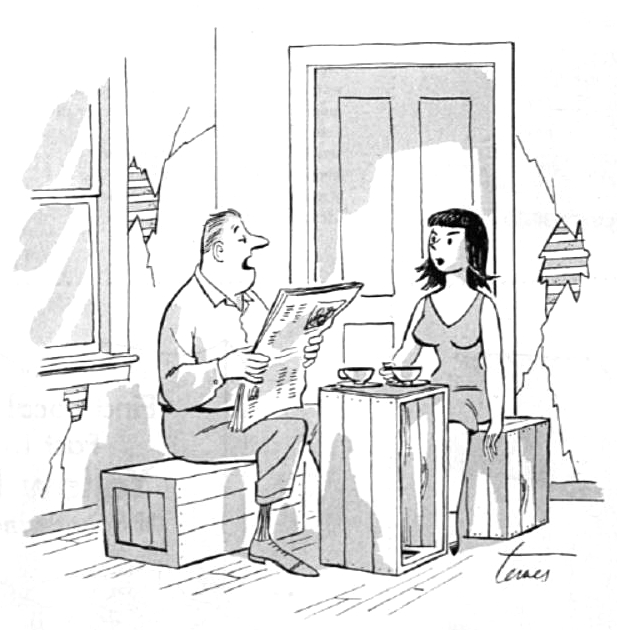
Mort Temes
May 2, 1959
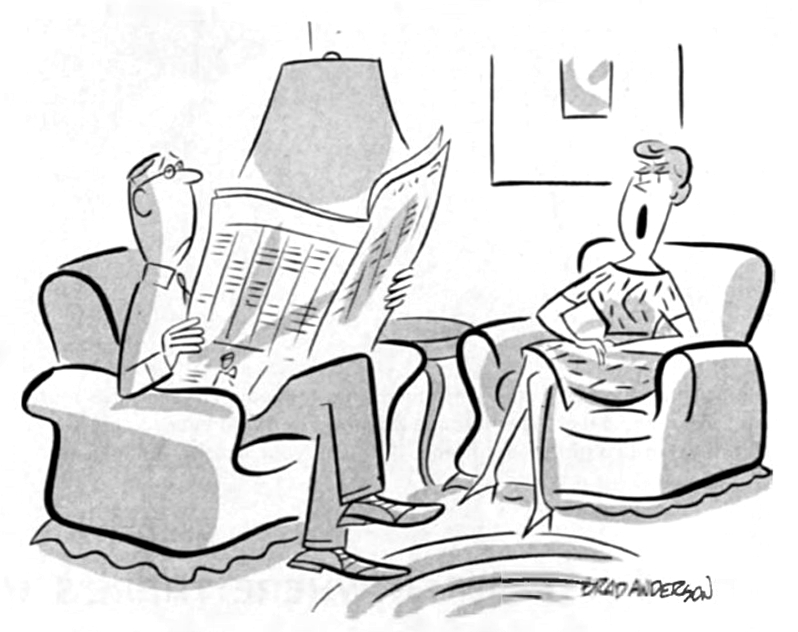
Brad Anderson
March 26, 1960

Chon Day
March 24, 1962
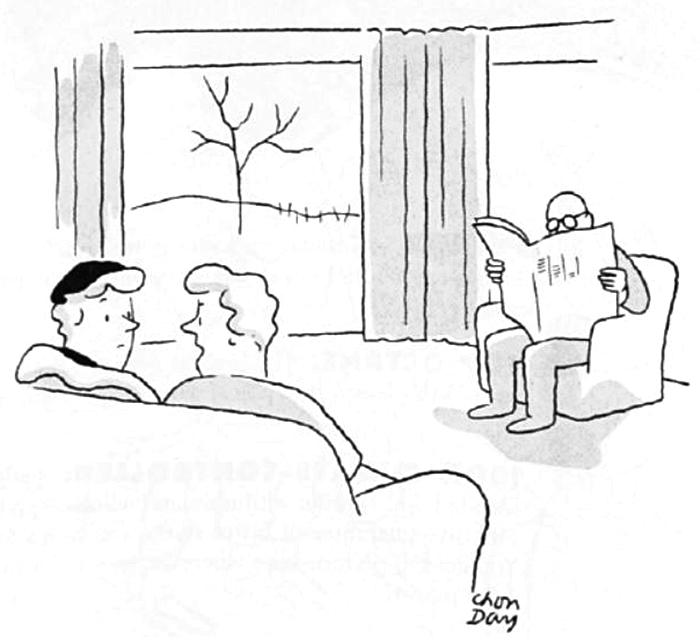
Chon Day
March 17, 1956
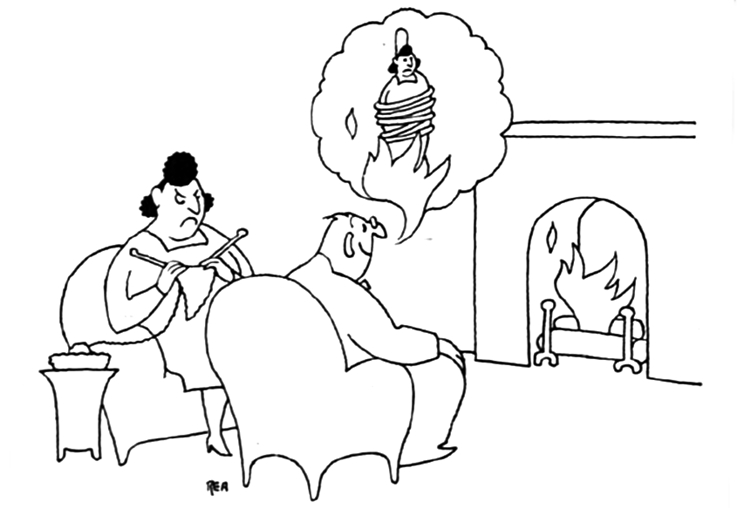
February 28, 1959

Stan Hunt
February 28, 1959
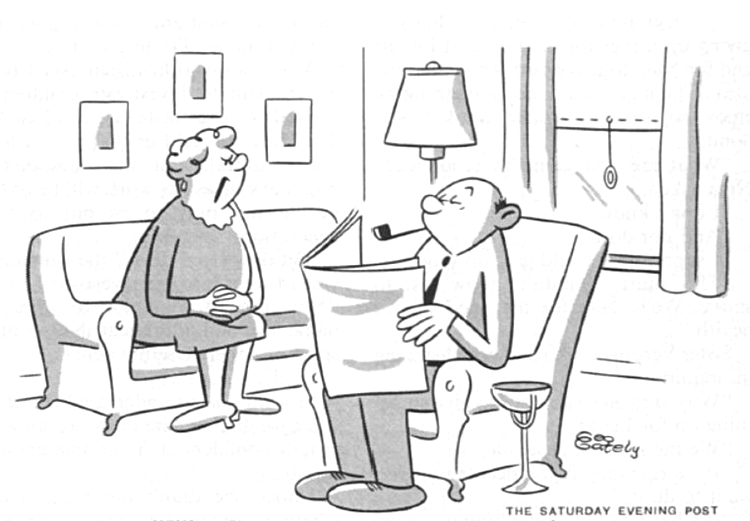
Geo. Gately
May 18, 1963
Want even more laughs? Subscribe to the magazine for cartoons, art, inspiring stories, fiction, humor, and features from our archives.
From the Archive: The Fantastic Walt Disney
—From “The Fantastic Walt Disney” by Bill Davidson, from the November 7, 1964, issue of The Saturday Evening Post
In the 1960s, the major film studios that had once been managed by tycoons were now being run by committees, boards of directors, banks, and others. But the Disney studio was bucking the trend. The organization ran from the top down, and no employee was left in doubt about it.
Nobody buys or sells or creates anything at the Walt Disney studios without the okay and involvement of the big man himself. Although everyone at the studio, from janitor to associate producer, calls him “Walt,” the “Walt” is spoken in tones of deference.

Not long ago a well-known executive came to work on a Walt Disney production. The first day on the job he was annoyed by the sound of a lawn mower outside his window, and he shouted at the gardener to desist. An hour later the executive received a call from Disney’s secretary, informing him that Disney wanted to see him. The executive rushed over, and Disney said, “You spoke harshly to that man. He’s been with me for 20 years. I don’t want it to happen again.”
The executive mumbled a contrite, “Yes, sir.”
Disney continued, “And there’s another thing I want you to remember. There’s only one S.O.B. at this studio — and that’s me.”

This article is featured in the November/December 2024 issue of The Saturday Evening Post. Subscribe to the magazine for more art, inspiring stories, fiction, humor, and features from our archives.
Doctor’s Note: Hammered for the Holidays
The holiday season is once again upon us. During the months of November and December, millions of Americans will share good times and good cheer with family and friends. And in the majority of American families, “good cheer” includes alcoholic drinks. Nearly two-thirds of Americans are alcohol drinkers, a number that has stayed remarkably stable ever since the end of Prohibition. And as a nation we drink roughly twice as much alcohol per week during the holiday season compared to the rest of the year. So how much alcohol is too much? Are we Americans getting hammered for the holidays?
Alcohol-related illness and death have increased dramatically in the U.S. between 2000 and the present day, even though per-capita alcohol consumption has only increased by a small amount and remains much lower than in the 1970s-’80s. This reflects the fact that alcohol-related illness isn’t linked to how much the average person drinks, but how much the heaviest drinkers drink. The top 10 percent heaviest drinkers in the U.S. consume most of the alcohol, and their drinking habits have become more problematic in recent years.
The COVID-19 pandemic of 2020 saw a 25 percent year-over-year increase in alcohol-related deaths, by far the largest such change ever measured. The increase in problem drinking affected women more than men, with a 41 percent increase in problem drinking among U.S. women. A 2022 health survey showed that heavy drinking remained elevated long after the end of COVID lockdowns, with an absolute prevalence increase of 1.19 percent over four years. This may not sound like much, but multiplied by the population of the U.S., it’s 3 million additional heavy drinkers.
What is the definition of heavy drinking? The current U.S. definition is four drinks in one day for women or five drinks for men, occurring at least five days a month. A standard alcoholic drink is 14 grams of alcohol, which is equivalent to 12 ounces of 5 percent ABV beer, 5 ounces of 12 percent ABV wine, or 1.5 ounces of 80-proof liquor. Four to five drinks in one sitting is approximately how much it takes to exceed the 0.08 percent blood alcohol content (BAC) threshold for being legally impaired in most states (Utah’s threshold is 0.05 percent).
It shouldn’t be a surprise to learn that heavy alcohol use is very bad for your health. The CDC estimates that more than 178,000 Americans die of alcohol-related disease each year. This includes acute alcohol poisoning, alcoholic liver disease, alcohol-related cancers, and traffic accidents. Roughly a third of all motor vehicle fatalities involve a drunk driver, accounting for over 13,500 deaths per year. Heavy drinking is unequivocally bad for your health.
What about moderate drinking? The CDC defines moderate alcohol use as no more than two standard alcoholic drinks per day for men, or one alcoholic drink for women. Until recently, many medical textbooks stated that moderate alcohol consumption protected against heart disease. This was largely based on data from the 1960s-1990s showing a “J-shaped curve” of alcohol intake versus risk of cardiovascular death, cholesterol and other blood markers, even overall lifespan. Men consuming up to two drinks a day and women consuming up to one drink a day were modestly healthier than nondrinkers, while those consuming higher levels of alcohol were much less healthy.
These studies popularized the practice of drinking “a toast to your health,” or even calling a glass of wine your “daily medicine.” Drinking red wine for health reasons is especially popular since it contains grape-derived antioxidants like resveratrol. Unfortunately, many of the scientific studies on red-wine health benefits have been tainted by academic fraud.
But even in the larger body of moderate-drinking epidemiology, researchers in recent decades have questioned the appearance of confounding bias in the older “J-curve” data. Moderate drinkers are more likely to be socially active and physically active, and typically have higher incomes than nondrinkers. Some former drinkers only quit drinking because they were medically ill. Most newer analyses that correct for these confounding factors do not show significant benefits from light-to-moderate alcohol use. Some studies show a small amount of harm. Others show no difference. Altogether there is no broadly-accepted consensus on the health effects of moderate drinking.
And that should be a reassuring thought for the holiday season. If you’re a teetotaler, you don’t have to worry that you are missing out on tipsy “medicine.” And if you’re a drinker, feel free to enjoy your favorite drinks. Just do so in moderation.
Going to the Dogs
A small brown mop of a dog trots a neat circle around the royal blue carpet of the Greater Philadelphia Expo Center. Her eyes are barely visible beneath a thick corded coat that looks a bit like dreadlocks. The dog’s name is Abby and she’s a Puli, an uncommon breed thought to be descended from the Tibetan Terrier, according to the show’s host. It’s impossible to watch Abby scurry around the stage and refrain from smiling.
Just minutes later, a glamorous little Shih Tzu named Comet scampers around the arena with her handler, her long gold-and-white-streaked hair sweeping the floor and pinned back from her eyes with a bejeweled blue hairbow. Later, a black-and-white spotted Great Dane named Carson will take a spin around the stage, a dog so large his head reaches the level of his handler’s chest.
Abby the Puli, Comet the Shih Tzu, and Carson the Great Dane represent some of the 213 AKC-recognized breeds and varieties who regularly compete in The National Dog Show Presented by Purina, televised each year on Thanksgiving Day. The two-hour NBC special explains the history and celebrates the beauty and diversity of the nation’s finest purebred dogs. The program has also become a Thanksgiving tradition for many families across America, one that takes its place right alongside pumpkin pie and football.

Creating a National Dog Show
The National Dog Show is the televised version of the annual dog competition of the Kennel Club of Philadelphia (KCP), a prestigious organization which traces its history to the late 19th century. But it was in 2002 that the KCP found its canine contest elevated to the national stage thanks to an unlikely champion at NBC Sports.

“We had a bunch of friends over on a cold, miserable Saturday night in January 2002,” says Jon Miller, president of acquisitions and partnerships for NBC Sports and the owner of a Cavachon named Cooper. “Together we shared a bottle of wine and watched Best in Show, which my wife had picked up at Blockbuster. We all laughed hysterically.”
The popular mockumentary premiered to critical acclaim in 2000. Written and directed by Christopher Guest and starring actors Eugene Levy and Catherine O’Hara, Best in Show parodied the highly competitive world of purebred dog shows and their at times cutthroat pet owners. The movie became an instant pop-culture classic.
Best in Show highlights the fictional Mayflower Kennel Club Dog Show, a riff on New York’s Westminster Kennel Club Dog Show. But writer/director Guest located his fictional competition in Philadelphia — home of the KCP.
After Miller and his friends finished watching the comedy, the group called it a night. But Miller remained intrigued.
“I ended up watching it a second time,” he says. “It was just such a wonderful, fun movie.”

As luck would have it, NBC Sports was looking for fresh Thanksgiving Day programming. The network already had a blockbuster in the Macy’s Thanksgiving Day Parade, which aired in the morning. But they were looking for something to keep viewers tuned in, and NBC had recently lost the rights to broadcast NFL games. So Miller suggested his team produce the KCP’s annual dog show, which happens to take place in mid-November, and air it in the slot immediately following the parade. The pushback was significant at first.
“We’re a sports division,” says Miller. “We don’t generally do these kinds of things.”
Still, thanks to Miller’s track record and his persistence, the network decided to give the idea a go. Miller quickly secured Purina as a lead financial sponsor. Then he rounded up the cohosting talents of David Frei, an AKC-licensed judge who has officiated dog events around the world, and actor John O’Hurley, best known as J. Peterman in the hit TV show Seinfeld.
The resulting television ratings surpassed the network’s wildest expectations. The National Dog Show earned five times the viewership of Frank Capra’s It’s a Wonderful Life, which had previously filled the post-Macy’s parade time slot.
“The National Dog Show really became an annual holiday classic, a tradition,” says Miller. “I’ve been fortunate to be involved in creating a number of television programs, but this one is special because I know it touches families.”
The initial success of the canine competition was no fluke; the show has maintained its popularity over two decades, drawing more than 20 million viewers every year. David Frei and John O’Hurley have cohosted every broadcast since the show debuted in 2002 and were joined by NBC Sports analyst Mary Carillo in 2016. Fans love the opportunity to root for their favorite dogs, to watch for unexpected antics, and to join what has become for many families must-see TV.
“The National Dog Show has captured the public imagination,” says Steve Griffith, the director of communications for the show and for the KCP, as well as the owner of an Australian Shepherd named Murphy. “First of all, it follows the parade, which everyone is watching anyway. It’s a holiday, so people are home to watch it. The show airs before the day’s football games have begun. And then, of course, The National Dog Show features dogs, which appeal to the entire family.”

Making of the Best in Show
More than 20 years after its inception, some 30,000 dogs representing 213 AKC-recognized breeds and varieties have participated in the KCP event that has become popularized as The National Dog Show. But despite the high-powered celebrities, bright lights, and television cameras of the last two decades, the KCP’s goals remain much as they have since the organization launched its first dog show in 1879: dedication to educating the public about dog breeds, promotion of responsible pet ownership, and general admiration of canines. The KCP predates the better-known American Kennel Club (AKC) by five years.
Each of the 2,000 dogs that participates in The National Dog Show is classified by its specific breed and also assigned to one of seven categories, based on the characteristics and functions the dogs were originally bred for: Terrier, Toy, Working, Sporting, Hound, Non-Sporting, and Herding.
In preliminary rounds, dogs of the same breed compete against one other. One dog from each category is deemed Best of Breed, and they advance to the group competition. In the final round, the seven group champions vie for the prestigious title of Best of Show.
The Seven Groups
Each of the 213 AKC-registered breeds and varieties are assigned to one of seven groups representing characteristics and functions the breeds were originally bred for. The First in Group from among each of these seven groups compete against each other for Best in Show.
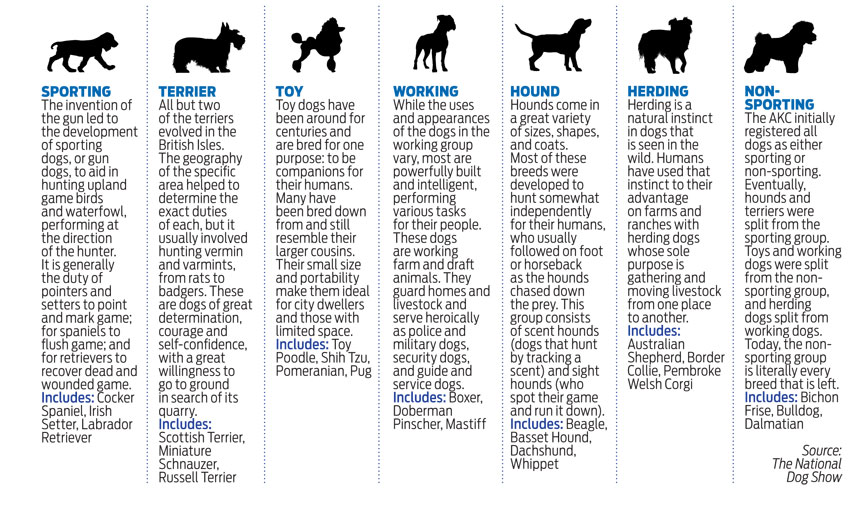
One of the things viewers love about The National Dog Show is that it is a benched show. At a benched show, canine competitors are required to be on display and in their assigned area or “bench” unless they are competing, being groomed, or exercising. This enables spectators to meet the canines up close and ask their handlers and groomers about their specific breeds, fulfilling part of KCP’s stated mission of educating the public about responsible ownership.
From the ubiquitous to the rare, breeds of all sorts find their way into The National Dog Show competition. Participants range from common German Shepherds, Poodles, and Dalmatians to Otterhounds, Norwegian Lundehunds, and the Canaan Dog, the national dog of Israel.
And while you might guess that judges would have a bias toward the more extraordinary breeds, over the course of The National Dog Show’s 22-year run, Best in Show honors have been spread across 19 different breeds. Standard Terriers, Poodles, and Bulldogs have been among the winners, as have a less common Sealyham Terrier named Stache, who won in 2023, and a Scottish Deerhound named Claire, who in 2020 and 2021 became the only back-to-back Best in Show champion in the show’s history.
While the KCP competition takes place live over two days, The National Dog Show is edited down to two hours for broadcast on Thanksgiving afternoon. Interspersed within footage of action from the arena — dogs being groomed, examined, trotted around the expo center, and rewarded with doggie treats — the show cuts away to air canine trivia, interesting mythology, history behind various breeds, and other tidbits about dogs. For example, the world’s largest dog breed is the Mastiff, averaging 160-230 pounds; the Skye Terrier is among the rarest dogs in the world, with only approximately 450 in the U.S.
If there’s a chance that The National Dog Show will fade in its appeal, there’s nothing to indicate it will happen anytime soon, according to organizers. In fact, there’s every reason to believe the event has become a holiday mainstay, one that fits nicely between family favorites like the Thanksgiving Day Parade, turkey dinner, and afternoon football. And after all, for America’s more than 65 million pet-owning households, a holiday focused around family must, by definition, include their fuzzy babies.
Hosting the Nation’s Largest Dog Show
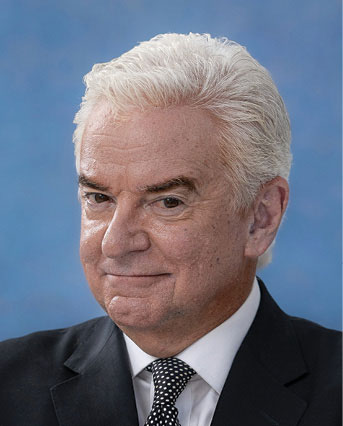
For cohost John O’Hurley, participating in a dog-oriented TV show is no chore. Dogs have been an important part of the actor and entertainer’s life since the age of four, when he spent afternoons exploring the swamp near his Massachusetts home with a little Dachshund named Taffy. And while O’Hurley is best known as a performer, he is also the author of three books, all of which revolve around canines. His children’s book The Perfect Dog has even been adapted for the stage.
“I knew nothing about dog shows when I signed on to host The National Dog Show,” says O’Hurley. “I’d never been to one, had never seen one, so my learning curve was rather extraordinary. But I’ve always, always had a dog in my life.” He is currently the owner of two rescue dogs, Mia and Charlotte.
Thanks to years of hosting The National Dog Show, O’Hurley has become sufficiently knowledgeable about the qualities that competition judges are looking for — the physical traits that form the hallmarks of a breed, the dog’s attentiveness, its carriage and its temperament — that he can sometimes predict which participant will win.
But part of the fun of hosting the show are those unscripted — and often untelevised — moments when a dog reverts to simply being a dog, doing precisely as it pleases. One of O’Hurley’s favorite moments came in the show’s early years, when a large Great Dane paused in its circuit around the stage to look the actor straight in the eyes, squat, and deliver what the host likes to call “an editorial comment on my performance.”
O’Hurley appreciates the show’s emphasis on the ways dogs contribute to human lives: canines who assist with law enforcement and the military, guide dogs, physical and psychotherapy dogs, and working dogs who herd or pull weight. But he thinks most viewers relate to their personal connection with a dog, the juxtaposition of a model dog onscreen and their beloved family dog, the one curled up beside them on the sofa and watching The National Dog Show along with everyone else.
“Whether you’re four or you’re 94, The National Dog Show is something that everybody can watch and enjoy,” says O’Hurley. “Because across the country, we have a love affair with our dogs. And always have.”
Amy S. Eckert is a freelance travel writer and photographer whose work has appeared in numerous publications, including National Geographic Traveler, AARP, and the Chicago Tribune. Visit amyeckert.com.
This article is featured in the November/December 2024 issue of The Saturday Evening Post. Subscribe to the magazine for more art, inspiring stories, fiction, humor, and features from our archives.
Ski the Sun Belt
Just because you live in the Sunny South doesn’t mean you have to fly north to hit the slopes. There are more than a few spots that boast a quick drive from the sun to the snow.
Lee Canyon Ski Resort
Mount Charleston, Nevada

Thirty miles from the Bellagio Fountain on the Las Vegas Strip sits a ski destination that rivals the best of the Rockies.
Besides being one of the prettiest drives in Nevada, the 45-minute trip from Vegas to Lee Canyon Ski Resort is also a whiplash-inducing study in extremes.
Just beyond the lights of Vegas, chair lifts glide into the indigo sky carrying excited families and seasoned skiers, their laughter and conversations muffled by the quilt of snow that has climbed a quarter of the way up the lift towers.
Here on Mount Charleston, 22 feet of snow made last year among the best ski seasons on record — and 2024 has seen their earliest opening date in 13 years.
The resort has invested $17 million in the past five years alone to upgrade the facilities, including a sleek, glass-walled lodge and two new lifts.
Besides skiing, there’s snowboarding and snow tubing. And if you just want to goof around in the snow, there’s always the Foxtail Play Area, where kids and grownups can sled, build snowmen, make snow angels – and momentarily escape the Vegas desert, where the average temperature is always at least 20 degrees higher than here.
If You Go: The upscale Retreat on Charleston Peak is a 20-minute drive from the Lee Canyon ski area. Still, most guests stay down in Vegas, where there may well be as many hotel rooms as there are slot machines, and drive rental cars to the slopes.
Cloudmont Ski & Golf Resort
Mentone, Alabama
(Uploaded to YouTube by DeKalb Tourism)
There’s no craggy peak to admire above the two gentle 1,000-foot ski runs at Cloudmont, since 1970 a favorite destination for snowy southern comfort. The resort is tucked into the sloping southwestern end of Lookout Mountain, a ridge that stretches all the way to Tennessee. (The locals insist you can see seven states from the top; Johnny Cash immortalized it in his super-dark song “I Drove Her Out of My Mind.”)
Not far away from Cloudmont is Little River Canyon National Preserve, a tourist-choked summer getaway that in winter becomes a snow-blanketed place of solitude.
If You Go: Check ahead with the resort to make sure they’re open: For the past couple of years, skiing at the family-owned slope has been severely limited due to reduced snowfall and reported family illness. There are hotel rooms, lodges, and cabins for rent in and around nearby Fort Payne, a town once known as “The Sock Capital of the World” and, more recently, the home of the country music band Alabama.
Ski Valley
Mount Lemmon, Arizona

Just 60 miles north of the Mexico border, towering over Arizona’s Sonoran Desert, Mount Lemmon’s Ski Valley is a well-kept secret even to many people in Tucson, just an hour’s drive away.
Despite the burning desert just below, Mount Lemmon somehow manages to collect enough snow for a season that can extend well into March. Still, the winters here are unpredictable; that’s why the mountain doesn’t sell season passes. Lift tickets are sold only on-site, not online; the operators want to make sure you eyeball the conditions before putting your money down.
For women skiers, Mount Lemmon holds a special place: It’s named after botanist Sarah Plummer Lemmon, who climbed to the top in 1881.
If You Go: Mt. Lemmon Highway heads for the hills northeast of Tucson; three of the closest hotels to that gateway are Hilton properties: Hampton Inn & Suites Tucson East/Williams Center, Embassy Suites Tucson East, and Hilton Tucson East. There’s food on the mountain, but don’t miss Mt. Lemmon Cookie Cabin for, of course, the cookies. They also have pizza.
Ski Cloudcroft
Cloudcroft, New Mexico

Thirty miles to the west, the relentless gypsum dunes of White Sands National Monument sprawl across the desert landscape. Just to the northwest, at Trinity Site, the first atomic bomb caused windows here to rattle. But in Cloudcroft, 9,000 feet high in the Sacramento Mountains, nearly 8 inches of natural snow form the base for Ski Cloudcroft, New Mexico’s southernmost ski area.
Three ski lifts serve 25 trails — including eight beginner slopes — across a vertical drop of 700 feet. If you happen to visit during December, Cloudcroft prides itself on its holiday events, including a Christmas Village at the Sacramento Mountains Museum.
If You Go: The landmark Lodge at Cloudcroft has been welcoming VIPs like Clark Gable, Judy Garland, and Pancho Villa since 1899. There’s also a resident ghost: Rebecca, a red-haired chambermaid who met a bad end at the hands of her jealous lumberjack boyfriend. About 50 minutes north of Cloudcroft is the beautifully appointed Inn of the Mountain Gods, with lake and mountain views that will make you forget there’s a casino downstairs.
Big Bear Mountain Resort
Southern California

For generations of Southern Californians, it has become a wintertime rite of passage to go surfing in the morning and snow skiing at Big Bear that same afternoon. In fact, movie studios have known for a century there’s no need to schlep camera crews to the north for top-tier snow scenes; Big Bear, just 80 miles east of the Hollywood sign, starts getting snow by the foot as early as October.
Unlike most sunbelt ski resorts, which offer a single snow area, Big Bear has three: Snow Valley focuses on beginners, Snow Summit presents more challenging slopes for intermediate skiers plus spectacular views of Big Bear Lake, and Bear Mountain, with the area’s highest lifts, is recommended for advanced skiers, with Southern California’s only halfpipes and an unmatched vista of San Gorgonio Mountain.
If You Go: Lots of quaint bed-and-breakfasts have sprung up in and around Big Bear. Gold Mountain Manor is as homey as they come, with carved wood furniture and a timbered common room. Wyndham’s WorldMark Big Bear offers a full hotel experience and a complete range of winter activities. And Robinhood Resort, right in the middle of Big Bear Lake Village, is a convenient and less-expensive option.
Mauna Kea
Hawaii

From the snow-capped summit of Mauna Kea, whose name means “White Mountain,” you almost feel as if you could step off the edge and onto the beaches of Hawaii’s Big Island, outlined against the ocean below.
The Mauna Kea ski experience is like no other, and by that I mean you’re skiing atop a 13,803-foot-high dormant volcano that is sacred to the island’s original people and peppered with 13 of the world’s most advanced astronomical telescopes. Also, there are no lifts; you’ll need to carry your skis up most hills, no small feat when the oxygen level is around 60 percent of that at sea level.
Just getting to the summit is no simple matter: By some measures, Mauna Kea is the tallest mountain on Earth (not the highest — that’s Everest, — and only one person has ever tried to ski down that one). You’ll have to check with the Division of Forestry and Wildlife, which limits the number of cars allowed each day and has rules about what they call “snow play.” After making sure the weather up there is safe, you’ll need a four-wheel-drive vehicle to climb the super-steep road, and you’ll also have to stop at a mid-mountain visitors center for a half-hour or so just to get your lungs accustomed to the thin air.
You know what? Just skip the skis. Get yourself to the top of Mauna Kea and soak in the rarified air and the wind whipping off the snow fields. (The last time I was there, I did notice some resourceful kids sliding down a slope on a flattened cardboard box.) Make it around sunset, and watch the profile of the mountain race across the ocean to the east.
Then fashion a snowball, throw it straight up, and go home to tell your friends you hurled one more than two miles into the air.
If You Go: If driving straight up a world-class mountain doesn’t appeal to you, numerous commercial tour companies are approved by the mountain’s administrators. Most will arrange stargazing tours atop the mountain.
Curtis Stone’s Holiday Party Game Plan
Christmas is a big deal at the Stone house. My wife Lindsay loves the holidays and makes each one of them special. I leave decorating and design details to her, from taking the boys to pick a tree to the finishing touches of gift wrapping and table settings. I, of course, am the Santa of the kitchen.
The holidays are a perfect opportunity to take stock and remind us of what and who is important in our lives. There is no better way to celebrate that than by breaking bread with our favorite people.
Holidays can be stressful, which is why I prefer to keep entertaining simple. Here are a few tips for pulling off a stress-free party: When cooking for a group, planning ahead pays off. Lay out your serving dishes, polish the silverware, and create a playlist. Get ahead of your kitchen prep. Delegate tasks such as greeting guests and hanging up coats to your best elves. Do as much as you can ahead of time so you spend less time in the kitchen and more time with guests. You don’t need to go overboard with food options. A few tried-and-true crowd-pleasers and you’re good to go.
Spicy Shrimp Cocktail is a festive, healthy, and easy appetizer that takes only 15 minutes to prepare. Roast Beef Crostini with Arugula Pesto is loaded with flavorful ingredients and is undeniably delicious. Place a platter of the meaty bits on the table so guests can help themselves. There’s always one guy who hovers and takes more than his fair share. (Guilty as charged!)

Spicy Shrimp Cocktail
(Makes 4 servings)
1/4 cup low-fat sour cream
1/4 cup low-fat mayonnaise
3 tablespoons prepared horseradish
2 1/2 tablespoons finely chopped fresh chives, divided
1 1/2 tablespoons fresh lemon juice
2 teaspoons ketchup
1/2 heart of romaine lettuce, very thinly sliced (about 2 cups)
1 1/2 pounds peeled and deveined cooked large shrimp
Lemon wedges, for garnish
In medium bowl, stir sour cream, mayonnaise, horseradish,
2 tablespoons of chives, lemon juice, and ketchup to blend. Season sauce with salt and pepper to taste. Cut all but 8 shrimp crosswise in half. Divide lettuce among 4 pretty glasses. Divide cut shrimp evenly among glasses, then place 2 whole shrimp on top of each serving. Drizzle some sauce over shrimp and sprinkle with remaining chives. Garnish with lemon wedges and serve.
Make-Ahead: The sauce can be made 8 hours ahead, covered, and refrigerated.
Per serving:
Calories: 273
Total Fat: 8 g
Saturated Fat: 2.5 g
Sodium: 455 mg
Carbohydrate: 8 g
Fiber: 1 g
Protein: 40 g
Diabetic Exchanges: 5.5 lean meat, 1 fat, .25 vegetable
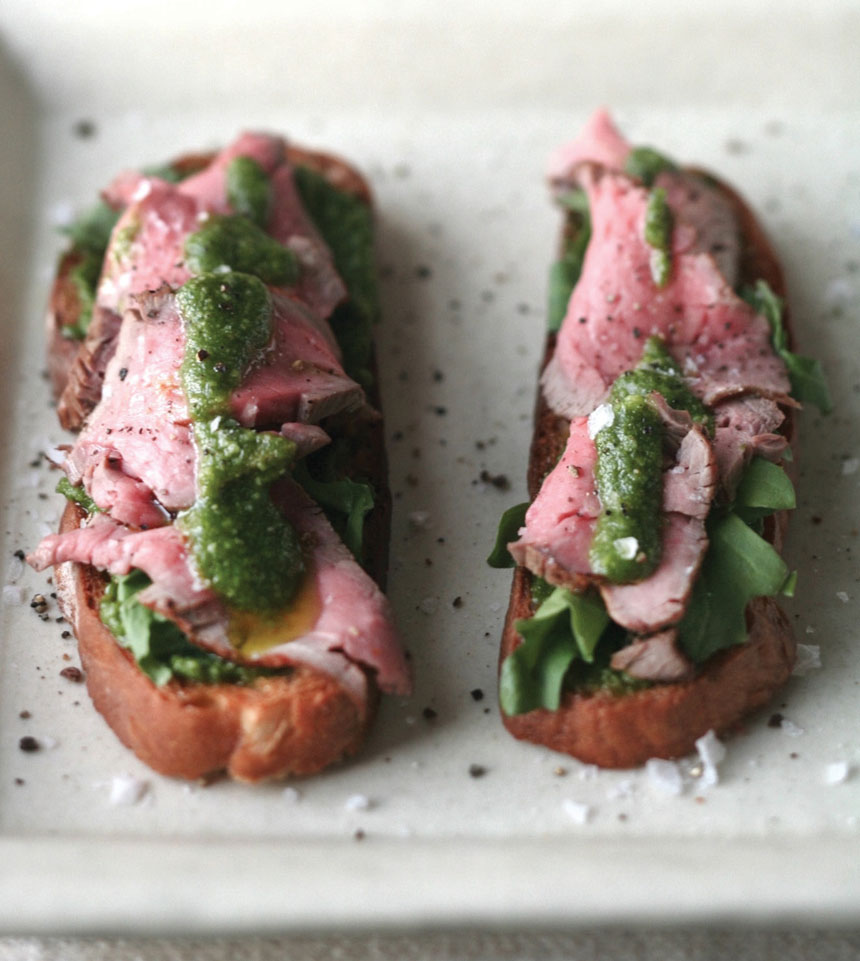
Roast Beef Crostini with Arugula Pesto
(Makes 24 crostini)
Pesto:
1 1/2 (lightly packed) cups fresh arugula
1/3 cup pine nuts, toasted
1 tablespoon freshly grated peeled fresh horseradish
1/3 cup freshly grated Parmesan cheese
1/3 cup extra-virgin olive oil
Crostini:
1 loaf ciabatta bread
1 1/2-pound beef tenderloin, silver skin removed
1 tablespoon olive oil
4 sprigs fresh rosemary
1 tablespoon finely chopped fresh basil
1 tablespoon finely chopped fresh chives
1 tablespoon finely chopped fresh flat leaf parsley
1 tablespoon finely chopped fresh tarragon
1 cup fresh arugula
To prepare pesto:
Blend 1 ½ cups arugula, pine nuts, and horseradish in food processor until nuts are finely chopped. Add Parmesan cheese and slowly blend in extra-virgin olive oil. Season with salt and pepper.
To prepare crostini:
Preheat oven to 400°F. Thinly slice ciabatta crosswise into 24 ¼-inch-thick slices and arrange slices in a single layer on two large baking sheets. Toast in oven for 5 minutes or until slightly golden. Remove from oven and cool. Maintain oven temperature.
Cut filet lengthwise into 3 even pieces. Place large frying pan over high heat. Sprinkle beef filets with salt and pepper and drizzle with olive oil. Place beef and rosemary sprigs in very hot pan and cook until beef is brown on all sides but still rare in center, about 6 minutes total. Place pan in oven for 2 minutes.
Remove beef from oven and let rest in pan for 5 minutes. Discard rosemary. Stir basil, chives, parsley, and tarragon on shallow plate. Roll beef filets in fresh herbs to coat.
Using sharp knife, very thinly slice beef filets crosswise. Arrange remaining arugula leaves atop crostini. Top with beef slices, drizzle pesto over beef, and serve.
Per serving: (1 slice)
Calories: 160
Total Fat: 11 g
Saturated Fat: 3 g
Sodium: 136 mg
Carbohydrate: 8 g
Fiber: 0.5 g
Protein: 8 g;
Diabetic Exchanges: 1 starch, 1 lean meat, 1.5 fat
This article is featured in the November/December 2024 issue of The Saturday Evening Post. Subscribe to the magazine for more art, inspiring stories, fiction, humor, and features from our archives.
Norwegian Wood
Outside his mother’s room, Detective Ron Conroy took a deep breath before knocking. The care home’s white hallways were hung with poorly rendered oil paintings, fading photographs, and sagging Christmas garland, while the floor was scuffed and worn from too many years of shuffling feet. The air smelled of chicken soup, disinfectant, and pee, and maybe just a little of despair. At least that was the overwhelming sensation the Cedar Hill Care Home evoked in him.
It was five years since he’d seen his Mom at his father’s funeral here on Canada’s West Coast, and eight since the massive fight with his father that had left him estranged from his family. He’d planned to visit Mom more since his dad died, but his job with the Regina Police Department always seemed to get in the way.
Or at least that was what he told himself.
Five years he’d been losing himself in his work, hoping to fill the emptiness that plagued his soul. It hadn’t worked. It was only Christmas, and his sister’s phone call about Mom’s frailty, that had brought him here now. But did he want Mom to see him like this?
He slicked his hand back through his brindled sideburns and spiky red hair and knocked. No one answered, so he took a breath and opened the door.
The small room was just large enough for a single hospital bed, a TV stand, a dresser, and a rocking chair by a window. A closet and a bathroom alcove with no door made up the rest of the space. Favorite framed photos and paintings Ron remembered from home covered the room’s walls, and the bed held a coverlet that had long lain at the end of his parents’ bed. The rocking chair was one Mom had used for years, and she sat in it now, her head turned, gaze apparently locked on the late afternoon’s snow-covered woods beyond her window. The play of sunlight and shadow reminded him of the photos of the forests of Norway she’d known as a young child. She’s always promised she’d take him there one day.
“Mom?”
Her shoulders stiffened and then, slowly, slowly, her head turned toward him.
She wasn’t the strawberry-blonde woman he remembered from his youth, or even the woman with time-faded hair she’d been last time he’d seen her. Gone was the woman with the flaming streaks of red at her temples who had filled his childhood with tales of warriors, Valkyries, and gods from her Nordic heritage, while acting out the swordplay and brave acts. The past five years had stripped the last red from her shoulder-length hair so it hung in a thinning, nondescript gray-blonde. The gleam was gone from her eyes, too, and the flesh from her bones. But then her rheumy gaze settled on him and a dim light came on.
“Ron? Ronnie? RON!” She struggled out of her chair and he rushed to help her, catching her in a hug and burying his face in her straw-like hair, trying to swallow the emotions. She was — so small — no longer the Valkyrie he’d always thought her to be.
She held him away, surprisingly stronger than she looked. “It is you! You came. Sylvia said you might, but I didn’t believe her. She’s not always right, though she likes to think she is. Come sit down and let me look at you.” He’d come straight from the airport. Sylvia had said it might be better if he made his peace with Mom alone.
He settled her back in her chair, the sidelight from the window deepening the lines on her face. Then he carefully uncovered the bouquet he’d brought — cedar boughs, holly, and white chrysanthemum — and held it out for her.
“I remembered how you loved to decorate the house and thought you might need a little decoration here.” The room held only a couple of Christmas cards pinned to a corkboard on the wall.
“They’re beautiful.” She settled the arrangement on her lap. “I love the holly. And the flowers.” She tugged a chrysanthemum to her face and inhaled, then sighed. “No scent. Nothing in here smells good. That’s why I’m always opening my window. The staff don’t like it, but I don’t care.” She looked up at him and smiled. “The flowers remind me of your father.”
Her right hand fidgeted with her left, turning a ring that was no longer there.
Ron frowned, because he couldn’t imagine his mother giving up her chrysanthemum-engraved wedding band. “How have you been?”
“Oh …” Her pale blue gaze focused far away. “As well as can be expected. I miss my family, but I’m making friends.”
Ron took off his jacket. “That’s good, isn’t it? What do you do with your friends? Are there Christmas celebrations?”
Her brow creased. “Well …” then her gaze snapped into focus on him. “But you don’t really care about that, do you? A detective and all.”
“If your friends make you happy, I care about them. Tell me about them.”
Mom shook her head, then glanced out her window. A murder of crows or maybe ravens rose from the snow-laden trees. “Why don’t you see if the staff will make us tea. Maybe we can play cards.”
Her gaze seemed locked on the birds; he was forgotten. Dismissed. Sighing, he abandoned his coat on the bed and went out into the hall.
He followed the pale linoleum until it passed a nursing station and spread from the hallway into a large cafeteria. It had two walls of windows that were perversely set too high for seated people to see out of. Bright fluorescent lights beat back the late afternoon sunlight. His mother lived here? In this artless place?
Ron swayed and closed his eyes. His parents’ snug home had had many windows, warm wood walls, and a stone fireplace, the walls filled with photographs and his mother’s paintings. Growing up, the place had always smelled of Mom’s fresh bread, cookies, a roast of beef once a week at his father’s request. It had been a good home — until it wasn’t. The friction between Ron and his dad had been too much. Mom said they were too much alike. Both dour, introverted men not good with their feelings.
Well, she’d been right about that.
“Can I help you?” A tall male nurse stepped out of the nursing station. He was close to Ron’s six-foot-two, with a gentle smile, close-cropped black curls, and mahogany skin.
“I’m visiting my mom, Kate Conroy. She said someone might make us tea.”
The gentle smile spread. “You must be Ron. Your sister’s been talking you up for the past few weeks. Your mother’s been very excited you were coming. You’ll find tea fixings in the little alcove there.” He motioned to the side of the cafeteria.
“How’s she doing?” Ron asked.
That gentle smile again. “As well as can be expected. Her memory’s deteriorating.” He shook his head. “But she’s very sweet.”
“Always has been.” Ron choked a little on his emotions. “A great lady.”
The nurse held out his hand. “I’m Nate Stephens, the shift nurse. If you need anything, just ask.”
“Thanks. There is something. Mom isn’t wearing her wedding ring. Do you know where it is?”
Nate frowned. “She never takes that ring off — not even for baths.”
“Well, she’s not wearing it now.”
“Then let’s make that tea and go talk to her.”
Nate made the tea and put together a plate of iced shortbread cookies shaped like Christmas trees for Ron to carry back to the room.
Nate knocked once and opened the door. A blast of cold air greeted them.
Mom had shifted her rocking chair to one side and was on her knees by the open window. She jerked around when she heard Nate and Ron. A flutter of black feathers came from beyond the glass as a black bird swooped up to the sky.
“Oh, it’s you!” Mom smiled. Then her gaze caught on Ron. “Ron, how wonderful of you to come. This is my friend Nate. He’s a lovely man.”
“And how are you this afternoon, Kate? You must be pleased to see your son. He brought you that lovely flower arrangement.” Nate eased past her and slid the window closed.
For a moment she looked confused, until she caught sight of Ron shifting the flowers to make room for the tray. “I remember.”
Nate helped Mom stand and got her settled in her chair. “Kate, I notice you aren’t wearing your wedding ring.”
Mom looked down at her hands, both barren of jewelry. “I — I don’t remember taking it off.” She looked questions up at Nate, but then turned to Ron. “Did you take it?”
Ron caught her hands. “Mom, this is the first time I’ve visited.” What kind of son was he to not have visited for five years? “I asked Nate about it because I noticed you weren’t wearing it.”
“Oh dear.” Her hand fluttered up to her neck. Then she fumbled with her collar, looking down at herself. “It’s gone! It’s gone.” She looked up at him with tears in her eyes. “How could it be gone?”
“What’s gone, Mom? What is it?”
“The necklace you gave me when you first started your job, dear. The one with the little flower.”
“It was a lily, Mom. The provincial flower of Saskatchewan.” He glanced at Nate. “I work for Regina Police — a detective.”
“Everything’s disappearing.” Mom’s watery gaze turned to outright tears and she covered her face.
Ron bent to catch her in a hug. “It’s okay, Mom. It is. Don’t worry about the necklace. I can get you another one.”
“But I want that one. It was special because you gave it to me.” Her words were muffled against his chest.
Ron looked up at Nate. “Something’s clearly going on here. Both her ring and her necklace? Have you had new residents on the floor? Hired new staff recently?”
Nate shook his head, but his sorrowful expression showed what he thought of Ron’s suspicions.
“Sorry. It’s the police work. But there must be some explanation for Mom’s jewelry going missing.”
“There was a hair barrette, too, dear. And a small mirrored compact. There were other things, too, that I can’t remember.”
Nate crouched down to look Kate in the eye. “Maybe you put them some place for safekeeping?” He turned to Ron. “We’ll need to have a good look around your mom’s room, and check the shower room, too, before we start a full-scale investigation, but things do go missing from time-to-time, what with people’s memories. It’s why we discourage people from coming here with valuables.”
Ron nodded. “Just do what you can. Please.” And he’d hope the items were found because he didn’t want to spend Christmas conducting his own investigation.
Nate excused himself. Ron settled on the bed across from Mom. She looked out the window, her hands restless in her lap. Beyond the glass, the light dimmed, and more flakes fell, adding to the clots of snow already netting the trees. The crows or ravens or whatever they were were ragged black shadows winging through the storm.
“I love watching the birds, don’t you? They have feeders down below next to the building, but I can’t see them from here.”
“Do you know what kind of birds they are? I remember when I was a kid, you and Dad were always pulling out your bird book wherever we went.”
Mom screwed up her face, then tapped her head. “Darn this memory. It used to be good. All I know is there are little red birds, and chickadees and — and — and sister crow comes there, too.”
“Sister crow?”
“She’s a lovely, big black bird that sits in the snow watching the feeder. Then she’ll swoop in and steal all the food from the little birds and fly away yelling. The staff try to chase her away, but she aways comes back.”
“She sounds like a bully to me.” He’d arrest a person who did something similar.
“I think she’s beautiful,” Mom said.
* * *
The next morning Ron parked his rental car in the care home’s snow-ploughed parking lot. Sylvia had made excuses that she had too much Christmas baking to do, and Mom and Ron’s relationship still needed mending. The building hunkered beyond the ridges of piled snow, steam rising from its chimneys, cold sunlight glinting off the icicles fringing the upper eaves of the two-story concrete structure. Not exactly what he’d pictured Mom moving into when she sold her home, but Sylvia had said it was the best option available.
The wall of dark, snow-bound forest surrounding the place looked even more foreboding today. Not quite the Norwegian woods Mom had described when he was a boy.
Cold radiated through the car’s windows and Ron shivered. God save him from a similar fate when he reached his mom’s 89. That meant the system had 35 years to fix itself.
He climbed out of the car and inhaled. At least it wasn’t as frigid as the day before, but the coastal dampness made all his joints ache. Back home it was a dry cold.
Inside, he waved hello to Nate who was pushing an elderly woman’s wheelchair. “Morning. Any luck finding Mom’s things?” He’d tossed and turned last night, chafing at the discussion he’d had with his sister when he’d returned to her place last night. Sylvia had been adamant that Ron should leave the situation up to the care home to resolve. Mom was old. She could have left her things in her pocket when the clothing went to the laundry. Or the items could have been thrown away wrapped in one of Mom’s meal-time napkins or in one of the ubiquitous tissues she stuffed in her pockets. It was a shame, but there was little that could be done.
Ron wasn’t so sure. Stories about thefts by care home staff were everywhere. Nate’s kindness might be a cover for something less savory. Then again, Mom’s simple silver ring and necklace only held a sentimental value.
Nate shook his head. “We tore her room apart last evening and I left messages for the other shift supervisors to keep an eye out. I contacted the laundry, too. Sometimes they find things. I’m glad you’re here. Kate’s having a difficult memory day.”
Ron thanked him and went to Mom’s room, knocked once and pushed the door partially open. “You decent?”
“Of course!”
He swung the door open and found the room strewn with clothing. Mom struggled with her winter coat, her feet still in slippers, an old black toque pulled over her hair. Through the window, new snow had started falling, swirling around the trees.
“About time you people arrived. I told you hours ago I want to go home. I can’t stand this place anymore.” She shrugged her arm into the second sleeve and stood there, wavering in front of him. “What do you have to say for yourself, or shall I call your employer?”
Ron sighed and caught her hand. “Mom, it’s me. It’s Ron, your son. I’m here for a visit, remember?” How could he tell her this was home now? “Now why don’t we get that coat off and we can have a visit and a nice cup of tea?”
“No!” She yanked away. “I want to go out. Sister crow is here, and I want to say goodbye before I leave.”
He remembered that fierce look from when he was a kid. She’d used it more than once when advocating for her family, and she’d always prevailed. “Why don’t you wait here a moment, and I’ll look for your boots. You can’t very well go out in slippers, can you?”
She looked down as if surprised she had feet. “Fine. I’ll wait here.”
Ron retreated down the hall and found Nate. “What do you think? I could take her for a drive … or maybe a short walk. I’ll bet the effort would make her glad to come back inside. And if she can see this crow she likes and the bird feeder, that might settle her, too.”
Nate looked doubtful. “She’s not too steady on her feet. She could fall.”
“I’ll have hold of her all the way.”
“I advise against it, but I can’t stop family from doing things at their own risk.”
Sylvia would have a bird if she knew what Ron was considering. It was one thing to go out in the summer, but this was shaping up to be a major west coast winter storm. But Mom was so adamant.
“I have to do this. Being a shut-in must rankle her. She was always an outdoors person. She and my dad had us out camping and hiking, even in winter. We’d hike up to cabins.”
Nate smiled and shook his head. “She’s not that person anymore.”
For a moment Ron was furious. It wasn’t kindness that created Nate’s smile, it was a way to mask pity and helplessness in the face of the inexorable march of age. Ron’s fists curled in frustration.
“Well maybe she still is.”
Ron returned to Mom. She sat on the edge of her bed struggling to slip her still-slippered feet into a pair of winter boots. “Here, let me help you.”
Buttoned and scarved and with mittens pulled up and toque pulled down, Ron led Mom out the care home’s locked front door. A blast of winter freeze scalded his cheeks, but Mom shook herself like a bird fluffing its feathers and raised her face to the morning wind.
“You can smell them, can’t you,” she said and nodded up at the gray sky. “They’re out there.”
“Smell who, Mom?” With his nostrils half frozen, he couldn’t smell a thing.
Her gaze was bright as she caught his hand in her mittened one. “Them. The birds. Other things. Wonder. There’s lots of things in the world, you know. Didn’t I teach you anything?”
He slung an arm around her shoulder. “Of course you did. You taught me the names of all the animals and more names of birds than I ever wanted to know.” He grinned down at her.
She gave a nod. “As long as you remember. Now come on. We’re out of there, and we have places to go and things to do.”
With a firm grip on his hand, she led him around the side of the care home, to a chain link fence and a metal gate that led into the back garden. Icy flakes swirled in the air. A flat, unmarked expanse of white covered what must be a lawn with scattered picnic tables mounded with snow. In a rear corner of the care home walls, a metal stand hung with two tubular bird feeders that pendulumed wildly in the harsh wind. Here and there, patients’ room windows revealed brightly colored Christmas snowflakes taped to the glass or Christmas twinkle lights flashing through the gloom.
Ron fumbled with the gate latch and pushed the gate open, but Mom refused to enter.
“I thought you wanted to see the bird feeders.”
The wind whipped strands of her faded hair across her face as she peered through the snow. “Why? There’re no birds there now. Sister crow is there.” She pointed along the fence line to the trees.
“But Mom, the snow’s deeper there. We should go back inside.”
“No,” she said, with that damned determined glare of hers. “I want you to meet her.”
“A bird?”
Rolling her eyes, she started along the fence line toward the trees, moving faster than he’d expected. Ron followed, uncertain, beyond strong-arming her, how to guide her back to the care home entrance.
At least the snow was barely up to his ankles, and Mom’s snow boots came well up her shins. But the snow seemed to come thicker with each step toward the trees, and he hurried to catch up to her to make sure she didn’t fall. Where the fence turned right along the back of the garden, Mom stepped between two of the tall cedar trees and the shadows took her.
Damn. He shoved after her, snow dusting from the branches and down his neck. Mom was right in front of him in a small clearing but was already headed for what looked like a path through the woods.
“Mom! Wait!”
Apparently, she was on a mission. She tugged away when he caught her arm. She glanced over her shoulder, snow spangling her cheeks and catching in her hair. “It’s this way, Ron.”
At least she remembered who he was. “Where are we going?”
“You’ll see.” She laughed like she had when he was a boy and ducked under a branch into the trail he’d spotted.
The trees were much bigger here, taller and thicker-trunked than the spruce and jack pine around Regina. Cedar and fir scents tinged the cold air as he followed behind her.
“Mom, we shouldn’t go too far. We’ll have to walk back, and you’re not that strong.”
“Strong enough,” she puffed, her breath visible and soured with coffee on the cold air. “We’re almost there.”
Almost where? Sure, the trail seemed to be widening — between the crowns of the trees, the late morning sky was heavy with clouds and falling snow. The trees seemed to peer down with disapproval. The cold had snuck beneath his collar with the snow. If his hands and toes tingled with cold, what must his mother feel with her lighter boots and mittens? He needed to get her back inside.
“Mom. It’s time to go home.”
She glanced back and smiled. Her flushed cheeks made her almost look young again. She threw back her head and laughed. “I thought you lived in Regina. You need to toughen up!”
The trail ended abruptly at a second small clearing, this one elongated like a ship’s prow. Tall cedar and fir trees fenced it in with a watchful presence like guardians. The wind swirled the snow, and the trees danced. Or at least swayed. Snow and shadowed branches conspired to form faces and horned helmets atop the trees. Cascading snow fell like long hair and heavy beards. Shadows became half-glimpsed armor and swords.
He tore his gaze away from the fantasy, but when he looked from Mom to the trees again, he couldn’t unsee the faces, the glitter of weapons. The groan of the trunks seemed like threatening voices. He was clearly tired — his imagination running away with him.
Mom waited with her head up, arms straight at her side. Snow had caught in her hair and on her lashes. Small white drifts had collected on her toque and shoulders.
Ron touched her arm. “Mom, we really should go.”
She shook her head. “She’s almost here.”
From the prow-end of the clearing came an explosion of wings, and a huge black bird croaked a call and swooped toward them. Ron grabbed his mother and pulled her aside, but the bird-crow-raven settled into the snow just in front of where his mother had stood. Fully three feet tall, and nightmare black, and with a beak at least six inches long, it tilted its head to peer up at them with beady, too-intelligent black eyes.
“Sister crow,” Mom breathed and pulled away from Ron. The bird stayed where it was, unnaturally tame.
Yell and scare it away? The bird could hurt his mother if it took off toward her. She could fall and break something.
The wind howled around them. Snow swirled and the creak of the trees increased. The tree-figures swayed and seemed to bow.
To a crow? The bird ruffled its feathers and seemed to grow. The wind stilled and silence flooded the clearing.
“Mom?” His voice was overloud.
She held out a mittened hand to him. “Come meet her.”
The crow peered up at him as Ron stepped up beside Mom.
“She’s not really a crow, you know. Her name’s Munin. She’s Odin’s raven. She found me after your father died. I’ve been feeding her ever since.”
For a moment his heart broke. Was his mother so desperate for something to love? It was his fault for not visiting. He’d left her and expected his sister to fill the void. He and Mom had always been close and then he stopped coming, all because of a stupid fight that didn’t even involve her.
“God, Mom, I’m sorry. I’ll visit more often,” he said into the quiet.
She patted his hand, but her concentration was on Munin almost as if they communed.
The bird croaked. Then it ruffled and preened its feathers. Quill-edges flashed blue-green-gold in the muted light, and something silver glittered. The bird shook its head and leapt to the sky with a rattle of feathers and a final croak. The wind rose, the snow fell, and the world seemed to shudder as the bird disappeared.
Mom knelt in the snow and pulled off a mitten to dig in the powder. Ron crouched beside her, his knees popping, as she grabbed his hand and unfolded his fingers. Into his palm she placed a silver ring chained with engraved flowers and a chain carrying a single lily bloom. She curled his fingers over them and stood. “These are yours now.”
“I don’t understand.” He shook his head. “How could that bird …” But he knew ravens and crows were collectors of shiny objects. “Why … how did you … Birds collect shiny objects. They don’t return them.”
“Because I asked her to, silly.” Mom’s eyes glittered when she looked up at him. “You’ve been caught in mundane detective work for so long, you’ve forgotten all the magic found in the world. Munin collects memories. My ring, my necklace. I don’t need them anymore, but I asked Odin to give them back to help you remember. Munin brought them for you as a Christmas gift.”
She gave him a hug and started back the way they’d come, her head bowed now and a slump to her shoulders. Ron hurried to catch up but glanced back once. The faces and horned helmets still crowned the swaying trees, but as they bowed, the image faded until they were simply tall cedar and fir.
He put his arm around Mom and she sagged into his warmth as they followed the trail back to the chain-link fence. The wind blew harder, and snow had already filled their tracks. They picked their way up the side of the care home to the front entrance, where he punched in the entry code, and they stumbled inside into the lunchtime scent of grilled cheese sandwiches and tomato soup.
On the second floor Nate caught up with them. “A good walk, Kate?”
She gave him a dazed look and then looked at Ron.
“We did,” Ron answered, the ring and the necklace still burning his palm.
“We kept some lunch warm for your mom. We’ll bring her a tray,” Nate said. “She looks done in.”
With a nod, Ron led Mom back to her room and helped her out of her coat and boots and settled her in her rocker. She was shivering, so he pulled a blanket around her shoulders.
“We shouldn’t have stayed out there, Mom. It’s too cold. Not even to retrieve your ring and necklace.” He set them on the table beside her chair.
“No!” She closed her eyes and frowned in concentration. Then her eyes flashed open and tears glittered on her cheeks. “I told you. They’re yours now. There’s so much in them—years of memories, but I started losing mine when I lost your father. So these are yours. As my memory fades you have to remember for us both. Better you than Odin. That’s why I asked him to have his memory bird bring them back. May they make you happy again like they kept me happy over the years.”
Exhaustion seemed to take her. When the tray came she was too tired to eat so he spooned soup to her almost slack mouth and saw the effort it took for her to swallow. How she had found the strength to walk in the woods he’d never know. When she refused to take any more, the staff helped her into bed and Ron sat with her until she slept.
When he stood to leave, he intended to leave the ring and necklace behind, but then thought better of it. Instead, he found Nate and told him Mom had found them again and that Ron would keep them safe for her. He didn’t say anything about Munin or Odin or the Viking trees. He still didn’t know quite what to believe.
Instead, he went out to his rental car and sat inside as the snow swirled around him and the wind rocked the car. He should get going before the roads were impassable. Everyone knew west coasters didn’t know how to drive in snow. Instead, he pulled out the ring and necklace and placed the small ring on the tip of his little finger.
A surge of warmth ran through him, along with a memory of walking with his mother and father through a leaf-dappled woodland glade, his mother pointing out an owl on its nest in the crook of a tree, his father swinging him high so he could see.
He slid the ring off and squeezed it tight in his palm, the memory still bright in his mind. The gift of memories, his mother — his parents had given him.
The wind shuddered around the car and tore at the trees. They bent and swayed, and he made a promise to visit the Norwegian woods his mother had grown up in. And to bring her back his memories when hers were gone.
In Search of the Turducken
With the holidays approaching, you might already have a 20-pound turkey taking over your icebox. Or maybe your family of four prefers chicken or duck.
But why not all three?
Why stop at one bird, when you could put one meaty matryoshka inside the other inside the other? Why have a normal meal when you could … just not? Self-described as turducken-curious, I’ve wanted answers to these exact questions.
To preface, I consume little meat aside from chicken. And when I do, I prefer my meat deeply abstracted from the animal as a whole: on a skewer, in a tender, or swimming in a sauce. So the turducken is a monstrosity I will never eat and hopefully never meet. And yet, I am enraptured by the turducken. It consumes my thoughts (and now my social media feed) and inspires dreams of the perfect trio Halloween costume.
So I went in search of the turducken: what it is, how it is, and perhaps most importantly, why it is.
If you can’t decipher the portmanteau, a turducken is a chicken stuffed inside a duck stuffed inside a turkey (all boneless and all desecrated). Although most people have heard of the turducken, this dish is, on the whole, an enigma. There are no official statistics on America’s turducken consumption. It’s nearly impossible to find a pre-made turducken outside of Louisiana. And, when I initially googled “history of turducken,” I hit numerous digital blockades, as if something fowl was at play.
The question of who invented this culinary chimera is even more difficult. While most credit Cajun chef Paul Prudhomme for creating the turducken in the late 1970s, another popular theory blames — my word, not history’s — Hebert’s Specialty Meats in Maurice, Louisiana. Hebert’s owners Junior and Sammy Hebert (pronounced “a bear”) claim to have made the dish at a customer’s special request. Even Dr. Gerald R. LaNasa, a New Orleans surgeon, has claimed to have been the first to concoct this conglomeration; I’m inclined to credit him, given the absolute detachment from blood and guts it must take to filet, pound, and insert one bird into another. But all of this, ultimately, is speculation on bird mutilation. There’s no phone number I can call, no heir to the turducken fortune I can question. I can’t look a man in the eye and ask him what ungodly impulse compelled him to see three perfectly fine meats and think, “There must be something more.”
The issue is complicated by the Europeans, who have a long history of stuffing birds inside of other birds. What a great thing to be known for! The French have their Quail à la Talleyrand — a quail inside a chicken inside a turkey — which dates back to the 1890s, as well as the Rôti Sans Pareil (literally “Roast without Equal”): 17 (count ’em! 17!) increasingly smaller birds — and an anchovy — stuffed inside a bustard. And of course, the English have their gooducken, which is exactly what it sounds like — goose, duck, chicken. One of the only sources on the gooducken is Chompasaurus, which describes the dish as capable of making “baby Jesus cry.”
This practice of engastration — the cooking technique of stuffing one animal’s remains into another — transcends cultural, temporal, and geographical boundaries. Since the Middle Ages, people across the globe have produced gems such as TurBacon, Kiviak, and even the Bedouin Wedding Feast: a camel stuffed with a lamb stuffed with 20 chickens. As part of this long lineage of engastration, the turducken may have no individual progenitor.
But if not what or who, then how? No, not how to make the turducken — there are plenty of recipes online with photos that feel more medical than culinary — but how has the turducken captured our attention and imagination? From what we know, the turducken was largely unknown until December 1, 1996, when Louisiana butcher Glenn Mistich hand-delivered the all-in-one feast to sports commentator John Madden at the Superdome. Madden was immediately hooked, supposedly devouring the entire flock with his bare hands while announcing a New Orleans Saints game. While consuming the turducken, Madden also allegedly said, “Daf a greaf prlay fromf Domsbrowfki.”
From that point on, Madden praised the turducken on the air every Thanksgiving, explained proper carving techniques via telestrator, and named the dish the official food of the All-Madden team. Madden NFL even included The Great Turducken Feast challenge in a recent video game update. Consequently, the dish’s popularity soared, with Mistich himself selling 5,000 to 6,000 turduckens a year. The turducken would become so fundamental to Madden’s persona that his obituary in People magazine was titled “The History of John Madden and the Turducken — and How You Can Buy the Triple-Meat Dish Now.” The piece dedicates about 135 words to mourning Madden and 990 to the recent history of turducken. Though Madden and the triple meat are inextricably tied, it’s no less weird to read a sentence like this from the obituary: “‘You can’t beat a good turducken,’ Madden himself said… in what is his final public word on the now immortal dish.”
And it is here that I return to why I’m such a sucker for the turducken, the fowl inside a fowl inside a fowl that a near-vegetarian like me can’t stop thinking about. It’s not for a desire to consume or create a turducken, but to investigate it from the inside out (and out and out). And though I may not have found satisfactory answers to all my questions, I believe I’ve discovered why the turducken exists. Inherent in this vulgar practice is something telling of our society, some irrational compulsion that compels consumers to buy zucchini spiralizers or billionaires to go to space. Once we’ve done all there is to do, we long for something new; we warp our veggies, build rocket ships, and stuff one bird inside another. There must always be something new to conquer, a new world record to break. Perhaps the desire to own that history or to die with it as your legacy is just as human.
Or maybe the Turducken is simply absurd. And maybe we will never know who, what, or how the turducken is… the turducken. But maybe the reason I love the turducken as a concept is because it is so utterly stupid and yet so quintessentially human.
From the Archive: Jimmy Breslin on the Legacy of JFK
—From “Still They Come to the Hillside” by Jimmy Breslin, from the November 21, 1964, issue of The Saturday Evening Post
Clinton Pollard, groundskeeper at Arlington National Cemetery, was one of the last people to serve President Kennedy. He was paid $3.01 an hour for it and he said the whole thing was an honor.
“When I dug the grave, I liked that good dirt that come up and I wanted to grow good turf for the grave on it. Well, we did that. But the summer was so tough it just dried it out.
“You can’t do what you want to do all the time. But it’s still kind of an honor just to try doing something.”
Pollard was silent for a while. He is just a gravedigger who tries, and he is not very important, and around the country there are big people who stand and ask for things in the name of John F. Kennedy. They run for office and write books and wear their sorrow until it becomes frayed, and when you come down to it, the gravedigger worrying about the parched grass on the grave shows more dignity than all of them.
This article is featured in the November/December 2024 issue of The Saturday Evening Post. Subscribe to the magazine for more art, inspiring stories, fiction, humor, and features from our archives.
News of the Week: Thanksgiving Sides, the Gettysburg Address, and the Colorful World of Colonel Bleep
Maryland Is the Only State That Likes Grandma’s Corn Pudding
Allrecipes, which I always spell as either AllRecipes or All Recipes, has a new map that shows the most popular Thanksgiving side dishes on their site, broken down by state.
Green Bean Casserole is really popular in Arizona, Massachusetts, and Wisconsin; people in Connecticut, Delaware, and Indiana really love Sweet Potato Casserole; if you’re in Alabama or Tennessee you eat a lot of Grandma’s Cornbread Dressing; and people in Alaska, California, and Hawaii are crazy for their Candied Yams recipe.
But wait a second. You mean to tell me there isn’t one state in the union where a mashed potatoes, carrots, or stuffing recipe is the most popular? Ridiculous.
I think Allrecipes’ methodology is off. They look at “total site traffic for a side dish in any given state.” But just because someone searches for a recipe and goes to that page and maybe even makes the recipe doesn’t mean it’s popular or well-liked, and it certainly doesn’t mean it’s the most popular in the entire state.
I’d also like to point out that Allrecipes says that these are “The 6 Most Popular Thanksgiving Side Dish Recipes.” Yet they only list five. So, I’m not sure about their other math either.
This 2023 map of the most popular side dishes from Zippia seems more logical to me, though I’d really like to know what the heck is going on with you people in North Dakota.
The Return of Hollywood Squares
To Tell the Truth was ruined when it came back, and the same will probably happen with Hollywood Squares. CBS Mornings host Nate Burleson is going to host a new version of the classic game show. The center square is going to be Drew Barrymore — a terrible choice, but she’s the executive producer of the show so she gets to say who sits there.
The only way I would watch this is if they had an AI-generated Paul Lynde in the center square.
You Can’t Spell “Holidays” Without an “A” and an “I”
Coca-Cola is not getting raves for their new Christmas commercial, a remake of their popular 1995 “Holidays Are Coming” ad. People say it looks too fake, it’s ugly, it’s sad, and some are even calling it “a creepy dystopian nightmare” because of the (over) use of AI. Judge for yourself:
Uploaded to YouTube by Pereira O’Dell
Yeah, they’re kinda right. It’s a jingle hell, a misery on 34th street, and it’s beginning to look a lot like the unholy combo of The Polar Express and a Thomas Kinkade painting.
Funny that one of Coke’s slogans is “the real thing.” It’s a long way from Coke’s classic Santa ads.
Colonel Bleep
Via Mike Lynch’s site, here’s the history of Colonel Bleep, the first cartoon to be shown in color on television.
Uploaded to YouTube by Ok so…
Headline of the Week
“Insurers Say Bear That Damaged Luxury Cars Was Actually a Person in a Costume”
RIP Arthur Frommer, Bela Karolyi, Thomas Kurtz, Vic Flick, Roy Haynes, Colin Petersen, and Dennis Bryon
Arthur Frommer was known for his travel guides, tours, and hotels. He died Monday at the age of 95.
Bela Karolyi was the successful yet controversial coach of such Olympic champion gymnasts as Nadia Comaneci, Mary Lou Retton, and Kerri Strug. He died last week at the age of 82.
Thomas Kurtz co-created the computer language BASIC (which I never understood in high school). He died last week at the age of 96.
Vic Flick played the guitar on the James Bond theme (and many other Bond film scores) as well as many other songs. He died last week at the age of 87.
Roy Haynes was a famed, influential jazz drummer who played with people like Sarah Vaughan, Lester Young, Thelonious Monk, Bud Powell, and Charlie Parker. He died last week at the age of 99.
Colin Petersen and Dennis Bryon were both drummers for the Bee Gees. They died within four days of each other, Petersen at 78 and Bryon at 76.
This Week in History
William Tell Shoots Apple off Son’s Head (November 18, 1307)
I always thought this was just some fun historical trivia but the real story is quite incredible.
Lincoln Delivers Gettysburg Address (November 19, 1863)
Here’s Post archives director Jeff Nilsson on the genius of Lincoln’s 270-word speech.
This Week in Saturday Evening Post History: “Thanksgiving Prayer” by R.E. Miller (November 22, 1941)

Is the girl eyeing the turkey or that bowl of cranberry sauce?
Thanksgiving Sides
Let’s start off with the famous Green Bean Casserole mentioned above. This weekend I saw a cooking show where they made a “fancy” version of this dish, with homemade this and real that, but what’s the point of making it if you’re not going to make Campbell’s Green Bean Casserole with the cream of mushroom soup and the French’s French fried onions?
Smitten Kitchen has recipes for Pretzel Parker House Rolls and Martha’s Macaroni and Cheese. That’s Martha Stewart, by the way.
RecipeGirl has the Perfect Mashed Potatoes, Food.com has a recipe for Maple Brown Sugar Carrots, Curtis Stone has Butternut Squash with Sage and Brown Butter, and the Pioneer Woman has recipes for a Basic Thanksgiving Stuffing and a Sweet Potato Casserole with Marshmallow.
Let me know in the comments what your favorite side dish is and what state you’re in. And have a great Thanksgiving!
Next Week’s Holidays and Events
Black Friday (November 29)
I don’t know if this is as popular as it used to be — do people still wait in line in the middle of the night to fight over the last toaster? — but there will be lots and lots of sales.
You’re Welcome Day (November 29)
This day comes after THANKSgiving, of course. It’s also called You’reWelcomeGiving Day but don’t call it that.
In a Word: Why There’s No Ham in Hamburger
Senior managing editor and logophile Andy Hollandbeck reveals the sometimes surprising roots of common English words and phrases. Remember: Etymology tells us where a word comes from, but not what it means today.
A White Castle that opened in Wichita, Kansas, in 1921 is widely considered to be the very first fast food restaurant in the world, selling their small, uniform hamburgers. The fast food industry has flourished and diversified since then, but it’s fair to say that it all began with hamburgers.
That word hamburger has an interesting history and is a wonderful example of how unexpectedly — and how quickly — a word can evolve and change in the English language.
The first Hamburger, of course, simply meant “from Hamburg, Germany.” Burg is German for “fort, castle.” The first part of the place name is either from Old High German hamma, which was literally “the back of the knee” but, by extension, “bend, angle,” or Middle High German hamme “enclosed pastureland, meadow.” To that end, a castle built on a meadow near a bend in the Elbe River in the 8th or 9th century is one of the oldest known settlements in the Hamburg area.
In the late 1800s, during a period of heavy German immigration, an item called Hamburger steak began appearing on American menus. It’s what you probably think: Beef that has been ground up and served as an entrée. This was considered to be typical of German cuisine at the time; no direct link specifically to Hamburg has been uncovered, however.
At some point, someone — likely tired of having their consumption slowed by knife and fork — realized that they could go utensil-free by nesting their Hamburger steak between slices of bread. This caught on and was call a Hamburger sandwich, or just a hamburger for short.
The modern hamburger — with its standard condiments — began to take shape in the early 20th century. The flood of German immigrants began to slow at this time as well, and little by little, the hamburger’s connection to Hamburg began to fade in the minds of Americans.
Seeing that there was ham in the word hamburger but not pork products in the sandwich, burger became a common shortening of the word. Anti-German sentiment during World War I probably gave a big boost to this shortening as well. (Indeed, in some places in the United States, the name hamburger was mistakenly replaced with Salisbury steak, which had been invented in 1885 and involved pounding a steak flat, rather than grinding it up, because it was believed to aid digestion.) Burger has long since embedded itself in the English lexicon, completely divorced from German geography.
Since Burg is German for “fort, castle,” you might say that the modern burger breaks down to “from a castle” — fitting considering that the first fast food burgers came from a restaurant called White Castle.
Burger has also become a combining form, giving us cheeseburgers and more modern fare like turkeyburgers and veggieburgers. The burger field has become so wide and varied that backformations like steakburger and beefburger have been coined to make it clear what type of meat you can expect to bite into, despite the fact that hamburger historically already indicates ground beef.