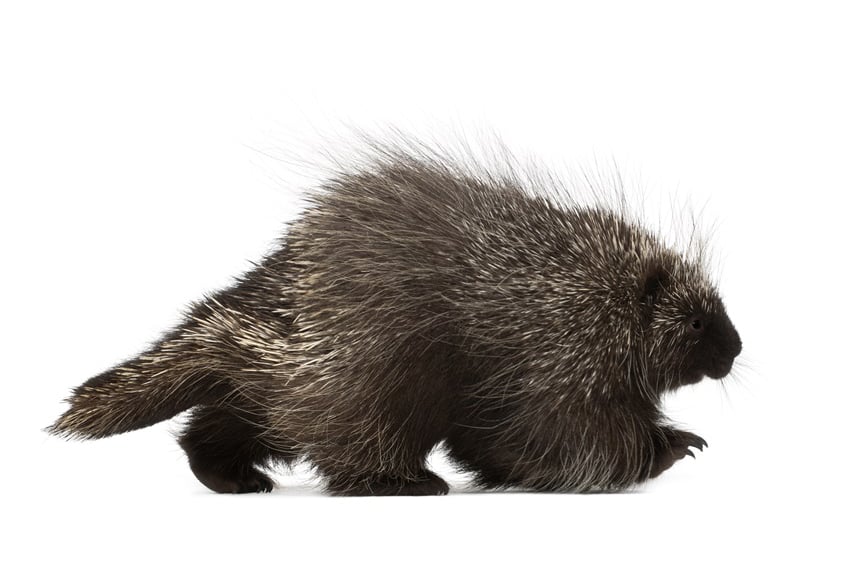
One of our native residents has an adorable face, makes welcome mats out of its own poop, openly carries weapons, and likes to talk to itself. Found in the western half of the country from Canada down to Mexico, as well as throughout the Great Lakes and New England regions, the North American porcupine (Erethizon dorsatum) is the only cold-hardy porcupine in the world, and one of the few that regularly climbs trees. Growing to 20 inches long, not including the tail, and weighing as much as 30 pounds, it’s the second-largest North American rodent behind the beaver.
The name porcupine derives from the Latin for quill-pig, but my Kanien’kehá:ka (Mohawk) friends call them anêntaks, or “bark eaters.” Reportedly, this is a less-than-endearing term they applied ages ago to their Algonquin neighbors, with whom they once shared hunting grounds in what is now northern New York State.
The Kanien’kehá:ka, like all six member-nations in the Haudenosaunee (Iroquois) Confederacy, have a long history as agronomists. The Algonquins, who were mainly hunter-gatherers at the time, wisely knew that the inner bark of pine, maple, elm and other trees is nutritious (and delicious in spring, as I know from experience). This is in fact how the Adirondack (Anêntaks) Mountains got their name.
These rodents of unusual size (not to be confused with the ROUS in The Princess Bride film) are active all winter, which is a great time to track them. More or less bullet-shaped, they make effective plows, and after a new snowfall, you can see trails that have been recently cleared. Though not strictly nocturnal, porkies do tend to be more active at night.
Uploaded to YouTube by Inconceivable Media
Like some of us, porcupines talk to themselves (check out Bill Staines’ folk song “All God’s Critters”). For the most part, they “speak” softly. If you like to camp, you may have heard one of these animals “muttering” as it passed near your tent in the dark. Vocalizations range from grunts and mewls to low whines, and even what sounds like the caw of a bird.
Porcupine fur includes roughly 30,000 (give or take) hollow, barbed quills that account for the animal’s ho-hum attitude toward people, dogs, and cars. Contrary to what I learned watching cartoons, quills can’t be launched at predators, but they do come off at the drop of a hat, provided you drop the hat on a porcupine. Usually cream at the base, transitioning to brown or black at the tips, quills have an innate beauty, but their barbed ends stick readily to skin, and if not removed promptly, can work their way through muscles and organs. Sadly, dogs can require urgent veterinary care if they get too close to these docile creatures and get quilled in the face.

Generally, quills lie flat until a predator comes on the scene, at which time a porky raises them and keep its back to the threat. Lashing its eight- to ten-inch-long tail side to side, it tries to make a protective radius around itself. Fishers, fierce predators and one of the largest members of the weasel family, are quick enough to outflank a porcupine and kill it by attacking the head. Great horned owls, coyotes, and wolves are said to hunt porcupines as well.
Having a cute face only gets you so far in life, and porcupines are despised by many folks because bark-eating harms and even kills trees. Since porkies are attracted to salt, they’ll chew on tool handles and other items used by people.
In addition to eating bark of all kinds, they have a particular weakness for apples. Unfortunately, this resulted in some of my apple trees getting pruned a bit more than I would have liked over the years.

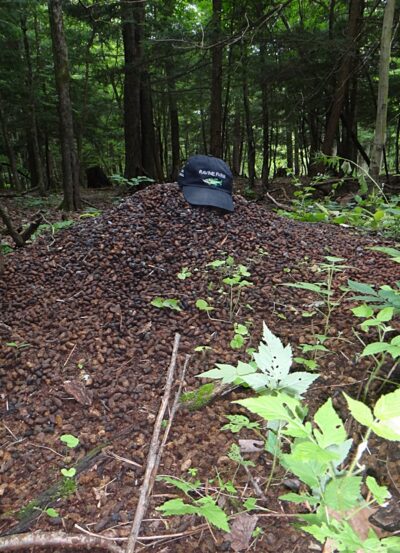
Porkies den in rock crevices, caves, and sometimes in hollow trees, the entrance often carpeted in a deep layer of crap that gets pushed out into an alluvial formation. Some biologists think this is to deter predators, but beyond a faint ammonia odor, it does not smell bad that I’ve noticed.
Breeding is in October and December. In May and June, females may birth up to four young, but typically just one. Not only do porcupines have a low birth rate, it takes more than two years for them to fully mature. In the wild, a porcupine may live 17 or 18 years, with the oldest on record being an ancient 28 years.
A former neighbor of mine who used to teach school at Akwesasne, a Mohawk reserve in northern New York State, once had a student present him with an orphan porcupine. He said it was easily house-trained and made a great pet, and showed me pictures of “Needles,” a full-size porky, in his lap. Apparently, he did try to release it into the wild once it grew up, but after few days it found its way back home, where it bypassed my neighbor’s outstretched arms and made a beeline for the litter box to hurriedly deposit several days’ worth of pent-up feces. It seemed that Needles knew how to eat in the wild, but not how to relieve itself.

Kids and adults love to watch porcupines, as they’re one of the few wild animals that will stand for such ogling. Just hang onto your dog if you have one!
Become a Saturday Evening Post member and enjoy unlimited access. Subscribe now




Comments
I just learned a lot about porcupines here, and won’t mind continuing through life without ever having seen or encountered one.
We don’t have any of these critters down in the rural South. I wonder how well they would coexist with Armadillos and Possums? How are they around poisonous snakes, like Copperheads or Rattlers? Are they preyed upon by Bobcats?