“There is no sex in talents, in genius.”
–From the November 1828 issue of Ladies’ Magazine
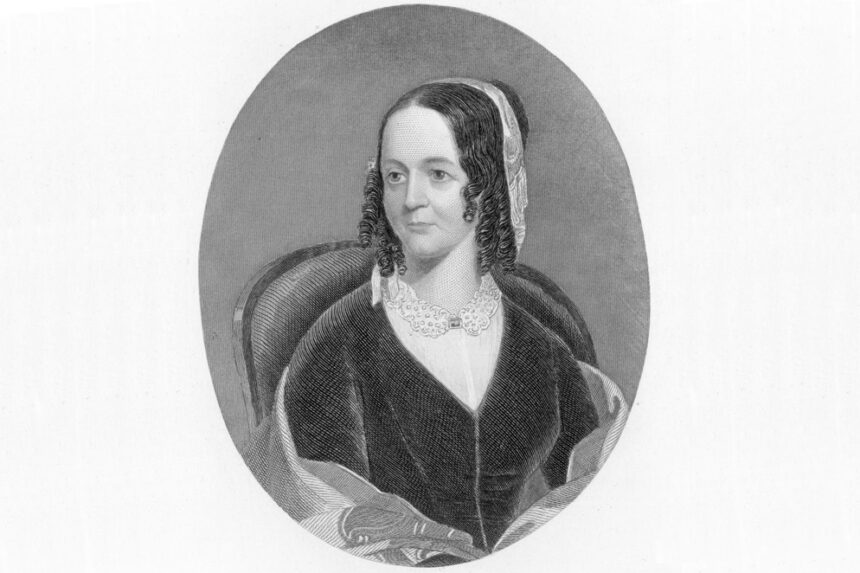
Sarah Josepha Hale of Newport, New Hampshire never forgot October 9, 1822, the day her attorney husband David died. Then pregnant with her fifth child, the grieving widow soon realized her husband had little savings. “I was left poor,” Hale later recalled. “The change added not one particle to my grief but for my children I was deeply distressed,” for there was no money for their education. The future editor never forgot her desperation and consequently spent her life advocating for women’s education and financial independence.
Through donations from local Freemasons, Hale opened a millinery shop with her sister-in-law, Hannah. During her marriage, she had casually written poems and stories, but after being widowed, submitted her work to professional publications. In 1823, after a small volume of The Genius of Oblivion; and Other Original Poems was published, Hale pursed writing as a full-time career, according to Ruth E. Finley’s book, The Lady of Godey’s: Sarah Josepha Hale. Other publications followed, among them her 1827 poem “Hymn to Charity,” which won the Boston Spectator and Ladies’ Album contest with a $20.00 award and gold medal, as reported in Melanie Kirkpatrick’s book, Lady Editor: A Biography Sarah Josepha Hale and the Making of the Modern Woman.

That same year, Hale’s novel Northwood: A Tale of New England was published and created a sensation. Not only was the author a woman, but the book also criticized the institution of slavery and reminded readers that “they forget the master is their brother as well as the servant.” The novel also illustrated thrifty New England values and promoted them as a key to national prosperity.
In 1828, following her successes, Reverend John Lauris Blake, an Episcopal clergyman, offered Hale the editorship of a start-up called Ladies’ Magazine. There was one hitch, according to Kirkpatrick: Hale had to move to Boston, which meant leaving her children behind in the care of relatives. Reluctantly, she accepted the job but brought her youngest son William with her.
Kirkpatrick reports that Hale’s friends were appalled. Mothers were supposed to care for their children. Moreover, the idea of becoming an editor — or “editress” as Hale insisted upon being called — was unheard of. The job, they warned, was an “absurd project” doomed to failure, which would force Hale to return to Newport. Years later, after Hale had risen to prominence, she defended her decision, claiming the job had enabled her to pay for her children’s education.
In the January 1828 debut issue of Ladies’ Magazine, Hale promoted the importance of education for women: “…no experiment will have an influence more important on the character and happiness of our society, than the granting to females the advantages of a systematic and thorough education.” An educated wife provided several advantages to her husband, for she would be a rational companion, agreeable friend, and a competent mother who would teach her children piety and virtue.
Later that year, in the November issue, Hale introduced her readers to her second passionate conviction: women’s independence. “I would have them seek some employment, have some some aim that will…make them less dependent on marriage as the means of support.”
Hale’s third conviction running through the pages of the magazine were articles illustrating a patriotic American identity rather than a European one. To foster appreciation for domestic talent, she featured young American authors like Nathaniel Hawthorne and Edgar Allan Poe, as well as female writers such as Eliza Cook, Elizabeth F. Ellet, and Lydia Sigourney. A column called “Sketches of American Character” featured fiction and nonfiction stories whose characters illustrated American customs, habits, and lifestyle.
Publishing entrepreneur Louis A. Godey, who admired Hale’s efforts to reach women “coping with life on serious terms,” then offered her the editorship of his own magazine in 1837. Godey’s Lady’s Book was less lofty that Hale’s Ladies’ Magazine; it emphasized fashion with only a smattering of poetry, fiction and portraits of European life.

Once again Hale was faced with a dilemma, for Godey expected her to relocate to Philadelphia. At first, she balked; she intended to remain in Boston until her 14-year-old son William entered and graduated from Harvard. Finally, Godey agreed she could edit the magazine from Boston.
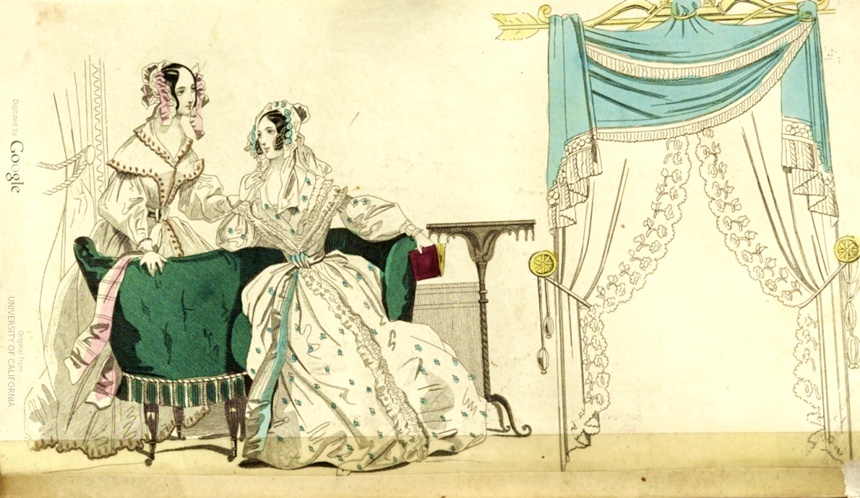
On her part, Hale accepted Godey’s insistence that sketches of the latest European fashions appear in every issue. These were colorful hand-tinted images of women in dresses and gowns, which were later reprinted and sold as collector’s items. Since Hale considered fashion a frivolous waste of time, she curtly suggested that readers modify the styles to “her own figure, face and circumstance,” according to Kirkpatrick.
Through Hale’s editorship and empowerment of women, Godey’s Lady’s Book soared to popularity and soon became America’s leading magazine. By 1860, readership had skyrocketed to 150,000 readers. To encourage opportunities for women, Hale featured stories about the best women’s schools, including opportunities at trade schools, night schools, and normal schools, and later, at colleges and medical colleges.
The magazine also offered ways to lighten women’s work, including introductions to the “domestic sciences” to systematize and professionalize homemaking through time-saving innovations like printed cookbooks, hand-churned washing machines, and dress patterns, according to Finley. There was even a shopping service where readers could order the clothes, bonnets, bridal wardrobes, and jewelry described in its issues. In short, Godey’s Lady’s Book offered a wealth of knowledge, entertainment, and ambitions to women unrivaled by any other publication.
At the helm was Hale, who was revered as America’s most influential spokesperson for women’s intellectual advancement. Ironically, though she objected to the call for the right to vote expressed in the 1848 meeting in Seneca Falls for women’s rights. “Would it be better if the sex was admitted to participate directly in the administration of government, voting and holding offices equally with men? No – I reply unhesitatingly, no! Feminine power is not coercive, but persuasive,” she declared in an 1867 Godey’s Lady’s Magazine editorial.
But after the spark of suffrage was lit, it burst into flame. Subsequent to the 1869 establishment of the National Woman Suffrage Association and the American Woman Suffrage Association, Hale’s ideas about women’s rights were increasingly perceived as old fashioned. Still, she remained the popular editor of Godey’s Lady’s Book until she was 89 years old. Sixteen months after her retirement on April 30, 1879, 90-year-old Hale suddenly died.
In her farewell editorial of December 1877, she wrote, “It has been our endeavor to devote the influence of the Lady’s Book particularly to the work of improving the education of women and extending their opportunities of usefulness.”
Despite her editorial use of the words “our endeavor,” readers knew that no one had done more to raise her gender than Hale.
Author Nancy Rubin Stuart is a contributing writer for the “Missing in History” column.
Become a Saturday Evening Post member and enjoy unlimited access. Subscribe now


Comments
Sarah Josepha Hale was both of her time, and ahead of it at the same time. Her own life experiences shaped her values and what she felt was important. For example, her promotion of the value of education for women in the January 1828 issue of ‘Ladies Magazine’ was something I’m sure she already felt was important, but having lost her husband several years earlier certainly emphasized its importance in her own life being able to support herself and her family.
The November 1828 issue expanded on that encouraging women to seek employment for their sense of independence and not having to rely solely on their husband’s earnings. She also knew the importance of virtues and principals otherwise, and instilling them in children from a young age.
Her acclaim and success as editor of ‘Godey’s Lady Book’ showed her vast array of knowledge and what women wanted to read and learn about at that time. Bringing circulation to 150,000 in 1860 is extremely impressive. It also seemed like a forerunner to general-interest magazines that would come along later. This alone, never mind all of her other accomplishments, puts her in a league of her own.