
In grade school, our class learned about nature’s food chain, a linear thing presumably made by surveyors who plan railroads and other really straight stuff. The example began with seaweed that got munched by salad-eating minnows that in turn got eaten by bigger kinds of fish (our textbooks failed to name these fish). It was a grim line of carnage where large fish dined on smaller species.

The chain came to a screeching halt with a top predator, which all the kids guessed was a shark. When it died of old age, its rotting carcass provided nutrients to aquatic plants back at the start of the food chain. Given all the bloodshed in the story, the ending was kind of a letdown.
In high school we got a different yarn. Someone realized life on Earth was more complex than straight lines, and we learned about the food web, which preceded the world wide web. The model aims to show the many ways various species are connected to one another.

For example, dragonflies eat biting insects, but they also consume bees and other pollinators. Since juvenile dragonflies spend one to two years underwater, chomping bugs and getting eaten by fish, their numbers could spike if the fish population dropped, which could then reduce pollination rates locally.

In 1911, Scottish-American naturalist John Muir, who helped create our National Park system, famously wrote “When we try to pick out anything by itself, we find it hitched to everything else in the universe.” If indeed every part of the natural world is connected, we might need a more elegant way to represent this, like a tapestry.
The corollary to Muir’s observation is that we never know for sure what consequences our actions will have when we pull on a thread in the fabric of nature. DDT seemed like a bright idea until we realized, almost too late, that it nearly wiped out eagles and other raptors.
In the mid-1990s, scientists developed a type of corn able to make a toxin that killed European corn earworms. As this new corn became dominant, the western bean cutworm, a bigger, more destructive pest that is impervious to the toxin, swept across the nation. It turned out that European corn earworms had been eating baby cutworms as soon as they hatched, in order to quash their competitors. In spite of our technical prowess, we’re often groping around in the dark, and not in the fun sense.
Although we’re a long way from mapping the countless threads of nature’s tapestry, even the simple connections we’ve traced are captivating, like the interplay between flowers and pollinators. We know most plants need a pollinator to reproduce, but we seldom think of the fact that pollinators rely on plants for food. This interdependence is called mutualism, which in some cases can be oddly specific.
The yucca plant, native to parts of California, Arizona, Utah, and Nevada, would go extinct if not for the aptly named yucca moth, a small, rather plain white moth. It’s the sole insect that has the right parts — in this case, mouth tentacles — to pollinate yuccas. A female chooses one yucca flower per plant in which to lay one egg, and then, her face coated in pollen, she moves to other yucca plants, thus assuring cross-pollination.

Yuccas reproduce thanks to the moths, and in return, the plants donate baby food for the moths’ wee caterpillars when they hatch. But the food they offer are their seeds, which sounds like it defeats the whole purpose. However, yuccas make 15 to 100 seeds per flower, and moth larvae only need a few to mature. Because the bell-shaped yucca flowers protect moth eggs and caterpillars from drying out or getting eaten, the moths need yuccas for their own survival.
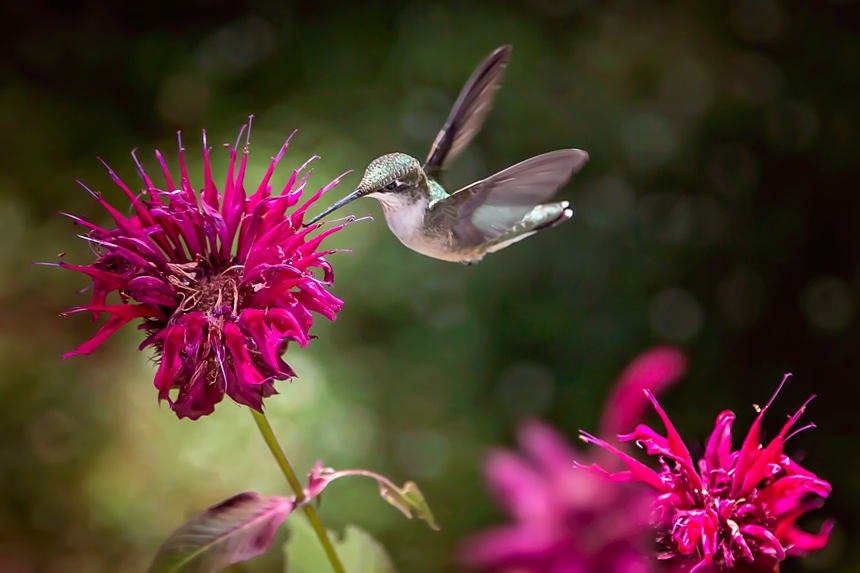
Plants pollinated by birds tend to make bright-colored flowers, often red, and particular shapes as well. Bee balm, widely planted in gardens, is native to most of the U.S. east of the Rockies. The trumpet-like corolla of bee balm flowers are perfectly tailored to a hummingbird’s long bill and tongue. Bee balm entices hummingbirds with sugary nectar to fuel their speedy metabolisms, while the plant gets pollinated so it can make seeds. It’s not an equal partnership, though, as the birds can get nectar elsewhere, but bee balm’s corollas are so long and thin that most other pollinators can’t reach in far enough to do the job.
We know that flowering plants make nectar to pay pollinators for their services. But in some cases, sexual favors are exchanged. For this transaction, we look to North Africa, the Middle East, and parts of Europe where a group of bee orchid species grow. Their flowers don’t have nectar for pollinators. Instead, these orchid blooms look like female bees, to trick guy-bees into paying a visit.

Beyond their visual mimicry, bee orchids exude the same sex pheromone as female bees do, which is how males locate lady-bee decoy flowers. As a male mates with the sex-doll orchid, a bang-up pollination job ensues. Luckily, males seem to bump into enough real female bees to perpetuate their species.
The tapestry of life is pretty cool, whether one sees it from a scientific, philosophic, or comedic point of view.
Become a Saturday Evening Post member and enjoy unlimited access. Subscribe now



Comments
Thanks for the tip, Bob! I’ll look for that episode.
Great feature, Paul, and actually extremely complicated. When their world here is a bad as human interactions with the deceptions and ordeals, it’s bad. That aside, man=made miceo and macroplastics are messing with DNA on a cellular level that’s causing terrible problems. I just watched an interview with Kim Bright on Thursday’s (7/31) episode of Redacted on what we can do on an individual level to protect our health to the extent we can.