Billy Joel: And So It Goes
⭐️ ⭐️ ⭐️ ⭐️
Run Time: 4 hours 52 minutes
Two-Part Documentary Series
Streaming on HBO
The first time I heard Billy Joel’s “Piano Man” on the radio, I insisted to my friends it had to be Harry Chapin. The soaring tenor, the crisp storytelling, the vividly drawn characters; this epic tale of desperate humanity gathered around a piano bar just had to be from the same mind that probed the psyche of a wasted cab driver in “Taxi” and captured a healing encounter between a fireman and a hippie in “What Made America Famous?”
Well, it was Billy Joel, all right; from the start, a musical chameleon who endeared himself to fans — and vexed music critics — with his facility in nearly every genre of music. When he wasn’t being mistaken for Chapin, he was often confused with Elton John. Or sometimes Paul McCartney. Or even Don MacLean.
The expansive two-part HBO documentary about Joel — clocking in at nearly five hours — leaves no Billy Joel jewel unexamined (not until near the end, anyway). It’s hard to imagine that directors Susan Lacy (Jane Fonda in Five Acts) and Jessica Levin (The Janes) left out a single significant song from Joel’s decades-deep catalog as the film proceeds along its conventional, but efficient, “And then I wrote…” path.
Along the way, Joel emerges as a guy from simple roots whose remarkable body of work is entangled in a bramble bush of childhood trauma and grown-up angst. His father, an accomplished musician, abandoned Joel, his sister, and his mother to return to his native Germany. Joel’s mom, in all likelihood, suffered from a bipolar disorder. Dropping out of high school, Joel recorded his first album (with the Long Island group The Hassles) at the ridiculously young age of 18, and unleashed “Piano Man” when he was 24. Joel was just 28 when his album The Stranger became Columbia’s top-selling record of all time.
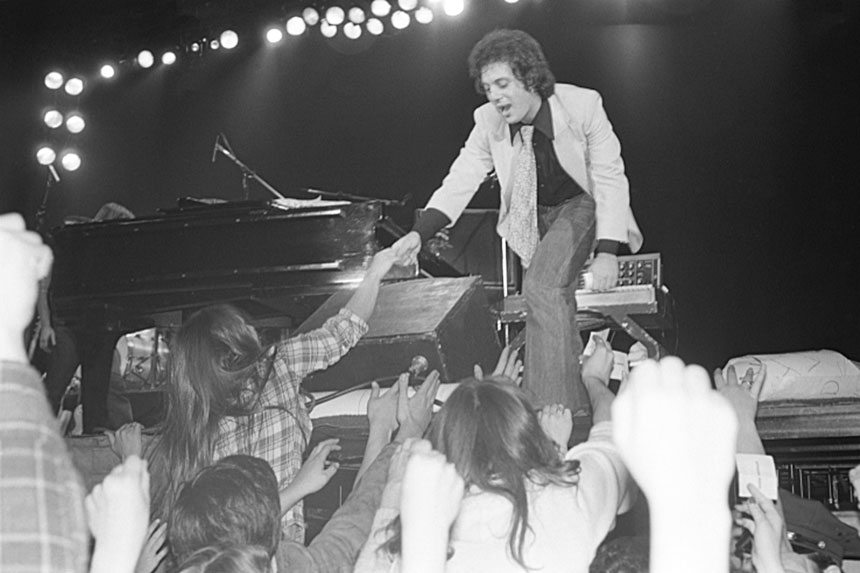
Sitting at a piano as he recalls those heady days, Joel, now in his mid-70s, seems to struggle finding joy in the memory beyond his onstage moments — the only time, his old friends and first spouse Elizabeth say, he seemed totally in his element. Indeed, while the filmmakers clearly give Joel all the time in the world to talk about his life and lessons learned, he nevertheless appears supremely uncomfortable; almost put on the spot.
One suspects he’d rather just turn to that keyboard and answer the questions with the songs that, over the course of 50 years, have served as his own personal narrative and therapy. How complicated was his relationship with his wife Elizabeth? Drop a needle on “She’s Always a Woman.” How did he feel about music critics complaining about his sound? Listen to him spit in their eyes with “My Life.” How deep was his heartbreak over seeing his daughter, Alexa, leave with Joel’s second wife, Christie Brinkley? Share a tear with him singing “Goodnight, My Angel.” How did his relationship with his estranged father pan out? Joel can’t bring himself to really talk about it, but give a listen to “Vienna,” his soulful plea for paternal affirmation.
It goes without saying that anyone who’s going to spend five hours with Billy Joel is a Billy Joel fan — at least a fan of his music — and no one in that contingent will be disappointed with Billy Joel: And So It Goes. The film’s length, however, makes more glaring the latter-day omissions: While it’s clear the younger Joel felt enormous, almost crippling pressure to continually produce new material, we never get a clear answer as to why the man who spent the first half of his life writing more hit songs than practically anybody virtually stopped cold turkey more than 30 years ago. There is no mention at all of his 2024 single “Turn the Lights Back On” — only his second new song since the early 1990s — which he famously performed live at the Grammy Awards. And most poignantly, the film fades out before any mention of Joel’s current battle with normal pressure hydrocephalus (NPH), a neurological condition that can be disabling, and that caused Joel to cancel all his planned concert dates.
For a film so nakedly confessional, the missing pieces leave glaring holes in the narrative. But, who knows? Maybe Joel is right now writing songs that will someday fill in the gaps. It’s what piano men do.
Become a Saturday Evening Post member and enjoy unlimited access. Subscribe now