
By late summer, Dave Benscoter can be found out looking for apples among the back roads, verges, and abandoned homesteads of his home near Spokane, Washington, a sprawling city of 229,000 with westerly views of the Cascade Mountains. Benscoter, a retired FBI agent, drives slowly. A career spent on cases from bank robberies to political corruption has taught him that clues can appear just about anywhere. Because while he’s no longer tracking down criminals, he’s far from giving up on sleuthing. In retirement, Benscoter, the author of the recent book Lost Apples: The Search for Rare and Heritage Apples in the Pacific Northwest, has become a kind of fruit detective — one dedicated to hunting for apple varietals now at risk of being lost forever.
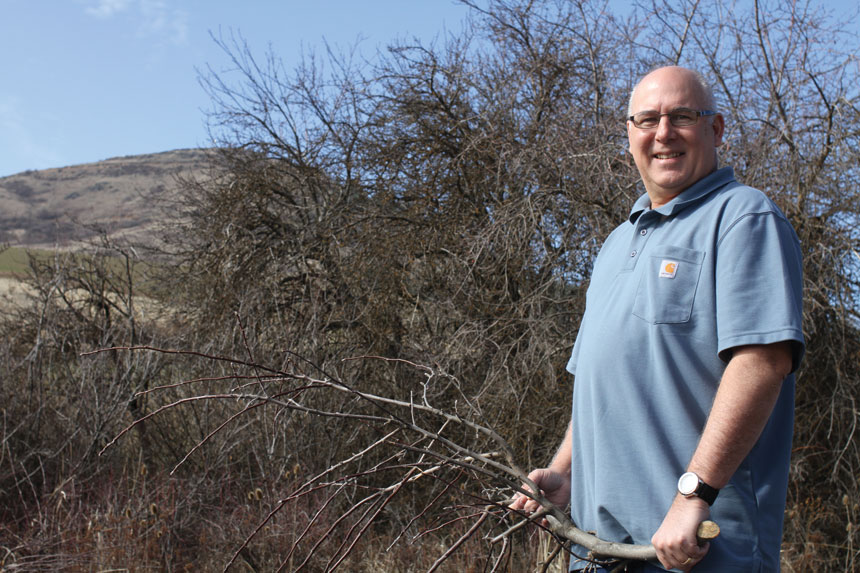
“I’ve always liked apples,” said Benscoter, a Red Delicious guy during his childhood, a time when, he insists, the bagged lunch staple tasted better than it does today. (The “delicious” part has been bred out, he explained.) And as America’s leading apple-producing state for more than a century, his home state is apple country by any measure. Its orchards produce some 10 billion apples each year, enough to wrap around the globe dozens of times. Harvest season fills both local farmstands and countless refrigerated trucks with gleaming piles of fruit whose names are all-stars of global produce aisles: Red Delicious, Gala, Granny Smith, Golden Delicious, Honeycrisp, Braeburn.
For most of his life, Benscoter enjoyed apples in the way that many of us do. He bought them, ate them, and otherwise didn’t give them very much thought. In the summer of 2008, however, a friend invited him over to help pick apples from the knobbly old trees her family had owned since the early 1900s. She thought two of the trees bore a kind of apple called Yellow Transparent, she said, a crisp, lightly flavored fruit that ripens early in the season. The other trees were a mystery.
Curiosity piqued by that conversation, Benscoter did an online search and learned that a century ago, when the friend’s trees took root, their rural area had many more kinds of apples than it does now. Today in Washington State, just eight apple cultivars account for 97 percent of the harvest. Its early pioneers and 20th-century farmers planted and tended trees bearing an astonishing 1,600 varieties. They entered their most prized fruit in county fairs, competing with neighbors to see whose was the shiniest, crispest, the best for cider, fresh or hard. Many of those cultivars — with names like Wagener, Gano, and Walbridge — are largely unknown today.
You can’t buy them at a local nursery or pick up a peck at the grocery store to make applesauce. “That’s when I discovered that there could be lost apples growing in eastern Washington,” he said. Apple trees can live for a hundred years or more. One apple tree in Vancouver, Washington, lived to 194. Counting backward, Benscoter realized that he still had time to locate and identify some of the holdout fruit planted by the earliest farmers. But he had to hurry.

It’s not only Washington state that once had much greater diversity of apples. In the early 20th century there were more than 17,000 apple varieties growing in North America. There were apples for cider and brandy and preserves, and fruits best eaten fresh from the hand. Farmers planted trees that would ripen in a season stretching from midsummer to late autumn, spreading out the harvest to avoid a glut of fruit that must be picked and processed all at once. It was practical, but also personal; people grew the fruit they craved. And Americans really did crave apples. Though the fruits’ wild ancestors came from Central Asia — amid the craggy peaks of modern-day Kazakhstan — by the 1800s the United States had more apple varieties than any country in the world.
Americans never lost their relish for apples, which are still the most popular fruit in the U.S. But the 20th-century rise of increasingly commercial cultivation, and markets eager for pest-resistant, uniform-looking fruit amenable to long-distance shipping and storage, meant that they were eating far fewer varieties as decades unfolded. Many old species were lost entirely. Others remained in backyards and abandoned farms, choking on meadow grasses or overshadowed by competing saplings that grew up around them.
As Benscoter began to gather evidence on Washington apples, he pored over county fair records, seed catalogues, and nursery record books in hopes of finding some names to put to the apples growing on the trees he saw growing near his home. He scoured local history books and drew up a list of lost apples. There was one that particularly intrigued him. The Walbridge apple was a cold-hardy fruit known for its distinctive, crimson-striped flesh. It was a one-time star that had faded into obscurity. “Six different people entered it in the county fair,” he said. “All the nursery flyers and catalogues from eastern Washington listed the Walbridge apple. It was very popular here.”
Thinking like a detective helped him identify his most-wanted fruit. To find the apples themselves, he had to learn to think like a farmer, scanning the landscape for areas with the rich soil and easy access to water that early settlers would have sought out. “There’s a lot of rolling hills in eastern Washington, and usually the homesteaders would have planted at the bottom,” Benscoter said. “When we go looking for an orchard and it’s not on flat ground, we just know where it’s going to be. It’s going to be in the ravines … the perfect place for a fruit tree.”
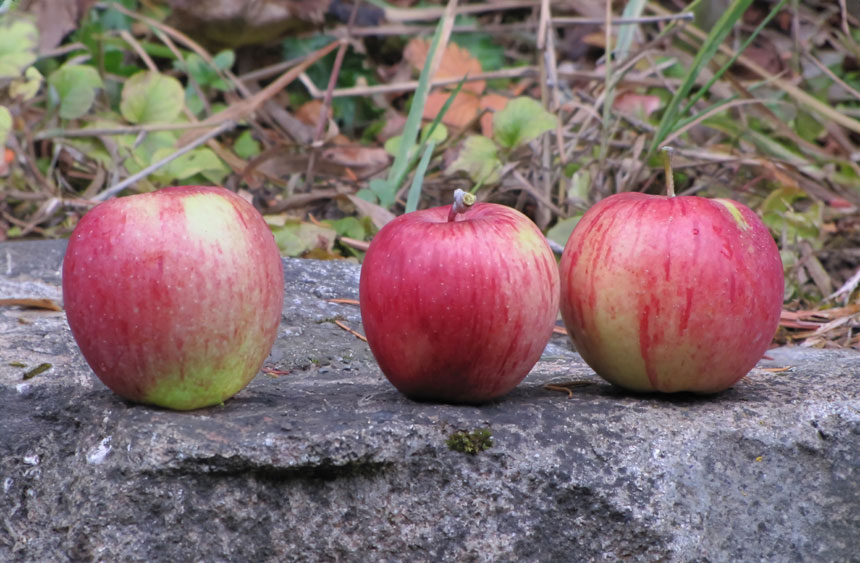
When Benscoter spotted a tree, he’d stop at the nearest home and ask if he could pick a few apples. No one ever refused. He’d pile some in a bag, map the spot, and take a bite. Once he began to look, it seemed like there were apples everywhere. But one spot, a barnacle-shaped promontory called Steptoe Butte, seemed like a particularly promising place to search for long-lost varieties; hundreds of old apple trees wrap the butte, many of them likely planted in the late 19th century. Finally, in the fall of 2014, Benscoter found his first lost apple on the slopes of the butte: Nero was a small, deep-red fruit with smooth skin that had, until that moment, been considered extinct. He took a bite. It was sweet and mildly acidic. Better than a latter-day Red Delicious, at any rate.
To understand the significance of finding apples like the Nero, it helps to know what happens when you spit out an apple seed. If a seed from a Fuji apple manages to sprout and grow where it lands, the resulting tree won’t be a Fuji. Every apple seed planted is a roll of the genetic dice. What grows will be an entirely new apple. Most wild apples are bitter and lumpy, or have tongue-scouring tannins, the kind of fruit you bite into once and never again. Named cultivars are the result of careful selective breeding. If you want to reproduce a great tree, you don’t use a seed at all. You take a cutting from the living tree, and either plant it or graft it onto existing rootstock. When the last apple tree of a given cultivar dies, the apple itself dies with it.

An old apple tree is “sort of a genetic history book,” said John Bunker, who has been searching out old apples since the 1970s, when a local farmer brought a basket of Black Oxford apples into the Belfast, Maine, food coop where he worked. He was enchanted by their deep, burnished hue. The apple had been in Maine since the 18th century, but he’d never seen anything like it. As Benscoter would do decades later, he began to search for more offbeat fruit.
“I began to realize that many of the apples I was finding, I couldn’t find anyone who knew what they were, including old timers,” said Bunker. Age was taking its toll, on both farmers and their orchards. “People were dying rapidly, and trees were dying rapidly… I decided that the contribution I could make was to try to track down, identify, and preserve these historic apples that were growing in Maine.” Today, Bunker grows hundreds of apple varieties at his off-grid farm in Palermo, Maine, from Adam’s Pearmain (lemony, tart, with a cheeky pink blush) to Yellow Bellflower (tender, juicy, great in granola).

In fact, apple lovers like Benscoter and Bunker have quietly been scouring groves from coast to coast — and still others are propagating what they find to preserve old fruit for generations of snackers, pie-bakers, and cider-makers yet to come. In Colorado, the Montezuma Orchard Restoration Project has a nursery of heritage trees in dozens of varieties; in 2017, the project founders, Jude and Addie Schuenemeyer, discovered the Colorado Orange, a sweet-and-tart apple variety long thought to be extinct. North Carolina’s Southern Heritage Apple Orchard has more than 425 cultivars growing, many of them nearly extinct, and they’re doing their best to spread the word. Their annual fruit tree sales serve to encourage other growers to plant rare apples. And in 2021, the University of Georgia established its Heirloom Apple Orchard with 139 varieties that once thrived across the state.
For Benscoter, the Nero was just the beginning. In 2015, he founded the nonprofit Lost Apple Project in partnership with a local historical society, in hopes of expanding his efforts to find old apples in eastern Washington. Two years later he found two more lost apples, Arkansas Beauty and Dickinson. Both were growing at Steptoe Butte. To date, Benscoter thinks he’s found around 30 old apples. His voicemail fills with messages from people in his community wondering if their own backyard trees might be his next discovery.
Benscoter acknowledges it isn’t always easy to say what is — and isn’t — a truly rare find. As with the Nero, pinning down the variety starts with a bite. He can compare the fruit to word-of-mouth descriptions, nursery catalogues, and the more than 7,000-odd apple paintings that comprise the USDA Pomological Watercolor Collection that the government commissioned between 1886 and 1942. In the early days, that was about where it stopped. Today, he gets final confirmation by handing fruit samples off to scientists, who can now use DNA analysis to bolster other clues.

“The modern piece is really helpful when it comes to making sure our identifications are correct,” said Amy Dunbar-Wallis, a biological researcher at the University of Colorado, Boulder’s REACH Lab, where she works with undergraduates on projects in collaboration with the Boulder Apple Tree Project that is mapping the city’s historical apple trees.
Dunbar-Wallis notes that old lists of apples are full of inconsistencies and misnomers; sometimes the same apple will have two or more names. “It’s a way to double-check our history and find out, ‘What were people calling things in the past that maybe were not actually correct?’” she says. “It turns into a little bit of a detective story.”
And the actual apple detective? As this harvest season weighs decades-old branches down with fruit, Benscoter is still dreaming of the fruit he hasn’t found yet. He hasn’t found the Walbridge, for example, that crimson-fleshed fruit that began his quest nearly two decades ago. He’s even begun to suspect that it no longer exists in eastern Washington, where he thinks cold winter weather may have killed off the last survivors.
But he’s got a few leads. He’s gotten some tips. He’s hoping to investigate some trees growing in the more temperate coastal climates of Maine and Oregon. “We still hope we’re going to find one,” he said. “We’ll just have to see.”
To learn more about the Lost Apple Project or to order scions — young shoots or twig cuts — for grafting or rooting at your home, visit lostappleproject.weebly.com.
Jen Rose Smith has written for The Washington Post, CNN Travel, Condé Nast Traveler, AFAR, Rolling Stone, USA Today, and Outside Online and is the author of six travel guidebooks to Vermont and New England. For more, visit jenrosesmith.com.
This article is featured in the September/October 2025 issue of The Saturday Evening Post. Subscribe to the magazine for more art, inspiring stories, fiction, humor, and features from our archives.
Become a Saturday Evening Post member and enjoy unlimited access. Subscribe now
Comments
I enjoy the fact knowing Mr Benscoter is preserving these “lost” varieties for future generations to enjoy. One question I have concerns the Nero variety. From what it sounds this variety may actually be the Arkansas Black, which is not a “lost” variety in itself. Is he double-checking his “discoveries?”