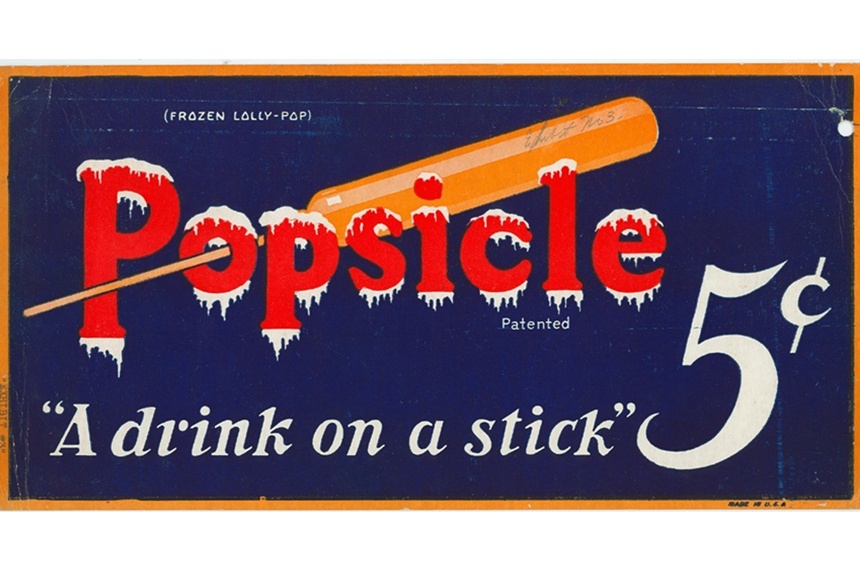
Even as the weather turns cold, many of us still find joy in a frozen treat, from a fancy baked Alaska or affogato to a simple bowl of ice cream, a tall milkshake, or a popsicle.
While the origins of frozen desserts are unclear, they likely trace their roots back to the Ancient Persians, who used ice houses to produce and store faloodeh (frozen rice noodles with rose and lime syrup) and sorbets. First-century Roman cookbooks included recipes for sweet desserts sprinkled with snow. Marco Polo is (probably falsely) credited with introducing frozen desserts to Italy after his travels in China, and Thomas Jefferson popularized ice cream in the United States — his handwritten vanilla ice cream recipe from the 1780s was one of the earliest in the nation.
But one story in frozen dessert history stands out. And it doesn’t center on a U.S. president or a Silk Road explorer, but on an 11-year-old boy from San Francisco.
On a winter day in 1905, 11-year-old Frank Epperson combined soda powder and water to make a sugary drink, but he accidentally left his cup on the porch with the stirring stick inside. Temperatures dropped overnight, and the next morning, Epperson found his cup where he had left it, the drink inside frozen solid. He ran the cup under hot water, pulled the hardened drink out by the stir stick, and tasted a new frozen dessert. He named it the Epsicle — combining Epperson and icicle — but unlike the circumstances of its invention, the product didn’t turn into a national success overnight.
Epperson continued making Epsicles for his friends and, later, his children — who began calling the treat Pop’s Sicle or Popsicle, the name the brand keeps to this day — for many years. In 1923, he decided to expand his market to Neptune Beach — then known as the “West Coast Coney Island” — where it became a beloved treat, selling as many as 8,000 in one day.
Epperson applied for a patent on June 11, 1924, describing the Popsicle as a “frozen confection of attractive appearance, which can be conveniently consumed without contamination by contact with the hand and without the need for a plate, spoon, fork or other implement.”

Epperson’s request was approved two months later, and he immediately sold all of the rights to the invention that had defined much of his life to the Joe Lowe Co., which later started a subsidiary called Popsicle Industries. It wasn’t greed but necessity that spurred the sale, and Epperson later regretted the loss. “I was flat and had to liquidate all my assets,” he said in an NPR interview. “I haven’t been the same since.” The frozen dessert brand, however, continued without him.
A few years later, the Great Depression weighed heavily on the American public. As the stock market crashed and employment declined, struggling families had to strike the ten-cent popsicles from their shopping lists. In response, the Popsicle Corporation devised the first two-stick popsicles so that two children could enjoy a snack for the price of one. According to a 1931 advertisement, “People who could not afford dimes, quarters and halves for ice cream gladly bought Popsicles at a nickel each for children, family and friends.” The two-stick popsicle became a huge success, doubling the company’s sales in a year. The Popsicle Corporation later declared itself “Depression Proof.”
But not everything was as sweet as the dessert itself for the Popsicle brand. The Popsicle Corporation had a rival in the company Good Humor — a brand known for its chocolate-coated ice cream bars and the first ice cream trucks. A series of court cases over patent violations ensued. The initial conflict ended with a compromise: The Popsicle Corporation would sell iced treats containing no milk, and Good Humor would sell products containing milk. However, when dairy prices dropped in 1932, Popsicle ignored the agreement and decided to tap into the ice cream market, coming out with a “Milk Popsicle” — which included 4.48 percent butter fat — and claiming the product wasn’t ice cream but sherbet.
Good Humor filed a lawsuit immediately. Both sides fought to define sherbet. Good Humor strictly defined it as “flavored water ice,” but Popsicle rebutted, claiming that most state regulators did not categorize the Milk Popsicle as ice cream, but with terms such as imitation ice cream, frozen custard, milk sherbet, and ice milk. The judge ruled in Good Humor’s favor, and both companies signed their new court-approved agreement in 1933.
Ironically, over the next six decades, Unilever — one of the largest global consumer goods companies — would buy the rights to both Good Humor and Popsicle, ending the cold war between the two companies.
If you remember buying a cold treat from a neighborhood ice cream truck on a hot summer day, eating a Firecracker during a Fourth of July party, or splitting a two-stick pop with a friend, you’re one of millions with nostalgic memories of Popsicles. It continues to be one of the most popular frozen dessert brands, and for that, we have an 11-year-old Frank Epperson to thank.
Selina Alipour Tabrizi was the Post’s 2025 summer intern. She is the Arts & Entertainment Editor for her school’s newspaper, Sword and Shield, and regularly contributes to the Los Angeles Times High School Insider.
This article is featured in the January/February 2026 issue of The Saturday Evening Post. Subscribe to the magazine for more art, inspiring stories, fiction, humor, and features from our archives.
Become a Saturday Evening Post member and enjoy unlimited access. Subscribe now


Comments
Definitely a fascinating story behind a treat we’ve all taken for granted, and seems like it’s been around forever. Of course it had its origin too, and you tell it very well here, Selina. The attorney part of my brain (my Dad was one) cringes in sadness for Frank when he sold all the rights to the Popsicle in 1924
He absolutely should have had a lawyer with him that specialized in corporate matters. The appropriate paperwork drawn up that would give him a percentage of the profits from that date forward. Even if he felt he couldn’t afford an attorney, there had to have been a way to keep him from being taken advantage of.
Desperate times for him called for desperate measure, unfortunately. This would have made a good episode of ‘Quantum Leap’ (1989-’93) where Sam Beckett (Scott Bakula) materializes as the lawyer he needed, and saves the day for Frank, setting him up for life with a really cool deal.