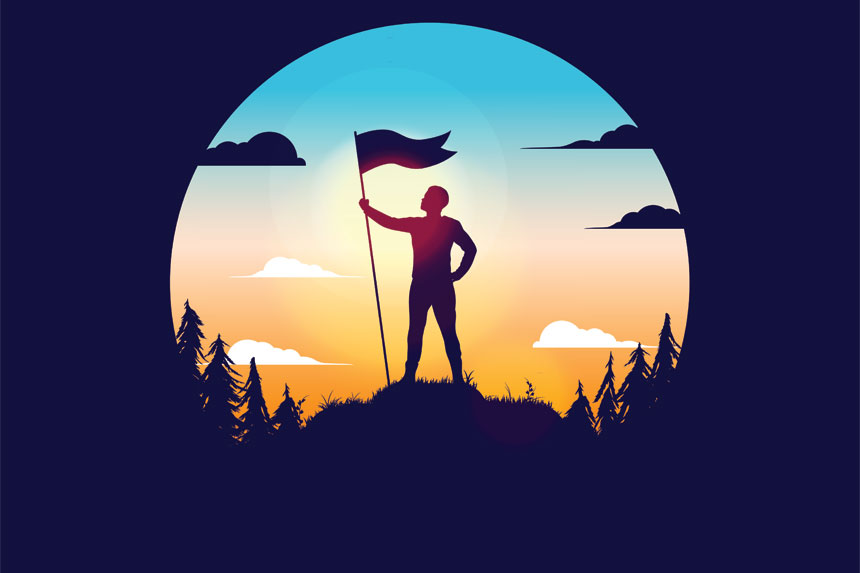
We were young when we became revolutionaries. I was nine, my brother Cameron was thirteen. He led me out to the woods and stopped at the bend of a shallow creek where two trees, maple and hickory, stood entwined. He placed his dirty sneaker on a knot in the roots and hooked his arm through a low branch. With his other hand raised in a righteous fist, he declared this little part of the woods to be our own country. He stumbled over the word independence; I didn’t even know what it meant. But when he said that nothing could hurt us there, I believed him.
We went out to the woods every afternoon that summer and didn’t come back until the sky was turning red and our legs were mottled the same angry shade from mosquito bites. First, we drew boundary lines with a fallen branch and placed down stones from the creek, imagining tall walls stretching overhead that would keep out bad guys and the creepy things that lived deeper in the woods.
Cameron found a wood pallet from an alley that was on his route home from middle school, and we borrowed our neighbor’s wagon to drag it out to our country. The kind lady who lived in the house next door had children, but they were all grown up, so she was alone a lot and started coming around to watch my brother and me after our mom got sick. The wagon we asked for was given to us, along with two glasses of lemonade made from powder, and a few fresh, warm cookies, which we ate on her front porch while she asked us about school and friends and our parents. Cameron did most of the talking; he was better with words than I was.
The wagon was old and rusted, and it squeaked every time the wheels turned. We did more dragging than pulling over the forest floor. I was so excited that I kept running ahead and had to double back to help Cameron. By the time we got the pallet out of the wagon and pushed it under the twin trees, it was nearly time to go home. We came back the next day with pebbles and sea glass and marbles to decorate it, and an old beach umbrella Cameron took from the coat closet to be a roof over our heads. The pallet became our home and our base of operations. We made plans there, gave speeches, held votes.
Over a year earlier, Mom had planned to grow a garden in the backyard. I went with her to the nursery, and we bought packets of seeds for everything from carrots to strawberries to irises. As we walked the aisles, smelling flowers and rubbing velvet-soft leaves between our fingers, she taught me everything she knew about gardening: how to plant, how to water, how to make plants flourish. But she got sick soon after and spent more days in bed than not, and the seed packets gathered dust in the shed.
I didn’t feel bad about taking them one sunny afternoon. I fished a stained tomato sauce can out of the recycling bin for a watering can, and I used a plastic spoon as a spade. Cameron helped me clear the undergrowth from a patch of land where a break in the canopy acted as a spotlight. When the ground was bare, I clumsily dug the spoon into the soft, clay-like dirt, making sure every hole went down two inches with my thumb before I dropped a couple seeds in, just the way Mom explained it. I made sure there were still seeds in each packet in case Mom ever got well enough to start her own garden. Cameron watched me fold the packets up as carefully as my nine-year-old fingers let me and didn’t say a word.
My plants grew fast. Some leaves were chewed up by caterpillars and some unripe strawberries were taken off the vine, but we still had enough to eat. We held a festival for the harvest, just the two of us, sharing the food I had grown. I picked the few irises that had bloomed and put them in a vase beside Mom’s bed. Cameron threw them out two weeks later when the smell of rotting flowers began to fill the room.
* * *
It rained the day we drafted the Decliration of Indapendince. We sat side by side on the pallet and Cameron explained what his history teacher had taught him about the American Revolutionary War.
“It’s how we tell everyone we’re our own country,” he said. “We already have the border” — he pointed to the line of rocks circling us — “and a capitol” — he tapped the pallet — “and resources” — he gestured to the creek and my garden next to it — “so now we need to make it official.”
Rain drummed on the canopy far above us. The few raindrops that slipped through tapped a gentle rhythm on our umbrella. Heavy fog threaded through the trees around us. The stifling afternoon heat had been made cool, and my arms prickled with goosebumps. I pulled Cameron’s arm over my head and pressed myself into his side for warmth.
“What’s a capitol?” I asked.
“It’s where everything important happens. People go there to make decisions and stuff.”
“Oh,” I said. “Like how when Mom and Dad don’t agree on things, they always go talk about it in their room?”
Cameron looked at me with his dark brown eyes, so close to black it was like looking at the night sky. “Yeah,” he said. “Kinda like that.”
Cameron did all the writing and most of the talking. “We, the — the independent nation of …” he mumbled to himself, pacing along the border of our small nation. “What’s our country called?”
“Banana Land!” I said, because I knew it would make him smile, which it did.
“No,” he said, shaking his head but still smiling. “It has to be something cool.” He began pacing again. “Well, we’re the Bradfords, so Bradland? Fordville?”
I gave him a thumbs down.
“New Bradford?”
Thumbs up.
He sat back down on the pallet, and I tucked in close to watch him write. We, President Cameron and Vice President Ollie, declare this land the independent nation of New Bradford. He put down his pen and folded his hands. “Now we need rules.”
Thumbs down. “I don’t like rules,” I said.
“Well, we get to pick them, so we’ll make good rules,” he said. “We’ll still get to do whatever we want.”
Our rules went something like this:
- President Cameron makes decisions. Vice President Ollie can veto them.
- Don’t take fruit or vegetables out of the garden before they’re ripe.
- No parents allowed.
I tried to veto that last one (after Cameron explained to me what vetoing was). He told me that it wasn’t something I could change. That we didn’t need them, just us. I told him that wasn’t fair, and he pulled the big brother card on me, so I pushed him off the pallet. For a moment, I was king of the castle. Cameron sat in the dirt, his knees grass-stained and hands dirtied, and for once, he looked up to me. Then he got up and pushed me right back.
We had fought many times before this, and we would fight many times after. I was at a disadvantage since my head only came up to his shoulder and he was stronger, so I learned quickly that I had to fight strategically. It also helped to bring him down to my level. A fight on the ground was easier for me to win.
I shoved him as hard as I could, and he landed on decaying leaves and clay-soft dirt. I pushed and he kicked and we rolled. Cameron was always as gentle as he could be, always aware of how much harder his hits would land. And besides, we didn’t want to hurt each other, not really; we just both wanted to put the other in their place. Maybe rub a little dirt on shiny pride.
We were at a stalemate, until Cameron got tired of it and shoved me off of him. My hand scraped against a sharp stone, and the raw skin of my palm started to bleed. I glared up at Cameron with watery eyes, causing his anger to melt into guilt.
“Ollie—” he started to say, but I picked myself up and ran down the trail back home. Cameron came home a little later and found me curled up in the corner of my bedroom. He led me to the bathroom and had me sit on the edge of the bathtub. With a wet towel, he wiped the mud and dried blood from my hand, then covered the scrape with a Spider-Man band-aid.
The rule stayed. I knew better than to ask again.
Summer days grew longer, then shorter. We went out to the woods every chance we could get. I noticed that the few times Cameron had friends over that summer, he never took them out to the woods. When I asked him why, he told me that our country was just for us.
“Is it a secret?” I asked.
“No,” he said. “It’s just special. You have to be careful who you share special things with.”
One Saturday afternoon, Dad forgot to take us to the movies. There was a new superhero movie Cam had been begging Dad to take him to see, and where Cam went, I went. But Dad wasn’t home when we woke up Saturday morning. Cam poured us both cereal and we watched Animal Planet while we waited. “He’s probably at the grocery store,” Cam said. “He’ll be back soon.”
We watched one episode. Then two, then three. Then Cam got up and stomped up the stairs. I heard him knock gently on a door and call out, “Mom?” A door creaked open and closed.
I turned off the TV and brought our cereal bowls to the kitchen like Dad taught me to. I crept upstairs and reached the landing just as Cameron was leaving Mom’s room.
“Dad’s at work,” he said, all storm clouds and thunder.
We were quiet for a minute.
“Can we go to the forest?” I asked.
Cam nodded, shaking his messy bedhead. “Go get dressed,” he told me.
Then we went out to the forest and became the President and Vice President of New Bradford. Cam stood tall on the wood pallet and gave a speech to me and the insects and the birds about a coming war. We climbed the tangled maple and hickory trees and surveyed the land for approaching enemies. “There!” Cam shouted, pointing to two wide pine trees. We fashioned swords out of fallen twigs and Cam led the army of two to the trees.
“For New Bradford!” Cam yelled. We hit and struck and stabbed until our swords broke and then we collapsed, breathless, onto the soft bed of pine needles.
“We did it,” he said, gasping. “We won the fight.”
I reached over and smacked him in the stomach with my broken sword.
Our country was special.
* * *
The school year began the way all dreaded things do: not with a bang or a huge commotion, but quietly. Quietly enough that when your brother wakes you up on the first day of school, it feels like a dream or like he’s just playing a trick on you.
But he wasn’t. Cam woke up earlier than we had in nearly two months and banged on my door to get me up shortly after. Dad poured us bowls of cereal and made sure our backpacks were packed and watched us walk to the bus stop from the doorway, holding a mug of coffee against his chest like a lifeline.
I didn’t have a lot of friends, and certainly none to sit on the bus with. Cam did. They whisked my brother away. As I watched him joke around and chat with his friends, he wasn’t President Cameron, just Cam Bradford, the now-high schooler who was too big to hang out with a weird little fourth grader.
I sat back, closed my eyes, and got lost in the fictional world where New Bradford was flourishing and my brother never had a reason to leave my side.
Cam shut himself in his bedroom when we got home that afternoon. I knocked on his door gently — we always had to be quiet when Mom was resting — and asked him to go out to the forest with me. “Not now,” he said through the closed door. So I went and rode my bicycle around the block until it got dark.
We repeated the same conversation the next day and the next and the next and by the end of the first week of school, I finally understood that our country was meant to be a summer thing, when Cam didn’t have school or clubs or friends to keep him occupied.
I thought about it every day. The fights we would win, the speeches I would give, the harvest festival we would throw. And I would have gone alone, but I wasn’t allowed out there by myself, so our country became nothing more than a daydream to keep me occupied. And it did keep me occupied. I found an old notebook in my desk and filled it with battle plans, sketches of a small but bustling country, incomplete speeches, presidential decrees. Then I just started writing. I wrote stories of a country led by two brothers who were fair, just, and strong leaders. In my stories, the border wall stretched high above the trees, with lookouts every few yards, and the thin creek was a roaring river whose steady flow powered the country (I learned about the concepts of electricity and dams in science class that year). My small garden became fields that stretched as far as the eye could see. Our pallet was a mansion, where my brother and I hosted foreign leaders such as the bunny that kept scurrying around and the cicadas that clung to the undersides of branches on the tangled trees.
The early stories were really bad. They hardly made sense and didn’t do justice to the world that lived in my head. I got better, though. Cam stayed busy, and I needed something to fill the hours. I started spending lonely school lunches in the library, reading books about American history, pulled from the “easy readers” shelf. My backpack weighed more than it ever had before, and my back ached by the end of every school day.
I read the books I got from the library front to back, nightly. Sometimes, I’d even read them to Mom. Cam was gone a lot of Saturdays, and Dad was called into work often. I don’t remember the first day I crept into her room, a book in hand, and asked her if she’d like to hear a story. She must have said yes, because it became tradition for me to creep into her room on quiet Saturdays and settle into the cushy antique armchair in the corner below the window with a book that I’d read to her. She would listen to anything I brought her: Fun Facts About the White House, A Short History of the American Revolution, Democratic Government for Early Learners. Sometimes, I would pause to study her. She sat propped up on a wedge pillow, her hands folded in her lap and eyes closed like a beautiful statue. The faintest of smiles twisted her lips. I tried not to see the bags under her eyes and the frailness in her bony fingers.
When I finished a book called Ancient Governments, one we’d had to stretch out over two weekends because it was a chapter book and reading aloud was still a long, halting process for me, I knew the next story I wanted to read to Mom: one of my own.
I had just finished writing a story. In it, the town of toads was fighting with the village of bees over resources, and President Cameron and his trusty VP Ollie had been called in to settle it. VP Ollie had been rallying their troops to fight alongside the toads, but the ever-wise President Cameron was able to keep an all-out war from starting, just in the nick of time. They all celebrated with a feast of honey and sweet strawberries instead.
“Mom?” I said, snapping the peaceful quiet like a too-tight guitar string. I looked up from my lap and the book I’d been fiddling with. Mom’s eyes were already on me. They were hazel, which I’d inherited from her, and just as dreamy. I think Mom lived in the world inside her head as much as I lived in the world in mine.
“I have another story,” I said. “I didn’t get it from the library this time.”
Mom smiled at me. “I’m all ears.” She settled back against the wedge pillow, becoming stone again.
I pulled out my notebook from where I’d tucked it between me and the arm of the chair, maybe for safe-keeping or maybe to hide it. I opened it and read to the statue in front of me about a country in the woods run by two brothers, living beside the rabbits and toads and bees and pine trees, who were our friends and enemies and allies and political rivals.
Mom had become reanimated by the time I finished the story. I was too embarrassed to meet her eyes, but I could tell she was looking at me.
“You’re going to be an author someday,” she said. “I’m sure of it.”
I didn’t know what to say. I’d never thought of that before. My name in the library, on the shelf of historical fiction I’d recently gained the confidence to start pulling books from.
“Thanks for reading that to me, Ollie,” she said. I could tell she was getting sleepy, so I picked up my notebook and library book, crossed the room to give her a hug, and then left her to rest.
I never read my stories to Dad or Cam. But every now and then, I’d read one to Mom. She even began to make an appearance in them. Queen Robin of a far-off land that was high in the mountains, so she was never able to visit New Bradford. Instead, she would send her robins with messages and gifts.
She laughed when I told her that part. “An army of robins,” she said. “I love it.”
I wrote about the robins more often, just to make her smile.
The weather finally turned nice again in the middle of April. It had been a gentle autumn, cool in the mornings and warm in the afternoons, with a breeze that was balmy instead of stinging. The winter was harder. The snow was a few feet deep and ice hung on the edges of our windows like lace trim. I woke up before Cam most mornings just to watch the snow fall. I would sit there quietly and wait for him to knock. It was nice to be reminded that I still took up space in his life.
Now, the snow was beginning to melt. I could hear it dripping off the roof and pouring down the gutter. I traced a map into the fog on my window, through which I could see our backyard and the woods beyond it. I realized then that I could see the dirt path that led to our country. That was my wake-up call. The country felt real again, no longer solely in my head. It was still there. I had almost forgotten.
Bolstered by the stories that now lived in my head and in my notebook, I wasn’t just Ollie Bradford, the now-ten-year-old. I felt like Vice President Ollie, the brave general of New Bradford. The bravery in my head was enough to spur me to pull my rain boots out of the downstairs closet and trek out to the backyard. I didn’t tell Cam where I was going, nor Mom, who was taking an afternoon nap. I simply left.
I was giddy as I walked down the path. The ground was frozen in most places, muddy in the others, and I slipped and slid and stumbled. Still, I marched like the general I was, back straight and head high.
I found our country destroyed.
The snowmelt had made the creek’s water level rise, flooding the rotten, limp remnants of my garden. The rock border was scattered. A huge branch, as long as I was tall, had fallen from the maple tree and broken a few of the wood pallet’s boards. The only thing that was untouched was the umbrella, which Cam had remembered to close and tuck under the pallet at the end of the summer.
I ran home and refused to go back. That Saturday, I told Mom about it when she noticed I was feeling down.
“Have you ever heard of a ghost town?” she asked. I hadn’t.
That day, my library book stayed shut on my lap, and Mom told me stories of Old West boom towns left to rot when the gold ran out. After I left her to take a nap, I wrote a story of an old country with crumbling border walls, left abandoned after floods and bad harvests, haunted by the ghost of its ex-VP. Its president had long since jumped ship, and only the vice president stayed to watch their beloved country go down.
That was the last story I wrote for a long while. I read Mom books from the school library until late May when school was out for the summer, but I didn’t have any more of my own stories for her.
* * *
The school year ended as quietly as it had begun. The last day moved as slow as molasses, each hour identical. I returned a huge stack of books to the library during my lunch period. The lightness of my backpack was foreign.
Cam wasn’t on the bus home, and the house was silent when I let myself in. It was like most afternoons, with Dad working and Mom resting and Cam at a friend’s house, but today felt different. Monumental. I wanted to celebrate the end of another school year with someone. Instead, I just headed upstairs and shoved my backpack in the far reaches of my closet where I wouldn’t have to see or think about it for the next two and a half months. And then I sat on my bed. There was nothing for me to do. No country to lead or army to command; no story to write. No friends to spend time with, and no family either.
There was a tap on my window. Then another one. Tink, tink, tink. I crept over and found a robin on my windowsill. It looked at me curiously. For a moment, I wondered if it had flown straight out of my stories to deliver a message to me. Good afternoon, Vice President Ollie of New Bradford. I am here on behalf of Queen Robin to deliver a message. But it was just a robin. It didn’t say anything.
A pebble bounced off my window, scaring the bird into flight. Down below, Cam had his face tilted up to look in my window, a cap shielding his eyes from the afternoon sun. He waved for me to come join him in the backyard.
Cam was practically bouncing when I let myself out of the house. “Come on,” he said. “Let’s go to the woods.”
The old hurt I’d gotten used to came back stronger. Now he had time for our country? For me? Why hadn’t he made time for me back in November, when the windows rattled so loudly from the wind? Or in January, when the outside air was so cold it stung but being inside was so stifling?
Before I could say anything, Cam took my hand and began to pull me down the path to New Bradford. I should have told him of the state I found our country in that spring, but I think I wanted to hope, for just a few minutes, that it might still be there. I wanted to feel like Vice President Ollie for just a little longer.
The strawberries had started to grow again. Little green shoots poked through the dirt. We found everything else destroyed, exactly the ghost town I left it.
Cam didn’t say anything for a bit. He walked along what had been the border wall, toeing rocks back into their original spots. “Should we rebuild?” he asked.
“It’s not the same,” I told him. To me, the country had been dead since last August. I had let it live on in my head for a while, and then I put that memory to rest, too.
I walked past Cam to the twisted maple and hickory trees. I placed my sneaker on a knot in the roots and hooked my arm through a low branch. And I began to climb. I worked my way through the tangled branches, going as high as I could. I didn’t have to look to know Cam was right below me the whole time. We stopped when we reached the thinner branches that bent dangerously when we put our weight on them.
“I wrote stories about our country,” I told him, looking out at the pine trees we waged war against last summer, “when you didn’t have time for me anymore.”
Cam grabbed my ankle, and I looked down at him and his night sky eyes. “Tell me them?” he asked. It wasn’t an apology.
I told him the stories. It wasn’t forgiveness.
We stayed up in the tree all afternoon. My legs began to cramp and my palms were raw from holding onto rough tree bark. When I ran out of stories, Cam told me one of his own.
“Once upon a time,” he said, “there was a president and a vice president of a little country out in the woods. Rabbits and cicadas and toads and robins lived out there, too, and they were friends with the president and his VP. But the president wasn’t very good at his job, and the harvests were bad and the border walls began to crumble. So, one day, he gathered everyone, the rabbits and cicadas and toads and robins. Even the pine trees listened in. And he told them to start calling his VP Ollie ‘President.’ And then the ex-president stepped down, and everyone welcomed the new president. He was a much better leader than the one who came before him, and the rabbits and cicadas and toads and robins and pine trees and bees all loved him.” It was an apology.
I pressed my dirty sneaker into his shoulder to get him to look up, and I saluted him. It was the beginning of forgiveness.
Cam climbed down the tree first and I followed close behind. He picked up the umbrella, but we left everything else out there, both a monument and a grave. We walked home side by side, the president and ex-president of a long-gone country. There would be no new game this summer.
The next morning, a stormy, gray Saturday, I settled in the antique armchair in Mom’s room. I read her a story, one of a small country in the woods with a president the forest creatures all loved, who rebuilt what had been left to rot. The border walls were made of the strongest stone, tall enough to keep every enemy out. The harvests were plentiful. The mansion in the capitol held lively parties with foreign leaders of every kind. The ghost town he loved lived again.
Become a Saturday Evening Post member and enjoy unlimited access. Subscribe now

Comments
A lovely story, grounded in tactile detail and honest feeling. Kudos, and thank you.
I found this to be an engaging, charming story. You really got into the minds of these two boys, especially Ollie. His sensitivity and caring for his sick mom here is wonderful, including reading to her and his love of learning; particularly early American history. We can see it was definitely inspired by his outdoor playtime.
The story also shows the importance OF playing outside, interacting with nature, getting your hands dirty, and using one’s imagination instead of being in front of a screen all the time, which is a real problem. Thank you, Ms. Weil.
My income reached $17,620 last month, thanks to a flexible online job. It’s astonishing how easy it is to get started and see real results. I spend my mornings working and still have the whole day to relax. The extra money has made a big difference in my financial situation. It’s a fantastic way to boost your income without overworking yourself..
Visit This…… The site is mentioned on my profile name for everyone who is interested.”