Let’s say a trusted friend says they located a ring, right in your back yard, that according to ancient lore was created by a race of magical beings. It might conjure up the sinister, elf-made Rings of Power in The Lord of the Rings trilogy. Or maybe the price of gold would come to mind, and you’d rub your hands with glee. Alas, real-life fairy rings aren’t gold or silver. On the other hand, at least they’re not evil.
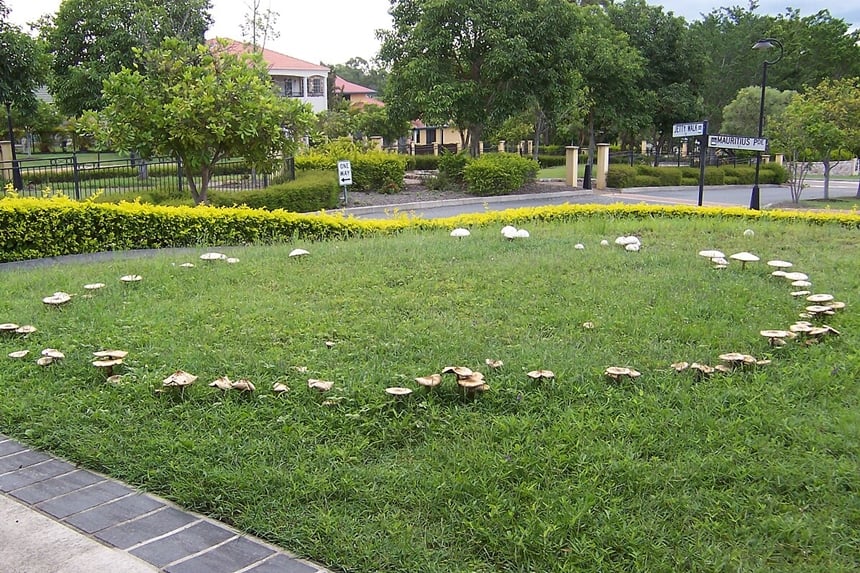
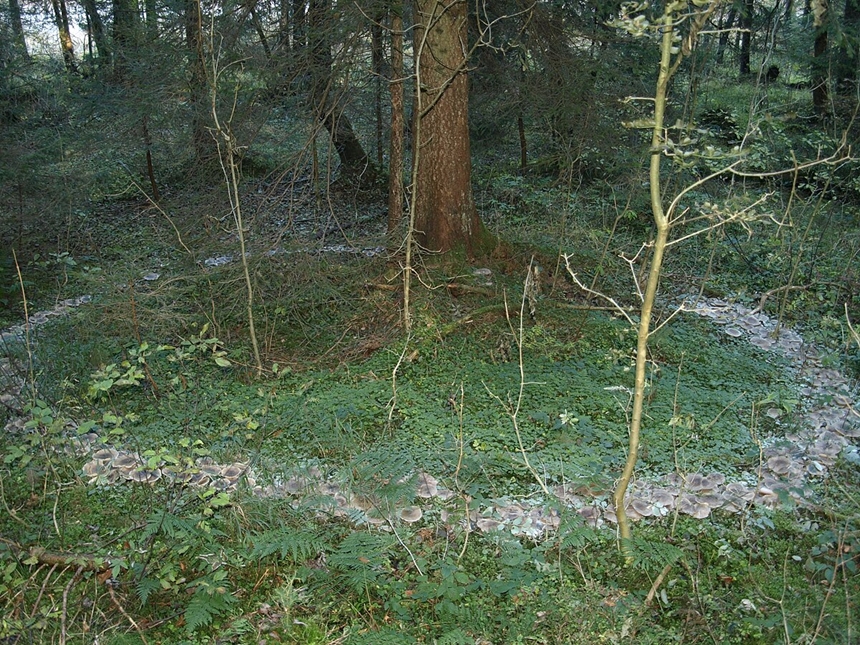
While there are different kinds of fairy rings, all are the work of fungi, rather than fairies or elves. These circles, or occasionally semicircles or arcs, range from about three feet in diameter to as much as thirty feet or more, and can suddenly appear in the landscape as if by magic. Depending on the species of fungi present, they are either rings of grass with a notably different color from the surrounding lawn, or they are circles of mushrooms.
At the core of all fairy rings is an underground cache of organic matter. It could be the remnants of an old stump that was ground-out years ago, or woody debris that got buried under topsoil during home construction other sources. When a lucky fungus stumbles upon such a trove of organic matter, they exploit it as a food source, and it becomes ground zero for a fairy ring.
As the fungus feasts on its organic smorgasbord and grows in size, it sends out thread-like filaments called hyphae in all directions to search for more food. The hyphae spread radially outward in a roughly circular pattern, changing the soil chemistry as they go. This in turn affects the color of grass in the ring.
Some species of fungi turn the soil waterproof, or hydrophobic. Because they prevent the soil from absorbing rain or irrigation water, these fungi cause a ring of brown, water-starved grass to form. This can be reversed with wetting agents. But other fungal types do just the opposite. They make more nitrogen available to plants, which results in a disk of greener, lusher grass.

And mushroom rings, which are not a deep-fried snack like onion rings, are made by a third group of fungi. About 60 fungal species are known to produce a fairy ring where, as long as there’s enough moisture in the soil, mushrooms spring up around its circumference. Some of these fungi also change the quality of grass in the ring. Mushrooms (or toadstools) are a type of fungal fruiting body where fungal spores or “seeds” are formed. You’re more likely to see mushrooms in late summer or early fall after a period of rain.
While some folks are charmed by the appearance of a fairy ring in their yard, most people like a uniformly green lawn, free of fairy-ring acne scars. The good news is that fairy rings will not spread throughout your lawn and kill it. Any bare spots can be re-seeded and will come back. Also, most rings fade away on their own as the fungi deplete their food source at the ring’s center. There are exceptions to this, like the fairy ring in Belfort, France, estimated at 700 years old, but that won’t happen on your lawn. Probably.
For those who’d like to erase any type of fairy ring, lawn-treatment options include dethatching and core-aeration. For cases where the grass is greener in the circle, applying a nitrogen fertilizer to the whole yard can help the rest of the lawn to blend in with the ring. For mushroom-flavored fairy rings, one can rake or hand-pick mushrooms as they appear. Always wear gloves when doing this, as a few species are toxic, and even the spores can cause illness if ingested. Keep in mind that mushrooms are only present for part of the season.
Fungicides are not considered very effective, but if you do try this route, only apply them right after the lawn has been core-aerated. If they’re going to work at all, fungicide treatments usually have to be repeated for two to three years.
Of course, the downside to disturbing a fairy ring is that you risk being cursed or taken to another dimension, among a host of dreadful possibilities. I guess it depends on what, if any, folklore you subscribe to.
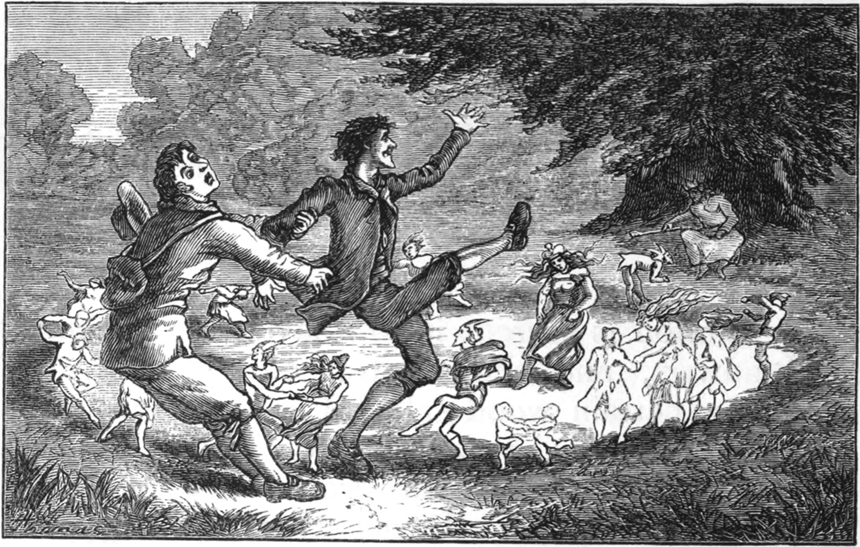
On the Irish side of my family, my mother’s people believed fairy rings were sacred spaces where the fairies danced, portals to another world. If you stepped in one, you might be taken to another dimension for a brief time, only to return and find a hundred years have passed. But leaving offerings of milk or food just outside a ring brought good luck. My German ancestors had a darker view, believing fairy rings were where witches danced.
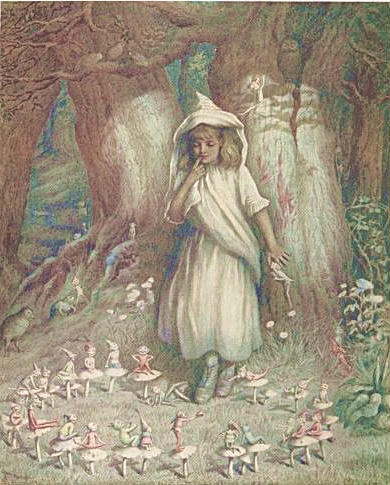
In French tradition, fairy rings were guarded by bug-eyed toads that cursed trespassers. In Austria, fairy rings were where the Devil set down his milk churn – who knew he was so fond of dairy? At least some Dutch held that if you were cursed for crossing a fairy ring, it could be reversed by running around the ring nine times under a full moon.
And in A Midsummer Night’s Dream, William Shakespeare offers this advice:
If you see a fairy ring
In a field of grass,
Very lightly step around,
Tiptoe as you pass;
Last night fairies frolicked there,
And they’re sleeping somewhere near.
Become a Saturday Evening Post member and enjoy unlimited access. Subscribe now




Comments
There are four main types of common toenail fungal infections, with several dozen, perhaps hundreds, of species that can apparently cause atypical nail infections.
Worldwide, there are an estimated 2.2 to 3.8 million species of fungi in the wild, but I do not know if any of them also cause nail infections.
Is it the same type of fungus that grows under toe nails or are they 2 different funguses?
Really Paul, I just learned about something here I didn’t know, but I needed to know, but didn’t realize it. I’ll look at lawn mushrooms differently from this point forward. I checked out all the links, which were helpful. You do skillfully blend science and magic here.
I found the Irish, Dutch, French and German beliefs on the rings to all be equally interesting. The Shakespeare poem is great too, although I wanted it to rhyme at the end. How about changing the last line to “And they’re sleeping somewhere near the fair.”