Read Bill Newcott’s story on many of the other U.S. towns named Bethlehem.
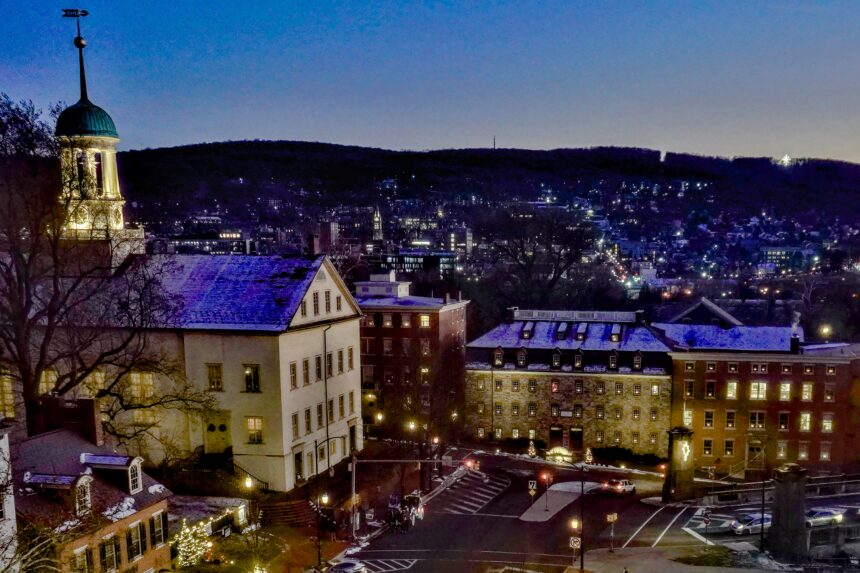
The calendar insists Christmas isn’t quite here, but don’t tell that to the folks on Main Street in Bethlehem, Pennsylvania, where a soft snowfall is sifting a feathery curtain past two neat lines of Christmasy shop windows. Recessed doorways with red-ribboned wreaths shelter rosy-cheeked customers as they tug down their hats and tighten their scarves before venturing into the frigid flurry.
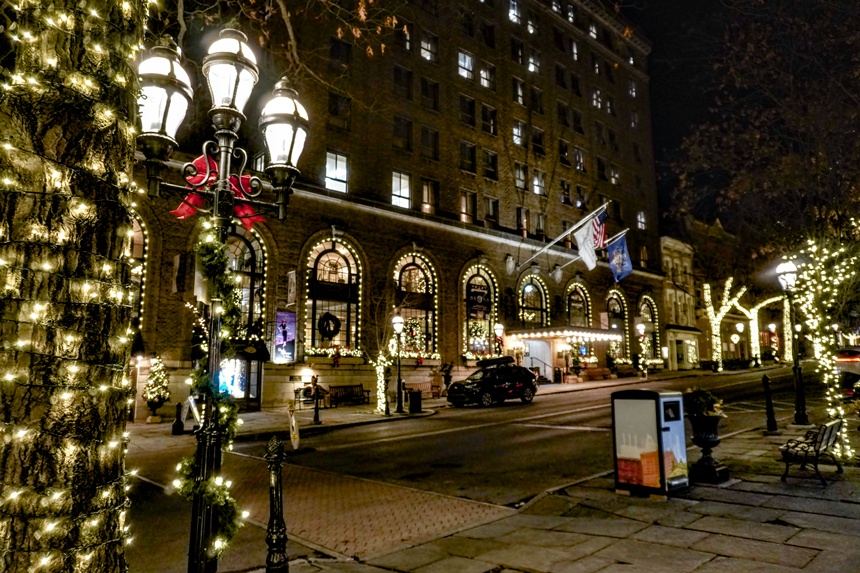
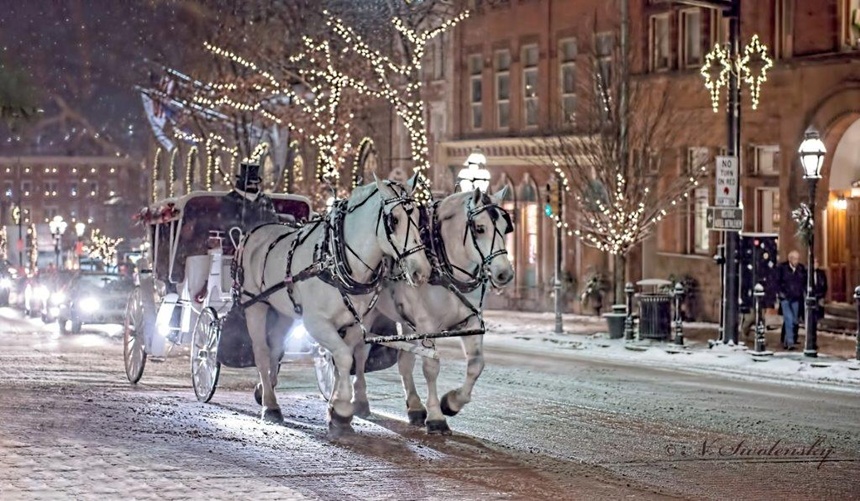
Above, on the shadowy second and third stories, every window seems to frame a single glowing candle. Each tree lining Main is dressed in strands of warm, creamy white lights. Holiday music floats from one end of the three-block downtown to the other; a lyrical background to the song of laughing children and the clip-clop of a horse-drawn carriage.
And beyond the far end of the street, perched on a mountaintop nearly two miles away, flickers to life a brilliant five-pointed, 100-foot-high Christmas star, surrounded by eight radiant beams of light.
I stop in my snowy tracks. Is that an angel choir I hear?
If ever there were an explosion in an art museum featuring the works of Currier & Ives, Norman Rockwell, and Thomas Kinkade, the resulting fallout would probably resemble a casual stroll along the main drag in Bethlehem, a city founded on Christmas Eve, named for the birthplace of Christmas, and, since 1937, the self-proclaimed Christmas City, U.S.A.
No brag, as they say in the mountains of eastern Pennsylvania. Just fact.
I head up the steps of the Historic Hotel Bethlehem, anchoring the south end of Main Street, and stomp the snow off my feet before venturing into the two-story lobby, dominated by a pair of 20-foot-high Christmas trees and, set on a ledge above the doorway, a near-life-size Nativity scene.

Business is brisk in The Tap Room, the lobby restaurant/bar. Even were the tables not crammed with holiday-loving visitors, there’d still be quite a crowd: Dozens of photos lining the walls recall the rich and famous who’ve laid their heads here over the past 103 years, among them Amelia Earhart, Thomas Edison, The Grateful Dead, Muhammad Ali, Ozzie and Harriet, Bob Dylan, and Yo-Yo Ma.
On two columns, appropriately positioned to the left and right, are portraits of the presidents who’ve walked through those doors: JFK and Bill Clinton on one; Dwight D. Eisenhower and Gerald Ford on the other.
But Bethlehem’s story, if not quite as old as that of the original city, goes back much farther than the visits of presidents and performers.
Bethlehem’s Moravian History
During colonial times, Christmas decorations were a whole lot less emphatic than they are today. A single candle in each window of a home symbolized the coming Light of the World. Arrangements of holly, wreaths, and candles wrapped in red ribbons were about as festive as things got.
That’s the subdued level of décor that surrounds me in the Tavern at the Sun Inn, which has been welcoming visitors since 1758. Slurping a bowl of agreeably hot onion soup, I listen to the echo of footsteps on the bare wood floor, a sound that has reverberated within these walls since the likes of George and Martha Washington, Ben Franklin, Alexander Hamilton, and the Marquis de Lafayette checked in (The inn’s Wi-Fi code is GWslepthere). In 1777, when the British occupied Philadelphia, the guest book was signed by 10 members of the Continental Congress, including John Hancock and John and Samuel Adams (curiously, the tavern doesn’t have Sam Adams beer on tap). The place also welcomed 51 chiefs of the Iroquois Nation.
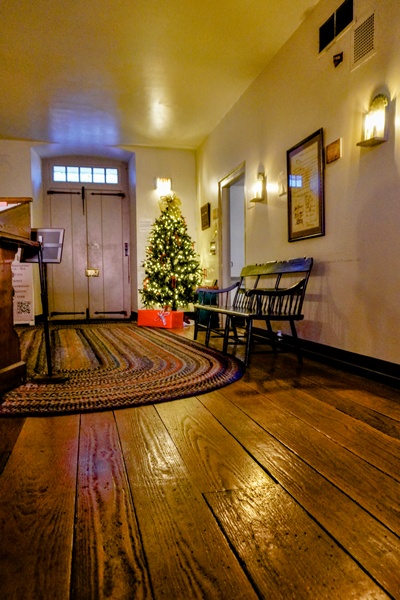
John Adams wrote that the Sun was “the best inn I ever saw.” It was certainly the best in Bethlehem, because it was the only inn in Bethlehem, built exclusively for the lodging of “strangers” by the Moravians, a religious sect that founded the town on, appropriately, December 24, 1741.
Any visitors to the town, you see, had to be at all times accompanied by a local Moravian host. For while the Moravians were more than happy to trade with the outside world, they were loath to import possibly dark influences into their insular community.
The Moravians started out in today’s Czech Republic, where, nearly a century before Martin Luther, a group of Christian believers launched their own Reformation by splitting with the Catholic Church. Rome reacted badly, of course, and that led to centuries of Moravians — who at the time called themselves Unity of the Brethren — fleeing persecution.
One group, out of Germany, eventually settled on the banks of the Lehigh River, where the families briefly shared a single large log cabin (on the site of today’s Historic Hotel Bethlehem). But the Moravians had big plans: In the creek valley that spread below the cabin, they set to work creating Bethlehem’s historic Colonial Industrial Quarter, what is now recognized as North America’s first industrial park.

Walking downhill toward the creek, I pass the Moravians’ still-sturdy 18th century tannery, plus standing remains of a dye house, a butchery, a grist mill, a seed pressing mill, and a pottery.

A clucking cluster of geese, picking at strands of grass poking through the thin layer of snow, gather near a small stone building with a Christmas wreath hung on its wooden door. Virtually unchanged in more than 250 years, this modest structure is the Bethlehem Waterworks, a water wheel-powered pump house that pushed water some 100 feet upward from a spring to a community storage tank. Now a National Historic Civil Engineering Landmark — on the same list as Hoover Dam and New York’s Grand Central Station — the Moravian pump house is recognized as America’s first municipal pumped water system.
Atop the hill, the Moravians built their community — with an emphasis on the commune. Foreswearing all private property, they lived by a set of alarmingly strict rules: Single men all lived under one roof in an enormous building that slept 200. Single women lived in separate housing. Widows had their own digs, as did widowers. Married couples lived in yet another building — but segregated by gender.
As for the process of making more Moravians, there was a private parlor called The Blue Room. Couples had to sign up for a time slot. (Newlyweds were reportedly told the mechanics of procreation moments before their first appointment.) The process seemed to work: Moravians did have a lot of children, who lived with their mothers until about 18 months, then moved to yet another house where they were raised communally.
This remarkably stratified social arrangement fell away by the 1800s, but most of those old living quarters remain, now in use by either Bethlehem’s Central Moravian Church or Moravian University — founded in 1742 as the Moravian Female Seminary, the first colonial college to educate women.
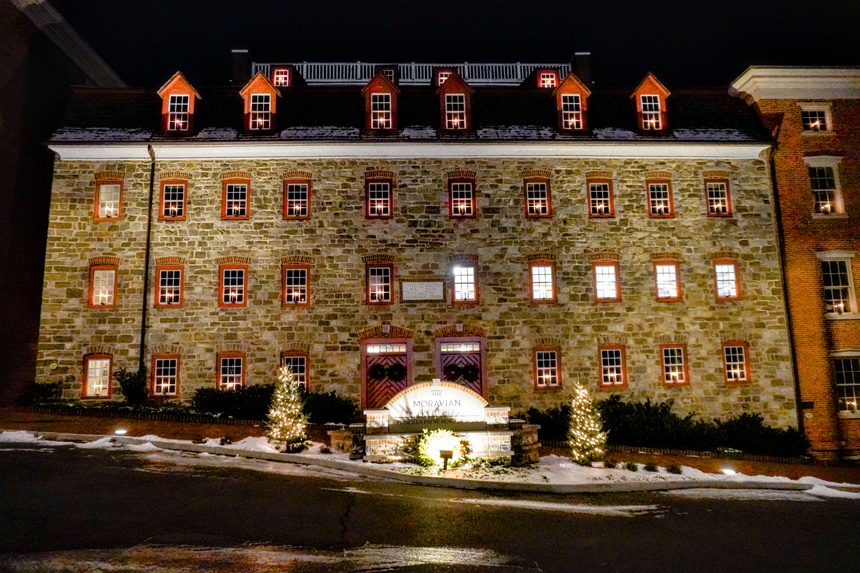
At the lower end of Main Street sits the huge “Single Brethren’s House,” at one time among the largest non-church buildings in America. For the Christmas season, each of its 38 street-facing windows is illuminated with a single candle. Standing on the sidewalk, it is easy to imagine young 18th century men at each of those windows, holding one of those candles, gazing longingly in the direction of the single sisters’ quarters.
Central Moravian Church
Every Christmas season, tour buses roll into Bethlehem by the dozens, most of them pulling into the tree-shaded campus of Central Moravian Church. Since 1937, the members of Central have presented their annual Moravian Christmas Putz – an elaborate Nativity display, using cast figurines and small theatrical sets placed among natural plants and moss, accompanied by recorded music, a narrated soundtrack, and creative lighting.

The Bethlehem Moravian Putz, easily the hottest ticket in town, has become something of a legend in these parts, so I expect to find it housed in some specially purposed space, with theater seats facing a finely crafted proscenium stage.
Instead, I am somewhat surprised when Rev. Janel Rice, pastor of Central Moravian, leads me down a set of basement stairs to the education building and ushers me into what has to be, the rest of the year, a large Sunday school classroom. Fifty or so metal folding chairs face a wide closed curtain.
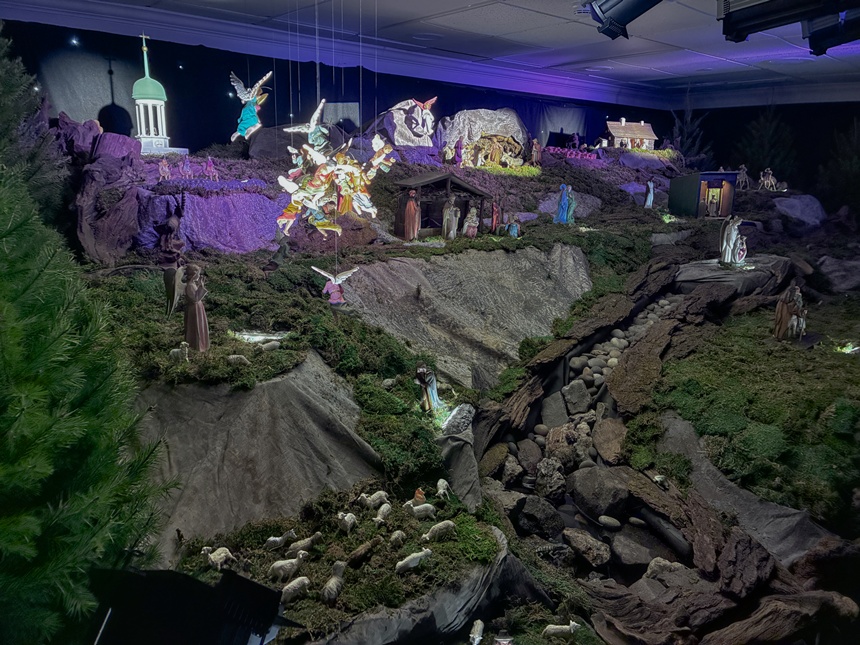
“You’re gonna hear my voice on the narration,” Rice says sheepishly as the curtains open, revealing a mossy landscape (church members head out to a nearby state park to collect it each year) punctuated by figures of angels, both flying and earthbound, shepherds and their sheep, and camel-borne wise men. To the rear, in the dark, I can make out the outline of a manger scene.
An organ plays on the soundtrack; then a child’s voice sings “Morning Star,” a Moravian hymn based on a 1657 poem. For the next 20 minutes, through light and song, Rice relates not just the story of the first Christmas, but also of the Moravians.
The angels sing. The shepherds gasp. The drab classroom walls fall away, and I am transported — if not to the Holy Land of the year Zero, then to some realm of faith and devotion that transcends metal chairs and a surprisingly low ceiling.
The lights come up, and the Putz scene remains on display for a closeup look. I notice a tiny stream flowing diagonally across the mini landscape.
“One of my jobs is to make sure that water keeps flowing,” says Rice with a laugh. Of course, Rice’s main job is preaching in the church’s two sanctuaries. One, the 1751 “Old Chapel,” hosted George Washington, Ben Franklin, and other luminaries who wandered down from the Sun Inn for worship. White-walled and without ornamentation, the chapel reflects the simple faith that drove the early Moravians.

Across a wide sidewalk stands a house of worship with considerably more ambition: the cavernous 1803 Central Moravian Church, which at a capacity of 1,100 would give most 21st century megachurches a run for their money. The place was constructed without pillars, lest one single congregant be deprived a clear view of the pulpit and choir.
“It was a pretty big project considering there were only about 500 people here at the time,” Rice says.
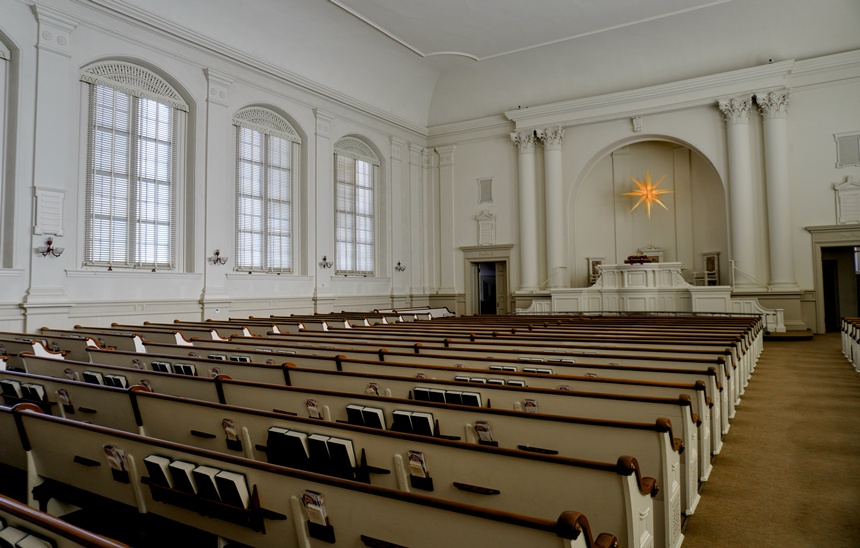
Most Sundays see about 200 people attend services, but this month the place will be packed to capacity for Christmas Vespers, a series of concerts featuring singers and musicians from the church and Moravian University. Filling the arched space with the Christmas hymn “Angels from the Realms of Glory,” every one of the 1,100-plus people present will hold a lit candle — made by the church’s own artisans — welcoming the Season in a way worshippers have done here since before Abraham Lincoln was born.
Around Bethlehem and the Lehigh Valley
“Let’s go for a ride,” says Bruce Haines, pulling a brown Lehigh University baseball cap over his full head of gray hair. The controlling partner of the Historic Hotel Bethlehem, he’s the guy who had the boards pulled off the bankrupt building’s windows in 1999 and restored it to become, according to USA Today, America’s Number One Historic Hotel.
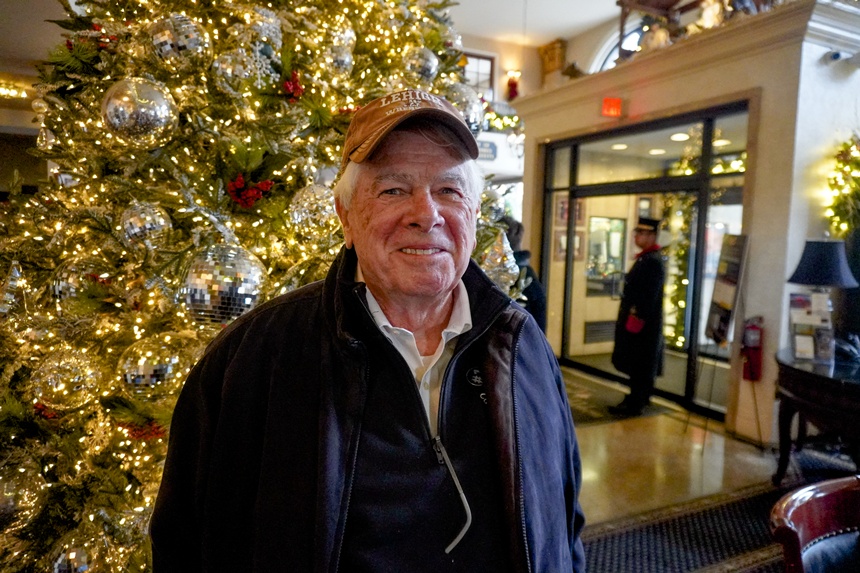
We’ve been having breakfast at Haines’s customary corner table in The Tap Room — that is, when he hasn’t jumped up from his seat to ask other diners how they enjoyed their stay, what they liked best, and how he could do better. Now we’re headed out to his black SUV, parked at the front door, for a side trip to see the remnants of a Bethlehem past that’s every bit as significant as the Moravians’.
Bethlehem Steel was a local powerhouse from the 1800s, but it collapsed, along with most American steel production, in 2003. Still, much of its historic infrastructure remains: As we cross the Minsi Trail Bridge, Bethlehem Steel’s five remaining smelter towers, standing on the south bank of the Lehigh Reiver, resemble enormous, rusting lab equipment.
For more than a century, those smelters, cranked up to temperatures one-third that of the sun’s surface, produced the iron that built bridges from the George Washington to the Golden Gate and buildings from the Empire State to Alcatraz.
Today they stand cold and silent; and on this particular day they preside over the Lehigh Valley Christkindlmarkt, a holiday tradition for 33 years. Craftspeople both local and regional stand in their stalls offering hand-made ornaments for sale. Ice carvers do their chainsaw thing. And kids labor over holiday crafts at a station sponsored by Crayola Crayons, a Lehigh Valley corporate resident for 140 years.

It’s the rusting stacks above that most fascinate Haines, though. Educated at nearby Lehigh University, he went to work for United States Steel in Pittsburgh and rose high into the executive ranks. His love for the Bethlehem area never faltered, however, and his retirement plan always involved returning and, in his words, becoming a town tour guide, “wearing one of those floppy hats and sharing the town’s history.”
That plan was upended when, in 1999, he heard the Hotel Bethlehem had gone under. With a team of business partners, he dragged the old girl out of despondency. The rooms were redone. The 1970s shag carpets were pulled up to reveal fine Moravian tile underneath. The lobby’s suspended ceilings were ripped down.
Haines, now 80, is proud his place is now a member of the prestigious Historic Hotels of America group — but mostly, he’s gratified that after two decades of intense lobbying from him and other Bethlehem city leaders, in early 2025 Bethlehem’s Moravian Church settlement was designated a UNESCO World Heritage Site.
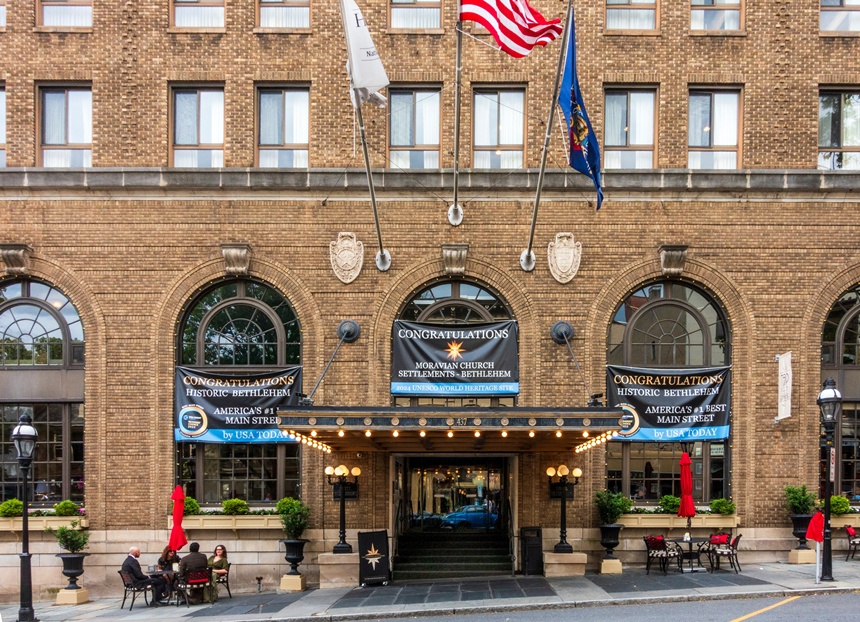
“Before this,” he says, “we were just another great hotel. But now we’re sitting right in the middle of a global historic destination. I mean, we’re mentioned in the same breath as The Statue of Liberty, and Monticello, and Independence Hall.”
He smiles and shakes his head, as if he can’t believe what he’s saying.
“I’d love our place to be a center for World Heritage travel; people stay here and go to Independence Hall, an hour away. And the Statue of Liberty, an hour and a half away. And then they come back here, staying right in the middle of another World Heritage Site.
“I may sound like I’m bragging. But I feel like we’re just that special.”
The Magic of Bethlehem
The Hotel Bethlehem’s 1741 on the Terrace restaurant sits in the establishment’s former garden terrace, with floor-to-ceiling Palladian windows overlooking Main Street. I’m lingering over a heaping plate of lobster macaroni and cheese, paired with an excellent Sauvignon Blanc.
Yesterday’s early snow has evaporated, but it’s clear from tonight’s bundled clumps of humanity, hustling on the sidewalk below my window seat, that we are in for another frigid night in the Pennsylvania mountains. Just beneath me, people push in and out the door of the hotel’s gift shop, toting bags filled with ornaments and pine scented candles.
A man turns abruptly and flags down a white hansom cab, drawn by two black horses. He extends a hand to his female companion, helping her into the leather seat. And then they are off, clip clopping up the incline of Main Street.
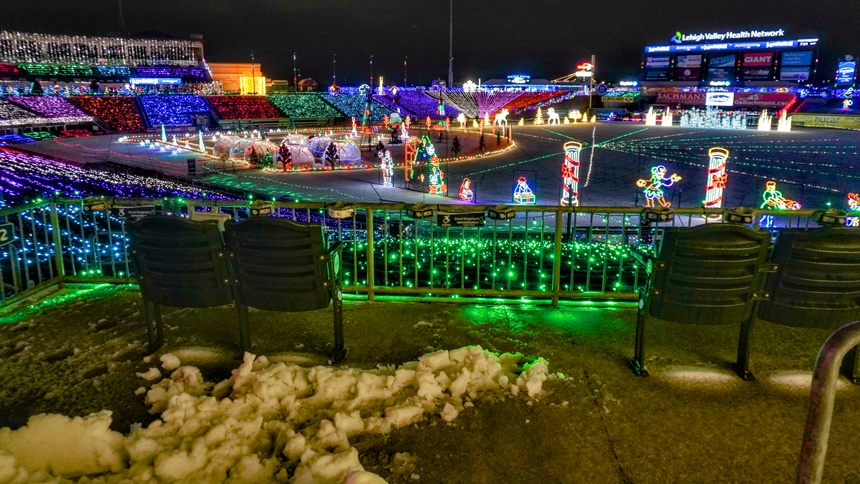
If holiday spectacle is what you’re after, by all means head over to Illumination at neighboring Allentown’s Coca-Cola Park, where the minor league baseball stadium has been blanketed with 1.5 million lights. A Christmas train, circling the warning track, feels like a voyage on the Polar Express.
But then return to the quiet glories of Bethlehem; the flickering candles in the windows; the whispered echoes of Christmases past whooshing through the dimly lighted trees.
Silent Night, indeed.
Become a Saturday Evening Post member and enjoy unlimited access. Subscribe now


Comments
I was a high school junior with an assignment from my English teacher to write a short story. It must have been in November or December because I decided on a Christmas theme. I remember vividly writing about a man who boarded a train in New York City (I don’t recall but maybe I chose Christmas Eve as the day). His destination was Bethlehem Connecticut. In his rush he misread the sign and got on the train for Bethlehem Pennsylvania. He dozed on the journey only waking up when the conductor announced “arriving in Bethlehem!”. The traveler realized his error as the train pulled away — the last one that night. The station was dark and nearly businesses were closed. He started to walk in the cold, empty streets in search of somewhere to find warmth, and maybe a phone. After a few blocks, he spotted a light and hurried in its direction. It was a church, and Midnight Mass was about to begin. He had not cared much for God or religion in his recent troubled life. As the candles gleamed, and the choir sang Silent Night, he knew he had made an arrow for a reason.
When Sister Eustelle handed me back my graded paper with an A, she remarked that the story felt like it had come from the pages of the Saturday Evening Post. I guess I shouldn’t have been surprised. My dad had been a subscriber as long as I remembered, and each week I ran to the mailbox to be the first one who read each issue. That happened in 1960. Thanks for your piece about all the places named Bethlehem.