This year the store Paper, Ink has set up a kiosk out front, in its hip block of shops, and Jen works there all day wrapping. You bring in your present with your receipt from one of the stores and get a discount. It’s part of the strategy for reviving this old beach town’s center. She uses muted, cool, shimmery papers and French wire ribbons. She does each gift with care, choosing among the trims she made ahead — seashells and starfish sprayed silver, the Florida equivalent of snowflakes.
When she began, shoppers would watch her, then go into the store to buy supplies to do the work themselves, but now, two days before Christmas, they have abandoned such ambitions. Today some even come with presents bought elsewhere and pay full price. She is astonished at how much money other people have to throw away.
A young guy places three identical jewelry boxes on her counter. She asks how he wants her to mark which is whose. “No,” he confides, “I got them all the same, ankle bracelets, no mistakes. They’re for my girlfriends.” He says this ruefully, with a flash of dark eyes. As she twists out a chrysanthemum bow, he says, “You have beautiful hands,” such a flirt she knows how easily he’s keeping three women on the hook. She remembers when she was single and had time to be miserable.
Now she has a sweet husband, Carlos, and a son, six-year-old Riley, so beautiful her heart twists each time she sees him. Her father has been with them since the weekend, and right about now he’s picking up her sister at the airport. Her mother died last June, and for the first time Jen is the home base for the holiday. Her mother made a big deal of Christmas — too big, Jen always thought, full of such effort and dressing up, no one could relax. She misses her mother, but she definitely doesn’t want to be like her.
At half past five, just as she’s closing, her sister arrives. Haley is younger, taller, blonder, and richer than Jen. That’s always her first impression, Haley’s vitality, before her discontent comes through. She works 80 hours a week marketing technology. Haley’s phone calls are a cascade of promotions, raises, moving expenses to new states, last month a vacation to Australia. She has friendships on the internet and no sign of any permanent connections.
“Dad’s parking,” Haley says. “Riley’s with him. He’s so cute. I haven’t seen him since the funeral.”
Jen asks Haley to help her carry in the supplies and introduces her to the other women from the shop. Haley is pleasant till they get outside again. Then she says, “Riley says you didn’t make the lebkuchen.”
Jen sighs. She knew there would be trouble if she didn’t make those cookies. Haley sent her the recipe in November, even though Jen already had it, and a set of cutters just like their mother’s. “Listen, this is what I’m doing,” Jen says. “Carlos got this smoker and he’s smoking a goose. I’m making light stuff. We’re having a fruit salad and pumpkin risotto and green beans and some good bread. And mango ice cream for dessert because that’s Riley’s favorite. He wouldn’t even eat the lebkuchen last year. He doesn’t like food to be crunchy. Okay?”
“No mashed potatoes?” her sister says. “No squash?”
Jen sighs. “No. And no minced pie.”
“Okay, but there have to be lebkuchen,” her sister says.
“I got the ingredients, Haley, but I just didn’t have time,” Jen says. “They take all day, you know that. I’ve been working extra hours, and I’ve had Dad here. Give me a break.”
“Lebkuchen are traditional in our family,” Haley says. “Our great-grandmother made them.”
“Sometimes you have to start new traditions,” Jen says.
Haley doesn’t answer. She has a stubborn sulky look Jen knows well, the one she wore when she wanted something from their mother.
“Mom made all that stuff last year,” Jen says, “when she shouldn’t have.”
Last year at Christmas, their mother knew she was sick. She didn’t tell them till after the dinner, after the huge ridiculous turkey and mashed potatoes and creamed onions and the big sticky trifle no one ate. Last year — the sisters look at each other and veer away. Riley runs up to them, towing his grandfather.
“You’re right,” Haley says. But she doesn’t sound convinced.
Jen and Carlos have a small blue deco house in an old neighborhood on the rise. It has a fireplace, a little turret, hardly any closets, and no guest room. When they get home she puts her sister’s two big suitcases in the narrow Florida room, where there’s a futon. Her dad has been sleeping there, but now he’ll bunk in with Riley.
After dinner they all decorate the small tree with her collection of birds — Guatemalan and Moravian doves, origami cranes, sequined peacocks, lovebirds of spun glass. They top it with a paper partridge in a nest of gold shreds Riley made when he was with her at work after school last week. Then she lets her sister read to Riley and put him to bed.
When she goes in to kiss him goodnight, after doing the dishes, Haley is telling him how their great-grandmother came from Alsace as a small girl, her father a baker. “Lebkuchen was their recipe,” Haley says, looking at Jen. “It’s from the word lieb, love. It means ‘love cookie.’”
“Do you remember them from last year?” Jen asks him. Riley sleepily shakes his head no.
When Jen was Riley’s age, her great-grandmother was still alive — a hefty woman with gray braids pinned up around her head in a crown and the most wonderful cheeks, ruddy and curved. Riley’s cheeks have that same shape right now. And so Jen yields. “I guess we could make them tomorrow,” she says to Haley. “But you’ll have to do most of the work.”
Her dad — Riley McGraw, Big Riley he wants to be called now — has happily gone to seed since her mother’s death. Up in Newport News, he fished all summer and never cleaned the house. This week, when Jen sent him out for groceries, he found a neighborhood bar she didn’t know existed, a cubbyhole where the owner, Ed, is a great guy, her dad says. They were in the same Navy, same ocean. Now her dad asks if he can invite Ed for Christmas dinner. What can she say but yes? And his girlfriend, her dad adds, the barmaid, a great gal. They’ll bring something to eat.
Later, as they collapse into bed, she tells Carlos it’s all too much. “Next year,” he says, “we’ll find someplace to take everybody out.” Carlos was raised by his aunt who brought him from Argentina. She died while he was in college. Everyone but Jen calls Carlos Chuck, he’s the most American guy you’ve ever seen, and he rarely talks about the past. After her mother’s death he wept in big coughing groans. For that, among other things, she’ll love him forever.
You add the baking soda to the mix of molasses and sugar and spices and lard and it all fizzes up. That’s the fun part,” her sister says. Riley, in his striped pj’s, sits on a stool, watching seriously.
“Now the egg yolk. Then you sift in flour a cup at a time.” Haley sifts while Jen stirs.
“I just barely remember when our grandmother made these,” Jen says. “You were a baby then, Haley.”
“The earliest I remember is Grandma’s house. She lived in the mountains,” Haley tells Riley, “in a big old house.”
“Everyone would gather. There were so many women — two different Aunt Mildreds, and Grandma, and Mom, and Aunt Judy who used to be married to our Uncle Bob. And more, some cousins, who were very old.”
“They’d put the dough in a crock and set it outside to chill overnight.”
“We’re going to have to put it in the fridge — God, there’s a lot of it, Haley.”
“And this is the half recipe —”
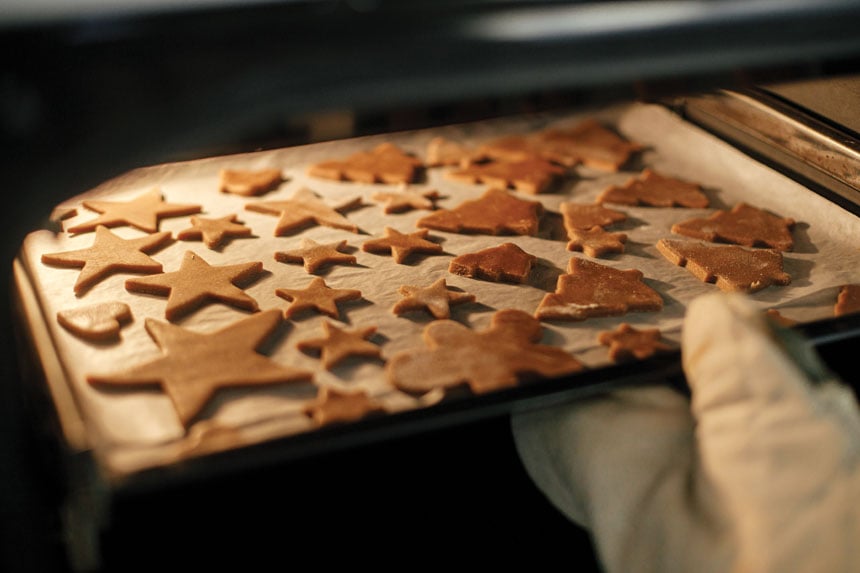
“It needs to chill till it’s hard. And then we’ll roll it out and cut it. Here are the cutters — you can play with them, Riley, they’re not sharp. After you bake them and they cool, you ice them.”
Her arm aches. Jen hands off to Haley, turns to make coffee. She can hear her father moving around in the bathroom. Carlos left for work early.
“So there’s a story Mom told us,” Haley says.
“Tell me,” Riley says.
“Well, it seems that our mom and dad got engaged just before Christmas one year, and then, when all the women were making the lebkuchen, she was helping and she noticed after they’d made the dough —”
“I think it was after the rolling out,” says Jen.
“No, it was after making the dough — after it had been put outside and turned into a big frozen lump, as I heard it. Anyway, Mom noticed that she’d lost her engagement ring.”
“This old tale,” her father says as he comes into the kitchen.
“Well, they looked all over. The other women had put their rings in a teacup before they started, but Mom was so proud of her new ring, she hadn’t wanted to take it off.” Haley shook her arm, stretched. “And they realized it must be in the dough.”
Jen takes over. The dough is almost too stiff to stir. “So they looked for it when they made the cookies, but they didn’t see it,” Jen says. “And then as everyone ate them they had to be really careful because a diamond could crack your teeth, you know.”
“What are you talking about?” her dad says. “Those lebkuchen are so hard they can break teeth all on their own. That’s how I lost mine,” he says and pops out his partial plate, to Riley’s delight.
“Oh, Dad,” says Haley. “Just ’cause it’s not your family recipe.”
“My mother made fruitcake,” he says. Haley and Jen roll their eyes at each other. Nobody liked that fruitcake, gummy and stiff.
“Let me finish the story,” Jen says. “So guess who bit into a cookie and found it?”
“Who,” says Riley. “Did you, Mom?”
“No, no, I wasn’t born yet.”
“Not even thought of,” their dad says. “Your mother wasn’t the type.”
Jen and Haley laugh at their dad, the rogue.
“No, Mary found it. That’s your grandmother,” he says to Riley. “She ate nothing but lebkuchen all Christmas Day, she was so determined not to let that ring be lost down anyone’s gullet.”
“Which shape cookie was it in?” asks Riley.
His grandfather looks over the Santa, the bell, the Christmas tree, the moon, the star, and the gingerbread boy. “It was the moon. And that’s why, your grandmother said, the moon always tastes the best.”
Later, her father, alone with Jen, says, “You know, that bit with the ring didn’t happen to your mom, but to your Aunt Judy, when she was your uncle’s fiancée.”
“What do you mean? Mom always told it to us this way.”
“Well as I recall it happened to Judy, and then when Judy left the family, in the divorce, I think your mother sort of adopted it. You couldn’t let such a fun story go just because of a little divorce.”
“I can’t believe that. Really? Are you just teasing me?”
“Your mother had her ideas,” he says, looking so sad all of a sudden that Jen lets it go.
Christmas Eve. She wraps umbrellas, diving gear, breakable bowls, designer toothbrushes, lotions with the smell of carnations and rain. People are humming, people are crazed.
She has the feeling that all her indomitability, all her thought and skill and work, are being poured into things that don’t get anywhere, don’t mount up. They’re like this wrapping she’s doing, lavished with her talent only to be torn apart tomorrow and tossed out.
When she gets home, Carlos is drinking a beer in the backyard and watching Riley chase lizards. “She’s sent me to Publix, twice,” Carlos says. “On Christmas Eve. She needed more baking sheets, and then waxed paper and containers to put the cookies in, after. And I had to take the battery out of the smoke detector — it kept going off.”
“I’m sorry,” Jen says. “Hey, Riley, how come you’re not helping Aunt Haley?”
“I did,” he says, “but I got tired. Look Mom, my tooth is loose.”
And he wiggles his lower left front tooth till it sticks out at a wild angle. Already? She has a pang. It’s all going to happen to him — loss, change, death. She knows she must be tired, to leap from a loose tooth to her son’s mortality.
She gathers her strength and pushes through a wall of gingery heat into the kitchen. Haley’s hair is in her face. “Your kitchen is small,” Haley says accusingly.
“Hi, honey — I’ll help you in a minute.” Jen walks into the bedroom and closes the door. She changes into a T-shirt and shorts, pulls her hair back, and takes a deep breath before she goes out to bake.
“It must be a hundred degrees in here,” Haley says, pulling a hot tray out.
“At least. Florida’s no place for this kind of cooking. I told you that.”
“You know what,” Haley says, “I don’t need this. I’ve been working for hours, just trying to make something nice—” Her voice breaks.
“You’re just like Mom,” Jen says. “You want everything to be a big production.” She tries to say it lightly, but it comes out with a sting.
“I’m not the one,” says Haley. “It’s you. You have to have your own ideas about how everything’s supposed to be, all new and different and artsy—”
“Okay, fine. At least in her own home,” Jen dumps shortening on the next sheet right over the greasy crumbs, “Mom got to do things her way.”
“Humph,” grunts Haley, a sound so precisely like their mother in her Christmas snit that Jen wants to laugh.
And then, to her horror, as she fits lebkuchen on the baking sheet, she humphs too. Maybe it’s a German noise, she thinks, old as Father Christmas and the spice cookies themselves, an ancient female sound of solstice effort.
“It’s so hard to believe she’s gone,” Haley says, and the sisters work on through a glaze of tears.
Two hundred cookies fill the house. Her dad has picked up pizza, and they eat it in the yard.
Jen puts Riley to bed and almost falls asleep beside him, soothed by his even breathing. She and Carlos go about their final Christmas Eve tasks while Haley mutters over the icing. She covers the dining room table with waxed paper and lays the cookies out on it.
Jen sways, looking at her. Where does her sister get the energy?
“Go to bed,” Haley says, unexpectedly tender. “I have it under control. You were right — these are too much to do.”
“Maybe a quarter recipe?” Jen sticks her finger in the icing, already hardening.
“You need a team of women.”
“Women who have time,” Jen agrees.
Christmas morning is warm, shiny. Jen is the first up, leaving Carlos snoring. Her father lies in a sleeping bag by Riley’s bed, surrounded by stuffed animals, with his teeth out. Riley is cuddled next to him. Haley, on the futon, is tousled, groggy, young.
Jen plugs in the lights and the tree glitters, all the birds flocked upon it, presents mounded underneath. Hers (beautiful pens for the adults, an easel and art set for Riley) are wrapped in silver and purple, Carlos’s done in funny papers he saved up. Haley’s gifts make a pile of traditional green and red. Her father’s, in foil bags, are clearly bottles. Santa — very hip — left presents wrapped in white tissue rubber-stamped with hot pink reindeer. She sits enjoying the way it all shimmers until the others get up, thinking how her mother must have felt last Christmas, trying to make something lavish before she left them.
Then, in their pajamas, her family opens everything in a binge of rip and ooh.
And the day actually goes something like she’d imagined. They hang around and play with Riley’s new kangaroo and joey puppets and world habitats puzzle and the whoopee cushion from his grandfather, while the goose smokes. The rest of the dinner is easily made. Her dad’s buddy Ed shows up with his girlfriend, Emilia, who brings a paneton, traditional, she says, at home in Lima. “Somewhat like fruitcake,” her dad says, “but cakier,” and then Carlos says, “It’s what my aunt used to serve for dessert on Christmas, always with cocoa.”
So their Christmas dessert is mango ice cream, lebkuchen, hot chocolate, and paneton. The lebkuchen are thicker than normal. “I probably didn’t roll them out enough. I was trying to go fast,” Haley says.
They lack that crisp snap, but they’re delicious, better in fact, altogether more Southern and yielding. Jen tastes more molasses, less clove. And Riley is already halfway through a moon.
Lynne Barrett’s stories have received an Edgar Allan Poe Award for Best Mystery Short Story and a Florida Book Awards gold medal for her third short story collection, Magpies. She teaches creative writing at Florida International University and edits the Florida Book Review.
This article is featured in the November/December 2025 issue of The Saturday Evening Post. Subscribe to the magazine for more art, inspiring stories, fiction, humor, and features from our archives.
Become a Saturday Evening Post member and enjoy unlimited access. Subscribe now