
As American colonists were taking up arms against England, one of that country’s most famous authors was just coming into the world. Two hundred and fifty years ago, Jane Austen was born in Steventon, England, on December 16, 1775. Although she lived a short life, dying at the age of 41 in 1817, her scant literary output of six novels would come to have an outsized presence in many of our lives.
Why would Americans take to Jane Austen’s work, which is, after all, characterized by wonderfully precise portraits of manners, intention, and desires painted with words that, according to her contemporary Sir Walter Scott, show “a correct and striking representation of that which is daily taking place around him”? Scott further posits that Austen was the first novelist in history to offer an accurate representation of “the current of ordinary life.” But what does any of that have to do with the literary interests of 21st-century Americans?
When I was in high school in the 1970s, Jane Austen was definitely not in favor with my contemporaries. We were trying to understand what was happening as our country attempted to extricate itself from an extremely unpopular war in Vietnam, as well as deal with the aftermath of the Watergate break-in that led to the resignation of President Nixon. Novels set in Regency-era England weren’t even on the periphery of my interest when, as a teenager, I thought America was going to hell in a hand cart. It wasn’t until a decade or two later that I first discovered a love of Jane Austen’s work in a way that may have horrified the author had she been alive. I received my first doses of Austen via the big and small screens.
I don’t think my introduction to Austen was unusual in America. My mother, who insisted on making us watch all movies made before 1960, introduced me to 1940’s Pride and Prejudice, starring Greer Garson and Laurence Olivier, when it happened to air on one of the three television channels we got in rural New York in the 1970s. I had loved Greer Garson in Mrs. Miniver, so I was primed to love her in Pride and Prejudice. It wasn’t until much later, after I finally read the book, that I wondered why she had been cast to play Elizabeth Bennet, a character half her age. And those dresses — they were all wrong. Even I knew they should have been high-waisted Empire Style dresses, which happened to be all the rage at my high school prom in 1974.
The Austenverse
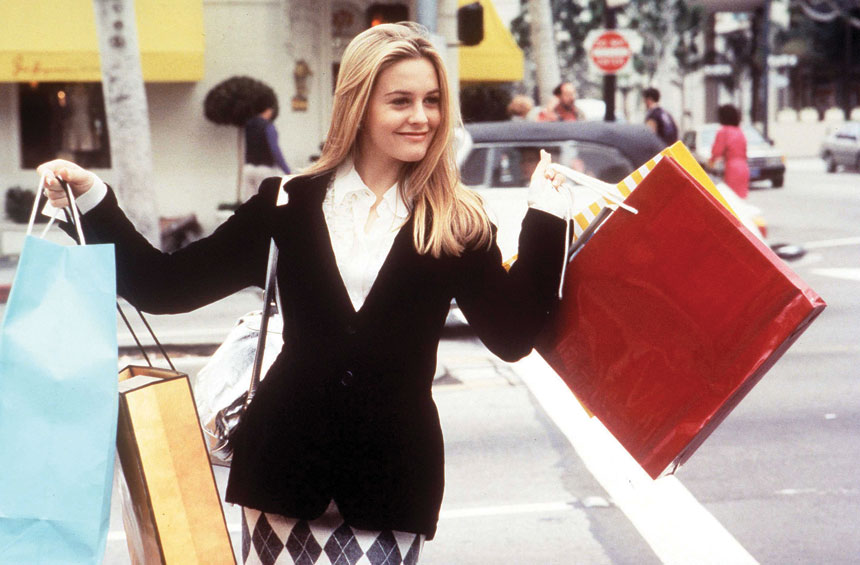
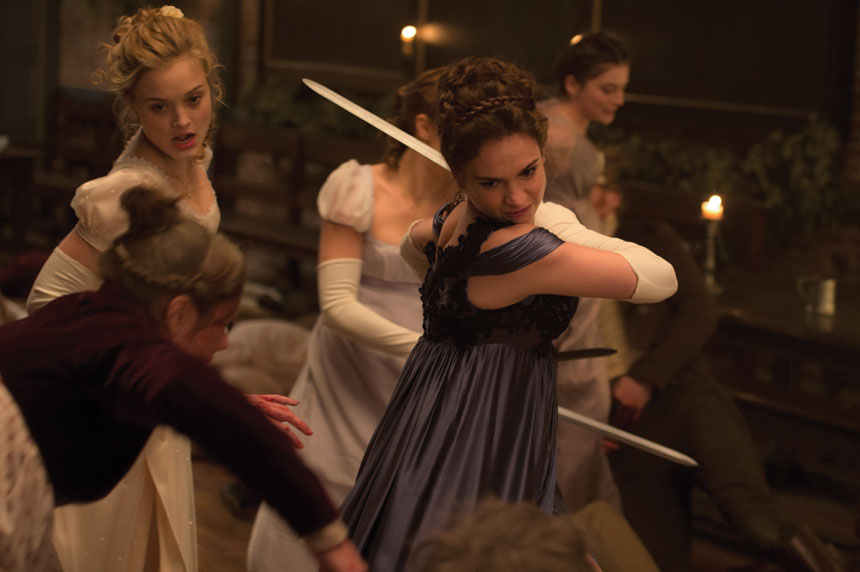
These movies are all based on the works of Jane Austen.

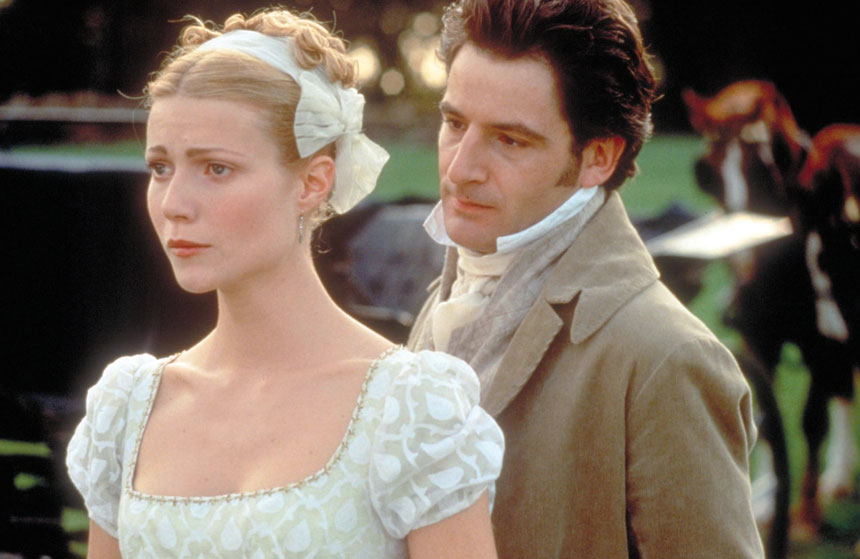
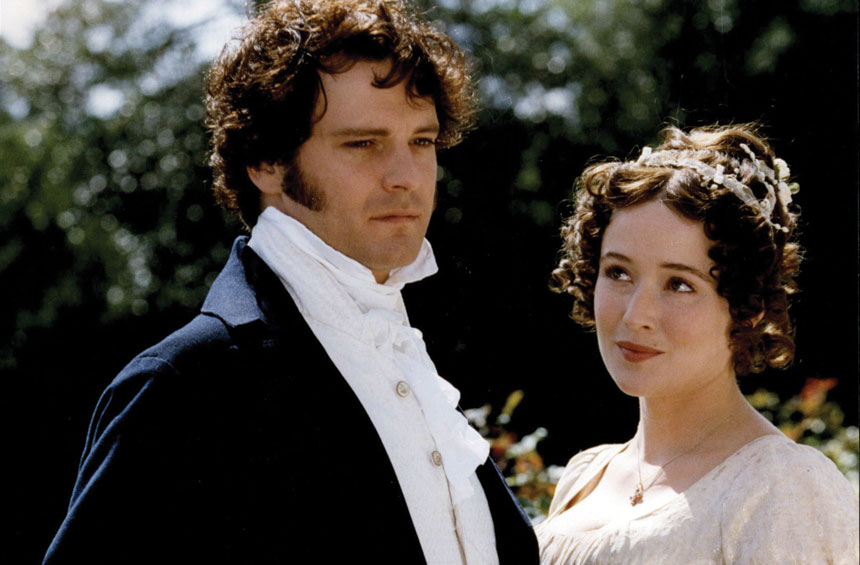
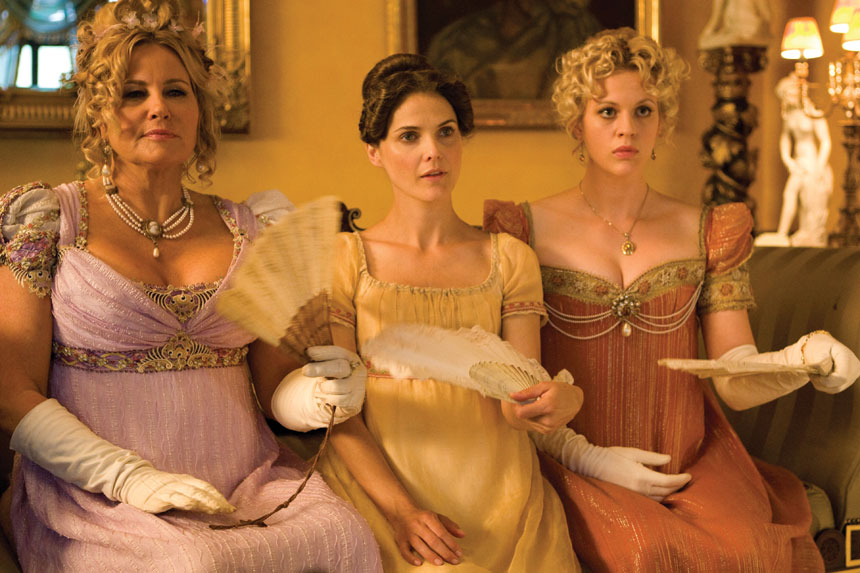



Two decades later in 1995, the BBC’s Pride and Prejudice mini-series, starring Jennifer Ehle and Colin Firth, made men and women swoon on both sides of the pond and turned Firth into a superstar. I mean, who can forget him emerging from the lake at Pemberly, wet shirt clinging to his body? Sense and Sensibility, which starred Emma Thompson, came out around the same time, and a scant year later Emma, with Gwyneth Paltrow in the title role, burst on the scene. This is when Americans began to take note of the world Jane Austen created, and that interest has only grown over the decades. To give you a sense of the scale of current Austen-mania, more than 78,000 copies of Austen’s novels were sold just in the first quarter of 2025. Put another way, as Lily Isaacs recently wrote in UnHerd, “Pride and Prejudice outsells new John Grisham novels.”
All of Austen’s published novels (Pride and Prejudice, Sense and Sensibility, Persuasion, Mansfield Park, Emma, and Northanger Abbey) have been made into movies, often more than once, and her unfinished Sanditon made it to the small screen as a series. Then there are the films inspired by Austen novels, like Clueless, Bride and Prejudice, Fire Island, Bridget Jones’ Diary, and Pride and Prejudice and Zombies. I admit to seeing all of them as well as Austenland, The Jane Austen Book Club, Lost in Austen, and Jane Austen Wrecked My Life. I even watched The Rewrite, in which Hugh Grant meets his nemesis in an Austen scholar played by Allison Janney. And who among serious Austen fans has not read Camp Austen: My Life as an Accidental Jane Austen Superfan by Ted Scheinman?
The Jane Austen Society of North America publishes Persuasions: The Jane Austen Journal On-Line, a collection of papers and essays written by scholars. It’s a wealth of fascinating reading for serious fans and scholars of Austen’s work. Those who describe themselves as fans — serious fans — refer to themselves as Janeites, whereas the scholars are called Austenites. “The Jane Austen franchise has now expanded so much that there seems to be no limit to the deluge of Austen-themed items,” writes Austen scholar Rosa García-Periago. Janeites cosplay Regency balls complete with historically accurate costumes and dances (quadrille anyone?).
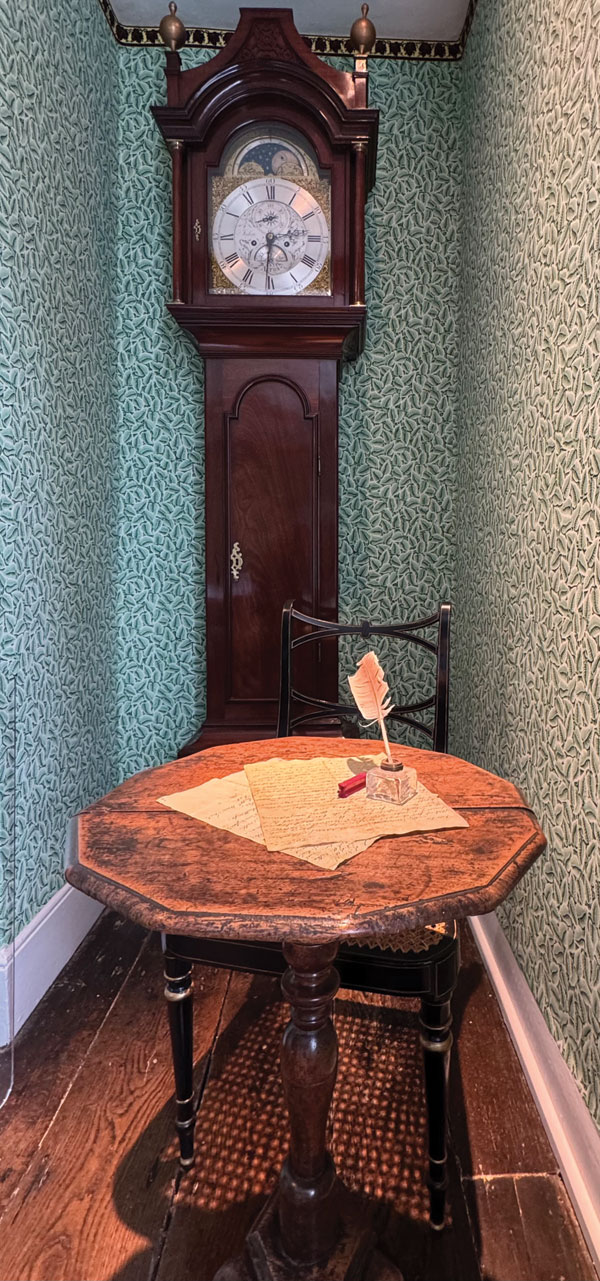
This past spring, while waiting for a transcontinental crossing of the Queen Mary 2 from Southampton, England, to New York, I visited Jane Austen’s House in Chawton, Hampshire, where the author spent the last eight years of her life living with her mother, sister Cassandra, and family friend Martha Lloyd. After the death of Jane’s father, George Austen, her brother Edward invited them to stay in the small house on his estate. As I approached the house, simple poplin dresses flapped in the breeze from a clothesline strung across the courtyard, and daffodils, primrose, and snowdrops grew beneath the trees. I walked through the rooms in the 500-year-old house once occupied by the Austens and read letters and pages of journals on display. The dining room table was set with blue and white china for a tea that would never happen. In an alcove near a grandfather clock sat Jane’s writing table, a tiny 12-sided wooden table big enough to hold a sheet of paper and an inkwell, where Austen wrote and revised her six major novels. It was small enough to be carried from room to room to take advantage of the best light to accommodate Jane’s weakening eyesight.
There were few items in the house that were present when the Austens lived there, although the original wallpaper had been carefully re-created in several of the rooms. There was something both exhilarating and melancholic about wandering through her home as a way to gather insight into her life and work. She was a keen observer of customs and manners, yet her life — by choice and circumstance — felt small (although not Emily Dickinson small). When you immerse yourself in Austen fandom, it’s easy to lose sight that it all comes from the mind of a woman sitting at a tiny writing table in a village in Hampshire.
Jane Austen spent the last few months of her life in the nearby city of Winchester seeking medical attention for her failing health. She was in agony, and there was little they could do to ease her suffering. After she died at age 41 in July 1817, she was buried in the nave of Winchester Cathedral under a simple black stone that mentions the “benevolence of her heart, the sweetness of her temper, and the extraordinary endowments of her mind” but does not point out that she was a writer. The cause of her death was a mystery at the time and was later attributed to Addison’s disease, or perhaps Hodgkin’s lymphoma.
Although at times Jane Austen’s work has fallen out of favor, it has never been completely forgotten by the reading public. The continued interest in the lives of the Dashwoods, the Bennets, Fanny Price, Mr. Darcy, Emma Woodhouse, Anne Elliot, and Lady Catherine de Bourgh means we may have another century or two to parse every word, look, and bon mot that comes from those fascinating characters created by Austen.
Brief Life, Enduring Legacy
Jane Austen’s first four novels were published anonymously over five years. Sense and Sensibility (1811) was attributed to “A Lady,” and Pride and Prejudice (1813), Mansfield Park (1814), and Emma (1815) were credited to the author of the previous novels. Persuasion and Northanger Abbey were published posthumously in 1817 with a foreword written by her brother Henry, who identified Jane Austen as the author of all six novels.
Born the seventh child of eight, Austen had six brothers and one older sister, Cassandra. Although Austen had little formal education, she spent her time in her father’s extensive library reading French romances, Gothic novels, moral essays by Samuel Johnson, and the works of Alexander Pope. By age 19, she had finished writing two novels, titled First Impressions (which became Pride and Prejudice) and Elinor and Marianne (Sense and Sensibility). Her father wrote to a London publisher in 1797 asking him to consider First Impressions, which he turned down without reading the manuscript.
The Life and Death of Jane Austen


Fortunately for Jane and for us, her family believed in her talent, and she was excused from doing household chores because they wanted her to write. The Austens were never financially flush. Mr. Austen was rector of a church, then a farmer, and then ran a boys’ school. When he died in 1805, Mrs. Austen, Cassandra, and Jane drifted from place to place for a couple of years until Jane’s brother Edward offered the use of Chawton Cottage. Jane was first paid for her work when she was 36.
Although in Jane Austen’s books marriage defines the happy endings, Austen never married. She was engaged for one day, and likely had one or two more suitors, but she spent her life with her family. She and Cassandra were particularly close.
After Jane’s death, her books were out of print for 12 years, and she might have been totally forgotten had her nephew James Austen-Leigh not written A Memoir of Jane Austen in 1870. Austen-Leigh sanitized reality and portrayed the Austen family as upper middle class, whereas the Austens often survived closer to the poverty line. But the Victorians devoured Austen’s books, which have never been out of print since. Pride and Prejudice has sold over 20 million copies worldwide in the past 200 years and is considered England’s favorite novel.
Rachel Dickinson is the author of several books; her most recent is The Loneliest Places: Loss, Grief, and the Long Journey Home. Her work has appeared in numerous publications, including The Atlantic, Outside, Men’s Journal, Aeon, Salon, and Audubon.
This article is featured in the November/December 2025 issue of The Saturday Evening Post. Subscribe to the magazine for more art, inspiring stories, fiction, humor, and features from our archives.
Become a Saturday Evening Post member and enjoy unlimited access. Subscribe now



Comments
Thanks for this feature, Rachel. I can relate to what you say here in the 3rd paragraph. I graduated from high school in 1975; the first school year after Nixon resigned. It wasn’t an era that lent appreciation to Jane Austen, but her time would come–again. She who laughs last, laughs best, right?
I haven’t read any of her books yet, but she’s on my list for the new year almost here. In the last 10 years, I’ve developed a strong appreciation and curiosity about the 19th century from all aspects, and speaketh the truth when stating I particularly love early 19th speaking and writing styles, where words flowed and weren’t reduced to the ‘bottom line’ scourge of present-day ugliness.