
The Ritchie Boys were a secret U.S. military intelligence unit during World War II, primarily composed of Jewish refugees from Nazi Germany, who were trained at bucolic Camp Ritchie nestled in the Blue Ridge Mountains in Maryland. After training, they were shipped to Europe with other U.S. troops, landing on June 6, 1944, D-Day.
It’s amazing we don’t know more about the Ritchie Boys. The reason is that the Army kept their operation classified as top-secret until well into the 1990s. Since the Ritchie Boys were told not to talk about their mission, most didn’t join veterans’ groups, and their stories haven’t been widely spread.
By the time of Kristallnacht, known as the Night of Broken Glass, on November 9, 1938, tens of thousands of German Jews had already immigrated to the United States. From then on, however, it was almost impossible for whole families to get out of Germany. Through the efforts of Jewish relief organizations, families were able to get one child under the age of 16 to safety. Many parents chose to send off their eldest son so they could carry on the family name. Decades later, one of the former Ritchie Boys remarked, “A visa to the United States was the most valuable document in the world.”
After seeing what was happening in Europe, these young Jews were strong believers in U.S. democracy, freedom, and patriotism. By the time America entered the war after the Japanese attack on Pearl Harbor in December 1941, they were eager to fight with the American military. Many tried to enlist but were turned away because they were viewed as enemy aliens and thought to be a security risk.
However, after Gen. George C. Marshall was exposed to intelligence training in the British military, he became concerned about the lack thereof in the U.S. Army. At some point, the government realized that refugees born in Germany had invaluable language skills and knew the culture, customs, and psychological makeup of Germans. The U.S. thus inducted them into the Army, even those who had been previously denied entry to the military. Those enemy aliens were immediately made naturalized U.S. citizens.
By mid-1942, the Army began molding the young Jewish immigrants into a top-secret decisive force to help win the war in Europe.
Camp Ritchie was founded by the Maryland National Guard but taken over by the U.S. Army in 1942. By the time the new Jewish citizens arrived, Camp Ritchie had replicas of German villages. The guards wore German uniforms, some Wehrmacht, some gestapo, and every other kind of German uniform of every rank. From the M.P. at the gate to all inside the camp, everyone spoke German. There were German cultural and military activities in the simulated villages. They even held mock rallies.
The fake German atmosphere was so convincing that nearby Maryland farmers were frightened. They were convinced America had been invaded.
The men spent most of the time in classrooms, learning the subtleties of how to interrogate. They were taught many other skills as well. They learned Morse Code, how to write propaganda, and how to interpret aerial photography. Outside the classrooms, they were taught close combat, such as how to kill a person quickly.
At the camp, the German-American Jews often met others they knew. It happened frequently that the men would run into someone they’d grown up with in Germany before they escaped.
One of the Ritchie Boys, Paul Fairbrook, later explained how enthusiastic he and other German Jews viewed their time at Camp Ritchie. “Look, I’m a German Jew and there’s nothing that I wanted more as to get some revenge on Hitler who killed my family, my uncles and my aunts and my cousins. And there was no question in my mind or the men in Camp Ritchie. We were all on the same wavelength. We were delighted to get a chance to do something for the United States.”

Most Ritchie Boys parachuted onto Omaha Beach in Normandy on D-Day. Bodies were everywhere on the beach when they landed. The smell of death was terrible. Years later, one of the Ritchie Boys said that no movie can re-create the stink of war, and that if people could just smell it, they would become pacifists.
The Ritchie Boys joined Gen. George S. Patton’s forces and raced with the tanks across occupied France. They fought in the Battle of the Bulge and took part in every other campaign and battle.
Most of the Ritchie Boys were known as IPWs, interrogators of prisoners of war. They were divided into six-man teams. Tens of thousands of Third Reich prisoners and civilians were interrogated by these teams. One of the Ritchie Boys authored the book Order of Battle of the German Army, which permitted all the interrogators to better question German POWs because it identified the dates and places of every battle fought by the German Army.
The Ritchie Boys collected valuable intelligence about enemy strength, casualties, troop movements, defensive positions, and morale. They would find out where a minefield was, where a machine gun nest was, and how many machine guns there were in each nest. The Ritchie Boy teams were able to provide such detailed information that American howitzers were deadly accurate.
Their goal was to interrogate a POW as soon as possible after capture and before they were processed. Newly captured prisoners were more frightened and confused and more likely to provide information. Also, since things changed so quickly, the sooner the U.S. knew what the POW knew, the more valuable the information.
They avoided violence and threats in their interrogations, opting for a softer approach. They’d begin conversationally, offering a cigarette. The first question might be, “How were you taken prisoner?” Many Ritchie Boys avoided taking notes because that tended to make the prisoners security-conscious, reminding them they weren’t supposed to say anything.
One Ritchie Boy recognized a name on a prisoner list. He and the POW had belonged to the same sports club in Germany. They had often competed with each other in athletics. He thought about seeking him out to find out information about his family, but he didn’t because he feared the answer.
The Ritchie Boys also used loudspeakers to appeal to German troops in their own language to surrender. They authored a leaflet supposedly, but not really, signed by Gen. Dwight D. Eisenhower. The leaflet told the German soldiers to hand it to any American soldier and they’d be given safe conduct. Many German soldiers handed over a leaflet during their surrender.
By the end of the war, it was estimated that 60 percent of the credible intelligence gathered in Europe came from the Ritchie Boys.

During World War II, the military was still imprinting a soldier’s religion on his dog tags. That was a frightening prospect for the Jewish soldiers. If they were to be taken prisoner by the Nazis, they feared they wouldn’t have protections as POWs under the Geneva Convention or would be executed because they were German Jews in the U.S. Army. Many managed to scrape off part of the H for Hebrew and make it look like P for Protestant.
Moving within units and moving from one unit to another required passwords. One team of Ritchie Boys passed from one division to another and didn’t know the password for the new division. They explained who they were, but it was at a time when German troops were masquerading as Americans, wearing U.S. military uniforms. When the Americans who were demanding the password heard their German accents, they raised their rifles. The Ritchie Boys tried to explain they really were Americans, upon which the challengers asked them questions any American could answer. What’s the Windy City? Who won the World Series? None of the Ritchie Boys knew the answers. Finally, they were taken to the commanding officer and permitted to explain who they were. The C.O. gave them the password, sent them on their way, and warned them not to speak German.
Another time, a Ritchie Boy in his own unit was on his way to the latrine when he was challenged to give the password. He gave the correct password, but he did it with a German accent. He was shot and killed.
The Ritchie Boys sometimes got a bit theatrical. From a released Russian prisoner, Ritchie Boy Günther “Guy” Stern obtained a Soviet military uniform adorned with medals and patches. German POWs were terrified of being taken prisoner by the Russians. Thus, when POWs were not forthcoming with information, Stern would sometimes pose as Commissar Krukov and speak German with a strong Russian accent. He talked about sending the prisoner to Siberia. It was sort of a good cop/bad cop routine. After “Commissar Krukov” mentioned Siberia, a “good cop” Ritchie Boy would tell the POW he might be able to help him. That usually got an uncooperative POW talking.
But nothing tops a story Stern tells in the 2004 documentary The Ritchie Boys. It seems a few on his team were feeling lighthearted and decided to give the fellows back at headquarters a laugh. They concocted a yarn about interrogating a prisoner who had been Hitler’s latrine orderly, and Stern filled out a phony interrogation report. The report related how the orderly described Hitler’s shrunken testicles and other crude comments about Der Führer’s private parts. The guys at headquarters got a big kick out of it.
Unfortunately, someone forwarded the report to Washington, D.C. About a week later, a colonel from D.C. came to Stern’s team asking to speak with the POW who was Hitler’s orderly. Even more unfortunately, the phony report made its way into the National Archives, and a few scholars included the information in their historical writings.
During the documentary, as Stern guffawed through his telling of this story, another Ritchie Boy, Fred Howard, quipped, “Only in the American Army.”
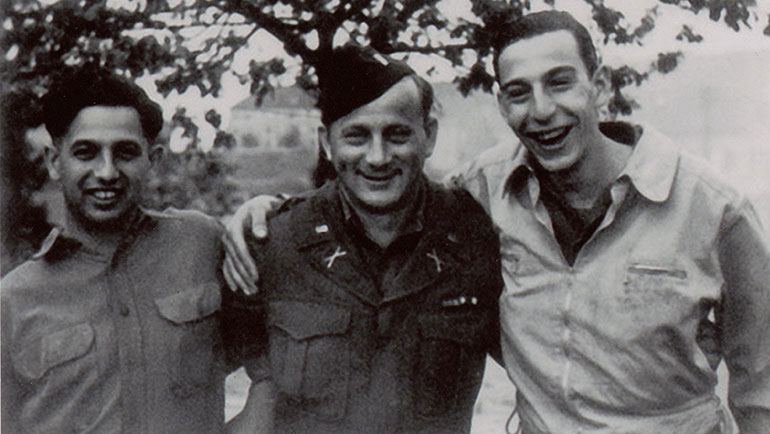
Germany capitulated on May 8, 1945. Thus, the Ritchie Boys marched back into the country where they were born. But they found their homes empty.
The Ritchie Boys then became part of the denazification program, an Allied initiative after World War II to remove Nazi influence from German society, culture, and politics by removing Nazi party members from positions of power, disbanding Nazi organizations, and trying prominent Nazis for war crimes. They also gathered evidence for postwar trials.
The Jewish soldiers prepared a questionnaire that had to be filled out by every German as part of the denazification process. One Ritchie Boy said that nearly every civilian with whom he spoke claimed to have worked for the Resistance. And many neighbors accused others of being pro-Nazi.
The Ritchie Boys led the country’s citizens on tours of concentration camps. Sometimes entire German towns were forced to pay respect to the dead. Photos of Nazi atrocities were placed in shop windows.
Ritchie Boy Fred Howard summed up his experience in the documentary: “It was an incredible immigration process.” Attesting to their successful immigration, the Ritchie Boys came home to America and went on with their lives. I was only able to find out how a few of the thousands of Ritchie Boys spent their lives after the war, but what little I found demonstrates the American Dream came true for them. You might even recognize a few of the names!
Werner Angress, history professor at Berkeley; Si Lewen, artist; Henry Kissinger, National Security Advisor and Secretary of State; Rudy Michaels, Sacramento Superior Court judge; Morris Parloff, psychiatrist with National Institute of Mental Health; J.D. Salinger, author of Catcher in the Rye; Richard Schifter, U.S. ambassador to the United Nations; Rudolph Schirmer, publisher of classical music.
Reprinted from Daily Journal, copyright 2025. Reprinted with permission.
Editor’s note: On Feb. 14, 2006, Congress issued House Concurrent Resolution 315, which states: “Resolved … that Congress urges the President to issue each year a proclamation calling on State and local governments and the people of the United States to observe an American Jewish History Month with appropriate programs, ceremonies, and activities.” Since then, annual proclamations have been made by Presidents Bush, Obama, Trump, and Biden each May.
Justice Eileen C. Moore of the California Court of Appeals is a decorated combat nurse who served in Vietnam with the Army Nurse Corps. A member of Vietnam Veterans of America, she is the author of two books, Race Results: Hollywood vs. the Supreme Court: Ten Decades of Racial Decisions and Gender Results: Hollywood vs. the Supreme Court.
This article is featured in the January/February 2026 issue of The Saturday Evening Post. Subscribe to the magazine for more art, inspiring stories, fiction, humor, and features from our archives.
Become a Saturday Evening Post member and enjoy unlimited access. Subscribe now
Comments
Remarkable story. Thank you!
I love the stories in the Saturday Evening Post. I am 79 years old and my father served in the ICB during WWII. He was stationed in INDIA and in the Army Air Force. He was a radio operator. I am from the South but now live in Montana, Gods country. I have been reading the Saturday Evening Post all my life. I love the Hazel cartoons.