This series by American studies professor Ben Railton explores the connections between America’s past and present.
On January 10, 1776, the English-born printer, journalist, and Revolutionary advocate Thomas Paine published the first version of his incendiary and important pamphlet, Common Sense. Paine’s arguments for the nascent American Revolution would become hugely influential, not only in the broad public conversation over whether and how the rebellion against England should continue, but also for the delegates to the Second Continental Congress and specifically the idea for the Declaration of Independence. Outside of the Declaration itself, no single Revolutionary text would be more crucial to the cause than Common Sense.

While Common Sense is well worth remembering here on its 250th anniversary, Paine’s pamphlet can also offer a perspective on the overlooked Revolutionary community known as the Loyalists, who demonstrated that the Revolution was fought not by or for a particular culture or community, but for a set of foundational ideals.
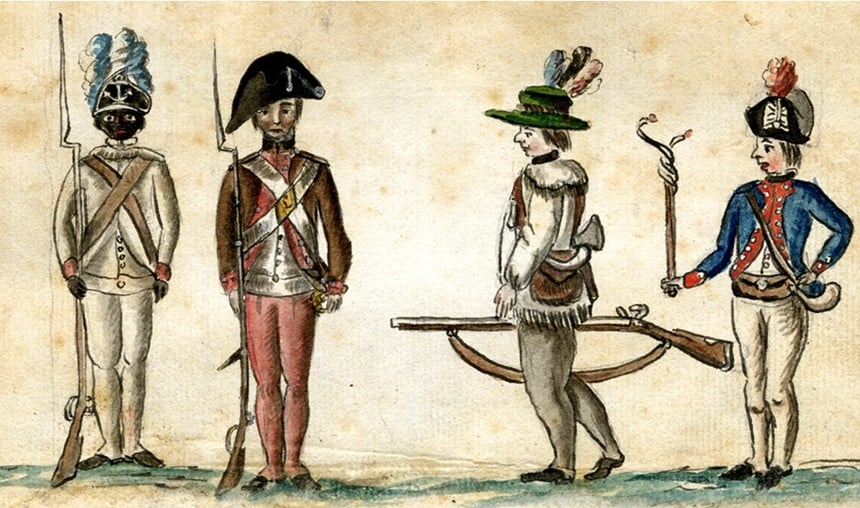
Loyalists (also known as Tories) were the community arguing for peace and a continued relationship with England. Unlike the British troops that are usually depicted as the adversaries against whom the Revolutionaries were fighting, Loyalists were fellow Americans, part of the same families and towns, colonies and regions from which the Revolutionary leaders, soldiers, and advocates emerged. In 1776, as throughout the Revolution’s early years, they comprised a sizeable community. And Thomas Paine’s pamphlet both reflects that Loyalist presence and helps us understand the Revolutionary arguments that opposed them.
Common Sense, first published in January 1776 and reissued in extended form in February, became a key set of arguments to which the Continental Congress delegates turned as they began debating and then drafting the Declaration of Independence. That Declaration would be explicitly addressed to both a global audience and the judgments of posterity: It begins with, “a decent respect to the opinions of mankind requires that [the Revolutionaries] should declare the causes which impel them to the separation”; and concludes, “We, therefore, the Representatives of the united States of America, in General Congress, Assembled, appealing to the Supreme Judge of the world for the rectitude of our intentions.” Although very much of its moment in its list of grievances against the King of England, this document was nonetheless both outward- and future-facing.

While Common Sense includes moments that point toward both a global audience and the judgments of posterity, in his pamphlet Paine is far more consistently addressing an audience of his fellow Americans, and more exactly those Americans who were either opposed to or were undecided about the incipient Revolution. He describes this intended audience as “the warmest advocate for reconciliation” with England, and in a famous and aggressive passage goes further in defining the various perspectives that make up that community:
Though I would carefully avoid giving unnecessary offence, yet I am inclined to believe, that all those who espouse the doctrine of reconciliation, may be included within the following descriptions.
Interested men, who are not to be trusted, weak men who cannot see, prejudiced men who will not see, and a certain set of moderate men who think better of the European world than it deserves; and this last class, by an ill-judged deliberation, will be the cause of more calamities to this Continent than all the other three.
Paine’s adversaries would certainly have disagreed with the tone of these descriptions, but he was unquestionably accurate about one thing: Loyalists were a large and multilayered American community in early 1776. Indeed, one of the most prominent battles in the months after the publication of Common Sense, the February 1776 Battle of Moores Creek Bridge in North Carolina, featured no British army soldiers; it was a conflict between Revolutionary (also known as Patriot) and Loyalist forces from the state. Those Loyalist forces included 1,400 immigrants from Scotland and 200 North Carolina backwoodsmen known as Regulators, reflecting the diversity that characterized the Loyalist cause.

Another 1776 battle, one that began just before the publication of the Declaration of Independence, further exemplifies both the diversity and the significance of the ongoing Loyalist movement. On July 1, 1776, Cherokee warriors, allied with Loyalist forces and responding to aggressive incursions onto their land by pro-Revolutionary settlers, began a military campaign against settlements in Virginia, North Carolina, South Carolina, and Georgia. Known as the Cherokee War, this conflict was inseparable from the larger Revolutionary War, and would continue until it was resolved with the May 1877 Treaty of DeWitt’s Corner. Such battles between Revolutionaries and combined Loyalist/Native American forces took place throughout the Revolution, and yet other indigenous communities allied with the Revolutionaries, reflecting the diverse coalitions on both sides of the conflict.
The conflicts between Revolutionaries and Loyalists didn’t just divide national, regional, and ethnic communities — they also were frequently found within families. No family exemplified such divisions more than the famous and fraught Franklins: William Franklin, the illegitimate but fully recognized son of Founding Father Benjamin Franklin (Ben and his wife Deborah raised William), was the Royal Governor of New Jersey and one of the most vocal Loyalists; and yet his own son and Benjamin’s grandson (William) Temple Franklin was an equally ardent Revolutionary, one who worked closely with Benjamin and who served as a diplomat in direct opposition to his father. The Revolution ultimately shattered William’s life, as he was imprisoned for two years in Connecticut and eventually fled for England in 1782. But it helped achieve Temple’s legacy, as he was the secretary for the American delegation to the 1783 Treaty of Paris that ended the Revolution.

Those divisions within American families and communities offer a crucial fact about the Revolution: that it was fought not by or for particular peoples (whether ethnic, regional, national, religious, or otherwise), but rather for a set of ideals by which the Patriots were inspired. Returning to Paine’s Common Sense, we can find countless expressions of those ideals, as when he opens by arguing that the “Object for Attention is the Doctrine itself.” He spells out an essential element of that Doctrine in the pamphlet’s most famous line, writing, “let a crown be placed thereon, by which the world may know, that so far as we approve of monarchy, that in America the law is king.” And in an equally prominent concluding passage, Paine makes clear why he is so committed to convincing his fellow Americans of the necessity and value of fighting for such ideals:
The Sun never shined on a cause of greater worth. ‘Tis not the affair of a City, a County, a Province, or a Kingdom; but of a Continent — of at least one eighth part of the habitable Globe. ‘Tis not the concern of a day, a year, or an age; posterity are virtually involved in the contest, and will be more or less affected even to the end of time, by the proceedings now.
Become a Saturday Evening Post member and enjoy unlimited access. Subscribe now