H Is for Hawk
⭐️ ⭐️ ⭐️ ⭐️
Rating: PG-13
Run Time: 1 hour 59 minutes
Stars: Claire Foy, Brendan Gleeson
Writers: Emma Donoghue, Philippa Lowthorpe
Director: Philippa Lowthorpe
This based-on-a-true story film about a woman who takes on the herculean task of training a goshawk as a way of coping with the death of her father — a fiercely attentive bird lover — could have been a straight-up, soaring tale of happiness born of heartbreak.
Or, it could have been what we get here: a scorched-earth study of self-destructive obsession; a cautionary tale of what happens when we allow our lives to feed on sorrows that are already consuming us.
Call me crazy, but I’ll take Door Number Two, thank you. H Is for Hawk, ultimately a story of hard-earned triumph over adversities external and within, challenges the viewer in ways few films of its type would dare to.
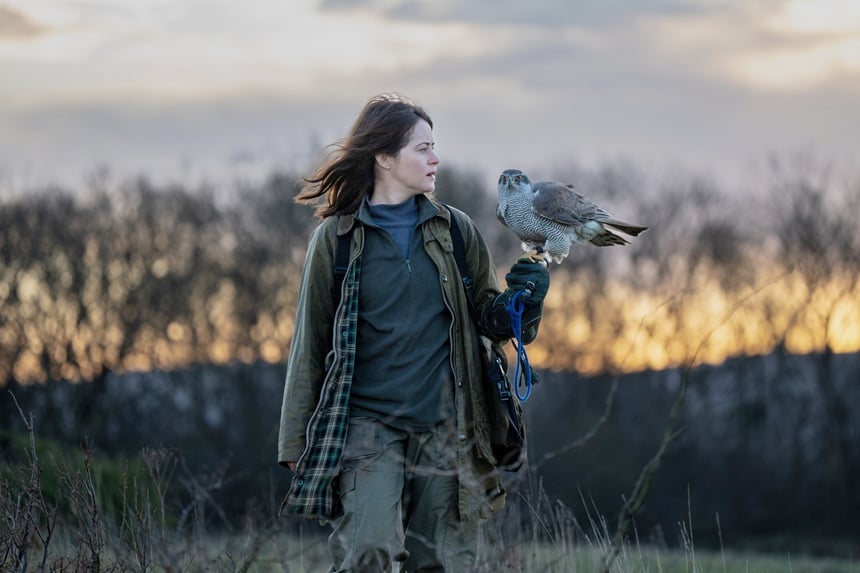
Claire Foy (young Queen Elizabeth on TV’s The Crown) is Helen, a Cambridge University graduate student who, even in the best of times, is uneasy in the company of fellow humans. She was raised in the fields of England, tromping up hills with her doting father (the always-imposing Brendan Gleeson), catching glimpses of wigeons and harriers and golden eagles and chatting endlessly about what winged wonder might be around the next bend.
Then, like a warbler falling from its roost, Helen’s dad suddenly dies. Crushed by the loss, she understandably decides to buy a bird. Less reasonably, she procures a wild goshawk — known by birders to be the most unruly, strong-willed thing on wings — intent on training it.
Enlisting the help of an old friend who has long experience training recalcitrant hawks (such people, it appears, actually exist), Helen spends long days in open fields training the bird — named, of all things, Mabel — to fly aloft and return to roost on her leather-clad arm. It’s a hit-and-miss process: Sometimes Mabel just takes off in a straight line with seemingly zilch intent to ever return, and Helen has no choice but to lope off in pursuit (prepare yourself for glimpses of Mabel chowing down on freshly killed bunny rabbits).
It is in these extended scenes that director Philippa Lowthorpe (The Crown, Call the Midwife) gives H Is for Hawk its wings, her camera racing across fields and over ridges with Mabel as she flexes her hunting skills. (In one breath-stealing sequence, Mabel pulls her wings tight to her body as she shoots, bullet-like, between impossibly close tree branches.)
Slowly, incrementally, Helen earns Mabel’s trust — and consequently, Mabel convinces Helen she’s here to stay.
“Here,” incidentally, is the living room of Helen’s university apartment, where Mabel spends nights sitting on her improbable perch, a leather hood over her eyes lest she lurch into the air chasing a wayward shadow or blown sheet of paper. As the bond between bird and birder strengthens, however, Helen slips her bonds with the rest of humanity. Her plan to ease the loss of her dad through bird training has, it turns out, had the opposite effect: The more time she spends with Mabel, the more bitterly she misses the man who inspired her love of birds.
There’s a quiet, yet harrowing tragedy to Foy’s portrayal of Helen’s descent into depression. She shuffles about the apartment, hollow-eyed and wild-haired, taking no real joy in her avian obsession yet possessed by it. Her concerned mother (radiant Lindsay Duncan) and now-disconnected friend (Denise Gough) come knocking with increasing alarm, but Helen hides in the shadows…and even shelters in a large cardboard box, leaving herself a view only of Mabel, silhouetted in a window, her head tilting curiously as the house is filled with the sound of tapping on the glass behind her.
H is for Hawk is based on a memoir, which leaves co-writer/director Lowthorpe little leeway when it comes to helping Helen resolve her depression. Indeed, there is no moment of revelation; no epiphany of parting emotional clouds. Instead, Helen emerges from her depression in the most realistic — and non-cinematic — way imaginable: through long reflection, re-connection with others, and re-evaluation of just what sort of relationship a child should maintain with a departed parent.
H Is for Hawk is, in the end, a lot like Mabel sitting on her living room perch: A little scary, undeniably beautiful, and quietly wise.
Become a Saturday Evening Post member and enjoy unlimited access. Subscribe now