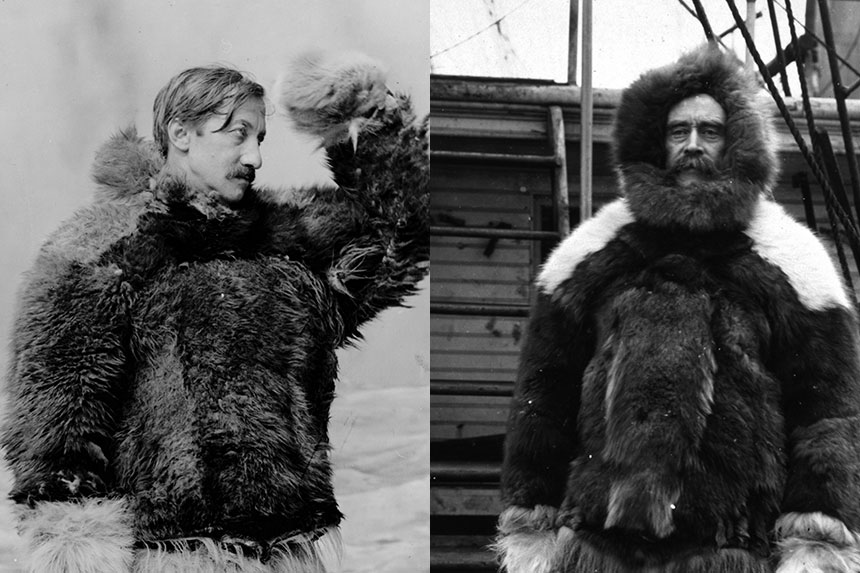
The steamer Hans Egede arrived at Lerwick, capital of the Shetland Islands in the North Atlantic, on a clear morning in early September 1909. A skiff was lowered into the water, and Dr. Frederick Cook and the ship’s mate rowed over to the docks where the herring boats delivered their catches for curing. After tying up, the men walked through a historic village of sandstone buildings to the hilltop telegraph station. When Cook handed over his handwritten message, the operator glanced up in surprise.
“Reached North Pole April 21, 1908,” began the telegram to the New York Herald.
The message went on to describe Cook’s discovery of land in the far north, and the promise of an exclusive report on the historic expedition for a fee of $3,000. The American would claim that in February 1908, he set out from the hunting settlement of Annoatok in Greenland. With him were nine Inuit, eleven sleds, and over a hundred dogs. About 360 miles from his goal, he sent most of the party back and continued onward with two top men, Ahpellah and Etukishook. The trio spent 24 days making a final push to the Pole.
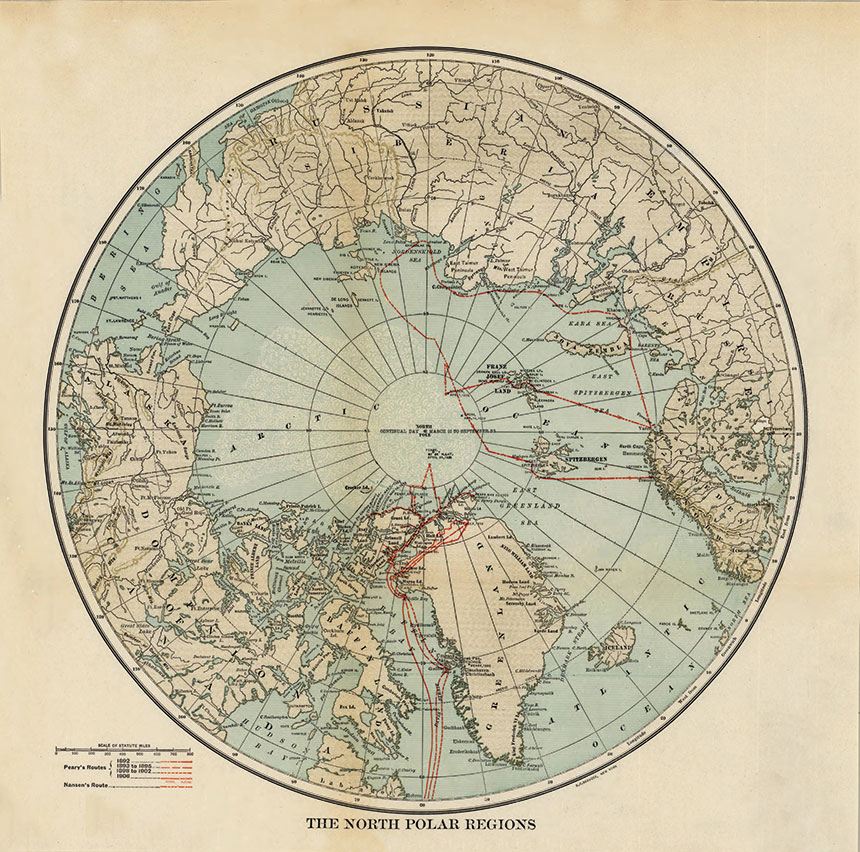
During the return journey, disaster struck when the pack ice broke up and their path was blocked by open water. They were forced to shelter in a cave on Devon Island until the following winter, desperately hunting for game to avoid starvation. When the sea refroze, they finally returned to Annoatok after 14 months of hardship. There they learned that everyone assumed they had perished. The lesser-known arctic explorer — the conqueror of Mount McKinley, called Denali in Alaska at the time — had surprised everyone once again. For decades, explorers had tried and failed to reach the elusive North Pole. Several infamous expeditions had ended with boats trapped or crushed by the drifting pack, with survivors setting out across the ice and often freezing to death. Now Cook’s party had braved the elements to achieve the crown jewel of exploration.
By the time the Hans Egede reached Copenhagen three days later, Cook was being hailed worldwide as a hero. Adoring fans and reporters gathered at the harbor, waving their hats and cheering. The smiling Cook wore the suit of a gentleman sailor and a mariner’s cap. He certainly looked the part of a rugged but aloof adventurer. For one thing, the 44-year-old had lost his front teeth during the expedition, though he soon had them replaced in the Danish capital.
Over the coming days, there were celebrations and banquets. Cook gave well-received lectures to packed houses. Various authorities in Europe and America had no reason to doubt Cook’s claim. They said they looked forward to examining the explorer’s data when he was ready to share his journals. Documentation of daily mileages, compass bearings, and astronomical observations was expected from record-seeking explorers to verify their discoveries.
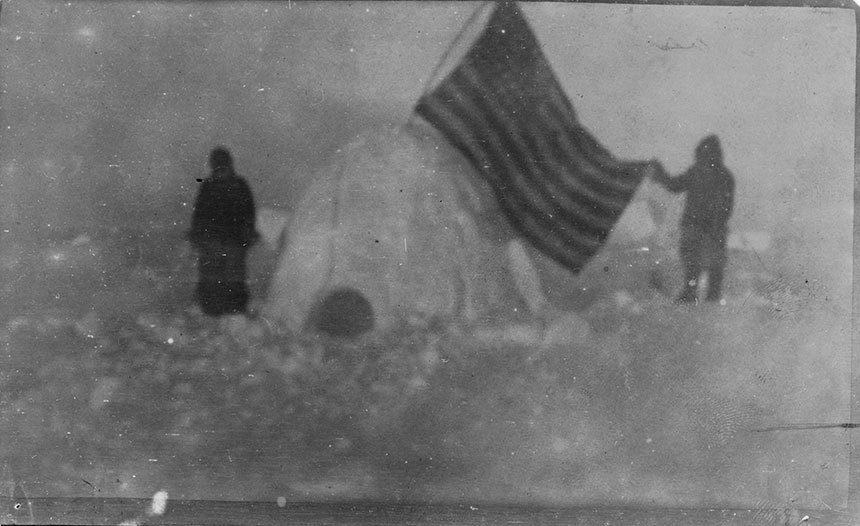
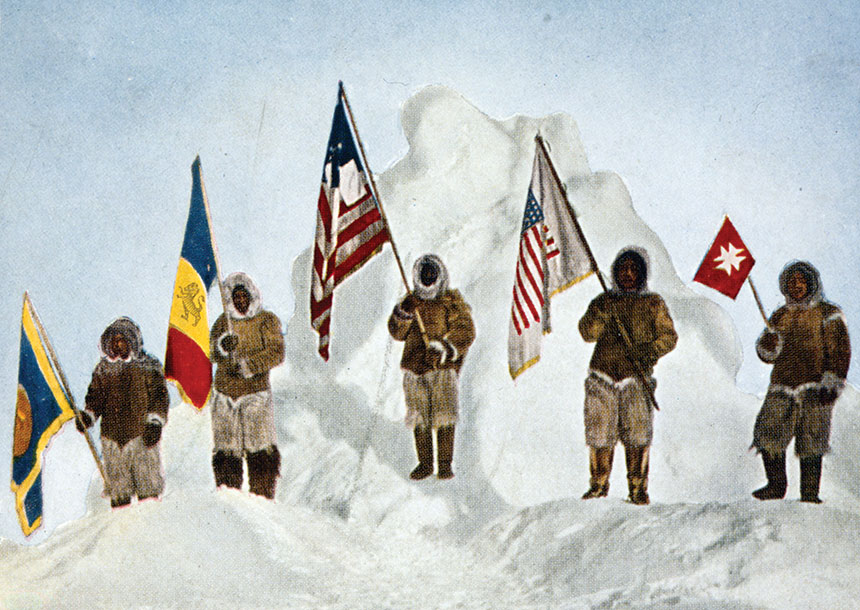
“Peary Discovers the North Pole After Eight Trials in 23 Years” was the headline in The New York Times on September 7, 1909. The article described how, five days after Cook’s declaration, the famous explorer Robert Peary emerged from the Arctic. He walked into a telegraph station at Indian Harbour in Labrador, Canada, and sent his own triumphant announcement.
“I have the pole, April sixth,” Peary had wired, with subsequent messages elaborating upon his claim. Peary was a 53-year-old U.S. Navy officer who was frequently sponsored by the National Geographic Society. He had spent decades developing the sledging practices and frozen routes to reach the North Pole. In the process, he’d lost all but two toes to frostbite. Yet he always trudged onward, never abandoning his dream of being first to reach 90 degrees north.
Upon returning to the edge of civilization, Peary was shocked to receive so little attention for what he expected would be the news of the century. When he learned the reason, he was furious. Peary considered Cook to be a trivial explorer with little chance of winning the prize. As a younger man, the latter had been a field surgeon for Peary during a lengthy Greenland campaign in the early 1890s. Peary was initially impressed by Cook, whom he judged to have a calm temperament, positive attitude, and the requisite physical endurance.
However, the two men had a falling out when Cook sought permission to publish a book about the expedition. The domineering Peary refused. Lacking the influential backers that Peary had long cornered, Cook embarked on his own series of shoestring expeditions to the far north. After completing an impressive first circumnavigation of Denali in 1903, he returned three years later to bag the summit of the tallest mountain in North America. With this feather in his cap, Cook found enough notoriety to line up a single benefactor for a longshot bid at the Pole.
To investigate Cook’s claim, Peary arranged an interview with Ahpellah and Etukishook. With a damning transcript in hand, Peary felt satisfied enough to wire a rebuttal to The New York Times.
“Cook’s story should not be taken too seriously,” Peary wrote. “The Eskimos who accompanied him say that he went no distance north. He did not get out of sight of land.”
The public response was, once again, not what Peary expected. Most of the establishment, including wealthy businessmen and esteemed members of the National Geographic Society, stuck with the celebrity explorer. Everyone else was firmly on the other side. The general public viewed Cook as a plucky underdog competing against a sore loser who belonged to the elites.
Cook particularly helped his case by maintaining a congratulatory and professional demeanor toward Peary. As the controversy deepened, and Peary’s wrath grew, Cook refused to publicly criticize his rival.
“I believe him!” Cook once said. “There is glory enough for us all!”
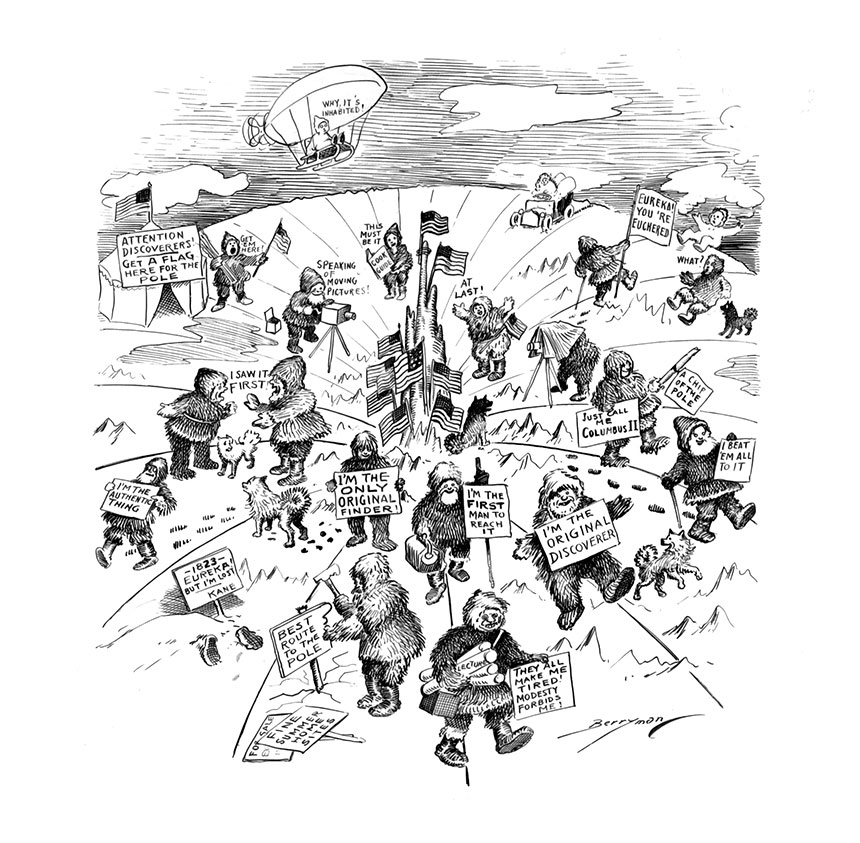
“We Believe in You” read a banner in Brooklyn. A hundred thousand spectators lined the parade route welcoming home Frederick Cook in late September. He was a native son, the child of German immigrants. After falling into poverty at age 5, when his father suddenly died, the tenacious Cook had worked his way through medical school. He was a self-made man who epitomized the American Dream, and every one of his fellow citizens seemed to have an opinion on the matter. Several newspapers conducted polls, including one by the Pittsburgh Press that reported 73,238 voters sided with Cook. Only 2,814 believed Peary.
Adding to the controversy was the fact that neither explorer had yet shared any proof of their polar accomplishments. Cook claimed he’d left his documents in the far north, for safekeeping, where they’d been lost. Peary said he was withholding his data so that the impostor Cook couldn’t steal the figures. As a result, the issue devolved into a debate about which one of them made it that was based upon the character and pedigree of each man. So, Peary and his allies launched a new front in their discreditation campaign.
In October 1909, Edward Barrill arrived in New York City with a wild story to share about the Denali expedition three years before. After failing to find a southern route up the mountain, the main party had been retreating toward the Pacific Coast during late summer of 1906. Along the way, Cook suddenly decided he wanted to split off and perform some foothills reconnaissance for next season’s attempt. He invited Barrill to be his lone partner. When Cook returned to civilization, he announced to the world that the two men had reached the top of the continent. Barrill went along with the ruse in hopes of making some money. Now the remorseful accomplice signed a sworn affidavit admitting it had all been a lie.
Regarding Denali’s summit at 20,310 feet, Barrill said the two men never got closer than 14 miles, nor did they ever climb higher than 8,000 feet. The dramatic summit photo that Cook had published to great acclaim? Staged on a minor outcropping that would come to be called “Fake Peak.” During their homebound journey, Cook had borrowed Barrill’s journal and doctored the entries that later were used as proof.
Supporters of Cook seethed that Barrill could not be trusted. They correctly surmised that he was being paid by the Peary camp to offer his testimony. However, other members of Cook’s 1906 Denali attempt soon came forward to corroborate Barrill’s account. The expedition photographer said that Belmore Browne had emerged as the strongest mountaineer in the party, serving as de facto leader when Cook kept leading them astray.
Browne and other members insisted the nature of the mountain made Cook’s claim impossible. Called the “High One” in local Athabascan, Denali was a massif that rose 18,000 feet above the surrounding tundra. Though there were taller mountains in the world, Denali had the greatest rise on land from base to peak. There was no way Cook and Barrill could have reached the summit during the brief time they were alone.
“I knew it in the same way that any New Yorker would know that no man could walk from the Brooklyn Bridge to Grant’s Tomb in ten minutes,” Browne later wrote.
Cook’s response was a mix of surprise and denial. He was given several opportunities to defend himself from both scandals, with invitations to testify before the Explorer’s Club and the National Geographic Society. Not only did Cook refuse to appear, but he soon claimed exhaustion and left the country. He was later spotted in Copenhagen, where he failed to renew any support from the Danish authorities who had once extolled him.
The public backlash against Cook was swift and severe, at home and across the world. Only the occasional die-hard fan continued to defend him. Most observers begrudgingly admitted that Peary was right after all. He’d been first to the North Pole. However, the adulation that the connected explorer sought never materialized, due to unfavorable impressions that formed during the scandal. The whole affair was dismissed as a farce. Numerous editorial cartoons lampooned both men, sometimes depicting them as children or brawlers slugging it out on pack ice.
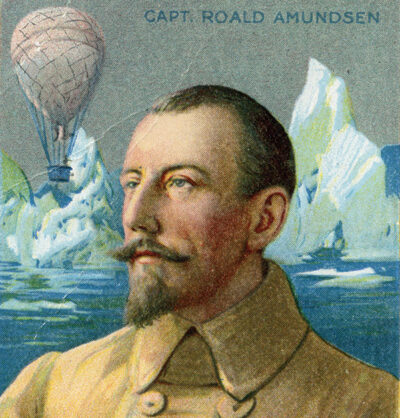
When Peary agreed to submit his records to the National Geographic Society, the quick confirmation seemed almost perfunctory. A few observers raised concerns that Peary’s claims seemed equally improbable. One critic was Roald Amundsen, the daring but fastidious Norwegian explorer who would successfully ski to the South Pole in 1911. However, few people seemed to care anymore. Not about the North Pole and not about Denali.
In time, Robert Peary’s 1909 claim on the North Pole would also be mostly debunked. After seven expeditions over two decades had come up short, the fatigued and aging Peary knew his eighth attempt would likely be his last. On April 1, 1909, he found himself out on the pack ice. He was the closest he’d ever been, but still 133 miles south of the Pole. Each day, they managed to sledge about 10 miles, at most 17. Sometimes it was less, given how often they had to navigate around pressure ridges of jagged ice or dangerous gaps of open water.
Then Peary made a particularly suspicious decision, sending back his second-in-command and strongest sledge driver, Bartlett. He was the only other expedition member capable of using instruments to verify the leader’s distances, bearings, and astronomical observations. Once Bartlett was gone, Peary, along with a personal assistant and four Inuit, made an improbable dash to the Pole in two-and-a-half days. Then he was back at Indian Harbour in Labrador four-and-a-half days after that.
To accomplish this incredible rate of travel, Peary’s small team would have had to cover a total distance of 429 miles in a week. Sledging an average of 60 miles per day, across the rough terrain of drifting pack ice, would have been a feat that had never been accomplished before. Nor has such speed been repeated since, though some Arctic adventurers have tried.
For pointing out these concerns, Roald Amundsen and other contemporary skeptics were mostly dismissed by the exploring establishment of the era. The Norwegian shrugged off the criticism, skied to the South Pole, and then became the first explorer to verifiably reach 90 degrees north as well. Only a few days before Amundsen arrived, yet another explorer had claimed to fly over the Pole in a propeller plane. His unverified claim was later debunked, whether due to mistaken navigating or purposeful fraud.
On May 12, 1926, Amundsen and a party of American and Italian adventurers floated over the North Pole in an experimental blimp. Because Peary’s claim remained widely accepted at that time, they didn’t know for certain that they were the first. They didn’t seem to care. They went because they wanted to see what was there.
The North Pole was a beautiful but obscure point that generations of brave explorers had sought to reach. There was no continent nor land of any kind. It was a frozen region that became the final resting place for many lost souls — including Amundsen. He would disappear in the Arctic two years later during a failed rescue mission to save other explorers.
The northernmost point on Earth was a serene expanse of drifting ice with an uncertain history of haunting lies.
From the Archive: Keeping Score
Like everyone, The Saturday Evening Post was following the North Pole controversy with interest but with perhaps a less serious stance on the whole hullabaloo:
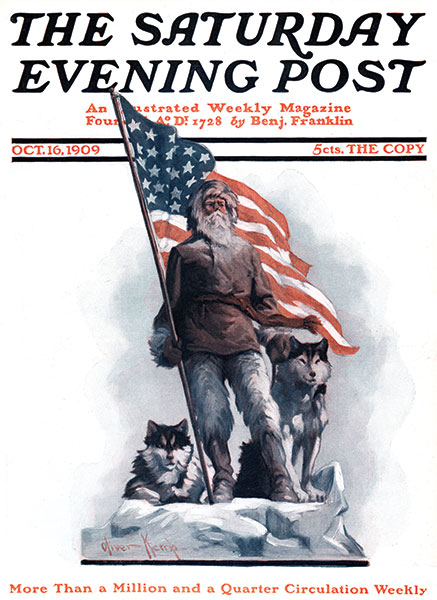
And so this Cook-Peary controversy is practically settled! Up to the hour of going to press the score stood as follows:
Cook Peary
Columns of newspaper notice 17,869 9,453
Times portrait was published 1,387 783
Dinners 369 0
Cash receipts $21,846 $3,427
Commander Peary is a good, deserving man, but it seems quite impossible that he should overcome this enormous lead. Regretfully we consider him as good as beaten. His expedition was well planned and up to the very culminating point it seems to have been conducted with admirable ability. But in the final crucial dash to the front page, the grub, and the box-office, he played — to borrow a sporting phrase — on a dead card: He got off on a blind lead and marooned himself, while his more fortunate competitor took possession of the goods.
As to which of the two discovered the Pole, that, of course, is immaterial. It is generally conceded that several Scandinavians came to America long before Columbus; that an Italian, and not Henry Hudson, discovered the river which bears the latter’s name; that Fulton did not invent the steamboat. Probably the verdict of history will be that Swan Johnson, of Minneapolis, discovered the North Pole in 1914, while trying to find his way home from a Sons of Thor lodge meeting.
—“The Discoverer of the Pole,”
Editorial, November 6, 1909
Mike Bezemek is an author of five books, including Discovering the Outlaw Trail and Space Age Adventures. His work has appeared in Outside, Smithsonian Magazine, Men’s Journal, National Parks Magazine, and others. For more about the author, visit mikebezemek.com.
Excerpted from Mysteries of the National Parks: 35 Stories of Baffling Disappearances, Unexplained Phenomena, and More, Copyright © 2025 by Mike Bezemek. Used with permission of the publisher, Sourcebooks. All rights reserved.
This article is featured in the March/April 2026 issue of The Saturday Evening Post. Subscribe to the magazine for more art, inspiring stories, fiction, humor, and features from our archives.
Become a Saturday Evening Post member and enjoy unlimited access. Subscribe now