Being born in Florida but raised in Indiana, I never felt like I truly fit in with my Hoosier peers. I read Cross Creek in elementary school, and Marjorie Kinnan Rawlings’s depiction of rural Depression-era Florida shaped how my young mind imagined “my” Florida: an enchanted land of orange groves and winding waters. When I found myself back in Gainesville last December, I knew a trip to Cross Creek was in order.
That visit to the Marjorie Kinnan Rawlings State Park found me in the midst of a thinning citrus grove, its sparseness due in part to the invasive citrus psyllid. These tiny insects transmit a bacterial disease known as citrus greening, and no treatment or cure is currently available; once a tree is infected, it will eventually die. Spanish explorers were responsible for introducing citrus trees to Florida, and it’s hard to imagine a Florida without oranges. In fact, the official state flower is the nonnative orange blossom.
Restoration does not always mean returning a place to what it once was. Ecological restoration, as defined by the Society for Ecological Restoration, is not about re-creating a frozen moment in time; rather, it is about helping landscapes recover along a path that makes sense for the place, history, and present conditions. When systems have been transformed beyond easy repair — as with Florida’s citrus groves — restoration asks us to look ahead, using history as a guide rather than a blueprint. The same logic applies to home landscaping: Restoration at any scale is less about perfection than it is direction.
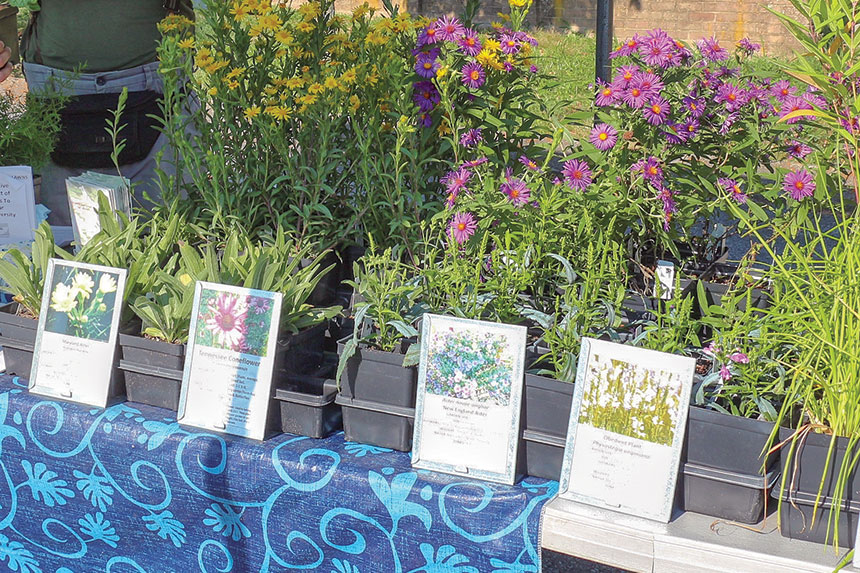
Each spring, that question of direction begins to take shape with the return of native plant sales. Their rows of trays, handwritten labels, and colorful pictures can spark a kind of runaway vernal enthusiasm at once exciting and overwhelming. To avoid decision fatigue and future letdown, it helps to step back and ask a simple but important question: What is my site like?
Spend time in your space and make a few observations. Notice the amount and quality of light, moisture levels, general soil characteristics, and any practical constraints (space, HOA regulations). Understanding the conditions in your space inevitably rules some things out, but it yields clarity that steers you toward plants suited to where you’re asking them to grow.
After you take stock of your site, you may be surprised by how many options remain. With so many worthy choices, it can be tempting to collect one of everything. But a few species planted in meaningful numbers with seasonality in mind will do more to support pollinators and recolonize a space than a long list of single specimens.
While all native plants play a role, some do more ecological work than others. Tools like the National Wildlife Federation’s Native Plant Finder
(nativeplantfinder.nwf.org) help narrow those choices by highlighting plants and trees that support the greatest number of insects, an essential foundation of the local food web.
Some homeowners’ associations are slower to embrace the wilder edges of native plantings. Fortunately, many short-stature native plants offer ecological value while still fitting within more traditional expectations.
Choosing native plants is ultimately less about the plants themselves than the relationships they make possible, between insects and birds, soil and water, people and place. When we plant with attention and humility, we participate in restoration not as an act of nostalgia, but as a forward-looking practice rooted in care.
Mary Margaret Moffett is an ecologist and Advanced Indiana Master Naturalist.
This article is featured in the March/April 2026 issue of The Saturday Evening Post. Subscribe to the magazine for more art, inspiring stories, fiction, humor, and features from our archives.
Become a Saturday Evening Post member and enjoy unlimited access. Subscribe now