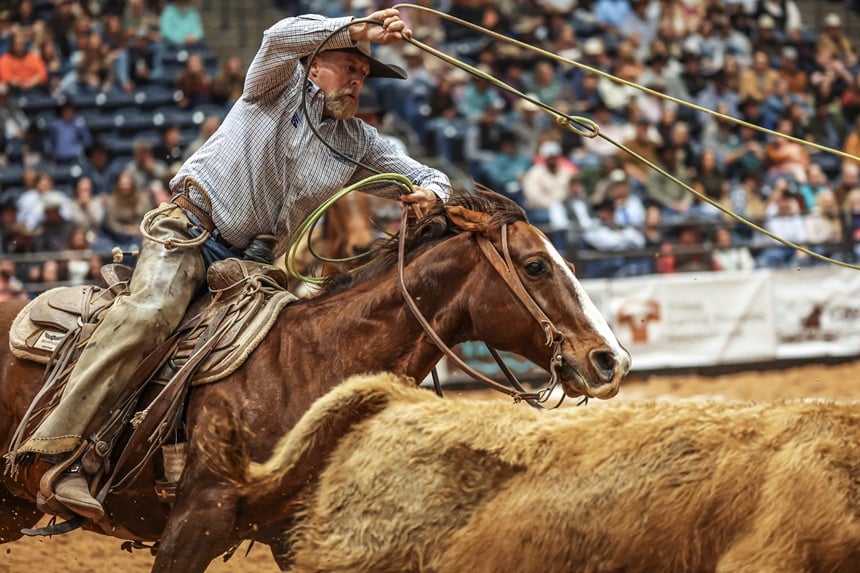
Dust clouds the November night under the generator-powered lights behind the Amarillo Civic Center. In the surrounding parking lots, cowboy hat-wearing fans weave through a maze of sedans, crossovers, oversized pickups and horse trailers. Four riders cross the street as a group, their horses’ hooves clopping over the asphalt, and head towards the tunnel into the arena.
Inside, booths fill the hallways and a banquet-sized room, selling everything from custom saddles to Western wear and artwork. Cowboys call out to friends from other ranches; families stream towards the arena. The entire center buzzes, the energy punctuated by the announcer’s calls.
By most standards, the Working Ranch Cowboy Association (WRCA) World Championship Ranch Rodeo looks like any other, until you realize the competitors wear shirts bearing their ranch’s name, not sponsorship badges. Randy Whipple, treasurer of the WRCA and one of its founding members, explains that’s because they work full-time or as day workers (contractors) for the ranches they represent.
Ranch Work As Rodeo
The participants also don’t compete in the same events as those in Professional Rodeo Cowboys Association (PRCA) rodeos. Instead of barrel racing, teams race against the clock to pen stray cattle; instead of bull riding, they “brand” cattle using an iron brand dipped in flour. Competition replicates the work they do on the ranch.
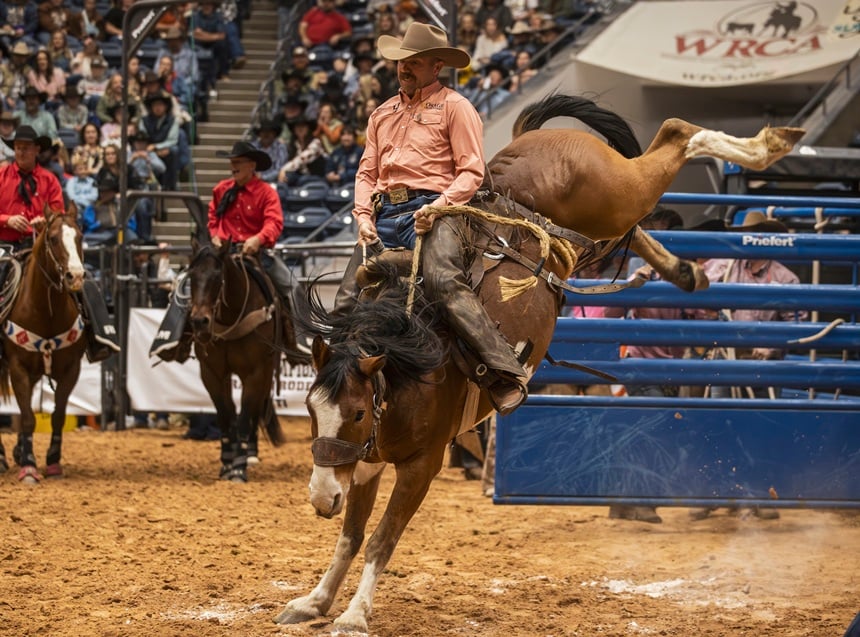
Even events shared by WRCA and PRCA rodeos can be very different. In the documentary, 20 Years of World Championship Ranch Rodeo, eight-time professional rodeo world champion Larry Mahan says professional bronc riders use a saddle designed to help them keep their legs above the horse’s shoulders. Competitors in the WRCA version use a standard ranch saddle.
At times, those differences can make WRCA events more dangerous. For example, PRCA team roping begins with a cow’s release from a chute. Two riders pursue, roping its head, then its heel. The concept is the same for the WRCA’s stray gathering event, except a ranch team of four divides into two. Each set of partners works simultaneously to separate their cow from the herd and rope its head and heels, sometimes leading to crashes.
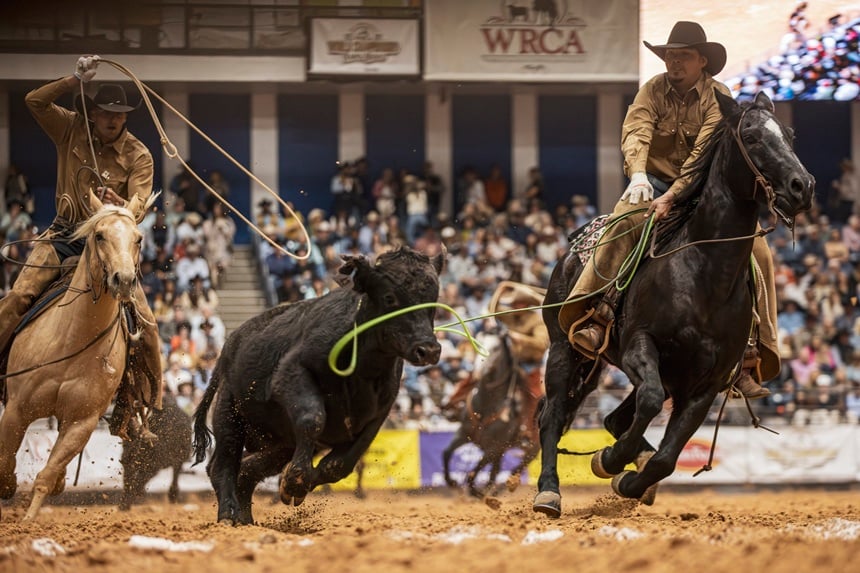
Whipple says the WRCA’s goal is to preserve ranching heritage, so they try to make each event as authentic as possible to what happens on the ranch. For example, when teams compete in stray gathering, they use skills similar to those necessary to administer a vaccination in the field. Bronc riding mimics breaking in young horses, while penning and branding are common tasks on a ranch.
The crowd favorite event, wild cow milking, is the exception. Ranch hands rarely rope and milk cows in open spaces today, but the event requires the skills they use daily — expert horsemanship, roping, and teamwork — to earn the fastest time.

Getting to the World Championship
Founded in 1995, the WRCA hosts two dozen ranch rodeos from March through September, and the winning teams at each receive an invitation to compete at the World Championship in Amarillo in November. Rodeo proceeds fund the WRCA Foundation, which helps support members experiencing financial hardship due to injury, illness, and natural disasters.
Teams generally have five members, although Whipple says you can bring a sixth who sits out, or you can compete at a disadvantage with just four. It’s not unusual to see multiple generations — sometimes even grandparent, parent, and teen — riding together, and Whipple estimates about half of the teams have female team members.
Even though the competitors must work full-time on the ranch, nothing precludes them from participating in professional rodeos on weekends, and some do. But rodeo never comes first; ranching does.
“It’s not the main thing for us,” says Willie Barron, who has participated in WRCA rodeos since the early 2000s but never in a professional rodeo. “It’s our opportunity to play.”
Barron says there is a lot of work leading up to participating in a rodeo, though. As part of the dual ranch team Barron-Highsmith & Short Ranches, he and his teammates — Matt Strickler, Jake Dykes, Armando Rodriguez, and TJ Hendricks — practice the skills they need for competition daily as part of their ranch work, but they occasionally meet to train as a team.
Last November, their work paid off when the team won the 30th WRCA World Championship. Individually, Dykes took top honors by earning the Top Hand award for his horsemanship, skills, and teamwork abilities.
Luck of the Draw
No matter how much you hone your skills, a win comes down to knowing your horse and teammates and, to an extent, some luck. Barron says rodeo can throw so many curves that it doesn’t take long for your plans to go awry. He uses sorting cattle as an example.
“You have 30 heifers standing out there, you’re riding four horses, and there’s four cowboys,” he says. “That’s 38 brains in one arena. It doesn’t take long for something to go wrong.”
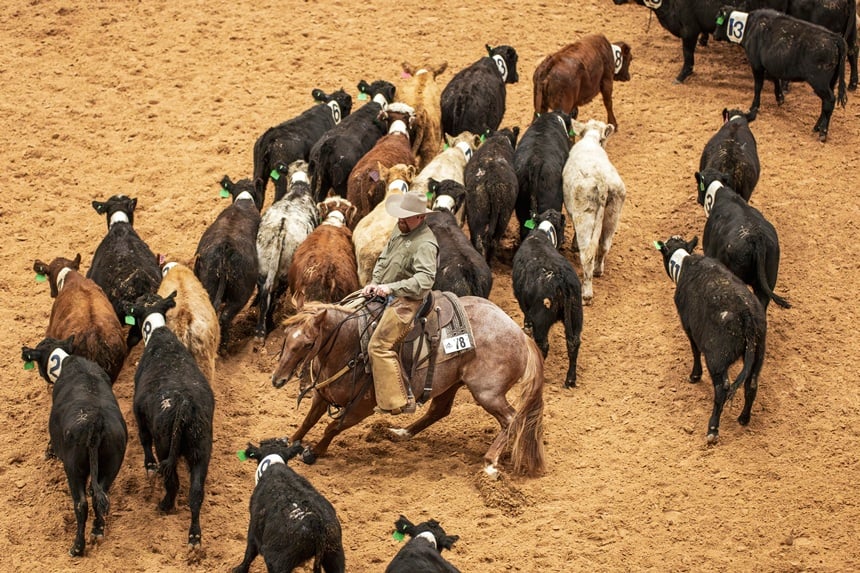
When that time comes, you have to rely on your experience as a team, he continues. You have to trust that your teammate is going to do his job and anticipate how he is going to react, so you can take the actions you need to. But that’s what you’d do on the ranch, too.
Luck factors in a team’s performance, but experience and skill help bring home a buckle. Championship aside, winning at any WRCA rodeo is a big deal because it signifies you’re among the best in the ranching world, according to Whipple. It also earns your team an invitation to Amarillo.
A Ranching Legacy
The World Championship kicks off on Thursday night with the grand entry of the teams, many carrying the flag of the state they represent. Half of the teams compete that night, half the next. On Saturday, cowboys age 5 to 16 compete in the WRCA Youth World Championship Ranch Rodeo. The adults’ rodeo concludes on Sunday when a new champion is crowned.

Although it doesn’t come close to the Wrangler National Finals Rodeo (the PRCA’s championship rodeo) grand prize of nearly $114,000, the WRCA awards its championship team $15,000 to $20,000, a $50,000 stock trailer, bronze trophy, and a sign they can put on their ranch gate announcing their win. Each team member also gets a buckle and custom-made saddle.
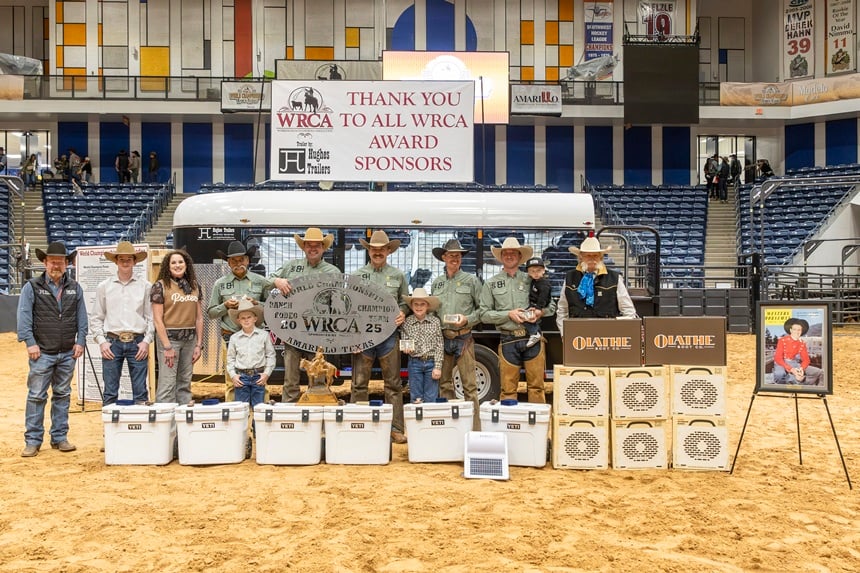
Additionally, the top three teams split roughly $200,000 worth of prizes, ranging from spurs, bits, and saddle pads to Yeti gear, and all World Championship participants receive a WRCA shirt and jacket.
Barron says he didn’t set out to win for the prizes.
“I don’t give a rip about the buckle or the trailer or the saddle,” he says. “I just care that my kids saw me work towards this goal and achieve it.”
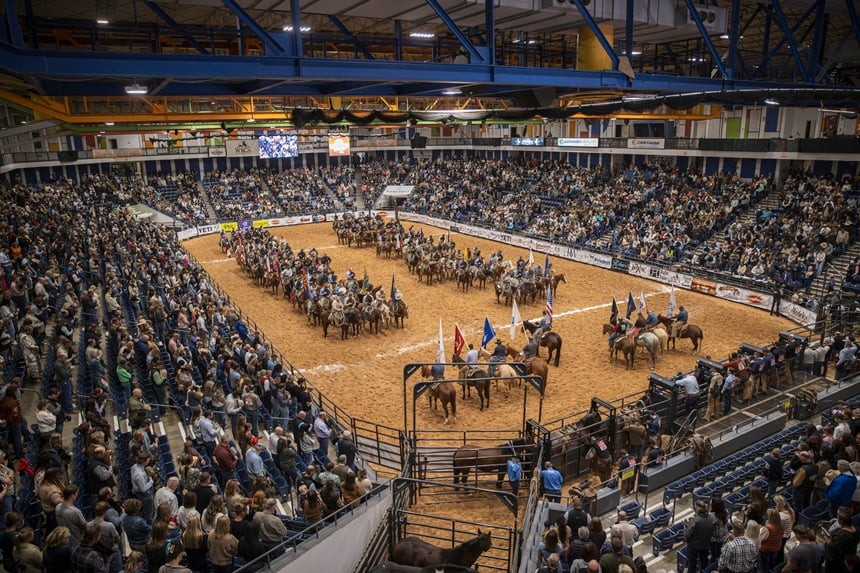
Providing for the next generation is at the heart of everything the WRCA does, according to Whipple. The association hosts youth rodeos to get kids excited about ranching life, whether they are participating or watching. Its foundation provides financial assistance when there’s a crisis or natural disaster so parents can continue running the ranch and pass it on to their children. Additionally, it offers scholarships for that next generation.
Just as important, though, the WRCA gives all rodeo spectators an appreciation for what cowboys and cowgirls do on a ranch every day to, as Whipple puts it, “put that steak on your plate.”
Become a Saturday Evening Post member and enjoy unlimited access. Subscribe now