Senior managing editor and logophile Andy Hollandbeck reveals the sometimes surprising roots of common English words and phrases. Remember: Etymology tells us where a word comes from, but not what it means today.
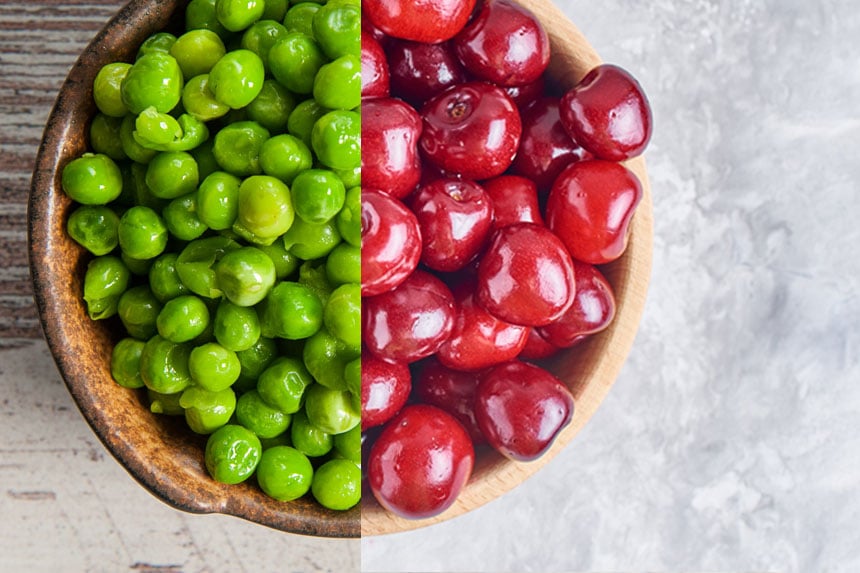
When planning a nice meal, peas and cherries aren’t the best pairing because, culinarily, their flavors don’t blend well together. They are too unalike.
But etymologically, the words pea and cherry share an uncommon trait that binds them together: They are both mistakes.
Old English had the word part ciris — it’s related to the German Kirsch — for words relating to a tasty little red drupe. I say “word part” because it wasn’t used alone but as part of larger terms; for example, ciristreow was a cherry tree, and the edible bit was a cirisæppel. (Both words begin with the “ch” sound in child.)
In Old North French, however, the word cherise could stand alone. English speakers started to hear a lot more French after the Norman conquest, and over time, the ciris- words were abandoned in favor of the French. However, the English often mistook the word’s final z sound (which appeared in the middle of the Old English terms) as an indication that the word was plural. Hearing something akin to “cherries,” they back-formed the singular version cherry. The mistake was common enough that it became set in the language.
The same thing happened with pea, only not so long ago. In Middle English, pease (plural pesen) was the name of the tiny edible green spheres and the plant that they grew from. The word was a mass noun when it referred to the edible parts: You might have a bowl of pease just as you might have bowls of rice and corn (as opposed to rices and corns). But around the 17th century, more and more people mistook the z sound as a plural marker and then chose a logical-sounding singular; soon, they could pluck a single pea from a bowl full of peas.
And yes, pease is — or peas are — the primary ingredient in the food mentioned in that old nursery rhyme “Pease porridge hot, pease porridge cold, pease porridge in the pot nine days old.” (Ick.)
Both cherry and pea can be traced back to Greek:
- Greek kerasos “cherry tree” > Late Greek kerasian “cherry” > Vulgar Latin ceresia > Old North French and Anglo-French cherise
- Greek pison “pea” > Latin pisum > Late Latin pisa > Old English pise > Middle English pease
This word formation through a mistaken plural isn’t terribly common in English, but there’s a third word undergoing the change today. Like the others, it’s from Greek, but it isn’t something you eat.
British university students picked up the word kudos (at the time pronounced KOO-doss) in the early 1800s. It’s from the Greek kydos “glory, fame,” and I imagine they stumbled across it while studying The Iliad and The Odyssey.
Kudos is singular — or at least it was — but it would be paired with some rather than a, just like how you would say “some praise” rather than “a praise.” That made it seem more plural than it really was.
A century later, English speakers had back-formed the more singular-sounding kudo to describe “a compliment” or “an award.” Today (another century after that), although some sticklers still insist that kudo “is not a word,” it is common enough that it gets its own dictionary entry.
Become a Saturday Evening Post member and enjoy unlimited access. Subscribe now