Senior managing editor and logophile Andy Hollandbeck reveals the sometimes surprising roots of common English words and phrases. Remember: Etymology tells us where a word comes from, but not what it means today.
Around the year 1317, a Franciscan friar known as Odoric of Pordenone set off from Venice and headed east, hoping to see the world and to do the Church’s work throughout Asia. For 12 years Odoric wandered the land, stopping in at established churches and known Franciscan houses, baptizing nearly 20,000 people, but above all experiencing cultures extremely removed from the Italian life he had known.
He wasn’t the first to make such a journey, of course: When Odoric began his travels, Marco Polo, who had spent two decades in the East before returning to Venice, was still alive. The stories of his adventures — which were recorded (and likely embellished) by Rustichello da Pisa, based on Polo’s oral recounting, and published around 1300 — would have been known to Odoric, and likely piqued his interest in the “exotic” east.
Friar Odoric journeyed as far east as Hangzhou, just inland from the East China sea, and as far south as Java. When he returned to Venice in c.1329, he had some amazing stories to tell: Rhubarb! Men with long fingernails! Paper money!
And tell it he did, to a younger friar who wrote those stories down in Latin. That manuscript was copied and distributed throughout Europe. Given the state of printing and literacy in the 1300s, Odoric’s tales were wildly popular — so much so that authors and publishers plagiarized them for decades.
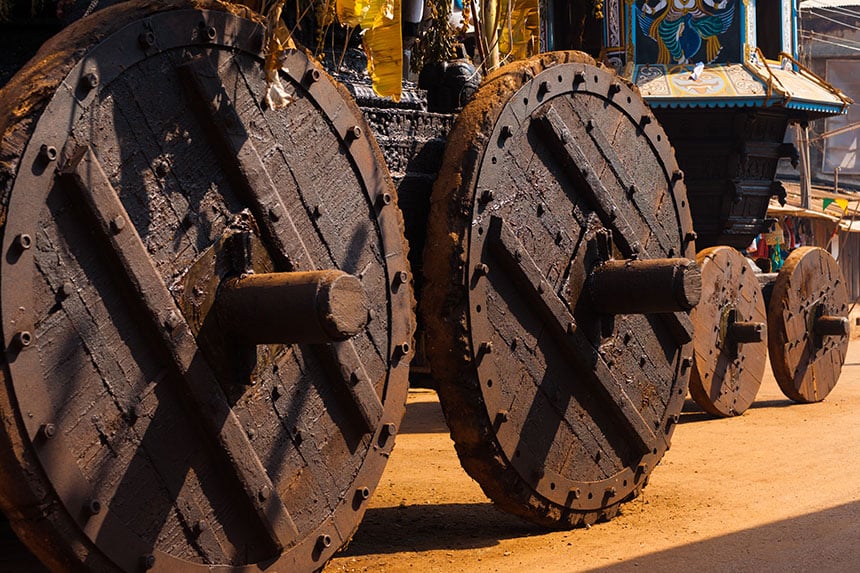
One story of interest to the etymology-minded occurred in India. During a village-wide celebration of Krishna, the eighth avatar of Vishnu, a massive rolling carriage bearing a representation of Krishna rolled through the streets. According to Odoric, devotees would sacrifice themselves to Krishna by throwing themselves beneath its wheels.
That sacrificial part was probably a misunderstanding, exaggeration, or simple embellishment; nonetheless, it appealed to readers who were hungry for stories of the exotic and incredible.
The Krishna of this celebration was given the title Jagannath, literally “master of the world” — from Sanskrit jagat “all that moves, the world” and natha “lord, master.” Of course, in India that title would not have been written in the Latin alphabet. Odoric brought the name back with him to Italy, where it was transcribed into Latin.
The story and the name spread through Europe and among its many languages, including to English speakers, where, according to the World English Historical Dictionary, it has appeared in print in myriad ways, including Iaggarnat, Jaga-Naut, and Jaggernat.
Today, after suffering the slings and arrows of outrageous language change, the word is now juggernaut. Divorced from its Hindu roots, it still carries with it the sense of something — a vehicle, a force, a campaign — that moves forward and crushes whatever is in its path.
Odoric was beatified in 1755 by Pope Benedict XIV.
Become a Saturday Evening Post member and enjoy unlimited access. Subscribe now