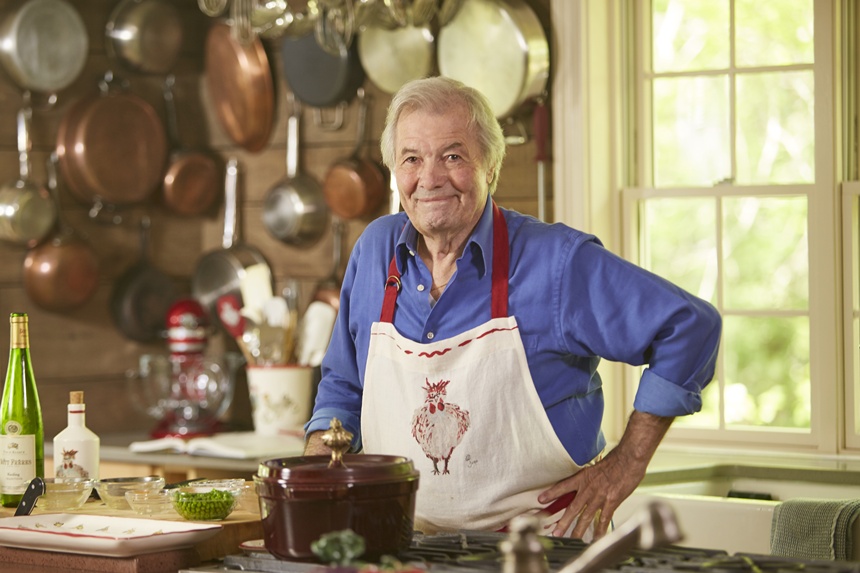
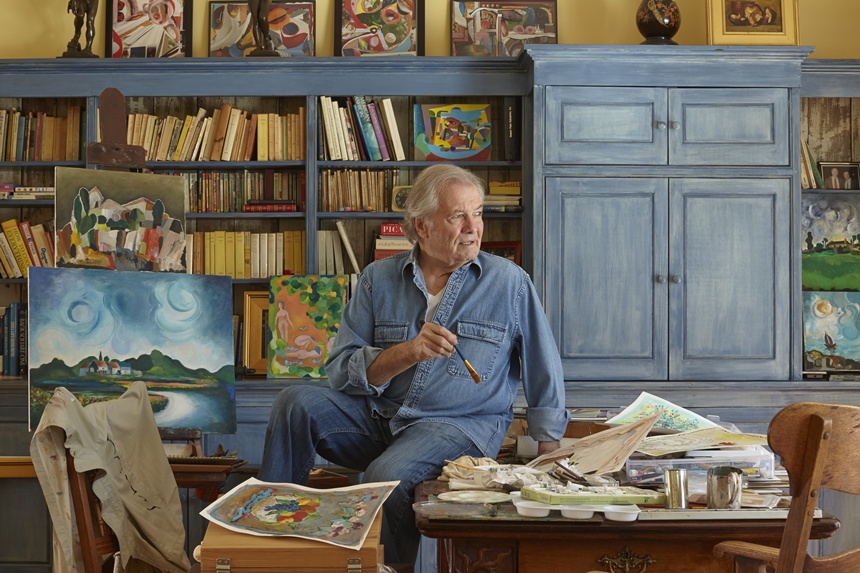
Renowned chef Jacques Pépin, now in his nineties, has spent a lifetime showing that cooking can be both elegant and accessible. At the heart of his work is the simple idea that cooking and art are acts of generosity. Whether in the kitchen or at the easel, he returns to the same principles: Use what you have, pay attention, and take pleasure in the process. It is a quiet philosophy, but one that has shaped a remarkable life and continues to inspire anyone who cooks.
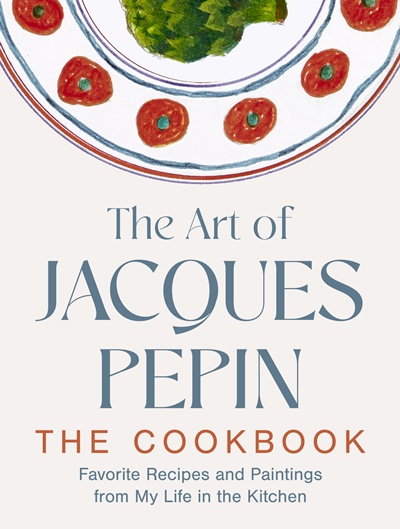
His newest cookbook (his thirtieth), The Art of Jacques Pépin, features family recipes alongside his own drawings, landscapes, and illustrated menus, and offers a reminder that good food, like good art, is made with attention, restraint, and a sense of joy.
Irene Rawlings: How would you describe the relationship between art and cooking?
Jacques Pépin: There is a deep relationship between art and cooking, but they are not the same. I have been cooking for more than 80 years. In the kitchen, I feel at home. I feel confident. I don’t always follow recipes. I follow the food. I adjust. I taste. I react.
If someone were filming me cooking the same dish twice, it would never be exactly the same. The variations happen naturally. I don’t even think about them. That is what cooking is. Cooking is alive. It changes from moment to moment. A sauce reducing a little more, a vegetable cooking a little less, the seasoning shifting depending on what the dish needs. You respond to what is in front of you. It is a conversation.
IR: How is painting different for you?
JP: When I paint, I don’t feel the same control. Sometimes I don’t know where I am going. I begin…then, at some point the painting takes hold and leads me. I follow it rather than direct it.
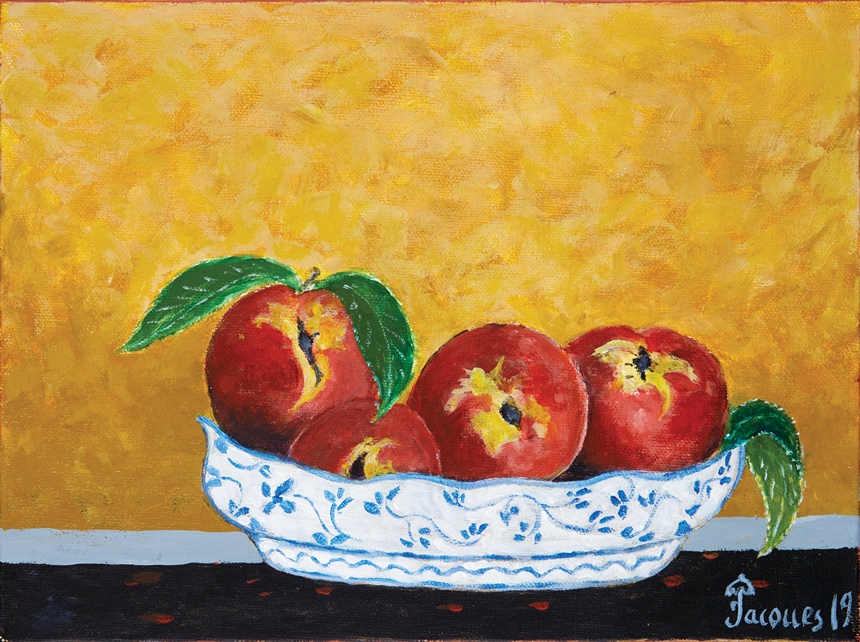
I don’t ask if it is good or bad. I ask if it makes my life happy, if it gives me energy, if it feels right. In that sense, painting is about letting go. That is where art and cooking meet. Both require attention. Both require trust. But one is about guiding, and the other is about surrendering.
IR: Chickens appear again and again in your cooking and your art. Why chickens?
JP: Chickens have been a constant in my life. I paint chickens. I cook chickens. They are simple, familiar, and essential.
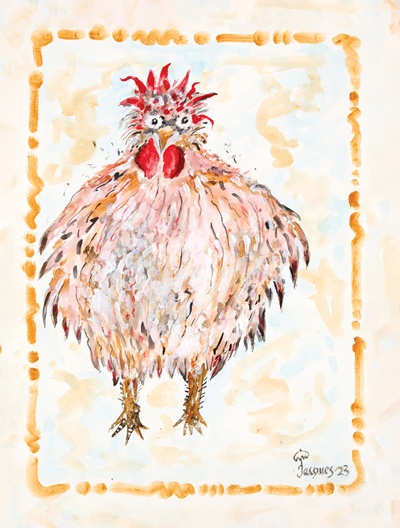
People often ask for the secret to the perfect roast chicken. There is no real secret. It begins with the bird itself — how it was raised, what it was fed, how it lived. In the town where I was raised, we had blue-footed chickens. The Bresse chickens are known for their quality and flavor. When you become accustomed to that kind of ingredient, it shapes your understanding. It becomes your foundation.
IR: Tell us your answer to this age-old question. What came first — the chicken or the egg?
JP: Eggs are essential. You ask me what came first, the chicken or the egg, I will always say the egg. I could live without chickens, but not without eggs. Over the years, I have learned to make omelets in different ways. My mother made what we would now call an American omelet — cooked through, slightly browned, filled and folded. Later, I learned the French omelet, which is cooked very quickly, never browned, soft and creamy inside. I make both. It depends on the moment. There is no single correct way…only what works, what satisfies, what brings pleasure.
IR: What was your early training and how did that shape your understanding of food?
JP: I began my apprenticeship in 1949. In my family, it was the women who cooked. They were strong, capable, and in control of the kitchen. Many of the professional kitchens I knew at the time were also led by formidable women. They fed not only their families but everyone around them. Food was central. It was not separate from life. It was life.
IR: You have cooked for world leaders. What was that like?
JP: Cooking took me into many different worlds. I was the personal chef in the household of Charles de Gaulle and his family when he was President of France. And I was part of the brigade that prepared formal state dinners for visiting world leaders like Dwight Eisenhower and John F. Kennedy. In those kitchens, there was strict protocol. Every movement mattered. Precision, discipline, and timing were essential.
But what stays with me most are not those formal meals. It is the family meals. With the de Gaulle family, meals for the children and grandchildren were simple…often roasted chicken, leg of lamb, or other familiar dishes. These meals were paid for out of their own budget.
IR: Please talk about your friendship with Julia Child.
Jacques Pépin and Julia Child cook classic American hamburgers on their television show Julia & Jacques Cooking at Home (Uploaded to YouTube by Hungry)
JP: I met Julia Child in 1969 in New York. [Restaurant critic] Craig Claiborne introduced us, and we became friends quickly. We spoke French. Her French was better than my English.
Julia had a deep respect for classical French technique. Spinach had to be blanched. Green beans as well. There was a discipline to her cooking, and I admired that. At the same time, I was often more interested in what was simple, what worked, what brought pleasure. Between us, there was a balance. Sometimes we disagreed…on live television. Once, she insisted on washing a chicken. I said, “We are putting it in a 400-degree oven. If anything walks out, I will shake its hand.”
IR: Let’s talk about cooking at home and with family.
JP: Cooking is a way of connecting with family. Children will eat anything they help cook. It is as simple as that. My granddaughter, Shorey, we cook together, even when she was very little. We go into the garden and pick herbs — parsley, chives, tarragon — and bring them back to the kitchen. We make simple dishes: macaroni and cheese with spinach and ham, a pound cake with raspberry preserves, a hot dog that curls in the pan. It is not about complexity. It is about time together. She is now finishing college. Time passes, but those moments remain.
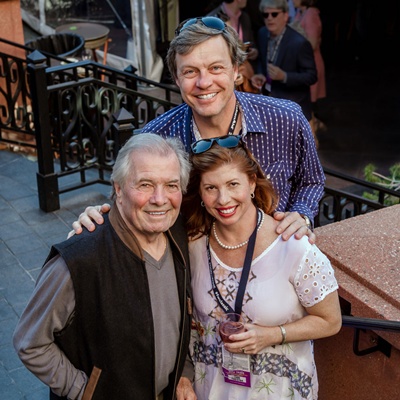
IR: Food can also bring people together in difficult times. Can you share an example?
JP: On September 11, I was at home in Connecticut. I was supposed to go to New York that day, but the plan changed. Like everyone else, I watched the events unfold on television…trying to understand. I went to New York soon after. At the French Culinary Institute, where I was dean, we made a decision. We would cook. Teachers and students came together and for weeks we prepared meals for firefighters, police officers and the volunteers working at the site. It was a small gesture, but it mattered. Food offers comfort when words cannot. It creates care. It creates connection. It reminds us that we are not alone.
IR: The impulse to teach and share continues to shape your work. The Jacques Pépin Foundation, based in Barrington, Rhode Island, supports culinary training programs across the country.
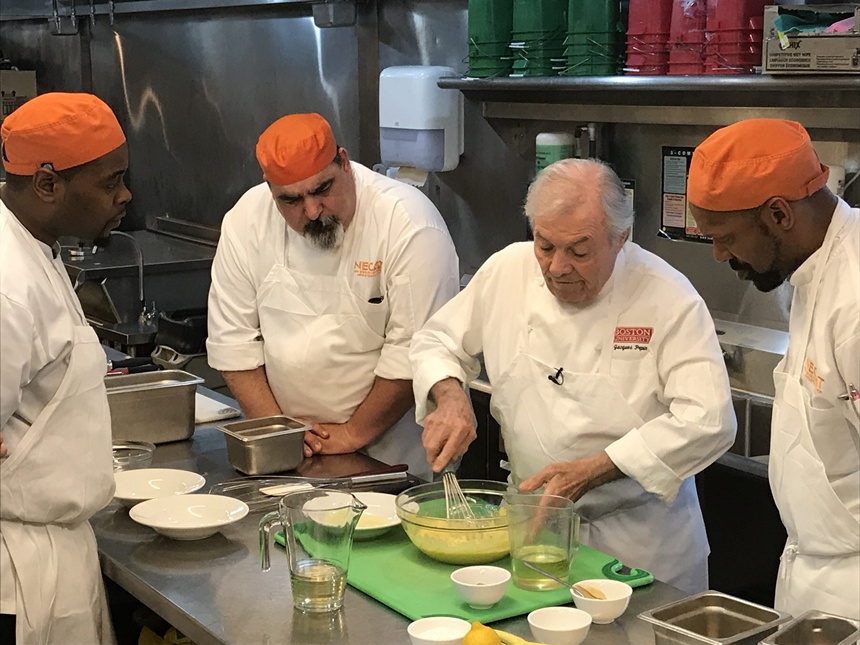
JP: Through the Jacques Pépin Foundation, we have created hundreds of instructional videos focused on basic cooking skills. We also offer free culinary and life-skills training to people coming out of prison, recovering from addiction, experiencing homelessness and underserved communities. In six weeks, someone can learn enough to begin working in a kitchen. More importantly, they gain confidence. They discover they can do something meaningful. They can build a life.
IR: What do you want everyone to understand about everyday cooking?
JP: Cooking does not need to be complicated. Some of the best meals take 15 minutes. You open the refrigerator, see what you have, and begin. If you are lucky enough to have a family that supports one another, create your own menu book. Write down what you cook, what you share, what you enjoy…not for perfection, but for memory. Do not wait for a special occasion. Make ordinary dinners special.
IR: What would you like us to take away from this conversation?
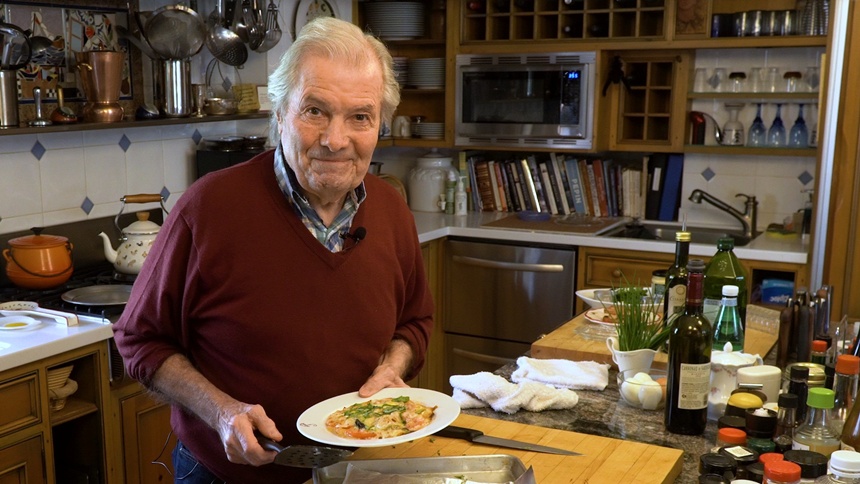
JP: Cooking is about sharing. It is about adapting. It is about living in the moment. Art is about letting go and allowing yourself to be guided by something you cannot fully control. In both, there is a philosophy I have always believed in: keep things simple, respect your ingredients, work with care, and take pleasure in what you do. And I have always believed that cooking should bring joy to you and those you are cooking for. That is enough.
Please join Irene Rawlings as she talks with Jacques Pépin on the Women, Books & More podcast.
Recipes from Jacques Pépin
Classic French Omelet
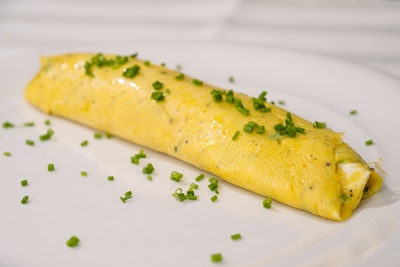
An omelet is among the simplest of dishes, yet it reveals the hand of the cook more than almost anything else. With only eggs, butter, and seasoning, there is nothing to hide behind. What matters is the movement of the fork, the heat of the pan, and the timing. Properly made, the French omelet is pale and delicate, with a tender interior that is just set, never dry.
Serves 1
Ingredients
3 large eggs
¼ teaspoon kosher salt
Freshly ground black pepper
1 tablespoon unsalted butter
Method
Crack the eggs into a bowl, add the salt and pepper, and beat well with a fork until the whites and yolks are fully blended. Heat an 8-inch nonstick skillet over medium-high heat. Add the butter and let it melt until it foams, but do not allow it to brown. Pour in the eggs. Immediately begin stirring them with the fork while shaking the pan back and forth. The eggs will form very small, soft curds. When the eggs are mostly set but still slightly creamy on the surface, stop stirring. Tilt the pan and gently fold the omelet toward the edge. Turn it seam-side down and let it sit briefly to set its shape, without browning. Slide onto a warm plate and serve at once.
Cook’s Note
- The entire cooking process takes about 30–60 seconds.
- A proper French omelet should be lightly set, not dry, and never browned.
- Optional: finish with chopped chives or fines herbes.
From Jacques Pépin Cooking at Home
Poulet a la Crème
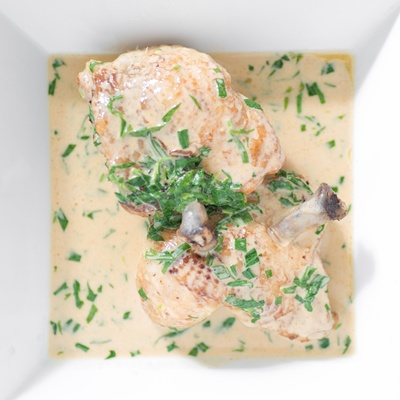
Chicken in a cream sauce is a specialty of the town where I was born, Bourg-en-Bresse. My mother’s simple recipe included a whole cut up chicken with water, a dash of flour and a bit of cream to finish. I have added white wine and mushrooms to make the dish a bit more sophisticated and used chicken thighs, which I consider to be the best part of the chicken. A sprinkling of chopped tarragon at the end makes it more special. I often serve this dish with rice.
Serves 4
Ingredients
1 ½ tablespoons butter
4 skinless chicken thighs (about 1 ½ pounds)
½ teaspoon salt
½ teaspoon freshly ground black pepper
½ cup chopped onion
1 tablespoon all-purpose flour
¼ cup white wine
1 cup sliced white mushrooms
¾ cup chicken stock
¼ cup heavy cream
1 tablespoon chopped fresh tarragon
Method
Heat the butter in a heavy skillet. Season the chicken with salt and pepper on both sides. Brown the chicken in the butter on high heat for 2 minutes on each side. Add the onion and cook for another minute. Sprinkle with the flour and make sure it is evenly distributed, turning the chicken. Add the wine, mushrooms and stock. Bring to a boil. Lower the heat, cover and boil gently for 30 minutes. Transfer the chicken to a serving dish. Add the cream to the skillet and return to a boil for another minute. Sprinkle the sauce with tarragon, spoon over the chicken, and serve.
From The Art of Jacques Pépin, the Cookbook. Reprinted with permission.
Become a Saturday Evening Post member and enjoy unlimited access. Subscribe now